Isaiah 13:18

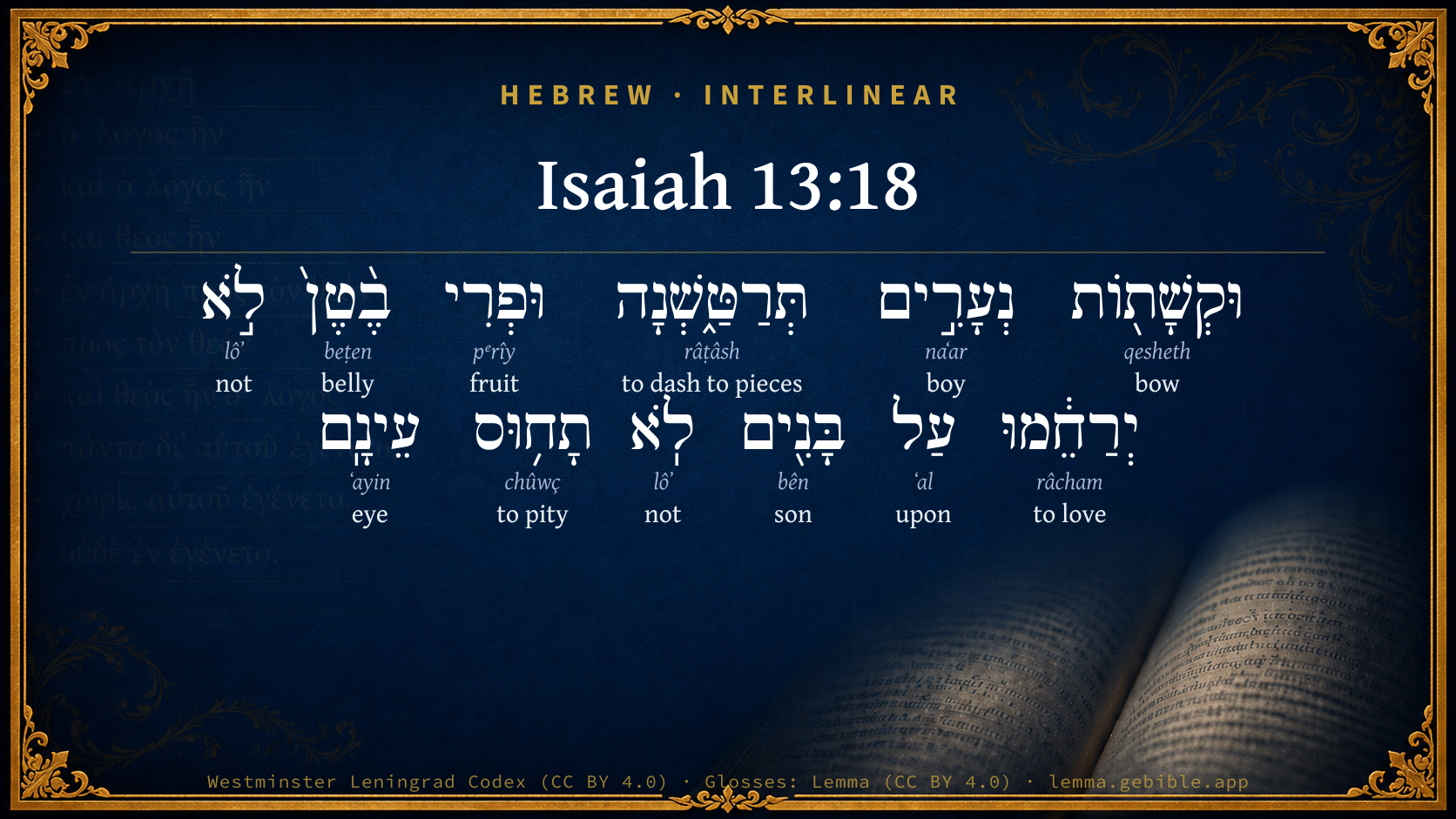
Hebrew (Westminster Leningrad Codex) Isaiah 13:18 appears in the Hebrew Old Testament. The text above is from the Westminster Leningrad Codex. Each word links to its Strong’s number, a concise gloss, and parsing drawn from the Open Scriptures Hebrew Bible morphology. Click any word for its full Brown-Driver-Briggs (BDB) entry.
Download image
Cite this verse

Isaiah 13:18 (World English Bible). Public Domain. Lemma interlinear Bible study tool, https://lemma.gebible.app/v/isaiah/13/18.

Show BibTeX & RIS
BibTeX
RIS
English Translation
[Their] bows shall dash the young men in pieces; and they shall have no pity on the fruit of the womb; their eye shall not spare children.
World English Bible · Public Domain
Download a study sheet

One document with this verse’s original text, its word-by-word gloss line, the meaning frame, cross-references with their text, attributed commentary, and full source and license credits — printable, and it pastes into notes with its structure intact.

This verse Autodidact and up

Study sheet (.html) Plain text (.txt)

A passage Seminary Student

Up to 50 verses in one chapter. A passage sheet keeps up to 6 commentary sources and 12 cross-references per verse, in the order this page ranks them, and says so on the sheet whenever that leaves anything out. Ask for a single verse and you get the Autodidact verse sheet above.

Everything on this page stays free to read, with no account — the sheet is a download of what is already on screen, not access to it.

Want to remove ads? Support Godless Engineer
Compare translations 3

The same verse in 3 English versions, stacked beneath the original-language interlinear above. Click any original word for its lexicon entry.

Each is an independent rendering of the whole verse — the interlinear is not word-aligned to these translations.

Highlighted words mark where these versions differ — a whole-verse word diff, not a word-by-word alignment.

  • World English Bible Public Domain
    [Their] bows shall dash the young men in pieces; and they shall have no pity on the fruit of the womb; their eye shall not spare children.
  • King James Version Public Domain
    Their bows also shall dash the young men to pieces; and they shall have no pity on the fruit of the womb; their eyes shall not spare children.
  • unfoldingWord Literal Text CC BY-SA 4.0
    And bows will dash young men, and they will not have compassion the fruit of the womb; their eye will not have pity on sons.”

unfoldingWord Literal Text — © unfoldingWord, licensed CC BY-SA 4.0. Word-aligned USFM3 via Door43 (git.door43.org/unfoldingWord/en_ult).

Versions to compare (up to 4)

3 of 4 selected

Show all 18 translations

Every available English version of this verse, each an independent rendering of the whole verse.

  • World English Bible Public Domain
    [Their] bows shall dash the young men in pieces; and they shall have no pity on the fruit of the womb; their eye shall not spare children.
  • Berean Standard Bible Public Domain
    Their bows will dash young men to pieces; they will have no mercy on the fruit of the womb; they will not look with pity on the children.
  • Majority Standard Bible Public Domain
    Their bows will dash young men to pieces; they will have no mercy on the fruit of the womb; they will not look with pity on the children.
  • King James Version Public Domain
    Their bows also shall dash the young men to pieces; and they shall have no pity on the fruit of the womb; their eyes shall not spare children.
  • American Standard Version (1901) Public Domain
    And `their' bows shall dash the young men in pieces; and they shall have no pity on the fruit of the womb; their eye shall not spare children.
  • Revised Version (1885) Public Domain
    And their bows shall dash the young men in pieces; and they shall have no pity on the fruit of the womb; their eye shall not spare children.
  • Geneva Bible (1599) Public Domain
    With bowes also shall they destroy ye children, and shall haue no compassion vpon the fruit of the wombe, and their eies shall not spare the children.
  • Douay-Rheims (1899) Public Domain
    But with their arrows they shall kill the children, and shall have no pity upon the sucklings of the womb, and their eye shall not spare their sons.
  • Young's Literal Translation Public Domain
    And bows dash young men to pieces, And the fruit of the womb they pity not, On sons their eye hath no pity.
  • Literal Standard Version CC BY-SA 4.0
    And bows dash young men to pieces, || And they do not pity the fruit of the womb, || Their eye has no pity on sons.
  • Unlocked Literal Bible CC BY-SA 4.0
    Their bows will strike down the young men; they will have no mercy on infants and they will not look with pity on children.
  • unfoldingWord Literal Text CC BY-SA 4.0
    And bows will dash young men, and they will not have compassion the fruit of the womb; their eye will not have pity on sons.”
  • Darby Bible Public Domain
    And [their] bows shall dash the young men to pieces, and they shall have no pity on the fruit of the womb: their eye shall not spare children.
  • World Messianic Bible Public Domain
    Their bows will dash the young men in pieces; and they shall have no pity on the fruit of the womb. Their eyes will not spare children.
  • Webster's Bible Public Domain
    Their bows also shall dash the young men to pieces; and they shall have no pity on the fruit of the womb; their eye shall not spare children.
  • Free Bible Version CC BY-SA 4.0
    Their bows will slaughter their young men; they will show no mercy to babies; they will have no pity on children.
  • Bible in Basic English Public Domain
    In their hands are bows and spears; they are cruel, violently putting the young men to death, and crushing the young women; they have no pity for children, and no mercy for the fruit of the body.
  • JPS Tanakh (1917) Public Domain
    And their bows shall dash the young men in pieces; and they shall have no pity on the fruit of the womb; their eye shall not spare children.

Literal Standard Version (2020), Covenant Press — licensed CC BY-SA 4.0. Text via the HelloAO Bible API (eBible.org). Unlocked Literal Bible (unfoldingWord) — licensed CC BY-SA 4.0. Text via the HelloAO Bible API (eBible.org). unfoldingWord Literal Text — © unfoldingWord, licensed CC BY-SA 4.0. Word-aligned USFM3 via Door43 (git.door43.org/unfoldingWord/en_ult). Free Bible Version, Dr. Jonathan Gallagher — licensed CC BY-SA 4.0. Text via the HelloAO Bible API (eBible.org).

Word by word

More ways to search: Search by grammar → Find every occurrence → Compare this word →

Practice this passage: Drill this verse → Learn its vocabulary →

תְּרַטַּ֑שְׁנָה
râṭâsh
H7376
“to dash to pieces”
Verb, Piel, Imperfect, 3rd Person, Feminine, Plural
Part of Speech
Verb
Stem
Piel
Form
Imperfect
Person
3rd Person
Gender
Feminine
Number
Plural
Full BDB Definition

Origin: a primitive root

TWOT: 2158

to dash to pieces - (Piel) to dash in pieces - (Pual) to be dashed in pieces
  1. וּקְשָׁת֖וֹת qesheth H7198 “and · bows” Conjunction + Noun, Common, Feminine, Plural, Absolute
  2. נְעָרִ֣ים naʻar H5288 “boys” Noun, Common, Masculine, Plural, Absolute
  3. וּפְרִי pᵉrîy H6529 “and · fruit of” Conjunction + Noun, Common, Masculine, Singular, Construct
  4. בֶ֨טֶן֙ beṭen H990 “belly” Noun, Common, Feminine, Singular, Absolute
  5. לֹ֣א lôʼ H3808 “not” Particle, Negative
  6. יְרַחֵ֔מוּ râcham H7355 “to love” Verb, Piel, Imperfect, 3rd Person, Masculine, Plural
  7. עַל ʻal H5921 “upon” Preposition
  8. בָּנִ֖ים bên H1121 “sons” Noun, Common, Masculine, Plural, Absolute
  9. לֹֽא lôʼ H3808 “not” Particle, Negative
  10. תָח֥וּס chûwç H2347 “to pity” Verb, Qal, Imperfect, 3rd Person, Feminine, Singular
  11. עֵינָֽם ʻayin H5869 “eye · their” Noun, Common, Both, Singular, Construct + Suffix, Personal, 3rd Person, Masculine, Plural

About this verse

These counts appear in no published source. They are computed here, from the morphology-tagged text and Lemma’s own curated glosses. What Lemma adds →

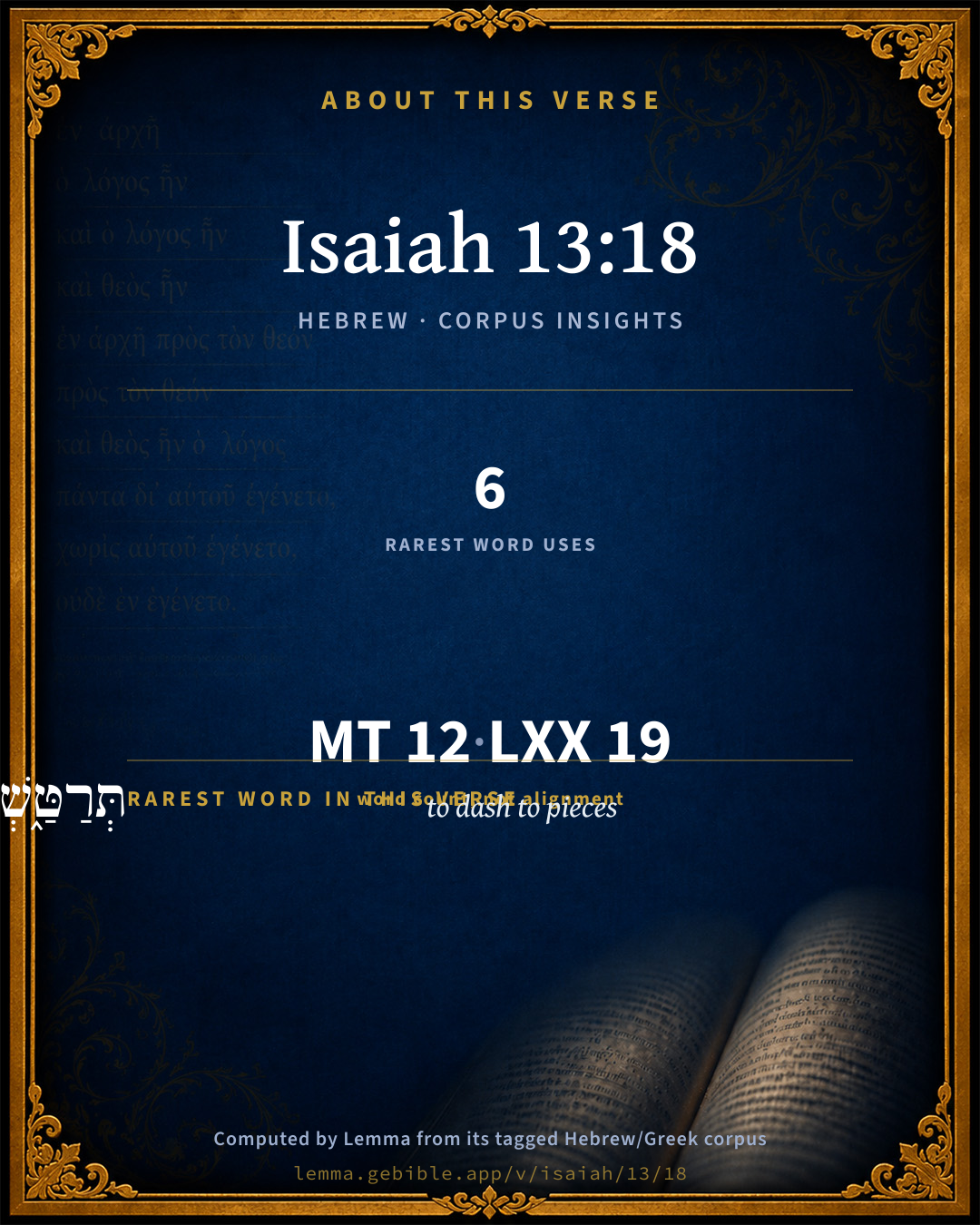
12
words
11
distinct lemmas
Prophets
section

Notable vocabulary

The rarest word here is תְּרַטַּ֑שְׁנָה to dash to pieces H7376 — appearing just 6 times in the whole Hebrew Bible.

Shared distinctive vocabulary

תְּרַטַּ֑שְׁנָה to dash to pieces H7376 occurs in 6 verses of the Hebrew Bible. Also found in:

Grammatical profile

  • 3 verbs
  • 6 nouns
  • 1 preposition
  • 2 particles

Verb forms

  • תְּרַטַּ֑שְׁנָה Piel · Imperfect
  • יְרַחֵ֔מוּ Piel · Imperfect
  • תָח֥וּס Qal · Imperfect

Repetition

A word recurs within this verse — often emphatic in Hebrew:

Hebrew & Septuagint length

In English translation the verse runs 27 words from the Hebrew and 25 from the Septuagint (LXX English) — closely comparable.

A rough comparison of the two English renderings, which tokenize alike — not a word-level alignment.

Word counts can differ between the Hebrew and the Greek without any difference in meaning — e.g. the Hebrew direct-object marker אֵת has no separate Greek word, and Greek often adds the article ὁ.

In the original languages it is 12 Hebrew tokens and 19 Greek tokens — but the two are counted differently (Hebrew bundles its prefixes and suffixes into one token; the Greek is in lemma form), so that isn’t a like-for-like length.

Cross-references

8

Topical passages linked to Isaiah 13:18 in the Treasury of Scripture Knowledge — connected by theme and wording, ordered by reader-vote popularity; previews shown in the World English Bible.

  • 2 Kings 8:12 Hazael said, Why weeps my lord? He answered, Because I know the evil that you will do to the children of Israel: their strongholds will you set on fire, and their young men will you kill with the sword, and will dash in pieces their little ones, and rip up their women with child.
  • 2 Chronicles 36:17 Therefore he brought on them the king of the Chaldeans, who killed their young men with the sword in the house of their sanctuary, and had no compassion on young man or virgin, old man or gray-headed: he gave them all into his hand.
  • Isaiah 13:16 Their infants also shall be dashed in pieces before their eyes; their houses shall be rifled, and their wives ravished.
  • Ezekiel 9:5–6 To the others he said in my hearing, Go you through the city after him, and strike: don't let your eye spare, neither have you pity;
  • Ezekiel 9:10 As for me also, my eye shall not spare, neither will I have pity, but I will bring their way on their head.
  • Hosea 13:16 Samaria will bear her guilt; For she has rebelled against her God. They will fall by the sword. Their infants will be dashed in pieces, And their pregnant women will be ripped open."
  • Nahum 2:1 He who dashes in pieces has come up against you. Keep the fortress! Watch the way! Strengthen your loins! Fortify your power mightily!
  • Nahum 3:10 Yet was she carried away. She went into captivity. Her young children also were dashed in pieces at the head of all the streets, and they cast lots for her honorable men, and all her great men were bound in chains.

Cross-references courtesy of OpenBible.info (CC BY 4.0).

Hebrew and Greek witnesses Masoretic Hebrew ↔ Greek Septuagint

The same verse in the two great witnesses to the Old Testament, shown verse-for-verse.

These are two independent witnesses, not word-aligned to each other, and the Septuagint is shown in lemma (dictionary) form.

Hebrew Isaiah 13:18 Masoretic · Westminster Leningrad Codex

וּקְשָׁת֖וֹת נְעָרִ֣ים תְּרַטַּ֑שְׁנָה וּפְרִי בֶ֨טֶן֙ לֹ֣א יְרַחֵ֔מוּ עַל בָּנִ֖ים לֹֽא תָח֥וּס עֵינָֽם

[Their] bows shall dash the young men in pieces; and they shall have no pity on the fruit of the womb; their eye shall not spare children.

World English Bible · Public Domain

Greek LXX Isaiah 13:18 Septuagint · lemma form

τόξευμα νεανίσκος συντρίβω καί ὁ τέκνον σύ οὐ μή ἐλεέω οὐδέ ἐπί ὁ τέκνον οὐ φείδομαι ὁ ὀφθαλμός αὐτός

They shall break the bows of the young men; and they shall have no mercy on your children; nor shall their eyes spare your children.

LXX2012 (modern English Septuagint) · Public Domain

On this verse, Adam Clarke's Commentary discusses the Septuagint’s reading. Read the note in Commentary ↓

Hebrew: Westminster Leningrad Codex (CC BY 4.0). Greek: Septuagint (public domain); English from LXX2012 (modern English Septuagint) (Public Domain). How the Septuagint differs from the Hebrew →

Targum (Aramaic paraphrase)

1

The Targum is the ancient Jewish Aramaic paraphrase of the Hebrew Scriptures — an interpretive translation, not the Hebrew text itself. Onkelos (literal) and Pseudo-Jonathan (expansive) render the Torah, and Jonathan the Prophets. Coverage is partial: where no permissively-licensed English translation exists for a verse, only the Aramaic is shown. This is verse-level text, not a word-by-word alignment to the Hebrew.

  1. Targum Jonathan Prophets (Joshua–Malachi)
    וְקַשְׁתָּתְהוֹן עוּלֵימִין יְבַזְעָן וְעַל וְלַד מָעִין לָא יְרַחֲמוּן עַל בְּנַיָא לָא תָחוֹס עֵינֵיהוֹן:

    And their bows shall strike through the young men; and they shall not compassionate the child of the womb; their eye shall not spare the children.

    Targum Jonathan — Aramaic: “Mikraot Gedolot” (public domain). English: “Sefaria Community Translation” (CC0 1.0 (public-domain dedication)); “London "Chaldee Paraphrase," 1871” (public domain). Text via Sefaria.

Commentary

Notes on Isaiah 13:18 from classic Christian and Jewish commentators (each source and its license shown beneath its notes). The classic Christian expositions comment on the surrounding passage and are grouped to its opening verse, so a note may address several verses; the Jewish commentaries on the Tanakh (Rashi and others) are per-verse, so they appear only where the commentator wrote on this verse.

Lemma curates 59 commentaries, every one of them public domain or Creative Commons licensed, each selected and text-cleaned for this edition rather than reprinted as found. About our sources →

Trapp's Complete Commentary

John Trapp

Isa 13:18 [Their] bows also shall dash the young men to pieces; and they shall have no pity on the fruit of the womb; their eye shall not spare children.

Ver. 18. Their bows also shall dash the young men.] They shall double destroy them. O barbaram crudelitatem! O cruel barbarian. {a}

And they shall have no pity on the fruit of the womb.] Quamvis adhuc teneri essent et fructus novelli, ripping up their mothers; {as Amo 1:13} or at the Sicilian Vespers; and as in the late Parisian and Irish massacres, which were the most prodigious horrid villanies that ever the sun saw.

Their eye shall not spare children.] In the massacre of Paris, a bloody Papist having snatched up a little child from one of the Protestants in his arms, the poor babe began to play with his beard, and to smile upon him. But he, more merciless than a tiger, stabbed it with a dagger, and so cast it all gory and bloody into the river. {b}

{a} Incredibilis sanguinis aviditas in milite bacchabitur.

{b} Acts. and Mon.

John Trapp, A Commentary or Exposition upon All the Books of the Old and New Testament (1647–1656) — public domain. Text from a community e-Sword module.

The Preacher's Complete Homiletical Commentary

Joseph S. Exell (gen. ed.)

SPARE THE CHILDREN

(Sunday-School Anniversary Sermon.)

Isa_13:18. Their eye shall not spare children.

This declaration is made concerning the Medes, by whom the power of Babylon was destined to be broken. So thoroughly bent will they be upon their mission of revenge, that they will not be turned away from it by any appeals either to their avarice (Isa_13:17) or to their pity (text). The helplessness of infancy and the innocence of youth, which are naturally so impressive and persuasive, will not avail to stay them in their devastating career.

We should display a singular ignorance of the world in which we live, if we were therefore to pronounce the Medes exceptional monsters of iniquity. Alas! there are many imitators of their relentless cruelty. In our own land children are not spared in relation to evils even more terrible than war. Youth is always beset by dangers, even when it is most carefully guarded; but when it is specially under the influence of wicked men, it is often ruthlessly sacrificed. Widespread is the spirit of evil which knows not how to pity it. Examples of its existence and operations are to be found—

1. In houses where the most hurtful principles and vicious practices are continually set before children. From their youth up they are not spared from the most disastrous influences (H. E. I., 775–779).

2. In business, where often the most sacred interests of childhood are sacrificed for the sake of gain. Their health, by inflicting upon them excessive labour. Even their morality, by fiends who tempt them into haunts of vice. Compared with these incarnations of diabolical cruelty, the Medes were merciful.

The season of childhood appeals to our concern and should awake our compassion—

1. By its helplessness. It has to lean upon others.

2. By its ignorance. It has had no time to learn (H. E. I., 780).

3. By its inexperience. Unless it is aided by the guidance of mature wisdom, it must almost necessarily go astray.

4. By its peculiar susceptibility to every kind of moral influence. To these appeals let us give reverent, cheerful, and thoughtful heed. Let us not be content to shudder at this prediction concerning the Medes, or at such historical records as that of the slaughter of the children of Bethlehem (Matthew 2); let us make the children the objects of our care.

1. Let us spare our own children, from all unreasonable demands upon them, from the mischiefs that will inevitably come upon them if we do not carefully train them in the way they should go.

2. Let us spare the children of the poor from the evils of ignorance. These evils are terrible and far-reaching. Not to rescue them from these evils when we have the power to do so, is to doom them to them. In the Sunday-school we have a means of rescue which we cannot neglect without sin.—William Manning.

The Preacher's Complete Homiletical Commentary (gen. ed. Joseph S. Exell; Funk & Wagnalls, c. 1892) — public domain (pre-1929). A full-Bible homiletical/sermon-outline anthology covering 65 of 66 books (2 John is absent from the source module). Text from a community e-Sword module.

Jamieson, Fausset & Brown

Robert Jamieson, A. R. Fausset & David Brown

bows--in the use of which the Persians were particularly skilled.

Jamieson, Fausset & Brown — Commentary Critical and Explanatory on the Whole Bible (1871) — public domain (CC PDM 1.0). Text via the HelloAO Bible API.

Adam Clarke's Commentary

Verse 18. Their bows also shall dash - "Their bows shall dash"] Both Herodotus, i. 61, and Xenophon, Anab. iii., mention, that the Persians used large bows τοξαμεγαλα: and the latter says particularly that their bows were three cubits long, Anab. iv. They were celebrated for their archers, see Isa 22:6; Jer 49:35. Probably their neighours and allies, the Medes, dealt much in the same sort of arms. In Ps 18:34, and Job 20:24, mention is made of a bow of steel; if the Persian bows were of metal, we may easily conceive that with a metalline bow of three cubits' length, and proportionably strong, the soldiers might dash and slay the young men, the weaker and unresisting of the inhabitants (for they are joined with the fruit of the womb and the children) in the general carnage on taking the city. תרתשנה terattashnah, shall be broken or shivered to pieces. This seems to refer, not to נערים nearim, young men, but to קשתות keshathoth, their bows. The bows of the young men shall be broken to pieces.

On the fruit, &c. - "And on the fruit," &c.] A MS. of Dr. Kennicott's reads ועל פרי veal peri and on the fruit. And nine MSS. (three ancient) and two editions, with the Septuagint, Vulgate, and Syriac, add likewise the conjunction ו vau, and, to על al, upon, afterwards.

Adam Clarke's Commentary on the Bible (1810–1826) — public domain. Text from a community e-Sword/MySword module.

Ellicott's Commentary for English Readers

(18) Their bows also shall dash the young men to pieces.—These, as in Isa_22:6, Jer_1:9-14, were the characteristic weapons of the Medo-Persian armies.

A Bible Commentary for English Readers, edited by Charles John Ellicott (1878–1897) — public domain. Text from a community e-Sword module.

John Gill's Exposition

Their bows also shall dash their young men to pieces,.... That is, the bows of the Medes should dash in pieces the young men of the Babylonians. The meaning is, either that they should put them into their bows, instead of arrows, and shoot them upon the ground, or against a wall, and so dash them to pieces; or that they should first shoot them through with their arrows, and then dash them with their bows; according to Xenophon (l), Cyrus came to Babylon with great numbers of archers and slingers:

and they shall have no pity on the fruit of the womb; even of those that were in the womb, but should rip up women with child, and cut them in pieces:

their eyes shall not spare children; in the arms of their parents, or running to them, shrieking and crying, and in the utmost fright; and yet their tender and innocent age would meet with no mercy. The Medes were notorious for their cruelty (m), and which issued at last in the ruin of their empire.

(l) Cyropaedia, l. 2. sect. 1. (m) Ammian. Marcellin. l. 23. c. 6. Diodor. Sicul. l. 13. p. 342.

John Gill's Exposition of the Whole Bible (1746–1763) — public domain (CC PDM 1.0). Text via the HelloAO Bible API.

Albert Barnes' Notes on the Bible

Their bows also - Bows and arrows were the usual weapons of the ancients in war; and the Persians were particularly skilled in their use. According to Xenophon, Cyrus came to Babylon with a great number of archers and slingers (Cyrop. ii. 1).

Shall dash the young men ... - That is, they shall dash the young men to pieces, or kill them by their bows and arrows. Vulgate, ‘And with their arrows shall they slay the young.’ The meaning of the word here rendered ‘dash to pieces,’ is to smite suddenly to the ground.

Albert Barnes' Notes on the Bible (1834–1885) — public domain. Text from a community e-Sword/MySword module.

Matthew Poole's English Annotations

Their bows; under which are comprehended their arrows, and possibly other weapons of war; for so generally sometimes is the bow used in Scripture, as 2Sa 1:18; Psa 78:9; Isa 41:2. Shall dash the young men to pieces; or, shall pierce the young men through, as the Chaldee readers it.

Matthew Poole's English Annotations on the Holy Bible (1683–1685) — public domain. Text from a community e-Sword/MySword module.

Whedon's Commentary on the Bible

Daniel D. Whedon

18. Their bows — Of very ancient use, generally made of wood, in a few instances of brass. Persian archers are spoken of with applause in profane history. See also Isa_22:3; Isa_22:6, and Jer_49:35; Jer_50:9; Jer_50:14; Jer_50:29; Jer_50:42.

No pity — Anciently, if the conqueror came in revenge of former wrongs it was the law of war to spare neither men, women, nor children. (On the subject of ancient war, see JAHN’S Hebrew Archaeology.)

Daniel D. Whedon (gen. ed.), Commentary on the Old and New Testaments (1874–1909) — public domain. Text from a community e-Sword module.

The Pulpit Commentary

Their bows. (comp. Jer_1:9, Jer_1:14) Both the Medes and the Persians were skilled archers. Herodotus tells us that every Persian youth was taught three things ride, to draw the bow, and to speak the truth" (1. 136). At Persepolis, Modes and Persians are alike represented as carrying bows and quivers. Aeschyius regards the contest between the Persians and the Greeks as one between the arrow and the spear ("Persae," 11. 135, 136).

The Pulpit Commentary (1880–1919), ed. H.D.M. Spence-Jones & Joseph S. Exell — public domain. Text from a community e-Sword module.

John Wesley's Explanatory Notes

Bows - Under which are comprehended, other weapons of war. Dash - Or, shalt pierce the young men through, as the Chaldee, renders it.

John Wesley, Explanatory Notes Upon the Whole Bible (1754–1765) — public domain. Text via the GEBible commentary corpus.

Keil & Delitzsch

C. F. Keil & F. Delitzsch

"And bows dash down young men; and they have no compassion on the fruit of the womb: their eye has no pity on children." The bows do not stand for the bowmen (see Isa 21:17), but the bows of the latter dash the young men to the ground by means of the arrows shot from them. They did not spare the fruit of the womb, since they ripped up the bodies of those that were with child (Kg2 8:12; Kg2 15:16, etc.). Even towards children they felt no emotion of compassionate regard, such as would express itself in the eye: chuus, to feel, more especially to feel with another, i.e., to sympathize; here and in Eze 5:11 it is ascribed to the eye as the mirror of the soul (compare the Arabic chasyet el-‛ain ala fulânin, carefulness of eye for a person: Hariri, Comment. p. 140). With such inhuman conduct on the part of the foe, the capital of the empire becomes the scene of a terrible conflagration.

Keil & Delitzsch — Biblical Commentary on the Old Testament (1861–1891) — public domain (CC PDM 1.0). Text via the HelloAO Bible API. (Old Testament only.)

J. A. Alexander on Isaiah

Joseph Addison Alexander

“And bows shall dash boys in pieces, and the fruit of the womb they shall not pity, on children their eye shall not have mercy.” The strong term ‘dash in pieces’ is employed instead of one more strictly appropriate, with evident allusion to its use in v. 16. The cruelty of the Medes seems to have been proverbial in the ancient world.

Joseph Addison Alexander, The Prophecies of Isaiah (1846–1847; New York: Scribner, 1870–1878) — public domain. Text from a community e-Sword module.

Rashi

Rabbi Shlomo Yitzchaki (Rashi)

And the bows of the peoples of Media.

youths of Babylon.

shall dash shall split with their arrows that they shoot with their bows.

newborn [lit. fruit of the womb] Frail infants.

Rashi on the Tanakh — English translations: “The Judaica Press complete Tanach with Rashi, translated by A. J. Rosenberg” (CC BY 4.0); “Pentateuch with Rashi's commentary by M. Rosenbaum and A.M. Silbermann, 1929-1934” (public domain); “The Metsudah Tanach series, Lakewood, N.J” (CC BY 4.0); and “The Book of Joshua, Metsudah Publications, 1997” (CC BY 4.0). Text via Sefaria.

Ibn Ezra

Rabbi Abraham ibn Ezra

תרטשנה They shall dash to pieces.

Ibn Ezra on the Tanakh — English translations: “Sefaria Community Translation” (CC0 1.0 (public-domain dedication)); “Yalkut, Sifsei Chachomim Chumash, Metsudah Publications, 2009” (CC BY 4.0); and “Commentary of Ibn Ezra on Isaiah - trans. by M. Friedlander, 1873” (public domain). Text via Sefaria.

Lesson kit

Teaching starters — assembled from the data on this page, not authored interpretation. Every prompt links to the verse data it draws on. Edit before teaching.

Isaiah, in the Prophets, opens this verse with 12 words (11 distinct Hebrew lemmas). Its most distinctive word is râṭâsh (“to dash to pieces”). A historical commentator’s framing appears above. Read the whole chapter for the surrounding context.

Discussion questions

  1. What does “to dash to pieces” (râṭâsh) contribute to the verse as a whole?
  2. 2 Kings 8:12 shares the word «to dash to pieces» with this verse. How do the two illuminate each other?
  3. “not” occurs 2× in this one verse. What is the effect of the repetition?
  4. These translations render this verse differently; the difference is in the English rendering, not the original. What questions does that raise?
  5. The verb «תְּרַטַּ֑שְׁנָה» is Piel Imperfect. How does its form color the action?
  6. Reading how Trapp's Complete Commentary and The Preacher's Complete Homiletical Commentary read this verse, where do the two commentators agree and where do they part?

Things to notice

Reading settings

Reading text

Shown beneath each verse's original-language words.

Old Testament
Old Testament edition

Read the OT as the Masoretic Hebrew (MT) or the Greek Septuagint (LXX).

English shown for the Greek Septuagint (in the Hebrew ↔ Greek comparison).

Comparing translations? Open the Compare panel on any verse page to stack up to four side by side.