
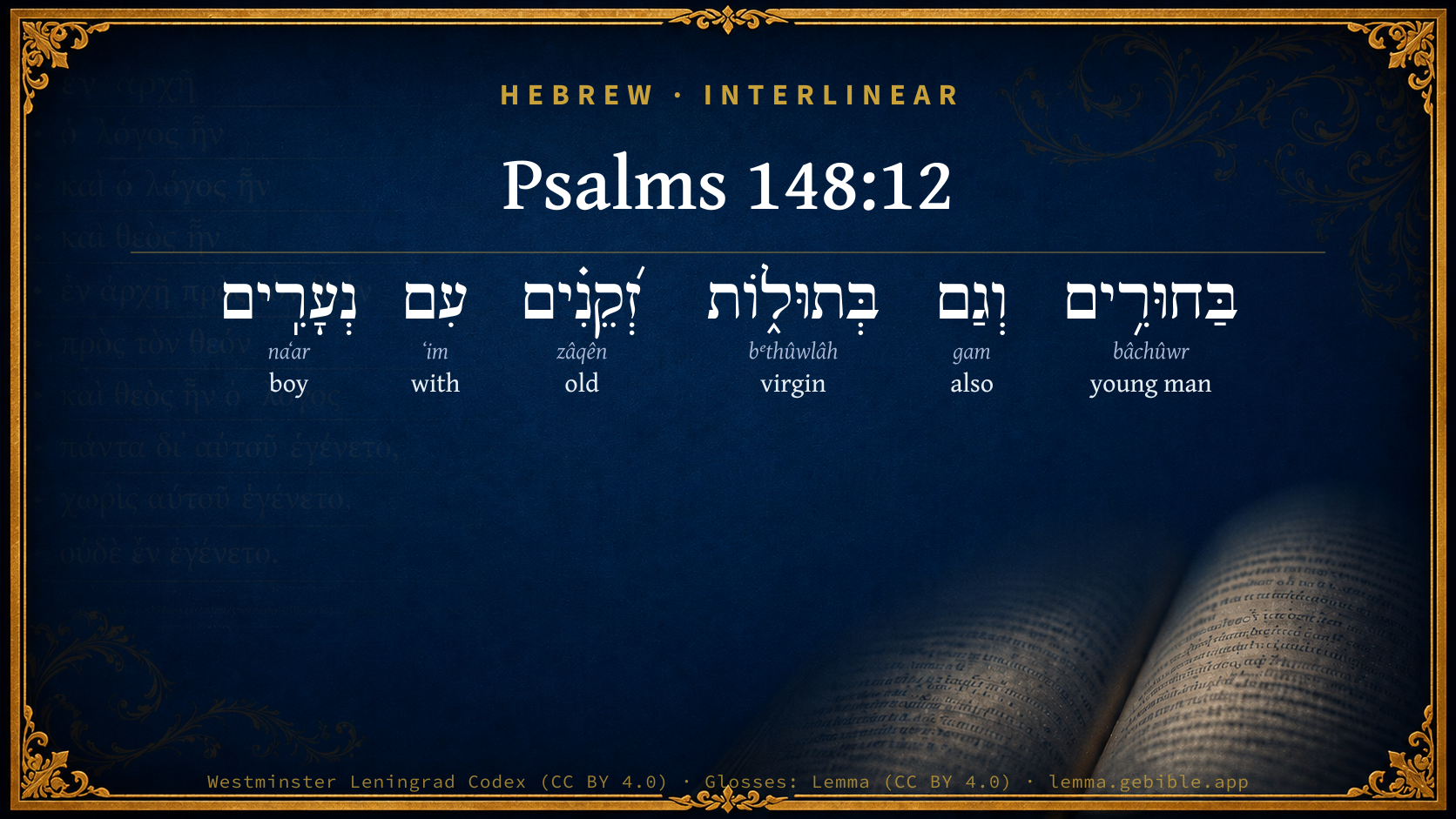
Psalms 148:12

Hebrew (Westminster Leningrad Codex) Psalms 148:12 appears in the Hebrew Old Testament. The text above is from the Westminster Leningrad Codex. Each word links to its Strong’s number, a concise gloss, and parsing drawn from the Open Scriptures Hebrew Bible morphology. Click any word for its full Brown-Driver-Briggs (BDB) entry.
Download image
Cite this verse

Psalms 148:12 (World English Bible). Public Domain. Lemma interlinear Bible study tool, https://lemma.gebible.app/v/psalms/148/12.

Show BibTeX & RIS
BibTeX
RIS
English Translation
Both young men and maidens; Old men and children:
World English Bible · Public Domain
Download a study sheet

One document with this verse’s original text, its word-by-word gloss line, the meaning frame, cross-references with their text, attributed commentary, and full source and license credits — printable, and it pastes into notes with its structure intact.

This verse Autodidact and up

Study sheet (.html) Plain text (.txt)

A passage Seminary Student

Up to 50 verses in one chapter. A passage sheet keeps up to 6 commentary sources and 12 cross-references per verse, in the order this page ranks them, and says so on the sheet whenever that leaves anything out. Ask for a single verse and you get the Autodidact verse sheet above.

Everything on this page stays free to read, with no account — the sheet is a download of what is already on screen, not access to it.

Want to remove ads? Support Godless Engineer
Compare translations 3

The same verse in 3 English versions, stacked beneath the original-language interlinear above. Click any original word for its lexicon entry.

Each is an independent rendering of the whole verse — the interlinear is not word-aligned to these translations.

Highlighted words mark where these versions differ — a whole-verse word diff, not a word-by-word alignment.

  • World English Bible Public Domain
    Both young men and maidens; Old men and children:
  • King James Version Public Domain
    Both young men, and maidens; old men, and children:
  • unfoldingWord Literal Text CC BY-SA 4.0
    young men and also young women, old men with youths.

unfoldingWord Literal Text — © unfoldingWord, licensed CC BY-SA 4.0. Word-aligned USFM3 via Door43 (git.door43.org/unfoldingWord/en_ult).

Versions to compare (up to 4)

3 of 4 selected

Show all 17 translations

Every available English version of this verse, each an independent rendering of the whole verse.

  • World English Bible Public Domain
    Both young men and maidens; Old men and children:
  • Berean Standard Bible Public Domain
    young men and maidens, old and young together.
  • Majority Standard Bible Public Domain
    young men and maidens, old and young together.
  • King James Version Public Domain
    Both young men, and maidens; old men, and children:
  • American Standard Version (1901) Public Domain
    Both young men and virgins; Old men and children:
  • Revised Version (1885) Public Domain
    Both young men and maidens; old men and children:
  • Geneva Bible (1599) Public Domain
    Yong men and maidens, also olde men and children:
  • Young's Literal Translation Public Domain
    Young men, and also maidens, Aged men, with youths,
  • Literal Standard Version CC BY-SA 4.0
    Young men, and also maidens, || Aged men, with youths,
  • Unlocked Literal Bible CC BY-SA 4.0
    both young men and young women, elderly and children.
  • unfoldingWord Literal Text CC BY-SA 4.0
    young men and also young women, old men with youths.
  • Darby Bible Public Domain
    Both young men and maidens, old men with youths, --
  • World Messianic Bible Public Domain
    both young men and maidens, old men and children.
  • Webster's Bible Public Domain
    Both young men, and maidens; old men, and children:
  • Free Bible Version CC BY-SA 4.0
    young men and women, old people and children—
  • Bible in Basic English Public Domain
    Young men and virgins; old men and children:
  • JPS Tanakh (1917) Public Domain
    Both young men and maidens, old men and children;

Literal Standard Version (2020), Covenant Press — licensed CC BY-SA 4.0. Text via the HelloAO Bible API (eBible.org). Unlocked Literal Bible (unfoldingWord) — licensed CC BY-SA 4.0. Text via the HelloAO Bible API (eBible.org). unfoldingWord Literal Text — © unfoldingWord, licensed CC BY-SA 4.0. Word-aligned USFM3 via Door43 (git.door43.org/unfoldingWord/en_ult). Free Bible Version, Dr. Jonathan Gallagher — licensed CC BY-SA 4.0. Text via the HelloAO Bible API (eBible.org).

Word by word

More ways to search: Search by grammar → Find every occurrence → Compare this word →

Practice this passage: Drill this verse → Learn its vocabulary →

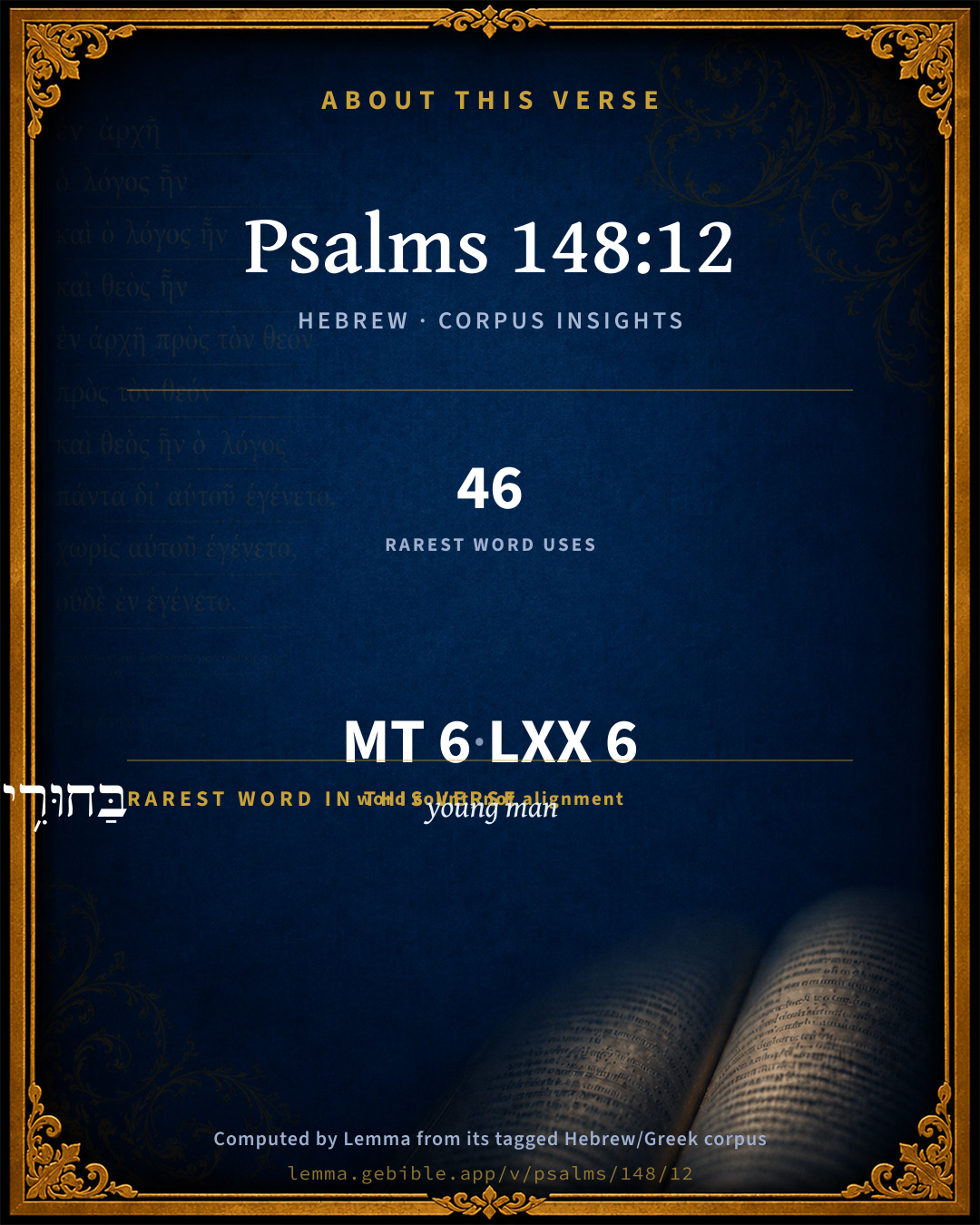
About this verse

These counts appear in no published source. They are computed here, from the morphology-tagged text and Lemma’s own curated glosses. What Lemma adds →

6
words
6
distinct lemmas
Wisdom
section

Shared distinctive vocabulary

בַּחוּרִ֥ים young man H970 occurs in 45 verses of the Hebrew Bible. Also found in:

Grammatical profile

  • 3 nouns
  • 1 adjective
  • 1 preposition
  • 1 particle

Hebrew & Septuagint length

In English translation the verse runs 9 words from the Hebrew and 8 from the Septuagint (LXX English) — closely comparable.

A rough comparison of the two English renderings, which tokenize alike — not a word-level alignment.

Word counts can differ between the Hebrew and the Greek without any difference in meaning — e.g. the Hebrew direct-object marker אֵת has no separate Greek word, and Greek often adds the article ὁ.

In the original languages it is 6 Hebrew tokens and 6 Greek tokens — but the two are counted differently (Hebrew bundles its prefixes and suffixes into one token; the Greek is in lemma form), so that isn’t a like-for-like length.

Cross-references

7

Topical passages linked to Psalms 148:12 in the Treasury of Scripture Knowledge — connected by theme and wording, ordered by reader-vote popularity; previews shown in the World English Bible.

  • Jeremiah 31:13 Then shall the virgin rejoice in the dance, and the young men and the old together; for I will turn their mourning into joy, and will comfort them, and make them rejoice from their sorrow.
  • Psalms 68:25 The singers went before, the minstrels followed after, In the midst of the ladies playing with tambourines,
  • Titus 2:4–6 that they may train the young women to love their husbands, to love their children,
  • Psalms 8:2 From the lips of babes and infants you have established strength, Because of your adversaries, that you might silence the enemy and the avenger.
  • Zechariah 9:17 For how great is his goodness, And how great is his beauty! Grain will make the young men flourish, And new wine the virgins.
  • Matthew 21:15–16 But when the chief priests and the scribes saw the wonderful things that he did, and the children who were crying in the temple and saying, "Hosanna to the son of David!" they were indignant,
  • Luke 19:37 As he was now getting near, at the descent of the Mount of Olives, the whole multitude of the disciples began to rejoice and praise God with a loud voice for all the mighty works which they had seen,

Cross-references courtesy of OpenBible.info (CC BY 4.0).

Hebrew and Greek witnesses Masoretic Hebrew ↔ Greek Septuagint

The same verse in the two great witnesses to the Old Testament, shown verse-for-verse.

You’re reading Greek Psalm 148 (Hebrew Psalm 148). The Septuagint counts the superscription, so verse numbers can differ from the Hebrew — chapter-level alignment, not verse-by-verse. Numbering follows Rahlfs.

These are two independent witnesses, not word-aligned to each other, and the Septuagint is shown in lemma (dictionary) form.

Hebrew Psalms 148:12 Masoretic · Westminster Leningrad Codex

בַּחוּרִ֥ים וְגַם בְּתוּל֑וֹת זְ֝קֵנִ֗ים עִם נְעָרִֽים

Both young men and maidens; Old men and children:

World English Bible · Public Domain

Greek LXX Greek Psalm 148:12 Septuagint · lemma form

νεανίσκος καί παρθένος πρεσβύτης μετά νέος

young men and virgins, old men with youths:

LXX2012 (modern English Septuagint) · Public Domain

Hebrew: Westminster Leningrad Codex (CC BY 4.0). Greek: Septuagint (public domain); English from LXX2012 (modern English Septuagint) (Public Domain). How the Septuagint differs from the Hebrew →

Commentary

Notes on Psalms 148:12 from classic Christian and Jewish commentators (each source and its license shown beneath its notes). The classic Christian expositions comment on the surrounding passage and are grouped to its opening verse, so a note may address several verses; the Jewish commentaries on the Tanakh (Rashi and others) are per-verse, so they appear only where the commentator wrote on this verse.

Lemma curates 59 commentaries, every one of them public domain or Creative Commons licensed, each selected and text-cleaned for this edition rather than reprinted as found. About our sources →

Trapp's Complete Commentary

John Trapp

Psa 148:12 Both young men, and maidens; old men, and children:

Ver. 12. Both young men, and maidens] Souls have no sexes; let the choice youths and the compt lasses quae totae occupantur in sese ornandis, saith Kimchi, who are much taken up in tricking and trimming themselves, leave that folly, and give glory to God.

John Trapp, A Commentary or Exposition upon All the Books of the Old and New Testament (1647–1656) — public domain. Text from a community e-Sword module.

The Biblical Illustrator

Joseph S. Exell

Psa_148:12

Both young men and maidens.

Happy work for everybody

I. What it is to praise the Lord. Praise is the heart singing. We want the heart that sees and feels how kind our heavenly Father is, and loves Him for everything. One day as I was going along the road I saw a large coil of telegraph wire lying in a heap. There keeping itself all to itself, dull and heavy, it was the very last thing that you would ever expect to get any music out of. Soon afterwards, as we were going that way again, my little girl said to me, Hark! what is that playing? I pointed up to the wire--the same wire that lay coiled up in heavy silence. Now it was stretched along from post to post, and was making music the whole day through. And so it is with us. We keep our love in to ourselves and wrapped around ourselves, and then there is no music. But when our love stretches away to Jesus, then it makes the constant music of praise--at home or at school, at work or at play.

II. Reasons why we should praise the Lord.

1. Because He has loved us, and given Himself for us.

2. We are the only creatures in the world that can praise Him. After all, the dragons and great deeps cant really praise Him, nor the sun or stars. It is like the telegraph wire again. When the wind has come to the wire, then the music comes. The air that is in this chapel is blown into the organ, but it has no sound until it comes through the organ pipes. So all things in Gods great world are dumb until they come to us. We are the harp and the organ by which their praise is to go up to heaven.

3. Praise is the only thing that we can give to the Lord.

4. Loving praise is the only thing that can satisfy our loving Lord.

5. It is the happy work that we shall do in heaven. Let us practise it down here. (M. G. Pearse.)

The Biblical Illustrator, edited by Joseph S. Exell (c. 1880s–1900s) — public domain. Text from a community e-Sword module.

J. A. Alexander on Psalms

Joseph Addison Alexander

12. (Psa 148:12) Young men and also maidens, old men with children. The obvious meaning of this verse is, all men, without distinction of sex or age. There is no need, therefore, of refining on the several particulars, or undertaking to explain why old men and young men are both mentioned, since neither of them could have been omitted without failing to accomplish the design of the enumeration. For the etymology and primary meaning of the first word in Hebrew see above, on Psa 78:63, where it stands in precisely the same combination. The two nouns in the last clause may be considered as of common gender.

Joseph Addison Alexander, The Psalms Translated and Explained (1850) — public domain. Text from a community e-Sword module.

Adam Clarke's Commentary

Verse 12. Both young men, and maidens] Who are in the bloom of youth, and in the height of health and vigour; know that God is your Father; and let the morning and energy of your days be devoted to him.

Old men, and children] Very appropriately united here, as the beginning and conclusion of life present nearly the same passions, appetites, caprices, and infirmities: yet in both the beneficence, all-sustaining power, and goodness of God are seen.

Adam Clarke's Commentary on the Bible (1810–1826) — public domain. Text from a community e-Sword/MySword module.

John Gill's Exposition

Both young men, and maidens,.... These should praise the Lord, the one for their strength, the other for their beauty; and both should remember their Creator in the days of their youth, and fear, serve, and worship him; so they will praise and glorify him, as did Obadiah, Josiah, Timothy, and the four daughters of Philip the evangelist;

old men, and children; the former have had a large experience of the providential goodness of God, and, if good men, of the grace of God, and are under great obligation to praise the Lord for all that he has done for them; for they have known him that is from the beginning, and have seen many of his wonderful works, which they should not forget to declare to their children, to the honour and glory of God; and even out of the mouth of "children", of babes and sucklings, who have less knowledge, and less experience, God sometimes does ordain strength and perfect praise to himself; see Psa 8:2; compared with Mat 21:15.

John Gill's Exposition of the Whole Bible (1746–1763) — public domain (CC PDM 1.0). Text via the HelloAO Bible API.

Albert Barnes' Notes on the Bible

Both young men, and maidens - Those in the morning of life, just entering on their career; just forming their character: with ardor, elasticity, cheerfulness, hope; let them consecrate all this to God: let all that there is in the buoyancy of their feelings, in the melody of their voices, in their ardor and vigor, be employed in the praise and the service of God.

Old men, and children - Old men, with what remains of life, and children, with all that there is of joyousness - let all unite in praising God. Life, as it closes - life, as it begins - let it all be devoted to God.

Albert Barnes' Notes on the Bible (1834–1885) — public domain. Text from a community e-Sword/MySword module.

The Treasury of David

Charles H. Spurgeon

Ver. 12. Both young men, and maidens; old men, and children. Both sexes and all ages are summoned to the blessed service of song. Those who usually make merry together are to be devoutly joyful together: those who make up the ends of families, that is to say, the elders and the juveniles, should make the Lord their one and only end. Old men should by their experience teach children to praise; and children by their cheerfulness should excite old men to song. There is room for every voice at this concert: fruitful trees and maidens, cedars and young men, angels and children, old men and judgesall may unite in this oratorio. None, indeed, can be dispensed with: for perfect Psalmody we must have the whole universe aroused to worship, and all parts of creation must take their parts in devotion.

Ver. 12. Both young men, and maidens; old men, and children. The parties are mentioned by couples, being tied two and two together. "Young men and maidens; old men and children." And here is a double caveat; first, against presumption; and secondly, against despair. First, that the younger sort might desire to praise God, they are exhorted to address themselves to the service of God, to remember their Creator in the days of their youth. Secondly, for aged men, that they might not doubt of the acceptation of their service, our Prophet exhorts them also. For the first, you know, David calls upon the sun and the moon to praise God. Should the sun reply, I will not do it in the morning, or at noon time, but when I am about to set? or the moon reply, I will not in the full, but in the wane? or the tree, not in the spring time, or in the summer, but at the fall of the leaf? So likewise, thou young man, defer not the time of praising God: take the swing of thy youth, and do not defer to apply thyself to the service of God till thy old age; but remember that for all these things thou shalt come to judgment. He that styles himself by the title I AM, cares not for I will be, or I have been, but he that is at this present: take heed, therefore, thou strong and lusty young man: the Devil that holds thee now will every day tie a new cord about thee. Consider this, you that are yet young, whom the morning sun of light adorns with his glorious rays: everyone doth not live to be old. Let us not procrastinate in God's service; for the longer we defer to serve God, the farther God's grace is distant from us, and the dominion of Satan is more strengthened in our hearts; the more we delay, the more is our debt, the greater our sin, and the less our grace. I will commend this lesson unto all. He that doth not repent today hath a day more to repent of, and a day less to repent in. I shall conclude with a hearty exhortation for us all, of what sex, age, and degree soever; I could wish that all our lives might end like this book of Psalms, in blessing and praising Almighty God. Thomas Cheshire, in "A Sermon preached, in Saint Paule's Church", 1641.

Verse 12. Old men. Think not, ye who are now near the end of life, that your tongues may without blame be silent in the praises of the Lord, because you are come to those years in which men say, they "have no pleasure in them." Were you not frequently praising God when you were children and young men? Have you less, or have you not greater, reason now to praise God than in those early days of life?

Old men ought to be better qualified than young persons to show forth the glory both of the perfections and works of God, because they have enjoyed more time, and more abundant opportunities than their juniors, for attaining the knowledge of God, and of those glorious perfections and works which furnish us with endless materials for praise. "Days should speak, and the multitude of years should teach wisdom."

The heavens are constantly declaring "the glory of God, and the firmament showeth forth his handy work. Day unto day uttereth speech, and night unto night showeth knowledge." Have you, then, lived twenty thousand days and twenty thousand nights? What deep impressions ought to be made upon your spirits, of those wonders which have been preached in your ears or eyes, ever since you could use your bodily senses as ministers to your intellectual powers! All the works of God praise him, by showing forth how wonderful in power, and goodness, and wisdom, the Creator is. Your tongues are indeed inexcusable, if they are silent in the praises of him whose glory is proclaimed by every object above or around them, and even by every member of their own bodies, and every faculty of their souls. But old men are doubly inexcusable, if they are inattentive to those precious instructions which are given them by all the works of God which they have seen, or of which they have been informed, every day since the powers of their rational natures began to operate.

But old men in this highly favoured land have been blessed with more excellent instructions than those which are given them by the mountains and fruitful valleys, by the dragons of the desert or the deep, or by the fowls of heaven, and the beasts of the earth, or by the sun and stars of heaven. For many more years than young men or maidens you have been learners, or you are very blamable if you have not been at the school of Christ. You were early taught to read the Word of God. In the course of fifty or sixty years, you have probably heard six thousand religious discourses from the ministers of Christ, not to mention other excellent means you have enjoyed for increasing in the knowledge of God. "For the time", says Paul to the Hebrew Christians, "ye might have been teachers." May I not say the same to all aged Christians, who have had the Bible in their possession, and have enjoyed opportunities of frequenting the holy assemblies from their earliest days? May it not be expected that your hearts and your mouths will be filled with the praises of God, not only as your Maker, but as your Redeemer?

But there are many things more especially relating to themselves, which should induce the aged to abound in this duty of praise to God.

Consider how long you have lived. Is not every day of life, and even every hour, and every moment, an undeserved mercy? You might have been cut off from the breast and the womb, for you were conceived in iniquity and born in sin. How many of your race have been cut off before they could distinguish between their right hand and their left, before they could do good or evil! Since you were moral agents, not a day has passed in which you were not chargeable with many sins. What riches of long suffering is manifested in a life of sixty or seventy years! If you have lived in a state of sin all that time, have you not reason to be astonished, that you are not already in a condition which would for ever render it impossible for you to utter the voice of praise? Give glory, therefore, to that God who has still preserved you alive.

Consider with what mercies your days have been filled up. God's mercies have been new to you every morning, although every day you have sinned against him.

Reflections on your own conduct through life will suggest to you many reasons for praise and thanksgiving. But on this part of the subject it is proper to put you in mind of the two great classes into which men are divided: saints and sinners. If you belong to the former class, who is it that has made you to differ from others? Give thanks to him who delivered you from the power of darkness and translated you into the kingdom of his dear Son. Have you been enabled to do some good works in the course of your lives? For every one of them bless God, who wrought "in you both to will and to do of his good pleasure." Have any of your endeavours been successful to bring about the reformation of any of your fellow men, or to promote their spiritual welfare? What sufficient thanks can you render to God for making you the humble ministers of his grace?

But there are too many of the old who have no reason to think that they have yet passed from death to life. These, certainly, are very unfit to praise God, and will not be able to praise him with their hearts, unless that change pass upon them, without which no man shall ever enter into the kingdom of heaven. Yet, surely, they have great reason to praise the Lord; and they may see good reason for it, although they cannot carry their knowledge into practice. You have, indeed, greater reason to praise God that you are in the land of the living, than those who are in a better state; because, if you were deprived of your present life, nothing is left for you but the terrors of eternal death. Bless God, ye who have lived fifty or sixty years in sin, and have been all along spared in a world so full of mercy. You are still called by the gospel to receive that salvation which you have long treated with contempt. Condensed from a Sermon by George Lawson (1749-1820), entitled, "The Duty of the Old to praise God."

Ver. 12. Old men and children. It is interesting always to see a friendship between the old and the young. It is striking to see the aged one retaining so much of freshness and simplicity as not to repel the sympathies of boyhood. It is surprising to see the younger one so advanced and thoughtful, as not to find dull the society of one who has outlived excitability and passion. Frederick William Robertson.

Ver. 12-13. The Psalms are church songs, and all who belong to the church are to sing them. Both young men, and maidens; old men, and children; let them praise the name of the LORD. The ripe believer who can triumph in the steadfast hope of God's glory, is to lend his voice to swell the song of the church when she cries to God out of the depths; and the penitent, who is still sitting in darkness, is not to refrain his voice when the church pours out in song her sense of God's love. The whole church has fellowship in the Psalms. William Binnie, in "The Psalms, their History, Teachings, and Use", 1870.

Ver. 12-13. Old men...Let them praise the name of the LORD. It is a favourite speculation of mine that if spared to sixty we then enter on the seventh decade of human life, and that this, if possible, should be turned into the Sabbath of our earthly pilgrimage and spent sabbatically, as if on the shores of an eternal world, or in the outer courts, as it were, of the temple that is above, the tabernacle in heaven. Thomas Chalmers.

Ver. 12. God to be served by strength and beauty, experience and expectation.

Ver. 12. And children. A Children's Address.

1. Where the children are found (Ps 148:11-12). In royal and distinguished society: yet not lost or overlooked.

2. What they are called to. "Praise the Lord." Even they have abundant reason.

3. What are the lessons of the subject?

a) Children should come up with their parents on the Sabbath.

b) Children should unite in heart and voice in God's praises.

c) Children should seek fitness for this praise by believing in Christ. W.B.H.

Psalms 148:13*

Charles H. Spurgeon's The Treasury of David (1869–1885) — public domain. Psalms only. Text from a community e-Sword/MySword module.

The Pulpit Commentary

Both young men, and maidens; old men, and children. All mar. bind, i.e., of each sex and of every age. The obligation to praise God lies upon all.

The Pulpit Commentary (1880–1919), ed. H.D.M. Spence-Jones & Joseph S. Exell — public domain. Text from a community e-Sword module.

Lesson kit

Teaching starters — assembled from the data on this page, not authored interpretation. Every prompt links to the verse data it draws on. Edit before teaching.

Psalms, in the Wisdom, opens this verse with 6 words (6 distinct Hebrew lemmas). Its most distinctive word is bâchûwr (“young man”). A historical commentator’s framing appears above. Read the whole chapter for the surrounding context.

Discussion questions

  1. How does “young man” (bâchûwr) shape what this verse is saying?
  2. Deuteronomy 32:25 shares the word «young man» with this verse. How do the two illuminate each other?
  3. These translations render this verse differently; the difference is in the English rendering, not the original. What questions does that raise?
  4. Reading how Trapp's Complete Commentary and The Biblical Illustrator read this verse, where do the two commentators agree and where do they part?

Things to notice

Reading settings

Reading text

Shown beneath each verse's original-language words.

Old Testament
Old Testament edition

Read the OT as the Masoretic Hebrew (MT) or the Greek Septuagint (LXX).

English shown for the Greek Septuagint (in the Hebrew ↔ Greek comparison).

Comparing translations? Open the Compare panel on any verse page to stack up to four side by side.