
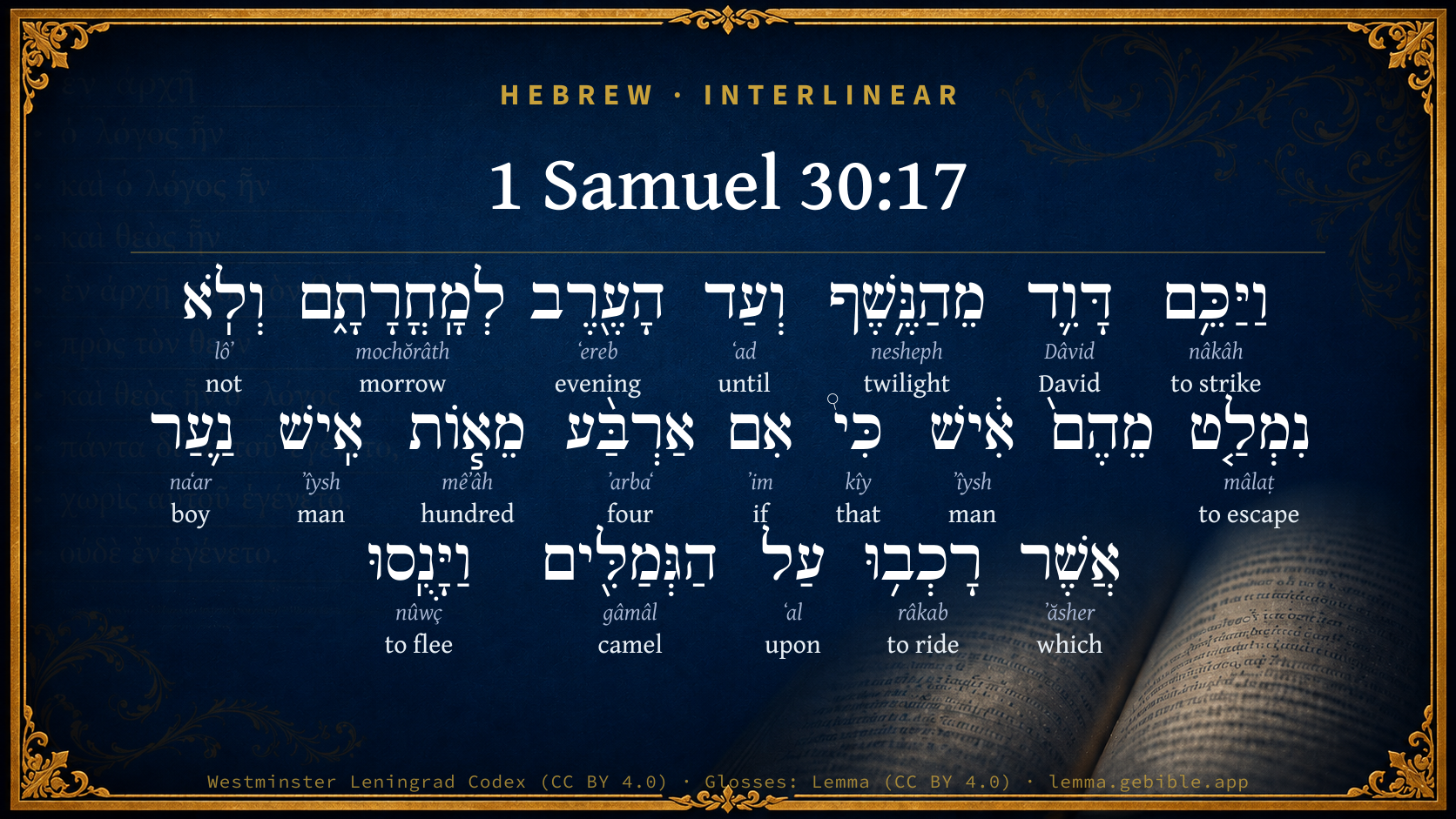
1 Samuel 30:17

Hebrew (Westminster Leningrad Codex) 1 Samuel 30:17 appears in the Hebrew Old Testament. The text above is from the Westminster Leningrad Codex. Each word links to its Strong’s number, a concise gloss, and parsing drawn from the Open Scriptures Hebrew Bible morphology. Click any word for its full Brown-Driver-Briggs (BDB) entry.
Download image
Cite this verse

1 Samuel 30:17 (World English Bible). Public Domain. Lemma interlinear Bible study tool, https://lemma.gebible.app/v/1-samuel/30/17.

Show BibTeX & RIS
BibTeX
RIS
English Translation
David struck them from the twilight even to the evening of the next day: and there not a man of them escaped, except four hundred young men, who rode on camels and fled.
World English Bible · Public Domain
Highlights
  • 1 first appearance in the Hebrew Bible
Full analysis ↓
Download a study sheet

One document with this verse’s original text, its word-by-word gloss line, the meaning frame, cross-references with their text, attributed commentary, and full source and license credits — printable, and it pastes into notes with its structure intact.

This verse Autodidact and up

Study sheet (.html) Plain text (.txt)

A passage Seminary Student

Up to 50 verses in one chapter. A passage sheet keeps up to 6 commentary sources and 12 cross-references per verse, in the order this page ranks them, and says so on the sheet whenever that leaves anything out. Ask for a single verse and you get the Autodidact verse sheet above.

Everything on this page stays free to read, with no account — the sheet is a download of what is already on screen, not access to it.

Want to remove ads? Support Godless Engineer
Compare translations 3

The same verse in 3 English versions, stacked beneath the original-language interlinear above. Click any original word for its lexicon entry.

Each is an independent rendering of the whole verse — the interlinear is not word-aligned to these translations.

Highlighted words mark where these versions differ — a whole-verse word diff, not a word-by-word alignment.

  • World English Bible Public Domain
    David struck them from the twilight even to the evening of the next day: and there not a man of them escaped, except four hundred young men, who rode on camels and fled.
  • King James Version Public Domain
    And David smote them from the twilight even unto the evening of the next day: and there escaped not a man of them, save four hundred young men, which rode upon camels, and fled.
  • unfoldingWord Literal Text CC BY-SA 4.0
    And David struck them from twilight and until the evening of the next day of them. And a man did not escape from them except 400 men, young men who rode on camels and fled.

unfoldingWord Literal Text — © unfoldingWord, licensed CC BY-SA 4.0. Word-aligned USFM3 via Door43 (git.door43.org/unfoldingWord/en_ult).

Versions to compare (up to 4)

3 of 4 selected

Show all 18 translations

Every available English version of this verse, each an independent rendering of the whole verse.

  • World English Bible Public Domain
    David struck them from the twilight even to the evening of the next day: and there not a man of them escaped, except four hundred young men, who rode on camels and fled.
  • Berean Standard Bible Public Domain
    And David struck them down from twilight until the evening of the next day. Not a man escaped, except four hundred young men who fled, riding off on camels.
  • Majority Standard Bible Public Domain
    And David struck them down from twilight until the evening of the next day. Not a man escaped, except four hundred young men who fled, riding off on camels.
  • King James Version Public Domain
    And David smote them from the twilight even unto the evening of the next day: and there escaped not a man of them, save four hundred young men, which rode upon camels, and fled.
  • American Standard Version (1901) Public Domain
    And David smote them from the twilight even unto the evening of the next day: and there escaped not a man of them, save four hundred young men, who rode upon camels and fled.
  • Revised Version (1885) Public Domain
    And David smote them from the twilight even unto the evening of the next day: and there escaped not a man of them save four hundred young men, which rode upon camels and fled.
  • Geneva Bible (1599) Public Domain
    And Dauid smote them from the twilight, euen vnto the euening of the next morowe, so that there escaped not a man of them, saue foure hundreth yong men, which rode vpon camels, and fled.
  • Douay-Rheims (1899) Public Domain
    And David slew them from the evening unto the evening of the next day, and there escaped not a man of them, but four hundred young men, who had gotten upon camels, and fled.
  • Young's Literal Translation Public Domain
    And David smiteth them from the twilight even unto the evening of the morrow, and there hath not escaped of them a man, except four hundred young men who have ridden on the camels, and are fled.
  • Literal Standard Version CC BY-SA 4.0
    And David strikes them from the twilight even to the evening of the next day, and there has not escaped of them a man, except four hundred young men who have ridden on the camels and flee.
  • Unlocked Literal Bible CC BY-SA 4.0
    David attacked them from the twilight to the evening of the next day. Not a man escaped except for four hundred young men, who rode on camels and fled.
  • unfoldingWord Literal Text CC BY-SA 4.0
    And David struck them from twilight and until the evening of the next day of them. And a man did not escape from them except 400 men, young men who rode on camels and fled.
  • Darby Bible Public Domain
    And David smote them from the twilight even to the evening of the next day; and there escaped not a man of them, save four hundred young men, who rode upon camels, and fled.
  • World Messianic Bible Public Domain
    David struck them from the twilight even to the evening of the next day. Not a man of them escaped from there, except four hundred young men who rode on camels and fled.
  • Webster's Bible Public Domain
    And David smote them from the twilight even to the evening of the next day: and there escaped not a man of them, save four hundred young men, who rode upon camels, and fled.
  • Free Bible Version CC BY-SA 4.0
    David attacked them from dusk until the following evening. Nobody escaped, except for four hundred men who managed to get away, riding on camels.
  • Bible in Basic English Public Domain
    And David went on fighting them from evening till the evening of the day after; and not one of them got away but only four hundred young men who went in flight on camels.
  • JPS Tanakh (1917) Public Domain
    And David smote them from the twilight even unto the evening of the next day; and there escaped not a man of them, save four hundred young men, who rode upon camels and fled.

Literal Standard Version (2020), Covenant Press — licensed CC BY-SA 4.0. Text via the HelloAO Bible API (eBible.org). Unlocked Literal Bible (unfoldingWord) — licensed CC BY-SA 4.0. Text via the HelloAO Bible API (eBible.org). unfoldingWord Literal Text — © unfoldingWord, licensed CC BY-SA 4.0. Word-aligned USFM3 via Door43 (git.door43.org/unfoldingWord/en_ult). Free Bible Version, Dr. Jonathan Gallagher — licensed CC BY-SA 4.0. Text via the HelloAO Bible API (eBible.org).

Word by word

More ways to search: Search by grammar → Find every occurrence → Compare this word →

Practice this passage: Drill this verse → Learn its vocabulary →

מֵהַנֶּ֥שֶׁף
nesheph
H5399
“from · the · twilight”
Preposition + Particle, Definite Article + Noun, Common, Masculine, Singular, Absolute
Part of Speech
Preposition + Particle + Noun
Type
Common
Gender
Masculine
Number
Singular
State
Absolute
Full BDB Definition

Origin: from H5398

TWOT: 1434a

twilight - evening twilight - morning twilight
  1. וַיַּכֵּ֥ם nâkâh H5221 “and · to strike · them” Conjunction + Verb, Hiphil, Sequential Imperfect, 3rd Person, Masculine, Singular + Suffix, Personal, 3rd Person, Masculine, Plural
  2. דָּוִ֛ד Dâvid H1732 “David” Noun, Proper
  3. וְעַד ʻad H5704 “and · until” Conjunction + Preposition
  4. הָעֶ֖רֶב ʻereb H6153 “the · evening” Particle, Definite Article + Noun, Common, Masculine, Singular, Absolute
  5. לְמָֽחֳרָתָ֑ם mochŏrâth H4283 “to/for · morrow · their” Preposition + Noun, Common, Feminine, Singular, Construct + Suffix, Personal, 3rd Person, Masculine, Plural
  6. וְלֹֽא lôʼ H3808 “and · not” Conjunction + Particle, Negative
  7. נִמְלַ֤ט mâlaṭ H4422 “to escape” Verb, Niphal, Perfect, 3rd Person, Masculine, Singular
  8. אִ֔ישׁ ʼîysh H376 “man” Noun, Common, Masculine, Singular, Absolute
  9. כִּי֩ kîy H3588 “that” Conjunction
  10. אִם ʼim H518 “if” Conjunction
  11. אַרְבַּ֨ע ʼarbaʻ H702 “four” Adjective, Cardinal number, Feminine, Singular, Absolute
  12. מֵא֧וֹת mêʼâh H3967 “hundred” Adjective, Cardinal number, Both, Plural, Absolute
  13. אִֽישׁ ʼîysh H376 “man” Noun, Common, Masculine, Singular, Absolute
  14. נַ֛עַר naʻar H5288 “boy” Noun, Common, Masculine, Singular, Absolute
  15. אֲשֶׁר ʼăsher H834 “which” Particle, Relative
  16. רָכְב֥וּ râkab H7392 “to ride” Verb, Qal, Perfect, 3rd Person, Common, Plural
  17. עַל ʻal H5921 “upon” Preposition
  18. הַגְּמַלִּ֖ים gâmâl H1581 “the · camels” Particle, Definite Article + Noun, Common, Masculine, Plural, Absolute
  19. וַיָּנֻֽסוּ nûwç H5127 “and · to flee” Conjunction + Verb, Qal, Sequential Imperfect, 3rd Person, Masculine, Plural

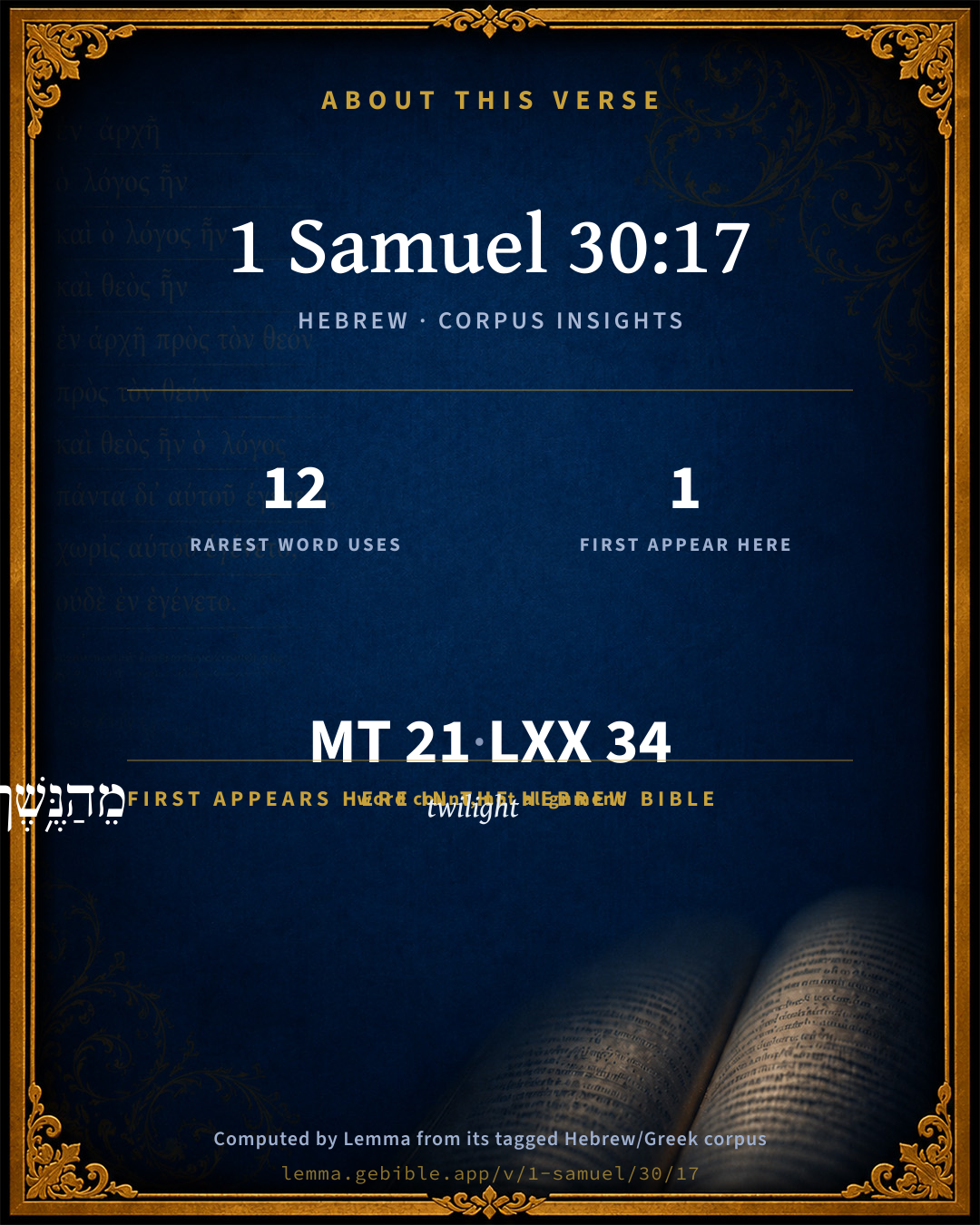
About this verse

These counts appear in no published source. They are computed here, from the morphology-tagged text and Lemma’s own curated glosses. What Lemma adds →

21
words
19
distinct lemmas
Historical
section

Notable vocabulary

The rarest word here is מֵהַנֶּ֥שֶׁף twilight H5399 — appearing just 12 times in the whole Hebrew Bible.

First appearance in Scripture

This word makes its first canonical appearance in the Hebrew Bible here:

  • מֵהַנֶּ֥שֶׁף twilight H5399

Shared distinctive vocabulary

מֵהַנֶּ֥שֶׁף twilight H5399 occurs in 12 verses of the Hebrew Bible. Also found in:

Grammatical profile

  • 4 verbs
  • 8 nouns
  • 2 adjectives
  • 3 prepositions
  • 2 conjunctions
  • 2 particles

Verb forms

  • וַיַּכֵּ֥ם Hiphil · Sequential Imperfect
  • נִמְלַ֤ט Niphal · Perfect
  • רָכְב֥וּ Qal · Perfect
  • וַיָּנֻֽסוּ Qal · Sequential Imperfect

Repetition

A word recurs within this verse — often emphatic in Hebrew:

  • אִ֔ישׁ man H376 ×2

Hebrew & Septuagint length

In English translation the verse runs 33 words from the Hebrew and 37 from the Septuagint (LXX English) — closely comparable.

A rough comparison of the two English renderings, which tokenize alike — not a word-level alignment.

Word counts can differ between the Hebrew and the Greek without any difference in meaning — e.g. the Hebrew direct-object marker אֵת has no separate Greek word, and Greek often adds the article ὁ.

In the original languages it is 21 Hebrew tokens and 34 Greek tokens — but the two are counted differently (Hebrew bundles its prefixes and suffixes into one token; the Greek is in lemma form), so that isn’t a like-for-like length.

Cross-references

5

Topical passages linked to 1 Samuel 30:17 in the Treasury of Scripture Knowledge — connected by theme and wording, ordered by reader-vote popularity; previews shown in the World English Bible.

  • 1 Samuel 11:11 It was so on the next day, that Saul put the people in three companies; and they came into the midst of the camp in the morning watch, and struck the Ammonites until the heat of the day: and it happened, that those who remained were scattered, so that no two of them were left together.
  • Psalms 18:42 Then I beat them small as the dust before the wind. I cast them out as the mire of the streets.
  • Judges 4:16 But Barak pursued after the chariots, and after the host, to Harosheth of the Gentiles: and all the host of Sisera fell by the edge of the sword; there was not a man left.
  • 1 Samuel 15:3 Now go and strike Amalek, and utterly destroy all that they have, and don't spare them; but kill both man and woman, infant and suckling, ox and sheep, camel and donkey.
  • 1 Kings 20:29–30 They encamped one over against the other seven days. So it was, that in the seventh day the battle was joined; and the children of Israel killed of the Syrians one hundred thousand footmen in one day.

Cross-references courtesy of OpenBible.info (CC BY 4.0).

Hebrew and Greek witnesses Masoretic Hebrew ↔ Greek Septuagint

The same verse in the two great witnesses to the Old Testament, shown verse-for-verse.

These are two independent witnesses, not word-aligned to each other, and the Septuagint is shown in lemma (dictionary) form.

Hebrew 1 Samuel 30:17 Masoretic · Westminster Leningrad Codex

וַיַּכֵּ֥ם דָּוִ֛ד מֵהַנֶּ֥שֶׁף וְעַד הָעֶ֖רֶב לְמָֽחֳרָתָ֑ם וְלֹֽא נִמְלַ֤ט מֵהֶם֙ אִ֔ישׁ כִּי֩ אִם אַרְבַּ֨ע מֵא֧וֹת אִֽישׁ נַ֛עַר אֲשֶׁר רָכְב֥וּ עַל הַגְּמַלִּ֖ים וַיָּנֻֽסוּ

David struck them from the twilight even to the evening of the next day: and there not a man of them escaped, except four hundred young men, who rode on camels and fled.

World English Bible · Public Domain

Greek LXX 1 Samuel 30:17 Septuagint · lemma form

καί ἔρχομαι ἐπί αὐτός δαυίδ καί πατάσσω αὐτός ἀπό ἑωσφόρος ἕως δειλός καί ὁ ἀπαύριον καί οὐ σώζω ἐκ αὐτός ἀνήρ ὅτι ἀλλά ἤ τετρακόσιοι παιδάριον ὅς εἰμί ἐπιβαίνω ἐπί ὁ κάμηλος καί φεύγω

And David came upon them, and struck them from the morning till the evening, and on the next day; and not one of them escaped, except four hundred young men, who were mounted on camels, and fled.

LXX2012 (modern English Septuagint) · Public Domain

On this verse, Haydock's Catholic Bible Commentary discusses the Septuagint’s reading. Read the note in Commentary ↓

Hebrew: Westminster Leningrad Codex (CC BY 4.0). Greek: Septuagint (public domain); English from LXX2012 (modern English Septuagint) (Public Domain). How the Septuagint differs from the Hebrew →

Targum (Aramaic paraphrase)

1

The Targum is the ancient Jewish Aramaic paraphrase of the Hebrew Scriptures — an interpretive translation, not the Hebrew text itself. Onkelos (literal) and Pseudo-Jonathan (expansive) render the Torah, and Jonathan the Prophets. Coverage is partial: where no permissively-licensed English translation exists for a verse, only the Aramaic is shown. This is verse-level text, not a word-by-word alignment to the Hebrew.

  1. Targum Jonathan Prophets (Joshua–Malachi)
    וּמְחָנוּן דָוִד מִקְבָּלָא וְעַד עִדַן רַמְשָׁא בְּיוֹמָא דְבַתְרוֹהִי וְלָא אִשְׁתֵּיזֵיב מִנְהוֹן אֱנַשׁ אֱלָהֵין אַרְבַּע מְאָה גְבַר עוּלֵים דִרְכִיבוּ עַל גַמְלַיָא וְאַפִּיכוּ:

    (no public-domain English translation for this verse)

    Targum Jonathan — Aramaic: “Mikraot Gedolot” (public domain). English: “Sefaria Community Translation” (CC0 1.0 (public-domain dedication)); “London "Chaldee Paraphrase," 1871” (public domain). Text via Sefaria.

Commentary

Notes on 1 Samuel 30:17 from classic Christian and Jewish commentators (each source and its license shown beneath its notes). The classic Christian expositions comment on the surrounding passage and are grouped to its opening verse, so a note may address several verses; the Jewish commentaries on the Tanakh (Rashi and others) are per-verse, so they appear only where the commentator wrote on this verse.

Lemma curates 59 commentaries, every one of them public domain or Creative Commons licensed, each selected and text-cleaned for this edition rather than reprinted as found. About our sources →

Trapp's Complete Commentary

John Trapp

1Sa 30:17 And David smote them from the twilight even unto the evening of the next day: and there escaped not a man of them, save four hundred young men, which rode upon camels, and fled.

Ver. 17. From the twilight even unto the evening of the next day.] Heb., Of their morrow, i.e., of David’s men’s morrow; {a} the morrow after they set forth to pursue the Amalekites, whom they found it no hard matter to stab with the sword, who were intoxicated before.

Upon camels,] i.e., Upon coursers or dromedaries.

{a} Jun.

John Trapp, A Commentary or Exposition upon All the Books of the Old and New Testament (1647–1656) — public domain. Text from a community e-Sword module.

Tyndale Open Study Notes

Tyndale Open Resources

30:17 The total number of Amalekite raiders must have been quite large if 400 young men escaped.

Tyndale Open Study Notes — © Tyndale Open Resources, licensed CC BY-SA 4.0. Text via the HelloAO Bible API.

Geneva Bible (1599)

Geneva Bible translators

Some read, and unto the morrow of the two evenings: that is, three days.

Geneva Bible (1599) marginal notes — public domain. Text via Bolls.life.

Adam Clarke's Commentary

Verse 17. There escaped not a man of them] It is well known to every careful reader of the Bible, that the Amalekites were a proscribed people, even by God himself, and that in extirpating them it has been supposed David fulfilled the express will of God. But all this depends on whether he had an express commission to do so, received from God himself, as Saul had.

Adam Clarke's Commentary on the Bible (1810–1826) — public domain. Text from a community e-Sword/MySword module.

Ellicott's Commentary for English Readers

(17) From twilight even unto the evening of the next day.—Keil thinks the fighting went on from the evening twilight till the evening of the next day. Bishop Hervey, in the Speaker’s Commentary, with greater probability, supposes that “the twilight is the morning twilight, as the contrast between twilight and evening rather suggests.” David thus arrived at night, and finding his enemies eating and drinking, put off his attack until the morning dawn or twilight, when they would be still sleeping after their debauch. Although thus taken by surprise, their great numbers and their natural bravery enabled them to prolong the fierce struggle all through the day, and when the shades of evening were falling four hundred (we read) of the young men, a body of fugitives equal to David’s own force, managed to get clear of the rout and escape. The number of slain on this occasion must have been very great.

A Bible Commentary for English Readers, edited by Charles John Ellicott (1878–1897) — public domain. Text from a community e-Sword module.

The Cambridge Bible for Schools and Colleges

gen. ed. J. J. S. Perowne

17. And David smote, &c.] He reached the neighbourhood of their camp in the evening, and found them scattered about in disorder, carousing over the spoil. As soon as the morning began to dawn he attacked them (cp. 1Sa_11:11), and the fight lasted till nightfall. After the first surprise, the Amalekites made a stubborn resistance.

the evening of the next day] The battle can scarcely have lasted two whole days. If the reading is right, the phrase the evening towards the morrow may denote the evening with which the next day commenced, Jewish days being reckoned from sunset to sunset, so that the fight lasted from early dawn till past sunset.

young men] Perhaps servant, as in 1Sa_16:18. The Amalekites were famous for camels. Cp. Jdg_7:12; 1Sa_15:3.

The Cambridge Bible for Schools and Colleges (gen. ed. J. J. S. Perowne; Cambridge University Press, 1878–1918) — public domain. Text from a community e-Sword module.

John Gill's Exposition

And David smote them from the twilight even unto the evening of the next day,.... As there are two twilights, the twilight of the morning, and the twilight of the evening; this is differently understood some take it for the twilight of the morning, and that it was night when David came to them, and let them alone till they were drunk and asleep, and then early in the morning fell upon them, and smote them until the evening; so Josephus (s) relates it; but others take it to be the twilight of the evening, and that he fell upon them that night, and continued the slaughter of them to the evening of the next day, with which agrees the Targum; nay, some take the next day, or the morrow, to be that which followed after the two evenings; so that this slaughter was carried on to the third day:

and there escaped not a man of them, save four hundred young men that rode upon camels, and fled; that sort of camels called dromedaries, according to Josephus (t), and which were very swift, and much used by the Arabians, near whom these people dwelt, see Isa 60:6.

(s) Antiqu. l. 6. c. 4. sect. 6. (t) Ibid.

John Gill's Exposition of the Whole Bible (1746–1763) — public domain (CC PDM 1.0). Text via the HelloAO Bible API.

Haydock's Catholic Bible Commentary

Evening. Hebrew, "twilight," in the morning (Calmet) or evening. (Haydock) --- Some think that the pursuit lasted three days; others only from three till five in the evening. But David more probably slaughtered the intoxicated people, during the space of a whole day, from morning till evening. (Calmet) --- Septuagint, "from the morning or evening star rising, Greek: aro eosphorou, till the afternoon, and on the following day," (Haydock) which commenced at sun-set. (Calmet) --- It was no battle, but flight and carnage. (Menochius)

George Leo Haydock (1774–1849), Haydock's Catholic Family Bible and Commentary, 1859 edition — public domain. Excludes Psalms (Douay-Rheims chapter numbering differs from Protestant) and Deuterocanonical books (Catholic canon only).

Matthew Poole's English Annotations

From the twilight: the word signifies both the morning and evening twilight. But the latter seems here intended, partly because their eating, and drinking, and dancing was more customary and proper work for the evening than for the morning; and partly because the evening was more convenient for David, that the fewness of his forces might not be discovered by the day-light.

Object. It is not likely that David would fall upon the Amalekites before his men, who had been tired with a long and hasty march, were refreshed.

Answ. Nor is it said that he did. It is probable that when he came near them, he reposed himself and his army in some secret place, whereof there were many in those parts, for a convenient season; and then marched on so as to come to them at the evening time.

Matthew Poole's English Annotations on the Holy Bible (1683–1685) — public domain. Text from a community e-Sword/MySword module.

The Pulpit Commentary

DEFEAT OF THE AMALEKITES AND RECOVERY OF THE WOMEN AND SPOIL (vers. 17-20).

From the twilight. It has been debated whether this means the evening or the morning twilight; but the words which follow, "unto the evening of the next day," literally, "of (or for) their morrow," seem to prove that it was in the evening that David arrived. Moreover, in the morning they would not have been feasting, but sleeping. David probably attacked them at once, and slew all within reach until nightfall. The next morning the battle was renewed; but as David had but 400 men, and the Amalekites covered a large extent of country, and probably tried to defend themselves and their booty, it was not till towards the next evening that the combat and the pursuit were over. As they would need pasture and water for their cattle, they had evidently broken up into detachments, which had gone each into a different place with their herds. The pursuit must have been prolonged to a considerable distance, as no more than 400 young men escaped, and even they only by the aid of their camels.

The Pulpit Commentary (1880–1919), ed. H.D.M. Spence-Jones & Joseph S. Exell — public domain. Text from a community e-Sword module.

John Wesley's Explanatory Notes

Twilight - The word signifies both the morning and evening twilight. But the latter seems here intended, partly because their eating, and drinking, and dancing, was more proper work for the evening, than the morning; and partly, because the evening was more convenient for David, that the fewness of his forces might not be discovered by the day-light. It is probable, that when he came near them, he reposed himself, and his army, in some secret place, whereof there were many parts, for a convenient season; and then marched on so as to come to them at the evening time.

John Wesley, Explanatory Notes Upon the Whole Bible (1754–1765) — public domain. Text via the GEBible commentary corpus.

Keil & Delitzsch

C. F. Keil & F. Delitzsch

David surprised them in the midst of their security, and smote them from the evening twilight till the evening of the next day, so that no one escaped, with the exception of four hundred young men, who fled upon camels. Nesheph signifies the evening twilight here, not the dawn, - a meaning which is not even sustained by Job 7:4. The form מחרתם appears to be an adverbial formation, like יומם.

Keil & Delitzsch — Biblical Commentary on the Old Testament (1861–1891) — public domain (CC PDM 1.0). Text via the HelloAO Bible API. (Old Testament only.)

Rashi

Rabbi Shlomo Yitzchaki (Rashi)

Of the next day. The Amaleikites are accustomed to being defeated on the second day [of battle], as it is stated, "tomorrow I will stand…" Therefore, it states, "on the(ir) next day."

Rashi on the Tanakh — English translations: “The Judaica Press complete Tanach with Rashi, translated by A. J. Rosenberg” (CC BY 4.0); “Pentateuch with Rashi's commentary by M. Rosenbaum and A.M. Silbermann, 1929-1934” (public domain); “The Metsudah Tanach series, Lakewood, N.J” (CC BY 4.0); and “The Book of Joshua, Metsudah Publications, 1997” (CC BY 4.0). Text via Sefaria.

Lesson kit

Teaching starters — assembled from the data on this page, not authored interpretation. Every prompt links to the verse data it draws on. Edit before teaching.

1 Samuel, in the Historical, opens this verse with 21 words (19 distinct Hebrew lemmas). Its most distinctive word is nesheph (“twilight”). A historical commentator’s framing appears above. Read the whole chapter for the surrounding context.

Discussion questions

  1. What does “twilight” (nesheph) contribute to the verse as a whole?
  2. This is the first place “twilight” appears in Scripture (first appears here). What does its debut here establish?
  3. How does 2 Kings 7:5, which shares the word «twilight», read alongside this verse?
  4. What does the repetition of “man” (2× in this one verse) do in this verse?
  5. The translations on this page render this verse differently — a whole-verse word diff, not a word-by-word alignment. What might account for the different wordings?
  6. «וַיַּכֵּ֥ם» is a Hiphil Sequential Imperfect verb. How does that grammatical form shape the action described?
  7. Compare how Trapp's Complete Commentary and Tyndale Open Study Notes read this verse. Where do they agree or differ?

Things to notice

Reading settings

Reading text

Shown beneath each verse's original-language words.

Old Testament
Old Testament edition

Read the OT as the Masoretic Hebrew (MT) or the Greek Septuagint (LXX).

English shown for the Greek Septuagint (in the Hebrew ↔ Greek comparison).

Comparing translations? Open the Compare panel on any verse page to stack up to four side by side.