

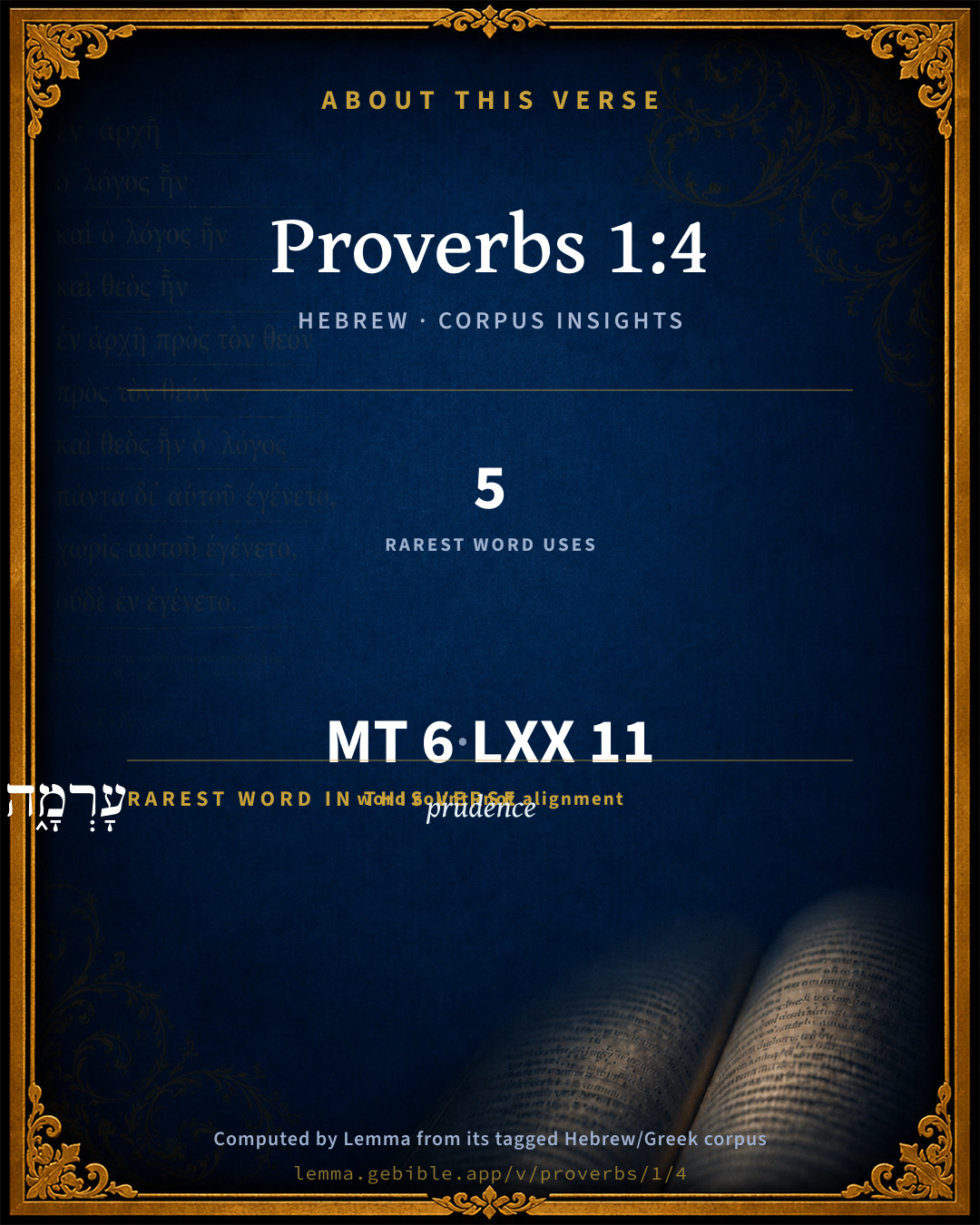
Proverbs 1:4

Hebrew (Westminster Leningrad Codex) Proverbs 1:4 appears in the Hebrew Old Testament. The text above is from the Westminster Leningrad Codex. Each word links to its Strong’s number, a concise gloss, and parsing drawn from the Open Scriptures Hebrew Bible morphology. Click any word for its full Brown-Driver-Briggs (BDB) entry.
Download image
Cite this verse

Proverbs 1:4 (World English Bible). Public Domain. Lemma interlinear Bible study tool, https://lemma.gebible.app/v/proverbs/1/4.

Show BibTeX & RIS
BibTeX
RIS
English Translation
To give prudence to the simple, Knowledge and discretion to the young man:
World English Bible · Public Domain
Download a study sheet

One document with this verse’s original text, its word-by-word gloss line, the meaning frame, cross-references with their text, attributed commentary, and full source and license credits — printable, and it pastes into notes with its structure intact.

This verse Autodidact and up

Study sheet (.html) Plain text (.txt)

A passage Seminary Student

Up to 50 verses in one chapter. A passage sheet keeps up to 6 commentary sources and 12 cross-references per verse, in the order this page ranks them, and says so on the sheet whenever that leaves anything out. Ask for a single verse and you get the Autodidact verse sheet above.

Everything on this page stays free to read, with no account — the sheet is a download of what is already on screen, not access to it.

Want to remove ads? Support Godless Engineer
Compare translations 3

The same verse in 3 English versions, stacked beneath the original-language interlinear above. Click any original word for its lexicon entry.

Each is an independent rendering of the whole verse — the interlinear is not word-aligned to these translations.

Highlighted words mark where these versions differ — a whole-verse word diff, not a word-by-word alignment.

  • World English Bible Public Domain
    To give prudence to the simple, Knowledge and discretion to the young man:
  • King James Version Public Domain
    To give subtilty to the simple, to the young man knowledge and discretion.
  • unfoldingWord Literal Text CC BY-SA 4.0
    to give to naive ones prudence, to a young man knowledge and discretion

unfoldingWord Literal Text — © unfoldingWord, licensed CC BY-SA 4.0. Word-aligned USFM3 via Door43 (git.door43.org/unfoldingWord/en_ult).

Versions to compare (up to 4)

3 of 4 selected

Show all 18 translations

Every available English version of this verse, each an independent rendering of the whole verse.

  • World English Bible Public Domain
    To give prudence to the simple, Knowledge and discretion to the young man:
  • Berean Standard Bible Public Domain
    To impart prudence to the simple and knowledge and discretion to the young,
  • Majority Standard Bible Public Domain
    To impart prudence to the simple and knowledge and discretion to the young,
  • King James Version Public Domain
    To give subtilty to the simple, to the young man knowledge and discretion.
  • American Standard Version (1901) Public Domain
    To give prudence to the simple, To the young man knowledge and discretion:
  • Revised Version (1885) Public Domain
    To give subtilty to the simple, to the young man knowledge and discretion:
  • Geneva Bible (1599) Public Domain
    To giue vnto the simple, sharpenesse of wit, and to the childe knowledge and discretion.
  • Douay-Rheims (1899) Public Domain
    To give subtilty to little ones, to the young man knowledge and understanding.
  • Young's Literal Translation Public Domain
    For giving to simple ones -- prudence, To a youth -- knowledge and discretion.
  • Literal Standard Version CC BY-SA 4.0
    For giving to simple ones—prudence, || To a youth—knowledge and discretion.
  • Unlocked Literal Bible CC BY-SA 4.0
    These proverbs are also to give wisdom to the naive, and to give knowledge and discretion to young people.
  • unfoldingWord Literal Text CC BY-SA 4.0
    to give to naive ones prudence, to a young man knowledge and discretion
  • Darby Bible Public Domain
    to give prudence to the simple, to the young man knowledge and discretion.
  • World Messianic Bible Public Domain
    to give prudence to the simple, knowledge and discretion to the young man—
  • Webster's Bible Public Domain
    To give subtilty to the simple, to the young man knowledge and discretion.
  • Free Bible Version CC BY-SA 4.0
    They give discernment to the immature, knowledge and discretion to the young.
  • Bible in Basic English Public Domain
    To make the simple-minded sharp, and to give the young man knowledge, and serious purpose:
  • JPS Tanakh (1917) Public Domain
    To give prudence to the simple, to the young man knowledge and discretion;

Literal Standard Version (2020), Covenant Press — licensed CC BY-SA 4.0. Text via the HelloAO Bible API (eBible.org). Unlocked Literal Bible (unfoldingWord) — licensed CC BY-SA 4.0. Text via the HelloAO Bible API (eBible.org). unfoldingWord Literal Text — © unfoldingWord, licensed CC BY-SA 4.0. Word-aligned USFM3 via Door43 (git.door43.org/unfoldingWord/en_ult). Free Bible Version, Dr. Jonathan Gallagher — licensed CC BY-SA 4.0. Text via the HelloAO Bible API (eBible.org).

Word by word

More ways to search: Search by grammar → Find every occurrence → Compare this word →

Practice this passage: Drill this verse → Learn its vocabulary →

About this verse

These counts appear in no published source. They are computed here, from the morphology-tagged text and Lemma’s own curated glosses. What Lemma adds →

6
words
6
distinct lemmas
Wisdom
section

Notable vocabulary

The rarest word here is עָרְמָ֑ה prudence H6195 — appearing just 5 times in the whole Hebrew Bible.

Shared distinctive vocabulary

עָרְמָ֑ה prudence H6195 occurs in 5 verses of the Hebrew Bible. Also found in:

Grammatical profile

  • 1 verb
  • 5 nouns

Verb forms

  • לָתֵ֣ת Qal · Infinitive Construct

Hebrew & Septuagint length

In English translation the verse runs 13 words from the Hebrew and 16 from the Septuagint (LXX English) — closely comparable.

A rough comparison of the two English renderings, which tokenize alike — not a word-level alignment.

Word counts can differ between the Hebrew and the Greek without any difference in meaning — e.g. the Hebrew direct-object marker אֵת has no separate Greek word, and Greek often adds the article ὁ.

In the original languages it is 6 Hebrew tokens and 11 Greek tokens — but the two are counted differently (Hebrew bundles its prefixes and suffixes into one token; the Greek is in lemma form), so that isn’t a like-for-like length.

Cross-references

17

Topical passages linked to Proverbs 1:4 in the Treasury of Scripture Knowledge — connected by theme and wording, ordered by reader-vote popularity; previews shown in the World English Bible.

  • Proverbs 8:5 You simple, understand prudence. You fools, be of an understanding heart.
  • Proverbs 8:17 I love those who love me. Those who seek me diligently will find me.
  • Psalms 119:9 How can a young man keep his way pure? By living according to your word.
  • Psalms 119:130 The entrance of your words gives light. It gives understanding to the simple.
  • Proverbs 8:12 "I, wisdom, have made prudence my dwelling. Find out knowledge and discretion.
  • Proverbs 8:32 "Now therefore, my sons, listen to me, For blessed are those who keep my ways.
  • Proverbs 9:4–6 "Whoever is simple, let him turn in here!" As for him who is void of understanding, she says to him,
  • Psalms 19:7 Yahweh's law is perfect, restoring the soul. Yahweh's testimony is sure, making wise the simple.
  • Psalms 34:11 Come, you children, listen to me. I will teach you the fear of Yahweh.
  • Proverbs 1:22–23 "How long, you simple ones, will you love simplicity? How long will mockers delight themselves in mockery, And fools hate knowledge?
  • Proverbs 2:10–11 For wisdom will enter into your heart. Knowledge will be pleasant to your soul.
  • Proverbs 3:21 My son, let them not depart from your eyes. Keep sound wisdom and discretion:
  • Proverbs 7:7–24 I saw among the simple ones. I discerned among the youths a young man void of understanding,
  • Isaiah 35:8 A highway shall be there, and a way, and it shall be called The way of holiness. The unclean shall not pass over it, but is shall be for for him who walks in the Way. Wicked fools will not go there.
  • 2 Timothy 2:22 Flee from youthful lusts; but pursue righteousness, faith, love, and peace with those who call on the Lord out of a pure heart.
  • Titus 2:6 Likewise, exhort the younger men to be sober-minded;
  • Ecclesiastes 11:9–12:1 Rejoice, young man, in your youth, And let your heart cheer you in the days of your youth, And walk in the ways of your heart, And in the sight of your eyes; But know that for all these things God will bring you into judgment.

Cross-references courtesy of OpenBible.info (CC BY 4.0).

Hebrew and Greek witnesses Masoretic Hebrew ↔ Greek Septuagint

The same verse in the two great witnesses to the Old Testament, shown verse-for-verse.

These are two independent witnesses, not word-aligned to each other, and the Septuagint is shown in lemma (dictionary) form.

Hebrew Proverbs 1:4 Masoretic · Westminster Leningrad Codex

לָתֵ֣ת לִפְתָאיִ֣ם עָרְמָ֑ה לְ֝נַ֗עַר דַּ֣עַת וּמְזִמָּֽה

To give prudence to the simple, Knowledge and discretion to the young man:

World English Bible · Public Domain

Greek LXX Proverbs 1:4 Septuagint · lemma form

ἵνα δίδωμι ἄκακος πανουργιά παῖς δέ νέος αἴσθησις τε καί ἐννοία

that he might give subtlety to the simple, and to the young man discernment and understanding.

LXX2012 (modern English Septuagint) · Public Domain

On this verse, Adam Clarke's Commentary discusses the Septuagint’s reading. Read the note in Commentary ↓

Hebrew: Westminster Leningrad Codex (CC BY 4.0). Greek: Septuagint (public domain); English from LXX2012 (modern English Septuagint) (Public Domain). How the Septuagint differs from the Hebrew →

Commentary

Notes on Proverbs 1:4 from classic Christian and Jewish commentators (each source and its license shown beneath its notes). The classic Christian expositions comment on the surrounding passage and are grouped to its opening verse, so a note may address several verses; the Jewish commentaries on the Tanakh (Rashi and others) are per-verse, so they appear only where the commentator wrote on this verse.

Lemma curates 59 commentaries, every one of them public domain or Creative Commons licensed, each selected and text-cleaned for this edition rather than reprinted as found. About our sources →

Trapp's Complete Commentary

John Trapp

Pro 1:4 To give subtilty to the simple, to the young man knowledge and discretion.

Ver. 4. To give subtilty.] Serpentine subtilty, {Gen 3:1} sacred sagacity, a sharp wit, a deep reach, a Spirit that "searcheth all things, yea, the deep things of God," {1Co 2:10} and transformeth a man "into the same image from glory to glory." {2Co 3:18} Equidem scio multos esse qui hoc non credant, et non paucos qui ea rideant, nosque insanire arbitrentur, saith Peter Martyr, {a} sed istos rogatos velim, &c.: that is, I know well there be many that will not believe it, and not a few that will deride it, and think we are mad in ascribing so much to the Scriptures. But oh that they would be entreated to make trial awhile, and to take to the reading of the Bible! Male mihi sit (ita enim in tanta causa iurare ausim) nisi tandem capiantur: sentient denique quantum divina hac ab humanis distent, &c. Let me never be believed, if they perceive not a plain and palpable difference between these and all human writings whatsoever. And to the same purpose Erasmus, {b} expertus sum in meipso, saith he, I can speak it by experience, that there is little good to be gotten by reading the Bible cursorily and carelessly; but do it duly and dillgently, with attention and affection, and you shall find such an efficacy as is to be found in no other book that can be named.

To the simple.] Fatuo, פחא, fatuello - Lipsius’s diminutive; to the silly simple, whose learning hangs not in his light, who holds not himself too wise to be taught, who is not uncounsellable, unpersuadable. Bis desipit qui sibi sapit; { c} he is two fools that is wise in his own eyes. {Pro 3:7} Plurima ignoro, sed ignorantiam meam non ignoro. Little though it be that I know, yet this I know, that I know but little.

To the young man.] Though rude and rash, headlong and headstrong, {d} untameable and untractable as "a wild ass’s colt"; {Job 11:12} though addicted to "youthful lusts," {2Ti 2:22} and madly set upon sin, yet he may "cleanse his ways by cleaving to God’s word," {Psa 119:9 Ecc 11:10} and become a young saint, an old angel; whereas otherwise, like young lapwings, he is apt to be snatched up by every buzzard.

{a} Pet. Mart. in Rom. Ep. dedicat.

{b} Erasm., Praefat. in Lucam.

{c} Chytraeus.

{d} Arist., Ethic., lib. i.

John Trapp, A Commentary or Exposition upon All the Books of the Old and New Testament (1647–1656) — public domain. Text from a community e-Sword module.

The Biblical Illustrator

Joseph S. Exell

Pro_1:4

To give subtilty to the simple, to the young man knowledge and discretion.

Subtilty for the simple

The word is sometimes taken in an ill sense, for a crafty wit to deceive others. Sometimes in a good sense, for understanding to prevent dangers that crafty men might bring upon us. So it is taken here. Compare simple with the Latin fatuus, a fool. Simple comes from a verb which signifies to allure or seduce one that wants understanding of Gods truths and will, and so is easily allured to any error or wickedness by good words, as giving credit everything, because not able to examine things for want of judgment. He falls into danger for lack of knowledge. The word also signifies one who wants foresight to prevent danger.

1. The Scripture contains a store of heavenly knowledge sufficient to inform simple persons. Note the store of heavenly mysteries in the Scripture; the clearness of them; the variousness of them.

2. Subtilty for preventing of dangers is best learned out of the Scriptures.

3. We are naturally simple, and easily led into error.

4. The way to keep us from errors is the right understanding of Scripture.

5. Most danger of going astray is in the time of youth.

6. Bare knowledge is not enough, but discretion must be laboured for also. Knowledge is imperfect, and will need further augmentation by deliberation. And knowing men do things rashly oftentimes, being disturbed with passion. (Francis Taylor.)

Good subtilty

This term suggests the very point of Solomons advice. The young man who comes from a quiet home, where he has been under wise guidance, is really simple, unsophisticated, unused to the ways of the world, unfit to meet its temptations, and needing much good counsel and warning from those who are experienced in the worlds ways. Simple here is not silly, but guileless, unsuspecting, easily drawn aside, over-trustful. It is familiarly said that experience is a dear school, but fools will learn in no other. Solomon urges on the young man that if he would be willing to learn, he might be saved from many bitter and even degrading experiences. There is an evil sense attaching to the word subtilty, from its association with the serpent that tempted Eve; but the better meaning of the word comes to view through Solomons connecting it with other good and suggestive terms. He thinks that the young man, at the very outset of life, needs wisdom, which we may take in the general sense of culture; an instruction, that is, discipline, training, and understanding, or the power of weighing, distinguishing, discriminating: and wisdom, in the further sense of thoughtfulness, the habit of looking things well round before we decide on our action. Impulsiveness is a constant weakness in young people. They act before they think. And Justice, or the first principles of righteousness, by which all proposed conduct should be appraised, and judgment, or the self-estimating which is virtually the same as a cultured and active conscience, and equity, or the various adjustment of principles to the different relationships of men, and the various circumstances in which they may be placed; and discretion, or that kind of reticence which keeps the young man from being duped by false advisers.

1. Expect subtilty in those who would tempt you astray. Here the word takes its bad form, as crafty, designing, making good appearance in order to deceive; keeping back part of the truth: and so leaving a designedly false impression. See temptation of Eve. There is a good suspiciousness, which is a safeguard.

2. Show subtilty in not readily yielding to the tempters. Here the word is used in a good sense. Be on your guard. Do not give your love to the first person who seeks it. Beware of the plausible man, and the flatterers. Be forewarned and so you will be forearmed. Keep your own counsel. See underneath, and do not be caught by mere outside glitter. (Robert Tuck, B. A.)

The simple man

Plato wrote on the door of his academy, Let no man unskilled in geometry come hither. Solomon writes the very reverse on the door of his school, Let the simple man come hither. (G. Lawson, D. D.)

Discretion

There are many more shining qualities in the mind of man, but there is none more useful than discretion; it is this, indeed, which gives a value to all the rest, which sets them at work in their proper times and places, and turns them to the advantage of the person who is possessed of them. Without it, learning is pedantry, and wit impertinence; virtue itself looks like weakness; the best parts only qualify a man to be more sprightly in his errors, and active to his own prejudice. (W. Addison.)

Discretion

A father that had three sons was desirous to try their discretion, which he did by giving to each of them an apple that had some part of it rotten. The first eats up his apple, rotten and all; the second throws all his away, because some part of it was rotten; but the third picks out the rotten, and eats that which was good, so that he appeared the wisest: thus, some in these days, for want of discretion, swallow down all that is presented, rotten and sound altogether; others throw away all truth, because everything delivered unto them is not truth, but surely they are the wisest and most discreet, that know how to try the spirits whether they be of God or not--how to choose the good and refuse the evil. (J. Spencer.)

The Biblical Illustrator, edited by Joseph S. Exell (c. 1880s–1900s) — public domain. Text from a community e-Sword module.

Tyndale Open Study Notes

Tyndale Open Resources

1:4 The simple are like empty containers. Wisdom and folly compete to fill their minds and hearts (see 9:1-18).

Tyndale Open Study Notes — © Tyndale Open Resources, licensed CC BY-SA 4.0. Text via the HelloAO Bible API.

Geneva Bible (1599)

Geneva Bible translators

To such as have no discretion to rule themselves.

Geneva Bible (1599) marginal notes — public domain. Text via Bolls.life.

Jamieson, Fausset & Brown

Robert Jamieson, A. R. Fausset & David Brown

simple--one easily led to good or evil; so the parallel.

young man--one inexperienced.

subtilty--or prudence (Pro 3:21; Pro 5:21).

discretion--literally, "device," both qualities, either good or bad, according to their use. Here good, as they imply wariness by which to escape evil and find good.

Jamieson, Fausset & Brown — Commentary Critical and Explanatory on the Whole Bible (1871) — public domain (CC PDM 1.0). Text via the HelloAO Bible API.

Adam Clarke's Commentary

Verse 4. To give subtilty to the simple] The word simple, from simplex, compounded of sine, without, and plica, a fold, properly signifies plain and honest, one that has no by-ends in view, who is what he appears to be; and is opposed to complex, from complico, to fold together, to make one rope or cord out of many strands; but because honesty and plaindealing are so rare in the world, and none but the truly religious man will practice them, farther than the fear of the law obliges him, hence simple has sunk into a state of progressive deterioration. At first, it signified, as above, without fold, unmixed, uncompounded: this was its radical meaning. Then, as applied to men, it signified innocent, harmless, without disguise; but, as such persons were rather an unfashionable sort of people, it sunk in its meaning to homely, homespun, mean, ordinary. And, as worldly men, who were seeking their portion in this life, and had little to do with religion, supposed that wisdom, wit, and understanding, were given to men that they might make the best of them in reference to the things of this life, the word sunk still lower in its meaning, and signified silly, foolish; and there, to the dishonour of our language and morals, it stands! I have taken those acceptations which I have marked in Italics out of the first dictionary that came to hand - Martin's; but if I had gone to Johnson, I might have added to SILLY, not wise, not cunning. Simplicity, that meant at first, as MARTIN defines it, openness, plaindealing, downright honesty, is now degraded to weakness, silliness, foolishness. And these terms will continue thus degraded, till downright honesty and plaindealing get again into vogue. There are two Hebrew words generally supposed to come from the same root, which in our common version are rendered the simple, פתאים pethaim, and פתים or פתיים pethayim; the former comes from פתא patha, to be rash, hasty; the latter, from פתה pathah, to draw aside, seduce, entice. It is the first of these words which is used here, and may be applied to youth; the inconsiderate, the unwary, who, for want of knowledge and experience, act precipitately. Hence the Vulgate renders it parvulis, little ones, young children, or little children, as my old MS.; or very babes, as Coverdale. The Septuagint renders it ακακοις, those that are without evil; and the versions in general understand it of those who are young, giddy, and inexperienced.

To the young man] נער naar is frequently used to signify such as are in the state of adolescence, grown up boys, very well translated in my old MS. yunge fulwaxen; what we would now call the grown up lads. These, as being giddy and inexperienced, stand in especial need of lessons of wisdom and discretion. The Hebrew for discretion, מזמה mezimmah, is taken both in a good and bad sense, as זם zam, its root, signifies to devise or imagine; for the device may be either mischief, or the contrivance of some good purpose.

Adam Clarke's Commentary on the Bible (1810–1826) — public domain. Text from a community e-Sword/MySword module.

Ellicott's Commentary for English Readers

(4) Subtilty (‘Ormah).—Used in a bad sense (Exo_21:14) for “guile.” For the meaning here, comp. Mat_10:16 : “Be ye wise as serpents;” comp. also the reproof of Luk_16:8, that “the children of this world are in their generation wiser than the children of light;” and St. Paul’s advice to “redeem the time “(Eph_5:16), i.e., seize opportunities for good.

Simple.—Literally, those who are open to good impressions and influences, but who also can be easily led astray. (Comp. Pro_8:5; Pro_14:15.)

Young man.—The Hebrew term is used of any age from birth to about the twentieth year.

Discretion.—Or rather, thoughtfulness; a word also used in a bad sense in Pro_12:2, and there translated “wicked devices.”

A Bible Commentary for English Readers, edited by Charles John Ellicott (1878–1897) — public domain. Text from a community e-Sword module.

The Cambridge Bible for Schools and Colleges

gen. ed. J. J. S. Perowne

4. subtilty to the simple] Both words are here used in a good sense, or perhaps we might say, in their proper or neutral sense. The Hebrew word for simple is literally open (Heb.), sc. to influence, whether good or bad. The primary meaning of the English word simple, whether it be without fold (Trench) or one-fold (Skeat) is entirely different; but the idea conveyed by it adequately represents the meaning of the Hebrew. For, as Trench points out, to be without fold (or to be one-fold) is to be “just what we may imagine Nathanael to have been, and what our Lord attributes as the highest honour to him, the ‘Israelite without guile.’ ” But then since, as he truly adds, “in a world like ours such a man will make himself a prey, will prove no match for the fraud and falsehood he will everywhere encounter,” he needs the safeguard of subtilty, or prudence (R.V. marg.) to preserve him (see Pro_1:22, below). Such subtilty may be the craft of the serpent (Gen_3:1, where the Heb. word is the same); but it may be the wisdom of the serpent without its guile (see Mat_10:16, and comp. Pro_8:5; Pro_15:5; Pro_19:25).

The simple, though specially to be found among the young of the parallel clause of the verse, embrace others also.

The Cambridge Bible for Schools and Colleges (gen. ed. J. J. S. Perowne; Cambridge University Press, 1878–1918) — public domain. Text from a community e-Sword module.

John Gill's Exposition

To give subtlety to the simple,.... Men of mean abilities, weak capacities, shallow understandings, incautious, credulous, and easily imposed upon: these, by attending to what is herein contained, may arrive to a serpentine subtlety; though they are simple and harmless as doves, may become as wise as serpents; may attain to an exquisite knowledge of divine things and know even more than the wise and sage philosophers among the Gentiles, or any of the Rabbins and masters of Israel; or any of the princes of this world, whose wisdom comes to nought; and become very cautious and circumspect how they are drawn aside by the old serpent the devil, or by such who lie in wait to deceive; and perform their duty both to God and man;

to the young man knowledge and discretion; or "thought" (i); who wants both: this book will teach him the knowledge of things moral, civil, and religious: to think and act aright; how to behave and conduct himself wisely and discreetly before men; and be a means of forming his mind betimes for piety and religion; and of furnishing him with rules for his deportment in future life, in all the periods of it; and in whatsoever state and condition he may come into. A "young man may cleanse his way", Psa 119:9, reform his manners, behave with purity and uprightness, by taking "heed" to the things herein contained.

(i) "cogitationem", Pagninus, Mercerus; "bonam cogitationem", Michaelis.

John Gill's Exposition of the Whole Bible (1746–1763) — public domain (CC PDM 1.0). Text via the HelloAO Bible API.

Albert Barnes' Notes on the Bible

This verse points out the two classes for which the book will be useful:

(1) the “simple,” literally the “open,” the open-hearted, the minds ready to receive impressions for good or evil Pro 1:22; and

(2) the “young,” who need both knowledge and discipline.

To these the teacher offers the “subtilty,” which may turn to evil Exo 21:14 and become as the wisdom of the serpent Gen 3:1, but which also takes its place, as that wisdom does, among the highest moral gifts Mat 10:16; the “knowledge” of good and evil; and the “discretion,” or discernment, which sets a man on his guard, and keeps him from being duped by false advisers. The Septuagint renderings, πανουργία panourgia for “subtilty,” αἴσθησις aisthēsis for “knowledge,” ἔννοια ennoia for “discretion,” are interesting as showing the endeavor to find exact parallels for the Hebrew in the terminology of Greek ethics.

Albert Barnes' Notes on the Bible (1834–1885) — public domain. Text from a community e-Sword/MySword module.

Haydock's Catholic Bible Commentary

Subtilty. Discretion to the innocent. (Calmet)

George Leo Haydock (1774–1849), Haydock's Catholic Family Bible and Commentary, 1859 edition — public domain. Excludes Psalms (Douay-Rheims chapter numbering differs from Protestant) and Deuterocanonical books (Catholic canon only).

Matthew Poole's English Annotations

Subtilty; or rather,

prudence, as this word is used, Pro 3:21; 5:2; 8:5,12, which elsewhere is taken in an evil sense for craft or subtilty.

The simple; such as want wisdom, and are easily deceived by others, and therefore most need this blessing.

The young man, which wants both experience and self-government.

Matthew Poole's English Annotations on the Holy Bible (1683–1685) — public domain. Text from a community e-Sword/MySword module.

Whedon's Commentary on the Bible

Daniel D. Whedon

4. Having thus stated the object in general terms, the teacher proceeds to a more specific setting forth of what it is, or of what he anticipates in respect to certain classes. First, as to the young and untaught, those who are as yet untrained to thought and study; and secondly, as to those of greater maturity and reflection. To the פתאים, pethaim, simple (open) ones, novices, unskilled and inexperienced, he hopes to be able to give ערמה, ‘hormah, subtilty, expertness, shrewdness, to train them to mental activity and acumen; to the young man, נער, na’har, youth, standing in parallelism with pethaim, and meaning persons of the same class, he will impart knowledge and discretion. Several of the terms in this verse are sometimes used in a good, and sometimes in a bad sense. They are supposed to be used in a good sense here. Perhaps pethaim may be employed here in a middle sense, unthinking, unsophisticated, undisciplined. Such novices, or freshmen, he proposes to teach how to reflect properly, to drill and train them to the art of right thinking and right acting.

Daniel D. Whedon (gen. ed.), Commentary on the Old and New Testaments (1874–1909) — public domain. Text from a community e-Sword module.

The Pulpit Commentary

To give subtilty to the simple. In this verse and the following we are introduced to the classes of persons to whom the proverbs will be beneficial The l with the infinitive, ttel (latheth) shows that in construction this proposition is so ordinate with those in vers. 2 and 3, and not dependent as represented by ina dw (LXX) and iut detur (Vulgate). Subtilty; Hebrew, hmr (ar"mah), from the root ; (aram), "to be crafty or wily," properly means "nakedness" or "smoothness;" hence in a metaphorical sense it expresses "the capacity for escaping from the wiles of others" (Umbreit). We have this idea expressed as follows in Pro_22:3, "The prudent man ( arum) foreseeth the evil, and hideth himself." In the Arabic Version it is rendered by calliditas, "shrewdness," in a good sense. The Hebrew armah, like the Latin calliditas, also means "craftiness," as appears in the use of the cognate adjective arum in Gen_3:1, where we read, "The serpent was more subtle," etc. For "subtilty" the LXX has psnourgia , a Greek word which appears to be employed altogether in a bad sense, as "trickery," "villainy," "knavery;" but that scarcely appears to be the meaning of the Hebrew here, since the aim of the Proverbs is ethical and beneficial in the highest degree. The Vulgate astutia, the quality of the astutus, beside the bad sense of craftiness, also boars the good sense of shrewdness, sagacity, and so better represents the Hebrew. "Subtilty may turn to evil, but it also takes its place among the highest moral gifts" (Plumptre). The simple; Hebrew, (ph"thaim), plural of yTip (p"ti) from the root jtp (pathakh), "to be open," properly means the open-hearted, i.e. those who are susceptible to external impressions (Zockler), and so easily misled. The word occurs in Pro_7:7 Pro_8:5 Pro_9:6 Pro_14:18; and Pro_27:12. The LXX properly renders the word akakoi , "unknowing of evil." The same idea is indirectly expressed in the Vulgate parvuli, "the very young;" and the term is paraphrased in the Arabic Version, iis in quibus non est malitia ("those who are without malice"). The Hebrew here means "simple" in the sense of inexperienced. To the young man knowledge and discretion. The Hebrew naar (rn) is here used representatively for "youth" (cf. LXX, paiv neov ; Vulgate, adolescens) in general, which stands in need of the qualities here mentioned. It advances in idea beyond "the simple." Knowledge; Hebrew, tD (daath) , i.e. experimental knowledge (Delitzsch); insight (Gesenius); knowledge of good and evil (Plumptre). The LXX has aisyhsiv , which clasically means perception by the senses and also by the mind. Discretion; Hebrew, hMzim (m"zimmah), properly "thoughtfulness," and hence "circumspection" or "caution" (Zockler), or "discernment," that which sets a man on his guard and prevents him being duped by others (Plumptre). Ennoia was probably adopted by the LXX in its primary sense as representing the act of thinking; intellectus (Vulgate), equivalent to "a discerning" (see the marginal advisement").

The Pulpit Commentary (1880–1919), ed. H.D.M. Spence-Jones & Joseph S. Exell — public domain. Text from a community e-Sword module.

John Wesley's Explanatory Notes

Simple - Such as want wisdom. Young man - Who wants both experience and self-government.

John Wesley, Explanatory Notes Upon the Whole Bible (1754–1765) — public domain. Text via the GEBible commentary corpus.

unfoldingWord translationNotes

Door43 World Missions Community

are also to give wisdom to the naive

This can be reworded so that the abstract noun "wisdom" can be stated as the adjective "wise." This can also be stated in active form. AT: "also teach to those who are naive how to be wise" (See: Abstract Nouns and Active or Passive)

naive

inexperienced or immature

to give knowledge and discretion to young people

The abstract nouns "knowledge" and "discretion" can be stated as verbs. AT: "and to teach to young people what they need to know and how to discern the right thing to do" (See: Abstract Nouns)

discretion

knowing what should be done in a particular situation

Let wise people listen and increase their learning

"Let those who are wise pay attention and learn even more"

let discerning people get guidance

"let people who have understanding learn from these proverbs how to make good decisions"

riddles

sayings that one can understand only after thinking about them

translationWords

wise

know

discern

proverb

unfoldingWord translationNotes — © Distant Shores Media and the Door43 World Missions Community, licensed CC BY-SA 4.0. Source: git.door43.org/Door43/en_tn.

Rashi

Rabbi Shlomo Yitzchaki (Rashi)

To give prudence to the simple Koheleth stated these proverbs so that the simple should gain prudence. knowledge...to the youth And also to the youth, who is devoid of all [knowledge], who has not yet learned anything.

and discretion Thoughts of counsel.

Rashi on the Tanakh — English translations: “The Judaica Press complete Tanach with Rashi, translated by A. J. Rosenberg” (CC BY 4.0); “Pentateuch with Rashi's commentary by M. Rosenbaum and A.M. Silbermann, 1929-1934” (public domain); “The Metsudah Tanach series, Lakewood, N.J” (CC BY 4.0); and “The Book of Joshua, Metsudah Publications, 1997” (CC BY 4.0). Text via Sefaria.

Lesson kit

Teaching starters — assembled from the data on this page, not authored interpretation. Every prompt links to the verse data it draws on. Edit before teaching.

Proverbs, in the Wisdom, opens this verse with 6 words (6 distinct Hebrew lemmas). Its most distinctive word is ʻormâh (“prudence”). A historical commentator’s framing appears above. Read the whole chapter for the surrounding context.

Discussion questions

  1. How does “prudence” (ʻormâh) shape what this verse is saying?
  2. Exodus 21:14 shares the word «prudence» with this verse. How do the two illuminate each other?
  3. The translations on this page render this verse differently — a whole-verse word diff, not a word-by-word alignment. What might account for the different wordings?
  4. The verb «לָתֵ֣ת» is Qal Infinitive Construct. How does its form color the action?
  5. Reading how Trapp's Complete Commentary and The Biblical Illustrator read this verse, where do the two commentators agree and where do they part?

Things to notice

Reading settings

Reading text

Shown beneath each verse's original-language words.

Old Testament
Old Testament edition

Read the OT as the Masoretic Hebrew (MT) or the Greek Septuagint (LXX).

English shown for the Greek Septuagint (in the Hebrew ↔ Greek comparison).

Comparing translations? Open the Compare panel on any verse page to stack up to four side by side.