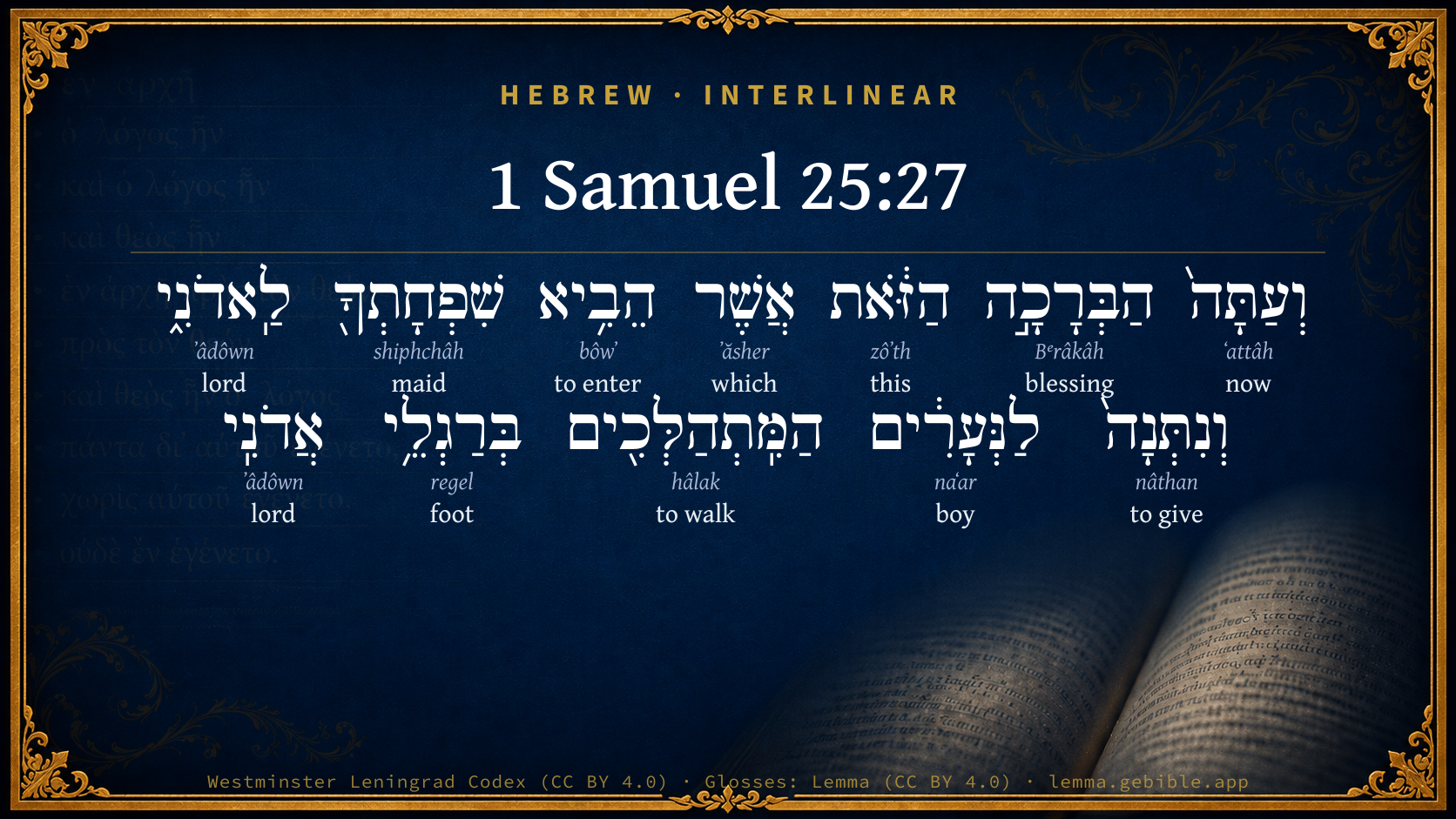
1 Samuel 25:27

Hebrew (Westminster Leningrad Codex) 1 Samuel 25:27 appears in the Hebrew Old Testament. The text above is from the Westminster Leningrad Codex. Each word links to its Strong’s number, a concise gloss, and parsing drawn from the Open Scriptures Hebrew Bible morphology. Click any word for its full Brown-Driver-Briggs (BDB) entry.
Download image
Cite this verse

1 Samuel 25:27 (World English Bible). Public Domain. Lemma interlinear Bible study tool, https://lemma.gebible.app/v/1-samuel/25/27.

Show BibTeX & RIS
BibTeX
RIS
English Translation
Now this present which your servant has brought to my lord, let it be given to the young men who follow my lord.
World English Bible · Public Domain
Download a study sheet

One document with this verse’s original text, its word-by-word gloss line, the meaning frame, cross-references with their text, attributed commentary, and full source and license credits — printable, and it pastes into notes with its structure intact.

This verse Autodidact and up

Study sheet (.html) Plain text (.txt)

A passage Seminary Student

Up to 50 verses in one chapter. A passage sheet keeps up to 6 commentary sources and 12 cross-references per verse, in the order this page ranks them, and says so on the sheet whenever that leaves anything out. Ask for a single verse and you get the Autodidact verse sheet above.

Everything on this page stays free to read, with no account — the sheet is a download of what is already on screen, not access to it.

Want to remove ads? Support Godless Engineer
Compare translations 3

The same verse in 3 English versions, stacked beneath the original-language interlinear above. Click any original word for its lexicon entry.

Each is an independent rendering of the whole verse — the interlinear is not word-aligned to these translations.

Highlighted words mark where these versions differ — a whole-verse word diff, not a word-by-word alignment.

  • World English Bible Public Domain
    Now this present which your servant has brought to my lord, let it be given to the young men who follow my lord.
  • King James Version Public Domain
    And now this blessing which thine handmaid hath brought unto my lord, let it even be given unto the young men that follow my lord.
  • unfoldingWord Literal Text CC BY-SA 4.0
    And now, may this blessing that your maidservant has caused to come to my master be given to the young men going about at the feet of my master.

unfoldingWord Literal Text — © unfoldingWord, licensed CC BY-SA 4.0. Word-aligned USFM3 via Door43 (git.door43.org/unfoldingWord/en_ult).

Versions to compare (up to 4)

3 of 4 selected

Show all 18 translations

Every available English version of this verse, each an independent rendering of the whole verse.

  • World English Bible Public Domain
    Now this present which your servant has brought to my lord, let it be given to the young men who follow my lord.
  • Berean Standard Bible Public Domain
    Now let this gift your servant has brought to my lord be given to the young men who follow you.
  • Majority Standard Bible Public Domain
    Now let this gift your servant has brought to my lord be given to the young men who follow you.
  • King James Version Public Domain
    And now this blessing which thine handmaid hath brought unto my lord, let it even be given unto the young men that follow my lord.
  • American Standard Version (1901) Public Domain
    And now this present which thy servant hath brought unto my lord, let it be given unto the young men that follow my lord.
  • Revised Version (1885) Public Domain
    And now this present which thy servant hath brought unto my lord, let it be given unto the young men that follow my lord.
  • Geneva Bible (1599) Public Domain
    And now, this blessing which thine handmaid hath brought vnto my lorde, let it be giuen vnto the yong men, that follow my lord.
  • Douay-Rheims (1899) Public Domain
    Wherefore receive this blessing, which thy handmaid hath brought to thee, my lord: and give it to the young men that follow thee, my lord.
  • Young's Literal Translation Public Domain
    `And, now, this blessing which thy maid-servant hath brought to my lord -- it hath been given to the young men who are going up and down at the feet of my lord.
  • Literal Standard Version CC BY-SA 4.0
    And now, this blessing which your maidservant has brought to my lord—it has been given to the young men who are going up and down at the feet of my lord.
  • Unlocked Literal Bible CC BY-SA 4.0
    Now let this present that your servant has brought to my master be given to the young men who follow my master.
  • unfoldingWord Literal Text CC BY-SA 4.0
    And now, may this blessing that your maidservant has caused to come to my master be given to the young men going about at the feet of my master.
  • Darby Bible Public Domain
    And now this blessing which thy bondmaid has brought to my lord, let it be given to the young men that follow my lord.
  • World Messianic Bible Public Domain
    Now this present which your servant has brought to my lord, let it be given to the young men who follow my lord.
  • Webster's Bible Public Domain
    And now this blessing which thy handmaid hath brought to my lord, let it even be given to the young men that follow my lord.
  • Free Bible Version CC BY-SA 4.0
    Please accept this present that I, your servant, have brought to you, sir, and give it to your men.
  • Bible in Basic English Public Domain
    And let this offering, which your servant gives to my lord, be given to the young men who are with my lord.
  • JPS Tanakh (1917) Public Domain
    And now this present which thy servant hath brought unto my lord, let it be given unto the young men that follow my lord.

Literal Standard Version (2020), Covenant Press — licensed CC BY-SA 4.0. Text via the HelloAO Bible API (eBible.org). Unlocked Literal Bible (unfoldingWord) — licensed CC BY-SA 4.0. Text via the HelloAO Bible API (eBible.org). unfoldingWord Literal Text — © unfoldingWord, licensed CC BY-SA 4.0. Word-aligned USFM3 via Door43 (git.door43.org/unfoldingWord/en_ult). Free Bible Version, Dr. Jonathan Gallagher — licensed CC BY-SA 4.0. Text via the HelloAO Bible API (eBible.org).

Word by word

More ways to search: Search by grammar → Find every occurrence → Compare this word →

Practice this passage: Drill this verse → Learn its vocabulary →

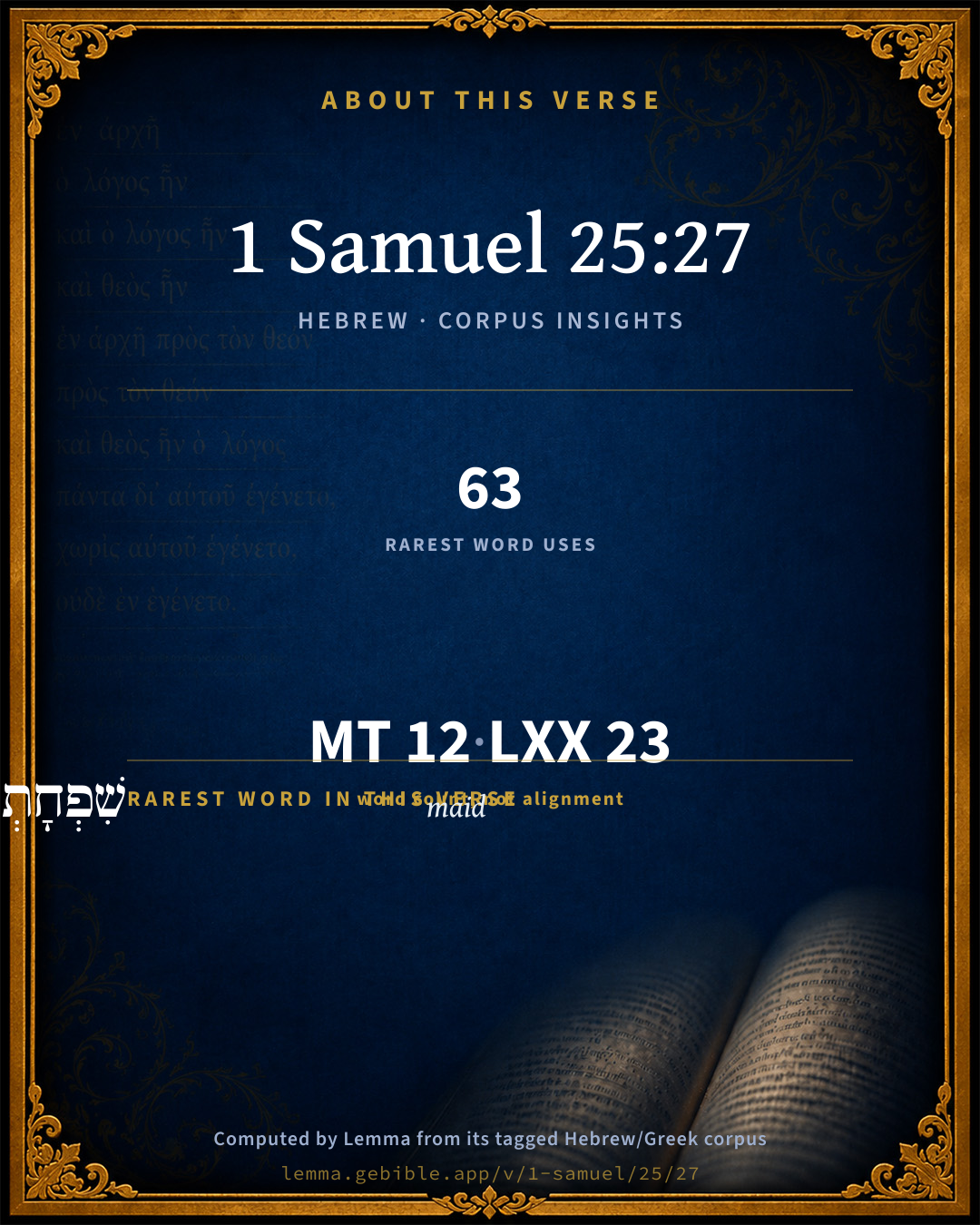
שִׁפְחָתְךָ֖
shiphchâh
H8198
“maid · your”
Noun, Common, Feminine, Singular, Construct + Suffix, Personal, 2nd Person, Masculine, Singular
Part of Speech
Noun
Type
Common
Gender
Feminine
Number
Singular
State
Construct
Full BDB Definition

Origin: from the same as H8207 ">H8207 )

TWOT: None

maid, maid-servant, slavegirl - maid, maid-servant (as belonging to a mistress) - of address, speaker, humility (figuratively)
  1. וְעַתָּה֙ ʻattâh H6258 “and · now” Conjunction + Adverb
  2. הַבְּרָכָ֣ה Bᵉrâkâh H1293 “the · blessing” Particle, Definite Article + Noun, Common, Feminine, Singular, Absolute
  3. הַזֹּ֔את zôʼth H2063 “the · this” Particle, Definite Article + Pronoun, Demonstrative, Feminine, Singular
  4. אֲשֶׁר ʼăsher H834 “which” Particle, Relative
  5. הֵבִ֥יא bôwʼ H935 “to enter” Verb, Hiphil, Perfect, 3rd Person, Masculine, Singular
  6. לַֽאדֹנִ֑י ʼâdôwn H113 “to/for · lord · my” Preposition + Noun, Common, Masculine, Singular, Construct + Suffix, Personal, 1st Person, Common, Singular
  7. וְנִתְּנָה֙ nâthan H5414 “and · to give” Conjunction + Verb, Niphal, Sequential Perfect, 3rd Person, Feminine, Singular
  8. לַנְּעָרִ֔ים naʻar H5288 “to/for the · boys” Preposition, Determined + Noun, Common, Masculine, Plural, Absolute
  9. הַמִּֽתְהַלְּכִ֖ים hâlak H1980 “the · walking” Particle, Definite Article + Verb, Hithpael, Participle Active, Masculine, Plural, Absolute
  10. בְּרַגְלֵ֥י regel H7272 “in/at · feet of” Preposition + Noun, Common, Feminine, Dual, Construct
  11. אֲדֹנִֽי ʼâdôwn H113 “lord · my” Noun, Common, Masculine, Singular, Construct + Suffix, Personal, 1st Person, Common, Singular

About this verse

These counts appear in no published source. They are computed here, from the morphology-tagged text and Lemma’s own curated glosses. What Lemma adds →

12
words
11
distinct lemmas
Historical
section

Grammatical profile

  • 3 verbs
  • 6 nouns
  • 1 pronoun
  • 1 adverb
  • 1 particle

Verb forms

  • הֵבִ֥יא Hiphil · Perfect
  • וְנִתְּנָה֙ Niphal · Sequential Perfect
  • הַמִּֽתְהַלְּכִ֖ים Hithpael · Participle Active

Repetition

A word recurs within this verse — often emphatic in Hebrew:

  • לַֽאדֹנִ֑י lord H113 ×2

Hebrew & Septuagint length

In English translation the verse runs 23 words from the Hebrew and 28 from the Septuagint (LXX English) — closely comparable.

A rough comparison of the two English renderings, which tokenize alike — not a word-level alignment.

Word counts can differ between the Hebrew and the Greek without any difference in meaning — e.g. the Hebrew direct-object marker אֵת has no separate Greek word, and Greek often adds the article ὁ.

In the original languages it is 12 Hebrew tokens and 23 Greek tokens — but the two are counted differently (Hebrew bundles its prefixes and suffixes into one token; the Greek is in lemma form), so that isn’t a like-for-like length.

Cross-references

7

Topical passages linked to 1 Samuel 25:27 in the Treasury of Scripture Knowledge — connected by theme and wording, ordered by reader-vote popularity; previews shown in the World English Bible.

  • Genesis 33:11 Please take the gift that I brought to you; because God has dealt graciously with me, and because I have enough." He urged him, and he took it.
  • 1 Samuel 30:26 When David came to Ziklag, he sent of the spoil to the elders of Judah, even to his friends, saying, Behold, a present for you of the spoil of the enemies of Yahweh:
  • 2 Kings 5:15 He returned to the man of God, he and all his company, and came, and stood before him; and he said, See now, I know that there is no God in all the earth, but in Israel: now therefore, please take a present from your servant.
  • Judges 4:10 Barak called Zebulun and Naphtali together to Kedesh; and there went up ten thousand men at his feet: and Deborah went up with him.
  • 1 Samuel 25:42 Abigail hurried, and arose, and rode on a donkey, with five ladies of hers who followed her; and she went after the messengers of David, and became his wife.
  • 2 Samuel 16:2 The king said to Ziba, What do you mean by these? Ziba said, The donkeys are for the king's household to ride on; and the bread and summer fruit for the young men to eat; and the wine, that such as are faint in the wilderness may drink.
  • 2 Corinthians 9:5 I thought it necessary therefore to entreat the brothers that they would go before to you, and arrange ahead of time the generous gift that you promised before, that the same might be ready as a matter of generosity, and not of greediness.

Cross-references courtesy of OpenBible.info (CC BY 4.0).

Hebrew and Greek witnesses Masoretic Hebrew ↔ Greek Septuagint

The same verse in the two great witnesses to the Old Testament, shown verse-for-verse.

These are two independent witnesses, not word-aligned to each other, and the Septuagint is shown in lemma (dictionary) form.

Hebrew 1 Samuel 25:27 Masoretic · Westminster Leningrad Codex

וְעַתָּה֙ הַבְּרָכָ֣ה הַזֹּ֔את אֲשֶׁר הֵבִ֥יא שִׁפְחָתְךָ֖ לַֽאדֹנִ֑י וְנִתְּנָה֙ לַנְּעָרִ֔ים הַמִּֽתְהַלְּכִ֖ים בְּרַגְלֵ֥י אֲדֹנִֽי

Now this present which your servant has brought to my lord, let it be given to the young men who follow my lord.

World English Bible · Public Domain

Greek LXX 1 Samuel 25:27 Septuagint · lemma form

καί νῦν λαμβάνω ὁ εὐλογία οὗτος ὅς φέρω ὁ δούλη σύ ὁ κύριος ἐγώ καί δίδωμι ὁ παιδάριον ὁ παραἵστημι ὁ κύριος ἐγώ

And now accept this token of goodwill, which your servant has brought to my lord, and you shall give it to the servants that wait on my lord.

LXX2012 (modern English Septuagint) · Public Domain

Hebrew: Westminster Leningrad Codex (CC BY 4.0). Greek: Septuagint (public domain); English from LXX2012 (modern English Septuagint) (Public Domain). How the Septuagint differs from the Hebrew →

Targum (Aramaic paraphrase)

1

The Targum is the ancient Jewish Aramaic paraphrase of the Hebrew Scriptures — an interpretive translation, not the Hebrew text itself. Onkelos (literal) and Pseudo-Jonathan (expansive) render the Torah, and Jonathan the Prophets. Coverage is partial: where no permissively-licensed English translation exists for a verse, only the Aramaic is shown. This is verse-level text, not a word-by-word alignment to the Hebrew.

  1. Targum Jonathan Prophets (Joshua–Malachi)
    וּכְעַן תִּקְרוֹבְתָּא הָדָא דְאַיְתִיאַת אַמְתָךְ לְרִבּוֹנִי וְתִתְיְהַב לְעוּלֵמַיָא דִמְשַׁמְשִׁין קֳדָם רִבּוֹנִי:

    (no public-domain English translation for this verse)

    Targum Jonathan — Aramaic: “Mikraot Gedolot” (public domain). English: “Sefaria Community Translation” (CC0 1.0 (public-domain dedication)); “London "Chaldee Paraphrase," 1871” (public domain). Text via Sefaria.

Commentary

Notes on 1 Samuel 25:27 from classic Christian and Jewish commentators (each source and its license shown beneath its notes). The classic Christian expositions comment on the surrounding passage and are grouped to its opening verse, so a note may address several verses; the Jewish commentaries on the Tanakh (Rashi and others) are per-verse, so they appear only where the commentator wrote on this verse.

Lemma curates 59 commentaries, every one of them public domain or Creative Commons licensed, each selected and text-cleaned for this edition rather than reprinted as found. About our sources →

Trapp's Complete Commentary

John Trapp

1Sa 25:27 And now this blessing which thine handmaid hath brought unto my lord, let it even be given unto the young men that follow my lord.

Ver. 27. And now this blessing,] i.e., This present, the fruit of God’s blessing.

Let it even be given unto the young men.] For of thine acceptance or personal use I hold it not worthy.

John Trapp, A Commentary or Exposition upon All the Books of the Old and New Testament (1647–1656) — public domain. Text from a community e-Sword module.

Joseph Benson's Commentary

1Sa 25:27. Now this blessing — That is, this present or gift. The same phrase is used, 1Sa 30:26; 2Ki 5:15. A present is termed a blessing, not only because the matter of it comes from God’s blessing, but also because it is given with a blessing, or with a good will. Let it be given unto the young men — As being unworthy of David’s own acceptance. Thus humbly she speaks of the noble present she had brought.

Joseph Benson's Commentary on the Old and New Testaments (1811–1818) — public domain. Text from a community e-Sword module.

Geneva Bible (1599)

Geneva Bible translators

Or, present.

Hebrew, walk at the feet.

Geneva Bible (1599) marginal notes — public domain. Text via Bolls.life.

Ellicott's Commentary for English Readers

(27) This blessing.—That is to say, gift. Of this Abigail makes little account—it was simply an expression of her homage and good will. It was not intended, of course, for David, but for his company; but she brought it, as is the custom in the East where an inferior approaches a superior, whether as a visitor or as a suppliant, to bring in the hand gifts. Let it be given, she added, to his companions.

A Bible Commentary for English Readers, edited by Charles John Ellicott (1878–1897) — public domain. Text from a community e-Sword module.

The Cambridge Bible for Schools and Colleges

gen. ed. J. J. S. Perowne

27. this blessing] So a complimentary present is styled in ch. 1Sa_30:26. Cp. Gen_33:11; 2Co_9:5 (εὐλογία, as here in the Sept.).

unto the young men] She does not presume to offer it for David’s own use.

The Cambridge Bible for Schools and Colleges (gen. ed. J. J. S. Perowne; Cambridge University Press, 1878–1918) — public domain. Text from a community e-Sword module.

John Gill's Exposition

And now this blessing, which thine handmaid hath brought unto my lord,.... The present, consisting of the things mentioned in Sa1 25:18; which came as a blessing from God, and with good will from her:

let it even be given unto the young men that follow my lord; the servants of David: in the original it is, "that walk at the feet of my lord": and which the Targum paraphrases, "who minister before my lord"; and so Abigail's damsels are called "pedissequae", or "that walked at her feet", Sa1 25:42; and with the Romans, in later times, servants were called a "pedibus" and "pedissequi" (d). This also is very artfully said, as if the present was not good enough for David, and worthy of his acceptance; might be agreeable to his men, and of service to them.

(d) Vid. Pignorium de Servis, p. 140, 248, 293.

John Gill's Exposition of the Whole Bible (1746–1763) — public domain (CC PDM 1.0). Text via the HelloAO Bible API.

Haydock's Catholic Bible Commentary

Blessing, or present. (Menochius) See 2 Corinthians ix. 5. (Calmet)

George Leo Haydock (1774–1849), Haydock's Catholic Family Bible and Commentary, 1859 edition — public domain. Excludes Psalms (Douay-Rheims chapter numbering differs from Protestant) and Deuterocanonical books (Catholic canon only).

Matthew Poole's English Annotations

This blessing; so a gift or present is called here, and Gen 33:11, and elsewhere; not only because the matter of it comes from God’s blessing, but also because it is given with a blessing, or with a good will.

Let it even be given unto the young men, as being unworthy of thine acceptance or use.

Matthew Poole's English Annotations on the Holy Bible (1683–1685) — public domain. Text from a community e-Sword/MySword module.

John Wesley's Explanatory Notes

Blessing - So a gift or present is called here, and elsewhere; not only because the matter of it comes from God's blessing; but also because it is given with a blessing, or with a good will. Unto the young men - As being unworthy of thine acceptance or use.

John Wesley, Explanatory Notes Upon the Whole Bible (1754–1765) — public domain. Text via the GEBible commentary corpus.

unfoldingWord translationNotes

Door43 World Missions Community

Connecting Statement:

Abigail continues to tell David not to be angry.

this present

"these gifts." The "present" was actually many different things.

your servant ... my master ... my master ... the trespass of your servant ... my master ... my master

Abigail speaks of herself and David as if they are two different people to show that she respects David. AT: "I ... you ... you ... my trespass ... you ... you" (See: Pronouns)

let this present ... be given to the young men

Abigail uses the passive to show her respect for David. This can be translated in active form. AT: "please give it to the young men" or "please let my master give it to the young men" (See: Active or Passive)

Yahweh will certainly make my master a sure house

Here "house" is an idiom used for "descendants." AT: "Yahweh will ensure that my master always has a descendant who serves as king" (See: Idiom)

fighting the battles of Yahweh

"fighting against Yahweh's enemies"

evil will not be found in you

This can be translated in active form. AT: "no one will ever see you do any evil thing" or "you will never do anything evil" (See: Active or Passive)

translationWords

servant

lord

forgive

trespass

Yahweh

house

evil

life

unfoldingWord translationNotes — © Distant Shores Media and the Door43 World Missions Community, licensed CC BY-SA 4.0. Source: git.door43.org/Door43/en_tn.

Rashi

Rabbi Shlomo Yitzchaki (Rashi)

Let it be given to the youths. And it will be given to the youths who are going, etc. נִתְּנָה [=it was given] is past tense, וְנִתְּנָה [=it will be given] is future tense.

Rashi on the Tanakh — English translations: “The Judaica Press complete Tanach with Rashi, translated by A. J. Rosenberg” (CC BY 4.0); “Pentateuch with Rashi's commentary by M. Rosenbaum and A.M. Silbermann, 1929-1934” (public domain); “The Metsudah Tanach series, Lakewood, N.J” (CC BY 4.0); and “The Book of Joshua, Metsudah Publications, 1997” (CC BY 4.0). Text via Sefaria.

Lesson kit

Teaching starters — assembled from the data on this page, not authored interpretation. Every prompt links to the verse data it draws on. Edit before teaching.

1 Samuel, in the Historical, opens this verse with 12 words (11 distinct Hebrew lemmas). Its most distinctive word is shiphchâh (“maid”). A historical commentator’s framing appears above. Read the whole chapter for the surrounding context.

Discussion questions

  1. What does “maid” (shiphchâh) contribute to the verse as a whole?
  2. Genesis 33:11 shares this passage’s theme. How do the two illuminate each other?
  3. “lord” occurs 2× in this one verse. What is the effect of the repetition?
  4. These translations render this verse differently. What is at stake in choosing one wording over another?
  5. The verb «הֵבִ֥יא» is Hiphil Perfect. How does its form color the action?
  6. Reading how Trapp's Complete Commentary and Joseph Benson's Commentary read this verse, where do the two commentators agree and where do they part?

Things to notice

Reading settings

Reading text

Shown beneath each verse's original-language words.

Old Testament
Old Testament edition

Read the OT as the Masoretic Hebrew (MT) or the Greek Septuagint (LXX).

English shown for the Greek Septuagint (in the Hebrew ↔ Greek comparison).

Comparing translations? Open the Compare panel on any verse page to stack up to four side by side.