1 Samuel 25:19

Hebrew (Westminster Leningrad Codex) 1 Samuel 25:19 appears in the Hebrew Old Testament. The text above is from the Westminster Leningrad Codex. Each word links to its Strong’s number, a concise gloss, and parsing drawn from the Open Scriptures Hebrew Bible morphology. Click any word for its full Brown-Driver-Briggs (BDB) entry.
Download image
Cite this verse

1 Samuel 25:19 (World English Bible). Public Domain. Lemma interlinear Bible study tool, https://lemma.gebible.app/v/1-samuel/25/19.

Show BibTeX & RIS
BibTeX
RIS
English Translation
She said to her young men, Go on before me; behold, I come after you. But she didn't tell her husband, Nabal.
World English Bible · Public Domain
Download a study sheet

One document with this verse’s original text, its word-by-word gloss line, the meaning frame, cross-references with their text, attributed commentary, and full source and license credits — printable, and it pastes into notes with its structure intact.

This verse Autodidact and up

Study sheet (.html) Plain text (.txt)

A passage Seminary Student

Up to 50 verses in one chapter. A passage sheet keeps up to 6 commentary sources and 12 cross-references per verse, in the order this page ranks them, and says so on the sheet whenever that leaves anything out. Ask for a single verse and you get the Autodidact verse sheet above.

Everything on this page stays free to read, with no account — the sheet is a download of what is already on screen, not access to it.

Want to remove ads? Support Godless Engineer
Compare translations 3

The same verse in 3 English versions, stacked beneath the original-language interlinear above. Click any original word for its lexicon entry.

Each is an independent rendering of the whole verse — the interlinear is not word-aligned to these translations.

Highlighted words mark where these versions differ — a whole-verse word diff, not a word-by-word alignment.

  • World English Bible Public Domain
    She said to her young men, Go on before me; behold, I come after you. But she didn't tell her husband, Nabal.
  • King James Version Public Domain
    And she said unto her servants, Go on before me; behold, I come after you. But she told not her husband Nabal.
  • unfoldingWord Literal Text CC BY-SA 4.0
    And she said to her young men, “Pass over to my face. Behold me, I will come after you.” But to her husband Nabal she did not declare.

unfoldingWord Literal Text — © unfoldingWord, licensed CC BY-SA 4.0. Word-aligned USFM3 via Door43 (git.door43.org/unfoldingWord/en_ult).

Versions to compare (up to 4)

3 of 4 selected

Show all 18 translations

Every available English version of this verse, each an independent rendering of the whole verse.

  • World English Bible Public Domain
    She said to her young men, Go on before me; behold, I come after you. But she didn't tell her husband, Nabal.
  • Berean Standard Bible Public Domain
    and said to her young men, “Go ahead of me. I will be right behind you.” But she did not tell her husband Nabal.
  • Majority Standard Bible Public Domain
    and said to her young men, “Go ahead of me. I will be right behind you.” But she did not tell her husband Nabal.
  • King James Version Public Domain
    And she said unto her servants, Go on before me; behold, I come after you. But she told not her husband Nabal.
  • American Standard Version (1901) Public Domain
    And she said unto her young men, Go on before me; behold, I come after you. But she told not her husband Nabal.
  • Revised Version (1885) Public Domain
    And she said unto her young men, Go on before me; behold, I come after you. But she told not her husband Nabal.
  • Geneva Bible (1599) Public Domain
    Then she said vnto her seruants, Go ye before me: beholde, I will come after you: yet she tolde not her husband Nabal.
  • Douay-Rheims (1899) Public Domain
    And she said to her servants: Go before me: behold I will follow after you: but she told not her husband Nabal.
  • Young's Literal Translation Public Domain
    And she saith to her young men, `Pass over before me; lo, after you I am coming;' and to her husband Nabal she hath not declared `it';
  • Literal Standard Version CC BY-SA 4.0
    And she says to her young men, “Pass over before me; behold, I am coming after you”; and she has not declared [it] to her husband Nabal;
  • Unlocked Literal Bible CC BY-SA 4.0
    She said to her young men, “Go on before me, and I will come after you.” But she did not tell her husband Nabal.
  • unfoldingWord Literal Text CC BY-SA 4.0
    And she said to her young men, “Pass over to my face. Behold me, I will come after you.” But to her husband Nabal she did not declare.
  • Darby Bible Public Domain
    And she said to her young men, Go on before me; behold, I come after you. But she did not tell her husband Nabal.
  • World Messianic Bible Public Domain
    She said to her young men, “Go on before me. Behold, I am coming after you.” But she didn’t tell her husband, Nabal.
  • Webster's Bible Public Domain
    And she said to her servants, Go on before me; behold, I come after you. But she told not her husband Nabal.
  • Free Bible Version CC BY-SA 4.0
    She told her men, “Go on ahead. I'll follow you.” But she didn't say anything to her husband Nabal.
  • Bible in Basic English Public Domain
    And she said to her young men, Go on in front of me and I will come after you. But she said nothing to her husband Nabal.
  • JPS Tanakh (1917) Public Domain
    And she said unto her young men: 'Go on before me; behold, I come after you.' But she told not her husband Nabal.

Literal Standard Version (2020), Covenant Press — licensed CC BY-SA 4.0. Text via the HelloAO Bible API (eBible.org). Unlocked Literal Bible (unfoldingWord) — licensed CC BY-SA 4.0. Text via the HelloAO Bible API (eBible.org). unfoldingWord Literal Text — © unfoldingWord, licensed CC BY-SA 4.0. Word-aligned USFM3 via Door43 (git.door43.org/unfoldingWord/en_ult). Free Bible Version, Dr. Jonathan Gallagher — licensed CC BY-SA 4.0. Text via the HelloAO Bible API (eBible.org).

Word by word

More ways to search: Search by grammar → Find every occurrence → Compare this word →

Practice this passage: Drill this verse → Learn its vocabulary →

נָבָ֖ל
Nâbâl
H5037
“Nabal”
Noun, Proper
Part of Speech
Noun
Type
Proper
Full BDB Definition

Origin: the same as H5036

TWOT: None

Nabhal or Nabal = "fool" - a man of Carmel who spurned David's messengers, then died of shock when he realised it might cause his death; his case was pleaded by his wife Abigail who became David's wife after his death
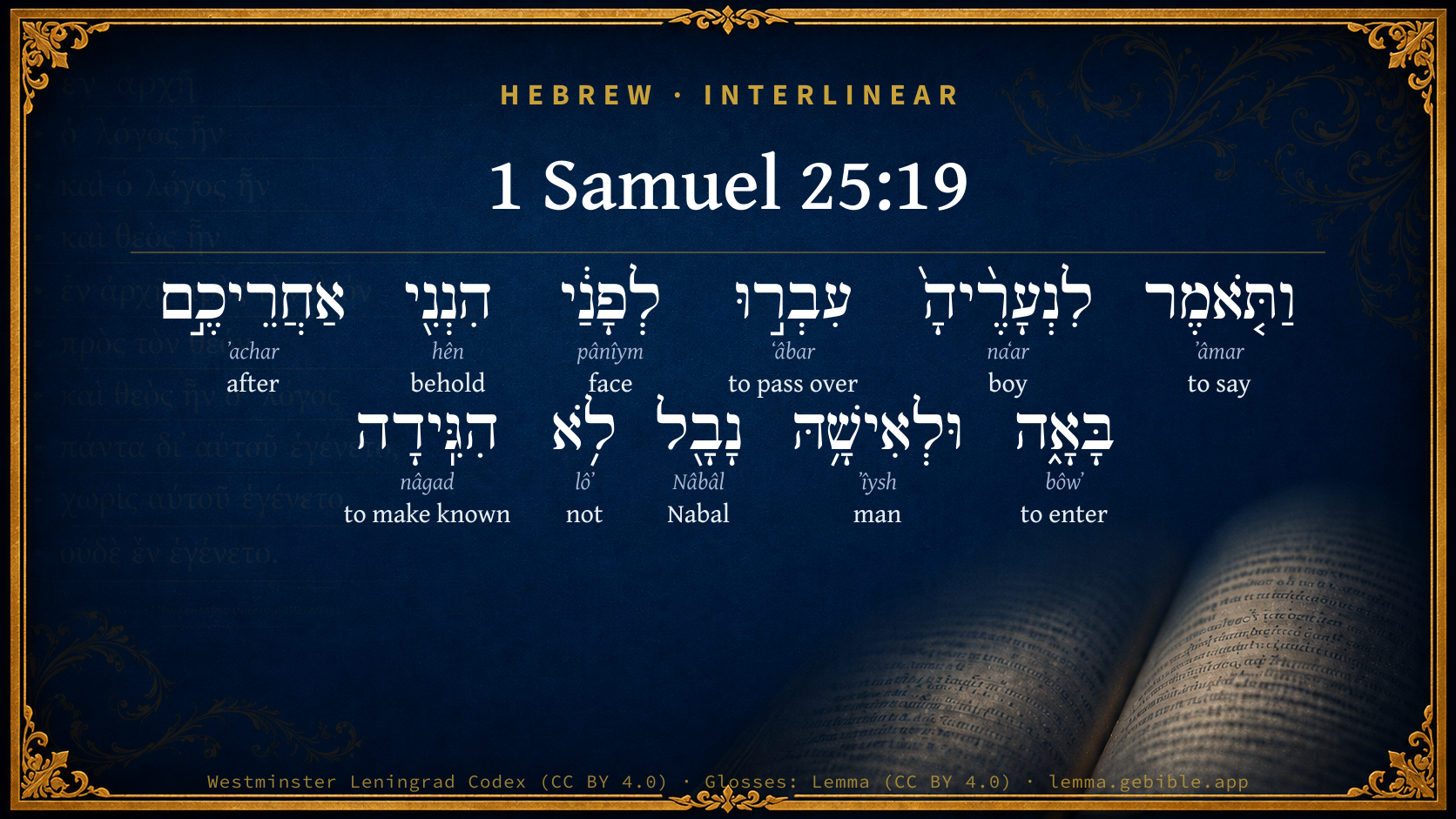
  1. וַתֹּ֤אמֶר ʼâmar H559 “and · to say” Conjunction + Verb, Qal, Sequential Imperfect, 3rd Person, Feminine, Singular
  2. לִנְעָרֶ֨יהָ֙ naʻar H5288 “to/for · boys · her” Preposition + Noun, Common, Masculine, Plural, Construct + Suffix, Personal, 3rd Person, Feminine, Singular
  3. עִבְר֣וּ ʻâbar H5674 “pass over” Verb, Qal, Imperative, 2nd Person, Masculine, Plural
  4. לְפָנַ֔י pânîym H6440 “to/for · face(s) · my” Preposition + Noun, Common, Both, Plural, Construct + Suffix, Personal, 1st Person, Common, Singular
  5. הִנְנִ֖י hên H2005 “behold · me” Particle, Demonstrative + Suffix, Personal, 1st Person, Common, Singular
  6. אַחֲרֵיכֶ֣ם ʼachar H310 “after · you” Preposition + Suffix, Personal, 2nd Person, Masculine, Plural
  7. בָּאָ֑ה bôwʼ H935 “entering” Verb, Qal, Participle Active, Feminine, Singular, Absolute
  8. וּלְאִישָׁ֥הּ ʼîysh H376 “and · to/for · man · her” Conjunction + Preposition + Noun, Common, Masculine, Singular, Construct + Suffix, Personal, 3rd Person, Feminine, Singular
  9. לֹ֥א lôʼ H3808 “not” Particle, Negative
  10. הִגִּֽידָה nâgad H5046 “to make known” Verb, Hiphil, Perfect, 3rd Person, Feminine, Singular

About this verse

These counts appear in no published source. They are computed here, from the morphology-tagged text and Lemma’s own curated glosses. What Lemma adds →

11
words
11
distinct lemmas
Historical
section

Notable vocabulary

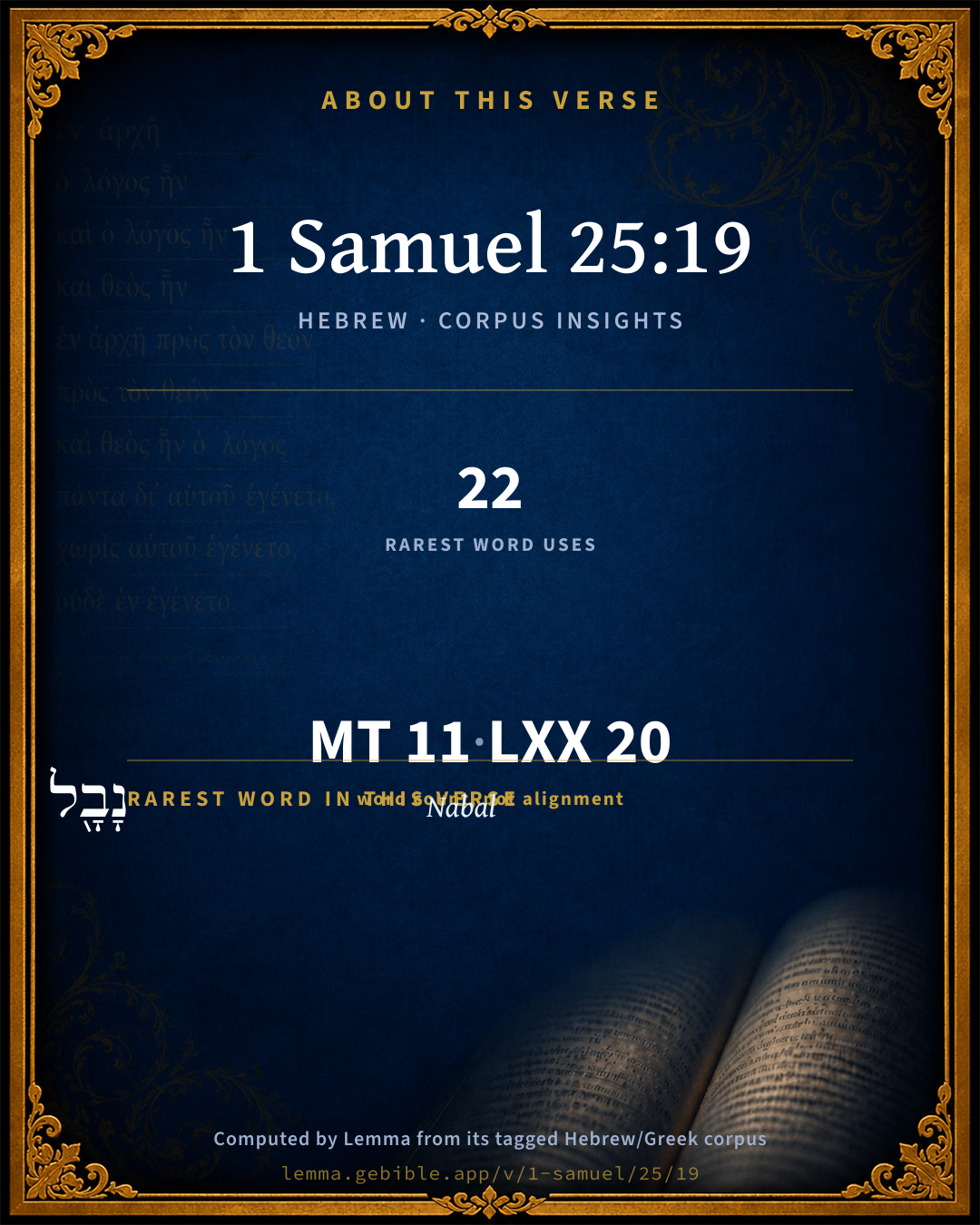
The rarest word here is נָבָ֖ל Nabal H5037 — appearing just 22 times in the whole Hebrew Bible.

Shared distinctive vocabulary

נָבָ֖ל Nabal H5037 occurs in 18 verses of the Hebrew Bible. Also found in:

Grammatical profile

  • 4 verbs
  • 4 nouns
  • 1 preposition
  • 2 particles

Verb forms

  • וַתֹּ֤אמֶר Qal · Sequential Imperfect
  • עִבְר֣וּ Qal · Imperative
  • בָּאָ֑ה Qal · Participle Active
  • הִגִּֽידָה Hiphil · Perfect

Hebrew & Septuagint length

In English translation the verse runs 22 words from the Hebrew and 22 from the Septuagint (LXX English) — the same length.

A rough comparison of the two English renderings, which tokenize alike — not a word-level alignment.

Word counts can differ between the Hebrew and the Greek without any difference in meaning — e.g. the Hebrew direct-object marker אֵת has no separate Greek word, and Greek often adds the article ὁ.

In the original languages it is 11 Hebrew tokens and 20 Greek tokens — but the two are counted differently (Hebrew bundles its prefixes and suffixes into one token; the Greek is in lemma form), so that isn’t a like-for-like length.

Cross-references

4

Topical passages linked to 1 Samuel 25:19 in the Treasury of Scripture Knowledge — connected by theme and wording, ordered by reader-vote popularity; previews shown in the World English Bible.

  • Genesis 32:20 You shall say, 'Not only that, but behold, your servant, Jacob, is behind us.'" For, he said, "I will appease him with the present that goes before me, and afterward I will see his face. Perhaps he will accept me."
  • Genesis 32:16 He delivered them into the hands of his servants, every herd by itself, and said to his servants, "Pass over before me, and put a space between herd and herd."
  • Proverbs 31:11–12 The heart of her husband trusts in her. He shall have no lack of gain.
  • Proverbs 31:27 She looks well to the ways of her household, And doesn't eat the bread of idleness.

Cross-references courtesy of OpenBible.info (CC BY 4.0).

Hebrew and Greek witnesses Masoretic Hebrew ↔ Greek Septuagint

The same verse in the two great witnesses to the Old Testament, shown verse-for-verse.

These are two independent witnesses, not word-aligned to each other, and the Septuagint is shown in lemma (dictionary) form.

Hebrew 1 Samuel 25:19 Masoretic · Westminster Leningrad Codex

וַתֹּ֤אמֶר לִנְעָרֶ֨יהָ֙ עִבְר֣וּ לְפָנַ֔י הִנְנִ֖י אַחֲרֵיכֶ֣ם בָּאָ֑ה וּלְאִישָׁ֥הּ נָבָ֖ל לֹ֥א הִגִּֽידָה

She said to her young men, Go on before me; behold, I come after you. But she didn't tell her husband, Nabal.

World English Bible · Public Domain

Greek LXX 1 Samuel 25:19 Septuagint · lemma form

καί εἶπον ὁ παιδάριον αὐτός προπορεύομαι ἔμπροσθεν ἐγώ καί ἰδού ἐγώ ὀπίσω σύ παραγίγνομαι καί ὁ ἀνήρ αὐτός οὐ ἀποἀγγέλλω

And she said to her servants, Go on before me, and behold I come after you: but she told not her husband.

LXX2012 (modern English Septuagint) · Public Domain

Hebrew: Westminster Leningrad Codex (CC BY 4.0). Greek: Septuagint (public domain); English from LXX2012 (modern English Septuagint) (Public Domain). How the Septuagint differs from the Hebrew →

Targum (Aramaic paraphrase)

1

The Targum is the ancient Jewish Aramaic paraphrase of the Hebrew Scriptures — an interpretive translation, not the Hebrew text itself. Onkelos (literal) and Pseudo-Jonathan (expansive) render the Torah, and Jonathan the Prophets. Coverage is partial: where no permissively-licensed English translation exists for a verse, only the Aramaic is shown. This is verse-level text, not a word-by-word alignment to the Hebrew.

  1. Targum Jonathan Prophets (Joshua–Malachi)
    וַאֲמַרַת לְעוּלֵמָהָא עֲבַרוּ קֳדָמַי הָא אֲנָא בַּתְרֵיכוֹן אַתְיָא וּלְבַעֲלָהּ נָבָל לָא חֲוִיאַת:

    (no public-domain English translation for this verse)

    Targum Jonathan — Aramaic: “Mikraot Gedolot” (public domain). English: “Sefaria Community Translation” (CC0 1.0 (public-domain dedication)); “London "Chaldee Paraphrase," 1871” (public domain). Text via Sefaria.

Commentary

Notes on 1 Samuel 25:19 from classic Christian and Jewish commentators (each source and its license shown beneath its notes). The classic Christian expositions comment on the surrounding passage and are grouped to its opening verse, so a note may address several verses; the Jewish commentaries on the Tanakh (Rashi and others) are per-verse, so they appear only where the commentator wrote on this verse.

Lemma curates 59 commentaries, every one of them public domain or Creative Commons licensed, each selected and text-cleaned for this edition rather than reprinted as found. About our sources →

Trapp's Complete Commentary

John Trapp

1Sa 25:19 And she said unto her servants, Go on before me; behold, I come after you. But she told not her husband Nabal.

Ver. 19. Behold, I come after you.] For she knew that none of them all could make her apology so well as herself.

But she told not her husband Nabal.] Lest that humorist should have crossed her enterprise, and marred all.

John Trapp, A Commentary or Exposition upon All the Books of the Old and New Testament (1647–1656) — public domain. Text from a community e-Sword module.

Geneva Bible (1599)

Geneva Bible translators

Because she knew his crooked nature, that he would rather have perished, than consented to her enterprise.

Geneva Bible (1599) marginal notes — public domain. Text via Bolls.life.

Jamieson, Fausset & Brown

Robert Jamieson, A. R. Fausset & David Brown

she said unto her servants, Go on before me; behold, I come after you--People in the East always try to produce an effect by their presents, loading on several beasts what might be easily carried by one, and bringing them forward, article by article, in succession. Abigail not only sent her servants in this way, but resolved to go in person, following her present, as is commonly done, to watch the impression which her munificence would produce.

Jamieson, Fausset & Brown — Commentary Critical and Explanatory on the Whole Bible (1871) — public domain (CC PDM 1.0). Text via the HelloAO Bible API.

John Gill's Exposition

And she said to her servants, go on before me,.... With the present, the sight of which she wisely considered would in a great measure pacify David, and prepare him to hear patiently what she had to say to him:

behold, I come after you; signifying it would not be long before she came up to them, and overtook them:

but she told not her husband Nabal; neither the danger he and his family were in through his conduct, nor the preparations she had made to prevent it; knowing his perverse and obstinate disposition, that it would take up too much time to reason with him, and persuade him, and bring him into proper measures; and which may be observed to excuse the conduct of Abigail in doing what she did, and taking and disposing of her husband's gods, without his knowledge and leave; the case required haste, and it was done to preserve him and his family from imminent ruin; and besides, he might not be in a fit condition to be spoken to, being drunk with passion, or with wine, or both, see Sa1 25:36; and no doubt she was directed by the Spirit of God to do what she did; and this being an extraordinary case, is not to be drawn into an example.

John Gill's Exposition of the Whole Bible (1746–1763) — public domain (CC PDM 1.0). Text via the HelloAO Bible API.

Haydock's Catholic Bible Commentary

Nabal. Knowing his churlish temper, and that he was drunk at this time, (ver. 36.; Haydock) she might be well excused from the ordinary laws which forbid a wife to dispose of her husband’s property, without his consent. The emergency left no time for consultation. She gave a part to save the whole. (Calmet)

George Leo Haydock (1774–1849), Haydock's Catholic Family Bible and Commentary, 1859 edition — public domain. Excludes Psalms (Douay-Rheims chapter numbering differs from Protestant) and Deuterocanonical books (Catholic canon only).

Matthew Poole's English Annotations

I come after you; for she knew she could quickly over take them.

Matthew Poole's English Annotations on the Holy Bible (1683–1685) — public domain. Text from a community e-Sword/MySword module.

Lesson kit

Teaching starters — assembled from the data on this page, not authored interpretation. Every prompt links to the verse data it draws on. Edit before teaching.

1 Samuel, in the Historical, opens this verse with 11 words (11 distinct Hebrew lemmas). Its most distinctive word is Nâbâl (“Nabal”). A historical commentator’s framing appears above. Read the whole chapter for the surrounding context.

Discussion questions

  1. The word Nâbâl carries the sense “Nabal.” How does it shape the verse?
  2. How does 1 Samuel 25:3, which shares the word «Nabal», read alongside this verse?
  3. These translations render this verse differently. What is at stake in choosing one wording over another?
  4. «וַתֹּ֤אמֶר» is a Qal Sequential Imperfect verb. How does that grammatical form shape the action described?
  5. Compare how Trapp's Complete Commentary and Geneva Bible (1599) read this verse. Where do they agree or differ?

Things to notice

Reading settings

Reading text

Shown beneath each verse's original-language words.

Old Testament
Old Testament edition

Read the OT as the Masoretic Hebrew (MT) or the Greek Septuagint (LXX).

English shown for the Greek Septuagint (in the Hebrew ↔ Greek comparison).

Comparing translations? Open the Compare panel on any verse page to stack up to four side by side.