Nehemiah 6:5

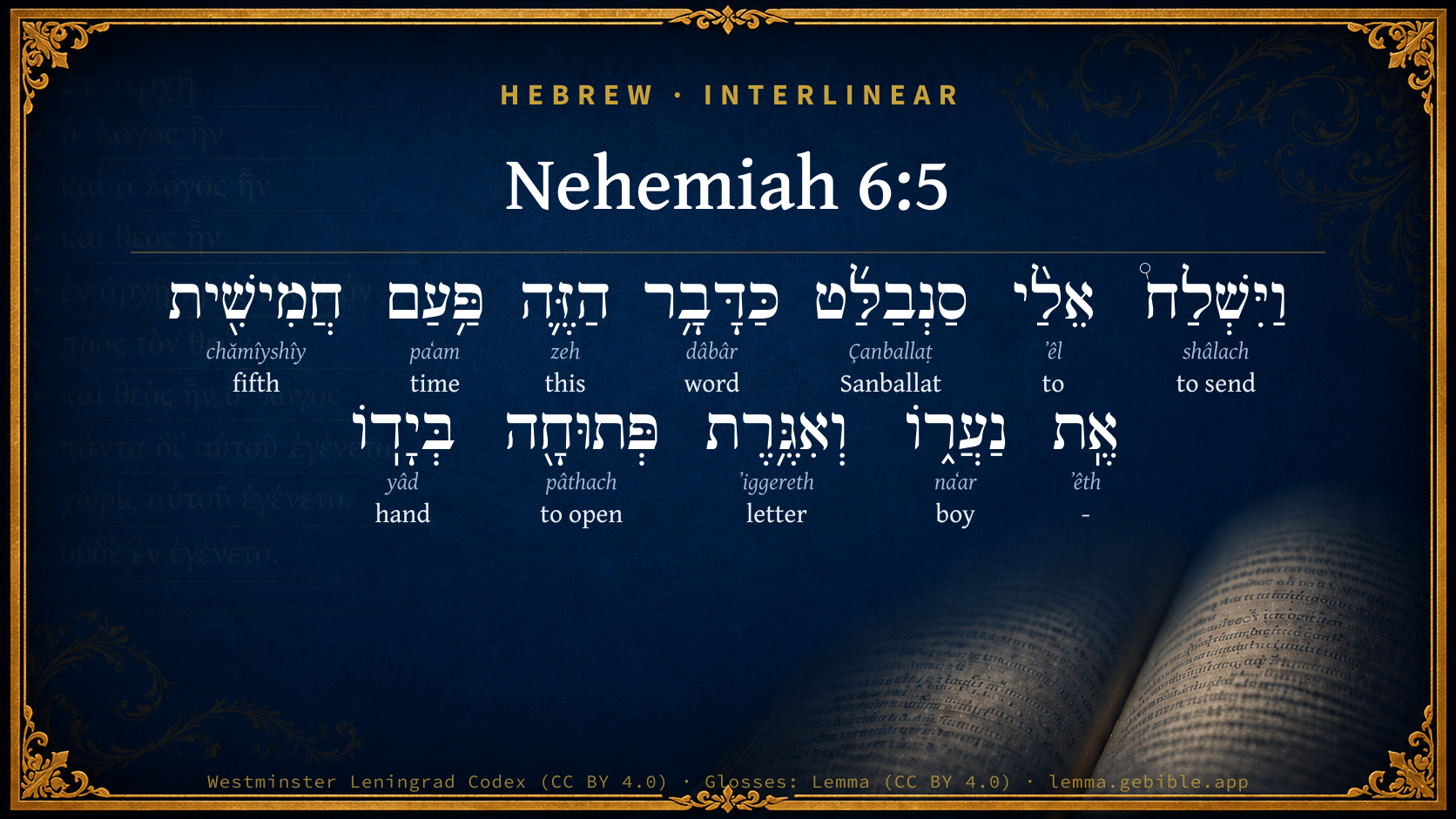
Hebrew (Westminster Leningrad Codex) Nehemiah 6:5 appears in the Hebrew Old Testament. The text above is from the Westminster Leningrad Codex. Each word links to its Strong’s number, a concise gloss, and parsing drawn from the Open Scriptures Hebrew Bible morphology. Click any word for its full Brown-Driver-Briggs (BDB) entry.
Download image
Cite this verse

Nehemiah 6:5 (World English Bible). Public Domain. Lemma interlinear Bible study tool, https://lemma.gebible.app/v/nehemiah/6/5.

Show BibTeX & RIS
BibTeX
RIS
English Translation
Then sent Sanballat his servant to me in like manner the fifth time with an open letter in his hand,
World English Bible · Public Domain
Download a study sheet

One document with this verse’s original text, its word-by-word gloss line, the meaning frame, cross-references with their text, attributed commentary, and full source and license credits — printable, and it pastes into notes with its structure intact.

This verse Autodidact and up

Study sheet (.html) Plain text (.txt)

A passage Seminary Student

Up to 50 verses in one chapter. A passage sheet keeps up to 6 commentary sources and 12 cross-references per verse, in the order this page ranks them, and says so on the sheet whenever that leaves anything out. Ask for a single verse and you get the Autodidact verse sheet above.

Everything on this page stays free to read, with no account — the sheet is a download of what is already on screen, not access to it.

Want to remove ads? Support Godless Engineer
Compare translations 3

The same verse in 3 English versions, stacked beneath the original-language interlinear above. Click any original word for its lexicon entry.

Each is an independent rendering of the whole verse — the interlinear is not word-aligned to these translations.

Highlighted words mark where these versions differ — a whole-verse word diff, not a word-by-word alignment.

  • World English Bible Public Domain
    Then sent Sanballat his servant to me in like manner the fifth time with an open letter in his hand,
  • King James Version Public Domain
    Then sent Sanballat his servant unto me in like manner the fifth time with an open letter in his hand;
  • unfoldingWord Literal Text CC BY-SA 4.0
    Then Sanballat sent his young man to me a fifth time according to this word, and an opened letter was in his hand.

unfoldingWord Literal Text — © unfoldingWord, licensed CC BY-SA 4.0. Word-aligned USFM3 via Door43 (git.door43.org/unfoldingWord/en_ult).

Versions to compare (up to 4)

3 of 4 selected

Show all 18 translations

Every available English version of this verse, each an independent rendering of the whole verse.

  • World English Bible Public Domain
    Then sent Sanballat his servant to me in like manner the fifth time with an open letter in his hand,
  • Berean Standard Bible Public Domain
    The fifth time, Sanballat sent me this same message by his young servant, who had in his hand an unsealed letter
  • Majority Standard Bible Public Domain
    The fifth time, Sanballat sent me this same message by his young servant, who had in his hand an unsealed letter
  • King James Version Public Domain
    Then sent Sanballat his servant unto me in like manner the fifth time with an open letter in his hand;
  • American Standard Version (1901) Public Domain
    Then sent Sanballat his servant unto me in like manner the fifth time with an open letter in his hand,
  • Revised Version (1885) Public Domain
    Then sent Sanballat his servant unto me in like manner the fifth time with an open letter in his hand;
  • Geneva Bible (1599) Public Domain
    Then sent Sanballat his seruant after this sorte vnto me the fift time, with an open letter in his hand,
  • Douay-Rheims (1899) Public Domain
    And Sanaballat sent his servant to me the fifth time according to the former word, and he had a letter in his hand written in this manner:
  • Young's Literal Translation Public Domain
    And Sanballat sendeth unto me, according to this word, a fifth time, his servant, and an open letter in his hand;
  • Literal Standard Version CC BY-SA 4.0
    And Sanballat sends to me, according to this word, a fifth time, his servant, and an open letter in his hand;
  • Unlocked Literal Bible CC BY-SA 4.0
    Sanballat sent his servant to me in the same way the fifth time, with an open letter in his hand.
  • unfoldingWord Literal Text CC BY-SA 4.0
    Then Sanballat sent his young man to me a fifth time according to this word, and an opened letter was in his hand.
  • Darby Bible Public Domain
    Then sent Sanballat his servant to me in this manner the fifth time, with an open letter in his hand,
  • World Messianic Bible Public Domain
    Then Sanballat sent his servant to me the same way the fifth time with an open letter in his hand,
  • Webster's Bible Public Domain
    Then Sanballat sent his servant to me in like manner the fifth time with an open letter in his hand;
  • Free Bible Version CC BY-SA 4.0
    Sanballat sent me the same message the fifth time by his servant, who brought in his hand an open letter.
  • Bible in Basic English Public Domain
    Then Sanballat sent his servant to me a fifth time with an open letter in his hand;
  • JPS Tanakh (1917) Public Domain
    Then sent Sanballat his servant unto me in like manner the fifth time with an open letter in his hand;

Literal Standard Version (2020), Covenant Press — licensed CC BY-SA 4.0. Text via the HelloAO Bible API (eBible.org). Unlocked Literal Bible (unfoldingWord) — licensed CC BY-SA 4.0. Text via the HelloAO Bible API (eBible.org). unfoldingWord Literal Text — © unfoldingWord, licensed CC BY-SA 4.0. Word-aligned USFM3 via Door43 (git.door43.org/unfoldingWord/en_ult). Free Bible Version, Dr. Jonathan Gallagher — licensed CC BY-SA 4.0. Text via the HelloAO Bible API (eBible.org).

Word by word

More ways to search: Search by grammar → Find every occurrence → Compare this word →

Practice this passage: Drill this verse → Learn its vocabulary →

סַנְבַלַּ֜ט
Çanballaṭ
H5571
“Sanballat”
Noun, Proper
Part of Speech
Noun
Type
Proper
Full BDB Definition

Origin: of foreign origin

TWOT: None

Sanballat = "strength" - a Moabite of Horonaim and the opponent of Nehemiah and the returned exiles in their goal of rebuilding the walls of Jerusalem
  1. וַיִּשְׁלַח֩ shâlach H7971 “and · to send” Conjunction + Verb, Qal, Sequential Imperfect, 3rd Person, Masculine, Singular
  2. אֵלַ֨י ʼêl H413 “to · me” Preposition + Suffix, Personal, 1st Person, Common, Singular
  3. כַּדָּבָ֥ר dâbâr H1697 “like/as the · word” Preposition, Determined + Noun, Common, Masculine, Singular, Absolute
  4. הַזֶּ֛ה zeh H2088 “the · this” Particle, Definite Article + Pronoun, Demonstrative, Masculine, Singular
  5. פַּ֥עַם paʻam H6471 “time” Noun, Common, Feminine, Singular, Absolute
  6. חֲמִישִׁ֖ית chămîyshîy H2549 “fifth” Adjective, Ordinal number, Feminine, Singular, Absolute
  7. אֶֽת ʼêth H853 “-” Particle, Direct Object
  8. נַעֲר֑וֹ naʻar H5288 “boy · his” Noun, Common, Masculine, Singular, Construct + Suffix, Personal, 3rd Person, Masculine, Singular
  9. וְאִגֶּ֥רֶת ʼiggereth H107 “and · letter of” Conjunction + Noun, Common, Feminine, Singular, Construct
  10. פְּתוּחָ֖ה pâthach H6605 “opened” Verb, Qal, Participle Passive, Feminine, Singular, Absolute
  11. בְּיָדֽוֹ yâd H3027 “in/at · hand · his” Preposition + Noun, Common, Both, Singular, Construct + Suffix, Personal, 3rd Person, Masculine, Singular

About this verse

These counts appear in no published source. They are computed here, from the morphology-tagged text and Lemma’s own curated glosses. What Lemma adds →

12
words
12
distinct lemmas
Historical
section

Notable vocabulary

The rarest word here is סַנְבַלַּ֜ט Sanballat H5571 — appearing just 10 times in the whole Hebrew Bible.

Shared distinctive vocabulary

סַנְבַלַּ֜ט Sanballat H5571 occurs in 10 verses of the Hebrew Bible. Also found in:

Grammatical profile

  • 2 verbs
  • 6 nouns
  • 1 adjective
  • 1 pronoun
  • 1 preposition
  • 1 particle

Verb forms

  • וַיִּשְׁלַח֩ Qal · Sequential Imperfect
  • פְּתוּחָ֖ה Qal · Participle Passive

Cross-references

5

Topical passages linked to Nehemiah 6:5 in the Treasury of Scripture Knowledge — connected by theme and wording, ordered by reader-vote popularity; previews shown in the World English Bible.

  • 2 Corinthians 11:13–15 For such men are false apostles, deceitful workers, masquerading as Christ's apostles.
  • 2 Thessalonians 2:10 and with all deception of wickedness for those who are being lost, because they didn't receive the love of the truth, that they might be saved.
  • 2 Kings 18:26–28 Then said Eliakim the son of Hilkiah, and Shebnah, and Joah, to Rabshakeh, Please speak to your servants in the Syrian language; for we understand it: and don't speak with us in the Jews' language, in the ears of the people who are on the wall.
  • 2 Corinthians 2:11 that no advantage may be gained over us by Satan; for we are not ignorant of his schemes.
  • Ephesians 6:11 Put on the whole armor of God, that you may be able to stand against the wiles of the devil.

Cross-references courtesy of OpenBible.info (CC BY 4.0).

Hebrew and Greek witnesses Masoretic Hebrew ↔ Greek Septuagint

The same verse in the two great witnesses to the Old Testament, shown verse-for-verse.

These are two independent witnesses, not word-aligned to each other, and the Septuagint is shown in lemma (dictionary) form.

Hebrew Nehemiah 6:5 Masoretic · Westminster Leningrad Codex

וַיִּשְׁלַח֩ אֵלַ֨י סַנְבַלַּ֜ט כַּדָּבָ֥ר הַזֶּ֛ה פַּ֥עַם חֲמִישִׁ֖ית אֶֽת נַעֲר֑וֹ וְאִגֶּ֥רֶת פְּתוּחָ֖ה בְּיָדֽוֹ

Then sent Sanballat his servant to me in like manner the fifth time with an open letter in his hand,

World English Bible · Public Domain

Greek LXX Structure differs

The Septuagint has no separate book of Nehemiah. Its Greek text is the second half of Esdras B (2 Esdras), chapters 11–23; Ezra is the first half (1–10).

A verse-for-verse comparison isn’t shown here because the chapters and verses don’t line up. Switch to the LXX edition with the MT / LXX toggle above to read the Greek directly.

On this verse, Haydock's Catholic Bible Commentary discusses the Septuagint’s reading. Read the note in Commentary ↓

Hebrew: Westminster Leningrad Codex (CC BY 4.0). Greek: Septuagint (public domain); English from a public-domain English Septuagint. How the Septuagint differs from the Hebrew →

Commentary

Notes on Nehemiah 6:5 from classic Christian and Jewish commentators (each source and its license shown beneath its notes). The classic Christian expositions comment on the surrounding passage and are grouped to its opening verse, so a note may address several verses; the Jewish commentaries on the Tanakh (Rashi and others) are per-verse, so they appear only where the commentator wrote on this verse.

Lemma curates 59 commentaries, every one of them public domain or Creative Commons licensed, each selected and text-cleaned for this edition rather than reprinted as found. About our sources →

Trapp's Complete Commentary

John Trapp

Neh 6:5 Then sent Sanballat his servant unto me in like manner the fifth time with an open letter in his hand;

Ver. 5. Then sent Sanballat … the fifth time] So restless are wicked persons; their souls are violently tossed about, as in a sling, 1Sa 25:29, Etsi non aliqua docuissent, &c. although they would not be taught by anything, Satan, their taskmaster, urgeth them; and when thou seest them most importunate and outrageous, Scito quia ab accensore suo daemone perurgentur, saith Bernard, know thou that the devil pricks them, and kicks them on to it.

With an open letter in his hand] Not sealed, as the manner is, for secrecy’ sake. The Jews use to write upon the back of their letters Nun, Cheth, Shin; that is, Niddui, Cherem, and Shammatha, all sorts of excommunication to him that shall open them. But this letter was purposely sent open, that whoso would might read it ere it came to Nehemiah’s hand, and be warned of having a hand in the pretended treason.

John Trapp, A Commentary or Exposition upon All the Books of the Old and New Testament (1647–1656) — public domain. Text from a community e-Sword module.

Joseph Benson's Commentary

Neh 6:5-6. With an open letter in his hand — Before, the message was delivered by word of mouth, but now by letter; yet open, as speaking of a thing commonly known, or in order that every one might see of what he was accused. It is reported among the heathen — The neighbouring people, whom you proudly and disdainfully call heathen. And Gashmu saith it — Probably the same as Geshem, mentioned Neh 6:1. That thou and the Jews think to rebel — Thus he endeavours to possess Nehemiah with an apprehension that his undertaking to build the walls of Jerusalem was generally considered as a factious and seditious proceeding, and would be resented accordingly at court. Some of the best men, even in their most innocent and excellent performances, have lain under a similar imputation. That thou mayest be king, according to these words — That is, according to these reports; or, according to these things, namely, when these things, which thou art now doing, shall be finished.

Joseph Benson's Commentary on the Old and New Testaments (1811–1818) — public domain. Text from a community e-Sword module.

Jamieson, Fausset & Brown

Robert Jamieson, A. R. Fausset & David Brown

Then sent Sanballat his servant . . . the fifth time with an open letter in his hand--In Western Asia, letters, after being rolled up like a map, are flattened to the breadth of an inch; and instead of being sealed, they are pasted at the ends. In Eastern Asia, the Persians make up their letters in the form of a roll about six inches long, and a bit of paper is fastened round it with gum, and sealed with an impression of ink, which resembles our printers' ink, but it is not so thick. Letters were, and are still, sent to persons of distinction in a bag or purse, and even to equals they are enclosed--the tie being made with a colored ribbon. But to inferiors, or persons who are to be treated contemptuously, the letters were sent open--that is, not enclosed in a bag. Nehemiah, accustomed to the punctillious ceremonial of the Persian court, would at once notice the want of the usual formality and know that it was from designed disrespect. The strain of the letter was equally insolent. It was to this effect: The fortifications with which he was so busy were intended to strengthen his position in the view of a meditated revolt: he had engaged prophets to incite the people to enter into his design and support his claim to be their native king; and, to stop the circulation of such reports, which would soon reach the court, he was earnestly besought to come to the wished-for conference. Nehemiah, strong in the consciousness of his own integrity, and penetrating the purpose of this shallow artifice, replied that there were no rumors of the kind described, that the idea of a revolt and the stimulating addresses of hired demagogues were stories of the writer's own invention, and that he declined now, as formerly, to leave his work.

Jamieson, Fausset & Brown — Commentary Critical and Explanatory on the Whole Bible (1871) — public domain (CC PDM 1.0). Text via the HelloAO Bible API.

Adam Clarke's Commentary

Verse 5. With an open letter in his hand] This was an insult to a person of Nehemiah's quality: as letters sent to chiefs and governors in the East are always carefully folded up, and put in costly silken bags, and these carefully sealed. The circumstance is thus marked to show the contempt he (Sanballat) had for him.

Adam Clarke's Commentary on the Bible (1810–1826) — public domain. Text from a community e-Sword/MySword module.

Ellicott's Commentary for English Readers

(5) The fifth time with an open letter in his hand.—Four times they strive to induce Nehemiah to meet them, under various pretexts, with the intention of doing him personal harm. Each time his reply was to the effect that he was finishing his own work, not without a touch of irony. This answer has an universal application, which preachers have known how to use. In the fifth letter the tactics are changed: the silken bag containing the missive was not sealed, and it was hoped that Nehemiah would be alarmed by the thought that its contents had been read by the people.

A Bible Commentary for English Readers, edited by Charles John Ellicott (1878–1897) — public domain. Text from a community e-Sword module.

The Cambridge Bible for Schools and Colleges

gen. ed. J. J. S. Perowne

5. his servant] Cf. Neh_4:22.

an open letter in his hand] ‘Open,’ not sealed. The object of this is obvious. It was intended that the contents of the letter should become public property. The servant himself and the adherents of Sanballat within the walls of Jerusalem (Neh_6:17) would possess themselves of its contents long before it reached the hands of Nehemiah. (1) The charge of treason against Nehemiah and the Jews would terrify the timid from active co-operation in the work, and decide those who were wavering to desist altogether (cf. Neh_6:9). The dissemination of the contents of the letter was therefore an attempt to stay the rebuilding of the walls at the last moment. (2) The effect upon the people which the letter was calculated to produce might decide Nehemiah to concede the proposed interview. Sanballat’s challenge being made public, it was hoped that Nehemiah would find himself compelled to rebut the charges, and to meet his adversaries in the way which they proposed (Neh_6:7). Thus the opportunity would be obtained of seizing his person and of employing to their own advantage the interval of his absence from the city.

The Cambridge Bible for Schools and Colleges (gen. ed. J. J. S. Perowne; Cambridge University Press, 1878–1918) — public domain. Text from a community e-Sword module.

John Gill's Exposition

Then sent Sanballat his servant unto me in like manner the fifth time,.... In his own name, neither Tobiah nor Geshem joining with him, he being more solicitous and anxious to get him into his hands than any of them; and it may be, as some think, pretending more friendship for him than the rest, and therefore writes alone, as if they knew nothing of his writing:

with an open letter in his hand: which having in it an intimation of Nehemiah being guilty of treason, anyone that would might read it, and so spread the defamation.

John Gill's Exposition of the Whole Bible (1746–1763) — public domain (CC PDM 1.0). Text via the HelloAO Bible API.

Albert Barnes' Notes on the Bible

The letter was “open,” in order that the contents might be generally known, and that the Jews, alarmed at the threats contained in it, might refuse to continue the work.

Albert Barnes' Notes on the Bible (1834–1885) — public domain. Text from a community e-Sword/MySword module.

Haydock's Catholic Bible Commentary

Letter. Hebrew, Septuagint, and Arabic add, "open:" but this word is not in Syriac. The letter might be an order to appear, or might be left open to signify that the bearer was a man of confidence, from whom Nehemias might receive any farther information; unless it was sent in this manner out of contempt. --- Gossem, the Arabian governor, chap. ii. 19. (Calmet)

George Leo Haydock (1774–1849), Haydock's Catholic Family Bible and Commentary, 1859 edition — public domain. Excludes Psalms (Douay-Rheims chapter numbering differs from Protestant) and Deuterocanonical books (Catholic canon only).

Matthew Poole's English Annotations

Thereby bidding open defiance to him, as before he had used secret practices; and intimating that he would do that by manifest force, which he had intended to do by sudden surprise.

Matthew Poole's English Annotations on the Holy Bible (1683–1685) — public domain. Text from a community e-Sword/MySword module.

Whedon's Commentary on the Bible

Daniel D. Whedon

5. With an open letter — Having failed in all his secret and crafty measures to entrap Nehemiah, Sanballat now proceeds to treat him with contempt and insult, and sends him an open letter, that any one may read. This he probably thought would terrify him, or excite the people against him.

Daniel D. Whedon (gen. ed.), Commentary on the Old and New Testaments (1874–1909) — public domain. Text from a community e-Sword module.

The Pulpit Commentary

An open letter. Letters in the East are usually placed in silken bags, which are then tied up and carefully sealed. An "open letter" invited perusal; and the object of sending this one "open" must have been to create alarm among the Jews, and to excite them against Nehemiah. Compare the conduct of Sennacherib"s ambassadors. (2Ki_18:27-33)

The Pulpit Commentary (1880–1919), ed. H.D.M. Spence-Jones & Joseph S. Exell — public domain. Text from a community e-Sword module.

John Wesley's Explanatory Notes

Open letter - As speaking of a thing commonly known.

John Wesley, Explanatory Notes Upon the Whole Bible (1754–1765) — public domain. Text via the GEBible commentary corpus.

unfoldingWord translationNotes

Door43 World Missions Community

Sanballat sent his servant to me in the same way the fifth time

Identifying this message separately means it is distinct in some way from the previous four messages and, therefore, should be noted. AT: " Sanballat sent his servant to me in the same way yet again" or "Sanballat sent his servant to me to deliver a fifth message" (See: Ordinal Numbers)

an open letter

The letter was an unsealed diplomatic communication. This was an insult to the recipient because the courier was free to read it and spread its contents among the people of the region.

in his hand

This means he had the letter in his possession, but he did not necessarily carry it in his hand at all times. AT: "in his possession" (See: Metonymy)

It is reported among the nations

This can be stated in active form. AT: "The rumor in the region is" (See: Active or Passive)

are planning to rebel

This means that they are planning to rebel against Artaxerxes, the Persian king, who was currently ruling the Jews. AT: "are planning to rebel against Artaxerxes" (See: Assumed Knowledge and Implicit Information)

translationWords

servant

epistle

written

report

nation

Jew

rebel

king

unfoldingWord translationNotes — © Distant Shores Media and the Door43 World Missions Community, licensed CC BY-SA 4.0. Source: git.door43.org/Door43/en_tn.

Rashi

Rabbi Shlomo Yitzchaki (Rashi)

with his servant through his servant.

and an open letter was in his hand He sent me a written letter through him.

Rashi on the Tanakh — English translations: “The Judaica Press complete Tanach with Rashi, translated by A. J. Rosenberg” (CC BY 4.0); “Pentateuch with Rashi's commentary by M. Rosenbaum and A.M. Silbermann, 1929-1934” (public domain); “The Metsudah Tanach series, Lakewood, N.J” (CC BY 4.0); and “The Book of Joshua, Metsudah Publications, 1997” (CC BY 4.0). Text via Sefaria.

Lesson kit

Teaching starters — assembled from the data on this page, not authored interpretation. Every prompt links to the verse data it draws on. Edit before teaching.

Nehemiah, in the Historical, opens this verse with 12 words (12 distinct Hebrew lemmas). Its most distinctive word is Çanballaṭ (“Sanballat”). A historical commentator’s framing appears above. Read the whole chapter for the surrounding context.

Discussion questions

  1. The word Çanballaṭ carries the sense “Sanballat.” How does it shape the verse?
  2. Nehemiah 2:10 shares the word «Sanballat» with this verse. How do the two illuminate each other?
  3. These translations render this verse differently. What is at stake in choosing one wording over another?
  4. The verb «וַיִּשְׁלַח֩» is Qal Sequential Imperfect. How does its form color the action?
  5. Reading how Trapp's Complete Commentary and Joseph Benson's Commentary read this verse, where do the two commentators agree and where do they part?

Things to notice

Reading settings

Reading text

Shown beneath each verse's original-language words.

Old Testament
Old Testament edition

Read the OT as the Masoretic Hebrew (MT) or the Greek Septuagint (LXX).

English shown for the Greek Septuagint (in the Hebrew ↔ Greek comparison).

Comparing translations? Open the Compare panel on any verse page to stack up to four side by side.