
Joshua 6:23

Hebrew (Westminster Leningrad Codex) Joshua 6:23 appears in the Hebrew Old Testament. The text above is from the Westminster Leningrad Codex. Each word links to its Strong’s number, a concise gloss, and parsing drawn from the Open Scriptures Hebrew Bible morphology. Click any word for its full Brown-Driver-Briggs (BDB) entry.
Download image
Cite this verse

Joshua 6:23 (World English Bible). Public Domain. Lemma interlinear Bible study tool, https://lemma.gebible.app/v/joshua/6/23.

Show BibTeX & RIS
BibTeX
RIS
English Translation
The young men the spies went in, and brought out Rahab, and her father, and her mother, and her brothers, and all that she had; all her relatives also they brought out; and they set them outside of the camp of Israel.
World English Bible · Public Domain
Download a study sheet

One document with this verse’s original text, its word-by-word gloss line, the meaning frame, cross-references with their text, attributed commentary, and full source and license credits — printable, and it pastes into notes with its structure intact.

This verse Autodidact and up

Study sheet (.html) Plain text (.txt)

A passage Seminary Student

Up to 50 verses in one chapter. A passage sheet keeps up to 6 commentary sources and 12 cross-references per verse, in the order this page ranks them, and says so on the sheet whenever that leaves anything out. Ask for a single verse and you get the Autodidact verse sheet above.

Everything on this page stays free to read, with no account — the sheet is a download of what is already on screen, not access to it.

Want to remove ads? Support Godless Engineer
Compare translations 3

The same verse in 3 English versions, stacked beneath the original-language interlinear above. Click any original word for its lexicon entry.

Each is an independent rendering of the whole verse — the interlinear is not word-aligned to these translations.

Highlighted words mark where these versions differ — a whole-verse word diff, not a word-by-word alignment.

  • World English Bible Public Domain
    The young men the spies went in, and brought out Rahab, and her father, and her mother, and her brothers, and all that she had; all her relatives also they brought out; and they set them outside of the camp of Israel.
  • King James Version Public Domain
    And the young men that were spies went in, and brought out Rahab, and her father, and her mother, and her brethren, and all that she had; and they brought out all her kindred, and left them without the camp of Israel.
  • unfoldingWord Literal Text CC BY-SA 4.0
    And the young men having spied entered and brought out Rahab and her father and her mother and her brothers and all who to her. And they brought out all of her relatives and put them outside the camp of Israel.

unfoldingWord Literal Text — © unfoldingWord, licensed CC BY-SA 4.0. Word-aligned USFM3 via Door43 (git.door43.org/unfoldingWord/en_ult).

Versions to compare (up to 4)

3 of 4 selected

Show all 18 translations

Every available English version of this verse, each an independent rendering of the whole verse.

  • World English Bible Public Domain
    The young men the spies went in, and brought out Rahab, and her father, and her mother, and her brothers, and all that she had; all her relatives also they brought out; and they set them outside of the camp of Israel.
  • Berean Standard Bible Public Domain
    So the young spies went in and brought out Rahab, her father and mother and brothers, and all who belonged to her. They brought out her whole family and settled them outside the camp of Israel.
  • Majority Standard Bible Public Domain
    So the young spies went in and brought out Rahab, her father and mother and brothers, and all who belonged to her. They brought out her whole family and settled them outside the camp of Israel.
  • King James Version Public Domain
    And the young men that were spies went in, and brought out Rahab, and her father, and her mother, and her brethren, and all that she had; and they brought out all her kindred, and left them without the camp of Israel.
  • American Standard Version (1901) Public Domain
    And the young men the spies went in, and brought out Rahab, and her father, and her mother, and her brethren, and all that she had; all her kindred also they brought out; and they set them without the camp of Israel.
  • Revised Version (1885) Public Domain
    And the young men the spies went in, and brought out Rahab, and her father, and her mother, and her brethren, and all that she had, all her kindred also they brought out; and they set them without the camp of Israel.
  • Geneva Bible (1599) Public Domain
    So the yong men that were spies, went in, and brought out Rahab, and her father, and her mother, and her brethren, and all that shee had: also they brought out all her familie, and put them without the host of Israel.
  • Douay-Rheims (1899) Public Domain
    And the young men went in and brought out Rahab, and her parents, her brethren also and all her goods and her kindred, and made them to stay without the camp.
  • Young's Literal Translation Public Domain
    And the young man, the spies, go in and bring out Rahab, and her father, and her mother, and her brethren, and all whom she hath; yea, all her families they have brought out, and place them at the outside of the camp of Israel.
  • Literal Standard Version CC BY-SA 4.0
    And the young men, those spying, go in and bring out Rahab, and her father, and her mother, and her brothers, and all whom she has; indeed, they have brought out all her relatives, and place them at the outside of the camp of Israel.
  • Unlocked Literal Bible CC BY-SA 4.0
    So the young men who had been spies went in and brought Rahab out. They brought out her father, mother, brothers, and all the relatives that were with her. They brought them to a place outside the camp of Israel.
  • unfoldingWord Literal Text CC BY-SA 4.0
    And the young men having spied entered and brought out Rahab and her father and her mother and her brothers and all who to her. And they brought out all of her relatives and put them outside the camp of Israel.
  • Darby Bible Public Domain
    And the young men, the spies, went in and brought out Rahab, and her father, and her mother, and her brethren, and all that she had: all her kindred did they bring out, and they left them outside the camp of Israel.
  • World Messianic Bible Public Domain
    The young men who were spies went in, and brought out Rahab with her father, her mother, her brothers, and all that she had. They also brought out all of her relatives, and they set them outside of the camp of Israel.
  • Webster's Bible Public Domain
    And the young men that were spies went in, and brought out Rahab, and her father, and her mother, and her brethren, and all that she had; and they brought out all her kindred, and left them without the camp of Israel.
  • Free Bible Version CC BY-SA 4.0
    So the spies went and brought out Rahab, her father and mother, and all who were with her. They brought out the whole family and took them to a place near the Israelite camp.
  • Bible in Basic English Public Domain
    So the searchers went in and got out Rahab and her father and mother and her brothers and all she had, and they got out all her family; and they took them outside the tents of Israel.
  • JPS Tanakh (1917) Public Domain
    And the young men the spies went in, and brought out Rahab, and her father, and her mother, and her brethren, and all that she had, all her kindred also they brought out; and they set them without the camp of Israel.

Literal Standard Version (2020), Covenant Press — licensed CC BY-SA 4.0. Text via the HelloAO Bible API (eBible.org). Unlocked Literal Bible (unfoldingWord) — licensed CC BY-SA 4.0. Text via the HelloAO Bible API (eBible.org). unfoldingWord Literal Text — © unfoldingWord, licensed CC BY-SA 4.0. Word-aligned USFM3 via Door43 (git.door43.org/unfoldingWord/en_ult). Free Bible Version, Dr. Jonathan Gallagher — licensed CC BY-SA 4.0. Text via the HelloAO Bible API (eBible.org).

Word by word

More ways to search: Search by grammar → Find every occurrence → Compare this word →

Practice this passage: Drill this verse → Learn its vocabulary →

רָ֠חָב
Râchâb
H7343
“Rahab”
Noun, Proper
Part of Speech
Noun
Type
Proper
Full BDB Definition

Origin: the same as H7342

TWOT: None

Rahab = "wide" - a harlot of Jericho who aided the spies to escape; saved from the destruction of Jericho; married Salmon, an ancestor of David and of Christ; commended for her faith in the book of James
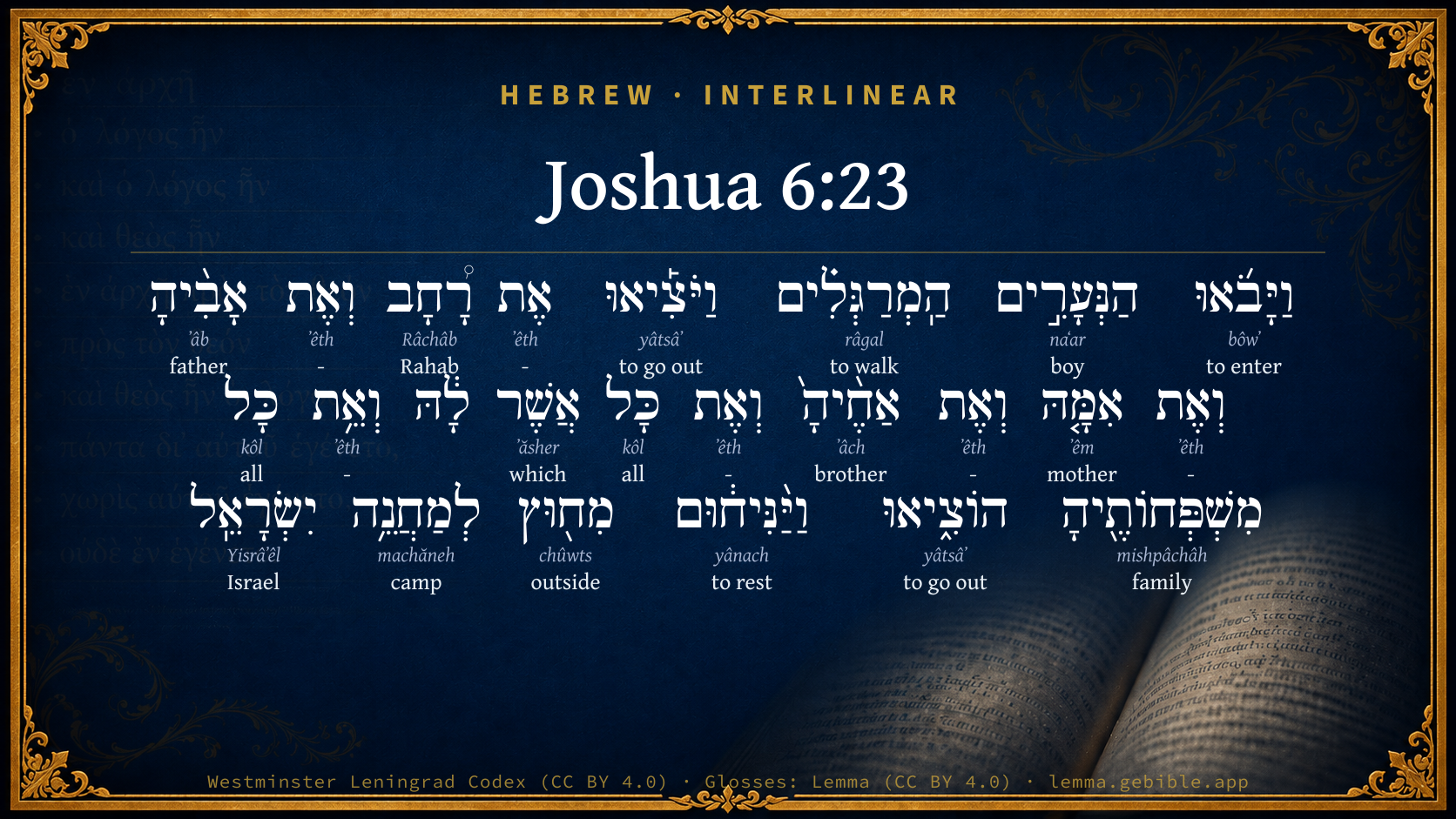
  1. וַיָּבֹ֜אוּ bôwʼ H935 “and · to enter” Conjunction + Verb, Qal, Sequential Imperfect, 3rd Person, Masculine, Plural
  2. הַנְּעָרִ֣ים naʻar H5288 “the · boys” Particle, Definite Article + Noun, Common, Masculine, Plural, Absolute
  3. הַֽמְרַגְּלִ֗ים râgal H7270 “the · walking” Particle, Definite Article + Verb, Piel, Participle Active, Masculine, Plural, Absolute
  4. וַיֹּצִ֡יאוּ yâtsâʼ H3318 “and · to go out” Conjunction + Verb, Hiphil, Sequential Imperfect, 3rd Person, Masculine, Plural
  5. אֶת ʼêth H853 “-” Particle, Direct Object
  6. וְאֶת ʼêth H853 “and · -” Conjunction + Particle, Direct Object
  7. אָבִ֨יהָ ʼâb H1 “father · her” Noun, Common, Masculine, Singular, Construct + Suffix, Personal, 3rd Person, Feminine, Singular
  8. וְאֶת ʼêth H853 “and · -” Conjunction + Particle, Direct Object
  9. אִמָּ֤הּ ʼêm H517 “mother · her” Noun, Common, Feminine, Singular, Construct + Suffix, Personal, 3rd Person, Feminine, Singular
  10. וְאֶת ʼêth H853 “and · -” Conjunction + Particle, Direct Object
  11. אַחֶ֨יהָ֙ ʼâch H251 “brothers · her” Noun, Common, Masculine, Plural, Construct + Suffix, Personal, 3rd Person, Feminine, Singular
  12. וְאֶת ʼêth H853 “and · -” Conjunction + Particle, Direct Object
  13. כָּל kôl H3605 “all of” Noun, Common, Masculine, Singular, Construct
  14. אֲשֶׁר ʼăsher H834 “which” Particle, Relative
  15. וְאֵ֥ת ʼêth H853 “and · -” Conjunction + Particle, Direct Object
  16. כָּל kôl H3605 “all of” Noun, Common, Masculine, Singular, Construct
  17. מִשְׁפְּחוֹתֶ֖יהָ mishpâchâh H4940 “families · her” Noun, Common, Feminine, Plural, Construct + Suffix, Personal, 3rd Person, Feminine, Singular
  18. הוֹצִ֑יאוּ yâtsâʼ H3318 “to go out” Verb, Hiphil, Perfect, 3rd Person, Common, Plural
  19. וַיַּ֨נִּיח֔וּם yânach H3240 “and · to rest · them” Conjunction + Verb, Hiphil, Sequential Imperfect, 3rd Person, Masculine, Plural + Suffix, Personal, 3rd Person, Masculine, Plural
  20. מִח֖וּץ chûwts H2351 “from · outside” Preposition + Noun, Common, Masculine, Singular, Absolute
  21. לְמַחֲנֵ֥ה machăneh H4264 “to/for · camp of” Preposition + Noun, Common, Both, Singular, Construct
  22. יִשְׂרָאֵֽל Yisrâʼêl H3478 “Israel” Noun, Proper

About this verse

These counts appear in no published source. They are computed here, from the morphology-tagged text and Lemma’s own curated glosses. What Lemma adds →

24
words
16
distinct lemmas
Historical
section

Notable vocabulary

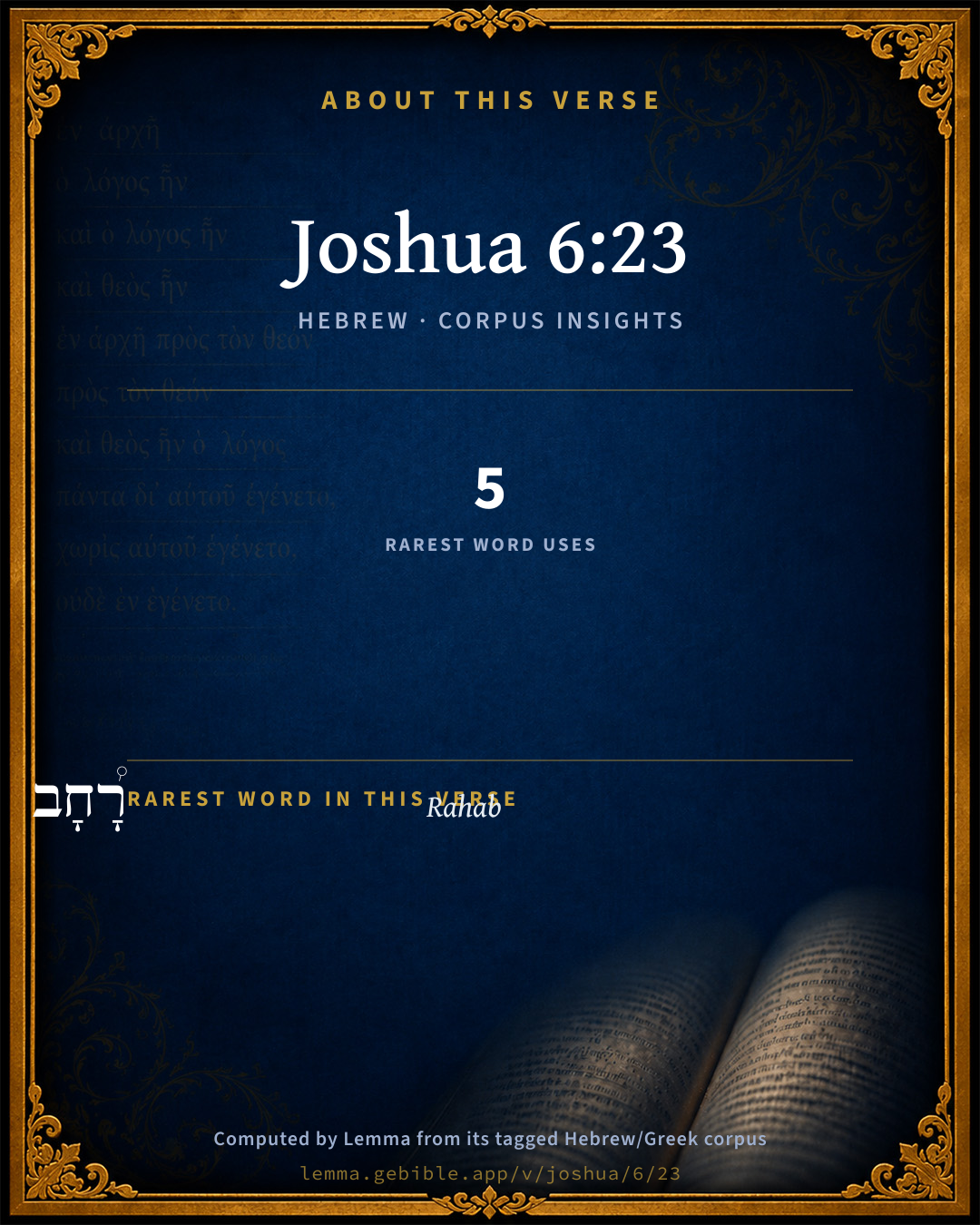
The rarest word here is רָ֠חָב Rahab H7343 — appearing just 5 times in the whole Hebrew Bible.

Shared distinctive vocabulary

רָ֠חָב Rahab H7343 occurs in 5 verses of the Hebrew Bible. Also found in:

Grammatical profile

  • 5 verbs
  • 11 nouns
  • 1 preposition
  • 7 particles

Verb forms

  • וַיָּבֹ֜אוּ Qal · Sequential Imperfect
  • הַֽמְרַגְּלִ֗ים Piel · Participle Active
  • וַיֹּצִ֡יאוּ Hiphil · Sequential Imperfect
  • הוֹצִ֑יאוּ Hiphil · Perfect
  • וַיַּ֨נִּיח֔וּם Hiphil · Sequential Imperfect

Repetition

Words recur within this verse — often emphatic in Hebrew:

  • וַיֹּצִ֡יאוּ to go out H3318 ×2
  • כָּל all H3605 ×2

Hebrew & Septuagint length

In English translation the verse runs 42 words from the Hebrew and 50 from the Septuagint (LXX English) — closely comparable.

A rough comparison of the two English renderings, which tokenize alike — not a word-level alignment.

Word counts can differ between the Hebrew and the Greek without any difference in meaning — e.g. the Hebrew direct-object marker אֵת has no separate Greek word, and Greek often adds the article ὁ.

Cross-references

12

Topical passages linked to Joshua 6:23 in the Treasury of Scripture Knowledge — connected by theme and wording, ordered by reader-vote popularity; previews shown in the World English Bible.

  • Hebrews 11:7 By faith, Noah, being warned about things not yet seen, moved with godly fear, prepared an ark for the saving of his house, through which he condemned the world, and became heir of the righteousness which is according to faith.
  • Genesis 12:2 I will make of you a great nation. I will bless you, and make your name great. You will be a blessing.
  • Genesis 18:24 What if there are fifty righteous within the city? Will you consume and not spare the place for the fifty righteous who are therein?
  • Numbers 5:2–3 "Command the children of Israel that they put out of the camp every leper, and everyone who has an issue, and whoever is unclean by the dead.
  • Numbers 31:19 Encamp you outside of the camp seven days: whoever has killed any person, and whoever has touched any slain, purify yourselves on the third day and on the seventh day, you and your captives.
  • Acts 10:28 He said to them, "You yourselves know how it is an unlawful thing for a man who is a Jew to join himself or come to one of another nation, but God has shown me that I shouldn't call any man unholy or unclean.
  • Acts 27:24 saying, 'Don't be afraid, Paul. You must stand before Caesar. Behold, God has granted you all those who sail with you.'
  • 1 Corinthians 5:12 For what have I to do with also judging those who are outside? Don't you judge those who are within?
  • Ephesians 2:12 that you were at that time separate from Christ, alienated from the commonwealth of Israel, and strangers from the covenants of the promise, having no hope and without God in the world.
  • Genesis 19:29 It happened, when God destroyed the cities of the plain, that God remembered Abraham, and sent Lot out of the midst of the overthrow, when he overthrew the cities in which Lot lived.
  • Joshua 2:13 and that you will save alive my father, and my mother, and my brothers, and my sisters, and all that they have, and will deliver our lives from death.
  • Joshua 2:18 Behold, when we come into the land, you shall bind this line of scarlet thread in the window which you did let us down by: and you shall gather to you into the house your father, and your mother, and your brothers, and all your father's household.

Cross-references courtesy of OpenBible.info (CC BY 4.0).

Hebrew and Greek witnesses Masoretic Hebrew ↔ Greek Septuagint

The same verse in the two great witnesses to the Old Testament, shown verse-for-verse.

These are two independent witnesses, not word-aligned to each other, and the Septuagint is shown in lemma (dictionary) form.

Hebrew Joshua 6:23 Masoretic · Westminster Leningrad Codex

וַיָּבֹ֜אוּ הַנְּעָרִ֣ים הַֽמְרַגְּלִ֗ים וַיֹּצִ֡יאוּ אֶת רָ֠חָב וְאֶת אָבִ֨יהָ וְאֶת אִמָּ֤הּ וְאֶת אַחֶ֨יהָ֙ וְאֶת כָּל אֲשֶׁר לָ֔הּ וְאֵ֥ת כָּל מִשְׁפְּחוֹתֶ֖יהָ הוֹצִ֑יאוּ וַיַּ֨נִּיח֔וּם מִח֖וּץ לְמַחֲנֵ֥ה יִשְׂרָאֵֽל

The young men the spies went in, and brought out Rahab, and her father, and her mother, and her brothers, and all that she had; all her relatives also they brought out; and they set them outside of the camp of Israel.

World English Bible · Public Domain

Greek LXX Joshua 6:23 Septuagint · lemma form

καί εἰςἔρχομαι ὁ δύο νεανίσκος ὁ κατασκοπεύω ὁ πόλις εἰς ὁ οἰκία ὁ γυνή καί ἐκἄγω ρααβ ὁ πόρνη καί ὁ πατήρ αὐτός καί ὁ μήτηρ αὐτός καί ὁ ἀδελφός αὐτός καί πᾶς ὅσος εἰμί αὐτός καί πᾶς ὁ συγγένεια αὐτός καί καταἵστημι αὐτός ἔξω ὁ παρεμβολή ἰσραήλ

And the two young men who had spied out the city entered into the house of the woman, and brought out Raab the harlot, and her father, and her mother, and her brethren, and her kindred, and all that she had; and they set her without the camp of Israel.

LXX2012 (modern English Septuagint) · Public Domain

On this verse, John Gill's Exposition discusses the Septuagint’s reading. Read the note in Commentary ↓

Hebrew: Westminster Leningrad Codex (CC BY 4.0). Greek: Septuagint (public domain); English from LXX2012 (modern English Septuagint) (Public Domain). How the Septuagint differs from the Hebrew →

Targum (Aramaic paraphrase)

1

The Targum is the ancient Jewish Aramaic paraphrase of the Hebrew Scriptures — an interpretive translation, not the Hebrew text itself. Onkelos (literal) and Pseudo-Jonathan (expansive) render the Torah, and Jonathan the Prophets. Coverage is partial: where no permissively-licensed English translation exists for a verse, only the Aramaic is shown. This is verse-level text, not a word-by-word alignment to the Hebrew.

  1. Targum Jonathan Prophets (Joshua–Malachi)
    וְעָלוּ עוּלֵמַיָא מְאַלְלַיָא וְאַפִּיקוּ יַת רָחָב וְיַת אֲבוּהָא וְיַת אִמָהּ וְיַת אֲחוּהָא וְיַת כָּל דִי לָהּ וְיַת כָּל זַרְעֲיָתָהָא אַפִּיקוּ וְאַשְׁרוּנוּן מִבָּרָא לְמַשְׁרִיתָא דְיִשְׂרָאֵל:

    (no public-domain English translation for this verse)

    Targum Jonathan — Aramaic: “Mikraot Gedolot” (public domain). English: “Sefaria Community Translation” (CC0 1.0 (public-domain dedication)); “London "Chaldee Paraphrase," 1871” (public domain). Text via Sefaria.

Commentary

Notes on Joshua 6:23 from classic Christian and Jewish commentators (each source and its license shown beneath its notes). The classic Christian expositions comment on the surrounding passage and are grouped to its opening verse, so a note may address several verses; the Jewish commentaries on the Tanakh (Rashi and others) are per-verse, so they appear only where the commentator wrote on this verse.

Lemma curates 59 commentaries, every one of them public domain or Creative Commons licensed, each selected and text-cleaned for this edition rather than reprinted as found. About our sources →

Trapp's Complete Commentary

John Trapp

Jos 6:23 And the young men that were spies went in, and brought out Rahab, and her father, and her mother, and her brethren, and all that she had; and they brought out all her kindred, and left them without the camp of Israel.

Ver. 23. And left them without the camp.] Lest it should be defiled by them, till they were proselyted. See Num 31:19.

John Trapp, A Commentary or Exposition upon All the Books of the Old and New Testament (1647–1656) — public domain. Text from a community e-Sword module.

Geneva Bible (1599)

Geneva Bible translators

For it was not lawful for strangers to dwell among the Israelites, till they were purged.

Geneva Bible (1599) marginal notes — public domain. Text via Bolls.life.

Jamieson, Fausset & Brown

Robert Jamieson, A. R. Fausset & David Brown

they brought out all her kindred, and left them without the camp of Israel--a temporary exclusion, in order that they might be cleansed from the defilement of their native idolatries and gradually trained for admission into the society of God's people.

Jamieson, Fausset & Brown — Commentary Critical and Explanatory on the Whole Bible (1871) — public domain (CC PDM 1.0). Text via the HelloAO Bible API.

Adam Clarke's Commentary

Verse 23. Brought out Rahab, and her father, c.] Rahab having been faithful to her vow of secrecy, the Israelites were bound by the oath of the spies, who acted as their representatives in this business, to preserve her and her family alive.

And left them without the camp] They were considered as persons unclean, and consequently left without the camp (see Le 13:46; Nu 12:14). When they had abjured heathenism, were purified, and the males had received circumcision, they were doubtless admitted into the camp, and became incorporated with Israel.

Adam Clarke's Commentary on the Bible (1810–1826) — public domain. Text from a community e-Sword/MySword module.

John Calvin's Commentaries

23. And the young men that were spies went in, etc God, doubtless, wished those to be safe, whose minds he thus inclined to embrace deliverance. Had it been otherwise, they would have rejected it not less proudly, and with no less scorn than the two sons-in-law of Lot. But a still better provision is made for them, when, by being placed without the camp, they receive a strict injunction to abandon their former course of life. For had they been immediately admitted and allowed to mix indiscriminately with the people, the thought of their impurity might never, perhaps, have occurred to them, and they might thus have continued to indulge in it. Now when they are placed apart, that they may not, by their infection, taint the flock, they are impressed with a feeling of shame, which may urge them to serious conversion.

It cannot be meant that they were thus set apart for safety, lest any one in the crowd might have risen up violently against them: for they would have been received by all with the greatest favor and gladness, whereas they might have been attacked in a solitary place more easily, and even with impunity. Their impurity, therefore, was brought visibly before them, that they might not while polluted come rashly forward into the holy meeting, but rather might be accustomed by this rudimentary training to change their mode of life. For it is added shortly after, that they dwelt in the midst of the people; in other words, having been purged from their defilement’s, they began to be regarded in the very same light as if they had originally belonged to the race of Abraham. In short, the meaning is, that after they had made a confession of their previous impurity, they were admitted indiscriminately along with others. By this admission, Rahab gained one of the noblest fruits of her faith.

John Calvin's Commentaries (1540-1563) — public domain. Text from the Calvin Translation Society English edition (1840s-50s) via the Christian Classics Ethereal Library (ccel.org). Calvin's coverage is partial (roughly two-thirds of the Bible); uncommented books and verses are honest gaps, never fabricated. The 19th-century editor's footnotes and remarks are omitted so the notes are faithfully Calvin's own voice.

Ellicott's Commentary for English Readers

(23) And left them.—Literally, caused them to rest.

A Bible Commentary for English Readers, edited by Charles John Ellicott (1878–1897) — public domain. Text from a community e-Sword module.

The Cambridge Bible for Schools and Colleges

gen. ed. J. J. S. Perowne

23. the young men] Vulg. juvenes. Comp. Gen_22:3, “And Abraham rose up early … and took two of his young men with him;” Jdg_8:20, “And he said unto Jether his firstborn, Up, and slay them. But the youth drew not his sword.”

all her kindred] Heb. families.

without the camp of Israel] Comp. Lev_24:14; Num_31:19. As heathen, they were unclean, and must therefore remain a specified time, probably seven days, “without the camp.”

The Cambridge Bible for Schools and Colleges (gen. ed. J. J. S. Perowne; Cambridge University Press, 1878–1918) — public domain. Text from a community e-Sword module.

John Gill's Exposition

And the young men that were spies went in, and brought out Rahab,.... Not only went into the city, but into Rahab's house, which they knew again by the scarlet thread hung out at the window of it. But here a difficulty occurs, how they could be said to go into her house, when it was built on the town wall, Jos 2:15; and that was now fallen down flat. Abarbinel thinks that when the spies went round the city, they saw the scarlet thread in the window of her house, and set their eyes on the house, or wistly observed it; and marked it in such manner, that after the fall of the wall they went to the place of her house, and brought her out, though her house was broken down, and no wall standing: but then they could not be said properly to go into her house, and bring her out. Kimchi is of opinion that not all the wall of the city fell, but what was over against the camp of Israel; and that the house of Rahab was on the wall on the other side: but it seems by the account of it as if the whole wall fell; and the apostle says, "the walls of Jericho fell down", Heb 11:30; all of them; and so the Septuagint version of Jos 6:20."and the whole wall, or all the wall fell round about:''and I see not why it may not be thought that the whole wall fell, excepting that small part alone which Rahab's house stood; and that standing alone would make the miracle the greater, and show the divine approbation of saving Rahab and her family: besides, if the wall sunk down in its place all around into the earth, as the Jews understand the phrase; See Gill on Jos 6:5; the house might continue on it firm and unmoved, going down with it to the surface of the earth, where it may be supposed the top of the wall was; and so they might go in and take her out, and preserve her from being destroyed with the rest of the inhabitants; and not only her:

but her father and her mother, and her brethren, and all that she had; all other relations that were with her, particularly her sisters, which are in her request, Jos 2:13; with all that appertained to her brethren and sisters, which is there expressed also:

and they brought out all her kindred; before mentioned, or if there were any other of her relations she had taken into her house for safety; or "all her families" (e), for her father's household might be branched out into various families, and become numerous, and so be an emblem of the number of Gentile sinners saved by Christ the antitype of Joshua:

and left them without the camp of Israel; until they, became proselytes, and embraced the religion of Israel, as Kimchi remarks. However, being Gentiles, some external rites and ceremonies were to be performed upon them, as well as a declaration at least of their renouncing idolatry was required of them, before they could be admitted into the camp of Israel; and which was required even of a proselyte of the gate, or of one that was only a sojourner among them.

(e) "omnes familias ejus", Pagninus, Montanus, Tigurine version.

John Gill's Exposition of the Whole Bible (1746–1763) — public domain (CC PDM 1.0). Text via the HelloAO Bible API.

Albert Barnes' Notes on the Bible

The part of the wall adjoining Rahab’s house had not fallen along with the rest. Rahab and “all that she had,” i. e., the persons belonging to her household, were brought out and “left without the camp of Israel.” These words literally “made to rest outside the camp of Israel” - indicate that being still in their paganism, they were separated from the camp of the Lord. This was only for a time. They desired, and eventually obtained, admission to the covenant of the chosen people of God Jos 6:25.

Albert Barnes' Notes on the Bible (1834–1885) — public domain. Text from a community e-Sword/MySword module.

Haydock's Catholic Bible Commentary

Men. Hebrew, "boys;" a name given to people advanced in years. --- Camp. A respect for the majesty of God, would not permit the Israelites to introduce unbelievers into the camp. They were first instructed, and then the men were circumcised, and the women received baptism. (Calmet)

George Leo Haydock (1774–1849), Haydock's Catholic Family Bible and Commentary, 1859 edition — public domain. Excludes Psalms (Douay-Rheims chapter numbering differs from Protestant) and Deuterocanonical books (Catholic canon only).

Matthew Poole's English Annotations

Till they were cleansed from the impurities of their Gentile state, and instructed in the Jewish religion, and solemnly admitted into that church in the usual way, to which Rahab’s good counsel and example had doubtless very much prepared them; and this stupendous work of God confirmed their purposes.

Matthew Poole's English Annotations on the Holy Bible (1683–1685) — public domain. Text from a community e-Sword/MySword module.

Whedon's Commentary on the Bible

Daniel D. Whedon

23. And her brethren — This term must be understood to include the sisters spoken of in Jos_2:13.

All that she had — This expression seems most naturally to include goods, and not kindred only. The neuter gender in the Septuagint and Vulgate supports this interpretation, and why should we deny that they were permitted to save all their portable possessions? We suppose that the spies had with them a large company of assistants, to carry her household furniture to the camp. It was honourable on the part of Joshua that she should suffer no loss, and that her faith should be profitable for the life that now is.

All her kindred — Hebrews, all her families; that is, all who were related to Rahab, and also their families. God honours the family institution which he has ordained. He saves by families not only in the Old Dispensation, as in this case, and Noah, and many others, but also in the New, as in the case of whole households admitted to baptism.

Left them without the camp — They were not prepared ceremonially to dwell among the Hebrews. It was not lawful for uncircumcised men, nor for females who had not publicly espoused the Jewish faith, to enter the camp, which was regarded as sacred because of the ark. This separation for a season would induce them to lay aside all their pagan habits, which an immediate reception might have confirmed.

Daniel D. Whedon (gen. ed.), Commentary on the Old and New Testaments (1874–1909) — public domain. Text from a community e-Sword module.

The Pulpit Commentary

Brought out. Therefore the medieval legends concerning Rahab"s house must be classed among superstitious fables. Rahab and her family and relations were saved, but her house shared the destruction which befel the rest of the city. Origen cites in reference to the deliverance of Rahab the harlot, 1Co_6:11, and Tit_3:3. (cf. also Eph_2:1-8 Eph_5:8 Col_3:7) Without the camp of Israel. Not in the camp of Israel outside the city, as some have rendered. The Hebrew distinctly connects the word xWhmi with the comp. They were as yet, as Gentiles, unclean. (cf. Num_5:2 Num_31:19)

The Pulpit Commentary (1880–1919), ed. H.D.M. Spence-Jones & Joseph S. Exell — public domain. Text from a community e-Sword module.

John Wesley's Explanatory Notes

Without the camp of Israel - 'Till they were cleansed from the impurities of their Gentile state, and instructed in the Jewish religion, and solemnly admitted into that church, for which Rahab's good counsel and example had doubtless prepared them.

John Wesley, Explanatory Notes Upon the Whole Bible (1754–1765) — public domain. Text via the GEBible commentary corpus.

unfoldingWord translationNotes

Door43 World Missions Community

They burned the city

The word "they" refers to the Israelite soldiers. It does not refer only to the two young men who brought Rahab and her family out of the city.

translationWords

Rahab

ancestor

Israel

silver

gold

bronze

house

Yahweh

unfoldingWord translationNotes — © Distant Shores Media and the Door43 World Missions Community, licensed CC BY-SA 4.0. Source: git.door43.org/Door43/en_tn.

Rashi

Rabbi Shlomo Yitzchaki (Rashi)

And the lads who were the spies went in. This mission required speed, thus they performed like speedy lads. However on the first night they were like angels, guarding themselves from sinning with Rochov, the harlot, therefore they were referred to as angels. Therefore they were referred to as men, as angels and as lads.

Rashi on the Tanakh — English translations: “The Judaica Press complete Tanach with Rashi, translated by A. J. Rosenberg” (CC BY 4.0); “Pentateuch with Rashi's commentary by M. Rosenbaum and A.M. Silbermann, 1929-1934” (public domain); “The Metsudah Tanach series, Lakewood, N.J” (CC BY 4.0); and “The Book of Joshua, Metsudah Publications, 1997” (CC BY 4.0). Text via Sefaria.

Lesson kit

Teaching starters — assembled from the data on this page, not authored interpretation. Every prompt links to the verse data it draws on. Edit before teaching.

Joshua, in the Historical, opens this verse with 24 words (16 distinct Hebrew lemmas). Its most distinctive word is Râchâb (“Rahab”). A historical commentator’s framing appears above. Read the whole chapter for the surrounding context.

Discussion questions

  1. The word Râchâb carries the sense “Rahab.” How does it shape the verse?
  2. How does Joshua 2:1, which shares the word «Rahab», read alongside this verse?
  3. What does the repetition of “to go out” (2× in this one verse) do in this verse?
  4. These translations render this verse differently. What is at stake in choosing one wording over another?
  5. «וַיָּבֹ֜אוּ» is a Qal Sequential Imperfect verb. How does that grammatical form shape the action described?
  6. Compare how Trapp's Complete Commentary and Geneva Bible (1599) read this verse. Where do they agree or differ?

Things to notice

Reading settings

Reading text

Shown beneath each verse's original-language words.

Old Testament
Old Testament edition

Read the OT as the Masoretic Hebrew (MT) or the Greek Septuagint (LXX).

English shown for the Greek Septuagint (in the Hebrew ↔ Greek comparison).

Comparing translations? Open the Compare panel on any verse page to stack up to four side by side.