
Esther 3:13

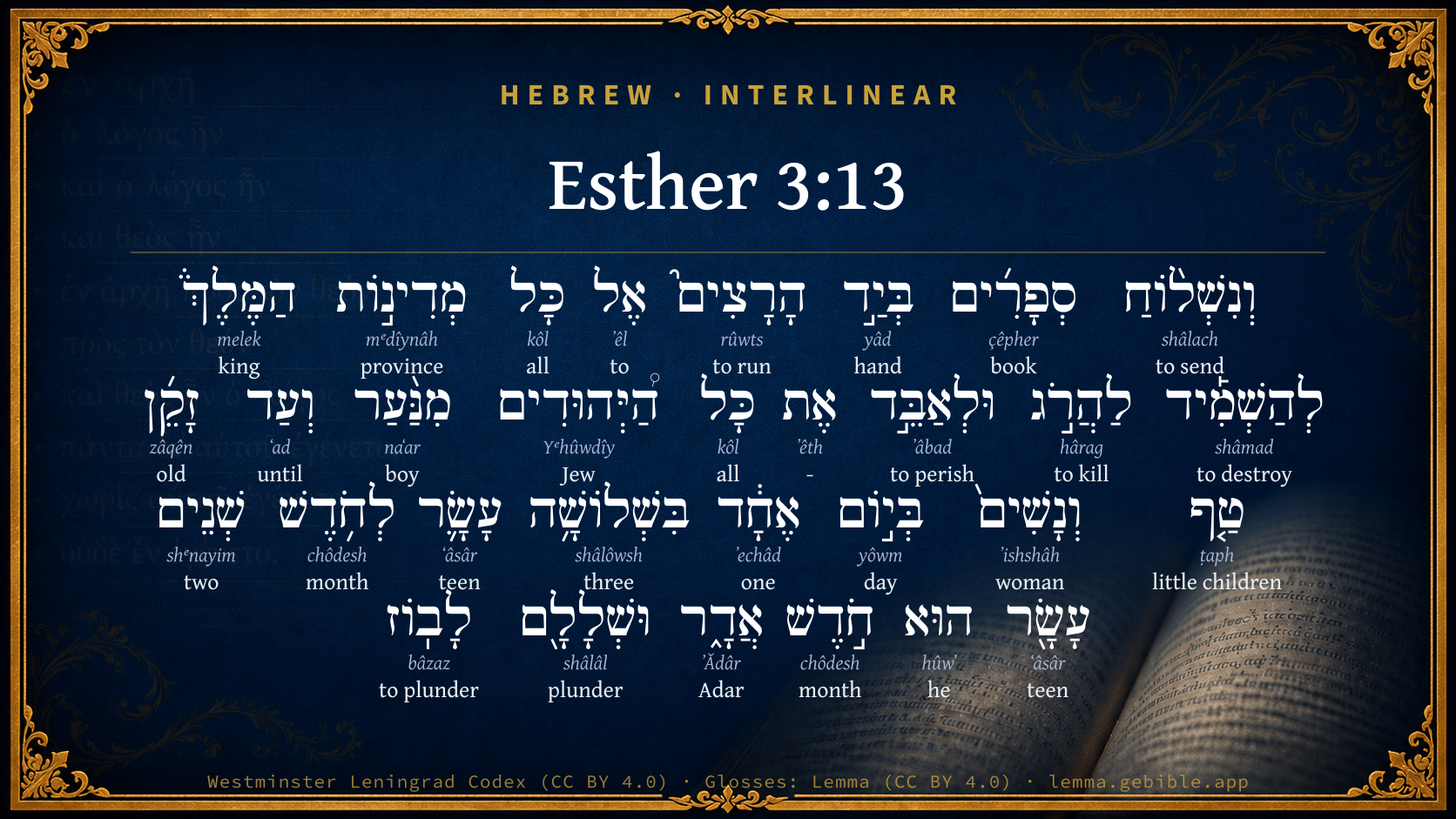
Hebrew (Westminster Leningrad Codex) Esther 3:13 appears in the Hebrew Old Testament. The text above is from the Westminster Leningrad Codex. Each word links to its Strong’s number, a concise gloss, and parsing drawn from the Open Scriptures Hebrew Bible morphology. Click any word for its full Brown-Driver-Briggs (BDB) entry.
Download image
Cite this verse

Esther 3:13 (World English Bible). Public Domain. Lemma interlinear Bible study tool, https://lemma.gebible.app/v/esther/3/13.

Show BibTeX & RIS
BibTeX
RIS
English Translation
Letters were sent by posts into all the king's provinces, to destroy, to kill, and to cause to perish, all Jews, both young and old, little children and women, in one day, even on the thirteenth [day] of the twelfth month, which is the month Adar, and to take the spoil of them for a prey.
World English Bible · Public Domain
Download a study sheet

One document with this verse’s original text, its word-by-word gloss line, the meaning frame, cross-references with their text, attributed commentary, and full source and license credits — printable, and it pastes into notes with its structure intact.

This verse Autodidact and up

Study sheet (.html) Plain text (.txt)

A passage Seminary Student

Up to 50 verses in one chapter. A passage sheet keeps up to 6 commentary sources and 12 cross-references per verse, in the order this page ranks them, and says so on the sheet whenever that leaves anything out. Ask for a single verse and you get the Autodidact verse sheet above.

Everything on this page stays free to read, with no account — the sheet is a download of what is already on screen, not access to it.

Want to remove ads? Support Godless Engineer
Compare translations 3

The same verse in 3 English versions, stacked beneath the original-language interlinear above. Click any original word for its lexicon entry.

Each is an independent rendering of the whole verse — the interlinear is not word-aligned to these translations.

Highlighted words mark where these versions differ — a whole-verse word diff, not a word-by-word alignment.

  • World English Bible Public Domain
    Letters were sent by posts into all the king's provinces, to destroy, to kill, and to cause to perish, all Jews, both young and old, little children and women, in one day, even on the thirteenth [day] of the twelfth month, which is the month Adar, and to take the spoil of them for a prey.
  • King James Version Public Domain
    And the letters were sent by posts into all the king's provinces, to destroy, to kill, and to cause to perish, all Jews, both young and old, little children and women, in one day, even upon the thirteenth day of the twelfth month, which is the month Adar, and to take the spoil of them for a prey.
  • unfoldingWord Literal Text CC BY-SA 4.0
    And letters were sent by the hand of runners to all of the provinces of the king, to annihilate, to slaughter, and to destroy all the Jews from young even to old, children and women, in one day, on the thirteenth of month 12 (which is the month of Adar), and to plunder their spoils.

unfoldingWord Literal Text — © unfoldingWord, licensed CC BY-SA 4.0. Word-aligned USFM3 via Door43 (git.door43.org/unfoldingWord/en_ult).

Versions to compare (up to 4)

3 of 4 selected

Show all 18 translations

Every available English version of this verse, each an independent rendering of the whole verse.

  • World English Bible Public Domain
    Letters were sent by posts into all the king's provinces, to destroy, to kill, and to cause to perish, all Jews, both young and old, little children and women, in one day, even on the thirteenth [day] of the twelfth month, which is the month Adar, and to take the spoil of them for a prey.
  • Berean Standard Bible Public Domain
    And the letters were sent by couriers to each of the royal provinces with the order to destroy, kill, and annihilate all the Jews—young and old, women and children—and to plunder their possessions on a single day, the thirteenth day of Adar, the twelfth month.
  • Majority Standard Bible Public Domain
    And the letters were sent by couriers to each of the royal provinces with the order to destroy, kill, and annihilate all the Jews—young and old, women and children—and to plunder their possessions on a single day, the thirteenth day of Adar, the twelfth month.
  • King James Version Public Domain
    And the letters were sent by posts into all the king's provinces, to destroy, to kill, and to cause to perish, all Jews, both young and old, little children and women, in one day, even upon the thirteenth day of the twelfth month, which is the month Adar, and to take the spoil of them for a prey.
  • American Standard Version (1901) Public Domain
    And letters were sent by posts into all the king's provinces, to destroy, to slay, and to cause to perish, all Jews, both young and old, little children and women, in one day, even upon the thirteenth `day' of the twelfth month, which is the month Adar, and to take the spoil of them for a prey.
  • Revised Version (1885) Public Domain
    And letters were sent by posts into all the king’s provinces, to destroy, to slay, and to cause to perish, all Jews, both young and old, little children and women, in one day, even upon the thirteenth day of the twelfth month, which is the month Adar, and to take the spoil of them for a prey.
  • Geneva Bible (1599) Public Domain
    And the letters were sent by postes into all the Kings prouinces, to roote out, to kill and to destroy all the Iewes, both yong and olde, children and women, in one day vpon the thirteenth day of the twelft moneth, (which is the moneth Adar) and to spoyle them as a pray.
  • Douay-Rheims (1899) Public Domain
    Were sent by the king's messengers to all provinces, to kill and destroy all the Jews, both young and old, little children, and women, in one day, that is, on the thirteenth of the twelfth month, which is called Adar, and to make a spoil of their goods.
  • Young's Literal Translation Public Domain
    and letters to be sent by the hand of the runners unto all provinces of the king, to cut off, to slay, and to destroy all the Jews, from young even unto old, infant and women, on one day, on the thirteenth of the twelfth month -- it `is' the month of Adar -- and their spoil to seize,
  • Literal Standard Version CC BY-SA 4.0
    and letters to be sent by the hand of the runners to all provinces of the king, to cut off, to slay, and to destroy all the Jews, from young even to old, infant and women, on one day, on the thirteenth of the twelfth month—it [is] the month of Adar—and to seize their spoil,
  • Unlocked Literal Bible CC BY-SA 4.0
    Documents were hand-delivered by couriers to all the king's provinces, to annihilate, kill, and destroy all Jews, from young to old, children and women, in one day—on the thirteenth day of the twelfth month (which is the month of Adar)—and to plunder their possessions.
  • unfoldingWord Literal Text CC BY-SA 4.0
    And letters were sent by the hand of runners to all of the provinces of the king, to annihilate, to slaughter, and to destroy all the Jews from young even to old, children and women, in one day, on the thirteenth of month 12 (which is the month of Adar), and to plunder their spoils.
  • Darby Bible Public Domain
    And the letters were sent by couriers into all the king's provinces, to destroy, to kill, and to cause to perish, all Jews, both young and old, little children and women, in one day, upon the thirteenth of the twelfth month, that is, the month Adar, and [to take] the spoil of them for a prey.
  • World Messianic Bible Public Domain
    Letters were sent by couriers into all the king’s provinces, to destroy, to kill, and to cause to perish, all Jews, both young and old, little children and women, in one day, even on the thirteenth day of the twelfth month, which is the month Adar, and to plunder their possessions.
  • Webster's Bible Public Domain
    And the letters were sent by posts into all the king's provinces, to destroy, to kill, and to cause to perish, all Jews, both young and old, little children and women, in one day, even upon the thirteenth day of the twelfth month, which is the month Adar, and to take the spoil of them for a prey.
  • Free Bible Version CC BY-SA 4.0
    Letters were sent by messenger to all the provinces in the king's empire with orders to destroy, kill, and annihilate all Jews, young and old, women and children, and confiscate their possessions, all in one day—the thirteenth day of the twelfth month, the month of Adar.
  • Bible in Basic English Public Domain
    And letters were sent by the runners into every division of the kingdom ordering the death and destruction of all Jews, young and old, little children and women, on the same day, even the thirteenth day of the twelfth month, the month Adar, and the taking of all their goods by force.
  • JPS Tanakh (1917) Public Domain
    And letters were sent by posts into all the king's provinces, to destroy, to slay, and to cause to perish, all Jews, both young and old, little children and women, in one day, even upon the thirteenth day of the twelfth month, which is the month Adar, and to take the spoil of them for a prey.

Literal Standard Version (2020), Covenant Press — licensed CC BY-SA 4.0. Text via the HelloAO Bible API (eBible.org). Unlocked Literal Bible (unfoldingWord) — licensed CC BY-SA 4.0. Text via the HelloAO Bible API (eBible.org). unfoldingWord Literal Text — © unfoldingWord, licensed CC BY-SA 4.0. Word-aligned USFM3 via Door43 (git.door43.org/unfoldingWord/en_ult). Free Bible Version, Dr. Jonathan Gallagher — licensed CC BY-SA 4.0. Text via the HelloAO Bible API (eBible.org).

Word by word

More ways to search: Search by grammar → Find every occurrence → Compare this word →

Practice this passage: Drill this verse → Learn its vocabulary →

אֲדָ֑ר
ʼĂdâr
H143
“Adar”
Noun, Proper
Part of Speech
Noun
Type
Proper
Full BDB Definition

Origin: probably of foreign derivation

TWOT: None

Adar = "glorious" - twelfth month, corresponding to modern March-April
  1. וְנִשְׁל֨וֹחַ shâlach H7971 “and · to send” Conjunction + Verb, Niphal, Infinitive Absolute
  2. סְפָרִ֜ים çêpher H5612 “books” Noun, Common, Masculine, Plural, Absolute
  3. בְּיַ֣ד yâd H3027 “in/at · hand of” Preposition + Noun, Common, Both, Singular, Construct
  4. הָרָצִים֮ rûwts H7323 “the · running” Particle, Definite Article + Verb, Qal, Participle Active, Masculine, Plural, Absolute
  5. אֶל ʼêl H413 “to” Preposition
  6. כָּל kôl H3605 “all of” Noun, Common, Masculine, Singular, Construct
  7. מְדִינ֣וֹת mᵉdîynâh H4082 “provinces of” Noun, Common, Feminine, Plural, Construct
  8. הַמֶּלֶךְ֒ melek H4428 “the · king” Particle, Definite Article + Noun, Common, Masculine, Singular, Absolute
  9. לְהַשְׁמִ֡יד shâmad H8045 “to destroy” Preposition + Verb, Hiphil, Infinitive Construct
  10. לַהֲרֹ֣ג hârag H2026 “to kill” Preposition + Verb, Qal, Infinitive Construct
  11. וּלְאַבֵּ֣ד ʼâbad H6 “and · to perish” Conjunction + Preposition + Verb, Piel, Infinitive Construct
  12. אֶת ʼêth H853 “-” Particle, Direct Object
  13. כָּל kôl H3605 “all of” Noun, Common, Masculine, Singular, Construct
  14. הַ֠יְּהוּדִים Yᵉhûwdîy H3064 “the · Jews” Particle, Definite Article + Noun, Gentilic, Masculine, Plural, Absolute
  15. מִנַּ֨עַר naʻar H5288 “from · boy” Preposition + Noun, Common, Masculine, Singular, Absolute
  16. וְעַד ʻad H5704 “and · until” Conjunction + Preposition
  17. זָקֵ֜ן zâqên H2205 “old” Adjective, Adjective, Masculine, Singular, Absolute
  18. טַ֤ף ṭaph H2945 “little children” Noun, Common, Masculine, Singular, Absolute
  19. וְנָשִׁים֙ ʼishshâh H802 “and · women” Conjunction + Noun, Common, Feminine, Plural, Absolute
  20. בְּי֣וֹם yôwm H3117 “in/at · day” Preposition + Noun, Common, Masculine, Singular, Absolute
  21. אֶחָ֔ד ʼechâd H259 “one” Adjective, Cardinal number, Masculine, Singular, Absolute
  22. בִּשְׁלוֹשָׁ֥ה shâlôwsh H7969 “in/at · three” Preposition + Adjective, Cardinal number, Masculine, Singular, Absolute
  23. עָשָׂ֛ר ʻâsâr H6240 “teen” Adjective, Cardinal number, Masculine, Singular, Absolute
  24. לְחֹ֥דֶשׁ chôdesh H2320 “to/for · month” Preposition + Noun, Common, Masculine, Singular, Absolute
  25. שְׁנֵים shᵉnayim H8147 “two” Adjective, Cardinal number, Masculine, Dual, Absolute
  26. עָשָׂ֖ר ʻâsâr H6240 “teen” Adjective, Cardinal number, Masculine, Singular, Absolute
  27. הוּא hûwʼ H1931 “he” Pronoun, Personal, 3rd Person, Masculine, Singular
  28. חֹ֣דֶשׁ chôdesh H2320 “month of” Noun, Common, Masculine, Singular, Construct
  29. וּשְׁלָלָ֖ם shâlâl H7998 “and · plunder · their” Conjunction + Noun, Common, Masculine, Singular, Construct + Suffix, Personal, 3rd Person, Masculine, Plural
  30. לָבֽוֹז bâzaz H962 “to plunder” Preposition + Verb, Qal, Infinitive Construct

About this verse

These counts appear in no published source. They are computed here, from the morphology-tagged text and Lemma’s own curated glosses. What Lemma adds →

31
words
28
distinct lemmas
Historical
section

Notable vocabulary

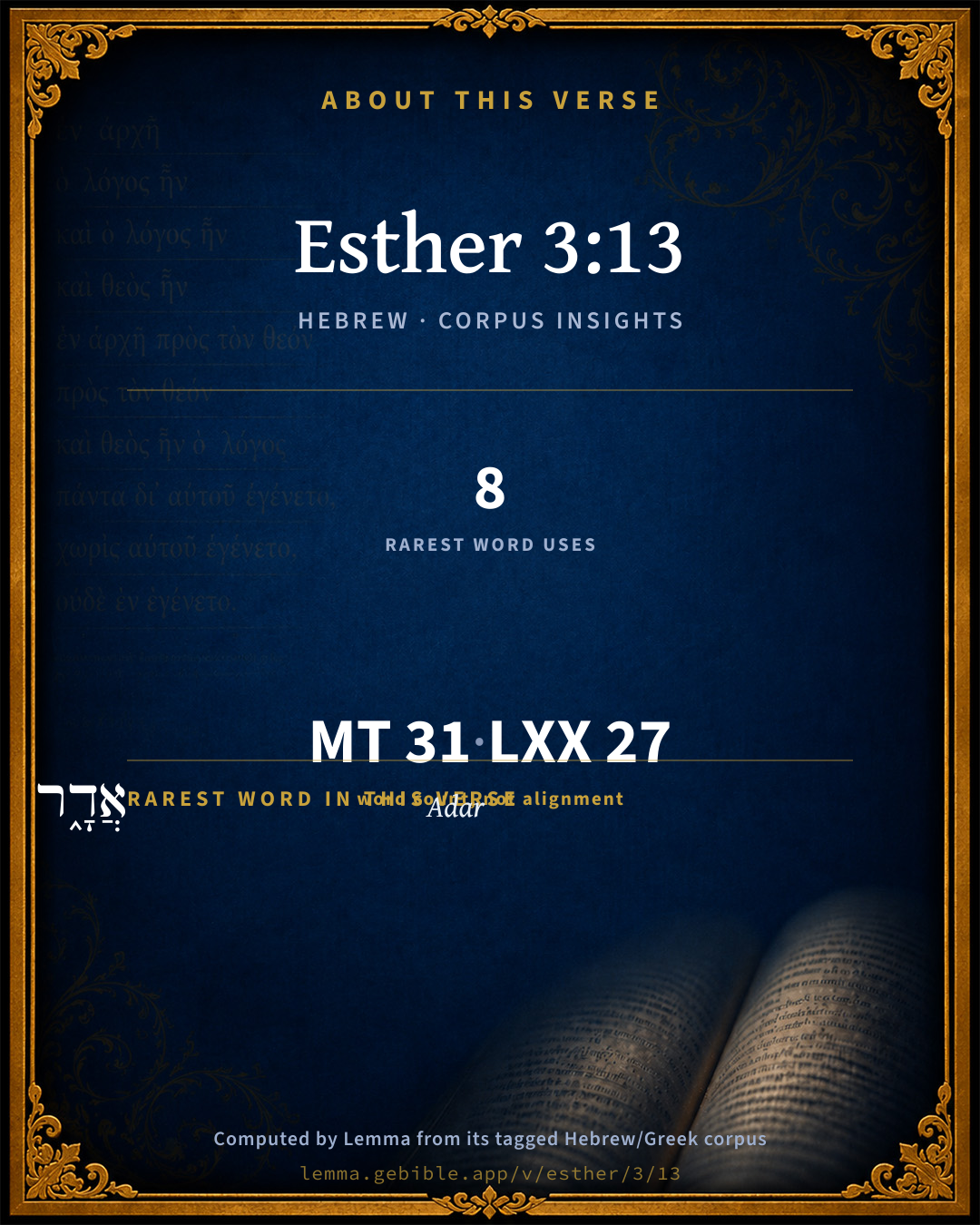
The rarest word here is אֲדָ֑ר Adar H143 — appearing just 8 times in the whole Hebrew Bible.

Shared distinctive vocabulary

אֲדָ֑ר Adar H143 occurs in 8 verses of the Hebrew Bible. Also found in:

Grammatical profile

  • 6 verbs
  • 15 nouns
  • 6 adjectives
  • 1 pronoun
  • 2 prepositions
  • 1 particle

Verb forms

  • וְנִשְׁל֨וֹחַ Niphal · Infinitive Absolute
  • הָרָצִים֮ Qal · Participle Active
  • לְהַשְׁמִ֡יד Hiphil · Infinitive Construct
  • לַהֲרֹ֣ג Qal · Infinitive Construct
  • וּלְאַבֵּ֣ד Piel · Infinitive Construct
  • לָבֽוֹז Qal · Infinitive Construct

Repetition

Words recur within this verse — often emphatic in Hebrew:

  • כָּל all H3605 ×2
  • עָשָׂ֛ר teen H6240 ×2
  • לְחֹ֥דֶשׁ month H2320 ×2

Hebrew & Septuagint length

In English translation the verse runs 56 words from the Hebrew and 361 from the Septuagint (LXX English) — the Septuagint runs noticeably longer here. See the side-by-side →

A rough comparison of the two English renderings, which tokenize alike — not a word-level alignment.

Word counts can differ between the Hebrew and the Greek without any difference in meaning — e.g. the Hebrew direct-object marker אֵת has no separate Greek word, and Greek often adds the article ὁ.

In the original languages it is 31 Hebrew tokens and 27 Greek tokens — but the two are counted differently (Hebrew bundles its prefixes and suffixes into one token; the Greek is in lemma form), so that isn’t a like-for-like length.

Cross-references

11

Topical passages linked to Esther 3:13 in the Treasury of Scripture Knowledge — connected by theme and wording, ordered by reader-vote popularity; previews shown in the World English Bible.

  • 2 Chronicles 30:6 So the posts went with the letters from the king and his princes throughout all Israel and Judah, and according to the commandment of the king, saying, You children of Israel, turn again to Yahweh, the God of Abraham, Isaac, and Israel, that he may return to the remnant that have escaped of you out of the hand of the kings of Assyria.
  • Esther 9:10 the ten sons of Haman the son of Hammedatha, the Jew's enemy, killed they; but they didn't lay their hand on the spoil.
  • 1 Samuel 15:3 Now go and strike Amalek, and utterly destroy all that they have, and don't spare them; but kill both man and woman, infant and suckling, ox and sheep, camel and donkey.
  • Esther 8:10–14 He wrote the name of king Ahasuerus, and sealed it with the king's ring, and sent letters by post on horseback, riding on swift steeds that were used in the king's service, bred of the stud:
  • 1 Samuel 22:19 Nob, the city of the priests, struck he with the edge of the sword, both men and women, children and nursing babies, and oxen and donkeys and sheep, with the edge of the sword.
  • Esther 7:4 for we are sold, I and my people, to be destroyed, to be slain, and to perish. But if we had been sold for bondservants and bondmaids, I had held my peace, although the adversary could not have compensated for the king's damage.
  • Job 9:25 "Now my days are swifter than a runner. They flee away, they see no good,
  • Isaiah 10:6 I will send him against a profane nation, and against the people of my wrath will I give him a charge, to take the spoil, and to take the prey, and to tread them down like the mire of the streets.
  • Jeremiah 51:31 One post shall run to meet another, and one messenger to met another, to show the king of Babylon that his city is taken on every quarter:
  • Romans 3:15 "Their feet are swift to shed blood.
  • James 2:13 For judgment is without mercy to him who has shown no mercy. Mercy triumphs over judgment.

Cross-references courtesy of OpenBible.info (CC BY 4.0).

Hebrew and Greek witnesses Masoretic Hebrew ↔ Greek Septuagint

The same verse in the two great witnesses to the Old Testament, shown verse-for-verse.

Here the Septuagint runs noticeably longer than the Hebrew — LXX2012 (modern English Septuagint) 361 words vs World English Bible 56. A rough length comparison of the two English translations, not a word-level alignment — read both below.

These are two independent witnesses, not word-aligned to each other, and the Septuagint is shown in lemma (dictionary) form.

Hebrew Esther 3:13 Masoretic · Westminster Leningrad Codex

וְנִשְׁל֨וֹחַ סְפָרִ֜ים בְּיַ֣ד הָרָצִים֮ אֶל כָּל מְדִינ֣וֹת הַמֶּלֶךְ֒ לְהַשְׁמִ֡יד לַהֲרֹ֣ג וּלְאַבֵּ֣ד אֶת כָּל הַ֠יְּהוּדִים מִנַּ֨עַר וְעַד זָקֵ֜ן טַ֤ף וְנָשִׁים֙ בְּי֣וֹם אֶחָ֔ד בִּשְׁלוֹשָׁ֥ה עָשָׂ֛ר לְחֹ֥דֶשׁ שְׁנֵים עָשָׂ֖ר הוּא חֹ֣דֶשׁ אֲדָ֑ר וּשְׁלָלָ֖ם לָבֽוֹז

Letters were sent by posts into all the king's provinces, to destroy, to kill, and to cause to perish, all Jews, both young and old, little children and women, in one day, even on the thirteenth [day] of the twelfth month, which is the month Adar, and to take the spoil of them for a prey.

World English Bible · Public Domain

Greek LXX Esther 3:13 Septuagint · lemma form

καί ἀποστέλλω διά βιβλιαφόρος εἰς ὁ ἀρταξέρξης βασιλεία ἀπο ἀναἵζω ὁ γένος ὁ ἰουδαῖος ἐν ἡμέρα εἷς μήν δωδέκατος ὅς εἰμί αδαρ καί διαἁρπάζω ὁ ὑποἄρχω αὐτός

And the message was sent by posts throughout the kingdom of Artaxerxes, to destroy utterly the race of the Jews on the first day of the twelfth month, which is Adar, and to plunder their goods. [And the following is the copy of the letter; The great king Artaxerxes writes thus to the rulers and inferior governors of one hundred and twenty-seven provinces, from India even to Ethiopia, who hold authority under him. Ruling over many nations and having obtained dominion over the whole world, I was minded (not elated by the confidence of power, but ever conducting myself with great moderation and gentleness) to make the lives of my subjects continually tranquil, desiring both to maintain the kingdom quiet and orderly to its utmost limits, and to restore the peace desired by all men. But when I had enquired of my counselors how this should be brought to pass. Aman, who excels in soundness of judgment among us, and has been manifestly well inclined without wavering and with unshaken fidelity, and had obtained the second post in the kingdom, informed us that a certain ill-disposed people is mixed up with all the tribes throughout the world, opposed in their law to every other nation, and continually neglecting the commands of the king, so that the united government blamelessly administered by us is not quietly established. Having then conceived that this nation alone of all others is continually set in opposition to every man, introducing as a change a foreign code of laws, and injuriously plotting to accomplish the worst of evils against our interests, and against the happy establishment of the monarchy; we signified to you in the letter written by Aman, who is set over the public affairs and is our second governor, to destroy them all utterly with their wives and children by the swords of the enemies, without pitying or sparing any, on the fourteenth day of the twelfth month Adar, of the present year; that the people aforetime and now ill-disposed to us having been violently consigned to death in one day, may hereafter secure to us continually a well constituted and quiet state of affairs.]

LXX2012 (modern English Septuagint) · Public Domain

On this verse, The Cambridge Bible for Schools and Colleges discusses the Septuagint’s reading. Read the note in Commentary ↓

Hebrew: Westminster Leningrad Codex (CC BY 4.0). Greek: Septuagint (public domain); English from LXX2012 (modern English Septuagint) (Public Domain). How the Septuagint differs from the Hebrew →

Commentary

Notes on Esther 3:13 from classic Christian and Jewish commentators (each source and its license shown beneath its notes). The classic Christian expositions comment on the surrounding passage and are grouped to its opening verse, so a note may address several verses; the Jewish commentaries on the Tanakh (Rashi and others) are per-verse, so they appear only where the commentator wrote on this verse.

Lemma curates 59 commentaries, every one of them public domain or Creative Commons licensed, each selected and text-cleaned for this edition rather than reprinted as found. About our sources →

Trapp's Complete Commentary

John Trapp

Est 3:13 And the letters were sent by posts into all the king’s provinces, to destroy, to kill, and to cause to perish, all Jews, both young and old, little children and women, in one day, [even] upon the thirteenth [day] of the twelfth month, which is the month Adar, and [to take] the spoil of them for a prey.

Ver. 13. And the letters were sent by posts] These the Persians called Angari, or (as Ruffin writeth it) Aggari. But why was this done in such post haste, so long before the day of execution? was it not to hold them all that while on the rack, and so to kill them piecemeal (as Tiberius used to do by his enemies), while, through fear of death, and expectation of that doleful day, they were all their lifetime subject to bondage? Heb 2:15.

To destroy, to kill, and to cause to perish] Words written not with black, but with blood; and therefore multiplied in this sort, to show that it mattered not how, so they were made away by any means, and the world well rid of them. Read the history of the French Massacre; and hear reverend Merlin (who narrowly, and indeed miraculously, escaped those bloody villains, as being chaplain to the admiral, and praying with him in his chamber a little before he was murdered), hear him, I say, commenting upon this text; Sic nostro saeculo, si scribenda fuerint edicta adversus religionem, non potuerunt sibi scribae satisfacere in excogitandis verbis significantibus, quibus atrociora et magis sanguinaria redderentur, &c.; that is, in our age also if any edicts are to be written against religion, the secretaries cannot satisfy themselves in devising significant words, whereby those edicts may be rendered the more cruel and sanguinary.

All Jews, both young and old, little children and women] All ages, sizes, and sexes. What could the devil himself have added to this abhorred cruelty, if it had gone on? Such a slaughter made Doeg at Nob; the Sicilians at their bloody vespers; the king of France with the Templars throughout his kingdom; Minerius, the pope’s champion, with the Protestants of Merindol and Chabriers (besides that of the Parisian Massacre before mentioned, and by Merlin upon this verse graphically described, like as that of Babylon is by Jeremiah, Jer 51:34). What a woeful slaughter had here been made had Fawkes but fired the powder! What an Aceldama had this whole land been turned into in a few days’ time! Necdum interiit saevus Hamani animus. Neither yet is Haman dead, but reviveth daily in his bloody and blasphemous successors. That like as Bucholcer saith of Cain, the devil’s patriarch, there are not a few that still carry about, adore, and worship as a sacred thing, Cain’s club red with the blood of Abel; so it is here.

Even upon the thirteenth day] That it was to be no sooner done was by a special providence of God, that ere that time came it might be happily prevented, as was before noted. See Est 3:7. Haman’s folly also was not a little seen in deferring the execution so long; for how knew he what a day might bring forth? it was indeed mirabile simulque miserabile dictu, as one saith, a wonderful and in addition a miserable thing, that none should be found among the Persians, Medes, and Chaldees to pity this poor people, and to intercede for them. To have spoken to Haman for them might likely have been as bootless as once it was to Minerius in the behalf of the Merindolians. Of whom when a few had escaped his all-devouring sword, and he was entreated to give them quarter for their lives, he sternly answered, I know what I have to do, not one of them shall escape my hands; I will send them to dwell in hell among the devils. But if Haman resolved no better, yet what knew he, but that in time the king might relent and repent of that rash and wretched edict, as he did.

Nam faciles motus mens generosa capit (Ovid).

We read in our Chronicles, that when King Henry III had given commandment for the apprehending of Hubert de Burgo, earl of Kent, he fled into a church in Essex. They to whom the business was committed, finding him upon his knees before the high altar, with the sacrament in one hand and a cross in the other, carried him away nevertheless unto the Tower of London. The bishop taking this to be a great violence and wrong to the Church, would never leave the king until he had caused the earl to be carried to the place whence he was fetched. This was done; and although order was taken he should not escape thence, yet it gave the king’s wrath a time to cool, and himself leisure to make proof of his innocence; by reason whereof he was afterwards restored to the king’s favour and former places of honour. And the like befell these Jews, ere the thirteenth of Adar; but Haman, blinded with pride and superstition, could not foresee it.

And to take the spoil of them for a prey] To be sure that none should escape, the goods of the slain are proposed for a reward to them that should slay them, and how far that would prevail with many covetous wretches who knoweth not? Covetousness is daring and desperate (Dεινος και παντολμος, Isid.), how much more when it is encouraged, as here, by a permission, nay, a precept, from the king and his chief favourite! where we may be sure, the wealthier any man was the sooner he should have been sent out of the world, as a tree with thick and large boughs is most likely to be lopped. Trithemius telleth us, that the Templars mentioned above were massacred by Philip the Fair, king of France, upon pretext of heresy; but indeed because they were rich, and Philip sore longed after their possessions. The Cyprians for their great wealth became a spoil to the Romans.

- Quid non mortalia pectora cogis,

Auri sacra fames?

John Trapp, A Commentary or Exposition upon All the Books of the Old and New Testament (1647–1656) — public domain. Text from a community e-Sword module.

The Biblical Illustrator

Joseph S. Exell

Est_3:13

To kill, and to cause to perish.

A wicked massacre

The wickedness of the intended massacre does not rest with Ahasuerus and Haman. Great multitudes of the kings subjects must participate in the guilt. The governors and rulers of every province, and the people under their command, have letters written to them, sealed with the kings seal, to contribute their part to the massacre. Let the great consider what they do. If they are wicked, they are not wicked alone. We ought to bless God that no man hath power to require us to do anything but according to the known laws of the land. And yet men of true virtue will not comply with the will of the most absolute monarchs when it is not consistent with the laws of justice and of mercy. At the famous Bartholomew massacre, when the King of France sent his orders to the commanders in the different provinces to massacre the Huguenots, one of them returned him this answer: In my district your Majesty has many brave soldiers, but no butchers. That virtuous governor never felt any effects of the royal resentment. It is to be feared that few of the Persian governors would have given such proofs of virtuous courage if the kings edict had not been reversed. (G. Lawson.)

The Biblical Illustrator, edited by Joseph S. Exell (c. 1880s–1900s) — public domain. Text from a community e-Sword module.

Tyndale Open Study Notes

Tyndale Open Resources

3:13 The phrase killed, slaughtered, and annihilated is repeated with ironic effect in 8:11 and 9:5. • on March 7 of the next year: Haman’s “lucky day” that was chosen by casting lots (3:7) was eleven months after the decree, by God’s providence, giving time to overcome the decree. • The property of the Jews would be given to those who killed them: Haman ingeniously bribed the would-be executioners.

Tyndale Open Study Notes — © Tyndale Open Resources, licensed CC BY-SA 4.0. Text via the HelloAO Bible API.

Geneva Bible (1599)

Geneva Bible translators

Hebrew, the hands of posts.

Geneva Bible (1599) marginal notes — public domain. Text via Bolls.life.

Adam Clarke's Commentary

Verse 13. To destroy, so kill, and to cause to perish] To put the whole of them to death in any manner, or by every way and means.

Take the spoil of them for a prey.] Thus, whoever killed a Jew had his property for his trouble! And thus the hand of every man was armed against this miserable people. Both in the Greek version and in the Latin the copy of this order is introduced at length, expressing "the king's desire to have all his dominions in quiet and prosperity; but that he is informed that this cannot be expected, while a certain detestable people are disseminated through all his provinces, who not only are not subject to the laws, but endeavour to change them; and that nothing less than their utter extermination will secure the peace and prosperity of the empire; and therefore he orders that they be all destroyed, both male and female, young and old," &c.

Adam Clarke's Commentary on the Bible (1810–1826) — public domain. Text from a community e-Sword/MySword module.

Ellicott's Commentary for English Readers

(13) Posts.—Literally, the runners. (See Note on Est_1:22.)

A Bible Commentary for English Readers, edited by Charles John Ellicott (1878–1897) — public domain. Text from a community e-Sword module.

The Cambridge Bible for Schools and Colleges

gen. ed. J. J. S. Perowne

13. And letters were sent by posts] Xenophon tells us (Cyr. viii. 6. 17) that these were carefully organised by Cyrus in the Persian Empire, and continued after his time. Stations were established at convenient distances apart, and supplied relays of horses and men, that the transmission of letters might be as rapid as possible, the forwarding of correspondence being often continued by night.[71] The Heb. for ‘posts’ here is literally the runners. The Greek word is angaros (ἄγγαρος), which, as denoting compulsory service, supplies a verb used three times in the N.T. (Mat_5:41; Mat_27:32; Mar_15:21) in the sense ‘to compel.’

[71] “Along the whole line of road there are men (they say) stationed with horses, in number equal to the number of days which the journey takes, allowing a man and a horse to each day; and these men will not be hindered either by snow, or rain, or heat, or by the darkness of night from accomplishing at their best speed the distance which they have to go. The first man delivers his despatch to the second, and the second passes it to the third; and so it is borne from hand to hand along the whole line like the light in the torch race” (Herod. viii. 98).

both young and old, little children and women] It was customary among the Persians (see Herod. iii. 119), and even among the Jews in early times (Jos_7:24 f.; 2Ki_9:26), to put to death the families of criminals. So too Appian (xii. 22) tells us that Mithridates, king of Pontus, sent out orders for the indiscriminate slaughter of Romans and all others of Italian birth. In European history the massacre of St Bartholomew is a conspicuous example of similar cruelty.

upon the thirteenth day] The LXX. has simply upon one day, and in that which purports to be the letter itself, as given in the apocryphal Additions to the Book of Esther (Esther 13:6), the date is given as ‘the fourteenth,’ as given also by the LXX. in Est_3:7 (see note there). In Est_9:1, however, the Greek supports the Hebrew date here given.

The Cambridge Bible for Schools and Colleges (gen. ed. J. J. S. Perowne; Cambridge University Press, 1878–1918) — public domain. Text from a community e-Sword module.

John Gill's Exposition

And the letters were sent by post into all the king's provinces,.... Or by the runners (x); by which it seems as if these letters were carried by running footmen, men swift of foot; or rather they were running horses, on which men rode post with letters, and which the Persians called Angari; a scheme invented by Cyrus, for the quick dispatch of letters from place to place, by fixing horses and men to ride them at a proper distance, to receive letters one from another, and who rode night and day (y), as our mail men do now; and nothing could be swifter, or done with greater speed; neither snow, nor rain, nor heat, nor night, could stop their course, we are told (z): the purport of these letters was:

to destroy, to kill, and to cause to perish, all Jews, both young and old, little children and women, in one day, even upon the thirteenth day of the twelfth month, which is the month Adar; see Est 3:7. The orders were to destroy, by any means whatsoever, all the Jews, of every age and sex, all in one day, in all the provinces which are here named, that they might be cut off with one blow: and to take the spoil of them for a prey; to be their own booty; which was proposed to engage them in this barbarous work, to encourage them in it to use the greater severity and dispatch.

(x) "in manu cursorum", Montanus; so the Tigurine version, Drusius, V. L. Junius & Tremellius, Piscator. (y) Xenophon. Cyropaedia, l. 8. c. 43. (z) Herodot. Urania, sive, l. 8. c. 98.

John Gill's Exposition of the Whole Bible (1746–1763) — public domain (CC PDM 1.0). Text via the HelloAO Bible API.

Albert Barnes' Notes on the Bible

Present, the Jews keep three days - the 13th, the 14th, and the 15th of Adar - as connected with “the Feast of Purim;” but they make the 13th a fast, commemorative of the fast of Esther Est 4:16, and keep the feast itself on the 14th and 15th of Adar.

Albert Barnes' Notes on the Bible (1834–1885) — public domain. Text from a community e-Sword/MySword module.

Haydock's Catholic Bible Commentary

Messengers. Literally, "runners." (Haydock) --- Posts were first established in Persia, and were the admiration of other nations, though nothing compared with ours, as they were not regular, nor for the people. They called these messengers Astandæ, or Angari, Matthew v. 41. Darius Condomanus was one of these postilions, before he came to the crown. (Calmet) --- At first the kings had people stationed on eminences, at a convenient distance, to make themselves heard, when they had to communicate some public news. (Diod. xix. p. 680.) --- Cyrus afterwards appointed horsemen, to succeed each other. (Xenophon, Cyrop. viii.) --- Cæsar made some regulations on this head, which were perfected by Augustus and Adrian; but being neglected, Charlemagne strove to restore them: yet it is thought that the posts were not established, in France, till the reign of Louis XI. (Calmet)

George Leo Haydock (1774–1849), Haydock's Catholic Family Bible and Commentary, 1859 edition — public domain. Excludes Psalms (Douay-Rheims chapter numbering differs from Protestant) and Deuterocanonical books (Catholic canon only).

Matthew Poole's English Annotations

Which was to oblige them to the greater severity and readiness, to execute this edict for their own advantage.

Matthew Poole's English Annotations on the Holy Bible (1683–1685) — public domain. Text from a community e-Sword/MySword module.

Whedon's Commentary on the Bible

Daniel D. Whedon

13. Sent by posts — See note on Est_1:22 for the Persian system of letter carrying.

To destroy… in one day — Some have thought that eleven months’ previous notice of such a decree would have frustrated Ha-man’s design, since it would have afforded the Jews opportunity to escape from the dominions of Xerxes. But the procedure was by no means incredible. We know too little of the exact circumstances of the dispersed Jews of that time, and the extent of country through which they were dispersed, to form a positive judgment in the case. Multitudes may have been in such a state of bondage as to make it impossible for any great number of them to escape; and as for others, it may have been expected and desired that some of them would leave the kingdom. But such as Mordecai, whom Haman especially wished to destroy, could not leave the kingdom any more than Nehemiah (compare Neh_2:6; Neh_13:6) without permission from the king. It was also in keeping with Haman’s character to cause all the anguish and horror possible to the Jews in anticipation of the dreadful day of slaughter. Then we must remember, as observed above on Est_3:7, that a wise Providence so overruled this whole procedure as to bring to naught the plans of the Jews’ enemy, and make his malignant hatred of the Jews the occasion of his ruin.

Daniel D. Whedon (gen. ed.), Commentary on the Old and New Testaments (1874–1909) — public domain. Text from a community e-Sword module.

The Pulpit Commentary

And the letters were sent by posts. The Persian system of posts is thus described by Xenophon, who attributes its introduction to Cyrus: for horses are erected along the various lines of route, at such a distance one from another as a horse can accomplish in a day. All the stables are provided with a number of horses and grooms. There is a post-master to preside over each, who receives the despatches along with the tired men and horses, and sends them on by fresh horses and fresh riders. Sometimes there is no stoppage in the conveyance even at night; since a night courier takes up the work of the day courier, and continues it.

It has been said that these posts outstrip the flight of birds, which is not altogether true; but beyond a doubt it is the most rapid of all methods of conveyance by land" ("Cyrop.," 8:6, To destroy, to kill, and to cause to perish. The writer quotes from the edict, which appears to have had as many surplus words as a modern English law paper. Young and old, little children and women. "To take the father"s life and spare the child"s" was thought to be an act of folly in ancient times. Wives and children of criminals were, as a matter of course, put to death with them. This was anciently even the Jewish practice (Jos_7:24, Jos_7:25; 2Ki_9:26 2Ki_14:6) and was quite an established usage in Persia (Herod., 3:119). The thirteenth day. The Septuagint has "the fourteenth day" in its professed copy of the decree, but confirms the Hebrew text here by making the thirteenth the actual day of the struggle. (Est_9:1) The fourteenth and fifteenth are the days now kept by the Jews; but it is suspected that an alteration has been made in order to assimilate the Purim to the passover feast, which began on the 14th of Nisan.

The Pulpit Commentary (1880–1919), ed. H.D.M. Spence-Jones & Joseph S. Exell — public domain. Text from a community e-Sword module.

Rashi

Rabbi Shlomo Yitzchaki (Rashi)

And letters shall be sent Heb. וְנִשְּׁלוֹחַ. And letters shall be sent, יtre tramis in O.Fr., to be sent, which is of the [same grammatical] structure as (Jud. 11:25): “did he ever fight? (נִלְחוֹם נִלְחַם)”; (I Sam. 2:27): “Did I appear? (נִגְלֹה נִגְלֵיתִי) (Hos. 10:15): “was silenced (נִדְמֹה נִדְמָה).”

on the thirteenth day of the twelfth month On the thirteenth day of that month, which is the twelfth month of the year.

Rashi on the Tanakh — English translations: “The Judaica Press complete Tanach with Rashi, translated by A. J. Rosenberg” (CC BY 4.0); “Pentateuch with Rashi's commentary by M. Rosenbaum and A.M. Silbermann, 1929-1934” (public domain); “The Metsudah Tanach series, Lakewood, N.J” (CC BY 4.0); and “The Book of Joshua, Metsudah Publications, 1997” (CC BY 4.0). Text via Sefaria.

Lesson kit

Teaching starters — assembled from the data on this page, not authored interpretation. Every prompt links to the verse data it draws on. Edit before teaching.

Esther, in the Historical, opens this verse with 31 words (28 distinct Hebrew lemmas). Its most distinctive word is ʼĂdâr (“Adar”). The Greek Septuagint runs longer here. A historical commentator’s framing appears above. Read the whole chapter for the surrounding context.

Discussion questions

  1. The word ʼĂdâr carries the sense “Adar.” How does it shape the verse?
  2. Esther 3:7 shares the word «Adar» with this verse. How do the two illuminate each other?
  3. “all” occurs 2× in this one verse. What is the effect of the repetition?
  4. Compared with the Hebrew, the Septuagint runs longer here. What questions does that raise?
  5. The translations on this page render this verse differently — a whole-verse word diff, not a word-by-word alignment. What might account for the different wordings?
  6. The verb «וְנִשְׁל֨וֹחַ» is Niphal Infinitive Absolute. How does its form color the action?
  7. Reading how Trapp's Complete Commentary and The Biblical Illustrator read this verse, where do the two commentators agree and where do they part?

Things to notice

Reading settings

Reading text

Shown beneath each verse's original-language words.

Old Testament
Old Testament edition

Read the OT as the Masoretic Hebrew (MT) or the Greek Septuagint (LXX).

English shown for the Greek Septuagint (in the Hebrew ↔ Greek comparison).

Comparing translations? Open the Compare panel on any verse page to stack up to four side by side.