
1 Samuel 17:33

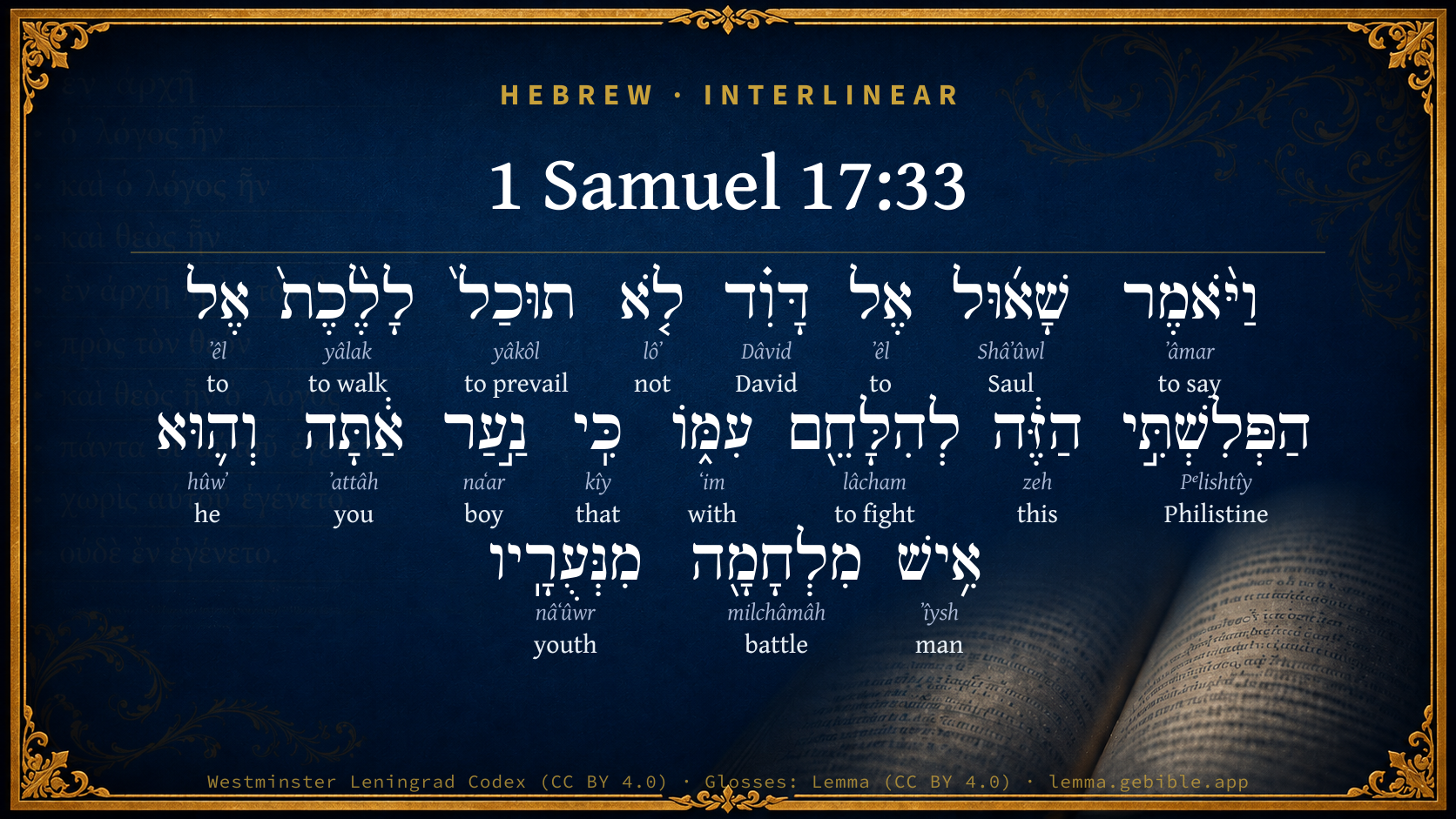
Hebrew (Westminster Leningrad Codex) 1 Samuel 17:33 appears in the Hebrew Old Testament. The text above is from the Westminster Leningrad Codex. Each word links to its Strong’s number, a concise gloss, and parsing drawn from the Open Scriptures Hebrew Bible morphology. Click any word for its full Brown-Driver-Briggs (BDB) entry.
Download image
Cite this verse

1 Samuel 17:33 (World English Bible). Public Domain. Lemma interlinear Bible study tool, https://lemma.gebible.app/v/1-samuel/17/33.

Show BibTeX & RIS
BibTeX
RIS
English Translation
Saul said to David, You are not able to go against this Philistine to fight with him; for you are but a youth, and he a man of war from his youth.
World English Bible · Public Domain
Download a study sheet

One document with this verse’s original text, its word-by-word gloss line, the meaning frame, cross-references with their text, attributed commentary, and full source and license credits — printable, and it pastes into notes with its structure intact.

This verse Autodidact and up

Study sheet (.html) Plain text (.txt)

A passage Seminary Student

Up to 50 verses in one chapter. A passage sheet keeps up to 6 commentary sources and 12 cross-references per verse, in the order this page ranks them, and says so on the sheet whenever that leaves anything out. Ask for a single verse and you get the Autodidact verse sheet above.

Everything on this page stays free to read, with no account — the sheet is a download of what is already on screen, not access to it.

Want to remove ads? Support Godless Engineer
Compare translations 3

The same verse in 3 English versions, stacked beneath the original-language interlinear above. Click any original word for its lexicon entry.

Each is an independent rendering of the whole verse — the interlinear is not word-aligned to these translations.

Highlighted words mark where these versions differ — a whole-verse word diff, not a word-by-word alignment.

  • World English Bible Public Domain
    Saul said to David, You are not able to go against this Philistine to fight with him; for you are but a youth, and he a man of war from his youth.
  • King James Version Public Domain
    And Saul said to David, Thou art not able to go against this Philistine to fight with him: for thou art but a youth, and he a man of war from his youth.
  • unfoldingWord Literal Text CC BY-SA 4.0
    But Saul said to David, “You are not able to go against this Philistine to fight with him. For you a youth, but he, a man of war from his youth.”

unfoldingWord Literal Text — © unfoldingWord, licensed CC BY-SA 4.0. Word-aligned USFM3 via Door43 (git.door43.org/unfoldingWord/en_ult).

Versions to compare (up to 4)

3 of 4 selected

Show all 18 translations

Every available English version of this verse, each an independent rendering of the whole verse.

  • World English Bible Public Domain
    Saul said to David, You are not able to go against this Philistine to fight with him; for you are but a youth, and he a man of war from his youth.
  • Berean Standard Bible Public Domain
    But Saul replied, “You cannot go out against this Philistine to fight him. You are just a boy, and he has been a warrior from his youth.”
  • Majority Standard Bible Public Domain
    But Saul replied, “You cannot go out against this Philistine to fight him. You are just a boy, and he has been a warrior from his youth.”
  • King James Version Public Domain
    And Saul said to David, Thou art not able to go against this Philistine to fight with him: for thou art but a youth, and he a man of war from his youth.
  • American Standard Version (1901) Public Domain
    And Saul said to David, Thou art not able to go against this Philistine to fight with him; for thou art but a youth, and he a man of war from his youth.
  • Revised Version (1885) Public Domain
    And Saul said to David, Thou art not able to go against this Philistine to fight with him: for thou art but a youth, and he a man of war from his youth.
  • Geneva Bible (1599) Public Domain
    And Saul sayde to Dauid, Thou art not able to goe against this Philistim to fight with him: for thou art a boye, and he is a man of warre from his youth.
  • Douay-Rheims (1899) Public Domain
    And Saul said to David: Thou art not able to withstand this Philistine, nor to fight against him: for thou art but a boy, but he is a warrior from his youth.
  • Young's Literal Translation Public Domain
    And Saul saith unto David, `Thou art not able to go unto this Philistine, to fight with him, for a youth thou `art', and he a man of war from his youth.'
  • Literal Standard Version CC BY-SA 4.0
    And Saul says to David, “You are not able to go to this Philistine, to fight with him, for you [are] a youth, and he [has been] a man of war from his youth.”
  • Unlocked Literal Bible CC BY-SA 4.0
    Saul said to David, “You are not able to go against this Philistine to fight with him; for you are only a youth, and he a man of war from his youth.”
  • unfoldingWord Literal Text CC BY-SA 4.0
    But Saul said to David, “You are not able to go against this Philistine to fight with him. For you a youth, but he, a man of war from his youth.”
  • Darby Bible Public Domain
    And Saul said to David, Thou art not able to go against this Philistine to fight with him; for thou art but a youth, and he a man of war from his youth.
  • World Messianic Bible Public Domain
    Saul said to David, “You are not able to go against this Philistine to fight with him; for you are but a youth, and he a man of war from his youth.”
  • Webster's Bible Public Domain
    And Saul said to David, Thou art not able to go against this Philistine to fight with him: for thou art but a youth, and he a man of war from his youth.
  • Free Bible Version CC BY-SA 4.0
    “You can't go out and fight this Philistine,” Saul replied. “You're just a boy, and he's a warrior trained from his youth.”
  • Bible in Basic English Public Domain
    And Saul said to David, You are not able to go out against this Philistine and have a fight with him: for you are only a boy, and he has been a man of war from his earliest days.
  • JPS Tanakh (1917) Public Domain
    And Saul said to David: 'Thou art not able to go against this Philistine to fight with him; for thou art but a youth, and he a man of war from his youth.'

Literal Standard Version (2020), Covenant Press — licensed CC BY-SA 4.0. Text via the HelloAO Bible API (eBible.org). Unlocked Literal Bible (unfoldingWord) — licensed CC BY-SA 4.0. Text via the HelloAO Bible API (eBible.org). unfoldingWord Literal Text — © unfoldingWord, licensed CC BY-SA 4.0. Word-aligned USFM3 via Door43 (git.door43.org/unfoldingWord/en_ult). Free Bible Version, Dr. Jonathan Gallagher — licensed CC BY-SA 4.0. Text via the HelloAO Bible API (eBible.org).

Word by word

More ways to search: Search by grammar → Find every occurrence → Compare this word →

Practice this passage: Drill this verse → Learn its vocabulary →

מִנְּעֻרָֽיו
nâʻûwr
H5271
“from · youth · his”
Preposition + Noun, Common, Both, Plural, Construct + Suffix, Personal, 3rd Person, Masculine, Singular
Part of Speech
Preposition + Noun
Type
Common
Gender
Both
Number
Plural
State
Construct
Full BDB Definition

Origin: properly, pass. participle from H5288 as denominative

TWOT: 1389d , 1389e

youth, early life
  1. וַיֹּ֨אמֶר ʼâmar H559 “and · to say” Conjunction + Verb, Qal, Sequential Imperfect, 3rd Person, Masculine, Singular
  2. שָׁא֜וּל Shâʼûwl H7586 “Saul” Noun, Proper
  3. אֶל ʼêl H413 “to” Preposition
  4. דָּוִ֗ד Dâvid H1732 “David” Noun, Proper
  5. לֹ֤א lôʼ H3808 “not” Particle, Negative
  6. תוּכַל֙ yâkôl H3201 “to prevail” Verb, Qal, Imperfect, 2nd Person, Masculine, Singular
  7. לָלֶ֨כֶת֙ yâlak H3212 “to walk” Preposition + Verb, Qal, Infinitive Construct
  8. אֶל ʼêl H413 “to” Preposition
  9. הַפְּלִשְׁתִּ֣י Pᵉlishtîy H6430 “the · Philistine” Particle, Definite Article + Noun, Gentilic, Masculine, Singular, Absolute
  10. הַזֶּ֔ה zeh H2088 “the · this” Particle, Definite Article + Pronoun, Demonstrative, Masculine, Singular
  11. לְהִלָּחֵ֖ם lâcham H3898 “to fight” Preposition + Verb, Niphal, Infinitive Construct
  12. עִמּ֑וֹ ʻim H5973 “with · him” Preposition + Suffix, Personal, 3rd Person, Masculine, Singular
  13. כִּֽי kîy H3588 “that” Conjunction
  14. נַ֣עַר naʻar H5288 “boy” Noun, Common, Masculine, Singular, Absolute
  15. אַ֔תָּה ʼattâh H859 “you” Pronoun, Personal, 2nd Person, Masculine, Singular
  16. וְה֛וּא hûwʼ H1931 “and · he” Conjunction + Pronoun, Personal, 3rd Person, Masculine, Singular
  17. אִ֥ישׁ ʼîysh H376 “man of” Noun, Common, Masculine, Singular, Construct
  18. מִלְחָמָ֖ה milchâmâh H4421 “battle” Noun, Common, Feminine, Singular, Absolute

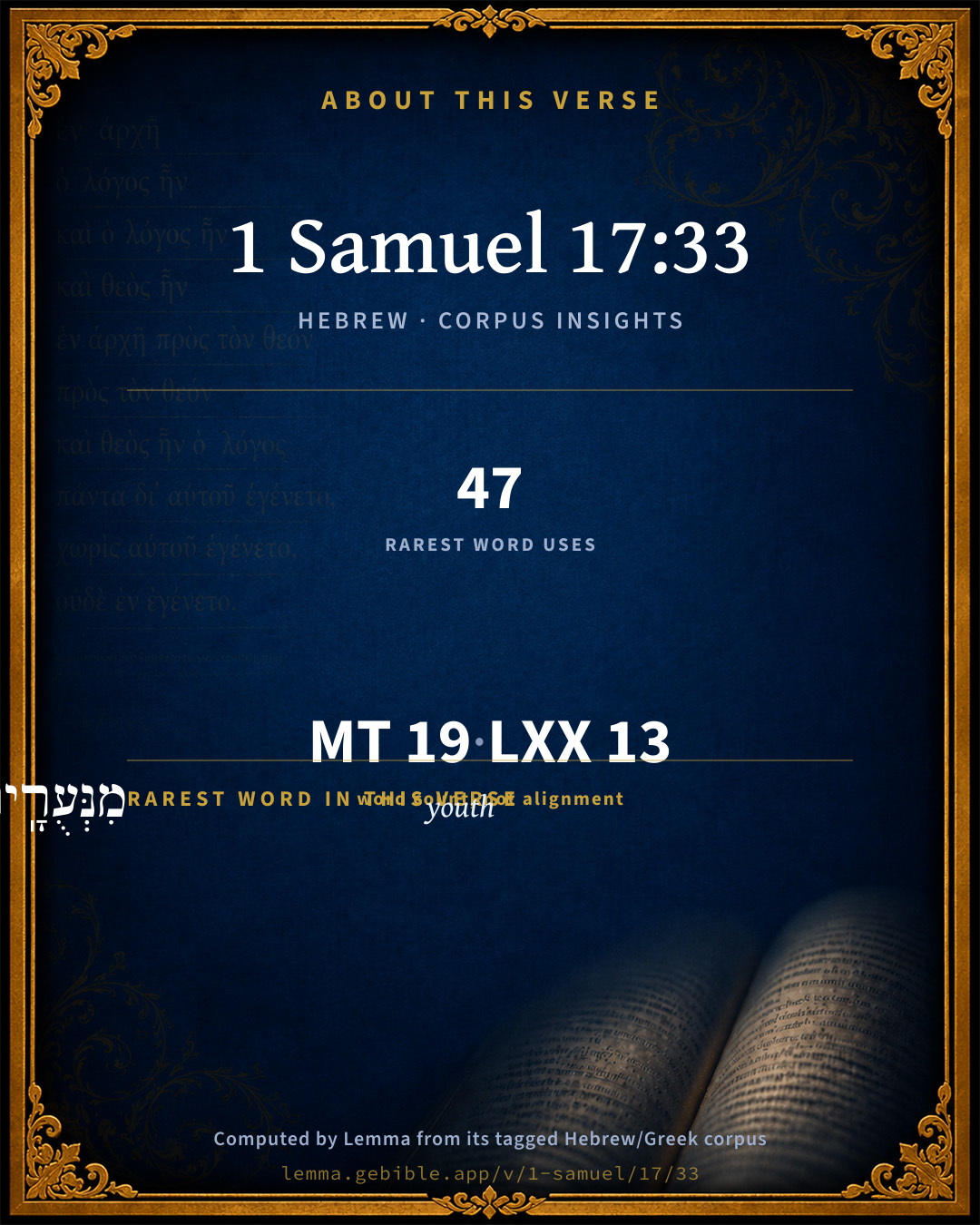
About this verse

These counts appear in no published source. They are computed here, from the morphology-tagged text and Lemma’s own curated glosses. What Lemma adds →

19
words
18
distinct lemmas
Historical
section

Shared distinctive vocabulary

מִנְּעֻרָֽיו youth H5271 occurs in 46 verses of the Hebrew Bible. Also found in:

Grammatical profile

  • 4 verbs
  • 7 nouns
  • 3 pronouns
  • 3 prepositions
  • 1 conjunction
  • 1 particle

Verb forms

  • וַיֹּ֨אמֶר Qal · Sequential Imperfect
  • תוּכַל֙ Qal · Imperfect
  • לָלֶ֨כֶת֙ Qal · Infinitive Construct
  • לְהִלָּחֵ֖ם Niphal · Infinitive Construct

Repetition

A word recurs within this verse — often emphatic in Hebrew:

  • אֶל to H413 ×2

Hebrew & Septuagint length

In English translation the verse runs 32 words from the Hebrew and 36 from the Septuagint (LXX English) — closely comparable.

A rough comparison of the two English renderings, which tokenize alike — not a word-level alignment.

Word counts can differ between the Hebrew and the Greek without any difference in meaning — e.g. the Hebrew direct-object marker אֵת has no separate Greek word, and Greek often adds the article ὁ.

In the original languages it is 19 Hebrew tokens and 13 Greek tokens — but the two are counted differently (Hebrew bundles its prefixes and suffixes into one token; the Greek is in lemma form), so that isn’t a like-for-like length.

Cross-references

6

Topical passages linked to 1 Samuel 17:33 in the Treasury of Scripture Knowledge — connected by theme and wording, ordered by reader-vote popularity; previews shown in the World English Bible.

  • Numbers 13:31 But the men who went up with him said, We aren't able to go up against the people; for they are stronger than we.
  • Deuteronomy 9:2 a people great and tall, the sons of the Anakim, whom you know, and of whom you have heard say, Who can stand before the sons of Anak?
  • Revelation 13:4 They worshiped the dragon, because he gave his authority to the beast, and they worshiped the beast, saying, "Who is like the beast? Who is able to make war with him?"
  • 1 Samuel 17:42 When the Philistine looked about, and saw David, he disdained him; for he was but a youth, and ruddy, and withal of a fair face.
  • 1 Samuel 17:56 The king said, "Inquire whose son the young man is!"
  • Psalms 11:1 In Yahweh, I take refuge. How can you say to my soul, "Flee as a bird to your mountain!"

Cross-references courtesy of OpenBible.info (CC BY 4.0).

Hebrew and Greek witnesses Masoretic Hebrew ↔ Greek Septuagint

The same verse in the two great witnesses to the Old Testament, shown verse-for-verse.

These are two independent witnesses, not word-aligned to each other, and the Septuagint is shown in lemma (dictionary) form.

Hebrew 1 Samuel 17:33 Masoretic · Westminster Leningrad Codex

וַיֹּ֨אמֶר שָׁא֜וּל אֶל דָּוִ֗ד לֹ֤א תוּכַל֙ לָלֶ֨כֶת֙ אֶל הַפְּלִשְׁתִּ֣י הַזֶּ֔ה לְהִלָּחֵ֖ם עִמּ֑וֹ כִּֽי נַ֣עַר אַ֔תָּה וְה֛וּא אִ֥ישׁ מִלְחָמָ֖ה מִנְּעֻרָֽיו

Saul said to David, You are not able to go against this Philistine to fight with him; for you are but a youth, and he a man of war from his youth.

World English Bible · Public Domain

Greek LXX 1 Samuel 17:33 Septuagint · lemma form

καί ἀναστρέφω ἀνήρ ἰσραήλ ἐκκλίνω ὀπίσω ὁ ἀλλόφυλος καί καταπατέω ὁ παρεμβολή αὐτός

And Saul said to David, You will not in anyway be able to go against this Philistine to fight with him, for you are a mere youth, and he a man of war from his youth.

LXX2012 (modern English Septuagint) · Public Domain

Hebrew: Westminster Leningrad Codex (CC BY 4.0). Greek: Septuagint (public domain); English from LXX2012 (modern English Septuagint) (Public Domain). How the Septuagint differs from the Hebrew →

Targum (Aramaic paraphrase)

1

The Targum is the ancient Jewish Aramaic paraphrase of the Hebrew Scriptures — an interpretive translation, not the Hebrew text itself. Onkelos (literal) and Pseudo-Jonathan (expansive) render the Torah, and Jonathan the Prophets. Coverage is partial: where no permissively-licensed English translation exists for a verse, only the Aramaic is shown. This is verse-level text, not a word-by-word alignment to the Hebrew.

  1. Targum Jonathan Prophets (Joshua–Malachi)
    וַאֲמַר שָׁאוּל לְדָוִד לָא תִכּוּל לְמֵיזַל עִם פְּלִשְׁתָּאָה הָדֵין לְאַגָחָא קְרָבָא עִמֵיהּ אֲרֵי יַנִיק אַתְּ וְהוּא גְבַר עָבִיד קְרָבִין מִיַנְקוּתֵיהּ:

    (no public-domain English translation for this verse)

    Targum Jonathan — Aramaic: “Mikraot Gedolot” (public domain). English: “Sefaria Community Translation” (CC0 1.0 (public-domain dedication)); “London "Chaldee Paraphrase," 1871” (public domain). Text via Sefaria.

Commentary

Notes on 1 Samuel 17:33 from classic Christian and Jewish commentators (each source and its license shown beneath its notes). The classic Christian expositions comment on the surrounding passage and are grouped to its opening verse, so a note may address several verses; the Jewish commentaries on the Tanakh (Rashi and others) are per-verse, so they appear only where the commentator wrote on this verse.

Lemma curates 59 commentaries, every one of them public domain or Creative Commons licensed, each selected and text-cleaned for this edition rather than reprinted as found. About our sources →

Trapp's Complete Commentary

John Trapp

1Sa 17:33 And Saul said to David, Thou art not able to go against this Philistine to fight with him: for thou [art but] a youth, and he a man of war from his youth.

Ver. 33. For thou art but a youth.] And therefore impar congressus Achilli, no fit match for this monster.

John Trapp, A Commentary or Exposition upon All the Books of the Old and New Testament (1647–1656) — public domain. Text from a community e-Sword module.

Geneva Bible (1599)

Geneva Bible translators

Here Satan proveth David’s faith, by the infidelity of Saul.

Geneva Bible (1599) marginal notes — public domain. Text via Bolls.life.

Adam Clarke's Commentary

Verse 33. Thou art but a youth] Supposed to be about twenty-two or twenty-three years of age.

Adam Clarke's Commentary on the Bible (1810–1826) — public domain. Text from a community e-Sword/MySword module.

Ellicott's Commentary for English Readers

(33) And Saul said to David . . .—The king evidently looked on the brave boy with love and admiration, but at first doubted in his heart the reality of David’s mission. Whether or not Saul recognised the youth as the sweet singer who had charmed away, perhaps more than once, that terrible soul malady of his which was desolating his once vigorous manhood, is doubtful. (See the Note at the end of this chapter.) He—more than any one in that armed camp—evidently felt that David possessed powers not usually bestowed on the sons of men, and was clearly disposed from the first to grant the shepherd boy’s startling petition that the honour of Israel might be entrusted to his almost child-hands. Still, Saul would talk with him, and set before him the grave perils of the terrible encounter he was so eager to engage in.

A Bible Commentary for English Readers, edited by Charles John Ellicott (1878–1897) — public domain. Text from a community e-Sword module.

The Cambridge Bible for Schools and Colleges

gen. ed. J. J. S. Perowne

33. thou art but a youth] Compared with the giant David was but a youth, though he had already shown sufficient promise to be called “a man of war” by Saul’s servant (1Sa_16:18).

The Cambridge Bible for Schools and Colleges (gen. ed. J. J. S. Perowne; Cambridge University Press, 1878–1918) — public domain. Text from a community e-Sword module.

John Gill's Exposition

And Saul said to David, thou art not able to go against this Philistine to fight with him,.... Had neither strength of body, nor skill in military affairs, to encounter with a man of his stature, and warlike genius and practice:

for thou art but a youth; some say about fourteen or sixteen years of age, but very probably about twenty, and not more, and so not only weak, but inexpert in the art of fighting:

and he a man of war from his youth; a gigantic man, trained up in, inured to, and expert in the affairs of war; so that David could not, on any account, be a competitor with him, and a match for him.

John Gill's Exposition of the Whole Bible (1746–1763) — public domain (CC PDM 1.0). Text via the HelloAO Bible API.

Haydock's Catholic Bible Commentary

Boy, compared with the giant, (Haydock) or Saul, though David might be about 22 years old, (Salien) or near 30. (Tirinus) --- St. Augustine and Theodoret say only 14 or 16. (Menochius) --- He had not yet been in the wars. (Calmet)

George Leo Haydock (1774–1849), Haydock's Catholic Family Bible and Commentary, 1859 edition — public domain. Excludes Psalms (Douay-Rheims chapter numbering differs from Protestant) and Deuterocanonical books (Catholic canon only).

Matthew Poole's English Annotations

But a youth; either,

1. For age, to wit, comparatively to Goliath, being now not much above twenty years old, as is supposed. Or rather,

2. For military skill, as the words following explain it; as if he should say, Thou art but a novice, a raw and unexperienced soldier, and therefore unable to fight with him.

Matthew Poole's English Annotations on the Holy Bible (1683–1685) — public domain. Text from a community e-Sword/MySword module.

John Wesley's Explanatory Notes

A youth - Not above 20 years old; and a novice, a raw and unexperienced soldier.

John Wesley, Explanatory Notes Upon the Whole Bible (1754–1765) — public domain. Text via the GEBible commentary corpus.

Lesson kit

Teaching starters — assembled from the data on this page, not authored interpretation. Every prompt links to the verse data it draws on. Edit before teaching.

1 Samuel, in the Historical, opens this verse with 19 words (18 distinct Hebrew lemmas). Its most distinctive word is nâʻûwr (“youth”). A historical commentator’s framing appears above. Read the whole chapter for the surrounding context.

Discussion questions

  1. The word nâʻûwr carries the sense “youth.” How does it shape the verse?
  2. Genesis 8:21 shares the word «youth» with this verse. How do the two illuminate each other?
  3. “to” occurs 2× in this one verse. What is the effect of the repetition?
  4. These translations render this verse differently; the difference is in the English rendering, not the original. What questions does that raise?
  5. The verb «וַיֹּ֨אמֶר» is Qal Sequential Imperfect. How does its form color the action?
  6. Reading how Trapp's Complete Commentary and Geneva Bible (1599) read this verse, where do the two commentators agree and where do they part?

Things to notice

Reading settings

Reading text

Shown beneath each verse's original-language words.

Old Testament
Old Testament edition

Read the OT as the Masoretic Hebrew (MT) or the Greek Septuagint (LXX).

English shown for the Greek Septuagint (in the Hebrew ↔ Greek comparison).

Comparing translations? Open the Compare panel on any verse page to stack up to four side by side.