
Proverbs 22:15

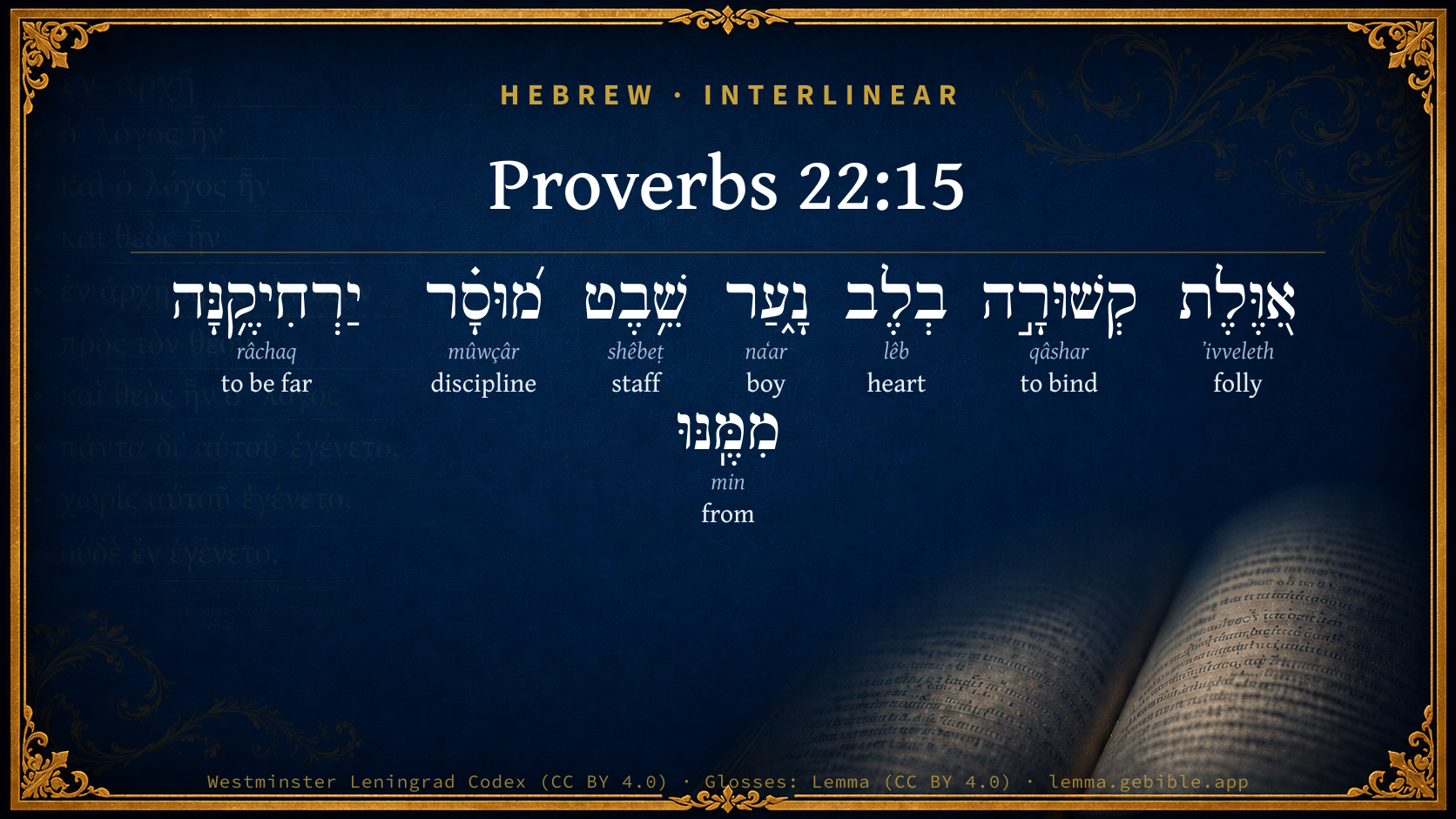
Hebrew (Westminster Leningrad Codex) Proverbs 22:15 appears in the Hebrew Old Testament. The text above is from the Westminster Leningrad Codex. Each word links to its Strong’s number, a concise gloss, and parsing drawn from the Open Scriptures Hebrew Bible morphology. Click any word for its full Brown-Driver-Briggs (BDB) entry.
Download image
Cite this verse

Proverbs 22:15 (World English Bible). Public Domain. Lemma interlinear Bible study tool, https://lemma.gebible.app/v/proverbs/22/15.

Show BibTeX & RIS
BibTeX
RIS
English Translation
Folly is bound up in the heart of a child: The rod of discipline drives it far from him.
World English Bible · Public Domain
Download a study sheet

One document with this verse’s original text, its word-by-word gloss line, the meaning frame, cross-references with their text, attributed commentary, and full source and license credits — printable, and it pastes into notes with its structure intact.

This verse Autodidact and up

Study sheet (.html) Plain text (.txt)

A passage Seminary Student

Up to 50 verses in one chapter. A passage sheet keeps up to 6 commentary sources and 12 cross-references per verse, in the order this page ranks them, and says so on the sheet whenever that leaves anything out. Ask for a single verse and you get the Autodidact verse sheet above.

Everything on this page stays free to read, with no account — the sheet is a download of what is already on screen, not access to it.

Want to remove ads? Support Godless Engineer
Compare translations 3

The same verse in 3 English versions, stacked beneath the original-language interlinear above. Click any original word for its lexicon entry.

Each is an independent rendering of the whole verse — the interlinear is not word-aligned to these translations.

Highlighted words mark where these versions differ — a whole-verse word diff, not a word-by-word alignment.

  • World English Bible Public Domain
    Folly is bound up in the heart of a child: The rod of discipline drives it far from him.
  • King James Version Public Domain
    Foolishness is bound in the heart of a child; but the rod of correction shall drive it far from him.
  • unfoldingWord Literal Text CC BY-SA 4.0
    Folly is bound up in the heart of a boy; the rod of discipline will cause it to be far away from him.

unfoldingWord Literal Text — © unfoldingWord, licensed CC BY-SA 4.0. Word-aligned USFM3 via Door43 (git.door43.org/unfoldingWord/en_ult).

Versions to compare (up to 4)

3 of 4 selected

Show all 18 translations

Every available English version of this verse, each an independent rendering of the whole verse.

  • World English Bible Public Domain
    Folly is bound up in the heart of a child: The rod of discipline drives it far from him.
  • Berean Standard Bible Public Domain
    Foolishness is bound up in the heart of a child, but the rod of discipline drives it far from him.
  • Majority Standard Bible Public Domain
    Foolishness is bound up in the heart of a child, but the rod of discipline drives it far from him.
  • King James Version Public Domain
    Foolishness is bound in the heart of a child; but the rod of correction shall drive it far from him.
  • American Standard Version (1901) Public Domain
    Foolishness is bound up in the heart of a child; `But' the rod of correction shall drive it far from him.
  • Revised Version (1885) Public Domain
    Foolishness is bound up in the heart of a child; but the rod of correction shall drive it far from him.
  • Geneva Bible (1599) Public Domain
    Foolishnesse is bounde in the heart of a childe: but the rodde of correction shall driue it away from him.
  • Douay-Rheims (1899) Public Domain
    Folly is bound up in the heart of a child, and the rod of correction shall drive it away.
  • Young's Literal Translation Public Domain
    Folly is bound up in the heart of a youth, The rod of chastisement putteth it far from him.
  • Literal Standard Version CC BY-SA 4.0
    Folly is bound up in the heart of a youth, || The rod of discipline puts it far from him.
  • Unlocked Literal Bible CC BY-SA 4.0
    Foolishness is bound up in the heart of a child, but the rod of discipline drives it far away.
  • unfoldingWord Literal Text CC BY-SA 4.0
    Folly is bound up in the heart of a boy; the rod of discipline will cause it to be far away from him.
  • Darby Bible Public Domain
    Folly is bound in the heart of a child; the rod of correction shall drive it far from him.
  • World Messianic Bible Public Domain
    Folly is bound up in the heart of a child; the rod of discipline drives it far from him.
  • Webster's Bible Public Domain
    Foolishness is bound in the heart of a child; but the rod of correction shall drive it far from him.
  • Free Bible Version CC BY-SA 4.0
    Children are naturally foolish; physical correction helps them to see sense.
  • Bible in Basic English Public Domain
    Foolish ways are deep-seated in the heart of a child, but the rod of punishment will send them far from him.
  • JPS Tanakh (1917) Public Domain
    Foolishness is bound up in the heart of a child; but the rod of correction shall drive it far from him.

Literal Standard Version (2020), Covenant Press — licensed CC BY-SA 4.0. Text via the HelloAO Bible API (eBible.org). Unlocked Literal Bible (unfoldingWord) — licensed CC BY-SA 4.0. Text via the HelloAO Bible API (eBible.org). unfoldingWord Literal Text — © unfoldingWord, licensed CC BY-SA 4.0. Word-aligned USFM3 via Door43 (git.door43.org/unfoldingWord/en_ult). Free Bible Version, Dr. Jonathan Gallagher — licensed CC BY-SA 4.0. Text via the HelloAO Bible API (eBible.org).

Word by word

More ways to search: Search by grammar → Find every occurrence → Compare this word →

Practice this passage: Drill this verse → Learn its vocabulary →

About this verse

These counts appear in no published source. They are computed here, from the morphology-tagged text and Lemma’s own curated glosses. What Lemma adds →

8
words
8
distinct lemmas
Wisdom
section

Notable vocabulary

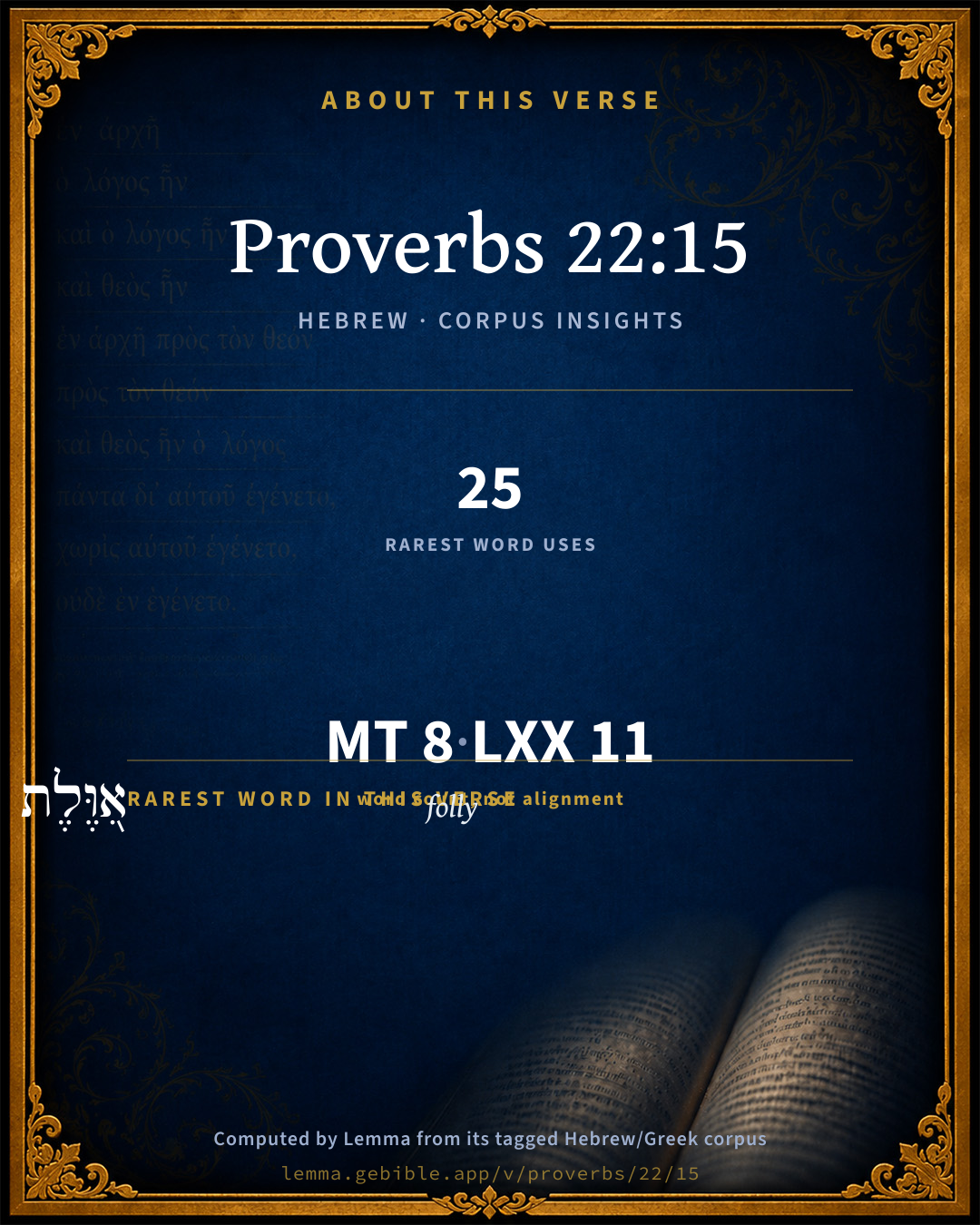
The rarest word here is אִ֭וֶּלֶת folly H200 — appearing just 25 times in the whole Hebrew Bible.

Shared distinctive vocabulary

אִ֭וֶּלֶת folly H200 occurs in 24 verses of the Hebrew Bible. Also found in:

Grammatical profile

  • 2 verbs
  • 5 nouns
  • 1 preposition

Verb forms

  • קְשׁוּרָ֣ה Qal · Participle Passive
  • יַרְחִיקֶ֥נָּה Hiphil · Imperfect

Hebrew & Septuagint length

In English translation the verse runs 19 words from the Hebrew and 19 from the Septuagint (LXX English) — the same length.

A rough comparison of the two English renderings, which tokenize alike — not a word-level alignment.

Word counts can differ between the Hebrew and the Greek without any difference in meaning — e.g. the Hebrew direct-object marker אֵת has no separate Greek word, and Greek often adds the article ὁ.

In the original languages it is 8 Hebrew tokens and 11 Greek tokens — but the two are counted differently (Hebrew bundles its prefixes and suffixes into one token; the Greek is in lemma form), so that isn’t a like-for-like length.

Cross-references

8

Topical passages linked to Proverbs 22:15 in the Treasury of Scripture Knowledge — connected by theme and wording, ordered by reader-vote popularity; previews shown in the World English Bible.

  • Proverbs 13:24 One who spares the rod hates his son, But one who loves him is careful to discipline him.
  • Proverbs 29:15 The rod of correction gives wisdom, But a child left to himself causes shame to his mother.
  • Proverbs 19:18 Discipline your son, for there is hope; Don't be a willing party to his death.
  • Proverbs 23:13–14 Don't withhold correction from a child. If you punish him with the rod, he will not die.
  • Proverbs 29:17 Correct your son, and he will give you peace; Yes, he will bring delight to your soul.
  • Hebrews 12:10–11 For they indeed, for a few days, punished us as seemed good to them; but he for our profit, that we may be partakers of his holiness.
  • Psalms 51:5 Behold, I was brought forth in iniquity. In sin my mother conceived me.
  • Ephesians 2:3 among whom we also all once lived in the lust of our flesh, doing the desires of the flesh and of the mind, and were by nature children of wrath, even as the rest.

Cross-references courtesy of OpenBible.info (CC BY 4.0).

Hebrew and Greek witnesses Masoretic Hebrew ↔ Greek Septuagint

The same verse in the two great witnesses to the Old Testament, shown verse-for-verse.

These are two independent witnesses, not word-aligned to each other, and the Septuagint is shown in lemma (dictionary) form.

Hebrew Proverbs 22:15 Masoretic · Westminster Leningrad Codex

אִ֭וֶּלֶת קְשׁוּרָ֣ה בְלֶב נָ֑עַר שֵׁ֥בֶט מ֝וּסָ֗ר יַרְחִיקֶ֥נָּה מִמֶּֽנּוּ

Folly is bound up in the heart of a child: The rod of discipline drives it far from him.

World English Bible · Public Domain

Greek LXX Proverbs 22:15 Septuagint · lemma form

ἄνοια ἐκἅπτω καρδία νέος ῥάβδος δέ καί παιδεία μακράν ἀπό αὐτός

Folly is attached to the heart of a child, but the rod and instruction are then far from him.

LXX2012 (modern English Septuagint) · Public Domain

On this verse, The Pulpit Commentary discusses the Septuagint’s reading. Read the note in Commentary ↓

Hebrew: Westminster Leningrad Codex (CC BY 4.0). Greek: Septuagint (public domain); English from LXX2012 (modern English Septuagint) (Public Domain). How the Septuagint differs from the Hebrew →

Commentary

Notes on Proverbs 22:15 from classic Christian and Jewish commentators (each source and its license shown beneath its notes). The classic Christian expositions comment on the surrounding passage and are grouped to its opening verse, so a note may address several verses; the Jewish commentaries on the Tanakh (Rashi and others) are per-verse, so they appear only where the commentator wrote on this verse.

Lemma curates 59 commentaries, every one of them public domain or Creative Commons licensed, each selected and text-cleaned for this edition rather than reprinted as found. About our sources →

Trapp's Complete Commentary

John Trapp

Pro 22:15 Foolishness [is] bound in the heart of a child; [but] the rod of correction shall drive it far from him.

Ver. 15. Foolishness is bound in the heart, &c.] As a pack or fardle is bound to a horse’s back. Error and folly be the knots of Satan, wherewith he ties children to the stake to be burnt in hell. Better see their brains dashed out against the stones, saith one, than suffer the ignorance of God to abide in their heads. Therefore, that we may loose the bands of death and works of the devil, parents must bring their sons in their arms, and their daughters upon their shoulders, to the house of God, that they may learn to know him. {Isa 49:22} They must also see to their profiting, and exact of them a daily growth, "nurturing," as well as nourishing them, {Eph 6:4} - the one being as needful as the other, - and using the rod where words will not do; so to chase away that evil by chastisement, seasoned with admonition, and seconded with prayer, that else will prove pernicious to their souls. Eli brought up his sons to bring down his house. David’s sons were undone by their father’s fondness. A fair hand, we say, makes a foul wound. Correction is a kind of cure, saith Aristotle; {a} and God usually blesseth it to that purpose. "Corrections of instructions are the way of life." {Pro 6:23}

{a} Iατρεια τις η παιδεια.

John Trapp, A Commentary or Exposition upon All the Books of the Old and New Testament (1647–1656) — public domain. Text from a community e-Sword module.

The Biblical Illustrator

Joseph S. Exell

Pro_22:15

Foolishness is bound in the heart of a child; but the rod of cor-rection shall drive it far from him.

Foolishness and the remedy

I. The evil deplored.

1. Of what does this foolishness consist? Wrong wishes, purposes, thoughts, pride, sin, levity, etc.

2. Where does this foolishness lurk? In the heart. Deep in the nature, among the affections. Hidden, secret, for some time unknown. In the heart of a child, even of a little child.

3. How this foolishness is held in the heart--bound. Children often hold to their folly with great tenacity; bound with other things, and spoiling what is good, like the thorns that choked the good seed.

4. How this foolishness in the heart shows itself. In evil tempers, in vain murmurings, in ungodly deeds, in wilfulness and obstinacy, etc.

5. The consequences to which, if uncorrected, this foolishness will lead. The forming of a character that men will despise and God hate. The embittering of the present life and the ruin of the life to come.

II. The remedy prescribed.

1. As a general rule correction is needed.

2. Literally, the rod required is often the whip for the fools back. It will often accomplish what words will not.

3. It may stand for wholesome discipline of many kinds. Learn--

(1) Seek the removal of folly from the heart by thought and prayer.

(2) In every correction, remember that it is for our good.

(3) Consider that the father who uses the rod does not willingly afflict.

(4) Better that folly be driven from us, than that we should be banished from heaven. (Handbook of S.S. Addresses.)

The Biblical Illustrator, edited by Joseph S. Exell (c. 1880s–1900s) — public domain. Text from a community e-Sword module.

Joseph Benson's Commentary

Pro 22:15. Foolishness is bound in the heart of a child — Is fixed and settled there, as being born with him, and rooted in his very nature; but the rod, &c., shall drive it far from him — The smart of punishment will make him weary of his sin, and watchful against it. “Ignorance, weakness, inclination to evil, corruption of heart,” says Calmet, “are maladies which accompany all men from their birth; education, instruction, correction,” to which we must add divine grace, earnestly asked of God, and received, “cure them, or diminish, very much, their ill effects.”

Joseph Benson's Commentary on the Old and New Testaments (1811–1818) — public domain. Text from a community e-Sword module.

The Preacher's Complete Homiletical Commentary

Joseph S. Exell (gen. ed.)

MAIN HOMILETICS OF Pro_22:15

A FACT STATED AND A DUTY INFERRED

I. Human nature in its most attractive form contains latent depravity. The flower of the thistle is beautiful to look upon, and its downy seed is an apparently harmless object, and one worthy of admiration, as it rears its head among the corn. But how much power of mischief is wrapped up in that ball of soft down, if it is allowed to scatter its seed unchecked. A young lion is as pretty and harmless a creature as a kitten, but what ferocious instincts lie dormant there. A child is the most attractive and innocent of human creatures. As we look upon its guileless face we can hardly connect the idea of sin with its nature, and hardly believe it possible that the most depraved man or woman in the world was once as pure and stainless. But the Book of God tells us that even that young soul is tainted with the disease that infects all our race, and what the Book says is confirmed by the experience of all who have had anything to do with training children. The foolishness of self-will very soon shows itself, and the little one early gives proof that he or she is a true child of Adam by rebelling against the restraints with which it is lovingly surrounded, and desiring at all risks to eat forbidden fruit. In the fairest child-form now living upon the globe there may be hidden seeds which, when fully developed, will fill the world with terror and misery.

II. That this depraved tendency is deeply rooted in the child’s nature. It is “bound” in it or “fettered” to it by a cable of many strands, or a chain of heavy links—it is not a slight preference for the wrong which can easily be overruled—not a garment put on which the wearer can easily be persuaded to put off again, but a part of the very nature—a bent of all the faculties of the soul.

III. The disease is one which will yield to proper treatment. We do not suppose that Solomon’s words teach that any corrective rod will be potent enough to drive out all tendency to go wrong, inasmuch as experience and observation contradict it, but the same experience and observation confirm the truth that wise correction in youth is mighty in its moral power, and may so bring the child round to the love of the true and the good, that its own efforts will second the efforts of the parent, and it will itself turn upon the enemies within, being fully convinced that the self-will that is bound up in its own heart is the greatest folly to which it is liable. There are many who, looking back upon the wise and loving chastisement of a tender parent, can bear testimony to the truth of this proverb. On this subject see also on chap. Pro_13:24, page 334.

OUTLINES AND SUGGESTIVE COMMENTS

The rod of correction is proper to drive away no other foolishness than that which is of a moral nature. But how comes wickedness to be so firmly bound, and strongly fixed, in the hearts of children, if it be not there naturally.—Jonathan Edwards.

Bound, or fettered.… Firmly knit, closely settled; well tied in; that is, fixed in the childish spirit; this is the sense of nearly all the commentators. Of course, there are great difficulties at once. The fact theologically is just the opposite. “Folly” is not fixed in the childish heart; but stronger and stronger in periods afterwards. Why not, pro vero, “bound?” In much the majority of texts it means simply “tied down,” or “fettered.” “Folly is fettered in the heart of a child”; that is, tied down, and, in many ways, repressed. This is literally the case. It is weak, and hemmed in, and easier to grapple with and drag out of the soul in youth than at any other period.—Miller.

Observe—it is foolishness, not childishness. That might belong to an unfallen child. No moral guilt attaches to the recollection—“When I was a child, I spake as a child, I understood as a child, I thought as a child.” (1Co_13:11.) “A child is to be punished”—as Mr. Scott wisely observed—“not for being a a child, but for being a wicked child.” Comparative ignorance, the imperfect and gradual opening of the faculties, constitute the nature, not the sinfulness of the child. The holy “child increased in wisdom.” (Luk_2:52.) But foolishness is the mighty propensity to evil—imbibing wrong principles, forming bad habits, entering into an ungodly course. It means the very root and essence of sin in a fallen nature—the folly of being revolted from a God of love.—Bridges.

The Preacher's Complete Homiletical Commentary (gen. ed. Joseph S. Exell; Funk & Wagnalls, c. 1892) — public domain (pre-1929). A full-Bible homiletical/sermon-outline anthology covering 65 of 66 books (2 John is absent from the source module). Text from a community e-Sword module.

Tyndale Open Study Notes

Tyndale Open Resources

22:15 Wisdom is learned, not inherited or innate. It takes discipline to change foolishness into wisdom.

Tyndale Open Study Notes — © Tyndale Open Resources, licensed CC BY-SA 4.0. Text via the HelloAO Bible API.

Geneva Bible (1599)

Geneva Bible translators

He is naturally given unto it.

Geneva Bible (1599) marginal notes — public domain. Text via Bolls.life.

Matthew Henry's Commentary

We have here two very sad considerations: - 1. That corruption is woven into our nature. Sin is foolishness; it is contrary both to our right reason and to our true interest. It is in the heart; there is an inward inclination to sin, to speak and act foolishly. It is in the heart of children; they bring it into the world with them; it is what they were shapen and conceived in. It is not only found there, but it is bound there; it is annexed to the heart (so some); vicious dispositions cleave closely to the soul, are bound to it as the cion to the stock into which it is grafted, which quite alters the property. There is a knot tied between the soul and sin, a true lover's knot; they two became one flesh. It is true of ourselves, it is true of our children, whom we have begotten in our own likeness. O God! thou knowest this foolishness. 2. That correction is necessary to the cure of it. It will not be got out by fair means and gentle methods; there must be strictness and severity, and that which will cause grief. Children need to be corrected, and kept under discipline, by their parents; and we all need to be corrected by our heavenly Father (Heb 12:6, Heb 12:7), and under the correction we must stroke down folly and kiss the rod.

Matthew Henry's Commentary on the Whole Bible (1708–1710) — public domain (CC PDM 1.0). Text via the HelloAO Bible API.

Jamieson, Fausset & Brown

Robert Jamieson, A. R. Fausset & David Brown

is bound--or firmly fixed. Chastisement deters from crime and so leads to reformation of principle.

Jamieson, Fausset & Brown — Commentary Critical and Explanatory on the Whole Bible (1871) — public domain (CC PDM 1.0). Text via the HelloAO Bible API.

Ellicott's Commentary for English Readers

(15) Foolishness is bound in the heart of a child.—Self-will is meant. (See above on Pro_1:7.) Children have to be taught to yield their wills to others.

A Bible Commentary for English Readers, edited by Charles John Ellicott (1878–1897) — public domain. Text from a community e-Sword module.

The Cambridge Bible for Schools and Colleges

gen. ed. J. J. S. Perowne

15. bound] Better, bound up, R.V. Comp., for the force of the Heb. word, Gen_44:30.

The Cambridge Bible for Schools and Colleges (gen. ed. J. J. S. Perowne; Cambridge University Press, 1878–1918) — public domain. Text from a community e-Sword module.

John Gill's Exposition

Foolishness is bound in the heart of a child,.... That is, sin, the greatest of all folly; this is naturally in the heart of man; it is in the heart of a child, it is in him from his infancy; it is bound in his heart, it is rooted and riveted in him, being conceived in sin, and shapen in iniquity; it is what cleaves close to him, and he has a strong affection for and desire after: the imagination of man's heart is evil from his youth, Gen 8:21; so that he is not easily brought off of sin, or becomes wise;

but the rod of correction shall drive it far from him; the rod used by parents, for the correction of sin and folly, is a means of making children wise, and of restraining the folly that is bound up in them; and of reclaiming them from those sinful ways, which the folly of their hearts leads them to, and so in some measure of driving it far from them.

John Gill's Exposition of the Whole Bible (1746–1763) — public domain (CC PDM 1.0). Text via the HelloAO Bible API.

Haydock's Catholic Bible Commentary

Folly. Ignorance and innate corruption are corrected by a good education.

George Leo Haydock (1774–1849), Haydock's Catholic Family Bible and Commentary, 1859 edition — public domain. Excludes Psalms (Douay-Rheims chapter numbering differs from Protestant) and Deuterocanonical books (Catholic canon only).

Matthew Poole's English Annotations

Is bound; is fixed and settled there, as being born with him, and rooted in his very nature, and not plucked up without great difficulty and diligence.

The rod of correction shall drive it far from him; the smart of punishment makes him weary of his sin, and watchful against it.

Matthew Poole's English Annotations on the Holy Bible (1683–1685) — public domain. Text from a community e-Sword/MySword module.

Whedon's Commentary on the Bible

Daniel D. Whedon

15. Foolishness — Probably meaning perverseness, rather than folly. Ignorance, weakness, inclination to evil, corruption of heart, are maladies which accompany all men from their birth. Pious education, instruction, correction, (with the divine blessing,) cure them, or, at least, diminish very much their ill effects. (Calmet.)

Is bound — Perhaps inheres; or, metaphorically, “is bound there,” as with cords — fixed there. Miller suggests this idea — that folly is bound in the heart of a child: and, therefore, more easily controlled than in older persons. This, however, seems contrary to the sense of the word else-where, which implies strength rather than weakness. But if any conjunction is needed, yet will express the relation of the two clauses better than but. Compare on this Gen_30:42. For the general subject compare Pro_13:24; Pro_19:18; Pro_23:13; Pro_29:15; Pro_29:17.

Daniel D. Whedon (gen. ed.), Commentary on the Old and New Testaments (1874–1909) — public domain. Text from a community e-Sword module.

The Pulpit Commentary

Foolishness is bound in the heart of a child. Foolishness (ivveleth) here implies the love of mischief, the waywardness and self-will, belonging to children, bound up in their very nature. Septuagint, "Folly is attached (exhptai ) to the heart of the young," in which version Cornelius a Lapide sees an allusion to the ornament hung by fond parents round the neck of a child whom they were inclined to spoil rather than to train in self-denying ways. To such a child folly adheres as closely as the bulla with which he is decorated. But the rod of correction shall drive it far from him. Judicious education overcomes this natural tendency, by punishing it when exhibited, and imparting wisdom and piety. (see on Pro_13:24 and Pro_19:18; and comp. Pro_23:13 Pro_29:15; Ecc 30:1, etc) The LXX pursue their notion of the the indulgent parents letting the child have his own way, for they render the last clause, "But the rod and discipline are far from him.

See homily on Pro_13:24. C.

The Pulpit Commentary (1880–1919), ed. H.D.M. Spence-Jones & Joseph S. Exell — public domain. Text from a community e-Sword module.

John Wesley's Explanatory Notes

Bound - Is fixed and settled there, as being born with him, and rooted in his very nature.

John Wesley, Explanatory Notes Upon the Whole Bible (1754–1765) — public domain. Text via the GEBible commentary corpus.

Keil & Delitzsch

C. F. Keil & F. Delitzsch

15 Folly is bound to the heart of a child;

The rod of correction driveth it forth.

Folly, i.e., pleasure in stupid tricks, silly sport, and foolish behaviour, is the portion of children as such; their heart is as yet childish, and folly is bound up in it. Education first driveth forth this childish, foolish nature (for, as Menander says:

Ὁ μὴ δαρεὶς ἄνθρωπος οὐ παιδεύεται),

and if effects this when it is unindulgently severe: the שׁבט מוּסר (vid., Pro 23:13) removeth אוּלת from the heart, for it imparts intelligence and makes wise (Pro 29:15). The lxx is right in rendering 16a: ἄνοια ἐξῆπται (from ἐξάπτειν) καρδίας νέου; but the Syr. has "here mangled the lxx, and in haste has read ἀνοίᾳ ἐξίπταται: folly makes the understanding of the child fly away" (Lagarde).

Keil & Delitzsch — Biblical Commentary on the Old Testament (1861–1891) — public domain (CC PDM 1.0). Text via the HelloAO Bible API. (Old Testament only.)

Bridges on Proverbs

Charles Bridges

What parent, what instructor of children, will not bear sad, but decisive, testimony to the foolishness of the child? ’A little innocent’ — is the miscalled name of fondness and fancy. One only of Adam’s race, and he — adored be his name! preserved by his holy conception (Luk 1:35 ) — lays claim to it. Foolishness is the birthright of all besides. The early development of waywardness and passion, — even before the power of speech;†1 before the child is capable of observing and imitating those around him — is a touching, but undeniable, evidence of the innate principle. Resistance therefore cannot begin too early. Education should commence even in the cradle.

Observe — it is foolishness, not childishness. That might belong to an unfallen child. No moral guilt attaches to the recollection — "When I was a child, I spake as a child, I understood as a child, I thought as a child." (1Co 13:11 .) ’A child is to be punished’ — as Mr. Scott wisely observed — ’not for being a child, but for being a wicked child.’†2 Comparative ignorance, the imperfect and gradual opening of the faculties, constitute the nature, not the sinfulness of the child. The holy "child increased in wisdom." (Luk 2:52 .) But foolishness is the mighty propensity to evil — imbibing wrong principles, forming bad habits, entering into an ungodly course. It means the very root and essence of sin in a fallen nature — the folly of being revolted from a God of love. It includes all the sins of which a child is capable — lying, deceit (Psa 58:3 ), willfulness, perverseness, want of submission to authority (Job 11:12 ) — a fearful aptness for evil, and revulsion against good. It is not the sheet of pure white paper; not the innocent, or even the tractable, creature, easily guided by proper means, that we have before us; but a little heart full of sin, containing all the seeds of future evil, multiplying to a fruitful harvest.

We delight in our children’s harmless play. We would make ourselves one with them in their sportiveness. But this foolishness — visible every hour before our eyes — never let it be a subject of sport, but of deep and constant sadness. Nor let childhood plead as an excuse for this foolishness. Children’s sins may not be chargeable with the guilt of adult responsibility; yet God has awfully shewn, that they are sins against Himself. The judgment on the "little children" of Bethel is enough to make "both the ears of" thoughtless parents "to tingle." (2Ki 2:23-24 .)

But whence the origin of this foolishness? "Look unto the rock whence we are hewn." Look unto "Adam" our father, and unto "Eve that bare us." (Isa 51:1-2 .) As is the root, so are the branches. As is the fountain, so are the waters. Our nature was poisoned at the spring. Our sinful parent, having lost God’s image, could only "beget a son after his image" (Gen 5:3 ) — a sinner begetting a sinner. "That which is born of the flesh is flesh" (Joh 3:6 ), and could be nothing else. Now "who can bring a clean thing out of an unclean?" (Job 14:4 ; Job 25:4 .) The creature therefore is produced into being with a radical enmity to God; — "by nature" therefore "a child of wrath." (Eph 2:3 .) The entail is held from "our first father," and can never be cut off. There is no division of this sad inheritance. Each of his children has the whole. His Maker testifies, that he is "a transgressor from the womb, that his heart is evil from his youth."†3 In shame he acknowledges the testimony — "Behold! I was shapen in iniquity, and in sin did my mother conceive me." (Psa 51:5 .) If the joy of a child’s birth blot out the remembrance of its pain and sorrow (Joh 16:21 ), yet must not this joy be chastened in the humbling recollection of what the child brings into the world — foolishness? That self-will, that proud independence, that shakes the very foundations of society, is the birth-sin of our fallen nature. Nor does it lie only on the surface, like some childish habits, easily corrected. It is bound in the child’s heart, ’held firmly there by chains invincible to human power.’†4 It is incorporated into his very nature. And so various are its forms, so subtle its workings, that the wisest parent is often at a loss how to detect and treat the evil.

The prescribed remedy, however, is clear. It is vain to bid the foolishness depart. And little inclination is there in the child himself to drive it far away. The rod of correction is distinctly named, and repeatedly inculcated, as God’s own means for this important end.†5 And surely the thought of having been an instrument of producing nature envenomed against a God of love must constrain the parent to use the means thus divinely appointed for destroying the deadly poison.

Only let the child see, that, as with our heavenly Father, love is the ruling principle;†6 that we follow the example of the wisest and best of parents, that we use his rod for driving men from foolishness;†7 that, like him, we "chasten, not for our pleasure, but for our child’s profit" (Heb 12:10 ); not from caprice or passion, but from tenderness to his soul. Use the LORD’s means, and we can then, what otherwise we cannot do, wait in faith for the promised blessing. Many a stirring movement of the flesh will be restrained. Man’s will will be put down, and God’s will gain the supremacy. Shame of sin will issue in abhorrence; and in this sorrow and humiliation the path of wisdom will be chosen, loved, and followed. (Pro 29:15 .)

We have indeed no right to demand to see God’s reasons for his ordinance. Yet we may be permitted, in part at least, to trace its workings. Habits are of immense value, as wrought into the character by the Holy Spirit. But there must be a beginning, and the use of means to fix the principle. If a child be punished for falsehood; to avoid future punishment, he abstains, and speaks the truth. As he advances, he finds the blessing and comfort of the right path. He learns gradually to speak truth from a higher motive. Insensibly his conscience acquires tenderness respecting it; and it becomes a principle in his character. Thus the rod of correction performs its work with permanent benefit.

Footnotes:

†1 Augustine mentions a living demonstration of the fall - the sight of an infant, before it could speak, shewing an evident look of envy and passion towards another infant about to share its nourishment. He adds - in reference to himself - ’When? I beseech thee, O my God, in what places, when or where, was I innocent?’ - Confess. lib. i. c. 7.

†2 Life, p. 622.

†3 Isa 48:8. Gen 8:21 .

†4 Cartwright in loco.

†5 Pro 19:18; Pro 23:13-14 ; Pro 29:17 .

†6 Pro 13:24, with Pro 3:11-12 .

†7 2Ch 33:12-13 .

Charles Bridges, An Exposition of the Book of Proverbs (1846) — public domain. Text from a community e-Sword module.

Kretzmann's Popular Commentary

Paul E. Kretzmann

v. 15. Foolishness is bound in the heart of a child, the reference being not merely to silly pranks and senseless escapades, but to the sinfulness of a child’s nature, which shows itself in evil words and acts; but the rod of correction, which the Lord has entrusted to parents, as His representatives, for the use of which they are responsible to Him, shall drive it far from him, judicious punishment properly administered will put the dread of evil in the heart of the child.

Paul E. Kretzmann, Popular Commentary of the Bible (1921–1924) — public domain. Text from a community e-Sword module.

unfoldingWord translationNotes

Door43 World Missions Community

Foolishness is bound up in the heart of a child

"The heart of a child is full of foolish things"

the rod of discipline

The writer speaks of a parent using any form of discipline as if that parent were hitting the child with a wooden rod. (See: Metonymy)

drives it far away

The writer speaks as if foolishness were a person that another person could use a physical rod to drive away. AT: "will make a child wise" (See: Metaphor)

to increase his wealth

"to become richer" or "to gain more money"

gives to rich people

"gives money to rich people"

will come to poverty

This is an idiom. AT: "will become poor" (See: Idiom)

translationWords

fool

heart

children

rod

discipline

oppress

unfoldingWord translationNotes — © Distant Shores Media and the Door43 World Missions Community, licensed CC BY-SA 4.0. Source: git.door43.org/Door43/en_tn.

Lesson kit

Teaching starters — assembled from the data on this page, not authored interpretation. Every prompt links to the verse data it draws on. Edit before teaching.

Proverbs, in the Wisdom, opens this verse with 8 words (8 distinct Hebrew lemmas). Its most distinctive word is ʼivveleth (“folly”). A historical commentator’s framing appears above. Read the whole chapter for the surrounding context.

Discussion questions

  1. How does “folly” (ʼivveleth) shape what this verse is saying?
  2. How does Psalms 38:5, which shares the word «folly», read alongside this verse?
  3. These translations render this verse differently. What is at stake in choosing one wording over another?
  4. «קְשׁוּרָ֣ה» is a Qal Participle Passive verb. How does that grammatical form shape the action described?
  5. Compare how Trapp's Complete Commentary and The Biblical Illustrator read this verse. Where do they agree or differ?

Things to notice

Reading settings

Reading text

Shown beneath each verse's original-language words.

Old Testament
Old Testament edition

Read the OT as the Masoretic Hebrew (MT) or the Greek Septuagint (LXX).

English shown for the Greek Septuagint (in the Hebrew ↔ Greek comparison).

Comparing translations? Open the Compare panel on any verse page to stack up to four side by side.