Judges 17:7

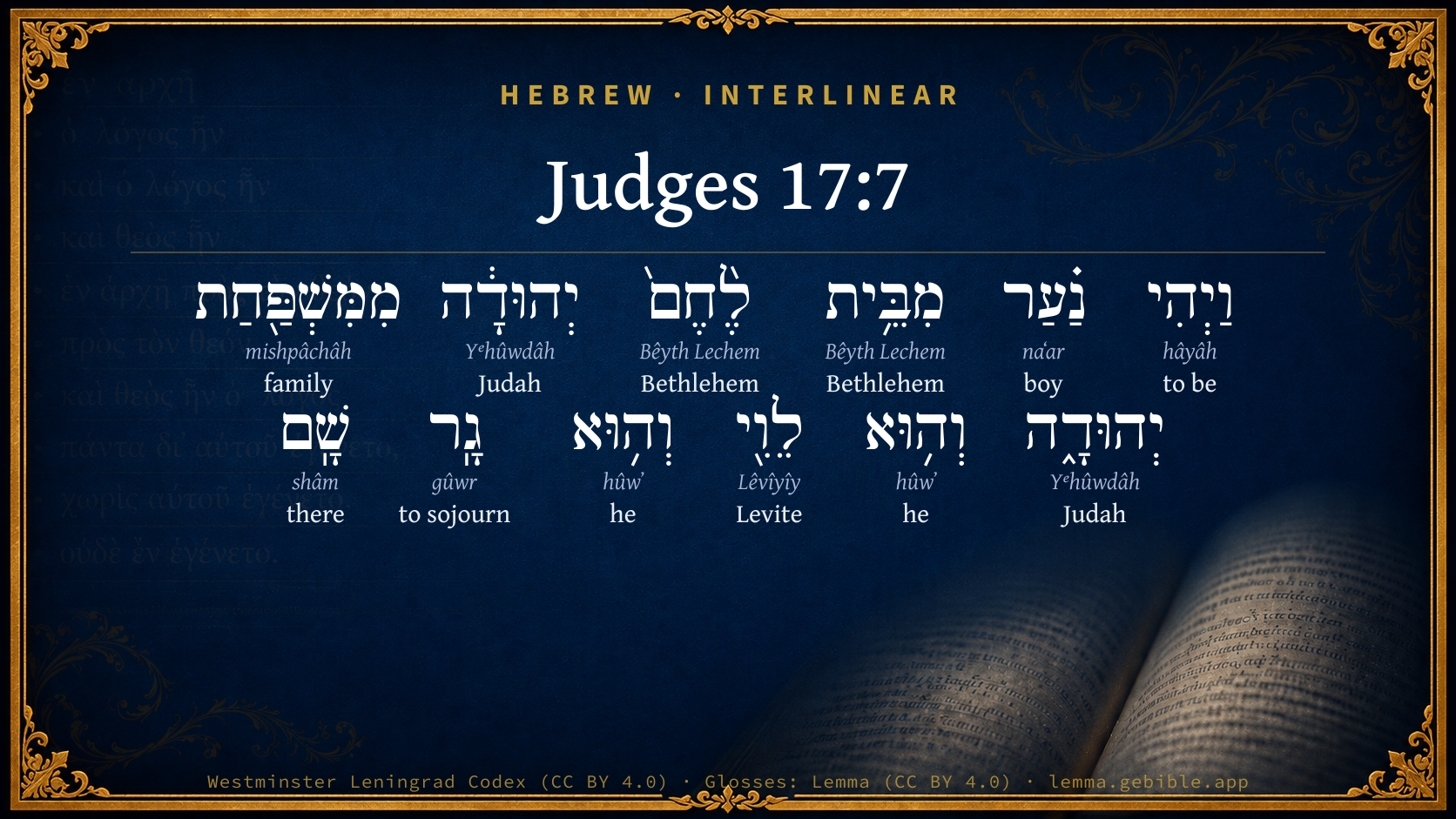
Hebrew (Westminster Leningrad Codex) Judges 17:7 appears in the Hebrew Old Testament. The text above is from the Westminster Leningrad Codex. Each word links to its Strong’s number, a concise gloss, and parsing drawn from the Open Scriptures Hebrew Bible morphology. Click any word for its full Brown-Driver-Briggs (BDB) entry.
Download image
Cite this verse

Judges 17:7 (World English Bible). Public Domain. Lemma interlinear Bible study tool, https://lemma.gebible.app/v/judges/17/7.

Show BibTeX & RIS
BibTeX
RIS
English Translation
There was a young man out of Bethlehem Judah, of the family of Judah, who was a Levite; and he sojourned there.
World English Bible · Public Domain
Download a study sheet

One document with this verse’s original text, its word-by-word gloss line, the meaning frame, cross-references with their text, attributed commentary, and full source and license credits — printable, and it pastes into notes with its structure intact.

This verse Autodidact and up

Study sheet (.html) Plain text (.txt)

A passage Seminary Student

Up to 50 verses in one chapter. A passage sheet keeps up to 6 commentary sources and 12 cross-references per verse, in the order this page ranks them, and says so on the sheet whenever that leaves anything out. Ask for a single verse and you get the Autodidact verse sheet above.

Everything on this page stays free to read, with no account — the sheet is a download of what is already on screen, not access to it.

Want to remove ads? Support Godless Engineer
Compare translations 3

The same verse in 3 English versions, stacked beneath the original-language interlinear above. Click any original word for its lexicon entry.

Each is an independent rendering of the whole verse — the interlinear is not word-aligned to these translations.

Highlighted words mark where these versions differ — a whole-verse word diff, not a word-by-word alignment.

  • World English Bible Public Domain
    There was a young man out of Bethlehem Judah, of the family of Judah, who was a Levite; and he sojourned there.
  • King James Version Public Domain
    And there was a young man out of Bethlehemjudah of the family of Judah, who was a Levite, and he sojourned there.
  • unfoldingWord Literal Text CC BY-SA 4.0
    Now there was a young man from Bethlehem Judah, from the clan of Judah. Now he was a Levite, and he was sojourning there.

unfoldingWord Literal Text — © unfoldingWord, licensed CC BY-SA 4.0. Word-aligned USFM3 via Door43 (git.door43.org/unfoldingWord/en_ult).

Versions to compare (up to 4)

3 of 4 selected

Show all 18 translations

Every available English version of this verse, each an independent rendering of the whole verse.

  • World English Bible Public Domain
    There was a young man out of Bethlehem Judah, of the family of Judah, who was a Levite; and he sojourned there.
  • Berean Standard Bible Public Domain
    And there was a young Levite from Bethlehem in Judah who had been residing within the clan of Judah.
  • Majority Standard Bible Public Domain
    And there was a young Levite from Bethlehem in Judah who had been residing within the clan of Judah.
  • King James Version Public Domain
    And there was a young man out of Bethlehemjudah of the family of Judah, who was a Levite, and he sojourned there.
  • American Standard Version (1901) Public Domain
    And there was a young man out of Beth-lehem-judah, of the family of Judah, who was a Levite; and he sojourned there.
  • Revised Version (1885) Public Domain
    And there was a young man out of Beth-lehem-judah, of the family of Judah, who was a Levite, and he sojourned there.
  • Geneva Bible (1599) Public Domain
    There was also a yong man out of Bethlehem Iudah, of the familie of Iudah: who was a Leuite, and soiourned there.
  • Douay-Rheims (1899) Public Domain
    There was also another young man of Bethlehem Juda, of the kindred thereof: and he was a Levite, and dwelt there.
  • Young's Literal Translation Public Domain
    And there is a young man of Beth-Lehem-Judah, of the family of Judah, and he `is' a Levite, and he `is' a sojourner there.
  • Literal Standard Version CC BY-SA 4.0
    And there is a young man of Beth-Lehem-Judah, of the family of Judah, and he [is] a Levite, and he [is] a sojourner there.
  • Unlocked Literal Bible CC BY-SA 4.0
    Now there was a young man of Bethlehem in Judah, of the clan of Judah, who was a Levite. He stayed there to fulfill his duties.
  • unfoldingWord Literal Text CC BY-SA 4.0
    Now there was a young man from Bethlehem Judah, from the clan of Judah. Now he was a Levite, and he was sojourning there.
  • Darby Bible Public Domain
    Now there was a young man of Bethlehem in Judah, of the family of Judah, who was a Levite; and he sojourned there.
  • World Messianic Bible Public Domain
    There was a young man out of Bethlehem Judah, of the family of Judah, who was a Levite; and he lived there.
  • Webster's Bible Public Domain
    And there was a young man out of Beth-lehem-judah of the family of Judah, who was a Levite, and he sojourned there.
  • Free Bible Version CC BY-SA 4.0
    One young man, a Levite from the tribe of Judah had been living in Bethlehem in Judah,
  • Bible in Basic English Public Domain
    Now there was a young man living in Beth-lehem-judah, of the family of Judah and a Levite, who was not a townsman of the place.
  • JPS Tanakh (1917) Public Domain
    And there was a young man out of Beth-lehem in Judah — in the family of Judah — who was a Levite, and he sojourned there.

Literal Standard Version (2020), Covenant Press — licensed CC BY-SA 4.0. Text via the HelloAO Bible API (eBible.org). Unlocked Literal Bible (unfoldingWord) — licensed CC BY-SA 4.0. Text via the HelloAO Bible API (eBible.org). unfoldingWord Literal Text — © unfoldingWord, licensed CC BY-SA 4.0. Word-aligned USFM3 via Door43 (git.door43.org/unfoldingWord/en_ult). Free Bible Version, Dr. Jonathan Gallagher — licensed CC BY-SA 4.0. Text via the HelloAO Bible API (eBible.org).

Word by word

More ways to search: Search by grammar → Find every occurrence → Compare this word →

Practice this passage: Drill this verse → Learn its vocabulary →

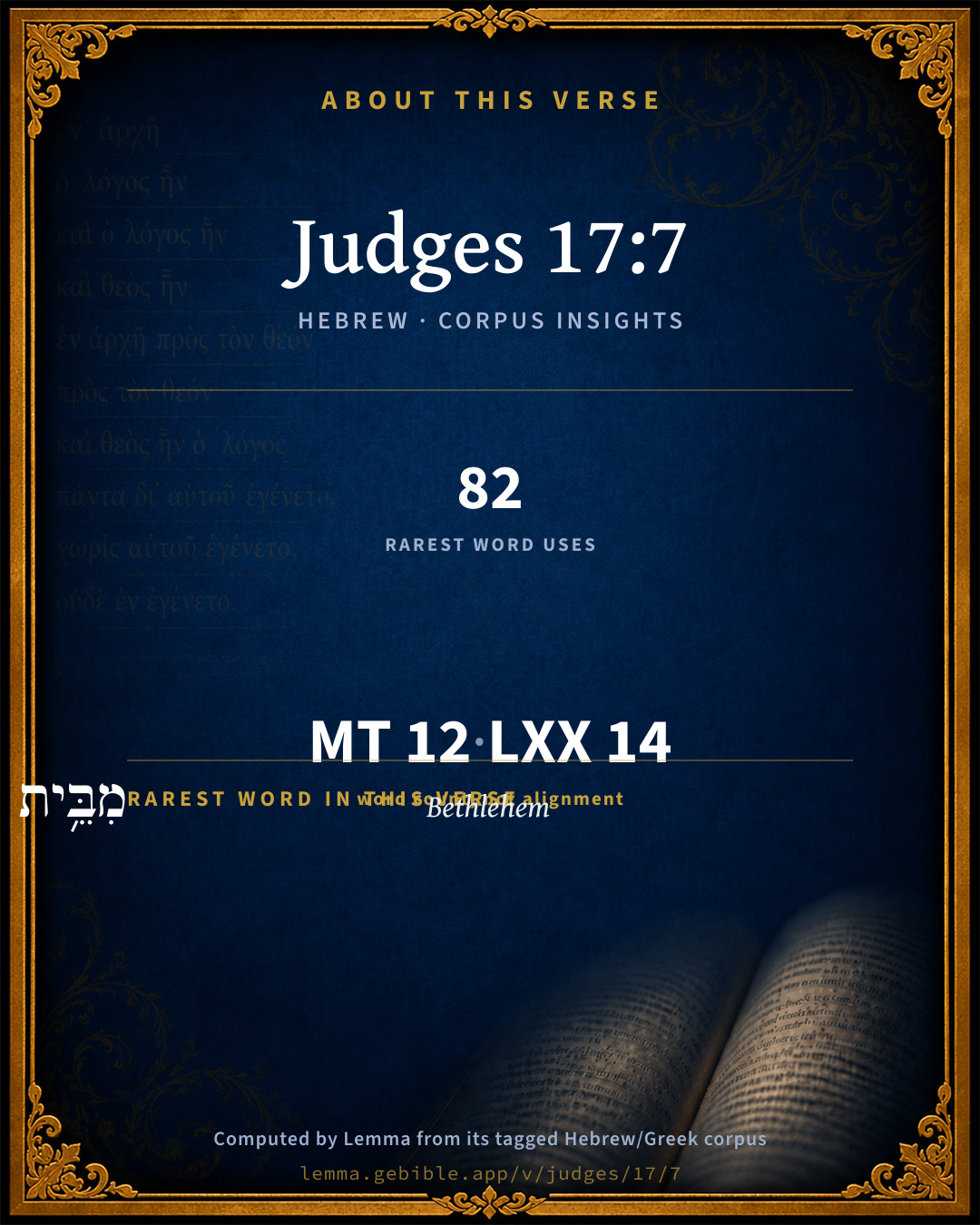
מִבֵּ֥ית
Bêyth Lechem
H1035
“from · Bethlehem”
Preposition + Noun, Proper
Part of Speech
Preposition + Noun
Type
Proper
Full BDB Definition

Origin: from H1004 and H3899

TWOT: 241b

Beth-lehem = "house of bread (food)" - a city in Judah, birthplace of David - a place in Zebulun
  1. וַיְהִי hâyâh H1961 “and · to be” Conjunction + Verb, Qal, Sequential Imperfect, 3rd Person, Masculine, Singular
  2. נַ֗עַר naʻar H5288 “boy” Noun, Common, Masculine, Singular, Absolute
  3. לֶ֨חֶם֙ Bêyth Lechem H1035 “Bethlehem” Noun, Proper
  4. יְהוּדָ֔ה Yᵉhûwdâh H3063 “Judah” Noun, Proper
  5. מִמִּשְׁפַּ֖חַת mishpâchâh H4940 “from · family of” Preposition + Noun, Common, Feminine, Singular, Construct
  6. יְהוּדָ֑ה Yᵉhûwdâh H3063 “Judah” Noun, Proper
  7. וְה֥וּא hûwʼ H1931 “and · he” Conjunction + Pronoun, Personal, 3rd Person, Masculine, Singular
  8. לֵוִ֖י Lêvîyîy H3881 “Levite” Noun, Gentilic, Masculine, Singular, Absolute
  9. וְה֥וּא hûwʼ H1931 “and · he” Conjunction + Pronoun, Personal, 3rd Person, Masculine, Singular
  10. גָֽר gûwr H1481 “sojourning” Verb, Qal, Participle Active, Masculine, Singular, Absolute
  11. שָֽׁם shâm H8033 “there” Adverb

About this verse

These counts appear in no published source. They are computed here, from the morphology-tagged text and Lemma’s own curated glosses. What Lemma adds →

12
words
9
distinct lemmas
Historical
section

Grammatical profile

  • 2 verbs
  • 7 nouns
  • 2 pronouns
  • 1 adverb

Verb forms

  • וַיְהִי Qal · Sequential Imperfect
  • גָֽר Qal · Participle Active

Repetition

Words recur within this verse — often emphatic in Hebrew:

  • מִבֵּ֥ית Bethlehem H1035 ×2
  • יְהוּדָ֔ה Judah H3063 ×2
  • וְה֥וּא he H1931 ×2

Hebrew & Septuagint length

In English translation the verse runs 22 words from the Hebrew and 23 from the Septuagint (LXX English) — closely comparable.

A rough comparison of the two English renderings, which tokenize alike — not a word-level alignment.

Word counts can differ between the Hebrew and the Greek without any difference in meaning — e.g. the Hebrew direct-object marker אֵת has no separate Greek word, and Greek often adds the article ὁ.

In the original languages it is 12 Hebrew tokens and 14 Greek tokens — but the two are counted differently (Hebrew bundles its prefixes and suffixes into one token; the Greek is in lemma form), so that isn’t a like-for-like length.

Cross-references

7

Topical passages linked to Judges 17:7 in the Treasury of Scripture Knowledge — connected by theme and wording, ordered by reader-vote popularity; previews shown in the World English Bible.

  • Ruth 1:1–2 It happened in the days when the judges judged, that there was a famine in the land. A certain man of Bethlehem Judah went to sojourn in the country of Moab, he, and his wife, and his two sons.
  • Micah 5:2 But you, Bethlehem Ephrathah, Being small among the clans of Judah, Out of you one will come forth to me that is to be ruler in Israel; Whose goings forth are from of old, from everlasting.
  • Matthew 2:1 Now when Jesus was born in Bethlehem of Judea in the days of Herod the king, behold, wise men from the east came to Jerusalem, saying,
  • Matthew 2:5–6 They said to him, "In Bethlehem of Judea, for thus it is written through the prophet,
  • Genesis 35:19 Rachel died, and was buried in the way to Ephrath (the same is Bethlehem).
  • Joshua 19:15 and Kattath, and Nahalal, and Shimron, and Idalah, and Bethlehem: twelve cities with their villages.
  • Judges 19:1–2 It happened in those days, when there was no king in Israel, that there was a certain Levite sojourning on the farther side of the hill-country of Ephraim, who took to him a concubine out of Bethlehem Judah.

Cross-references courtesy of OpenBible.info (CC BY 4.0).

Hebrew and Greek witnesses Masoretic Hebrew ↔ Greek Septuagint

The same verse in the two great witnesses to the Old Testament, shown verse-for-verse.

These are two independent witnesses, not word-aligned to each other, and the Septuagint is shown in lemma (dictionary) form.

Hebrew Judges 17:7 Masoretic · Westminster Leningrad Codex

וַיְהִי נַ֗עַר מִבֵּ֥ית לֶ֨חֶם֙ יְהוּדָ֔ה מִמִּשְׁפַּ֖חַת יְהוּדָ֑ה וְה֥וּא לֵוִ֖י וְה֥וּא גָֽר שָֽׁם

There was a young man out of Bethlehem Judah, of the family of Judah, who was a Levite; and he sojourned there.

World English Bible · Public Domain

Greek LXX Judges 17:7 Septuagint · lemma form

καί γίγνομαι νεανίας ἐκ βηθλεεμ δῆμος ιουδα καί αὐτός λευίτης καί οὗτος παραοἰκέω ἐκεῖ

And there was a young man in Bethleem of the tribe of Juda, and he was a Levite, and he was sojourning there.

LXX2012 (modern English Septuagint) · Public Domain

On this verse, Ellicott's Commentary for English Readers discusses the Septuagint’s reading. Read the note in Commentary ↓

Hebrew: Westminster Leningrad Codex (CC BY 4.0). Greek: Septuagint (public domain); English from LXX2012 (modern English Septuagint) (Public Domain). How the Septuagint differs from the Hebrew →

Targum (Aramaic paraphrase)

1

The Targum is the ancient Jewish Aramaic paraphrase of the Hebrew Scriptures — an interpretive translation, not the Hebrew text itself. Onkelos (literal) and Pseudo-Jonathan (expansive) render the Torah, and Jonathan the Prophets. Coverage is partial: where no permissively-licensed English translation exists for a verse, only the Aramaic is shown. This is verse-level text, not a word-by-word alignment to the Hebrew.

  1. Targum Jonathan Prophets (Joshua–Malachi)
    וַהֲוָה עוּלֵימָא מִבֵּית לֶחֶם יְהוּדָה מִזַרְעִית יְהוּדָה וְהוּא לֵוִי וְהוּא דָר תַמָן:

    (no public-domain English translation for this verse)

    Targum Jonathan — Aramaic: “Mikraot Gedolot” (public domain). English: “Sefaria Community Translation” (CC0 1.0 (public-domain dedication)); “London "Chaldee Paraphrase," 1871” (public domain). Text via Sefaria.

Commentary

Notes on Judges 17:7 from classic Christian and Jewish commentators (each source and its license shown beneath its notes). The classic Christian expositions comment on the surrounding passage and are grouped to its opening verse, so a note may address several verses; the Jewish commentaries on the Tanakh (Rashi and others) are per-verse, so they appear only where the commentator wrote on this verse.

Lemma curates 59 commentaries, every one of them public domain or Creative Commons licensed, each selected and text-cleaned for this edition rather than reprinted as found. About our sources →

Matthew Henry's Commentary

We have here an account of Micah's furnishing himself with a Levite for his chaplain, either thinking his son, because the heir of his estate, too good to officiate, or rather, because not of God's tribe, not good enough. Observe,

I. What brought this Levite to Micah. By his mother's side he was of the family of Judah, and lived at Bethlehem among his mother's relations (for that was not a Levites' city), or, upon some other account, as a stranger or inmate, sojourned there, Jdg 17:7. Thence he went to sojourn where he could find a place, and in his travels came to the house of Micah in Mount Ephraim, Jdg 17:8. Now, 1. Some think it was his unhappiness that he was under a necessity of removing, either because he was persecuted and abused, or rather neglected and starved, at Bethlehem. God had made plentiful provision for the Levites, but the people withheld their dues, and did not help them into the possession of the cities assigned to them; so that they were reduced to straits, and no care was taken for their relief. Israel's forsaking God began with forsaking the Levites, which therefore they are warned against, Deu 12:19. It is a sign religion is going to decay when good ministers are neglected and at a loss for a livelihood. But, 2. It seems rather to have been his fault and folly, that he loved to wander, threw himself out where he was, and forfeited the respect of his friends, and, having a roving head, would go to seek his fortune, as we say. We cannot conceive that things had yet come to such a pass among them that a Levite should be poor, unless it was his own fault. As those are fit to be pitied that would fix but may not, so those are fit to be punished that might fix but will not. Unsettledness being, one would think, a constant uneasiness, it is strange that any Israelite, especially any Levite, should affect it.

II. What bargain Micah made with him. Had he not been well enough content with his son for his priest, he would have gone or sent abroad to enquire out a Levite, but now he only takes hold of one that drops into his hands, which showed that he had no great zeal in the matter. It is probable that this rambling Levite had heard, in the country, of Micah's house of gods, his graven and molten image, which, if he had had any thing of the spirit of a Levite in him, would have brought him thither to reprove Micah for his idolatry, to tell how directly contrary it was to the law of God, and how it would bring the judgments of God upon him; but instead of this, like a base and degenerate branch of that sacred tribe, thither he goes to offer his service, with, Have you any work for a Levite? for I am out of business, and go to sojourn where I may find a place; all he aimed at was to get bread, not to do good, Jdg 17:9. Micah courts him into his family (v. 10), and promises him, 1. Good preferment: Be unto me a father and a priest. Though a young man, and taken up at the door, yet, if he take him for a priest, he will respect him as a father, so far is he from setting him among his servants. He asks not for his credentials, takes no time to enquire how he behaved in the place of his last settlement, considers not whether, though he was a Levite, yet he might not be of such a bad character as to be a plague and scandal to his family, but thinks, though he should be ever so great a rake, he might serve for a priest to a graven image, like Jeroboam's priest of the lowest of the people, Kg1 12:31. No marvel if those who can make any thing serve for a god can also make any thing serve for a priest. 2. A tolerable maintenance. He will allow him meat, and drink, and clothes, a double suit, so the word is in the margin, a better and a worse, one for every day's wear and one for holy days, and ten shekels, about twenty-five shillings, a year for spending money - a poor salary in comparison of what God provided for the Levites that behaved well; but those that forsake God's service will never better themselves, nor find a better master. The ministry is the best calling but the worst trade in the world.

III. The Levite's settlement with him (Jdg 17:11): He was content to dwell with the man; though his work was superstitious and his wages were scandalous, he objected against neither, but thought himself happy that he had lighted on so good a house. Micah, thinking himself holier than any of his neighbours, presumed to consecrate this Levite, v. 12. As if his building, furnishing, and endowing this chapel authorized him, not only to appoint the person that should officiate there, but to confer those orders upon him which he had no right to give nor the other to receive. And now he shows him respect as a father and tenderness as a son, and is willing thus to make up the deficiency of the coin he gave him.

IV. Micah's satisfaction in this (Jdg 17:13): Now know I that the Lord will do me good (that is, he hoped that his new establishment would gain reputation among his neighbours, which would turn to his advantage, for he would share in the profit of his altar; or, rather, he hoped that God would countenance and bless him in all he put his hand unto) because I have a Levite to be my priest. 1. He thought it was a sign of God's favour to him and his images that he had so opportunely sent a Levite to his door. Thus those who please themselves with their own delusions, if Providence unexpectedly bring any thing to their hands that furthers them in their evil way, are too apt to infer thence that God is pleased with them. 2. He thought now that the error of his priesthood was amended all was well, though he still retained his graven and molten image. Note, Many deceive themselves into a good opinion of their state by a partial reformation. They think they are as good as they should be, because, in some one particular instance, they are not so bad as they have been, as if the correcting of one fault would atone for their persisting in all the rest. 3. He thought the making of a Levite into a priest was a very meritorious act, which really was a presumptuous usurpation, and every provoking to God. Men's pride, and ignorance, and self-flattery, will undertake, not only to justify, but magnify and sanctify, the most daring impieties and invasions upon the divine prerogatives. With much reason might Micah have said, "Now may I fear that God will curse me, because I have debauched one of his own tribe, and drawn him into the worship of a graven image;" yet for this he hopes God will do him good. 4. He thought that having a Levite in the house with him would of course entitle him to the divine favour. Carnal hearts are apt to build too much upon their external privileges, and to conclude that God will certainly do them good because they are born of godly parents, dwell in praying families, are linked in society with those that are very good, and sit under a lively ministry; whereas all this is but like having a Levite to be their priest, which amounts to no security at all that God will do them good, unless they be good themselves, and make a good use of these advantages.

Matthew Henry's Commentary on the Whole Bible (1708–1710) — public domain (CC PDM 1.0). Text via the HelloAO Bible API.

Trapp's Complete Commentary

John Trapp

Jdg 17:7 And there was a young man out of Bethlehemjudah of the family of Judah, who [was] a Levite, and he sojourned there.

Ver. 7. And there was a young man.] Puer: so he is called ratione ministerii {Exo 33:11} saith Junius. And why not for his folly? as Gen 34:19. Neque distulit puer? A novice he was, Cereus in vitium flecti, one that would murder souls for a morsel of bread; {Eze 13:19} which was the worse in him, because this was Jonathan, the nephew of Moses the man of God: for men are therefore worse than others, because they ought to be better. See Jdg 18:30.

John Trapp, A Commentary or Exposition upon All the Books of the Old and New Testament (1647–1656) — public domain. Text from a community e-Sword module.

Joseph Benson's Commentary

Jdg 17:7. Beth-lehem-judah — So called here, as Mat 2:1; Mat 2:5, to distinguish it from Bethlehem in Zebulun. There he was born and bred. Of Judah — That is, of or belonging to the tribe of Judah; not by birth, for he was a Levite; but by his habitation and ministration. For the Levites were dispersed among all the tribes: and this man’s lot fell into the tribe of Judah. Sojourned — So he expresseth it, because this was not the proper place of his abode, this being no Levitical city.

Joseph Benson's Commentary on the Old and New Testaments (1811–1818) — public domain. Text from a community e-Sword module.

Geneva Bible (1599)

Geneva Bible translators

Which Bethlehem was in the tribe of Judah.

Geneva Bible (1599) marginal notes — public domain. Text via Bolls.life.

Jamieson, Fausset & Brown

Robert Jamieson, A. R. Fausset & David Brown

Beth-lehem-judah--so called in contradistinction to a town of the same name in Zebulun (Jos 19:15).

of the family--that is, tribe.

of Judah--Men of the tribe of Levi might connect themselves, as Aaron did (Exo 6:23), by marriage with another tribe; and this young Levite belonged to the tribe of Judah, by his mother's side, which accounts for his being in Beth-lehem, not one of the Levitical cities.

Jamieson, Fausset & Brown — Commentary Critical and Explanatory on the Whole Bible (1871) — public domain (CC PDM 1.0). Text via the HelloAO Bible API.

Adam Clarke's Commentary

Verse 7. Of the family of Judah] The word family may be taken here for tribe; or the young man might have been of the tribe of Judah by his mother, and of the tribe of Levi by his father, for he is called here a Levite; and it is probable that he might have officiated at Shiloh, in the Levitical office. A Levite might marry into any other tribe, providing the woman was not an heiress.

Adam Clarke's Commentary on the Bible (1810–1826) — public domain. Text from a community e-Sword/MySword module.

Ellicott's Commentary for English Readers

(7) A young man.—Later on in the story we, as it were incidentally, make the astonishing discovery that this young man was no other than a grandson of Moses.

Out of Beth-lehem-judah.—So called to distinguish it from the Bethlehem in Zebulon (Jos_19:15). (See Note on Jdg_12:8.) In later times, when Bethlehem was famous as David’s birthplace, and the other Bethlehem had sunk into insignificance, the descriptive addition is often dropped.

Of the family of Judah.—It may be doubted whether this refers to the “young man” or to Bethlehem, or whether it ought not, as in some MSS. and versions (LXX., Cod. B, and Syriac), to be omitted. If it applies to the young Levite, it must mean that he did not live in one of the Levitic cities, which belonged to his own family (the family of Gershom), which were in the northern and eastern tribes (Jos_21:6), but in Judah, and therefore was ranked in civil matters as belonging to that tribe. Homes in the tribe of Judah were assigned to the priests alone (Jos_21:9-42).

He sojourned there.—Comp. Jdg_19:1. The curse had been pronounced on the tribe of Levi: “I will divide them in Jacob, and scatter them in Israel” (Gen_49:7).

A Bible Commentary for English Readers, edited by Charles John Ellicott (1878–1897) — public domain. Text from a community e-Sword module.

The Cambridge Bible for Schools and Colleges

gen. ed. J. J. S. Perowne

7. a young man … sojourned there] i.e. in the neighbourhood of Micah’s house. Technically the word sojourner (Hebr. gçr) means one who lives under the protection of a tribe to which he does not belong by birth. This young man, a Levite of Judah, was settled in the place where Micah lived, became intimate with him (Jdg_17:11 b), and was installed as his domestic priest (Jdg_17:12 a); we hear of the young man again in Jdg_18:3; Jdg_18:15. He cannot be the same person as the wandering Levite, also of Judah, called the man in Jdg_17:8, who, in the course of his journey in search of employment, happened to arrive at Micah’s house, and for a fixed stipend agreed to take up his abode there (Jdg_17:8-11 a, 12b–13); his subsequent history is given in Jdg_18:4-6; Jdg_18:18-30. It is evident that two parallel narratives are interwoven here without altogether losing their distinctive features.

of Beth-lehem-judah, of the family of Judah … a Levite] Beth-lehem was a centre for Levites at this time, cf. Jdg_17:8, Jdg_19:1; Jdg_19:18. The memory of a connexion between certain Levitical families and the southern clans has been preserved by the genealogies: thus among the Levitical families mentioned in Num_26:58, the Libnites, Hebronites, Korahites are named after places in the territory of Judah (Jos_15:42; Jos_21:13; 1Ch_2:43).

How could the young man have belonged to the family of Judah and at the same time have been a Levite? (a) Wellhausen and Moore think that at this period Levite was the designation not of a tribe, but of a priestly caste open to any one1[61]

[61] So Driver, Exodus, p. 29, in agreement with McNeile, Exodus, p. lxvi. f.

. The young man is described as a Judaean by birth and a Levite by profession; for ‘in early times it was not the pedigree, but the art, that was the essential thing’ (Moore). The old tribe of Levi had been broken up (see Genesis 34; Gen_49:5-7); the scattered members of it followed the priestly calling; out of this nucleus a priestly ‘tribe’ of Levi was created by a genealogical fiction. (b) There may be some error in the text. The LXX. cod. B omits the first Judah; the Peshitto omits of the family of Judah, merely, no doubt, because the description seemed unintelligible Budde, however, suggests that the text has deliberately been altered: originally it ran of the family of Moses, and this was afterwards modified out of respect for the traditional founder of the priesthood. A certain amount of support for such an alteration is given by Jdg_18:30; but Judah is hardly the name which would obviously occur as a substitute for Moses. It seems best after all to take the text as it stands, and to suppose that there was a time when ‘Levite’ was the official title of one who had received the training of a priest, regardless of the tribe to which he belonged by birth (McNeile). The evidence suggests that the scattered members of the tribe of Levi, like those of Simeon, had attached themselves to the Judaean settlements. The break up of these two tribes is accounted for in Genesis 34; Gen_49:5-7, which refer to an episode apparently in the early days of the occupation of Canaan, and therefore not far removed in date from the present narrative. How the Levi of this ugly story came to be the priestly tribe is one of the obscure problems of Hebrew history; see HDB. s.v. Levi. Judah is here a family, the term applied to the small clan of the Danites (Jdg_13:2 n.). It was not till later, probably not before the time of David, that the family of Judah grew into the tribe; Beth-lehem and the neighbourhood was most likely its ancient seat.

The Cambridge Bible for Schools and Colleges (gen. ed. J. J. S. Perowne; Cambridge University Press, 1878–1918) — public domain. Text from a community e-Sword module.

John Gill's Exposition

And there was a young man out of Bethlehemjudah,.... As there were two Bethlehems, one in the tribe of Zebulun, Jos 19:15 and another in the tribe of Judah, the place here designed, Judah is added to it, to distinguish it from the other:

of the family of Judah: which refers either to the young man, who was by his father's side a Levite, and by his mother's side, as Jarchi thinks, of the tribe of Judah, which seems very probable, though the genealogies of families were not reckoned from the mother; wherefore he might be so called because he had lived chiefly in the tribe of Judah, and particularly at Bethlehem; but Kimchi, and several other Jewish commentators, refer this to the city of Bethlehem, that was of the tribe of Judah, family being put for the tribe; or belonged to the children of Judah; though one would think there was no need to have added this, since it was fully expressed before by calling it Bethlehemjudah; the former sense therefore seems best:

who was a Levite; his father being, as before observed, of that tribe, though his mother might be of the tribe of Judah: and he sojourned there; that is, at Bethlehem; he was not a native, nor an inhabitant there, but a sojourner, it not being a Levitical city.

John Gill's Exposition of the Whole Bible (1746–1763) — public domain (CC PDM 1.0). Text via the HelloAO Bible API.

Albert Barnes' Notes on the Bible

The Hebrew words for “he sojourned there” are, שׁם גר gêr shām, which words are used Jdg 18:30 in the genealogy of this young Levite, whose name was “Jonathan, the son of Gershom” (גרשׁם gêreshôm). Hence, some read here, “the son of Gershom.”

Albert Barnes' Notes on the Bible (1834–1885) — public domain. Text from a community e-Sword/MySword module.

Haydock's Catholic Bible Commentary

Another, is not in Hebrew or the Septuagint but it refers to the former young priest, the son of Michas, whose place he took. --- Thereof. It is uncertain whether this be spoken of the city or of the man. Some think that this Levite’s mother was of Juda, though his father was the son of Moses, chap. xviii. 30. (Calmet) --- He was poor, as the people neglected to pay tithes, and he imitated their irreligion, being of a fickle temper. He was yet single, (ver. 10 though he married among the Danites, chap. xviii. 30. (Menochius) --- Being a Levite, he is esteemed fitter for the priesthood; so Protestants receive with joy an apostate Catholic priest. (Worthington)

George Leo Haydock (1774–1849), Haydock's Catholic Family Bible and Commentary, 1859 edition — public domain. Excludes Psalms (Douay-Rheims chapter numbering differs from Protestant) and Deuterocanonical books (Catholic canon only).

Matthew Poole's English Annotations

Out of Beth-lehem-judah, or, of Beth-lehem-judah; so called here, as Mat 2:1,5, to difference it from Bethlehem in Zebulun, Jos 19:15. There he was born and bred. Of the family of Judah, i.e. of or belonging to the tribe of Judah; not by birth, for he was a Levite; nor by his mother, for though that might be true, the mother’s side is not regarded in genealogies; but by his habitation and ministration. For the Levites, especially in times of confusion and irreligion, were dispersed among all the tribes; and this man’s lot fell into the tribe of Judah; which seems to be here noted by way of reflection upon that tribe, and as an evidence of the general defection, that a Levite could not find entertainment in that great and famous tribe, which God had put so much honour upon, Gen 49:8-11, and therefore was forced to wander and seek for subsistence elsewhere.

He sojourned there; so he expresseth it, because this was not the proper nor usual place of his abode, this being no Levitical city.

Matthew Poole's English Annotations on the Holy Bible (1683–1685) — public domain. Text from a community e-Sword/MySword module.

Whedon's Commentary on the Bible

Daniel D. Whedon

7. Of the family of Judah — This does not mean that this young man was a descendant of Judah, for he is immediately called a Levite, but that he belonged to the Levites who occupied by divine appointment cities within the tribe-territory of Judah. Compare Jos_21:8-16. In Jdg_18:30, this Levite is called “Jonathan the son of Gershom, the son of Manasseh.” He seems from Jdg_18:3, to have been a person of some distinction, known at least to leading persons in the tribe of Dan. See notes on those passages. Beth-lehem-judah was not one of those cities allotted to the Levites, and hence it is added that this young man had only sojourned there, that is, dwelt there for a time as a stranger; it was not his native city nor his permanent home.

Daniel D. Whedon (gen. ed.), Commentary on the Old and New Testaments (1874–1909) — public domain. Text from a community e-Sword module.

The Pulpit Commentary

Of the family of Judah. These words are difficult to explain. If the man was a Levite he could not be of the family or tribe of Judah. Some explain the words to be merely a more accurate definition of Bethlehem-judah, as if he would say, I mean Bethlehem in the tribe of Judah. Others explain them to mean that he was one of a family of Levites who had settled in Bethlehem, and so came to be reckoned in civil matters as belonging to Judah. Others, that he was of the family of Judah on his mother s side, which might be the cause of his settling at Bethlehem. But many commentators think them spurious, as they are not found in the Septuagint (Cod. Vat.), nor in the Peschito, nor in No. 440 of De Rossi"s MSS. The Septuagint has Bethlehem of the family of Judah.

The Pulpit Commentary (1880–1919), ed. H.D.M. Spence-Jones & Joseph S. Exell — public domain. Text from a community e-Sword module.

John Wesley's Explanatory Notes

Bethlehem-judah - So called here, as Matt. ii, 1, 5, to difference it from Bethlehem in Zebulun. There he was born and bred. Of Judah - That is, of or belonging to the tribe of Judah; not by birth, for he was a Levite; but by his habitation and ministration. For the Levites were dispersed among all the tribes; and this man's lot fell into the tribe of Judah. Sojourned - So he expresseth it, because this was not the proper place of his abode, this being no Levitical city.

John Wesley, Explanatory Notes Upon the Whole Bible (1754–1765) — public domain. Text via the GEBible commentary corpus.

Kretzmann's Popular Commentary

Paul E. Kretzmann

A Levite Made the Idol’s Priest

v. 7. And there was a young man out of Bethlehem-judah, later the birthplace of the Savior, of the family of Judah, who was a Levite, and he sojourned there, he lived there for a while as a stranger.

v. 8. And the man departed out of the city from Bethlehem-judah to sojourn where he could find a place. Many of the cities which had been allotted to the Levites being still in the hands of the Canaanites, this man had no real home, and so traveled from the territory of Judah toward the north, in the hope of finding some place that would please him. And he came to Mount Ephraim, to the house of Micah, as he journeyed, the place evidently being on the main highway between the northern and southern parts of the country.

v. 9. And Micah said unto him, Whence comest thou? And he said unto him, I am a Levite of Bethlehem-judah, and I go to sojourn where I may find a place.

v. 10. And Micah said unto him, Dwell with me, and be unto me a father and a priest, to be treated with all reverence and honor, and I will give thee ten shekels of silver by the year (about $6. 40 cash) and a suit of apparel, the necessary clothing, and thy victuals, his board was thus also included. So the Levite went in, forgetting entirely that he was consecrated to the service of Jehovah alone.

v. 11. And the Levite was content to dwell with the man, he made up his mind to stay;and the young man was unto him as one of his sons, he took care of him in the same manner as he did his sons.

v. 12. And Micah consecrated the Levite, filled his hand, the standing expression for ordaining a priest, for inducting him into office, taken from the ceremony of laying the offerings required at the consecration of a priest upon his hands; and the young man became his priest and was in the house of Micah.

v. 13. Then said Micah, Now know I that the Lord will do me good, seeing I have a Levite to my priest. It was a peculiar blindness which caused Micah to look for blessings to Jehovah against whom he was sinning with his image worship. The mere fact that the man belonged to the tribe of Levi and was really under obligation to serve at the altar of Jehovah only could never change the fact of the mortal sin which was being committed in his house day by day, for the Levite himself did wrong in permitting himself to be hired. When men who have been called to be preachers of the Gospel become chaplains in antichristian societies, in which the honor of the Savior is set aside, they are committing the same sin as the Levite of Micah.

Paul E. Kretzmann, Popular Commentary of the Bible (1921–1924) — public domain. Text from a community e-Sword module.

unfoldingWord translationNotes

Door43 World Missions Community

of Bethlehem

"from Bethlehem"

of the clan of Judah

This means that he was living among the family of Judah, that is, the tribe of Judah. AT: "who was living among the tribe of Judah" (See: Assumed Knowledge and Implicit Information)

He stayed there to fulfill his duties

"He lived and worked there"

find a place to live

"find a different place to live"

where I might live

It is implied that he is looking for a place to live and work. AT: "where I might live and have a job" (See: Assumed Knowledge and Implicit Information)

translationWords

Bethlehem

Judah

Levi

fulfill

life

house

Ephraim

unfoldingWord translationNotes — © Distant Shores Media and the Door43 World Missions Community, licensed CC BY-SA 4.0. Source: git.door43.org/Door43/en_tn.

Rashi

Rabbi Shlomo Yitzchaki (Rashi)

Of the clan of Yehudah. He was a Leivi maternally. However, the Rabbis interpret that, because he behaved like Menasheh, who was descended from Yehudah, he is described as "of the clan of Yehudah." He was actually a Leivi, the son of Gershom, son of our master Moshe, as stated explicitly below, "Yehonasan, son of Gershom, etc."

Rashi on the Tanakh — English translations: “The Judaica Press complete Tanach with Rashi, translated by A. J. Rosenberg” (CC BY 4.0); “Pentateuch with Rashi's commentary by M. Rosenbaum and A.M. Silbermann, 1929-1934” (public domain); “The Metsudah Tanach series, Lakewood, N.J” (CC BY 4.0); and “The Book of Joshua, Metsudah Publications, 1997” (CC BY 4.0). Text via Sefaria.

Lesson kit

Teaching starters — assembled from the data on this page, not authored interpretation. Every prompt links to the verse data it draws on. Edit before teaching.

Judges, in the Historical, opens this verse with 12 words (9 distinct Hebrew lemmas). Its most distinctive word is Bêyth Lechem (“Bethlehem”). A historical commentator’s framing appears above. Read the whole chapter for the surrounding context.

Discussion questions

  1. What does “Bethlehem” (Bêyth Lechem) contribute to the verse as a whole?
  2. How does Ruth 1:1–2, which shares this passage’s theme, read alongside this verse?
  3. What does the repetition of “Bethlehem” (2× in this one verse) do in this verse?
  4. The translations on this page render this verse differently — a whole-verse word diff, not a word-by-word alignment. What might account for the different wordings?
  5. «וַיְהִי» is a Qal Sequential Imperfect verb. How does that grammatical form shape the action described?
  6. Compare how Matthew Henry's Commentary and Trapp's Complete Commentary read this verse. Where do they agree or differ?

Things to notice

Reading settings

Reading text

Shown beneath each verse's original-language words.

Old Testament
Old Testament edition

Read the OT as the Masoretic Hebrew (MT) or the Greek Septuagint (LXX).

English shown for the Greek Septuagint (in the Hebrew ↔ Greek comparison).

Comparing translations? Open the Compare panel on any verse page to stack up to four side by side.