2 Samuel 1:13

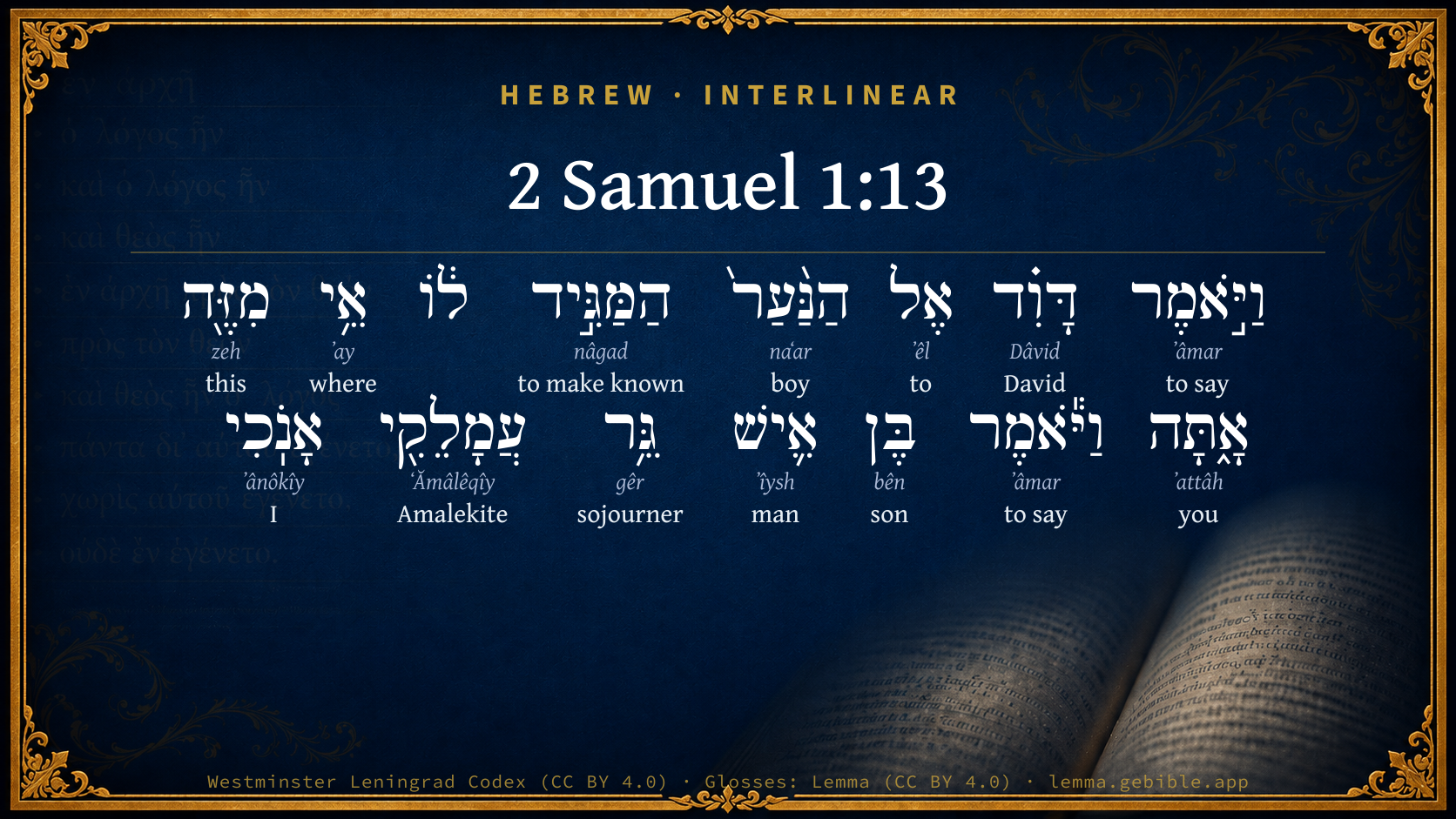
Hebrew (Westminster Leningrad Codex) 2 Samuel 1:13 appears in the Hebrew Old Testament. The text above is from the Westminster Leningrad Codex. Each word links to its Strong’s number, a concise gloss, and parsing drawn from the Open Scriptures Hebrew Bible morphology. Click any word for its full Brown-Driver-Briggs (BDB) entry.
Download image
Cite this verse

2 Samuel 1:13 (World English Bible). Public Domain. Lemma interlinear Bible study tool, https://lemma.gebible.app/v/2-samuel/1/13.

Show BibTeX & RIS
BibTeX
RIS
English Translation
David said to the young man who told him, Whence are you? He answered, I am the son of a foreigner, an Amalekite.
World English Bible · Public Domain
Download a study sheet

One document with this verse’s original text, its word-by-word gloss line, the meaning frame, cross-references with their text, attributed commentary, and full source and license credits — printable, and it pastes into notes with its structure intact.

This verse Autodidact and up

Study sheet (.html) Plain text (.txt)

A passage Seminary Student

Up to 50 verses in one chapter. A passage sheet keeps up to 6 commentary sources and 12 cross-references per verse, in the order this page ranks them, and says so on the sheet whenever that leaves anything out. Ask for a single verse and you get the Autodidact verse sheet above.

Everything on this page stays free to read, with no account — the sheet is a download of what is already on screen, not access to it.

Want to remove ads? Support Godless Engineer
Compare translations 3

The same verse in 3 English versions, stacked beneath the original-language interlinear above. Click any original word for its lexicon entry.

Each is an independent rendering of the whole verse — the interlinear is not word-aligned to these translations.

Highlighted words mark where these versions differ — a whole-verse word diff, not a word-by-word alignment.

  • World English Bible Public Domain
    David said to the young man who told him, Whence are you? He answered, I am the son of a foreigner, an Amalekite.
  • King James Version Public Domain
    And David said unto the young man that told him, Whence art thou? And he answered, I am the son of a stranger, an Amalekite.
  • unfoldingWord Literal Text CC BY-SA 4.0
    And David said to the young man declaring to him, “Where from this you?” And he said, “I the son of a man, a foreigner, an Amalekite.”

unfoldingWord Literal Text — © unfoldingWord, licensed CC BY-SA 4.0. Word-aligned USFM3 via Door43 (git.door43.org/unfoldingWord/en_ult).

Versions to compare (up to 4)

3 of 4 selected

Show all 18 translations

Every available English version of this verse, each an independent rendering of the whole verse.

  • World English Bible Public Domain
    David said to the young man who told him, Whence are you? He answered, I am the son of a foreigner, an Amalekite.
  • Berean Standard Bible Public Domain
    And David inquired of the young man who had brought him the report, “Where are you from?” “I am the son of a foreigner,” he answered. “I am an Amalekite.”
  • Majority Standard Bible Public Domain
    And David inquired of the young man who had brought him the report, “Where are you from?” “I am the son of a foreigner,” he answered. “I am an Amalekite.”
  • King James Version Public Domain
    And David said unto the young man that told him, Whence art thou? And he answered, I am the son of a stranger, an Amalekite.
  • American Standard Version (1901) Public Domain
    And David said unto the young man that told him, Whence art thou? And he answered, I am the son of a sojourner, an Amalekite.
  • Revised Version (1885) Public Domain
    And David said unto the young man that told him, Whence art thou? And he answered, I am the son of a stranger, an Amalekite.
  • Geneva Bible (1599) Public Domain
    Afterward Dauid saide vnto the yong man that tolde it him, Whence art thou? And hee answered, I am the sonne of a stranger an Amalekite.
  • Douay-Rheims (1899) Public Domain
    And David said to the young man that told him: Whence art thou? He answered: I am the son of a stranger of Amalee.
  • Young's Literal Translation Public Domain
    And David saith unto the youth who is declaring `it' to him, `Whence `art' thou?' and he saith, `Son of a sojourner, an Amalekite, I `am'.'
  • Literal Standard Version CC BY-SA 4.0
    And David says to the youth who is declaring [it] to him, “Where [are] you from?” And he says, “I [am] the son of a sojourner, an Amalekite.”
  • Unlocked Literal Bible CC BY-SA 4.0
    David said to the young man, “Where are you from?” He answered, “I am the son of a foreigner in the land, an Amalekite.”
  • unfoldingWord Literal Text CC BY-SA 4.0
    And David said to the young man declaring to him, “Where from this you?” And he said, “I the son of a man, a foreigner, an Amalekite.”
  • Darby Bible Public Domain
    And David said to the young man that told him, Whence art thou? And he said, I am the son of an Amalekite stranger.
  • World Messianic Bible Public Domain
    David said to the young man who told him, “Where are you from?” He answered, “I am the son of a foreigner, an Amalekite.”
  • Webster's Bible Public Domain
    And David said to the young man that told him, Whence art thou? And he answered, I am the son of a stranger, an Amalekite.
  • Free Bible Version CC BY-SA 4.0
    David asked the man who brought him the report, “Where are you from?” “I'm the son of a foreigner,” he replied. “I'm an Amalekite.”
  • Bible in Basic English Public Domain
    And David said to the young man who had given him the news, Where do you come from? And he said, I am the son of a man from a strange land; I am an Amalekite.
  • JPS Tanakh (1917) Public Domain
    And David said unto the young man that told him: 'Whence art thou?' And he answered: 'I am the son of an Amalekite stranger.'

Literal Standard Version (2020), Covenant Press — licensed CC BY-SA 4.0. Text via the HelloAO Bible API (eBible.org). Unlocked Literal Bible (unfoldingWord) — licensed CC BY-SA 4.0. Text via the HelloAO Bible API (eBible.org). unfoldingWord Literal Text — © unfoldingWord, licensed CC BY-SA 4.0. Word-aligned USFM3 via Door43 (git.door43.org/unfoldingWord/en_ult). Free Bible Version, Dr. Jonathan Gallagher — licensed CC BY-SA 4.0. Text via the HelloAO Bible API (eBible.org).

Word by word

More ways to search: Search by grammar → Find every occurrence → Compare this word →

Practice this passage: Drill this verse → Learn its vocabulary →

עֲמָלֵקִ֖י
ʻĂmâlêqîy
H6003
“Amalekite”
Noun, Gentilic, Masculine, Singular, Absolute
Part of Speech
Noun
Type
Gentilic
Gender
Masculine
Number
Singular
State
Absolute
Full BDB Definition

Origin: from H6002

TWOT: None

Amalekite = see Amalek " people of lapping" - descendants of Amalek, the grandson of Esau
  1. וַיֹּ֣אמֶר ʼâmar H559 “and · to say” Conjunction + Verb, Qal, Sequential Imperfect, 3rd Person, Masculine, Singular
  2. דָּוִ֗ד Dâvid H1732 “David” Noun, Proper
  3. אֶל ʼêl H413 “to” Preposition
  4. הַנַּ֨עַר֙ naʻar H5288 “the · boy” Particle, Definite Article + Noun, Common, Masculine, Singular, Absolute
  5. הַמַּגִּ֣יד nâgad H5046 “the · making known” Particle, Definite Article + Verb, Hiphil, Participle Active, Masculine, Singular, Absolute
  6. אֵ֥י ʼay H335 “where” Particle, Interrogative
  7. מִזֶּ֖ה zeh H2088 “from · this” Preposition + Pronoun, Demonstrative, Masculine, Singular
  8. אָ֑תָּה ʼattâh H859 “you” Pronoun, Personal, 2nd Person, Masculine, Singular
  9. וַיֹּ֕אמֶר ʼâmar H559 “and · to say” Conjunction + Verb, Qal, Sequential Imperfect, 3rd Person, Masculine, Singular
  10. בֶּן bên H1121 “son of” Noun, Common, Masculine, Singular, Construct
  11. אִ֛ישׁ ʼîysh H376 “man” Noun, Common, Masculine, Singular, Absolute
  12. גֵּ֥ר gêr H1616 “sojourner” Noun, Common, Masculine, Singular, Absolute
  13. אָנֹֽכִי ʼânôkîy H595 “I” Pronoun, Personal, 1st Person, Common, Singular

About this verse

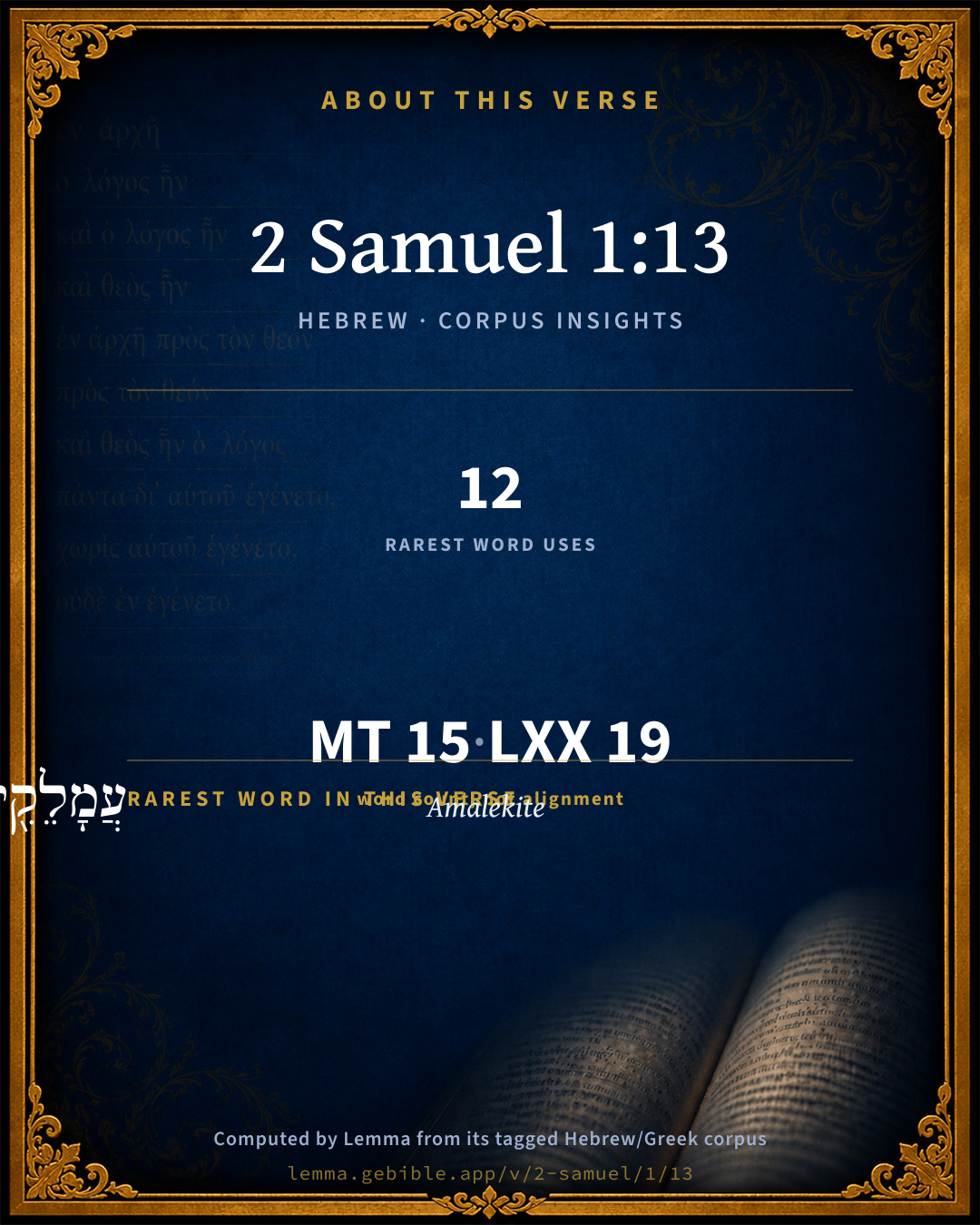
These counts appear in no published source. They are computed here, from the morphology-tagged text and Lemma’s own curated glosses. What Lemma adds →

15
words
13
distinct lemmas
Historical
section

Notable vocabulary

The rarest word here is עֲמָלֵקִ֖י Amalekite H6003 — appearing just 12 times in the whole Hebrew Bible.

Shared distinctive vocabulary

עֲמָלֵקִ֖י Amalekite H6003 occurs in 12 verses of the Hebrew Bible. Also found in:

Grammatical profile

  • 3 verbs
  • 6 nouns
  • 3 pronouns
  • 2 prepositions
  • 1 particle

Verb forms

  • וַיֹּ֣אמֶר Qal · Sequential Imperfect
  • הַמַּגִּ֣יד Hiphil · Participle Active
  • וַיֹּ֕אמֶר Qal · Sequential Imperfect

Repetition

A word recurs within this verse — often emphatic in Hebrew:

  • וַיֹּ֣אמֶר to say H559 ×2

Hebrew & Septuagint length

In English translation the verse runs 23 words from the Hebrew and 27 from the Septuagint (LXX English) — closely comparable.

A rough comparison of the two English renderings, which tokenize alike — not a word-level alignment.

Word counts can differ between the Hebrew and the Greek without any difference in meaning — e.g. the Hebrew direct-object marker אֵת has no separate Greek word, and Greek often adds the article ὁ.

In the original languages it is 15 Hebrew tokens and 19 Greek tokens — but the two are counted differently (Hebrew bundles its prefixes and suffixes into one token; the Greek is in lemma form), so that isn’t a like-for-like length.

Cross-references

1

Topical passages linked to 2 Samuel 1:13 in the Treasury of Scripture Knowledge — connected by theme and wording, ordered by reader-vote popularity; previews shown in the World English Bible.

  • 2 Samuel 1:8 He said to me, Who are you? I answered him, I am an Amalekite.

Cross-references courtesy of OpenBible.info (CC BY 4.0).

Hebrew and Greek witnesses Masoretic Hebrew ↔ Greek Septuagint

The same verse in the two great witnesses to the Old Testament, shown verse-for-verse.

These are two independent witnesses, not word-aligned to each other, and the Septuagint is shown in lemma (dictionary) form.

Hebrew 2 Samuel 1:13 Masoretic · Westminster Leningrad Codex

וַיֹּ֣אמֶר דָּוִ֗ד אֶל הַנַּ֨עַר֙ הַמַּגִּ֣יד ל֔וֹ אֵ֥י מִזֶּ֖ה אָ֑תָּה וַיֹּ֕אמֶר בֶּן אִ֛ישׁ גֵּ֥ר עֲמָלֵקִ֖י אָנֹֽכִי

David said to the young man who told him, Whence are you? He answered, I am the son of a foreigner, an Amalekite.

World English Bible · Public Domain

Greek LXX 2 Samuel 1:13 Septuagint · lemma form

καί εἶπον δαυίδ ὁ παιδάριον ὁ ἀποἀγγέλλω αὐτός πόθεν εἰμί σύ καί εἶπον υἱός ἀνήρ πάροικος αμαληκίτης ἐγώ εἰμί

And David said to the young man who brought the tidings to him, Whence are you? and he said, I am the son of an Amalekite sojourner.

LXX2012 (modern English Septuagint) · Public Domain

Hebrew: Westminster Leningrad Codex (CC BY 4.0). Greek: Septuagint (public domain); English from LXX2012 (modern English Septuagint) (Public Domain). How the Septuagint differs from the Hebrew →

Targum (Aramaic paraphrase)

1

The Targum is the ancient Jewish Aramaic paraphrase of the Hebrew Scriptures — an interpretive translation, not the Hebrew text itself. Onkelos (literal) and Pseudo-Jonathan (expansive) render the Torah, and Jonathan the Prophets. Coverage is partial: where no permissively-licensed English translation exists for a verse, only the Aramaic is shown. This is verse-level text, not a word-by-word alignment to the Hebrew.

  1. Targum Jonathan Prophets (Joshua–Malachi)
    וַאֲמַר דָוִד לְעוּלֵמָא דִמְחַוֵי לֵיהּ אֵי מִדֵין אַתְּ וַאֲמַר בַּר גְבַר גִיוֹר עֲמַלְקָאָה אֲנָא:

    (no public-domain English translation for this verse)

    Targum Jonathan — Aramaic: “Mikraot Gedolot” (public domain). English: “Sefaria Community Translation” (CC0 1.0 (public-domain dedication)); “London "Chaldee Paraphrase," 1871” (public domain). Text via Sefaria.

Commentary

Notes on 2 Samuel 1:13 from classic Christian and Jewish commentators (each source and its license shown beneath its notes). The classic Christian expositions comment on the surrounding passage and are grouped to its opening verse, so a note may address several verses; the Jewish commentaries on the Tanakh (Rashi and others) are per-verse, so they appear only where the commentator wrote on this verse.

Lemma curates 59 commentaries, every one of them public domain or Creative Commons licensed, each selected and text-cleaned for this edition rather than reprinted as found. About our sources →

Trapp's Complete Commentary

John Trapp

2Sa 1:13 And David said unto the young man that told him, Whence [art] thou? And he answered, I [am] the son of a stranger, an Amalekite.

Ver. 13. I am the son of a stranger, an Amalekite.] This he had said before in David’s hearing, {2Sa 1:8} but he being full of grief, minded it not belike.

John Trapp, A Commentary or Exposition upon All the Books of the Old and New Testament (1647–1656) — public domain. Text from a community e-Sword module.

Joseph Benson's Commentary

2Sa 1:13-14. The son of a stranger — This expression signifies one who resided among the Israelites, and had embraced their religion, though not admitted into their communion. David said, How wast thou not afraid to destroy the Lord’s anointed? — Who possibly might have recovered, and been carried off by some of his own men; the Philistines, by some extraordinary providence of God, being diverted from the pursuit. It was the greater presumption in this young man to do it, since none of Saul’s own servants durst venture upon such an act.

Joseph Benson's Commentary on the Old and New Testaments (1811–1818) — public domain. Text from a community e-Sword module.

Tyndale Open Study Notes

Tyndale Open Resources

1:13 Where are you from? David’s asking again (1:8) likely reflects the depth of his grief.

Tyndale Open Study Notes — © Tyndale Open Resources, licensed CC BY-SA 4.0. Text via the HelloAO Bible API.

Geneva Bible (1599)

Geneva Bible translators

After the lamentation, he examined him again.

Geneva Bible (1599) marginal notes — public domain. Text via Bolls.life.

Jamieson, Fausset & Brown

Robert Jamieson, A. R. Fausset & David Brown

David said unto the young man . . . Whence art thou?--The man had at the outset stated who he was. But the question was now formally and judicially put. The punishment inflicted on the Amalekite may seem too severe, but the respect paid to kings in the West must not be regarded as the standard for that which the East may think due to royal station. David's reverence for Saul, as the Lord's anointed, was in his mind a principle on which he had faithfully acted on several occasions of great temptation. In present circumstances it was especially important that his principle should be publicly known; and to free himself from the imputation of being in any way accessory to the execrable crime of regicide was the part of a righteous judge, no less than of a good politician.

Jamieson, Fausset & Brown — Commentary Critical and Explanatory on the Whole Bible (1871) — public domain (CC PDM 1.0). Text via the HelloAO Bible API.

The Cambridge Bible for Schools and Colleges

gen. ed. J. J. S. Perowne

13. the son of a stranger, an Amalekite] Or, the son of an Amalekite stranger, i.e. an Amalekite who had migrated into the land of Israel. The term is one regularly used in the O.T. of foreigners residing in a country not their own.

The Cambridge Bible for Schools and Colleges (gen. ed. J. J. S. Perowne; Cambridge University Press, 1878–1918) — public domain. Text from a community e-Sword module.

John Gill's Exposition

And David said unto the young man that told him, whence art thou?.... From what place, or of what people and nation art thou? though Abarbinel thinks it neither respects place nor people, but that David thought he was another man's servant; so that the sense of the question is, to what man did he belong?

and he answered, I am the son of a stranger, an Amalekite; he was not any man's servant, but the son of a proselyte, of one that was by birth and nation an Amalekite, but proselyted to the Jewish religion; he might know of what nation he originally was, by the account he had given of what passed between him and Saul, Sa2 1:8; though the mind of David might so disturbed as not to advert to it; or if he did, he might be willing to have it repeated for confirmation's sake.

John Gill's Exposition of the Whole Bible (1746–1763) — public domain (CC PDM 1.0). Text via the HelloAO Bible API.

Albert Barnes' Notes on the Bible

Whether David believed the Amalekite’s story, or not, his anger was equally excited, and the fact that the young man was an Amalekite, was not calculated to calm or check it. That David’s temper was hasty, we know from 1Sa 25:13, 1Sa 25:32-34.

Albert Barnes' Notes on the Bible (1834–1885) — public domain. Text from a community e-Sword/MySword module.

Haydock's Catholic Bible Commentary

CHAPTER I.

Stranger, residing among the Hebrews.

George Leo Haydock (1774–1849), Haydock's Catholic Family Bible and Commentary, 1859 edition — public domain. Excludes Psalms (Douay-Rheims chapter numbering differs from Protestant) and Deuterocanonical books (Catholic canon only).

Matthew Poole's English Annotations

Whence art thou? David heard and knew before what he was, but he asked it again judicially, in order to his trial and punishment.

Matthew Poole's English Annotations on the Holy Bible (1683–1685) — public domain. Text from a community e-Sword/MySword module.

The Pulpit Commentary

Vers. 13-16. (ZIGLAG.)

Capital punishment.

"Thy blood be upon thy head" (ver. 16). The grief of David at the death of Saul was associated with indignation at the conduct of the Amalekite, who, according to his own confession, had taken part in its infliction. At sunset he recalled the unhappy messenger, and having further questioned him, testified his abhorrence of his deed, and ordered his execution. Notice

I THE CRIME which was laid to his charge, viz. the intentional and unjustifiable taking away of the life of another:

1. Proceeding, like every act of murder, from indifference to the sacrednessof human life and the dignity of human nature, created in the image of God.

2. Aggravated in guilt by irreverence toward the person of the king, "theLord"s anointed," who ought, on account of his high position, to have been held in special honour. (1Sa_24:6 1Sa_26:11 1Sa_31:5) "When the Israelites were under royal authority, it would appear to have been a maxim of their law that the person of the king was inviolable, even though he might be tyrannical and unjust; and, in fact, this maxim is necessary, not only to the security of the king, but also to the welfare of the subject; for it is the dread of assassination and treacheries that usually makes kings tyrants, and novices in tyranny absolute despots" (Michaelis).

3. Exhibiting disobedience to the command of God. "Thou shalt not kill", (Exo_20:13) i.e. do no murder. (Exo_21:12) With this law the Amalekite was probably acquainted. He knew, at least, that it was wrong to take away life without adequate reason. Hence he sought to justify the act by pleading the request of Saul (ver. 9), and his suffering condition, which it was mercy to terminate. But how could Saul authorize another to do to him what he had no right to do to himself? Genuine loyalty and mercy would have prompted a different course of conduct; and malice and selfishness were clearly the motives of the deed. There was in it nothing praiseworthy, but everything to be abhorred and condemned (ver. 14).

II THE EVIDENCE on which he was convicted. "Thy mouth hath testified against thee," etc. (ver. 16). His confession was:

1. Voluntarily made; not extorted from him by the infliction or threateningof suffering, or the promise of reward.

2. Confirmed by the signs of his connection with the death of the king (ver.10).

3. A sufficient ground, under the circumstances, for judgment, withoutfurther inquiry. Even if, as is probable, he did not actually commit the deed, he took upon himself the responsibility, and justly incurred the consequences thereof. But why did he not retract and repudiate his confession? Perhaps he thought that it would be of no avail; and he would thereby have acknowledged his falsehood and mercenariness. Possibly he did retract, and was not believed. For "a liar is not believed though he speak the truth." Considered in relation to his times, the evidence on which David acted was sufficient; but the incident affords an illustration of the uncertainty which often pertains to the crime of murder and the fallibility of human judgment.

III THE AUTHORITY by which he was condemned. Although David was not yet publicly recognized as civil ruler, to whom the right of judging properly belonged, yet he was fully justified in assuming the office, inasmuch as:

1. It had been virtually conferred upon him by the appointment of theDivine King of Israel.

2. The chief hindrance to its exercise was removed by the death of Saul.There was no higher authority than his in the land, and it had been acknowledged by the Amalekite himself (ver. 10).

3. Its assumption was necessary to the fulfilment of the purpose of hisappointment, the manifestation of the justice of God, and the promotion of the welfare of the people. He may have wished to clear himself from the suspicion of complicity in the king"s death, to show that he entertained no feeling of revenge against him, and to gain the esteem of the people of Israel; but his main motive was of a higher nature. He acted on theocratic principles, as on a subsequent occasion. (2Sa_4:9-12)

IV THE PUNISHMENT which he suffered (ver. 15). "When the sentence of death was pronounced by the king, it was executed by his body guard". (2Sa_15:18 2Sa_20:23) Capital punishment may be upheld on the ground of:

1. The claims of justice. It has been generally felt, even from the most ancient period, (Gen_4:10, Gen_4:14) that the murderer deserves to die.

2. The teaching of Scripture. "Whoso sheddeth man"s blood," etc. (Gen_9:6) "This was the first command having reference to the temporal sword. By these words temporal government was established, and the sword placed in its hand by God" (Luther). It gave the right and imposed the duty of inflicting death; and it is of permanent obligation (Lev_24:17; Joh_19:11; Act_25:11; Rom_13:4)

3. The welfare of society. It exalts the principle of justice; declares the dignity of man in the most impressive manner; effectually prevents the offender from repeating his offence; powerfully deters others from following his example; and thus conduces to the security of human life. Severity to one is mercy to many.

On the other hand, it may be said that:

1. The claims of justice are adequately satisfied by a lifelong penalservitude.

2. Scripture, rightly interpreted, does not justify the infliction of death. TheNoachic precept (if it be such) was adapted only to an early stage of society, its literal fulfilment is no longer required, and the principle on which it rests (the dignity of man) is preserved and more fully maintained by the revelations and influences of Christianity. The whole spirit of the New Testament is in favour of seeking the reformation rather than effecting the destruction of the offender. "Mercy glorieth against judgment." Even the fratricide Cain was spared, (Gen_4:5) as if to show the possibility and propriety of sparing the life of the criminal.

3. The welfare of society is more fully promoted by sparing his life than bytaking it away. Hardened criminals and persons under the influence of strong passion are not deterred by the fear of death; other persons are more powerfully affected by other motives. The possibility of the innocent suffering a penalty which is irreversible causes hesitation in its infliction where there is the least doubt, and so the guilty often escape, punishment becomes uncertain, and men are tempted to commit crime in the hope of impunity. As a matter of fact, crime does not increase in those countries where capital punishment is abolished. "After the Divine permission to inflict capital punishment which had been given for a considerable period of time, had displayed itself as the most extreme madness in the execution of Christ, the question of its abolition has become only a question of time. The question is whether Christ may not have done enough for this" (Ewald, "Antiquities," p. 174). D.

The Pulpit Commentary (1880–1919), ed. H.D.M. Spence-Jones & Joseph S. Exell — public domain. Text from a community e-Sword module.

Lesson kit

Teaching starters — assembled from the data on this page, not authored interpretation. Every prompt links to the verse data it draws on. Edit before teaching.

2 Samuel, in the Historical, opens this verse with 15 words (13 distinct Hebrew lemmas). Its most distinctive word is ʻĂmâlêqîy (“Amalekite”). A historical commentator’s framing appears above. Read the whole chapter for the surrounding context.

Discussion questions

  1. How does “Amalekite” (ʻĂmâlêqîy) shape what this verse is saying?
  2. Genesis 14:7 shares the word «Amalekite» with this verse. How do the two illuminate each other?
  3. “to say” occurs 2× in this one verse. What is the effect of the repetition?
  4. These translations render this verse differently; the difference is in the English rendering, not the original. What questions does that raise?
  5. The verb «וַיֹּ֣אמֶר» is Qal Sequential Imperfect. How does its form color the action?
  6. Reading how Trapp's Complete Commentary and Joseph Benson's Commentary read this verse, where do the two commentators agree and where do they part?

Things to notice

Reading settings

Reading text

Shown beneath each verse's original-language words.

Old Testament
Old Testament edition

Read the OT as the Masoretic Hebrew (MT) or the Greek Septuagint (LXX).

English shown for the Greek Septuagint (in the Hebrew ↔ Greek comparison).

Comparing translations? Open the Compare panel on any verse page to stack up to four side by side.