
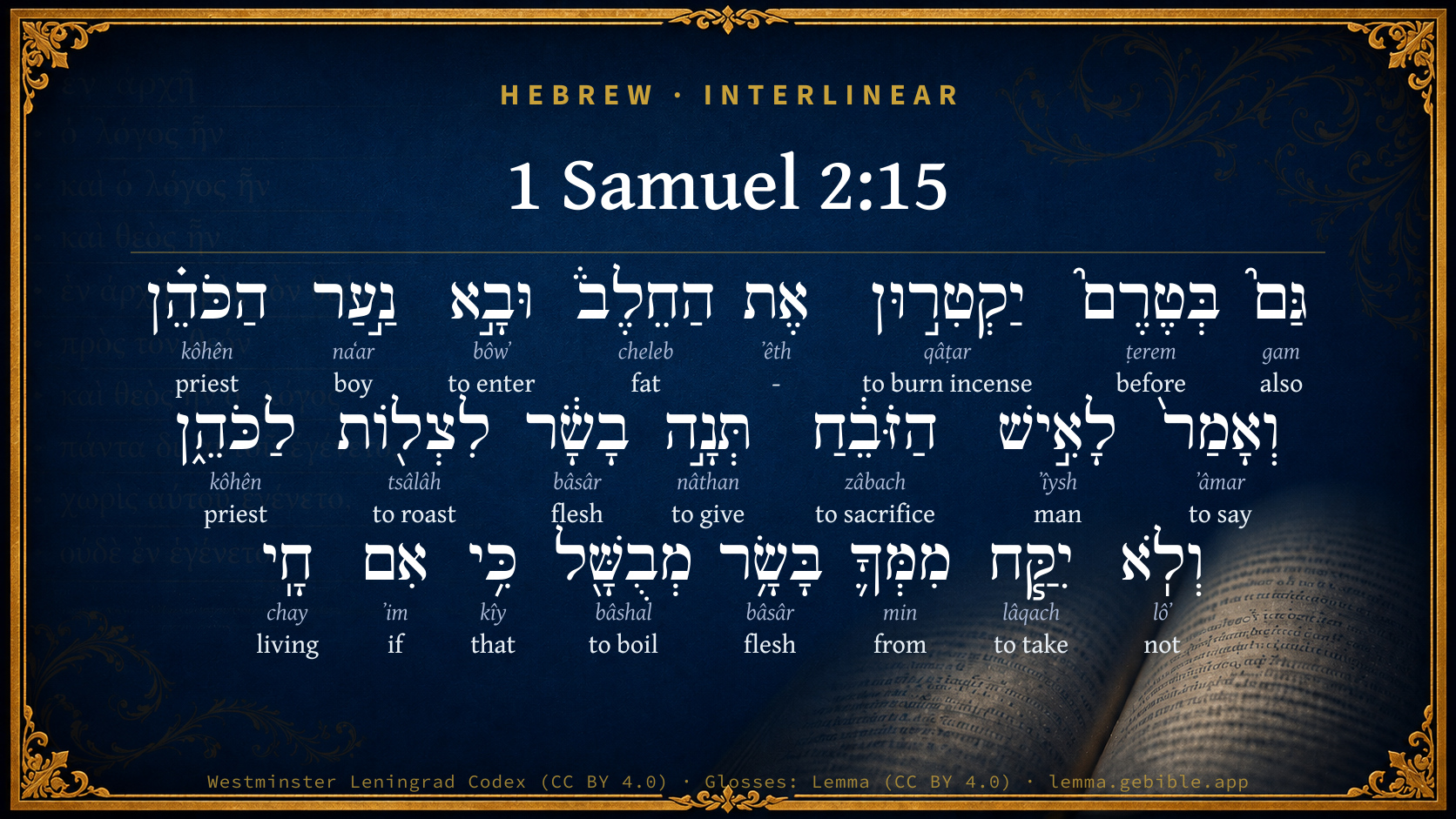
1 Samuel 2:15

Hebrew (Westminster Leningrad Codex) 1 Samuel 2:15 appears in the Hebrew Old Testament. The text above is from the Westminster Leningrad Codex. Each word links to its Strong’s number, a concise gloss, and parsing drawn from the Open Scriptures Hebrew Bible morphology. Click any word for its full Brown-Driver-Briggs (BDB) entry.
Download image
Cite this verse

1 Samuel 2:15 (World English Bible). Public Domain. Lemma interlinear Bible study tool, https://lemma.gebible.app/v/1-samuel/2/15.

Show BibTeX & RIS
BibTeX
RIS
English Translation
Yes, before they burnt the fat, the priest's servant came, and said to the man who sacrificed, Give flesh to roast for the priest; for he will not have boiled flesh of you, but raw.
World English Bible · Public Domain
Highlights
  • 1 first appearance in the Hebrew Bible
Full analysis ↓
Download a study sheet

One document with this verse’s original text, its word-by-word gloss line, the meaning frame, cross-references with their text, attributed commentary, and full source and license credits — printable, and it pastes into notes with its structure intact.

This verse Autodidact and up

Study sheet (.html) Plain text (.txt)

A passage Seminary Student

Up to 50 verses in one chapter. A passage sheet keeps up to 6 commentary sources and 12 cross-references per verse, in the order this page ranks them, and says so on the sheet whenever that leaves anything out. Ask for a single verse and you get the Autodidact verse sheet above.

Everything on this page stays free to read, with no account — the sheet is a download of what is already on screen, not access to it.

Want to remove ads? Support Godless Engineer
Compare translations 3

The same verse in 3 English versions, stacked beneath the original-language interlinear above. Click any original word for its lexicon entry.

Each is an independent rendering of the whole verse — the interlinear is not word-aligned to these translations.

Highlighted words mark where these versions differ — a whole-verse word diff, not a word-by-word alignment.

  • World English Bible Public Domain
    Yes, before they burnt the fat, the priest's servant came, and said to the man who sacrificed, Give flesh to roast for the priest; for he will not have boiled flesh of you, but raw.
  • King James Version Public Domain
    Also before they burnt the fat, the priest's servant came, and said to the man that sacrificed, Give flesh to roast for the priest; for he will not have sodden flesh of thee, but raw.
  • unfoldingWord Literal Text CC BY-SA 4.0
    Also, before they burned the fat, the servant of the priest would come, and he would say to the man sacrificing, “Give meat to the priest to roast, and he will not take boiled meat from you, but surely raw.”

unfoldingWord Literal Text — © unfoldingWord, licensed CC BY-SA 4.0. Word-aligned USFM3 via Door43 (git.door43.org/unfoldingWord/en_ult).

Versions to compare (up to 4)

3 of 4 selected

Show all 18 translations

Every available English version of this verse, each an independent rendering of the whole verse.

  • World English Bible Public Domain
    Yes, before they burnt the fat, the priest's servant came, and said to the man who sacrificed, Give flesh to roast for the priest; for he will not have boiled flesh of you, but raw.
  • Berean Standard Bible Public Domain
    Even before the fat was burned, the servant of the priest would come and say to the man who was sacrificing, “Give the priest some meat to roast, because he will not accept boiled meat from you, but only raw.”
  • Majority Standard Bible Public Domain
    Even before the fat was burned, the servant of the priest would come and say to the man who was sacrificing, “Give the priest some meat to roast, because he will not accept boiled meat from you, but only raw.”
  • King James Version Public Domain
    Also before they burnt the fat, the priest's servant came, and said to the man that sacrificed, Give flesh to roast for the priest; for he will not have sodden flesh of thee, but raw.
  • American Standard Version (1901) Public Domain
    Yea, before they burnt the fat, the priest's servant came, and said to the man that sacrificed, Give flesh to roast for the priest; for he will not have boiled flesh of thee, but raw.
  • Revised Version (1885) Public Domain
    Yea, before they burnt the fat, the priest’s servant came, and said to the man that sacrificed, Give flesh to roast for the priest; for he will not have sodden flesh of thee, but raw.
  • Geneva Bible (1599) Public Domain
    Yea, before they burnt the fat, the priests boy came and saide to the man that offered, Giue me flesh to rost for the priest: for he wil not haue sodden flesh of thee, but rawe.
  • Douay-Rheims (1899) Public Domain
    Also before they burnt the fat, the servant of the priest came, and said to the man that sacrificed: Give me flesh to boil for the priest: for I will not take of thee sodden flesh, but raw.
  • Young's Literal Translation Public Domain
    Also before they make perfume with the fat -- then hath the priest's servant come in, and said to the man who is sacrificing, `Give flesh to roast for the priest, and he doth not take of thee flesh boiled, but raw;'
  • Literal Standard Version CC BY-SA 4.0
    Also, before they make incense with the fat, then the priest’s servant has come in and said to the man who is sacrificing, “Give flesh to roast for the priest, and he does not take boiled flesh from you, but raw”;
  • Unlocked Literal Bible CC BY-SA 4.0
    Worse, before they burned the fat, the priest's servant came, and said to the man who was sacrificing, “Give meat to roast for the priest; for he will not accept boiled meat from you, but only raw.”
  • unfoldingWord Literal Text CC BY-SA 4.0
    Also, before they burned the fat, the servant of the priest would come, and he would say to the man sacrificing, “Give meat to the priest to roast, and he will not take boiled meat from you, but surely raw.”
  • Darby Bible Public Domain
    Even before they burned the fat, the priest's servant came, and said to the man that sacrificed, Give flesh to roast for the priest, and he will not accept sodden flesh of thee, but raw.
  • World Messianic Bible Public Domain
    Yes, before they burned the fat, the priest’s servant came, and said to the man who sacrificed, “Give meat to roast for the priest; for he will not accept boiled meat from you, but raw.”
  • Webster's Bible Public Domain
    Also before they burnt the fat, the priest's servant came, and said to the man that sacrificed, Give flesh to roast for the priest; for he will not have boiled flesh of thee, but raw.
  • Free Bible Version CC BY-SA 4.0
    In fact even before the fat of the sacrifice was burned up the servant would come and would demand from the man sacrificing, “Give me meat to roast for the priest. He doesn't want boiled meat from you—he wants it raw.”
  • Bible in Basic English Public Domain
    And more than this, before the fat was burned, the priest's servant would come and say to the man who was making the offering, Give me some of the flesh to be cooked for the priest; he has no taste for meat cooked in water, but would have you give it uncooked.
  • JPS Tanakh (1917) Public Domain
    Yea, before the fat was made to smoke, the priest's servant came, and said to the man that sacrificed: 'Give flesh to roast for the priest; for he will not have sodden flesh of thee, but raw.'

Literal Standard Version (2020), Covenant Press — licensed CC BY-SA 4.0. Text via the HelloAO Bible API (eBible.org). Unlocked Literal Bible (unfoldingWord) — licensed CC BY-SA 4.0. Text via the HelloAO Bible API (eBible.org). unfoldingWord Literal Text — © unfoldingWord, licensed CC BY-SA 4.0. Word-aligned USFM3 via Door43 (git.door43.org/unfoldingWord/en_ult). Free Bible Version, Dr. Jonathan Gallagher — licensed CC BY-SA 4.0. Text via the HelloAO Bible API (eBible.org).

Word by word

More ways to search: Search by grammar → Find every occurrence → Compare this word →

Practice this passage: Drill this verse → Learn its vocabulary →

לִצְל֖וֹת
tsâlâh
H6740
“to roast”
Preposition + Verb, Qal, Infinitive Construct
Part of Speech
Preposition + Verb
Stem
Qal
Form
Infinitive Construct
Full BDB Definition

Origin: a primitive root

TWOT: 1915

(Qal) to roast
  1. גַּם֮ gam H1571 “also” Particle, Accusative
  2. בְּטֶרֶם֮ ṭerem H2962 “in/at · before” Preposition + Adverb
  3. יַקְטִר֣וּן qâṭar H6999 “to burn incense” Verb, Hiphil, Imperfect, 3rd Person, Masculine, Plural + Suffix, n
  4. אֶת ʼêth H853 “-” Particle, Direct Object
  5. הַחֵלֶב֒ cheleb H2459 “the · fat” Particle, Definite Article + Noun, Common, Masculine, Singular, Absolute
  6. וּבָ֣א bôwʼ H935 “and · to enter” Conjunction + Verb, Qal, Sequential Perfect, 3rd Person, Masculine, Singular
  7. נַ֣עַר naʻar H5288 “boy of” Noun, Common, Masculine, Singular, Construct
  8. הַכֹּהֵ֗ן kôhên H3548 “the · priest” Particle, Definite Article + Noun, Common, Masculine, Singular, Absolute
  9. וְאָמַר֙ ʼâmar H559 “and · to say” Conjunction + Verb, Qal, Sequential Perfect, 3rd Person, Masculine, Singular
  10. לָאִ֣ישׁ ʼîysh H376 “to/for the · man” Preposition, Determined + Noun, Common, Masculine, Singular, Absolute
  11. הַזֹּבֵ֔חַ zâbach H2076 “the · sacrificing” Particle, Definite Article + Verb, Qal, Participle Active, Masculine, Singular, Absolute
  12. תְּנָ֣ה nâthan H5414 “give” Verb, Qal, Imperative, 2nd Person, Masculine, Singular + Suffix, h
  13. בָשָׂ֔ר bâsâr H1320 “flesh” Noun, Common, Masculine, Singular, Absolute
  14. לַכֹּהֵ֑ן kôhên H3548 “to/for the · priest” Preposition, Determined + Noun, Common, Masculine, Singular, Absolute
  15. וְלֹֽא lôʼ H3808 “and · not” Conjunction + Particle, Negative
  16. יִקַּ֧ח lâqach H3947 “to take” Verb, Qal, Imperfect, 3rd Person, Masculine, Singular
  17. מִמְּךָ֛ min H4480 “from · you” Preposition + Suffix, Personal, 2nd Person, Masculine, Singular
  18. בָּשָׂ֥ר bâsâr H1320 “flesh” Noun, Common, Masculine, Singular, Absolute
  19. מְבֻשָּׁ֖ל bâshal H1310 “boiled” Verb, Pual, Participle Passive, Masculine, Singular, Absolute
  20. כִּ֥י kîy H3588 “that” Conjunction
  21. אִם ʼim H518 “if” Conjunction
  22. חָֽי chay H2416 “living” Adjective, Adjective, Masculine, Singular, Absolute

About this verse

These counts appear in no published source. They are computed here, from the morphology-tagged text and Lemma’s own curated glosses. What Lemma adds →

23
words
21
distinct lemmas
Historical
section

Notable vocabulary

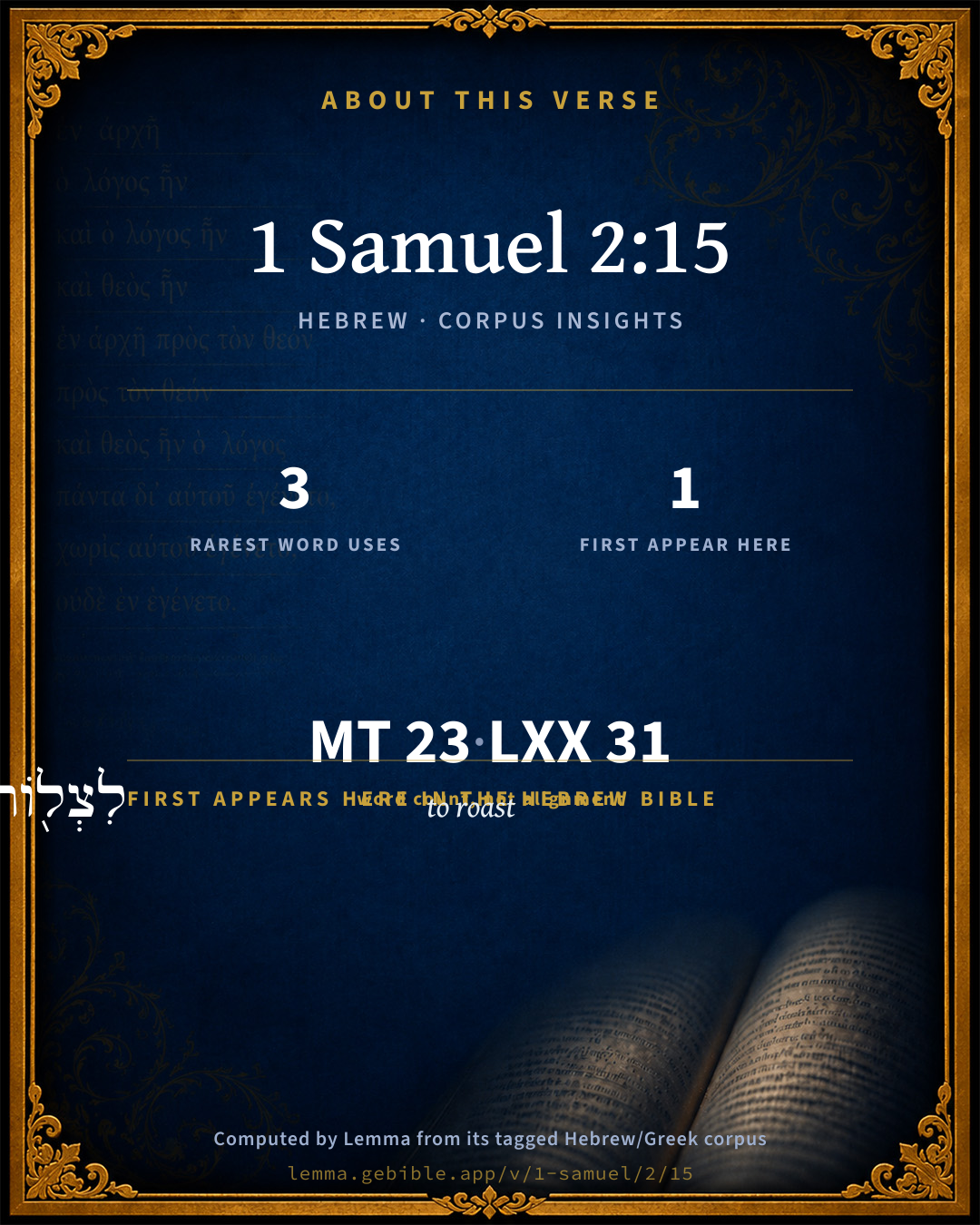
The rarest word here is לִצְל֖וֹת to roast H6740 — appearing just 3 times in the whole Hebrew Bible.

First appearance in Scripture

This word makes its first canonical appearance in the Hebrew Bible here:

  • לִצְל֖וֹת to roast H6740

Shared distinctive vocabulary

לִצְל֖וֹת to roast H6740 occurs in 3 verses of the Hebrew Bible. Also found in:

Grammatical profile

  • 8 verbs
  • 7 nouns
  • 1 adjective
  • 1 preposition
  • 2 conjunctions
  • 1 adverb
  • 3 particles

Verb forms

  • יַקְטִר֣וּן Hiphil · Imperfect
  • וּבָ֣א Qal · Sequential Perfect
  • וְאָמַר֙ Qal · Sequential Perfect
  • הַזֹּבֵ֔חַ Qal · Participle Active
  • תְּנָ֣ה Qal · Imperative
  • לִצְל֖וֹת Qal · Infinitive Construct
  • יִקַּ֧ח Qal · Imperfect
  • מְבֻשָּׁ֖ל Pual · Participle Passive

Repetition

Words recur within this verse — often emphatic in Hebrew:

  • הַכֹּהֵ֗ן priest H3548 ×2
  • בָשָׂ֔ר flesh H1320 ×2

Hebrew & Septuagint length

In English translation the verse runs 35 words from the Hebrew and 46 from the Septuagint (LXX English) — closely comparable.

A rough comparison of the two English renderings, which tokenize alike — not a word-level alignment.

Word counts can differ between the Hebrew and the Greek without any difference in meaning — e.g. the Hebrew direct-object marker אֵת has no separate Greek word, and Greek often adds the article ὁ.

In the original languages it is 23 Hebrew tokens and 31 Greek tokens — but the two are counted differently (Hebrew bundles its prefixes and suffixes into one token; the Greek is in lemma form), so that isn’t a like-for-like length.

Cross-references

5

Topical passages linked to 1 Samuel 2:15 in the Treasury of Scripture Knowledge — connected by theme and wording, ordered by reader-vote popularity; previews shown in the World English Bible.

  • Leviticus 3:16 The priest shall burn them on the altar: it is the food of the offering made by fire, for a sweet savor; all the fat is Yahweh's.
  • Leviticus 3:3–5 He shall offer of the sacrifice of peace offerings an offering made by fire to Yahweh; the fat that covers the innards, and all the fat that is on the innards,
  • Romans 16:18 For those who are such don't serve our Lord, Jesus Christ, but their own belly; and by their smooth and flattering speech, they deceive the hearts of the innocent.
  • Philippians 3:19 whose end is destruction, whose god is the belly, and whose glory is in their shame, who think about earthly things.
  • Jude 1:12 These are hidden rocky reefs in your love feasts when they feast with you, shepherds who without fear feed themselves; clouds without water, carried along by winds; autumn leaves without fruit, twice dead, plucked up by the roots;

Cross-references courtesy of OpenBible.info (CC BY 4.0).

Hebrew and Greek witnesses Masoretic Hebrew ↔ Greek Septuagint

The same verse in the two great witnesses to the Old Testament, shown verse-for-verse.

These are two independent witnesses, not word-aligned to each other, and the Septuagint is shown in lemma (dictionary) form.

Hebrew 1 Samuel 2:15 Masoretic · Westminster Leningrad Codex

גַּם֮ בְּטֶרֶם֮ יַקְטִר֣וּן אֶת הַחֵלֶב֒ וּבָ֣א נַ֣עַר הַכֹּהֵ֗ן וְאָמַר֙ לָאִ֣ישׁ הַזֹּבֵ֔חַ תְּנָ֣ה בָשָׂ֔ר לִצְל֖וֹת לַכֹּהֵ֑ן וְלֹֽא יִקַּ֧ח מִמְּךָ֛ בָּשָׂ֥ר מְבֻשָּׁ֖ל כִּ֥י אִם חָֽי

Yes, before they burnt the fat, the priest's servant came, and said to the man who sacrificed, Give flesh to roast for the priest; for he will not have boiled flesh of you, but raw.

World English Bible · Public Domain

Greek LXX 1 Samuel 2:15 Septuagint · lemma form

καί πρίν θυμιάω ὁ στέαρ ἄρχω ὁ παιδάριον ὁ ἱερεύς καί λέγω ὁ ἀνήρ ὁ θύω δίδωμι κρέας ὀπτάω ὁ ἱερεύς καί οὐ μή λαμβάνω παρά σύ ἑφθός ἐκ ὁ λέβης

And before the fat was burnt for a sweet savor, the servant of the priest would come, and say to the man that sacrificed, Give flesh to roast for the priest, and I will by no means take of you sodden flesh out of the caldron.

LXX2012 (modern English Septuagint) · Public Domain

Hebrew: Westminster Leningrad Codex (CC BY 4.0). Greek: Septuagint (public domain); English from LXX2012 (modern English Septuagint) (Public Domain). How the Septuagint differs from the Hebrew →

Targum (Aramaic paraphrase)

1

The Targum is the ancient Jewish Aramaic paraphrase of the Hebrew Scriptures — an interpretive translation, not the Hebrew text itself. Onkelos (literal) and Pseudo-Jonathan (expansive) render the Torah, and Jonathan the Prophets. Coverage is partial: where no permissively-licensed English translation exists for a verse, only the Aramaic is shown. This is verse-level text, not a word-by-word alignment to the Hebrew.

  1. Targum Jonathan Prophets (Joshua–Malachi)
    אַף עַד דְלָא יִתַּסְקוּן יַת תַּרְבָּא לְמַדְבְּחָא וְיֵתֵי עוּלֵימָא דְכַהֲנָא וַאֲמַר לְגַבְרָא דְדַבַּח הַב בִּסְרָא לְמִטְוֵי לְכַהֲנָא וְלָא יִסַב מִנָךְ בְּשַׂר מְבַשֵׁל אֱלָהֵן כַּד חָי:

    (no public-domain English translation for this verse)

    Targum Jonathan — Aramaic: “Mikraot Gedolot” (public domain). English: “Sefaria Community Translation” (CC0 1.0 (public-domain dedication)); “London "Chaldee Paraphrase," 1871” (public domain). Text via Sefaria.

Commentary

Notes on 1 Samuel 2:15 from classic Christian and Jewish commentators (each source and its license shown beneath its notes). The classic Christian expositions comment on the surrounding passage and are grouped to its opening verse, so a note may address several verses; the Jewish commentaries on the Tanakh (Rashi and others) are per-verse, so they appear only where the commentator wrote on this verse.

Lemma curates 59 commentaries, every one of them public domain or Creative Commons licensed, each selected and text-cleaned for this edition rather than reprinted as found. About our sources →

Trapp's Complete Commentary

John Trapp

1Sa 2:15 Also before they burnt the fat, the priest’s servant came, and said to the man that sacrificed, Give flesh to roast for the priest; for he will not have sodden flesh of thee, but raw.

Ver. 15. Also before they burnt the fat.] Due to God by the law, {Lev 3:3-4; Lev 3:9} who well may call for the best of the best; but these liquorish Lurcos would needs be served before him, and be their own carvers. Neither waved they the breast and shoulder before the Lord, in token that they had it of his free gift: but ravenously seized upon whatsoever they liked, and said in effect, We are lords.

Give flesh to roast for the priest.] Boiled meat would not content them. But it ill becometh a servant of the Lord to be a slave to his palate. Christ biddeth his apostles when they come into a house, "eat such things as are set before them," {a} if wholesome, though but homely.

{a} τα παρατιθεμενα.

John Trapp, A Commentary or Exposition upon All the Books of the Old and New Testament (1647–1656) — public domain. Text from a community e-Sword module.

Tyndale Open Study Notes

Tyndale Open Resources

2:15 God’s law stipulated that the sacrificial animal’s fat was the Lord’s portion and had to be burned on the altar first (Lev 3:3-17).

Tyndale Open Study Notes — © Tyndale Open Resources, licensed CC BY-SA 4.0. Text via the HelloAO Bible API.

Geneva Bible (1599)

Geneva Bible translators

Which was commanded first to have been offered to God.

Geneva Bible (1599) marginal notes — public domain. Text via Bolls.life.

Adam Clarke's Commentary

Verse 15. Before they burnt the fat] They would serve themselves before GOD was served! This was iniquity and arrogance of the first magnitude.

He will not have sodden flesh] He chooses roast meat, not boiled; and if they had it in the pot before the servant came, he took it out that it might be roasted.

Adam Clarke's Commentary on the Bible (1810–1826) — public domain. Text from a community e-Sword/MySword module.

Ellicott's Commentary for English Readers

(15) Before they burnt the fat.—This was a still graver offence against the ritual of the sacrifice. A contemptuous insult was here offered to the Lord. This fat was not to be eaten or taken by any one; it was God’s portion, to be burnt by the priest on the altar (Lev_3:16; Lev_7:23; Lev_7:25; Lev_7:30-31).

In all these strange rites and ceremonies there was a higher symbolism involved. This was ruthlessly set at nought and trampled on by these reckless, covetous guardians of the worship of Israel.

Portions of the sacrifice fell legally to the ministering priests in lieu of fee. It was fair “that they which ministered at the altar should live of the altar.” The “heave leg” and the “wave breast” of the slaughtered victim were theirs by right, and these the sacrificing priest was to receive after the fat portion of the sacrifice had been burnt upon the altar. But to take the flesh of the victim, and roast it before the symbolic offering had been made, was a crime which was equivalent to robbing God. It dishonoured the whole ceremony.

He will not have sodden flesh.—The meaning of this is, these priests and their attendants insisted on having the best part of the sacrificed victim raw, not boiled—that is, fresh, full of juice and strength—before the offering had been made.

A Bible Commentary for English Readers, edited by Charles John Ellicott (1878–1897) — public domain. Text from a community e-Sword module.

The Cambridge Bible for Schools and Colleges

gen. ed. J. J. S. Perowne

15. Also] Even. The climax of their transgression was the offence against Jehovah.

sodden] Boiled: the perf. of ‘seethe’ is ‘sod’ (Gen_25:29), and the past partic. ‘sodden.’

The Cambridge Bible for Schools and Colleges (gen. ed. J. J. S. Perowne; Cambridge University Press, 1878–1918) — public domain. Text from a community e-Sword module.

John Gill's Exposition

And if any man said unto him, let them not fail to burn the fat presently,.... Or stay till they have offered the fat, as the Targum; let that be done in the first place, which may be quickly done, in a very little time, and let as much haste be made as can be to do it:

and then take as much as thy soul desireth; by which it appears that the men that brought the sacrifice had more religion at heart, and were more concerned for the honour and glory of God than the priest; being willing to suffer in their property, but could not bear that the Lord should be dishonoured, and so rudely treated: they were willing the priests should take what they pleased of theirs, though they had no right to any; only they desired the Lord might be served first, which was but reasonable:

then he would answer him, nay, but thou shall give it me now, and if not, I will take it by force; signifying, he would not stay till the fat was burnt, and the Lord had his portion, but he would have it directly; and if he would not give it him freely, he would take it whether he would or not; to such a height of insolence and impiety were the priests arrived, as to put it in the power of their servants to make such wicked demands, and treat God, and those that brought their sacrifices to him, in such a contemptuous manner.

John Gill's Exposition of the Whole Bible (1746–1763) — public domain (CC PDM 1.0). Text via the HelloAO Bible API.

Haydock's Catholic Bible Commentary

Raw. Here are two other abuses. The fat ought first to have been burnt, in honour of the Lord; and the meat should have been boiled, in order that the priest might not be taken off from his sacred functions; as custom, it seems, had determined, though the law be silent on this head.

George Leo Haydock (1774–1849), Haydock's Catholic Family Bible and Commentary, 1859 edition — public domain. Excludes Psalms (Douay-Rheims chapter numbering differs from Protestant) and Deuterocanonical books (Catholic canon only).

Matthew Poole's English Annotations

The fat, and the other parts to be burnt with it. See Lev 3:3,4,9; 7:31. So this was an additional injury; for lest the fork should mistake and injure them, they took such parts as they best liked whilst it was raw, when it might be better discerned.

Matthew Poole's English Annotations on the Holy Bible (1683–1685) — public domain. Text from a community e-Sword/MySword module.

John Wesley's Explanatory Notes

The fat - And the other parts to be burnt with it. So this was all additional injury; for they took such parts as they best liked whilst it was raw.

John Wesley, Explanatory Notes Upon the Whole Bible (1754–1765) — public domain. Text via the GEBible commentary corpus.

unfoldingWord translationNotes

Door43 World Missions Community

General Information:

When people would offer animals as sacrifices, they would first burn the animal's fat and then boil the meat, give some to the priest, and eat the rest.

Worse, before

"They even did something worse than that. Before"

they burned

The person who actually did the burning can be made explicit. AT: "the man who was sacrificing took his sacrifice to the priests and the priests burned" (See: Assumed Knowledge and Implicit Information)

Give meat to roast for the priest

"Give me some meat so I can give it to the priest so he can roast it"

roast

cook over a fire

boiled

cooked in water

raw

not cooked

despised Yahweh's offering

The young men did not like Yahweh's instructions regarding the offering and paid no attention to them.

translationWords

sin

unfoldingWord translationNotes — © Distant Shores Media and the Door43 World Missions Community, licensed CC BY-SA 4.0. Source: git.door43.org/Door43/en_tn.

Lesson kit

Teaching starters — assembled from the data on this page, not authored interpretation. Every prompt links to the verse data it draws on. Edit before teaching.

1 Samuel, in the Historical, opens this verse with 23 words (21 distinct Hebrew lemmas). Its most distinctive word is tsâlâh (“to roast”). A historical commentator’s framing appears above. Read the whole chapter for the surrounding context.

Discussion questions

  1. The word tsâlâh carries the sense “to roast.” How does it shape the verse?
  2. The word “to roast” first appears here in Scripture. What is being introduced at this debut?
  3. Isaiah 44:16 shares the word «to roast» with this verse. How do the two illuminate each other?
  4. “priest” occurs 2× in this one verse. What is the effect of the repetition?
  5. These translations render this verse differently. What is at stake in choosing one wording over another?
  6. The verb «יַקְטִר֣וּן» is Hiphil Imperfect. How does its form color the action?
  7. Reading how Trapp's Complete Commentary and Tyndale Open Study Notes read this verse, where do the two commentators agree and where do they part?

Things to notice

Reading settings

Reading text

Shown beneath each verse's original-language words.

Old Testament
Old Testament edition

Read the OT as the Masoretic Hebrew (MT) or the Greek Septuagint (LXX).

English shown for the Greek Septuagint (in the Hebrew ↔ Greek comparison).

Comparing translations? Open the Compare panel on any verse page to stack up to four side by side.