
2 Kings 5:14

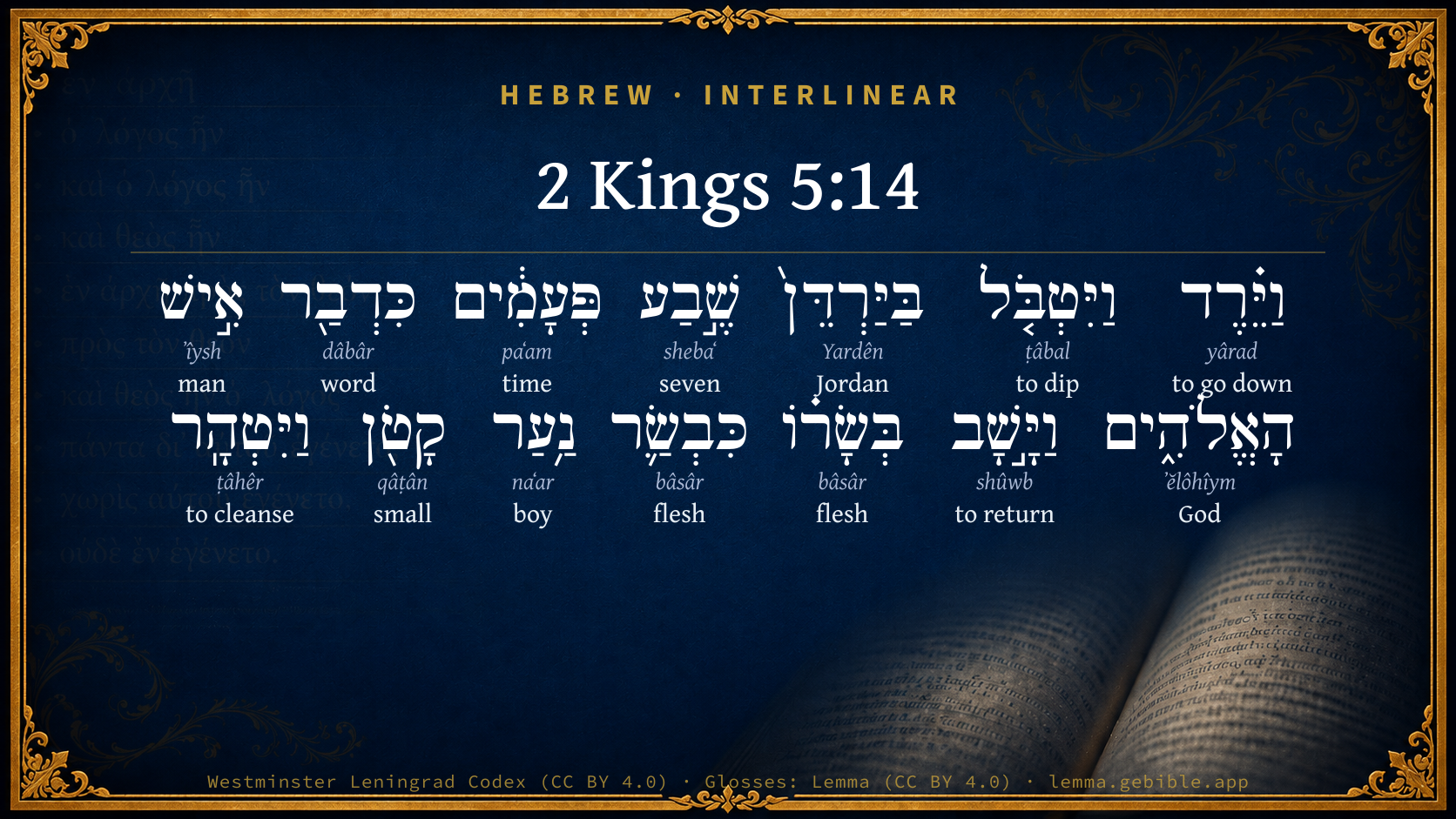
Hebrew (Westminster Leningrad Codex) 2 Kings 5:14 appears in the Hebrew Old Testament. The text above is from the Westminster Leningrad Codex. Each word links to its Strong’s number, a concise gloss, and parsing drawn from the Open Scriptures Hebrew Bible morphology. Click any word for its full Brown-Driver-Briggs (BDB) entry.
Download image
Cite this verse

2 Kings 5:14 (World English Bible). Public Domain. Lemma interlinear Bible study tool, https://lemma.gebible.app/v/2-kings/5/14.

Show BibTeX & RIS
BibTeX
RIS
English Translation
Then went he down, and dipped [himself] seven times in the Jordan, according to the saying of the man of God; and his flesh came again like the flesh of a little child, and he was clean.
World English Bible · Public Domain
Download a study sheet

One document with this verse’s original text, its word-by-word gloss line, the meaning frame, cross-references with their text, attributed commentary, and full source and license credits — printable, and it pastes into notes with its structure intact.

This verse Autodidact and up

Study sheet (.html) Plain text (.txt)

A passage Seminary Student

Up to 50 verses in one chapter. A passage sheet keeps up to 6 commentary sources and 12 cross-references per verse, in the order this page ranks them, and says so on the sheet whenever that leaves anything out. Ask for a single verse and you get the Autodidact verse sheet above.

Everything on this page stays free to read, with no account — the sheet is a download of what is already on screen, not access to it.

Want to remove ads? Support Godless Engineer
Compare translations 3

The same verse in 3 English versions, stacked beneath the original-language interlinear above. Click any original word for its lexicon entry.

Each is an independent rendering of the whole verse — the interlinear is not word-aligned to these translations.

Highlighted words mark where these versions differ — a whole-verse word diff, not a word-by-word alignment.

  • World English Bible Public Domain
    Then went he down, and dipped [himself] seven times in the Jordan, according to the saying of the man of God; and his flesh came again like the flesh of a little child, and he was clean.
  • King James Version Public Domain
    Then went he down, and dipped himself seven times in Jordan, according to the saying of the man of God: and his flesh came again like unto the flesh of a little child, and he was clean.
  • unfoldingWord Literal Text CC BY-SA 4.0
    So he went down, and he dipped in the Jordan seven times, according to the word of the man of God. And his flesh returned like the flesh of a little boy, and he became clean.

unfoldingWord Literal Text — © unfoldingWord, licensed CC BY-SA 4.0. Word-aligned USFM3 via Door43 (git.door43.org/unfoldingWord/en_ult).

Versions to compare (up to 4)

3 of 4 selected

Show all 18 translations

Every available English version of this verse, each an independent rendering of the whole verse.

  • World English Bible Public Domain
    Then went he down, and dipped [himself] seven times in the Jordan, according to the saying of the man of God; and his flesh came again like the flesh of a little child, and he was clean.
  • Berean Standard Bible Public Domain
    So Naaman went down and dipped himself in the Jordan seven times, according to the word of the man of God, and his flesh was restored and became like that of a little child, and he was clean.
  • Majority Standard Bible Public Domain
    So Naaman went down and dipped himself in the Jordan seven times, according to the word of the man of God, and his flesh was restored and became like that of a little child, and he was clean.
  • King James Version Public Domain
    Then went he down, and dipped himself seven times in Jordan, according to the saying of the man of God: and his flesh came again like unto the flesh of a little child, and he was clean.
  • American Standard Version (1901) Public Domain
    Then went he down, and dipped `himself' seven times in the Jordan, according to the saying of the man of God; and his flesh came again like unto the flesh of a little child, and he was clean.
  • Revised Version (1885) Public Domain
    Then went he down, and dipped himself seven times in Jordan, according to the saying of the man of God: and his flesh came again like unto the flesh of a little child, and he was clean.
  • Geneva Bible (1599) Public Domain
    Then went he downe, and washed him selfe seuen times in Iorden, according to the saying of the man of God: and his flesh came againe, like vnto ye flesh of a litle child, and he was cleane.
  • Douay-Rheims (1899) Public Domain
    Then he went down, and washed in the Jordan seven times: according to the word of the man of God, and his flesh was restored, like the flesh of a little child, and he was made clean.
  • Young's Literal Translation Public Domain
    And he goeth down and dippeth in Jordan seven times, according to the word of the man of God, and his flesh doth turn back as the flesh of a little youth, and is clean.
  • Literal Standard Version CC BY-SA 4.0
    And he goes down and dips in the Jordan seven times, according to the word of the man of God, and his flesh turns back as the flesh of a little youth, and is clean.
  • Unlocked Literal Bible CC BY-SA 4.0
    Then he went down and dipped himself seven times in the Jordan, obeying the instructions of the man of God. His flesh was restored again like the flesh of a little child, and he was healed.
  • unfoldingWord Literal Text CC BY-SA 4.0
    So he went down, and he dipped in the Jordan seven times, according to the word of the man of God. And his flesh returned like the flesh of a little boy, and he became clean.
  • Darby Bible Public Domain
    Then he went down, and plunged himself seven times in the Jordan, according to the saying of the man of God. And his flesh became again like the flesh of a little child, and he was clean.
  • World Messianic Bible Public Domain
    Then went he down and dipped himself seven times in the Jordan, according to the saying of the man of God; and his flesh was restored like the flesh of a little child, and he was clean.
  • Webster's Bible Public Domain
    Then he went down, and dipped himself seven times in Jordan, according to the saying of the man of God: and his flesh came again like the flesh of a little child, and he was clean.
  • Free Bible Version CC BY-SA 4.0
    So Naaman went down and plunged himself underwater in the Jordan seven times, as the man of God had told him. His body was healed, his skin became like a baby's, and he was clean.
  • Bible in Basic English Public Domain
    Then he went down seven times into the waters of Jordan, as the man of God had said; and his flesh became like the flesh of a little child again, and he was clean.
  • JPS Tanakh (1917) Public Domain
    Then went he down, and dipped himself seven times in the Jordan, according to the saying of the man of God; and his flesh came back like unto the flesh of a little child, and he was clean.

Literal Standard Version (2020), Covenant Press — licensed CC BY-SA 4.0. Text via the HelloAO Bible API (eBible.org). Unlocked Literal Bible (unfoldingWord) — licensed CC BY-SA 4.0. Text via the HelloAO Bible API (eBible.org). unfoldingWord Literal Text — © unfoldingWord, licensed CC BY-SA 4.0. Word-aligned USFM3 via Door43 (git.door43.org/unfoldingWord/en_ult). Free Bible Version, Dr. Jonathan Gallagher — licensed CC BY-SA 4.0. Text via the HelloAO Bible API (eBible.org).

Word by word

More ways to search: Search by grammar → Find every occurrence → Compare this word →

Practice this passage: Drill this verse → Learn its vocabulary →

וַיִּטְבֹּ֤ל
ṭâbal
H2881
“and · to dip”
Conjunction + Verb, Qal, Sequential Imperfect, 3rd Person, Masculine, Singular
Part of Speech
Conjunction + Verb
Stem
Qal
Form
Sequential Imperfect
Person
3rd Person
Gender
Masculine
Number
Singular
Full BDB Definition

Origin: a primitive root

TWOT: 787 , 788

to dip, dip into, plunge - (Qal) - to dip in or into - to dip oneself - (Niphal) to be dipped
  1. וַיֵּ֗רֶד yârad H3381 “and · to go down” Conjunction + Verb, Qal, Sequential Imperfect, 3rd Person, Masculine, Singular
  2. בַּיַּרְדֵּן֙ Yardên H3383 “in/at the · Jordan” Preposition, Determined + Noun, Proper
  3. שֶׁ֣בַע shebaʻ H7651 “seven” Adjective, Cardinal number, Feminine, Singular, Absolute
  4. פְּעָמִ֔ים paʻam H6471 “times” Noun, Common, Feminine, Plural, Absolute
  5. כִּדְבַ֖ר dâbâr H1697 “like/as · word of” Preposition + Noun, Common, Masculine, Singular, Construct
  6. אִ֣ישׁ ʼîysh H376 “man of” Noun, Common, Masculine, Singular, Construct
  7. הָאֱלֹהִ֑ים ʼĕlôhîym H430 “the · God(s)” Particle, Definite Article + Noun, Common, Masculine, Plural, Absolute
  8. וַיָּ֣שָׁב shûwb H7725 “and · to return” Conjunction + Verb, Qal, Sequential Imperfect, 3rd Person, Masculine, Singular
  9. בְּשָׂר֗וֹ bâsâr H1320 “flesh · his” Noun, Common, Masculine, Singular, Construct + Suffix, Personal, 3rd Person, Masculine, Singular
  10. כִּבְשַׂ֛ר bâsâr H1320 “like/as · flesh of” Preposition + Noun, Common, Masculine, Singular, Construct
  11. נַ֥עַר naʻar H5288 “boy” Noun, Common, Masculine, Singular, Absolute
  12. קָטֹ֖ן qâṭân H6996 “small” Adjective, Adjective, Masculine, Singular, Absolute
  13. וַיִּטְהָֽר ṭâhêr H2891 “and · to cleanse” Conjunction + Verb, Qal, Sequential Imperfect, 3rd Person, Masculine, Singular

About this verse

These counts appear in no published source. They are computed here, from the morphology-tagged text and Lemma’s own curated glosses. What Lemma adds →

14
words
13
distinct lemmas
Historical
section

Notable vocabulary

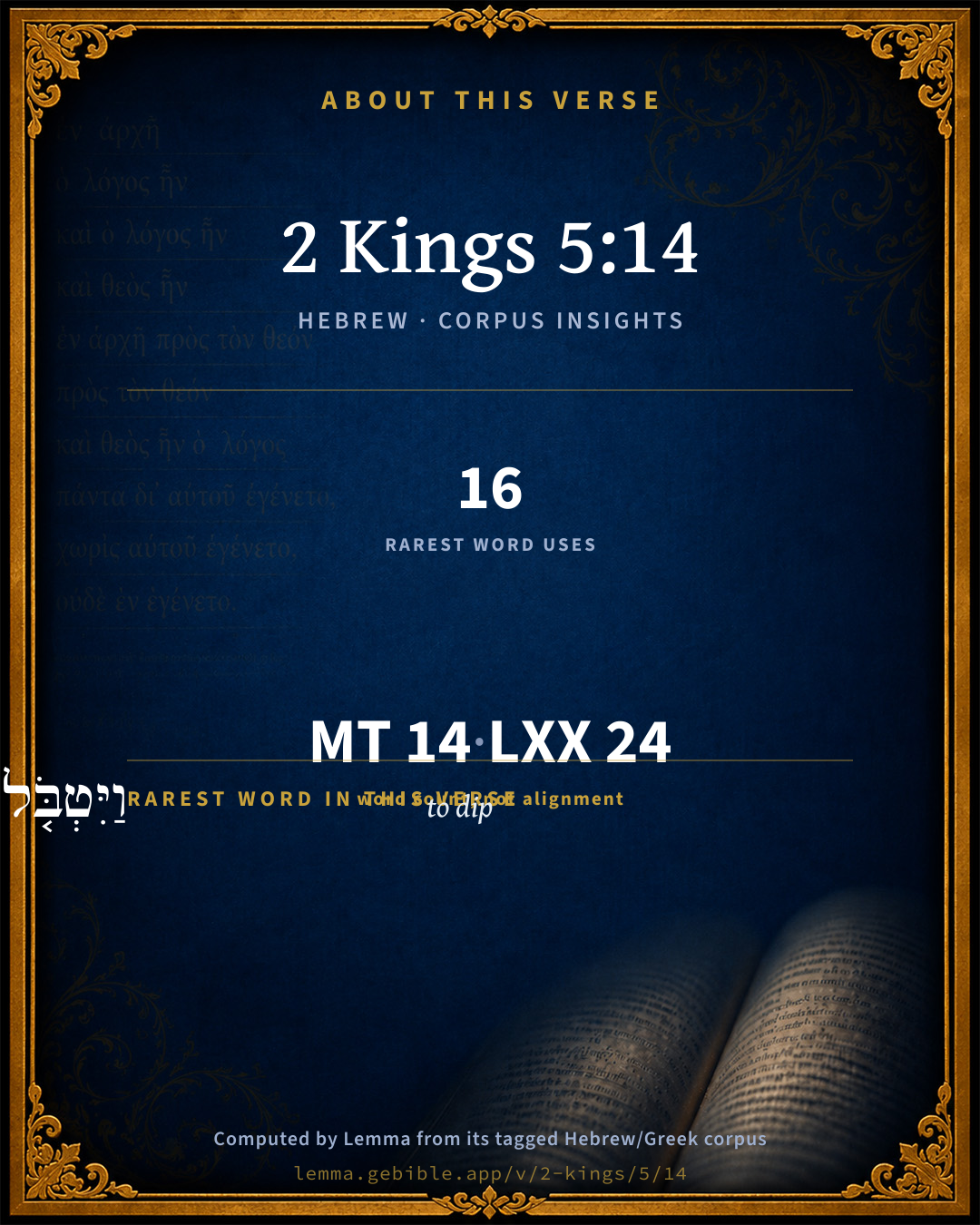
The rarest word here is וַיִּטְבֹּ֤ל to dip H2881 — appearing just 16 times in the whole Hebrew Bible.

Shared distinctive vocabulary

וַיִּטְבֹּ֤ל to dip H2881 occurs in 16 verses of the Hebrew Bible. Also found in:

Grammatical profile

  • 4 verbs
  • 8 nouns
  • 2 adjectives

Verb forms

  • וַיֵּ֗רֶד Qal · Sequential Imperfect
  • וַיִּטְבֹּ֤ל Qal · Sequential Imperfect
  • וַיָּ֣שָׁב Qal · Sequential Imperfect
  • וַיִּטְהָֽר Qal · Sequential Imperfect

Repetition

A word recurs within this verse — often emphatic in Hebrew:

  • בְּשָׂר֗וֹ flesh H1320 ×2

Hebrew & Septuagint length

In English translation the verse runs 37 words from the Hebrew and 34 from the Septuagint (LXX English) — closely comparable.

A rough comparison of the two English renderings, which tokenize alike — not a word-level alignment.

Word counts can differ between the Hebrew and the Greek without any difference in meaning — e.g. the Hebrew direct-object marker אֵת has no separate Greek word, and Greek often adds the article ὁ.

In the original languages it is 14 Hebrew tokens and 24 Greek tokens — but the two are counted differently (Hebrew bundles its prefixes and suffixes into one token; the Greek is in lemma form), so that isn’t a like-for-like length.

Cross-references

14

Topical passages linked to 2 Kings 5:14 in the Treasury of Scripture Knowledge — connected by theme and wording, ordered by reader-vote popularity; previews shown in the World English Bible.

  • Job 33:25 His flesh shall be fresher than a child's; He returns to the days of his youth.
  • Luke 4:27 There were many lepers in Israel in the time of Elisha the prophet, yet not one of them was cleansed, except Naaman, the Syrian."
  • Luke 5:13 He stretched out his hand, and touched him, saying, "I want to. Be made clean." Immediately the leprosy left him.
  • Zechariah 14:8 It will happen in that day, that living waters will go out from Jerusalem; half of them toward the eastern sea, and half of them toward the western sea; in summer and in winter will it be.
  • 2 Kings 5:10 Elisha sent a messenger to him, saying, Go and wash in the Jordan seven times, and your flesh shall come again to you, and you shall be clean.
  • Ezekiel 47:1–9 He brought me back to the door of the house; and, behold, waters issued out from under the threshold of the house eastward; (for the forefront of the house was toward the east;) and the waters came down from under, from the right side of the house, on the south of the altar.
  • John 2:5 His mother said to the servants, "Whatever he says to you, do it."
  • Job 31:13 "If I have despised the cause of my man-servant Or of my maid-servant, When they contended with me;
  • Proverbs 25:11–12 A word fitly spoken Is like apples of gold in settings of silver.
  • Zechariah 13:1 "In that day there will be a spring opened to the house of David and to the inhabitants of Jerusalem, for sin and for uncleanness.
  • Hebrews 11:7–8 By faith, Noah, being warned about things not yet seen, moved with godly fear, prepared an ark for the saving of his house, through which he condemned the world, and became heir of the righteousness which is according to faith.
  • 2 Chronicles 20:20 They rose early in the morning, and went forth into the wilderness of Tekoa: and as they went forth, Jehoshaphat stood and said, Hear me, Judah, and you inhabitants of Jerusalem: believe in Yahweh your God, so shall you be established; believe his prophets, so shall you prosper.
  • Proverbs 9:9 Instruct a wise man, and he will be still wiser. Teach a righteous man, and he will increase in learning.
  • Titus 2:14 who gave himself for us, that he might redeem us from all iniquity, and purify for himself a people for his own possession, zealous for good works.

Cross-references courtesy of OpenBible.info (CC BY 4.0).

Hebrew and Greek witnesses Masoretic Hebrew ↔ Greek Septuagint

The same verse in the two great witnesses to the Old Testament, shown verse-for-verse.

These are two independent witnesses, not word-aligned to each other, and the Septuagint is shown in lemma (dictionary) form.

Hebrew 2 Kings 5:14 Masoretic · Westminster Leningrad Codex

וַיֵּ֗רֶד וַיִּטְבֹּ֤ל בַּיַּרְדֵּן֙ שֶׁ֣בַע פְּעָמִ֔ים כִּדְבַ֖ר אִ֣ישׁ הָאֱלֹהִ֑ים וַיָּ֣שָׁב בְּשָׂר֗וֹ כִּבְשַׂ֛ר נַ֥עַר קָטֹ֖ן וַיִּטְהָֽר

Then went he down, and dipped [himself] seven times in the Jordan, according to the saying of the man of God; and his flesh came again like the flesh of a little child, and he was clean.

World English Bible · Public Domain

Greek LXX 2 Kings 5:14 Septuagint · lemma form

καί καταβαίνω ναιμαν καί βαπτίζω ἐν ὁ ἰορδάνης ἑπτάκι κατά ὁ ῥῆμα ελισαιε καί ἐπιστρέφω ὁ σάρξ αὐτός ὡς σάρξ παιδάριον μικρός καί καθαρίζω

So Naiman went down, and dipped himself seven times in Jordan, according to the word of Elisaie: and his flesh returned to him as the flesh of a little child, and he was cleansed.

LXX2012 (modern English Septuagint) · Public Domain

Hebrew: Westminster Leningrad Codex (CC BY 4.0). Greek: Septuagint (public domain); English from LXX2012 (modern English Septuagint) (Public Domain). How the Septuagint differs from the Hebrew →

Targum (Aramaic paraphrase)

1

The Targum is the ancient Jewish Aramaic paraphrase of the Hebrew Scriptures — an interpretive translation, not the Hebrew text itself. Onkelos (literal) and Pseudo-Jonathan (expansive) render the Torah, and Jonathan the Prophets. Coverage is partial: where no permissively-licensed English translation exists for a verse, only the Aramaic is shown. This is verse-level text, not a word-by-word alignment to the Hebrew.

  1. Targum Jonathan Prophets (Joshua–Malachi)
    וּנְחַת וּטְבַל בְּיַרְדְנָא שְׁבַע זִמְנִין כְּפִתְגָמָא נְבִיָא דַייָ וְתַב בִּסְרֵיהּ כִּבְסַר יַנִיק זְעֵיר וְאִתָּסֵי:

    (no public-domain English translation for this verse)

    Targum Jonathan — Aramaic: “Mikraot Gedolot” (public domain). English: “Sefaria Community Translation” (CC0 1.0 (public-domain dedication)); “London "Chaldee Paraphrase," 1871” (public domain). Text via Sefaria.

Commentary

Notes on 2 Kings 5:14 from classic Christian and Jewish commentators (each source and its license shown beneath its notes). The classic Christian expositions comment on the surrounding passage and are grouped to its opening verse, so a note may address several verses; the Jewish commentaries on the Tanakh (Rashi and others) are per-verse, so they appear only where the commentator wrote on this verse.

Lemma curates 59 commentaries, every one of them public domain or Creative Commons licensed, each selected and text-cleaned for this edition rather than reprinted as found. About our sources →

Trapp's Complete Commentary

John Trapp

2Ki 5:14 Then went he down, and dipped himself seven times in Jordan, according to the saying of the man of God: and his flesh came again like unto the flesh of a little child, and he was clean.

Ver. 14. Then went he down, &c.] He was not so morose or self-willed, though now in a great pelt, but that he would hearken to reason, though it came from servants.

According to the saying of the man of God: and his flesh, &c.] Long enough might Naaman have washed there in vain, if Elisha had not sent him, and said to him, Go, wash in Jordan seven times, &c. It is the word, the ordinance of the Almighty, which putteth efficacy into those means which by themselves are both impotent and improbable. What can water in baptism do of itself to the washing away of sin? Some tell us that by that water Constantine the Great was cured of a leprosy; but that was not, saith mine author, by the efficacy of the water, nor yet by the efficacy of baptism precisely and properly - since it was instituted for another purpose, - but because the baptismal water was to him divinae voluntatis et propheticae iussionis instrumentum, as Ambrose hath it of Jordan’s water to Naaman, a means to convey good to him both for body and soul.

John Trapp, A Commentary or Exposition upon All the Books of the Old and New Testament (1647–1656) — public domain. Text from a community e-Sword module.

The Biblical Illustrator

Joseph S. Exell

2Ki_5:14

Then went he down, and dipped himself seven times in Jordan.

Naamans cure

The story of Naamans cure is a brief, yet beautiful, episode in the current of Jewish history. It is inserted in order to convey an impressive lesson. That lesson is, Gods particular interest in each individual.

I. Note Naamans disease. He was a leper.

1. There is a singular equity in Gods administration. In every station of life there is some drawback.

2. This affliction was specially severe. Whether it was the direct effect of personal sin in Naaman (as in others), history does not say. The core of the calamity was this: it was incurable by art or skill of man. If there be anywhere a remedy for leprosy stored up in the cells of herbs, it has never been discovered.

3. Leprosy is an emblem of human sin. The Jewish prophets were accustomed thus to view it. For, like leprosy, sin gradually spreads its malignant virus through the whole man. It degrades, and corrupts, and destroys every part. And as leprosy, in olden time, excluded a man from temple worship, so still the leprosy of sin creates a gulf between man and God. Your sins have separated between you and Me, saith the Lord.

II. Note the simple prescription. The prescription was that he should dip himself seven times in Jordan.

1. The prescription was marked by great simplicity. The prophets counsel was as plain as language could run. There was no difficulty on the ground of painfulness or expense. No course of treatment could be easier; nothing could be pleasanter than to bathe in the cool stream. If, disregarding so simple a remedy, he should retain his disease, would not his soul be stung with remorse? Would he not become a laughing-stock among his comrades? And is not the remedy of the Gospel equally simple? To repose a sincere trust in the Son of God is simplicity itself. The blood of Jesus Christ Gods Son, cleanseth from all sin.

2. Yet the prescription was galling to Naamans pride. It is pride that keeps men back from a frank confession of their sins. Pride prevents our making reparation for the wrong done to others. Pride hinders us from putting our whole trust in Gods mercy. Pride blinds our moral vision, so that we do not see the baseness of our deeds; and often the pride in us disdains to be saved on the same terms as thieves and harlots. Pride goeth before destruction. The proud, our God knoweth afar off. Humility is the first essential to salvation.

3. The prescription obtained all its value from the power of God. My soul! wait thou only upon God.

III. Observe the speedy cure.

1. The cure was almost missed. Seldom has a man been so near the margin of ruin, and yet been rescued. His soldierly pride had been a tremendous stumbling-block. He had actually turned his back upon the healing stream; but the tender appeals of his own servants loosened the tenacity of his pride. An hour or two more, and his mettled steeds would have left afar in the rear the vale of Jordan, and death would have put his irrevocable seal upon him. The hour of opportunity was just about to close, the last days were fading in the west, when lo! his self-will relented. He turned his face toward Jordan.

2. The cure was sudden. Life was a new experience, the dawn of a better day. Speedily his home was invested with fresh charms, filled with an atmosphere more sacred than before. He would bestow an earthly fortune upon that little serving-maid. Already he foresaw the festive welcome that awaited him on the threshold of his palace. Already he heard the congratulations of his army, the congratulations of his king. The suddenness of his joy was a very peril to his life. The winter of his misfortune was in a moment transformed into summer glory.

3. Such gladness may be the symbol of our own. (J. Dickerson Davies, M. A.)

The cure of Naaman

But in studying our subject of the cure of Naaman, let us note:

I. That he got to the wrong house. In the community there are other houses which are strong beside those which seem so, which are strong on invisible and Divine lines. In estimating the forces which make for the health of my people. we must not leave out of count the most effective of all--those homes, whether rich or poor, where God is honoured, His laws observed, His name revered, His love enjoyed. These are the homes which are the healthgivers of the community, the places from which the Divine and vitalising leaven works which is to leaven the whole of the body politic. You cannot enumerate the salvatory forces of the world and leave the man of God out. He may be overlooked or sneered at, as he sometimes is, but the fact remains that if he is true to himself, to his fellows, and to the God whose commission he bears, he is one of the uplifting forces, and one of the strongest. Remove all such prophets, vocal or silent, and try to get on without them. Leave in those forces which work in the same direction, such as healthy writers and philanthropic institutions. They will run on for a time, like a coach slipped from a railway train; but at length there will be a slowing down, a stop, then a rush back down the recline to crash and wreck. Such men keep Gods waterway open, keep it from silting up; they are dredgers, if you like, true ministers, serving mens best interests by bringing to bear Gods truth and power upon the worlds life.

II. When he got to the right house, he lost his temper. And he turned and went away in a rage. Now, what is it that is the matter with Naaman? It is that which is the fruitful mother of hindrances to Gods doing His best for men--the pride of life. Elishas method is not good enough, not great enough. Naaman wants something which shall be more on a level with his position, something more adequate to that society standard which is, of course, the unquestioned standard. By no means is Naaman without his modern representatives. Thousands of proud men do not understand, or will not recognise that, for the most part, the power of God moves on lowly levels. It is in a peasant child and in lowliest circumstances that He incarnates Himself when He comes for the worlds salvation; Divine and authoritative wisdom comes from the lips of the working man of Nazareth. His throne of redeeming power and grace is a Cross, and Naaman joins hands with those to whom the Cross is folly or a stumbling-block. Yet it is the power of God unto salvation. It is a pity when a man holds his head so high that he cannot see God at his feet. It is both a pity and a mistake when a man resents and forsakes the methods of Gods communication with him because theirs are not good enough; when the river of their spiritual Israel and of their healing becomes too small, or too something; when that Church or agency which has, under God, laid the foundation of our home, and has fostered all that is best in our character, is forsaken and ignored, and that not for conscientious reasons, against which, of course, no objection could be raised, but simply from motives which rule in the social world. It is a pity and a mistake both, when the birthright is sold. Abana and Pharpar are not better, for healing purposes, than all the waters of Israel.

III. Naaman had the grace and good sense to fall in with the Divine arrangement. New heavens and a new earth opened to Naaman when, coming up out of the Jordan waters, he found that his flesh was as that of a little child. The steadily accumulating mortal burden of years is lifted off, and he swings free, clean shoulders; the east wind fades out of the sunshine; the fatal flaw is remedied. How he must have longed to go post haste to tell his wife the good news! It says much for the natural goodness of this fine character that at once he recognised the God who had healed him. He will take home two mules burden of earth on which to erect an altar that he may always sacrifice to Jehovah. And so the story which begins in a heathen land, in a palace, in pride, in leprosy, finds a resting-place, for the present, in Israel, at the prophets humble door, m a lean heart and a right spirit, in cleanness and sweetness and health. It is on parallel lines with the whole Gospel story, with all the saving operations of the Almighty as we know them. The law of entrance is the humbling of our pride; the lintel of the door is low, and we must bend our heads to get in. But when we do bend our heads and enter in, the oppressive burdens are removed, the soul is cleansed from all its defilement of flesh and spirit, and we go free into all the gracious liberty wherewith God makes His children free. (J. Feather.)

Gods plan of salvation

We propose to take the narrative as illustrative of the great truth--the necessity of conforming with Gods plan to secure salvation.

I. That Gods plan is contrary to the expectations of man. So it was here. Naaman had been thinking within himself how the prophet would act. Behold, I thought, etc. Men would cross the ocean and wander in far-off lands in search of wisdom, they would survey the heavens, and descend to the lowermost parts of the earth, but Gods word of life is nigh unto us, in our mouth and in our heart. If thou shalt confess with thy mouth the Lord Jesus, and shalt believe in thine heart that God has raised Him from the dead, thou shalt be saved.

II. That Gods plan tends to humble the pride of man. Naaman thought there was some royal cure for a royal patient, and an honourable way to deal with such an honourable man. How indignant he felt when the prophet only sent a messenger to him, and the remedy prescribed being so humiliating too. So Gods plan of salvation is mortifying to the pride of the sinful heart. The Pharisees were offended at the Saviour for making no distinction between them and the sinners. We find Peter, having received the consent of the Master, walking on the sea; but the moment he began to trust himself, and feel safe in the power of his own strength, the boisterous winds and the treacherous waves frightened him, and, conscious of his weakness, he with gladness entered the ship, and was safe in the arms of Jesus. The gate is strait, and the road is narrow, but he who is humble and obedient is led at last to safety and bliss.

III. That he who truly feels his need will accept Gods plan. Though Naaman was at first most seriously disappointed, and turned away in a rage, yet on the counsel of his servants, strengthened by his own need and his inward conviction, he complied with the directions given by the prophet. When the sinner really feels sin a burden, and believes that the meek and lowly Jesus is powerful to remove it, he will not quarrel with the method of salvation, but will Come at once and cast his burden down, and when he truly feels his guilt he will come to the fountain opened for sin and for uncleanness.

IV. That conformity to Gods plan will secure a mans salvation. Naaman obeyed, and he was accordingly cured. His flesh came again like unto the flesh of a little child, and he was clean.

1. Some means are generally used. The miracles of the Old and New Testaments are similar in this, that means were used in bringing about such wonderful deeds.

2. The means were not sufficient in themselves apart from the blessing of God to cure his leprosy, but as it was Gods plan it effected its purpose.

3. Naamans cure was instantaneous. What a happy moment for him when he discovered that the cause of his anxiety, trouble, and humiliation was removed. So the man who believes on the Lord Jesus Christ, and flees to Him for refuge, is from that moment free from condemnation. The Son hath made him free, and he is free indeed.

4. His cure was complete. His flesh was made like the flesh of a little child. So he who accepts Gods plan is wholly renewed, created anew in Christ Jesus. (H. C. Williams.)

The Biblical Illustrator, edited by Joseph S. Exell (c. 1880s–1900s) — public domain. Text from a community e-Sword module.

Joseph Benson's Commentary

2Ki 5:14. Then went he down and dipped himself, &c. — Upon second thoughts he yielded to make the experiment, yet probably with no great faith or resolution. However, God was pleased to honour himself and the word of his prophet, and to effect the cure, notwithstanding his evil reasoning and unbelief. His flesh came again like the flesh of a little child — No doubt to his great surprise and joy. And he was clean — Fresh and pure, free from every the least mixture or mark of the disease. This he got by yielding to the will of God, and obeying the injunction of his prophet, which he at first despised as unreasonable and foolish: and it is in the way of observing, not in the way of contemning and neglecting divine institutions, that we must expect the cure of our spiritual diseases.

Joseph Benson's Commentary on the Old and New Testaments (1811–1818) — public domain. Text from a community e-Sword module.

Jamieson, Fausset & Brown

Robert Jamieson, A. R. Fausset & David Brown

Then went he down, and dipped himself seven times in Jordan--Persuaded by his calmer and more reflecting attendants to try a method so simple and easy, he followed their instructions, and was cured. The cure was performed on the basis of God's covenant with Israel, by which the land, and all pertaining to it, was blessed. Seven was the symbol of the covenant [KEIL].

Jamieson, Fausset & Brown — Commentary Critical and Explanatory on the Whole Bible (1871) — public domain (CC PDM 1.0). Text via the HelloAO Bible API.

Adam Clarke's Commentary

Verse 14. Then went he down] He felt the force of this reasoning, and made a trial, probably expecting little success.

Like unto the flesh of a little child] The loathsome scurf was now entirely removed; his flesh assumed the appearance and health of youth; and the whole mass of his blood, and other juices, became purified, refined, and exalted! How mighty is God! What great things can he do by the simplest and feeblest of means!

Adam Clarke's Commentary on the Bible (1810–1826) — public domain. Text from a community e-Sword/MySword module.

Ellicott's Commentary for English Readers

(14) Then went he down.—And he went down: scil., from Samaria to the Jordan bed. The Syriac and Arabic, and some Hebrew MSS., read “and he departed;” probably an error of transcription.

Seven times.—“Because seven was significant of the Divine covenant with Israel, and the cure depended on that covenant; or to stamp the cure as a Divine work, for seven is the signature of the works of God” (Keil). In the Assyrian monuments there is an almost exact parallel to the above method of seeking a cure. It occurs among the so-called exorcisms, and belongs to the age of Sargon of Agadê (Accad), before 2200 B.C. Merodach is represented as asking his father Hea how to cure a sick man. Hea replies that the sick man must go and bathe in the sacred waters at the mouth of the Euphrates. It thus appears that in bidding Naaman bathe seven times in the Jordan, Elisha acted in accordance with ancient Semitic belief as to the healing virtue of running streams.

A Bible Commentary for English Readers, edited by Charles John Ellicott (1878–1897) — public domain. Text from a community e-Sword module.

The Cambridge Bible for Schools and Colleges

gen. ed. J. J. S. Perowne

14. Then went he down] His rage had first gone down, and thus he was in a fitter condition to undertake the journey commanded him.

and dipped himself seven times] Not only in the journey to the river, which was without any display, and merely terminated in some lonely spot on the river’s brink, but also in the repeated dippings was the faith of Naaman put to the test. For if we may judge from the fall of the walls of Jericho, which stood unmoved till the last time the ark was carried round them, it seems probable that the cure did not shew itself till the whole of the ablutions were completed.

like unto the flesh of a little child] In striking contrast to its former foul and diseased condition, it now became fresher and fairer than was natural in a full grown man.

The Cambridge Bible for Schools and Colleges (gen. ed. J. J. S. Perowne; Cambridge University Press, 1878–1918) — public domain. Text from a community e-Sword module.

John Gill's Exposition

Then went he down, and dipped himself seven times in Jordan, according to the saying of the man of God,.... He listened to the reasoning of his servant, and his passion subsided, and did as the prophet ordered him:

and his flesh came again like unto the flesh of a little child; clear and fresh, soft and tender as an infant, quite new flesh:

and he was clean; from the leprosy, and all the filthy symptoms of it.

John Gill's Exposition of the Whole Bible (1746–1763) — public domain (CC PDM 1.0). Text via the HelloAO Bible API.

Albert Barnes' Notes on the Bible

Seven times - Compare 1Ki 18:43. In both cases a somewhat severe trial was made of the individual’s faith. Compare the seven compassings of Jericho, and the sudden fall of the walls Josh. 6:3-20.

Albert Barnes' Notes on the Bible (1834–1885) — public domain. Text from a community e-Sword/MySword module.

Haydock's Catholic Bible Commentary

Clean. If bathing seven times in the Jordan had been an infallible remedy, there would soon have been no lepers in the land; and our Saviour plainly intimates that the cure was miraculous, Luke iv. 27. The leprosy of Naaman, though inveterate, was cured in an instant. To bathe in a rapid stream, is allowed to be very salutary for removing the diseases of the skin. (Calmet) (Vales. 38.) --- The fathers discover in this miracle, a figure of the Gentiles called to the faith by the Synagogue, which is in servitude, Galatians iv. 25. Baptism cleanses us from all the seven capital sins, (Tertullian, contra Marc. 4.) so that no vestiges remain. (St. Ambrose, &c.) (Calmet)

George Leo Haydock (1774–1849), Haydock's Catholic Family Bible and Commentary, 1859 edition — public domain. Excludes Psalms (Douay-Rheims chapter numbering differs from Protestant) and Deuterocanonical books (Catholic canon only).

Matthew Poole's English Annotations

Like unto the flesh of a little child, i.e. fresh and pure, free from the least mixture or mark of the disease.

Matthew Poole's English Annotations on the Holy Bible (1683–1685) — public domain. Text from a community e-Sword/MySword module.

Whedon's Commentary on the Bible

Daniel D. Whedon

14. His flesh came again — Whether Naaman began to be cured at the first washing, and gradually lost his leprosy as he continued to wash, or whether the cure was instantaneously wrought at the last washing, we are not informed. In either case the means prescribed by the prophet were thoroughly effectual, and showed Naaman that his cure was effected, not by a magical touch of the prophet, but by the living God of Israel.

Daniel D. Whedon (gen. ed.), Commentary on the Old and New Testaments (1874–1909) — public domain. Text from a community e-Sword module.

The Pulpit Commentary

Then went he down; i.e. descended into the deep Jordan valley from the highland of Samaria a descent of above a thousand feet. The nearest route would involve a journey of about twenty-five miles. And dipped himself seven times in Jordani.e. followed exactly the prophet"s directions in ver. 10according to the saying of the man of God: and his flesh came again like unto the flesh of a little child literally, of a little ladand he was clean. Not only was the leprosy removed, hut the flesh was more soft and tender than that of a grown man commonly is. It was like the flesh of a boy.

The Pulpit Commentary (1880–1919), ed. H.D.M. Spence-Jones & Joseph S. Exell — public domain. Text from a community e-Sword module.

Lesson kit

Teaching starters — assembled from the data on this page, not authored interpretation. Every prompt links to the verse data it draws on. Edit before teaching.

2 Kings, in the Historical, opens this verse with 14 words (13 distinct Hebrew lemmas). Its most distinctive word is ṭâbal (“to dip”). A historical commentator’s framing appears above. Read the whole chapter for the surrounding context.

Discussion questions

  1. How does “to dip” (ṭâbal) shape what this verse is saying?
  2. Genesis 37:31 shares the word «to dip» with this verse. How do the two illuminate each other?
  3. “flesh” occurs 2× in this one verse. What is the effect of the repetition?
  4. The translations on this page render this verse differently — a whole-verse word diff, not a word-by-word alignment. What might account for the different wordings?
  5. The verb «וַיֵּ֗רֶד» is Qal Sequential Imperfect. How does its form color the action?
  6. Reading how Trapp's Complete Commentary and The Biblical Illustrator read this verse, where do the two commentators agree and where do they part?

Things to notice

Reading settings

Reading text

Shown beneath each verse's original-language words.

Old Testament
Old Testament edition

Read the OT as the Masoretic Hebrew (MT) or the Greek Septuagint (LXX).

English shown for the Greek Septuagint (in the Hebrew ↔ Greek comparison).

Comparing translations? Open the Compare panel on any verse page to stack up to four side by side.