
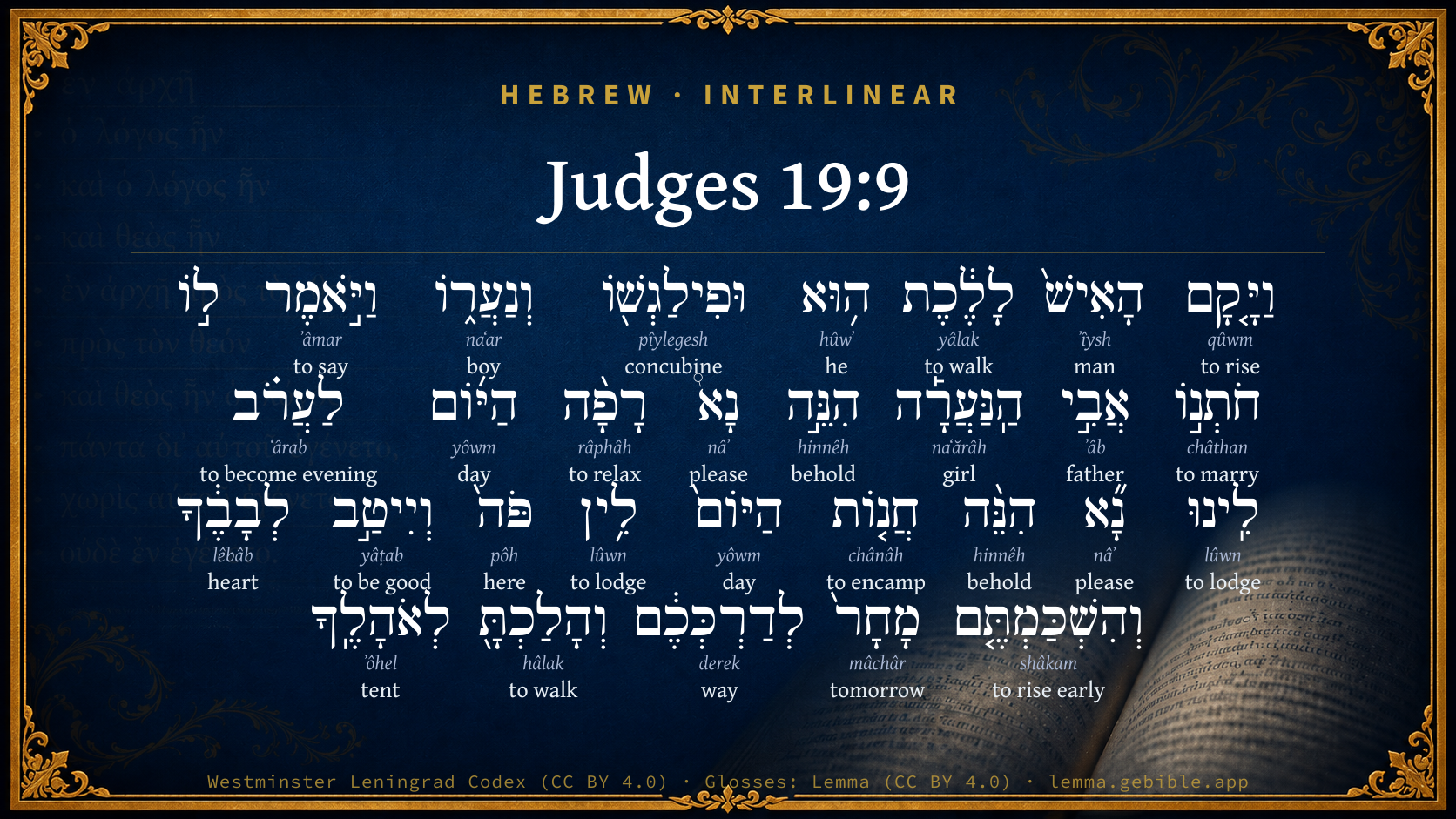
Judges 19:9

Hebrew (Westminster Leningrad Codex) Judges 19:9 appears in the Hebrew Old Testament. The text above is from the Westminster Leningrad Codex. Each word links to its Strong’s number, a concise gloss, and parsing drawn from the Open Scriptures Hebrew Bible morphology. Click any word for its full Brown-Driver-Briggs (BDB) entry.
Download image
Cite this verse

Judges 19:9 (World English Bible). Public Domain. Lemma interlinear Bible study tool, https://lemma.gebible.app/v/judges/19/9.

Show BibTeX & RIS
BibTeX
RIS
English Translation
When the man rose up to depart, he, and his concubine, and his servant, his father-in-law, the young lady's father, said to him, Behold, now the day draws toward evening, please stay all night: behold, the day grows to an end, lodge here, that your heart may be merry; and tomorrow get you early on your way, that you may go home.
World English Bible · Public Domain
Highlights
  • 1 first appearance in the Hebrew Bible
Full analysis ↓
Download a study sheet

One document with this verse’s original text, its word-by-word gloss line, the meaning frame, cross-references with their text, attributed commentary, and full source and license credits — printable, and it pastes into notes with its structure intact.

This verse Autodidact and up

Study sheet (.html) Plain text (.txt)

A passage Seminary Student

Up to 50 verses in one chapter. A passage sheet keeps up to 6 commentary sources and 12 cross-references per verse, in the order this page ranks them, and says so on the sheet whenever that leaves anything out. Ask for a single verse and you get the Autodidact verse sheet above.

Everything on this page stays free to read, with no account — the sheet is a download of what is already on screen, not access to it.

Want to remove ads? Support Godless Engineer
Compare translations 3

The same verse in 3 English versions, stacked beneath the original-language interlinear above. Click any original word for its lexicon entry.

Each is an independent rendering of the whole verse — the interlinear is not word-aligned to these translations.

Highlighted words mark where these versions differ — a whole-verse word diff, not a word-by-word alignment.

  • World English Bible Public Domain
    When the man rose up to depart, he, and his concubine, and his servant, his father-in-law, the young lady's father, said to him, Behold, now the day draws toward evening, please stay all night: behold, the day grows to an end, lodge here, that your heart may be merry; and tomorrow get you early on your way, that you may go home.
  • King James Version Public Domain
    And when the man rose up to depart, he, and his concubine, and his servant, his father in law, the damsel's father, said unto him, Behold, now the day draweth toward evening, I pray you tarry all night: behold, the day groweth to an end, lodge here, that thine heart may be merry; and to morrow get you early on your way, that thou mayest go home.
  • unfoldingWord Literal Text CC BY-SA 4.0
    And the man arose to go, he and his concubine and his young man. But his father-in-law, the father of the young woman, said to him, “Behold, please, the day has subsided toward evening. Please lodge. Behold the declining of the day. Lodge here, and may your heart be good. Then you shall get up early tomorrow to your road, and you shall go to your tent.”

unfoldingWord Literal Text — © unfoldingWord, licensed CC BY-SA 4.0. Word-aligned USFM3 via Door43 (git.door43.org/unfoldingWord/en_ult).

Versions to compare (up to 4)

3 of 4 selected

Show all 18 translations

Every available English version of this verse, each an independent rendering of the whole verse.

  • World English Bible Public Domain
    When the man rose up to depart, he, and his concubine, and his servant, his father-in-law, the young lady's father, said to him, Behold, now the day draws toward evening, please stay all night: behold, the day grows to an end, lodge here, that your heart may be merry; and tomorrow get you early on your way, that you may go home.
  • Berean Standard Bible Public Domain
    When the man got up to depart with his concubine and his servant, his father-in-law, the girl’s father, said to him, “Look, the day is drawing to a close. Please spend the night. See, the day is almost over. Spend the night here, that your heart may be merry. Then you can get up early tomorrow for your journey home.”
  • Majority Standard Bible Public Domain
    When the man got up to depart with his concubine and his servant, his father-in-law, the girl’s father, said to him, “Look, the day is drawing to a close. Please spend the night. See, the day is almost over. Spend the night here, that your heart may be merry. Then you can get up early tomorrow for your journey home.”
  • King James Version Public Domain
    And when the man rose up to depart, he, and his concubine, and his servant, his father in law, the damsel's father, said unto him, Behold, now the day draweth toward evening, I pray you tarry all night: behold, the day groweth to an end, lodge here, that thine heart may be merry; and to morrow get you early on your way, that thou mayest go home.
  • American Standard Version (1901) Public Domain
    And when the man rose up to depart, he, and his concubine, and his servant, his father-in-law, the damsel's father, said unto him, Behold, now the day draweth toward evening, I pray you tarry all night: behold, the day groweth to an end, lodge here, that thy heart may be merry; and to-morrow get you early on your way, that thou mayest go home.
  • Revised Version (1885) Public Domain
    And when the man rose up to depart, he, and his concubine, and his servant, his father in law, the damsel’s father, said unto him, Behold, now the day draweth toward evening, I pray you tarry all night: behold, the day groweth to an end, lodge here, that thine heart may be merry; and tomorrow get you early on your way, that thou mayest go home.
  • Geneva Bible (1599) Public Domain
    Afterwarde when the man arose to depart with his concubine and his seruant, his father in lawe, the yong womans father said vnto him, Beholde nowe, the day draweth towarde euen: I pray you, tary all night: beholde, the sunne goeth to rest: lodge here, that thine heart may be merie, and to morowe get you earely vpon your way, and goe to thy tent.
  • Douay-Rheims (1899) Public Domain
    And the young man arose to set forward with his wife and servant. And his father in law spoke to him again: Consider that the day is declining, and draweth toward evening: tarry with me to day also, and spend the day in mirth, and to morrow thou shalt depart, that thou mayest go into thy house.
  • Young's Literal Translation Public Domain
    And the man riseth to go, he and his concubine, and his young man, and his father-in-law, father of the young woman, saith to him, `Lo, I pray thee, the day hath fallen toward evening, lodge all night, I pray thee; lo, the declining of the day! lodge here, and let thine heart be glad -- and ye have risen early to-morrow for your journey, and thou hast gone to thy tent.'
  • Literal Standard Version CC BY-SA 4.0
    And the man rises to go, he, and his concubine, and his young man, but his father-in-law, father of the young woman, says to him, “Now behold, the day has fallen toward evening, please lodge all night; behold, the declining of the day! Lodge here and let your heart be glad—and you have risen early tomorrow for your journey, and you have gone to your tent.”
  • Unlocked Literal Bible CC BY-SA 4.0
    When the Levite and his concubine and his servant rose up to depart, his father-in-law, the girl's father said to him, “See, now the day is advancing toward evening. Please stay another night, and have a good time. You can get up early tomorrow and go back home.”
  • unfoldingWord Literal Text CC BY-SA 4.0
    And the man arose to go, he and his concubine and his young man. But his father-in-law, the father of the young woman, said to him, “Behold, please, the day has subsided toward evening. Please lodge. Behold the declining of the day. Lodge here, and may your heart be good. Then you shall get up early tomorrow to your road, and you shall go to your tent.”
  • Darby Bible Public Domain
    And when the man and his concubine and his servant rose up to depart, his father-in-law, the girl's father, said to him, "Behold, now the day has waned toward evening; pray tarry all night. Behold, the day draws to its close; lodge here and let your heart be merry; and tomorrow you shall arise early in the morning for your journey, and go home."
  • World Messianic Bible Public Domain
    When the man rose up to depart, he, and his concubine, and his servant, his father-in-law, the young lady’s father, said to him, “Behold, now the day draws toward evening, please stay all night. Behold, the day is ending. Stay here, that your heart may be merry; and tomorrow go on your way early, that you may go home.”
  • Webster's Bible Public Domain
    And when the man arose to depart, he, and his concubine, and his servant, his father-in-law, the damsel's father, said to him, Behold now the day draweth towards evening, I pray you tarry all night: behold, the day is coming to an end, lodge here, that thy heart may be merry; and to-morrow get you early on your way, that thou mayest go home.
  • Free Bible Version CC BY-SA 4.0
    When he got up to leave with his concubine and his servant, his father-in-law told him, “Look it's late—it's already evening. Spend the night here. The day's almost over. Stay here the night and enjoy yourself, then tomorrow you can get up early and be on your way home.”
  • Bible in Basic English Public Domain
    And when they got up to go away, his father-in-law, the girl's father, said to him, Now evening is coming on, so do not go tonight; see, the day is almost gone; take your rest here and let your heart be glad, and tomorrow early, go on your way back to your house.
  • JPS Tanakh (1917) Public Domain
    And when the man rose up to depart, he, and his concubine, and his servant, his father-in-law, the damsel's father, said unto him: 'Behold, now the day draweth toward evening; tarry, I pray you, all night; behold, the day groweth to an end; lodge here, that thy heart may be merry; and to-morrow get you early on your way, that thou mayest go home.'

Literal Standard Version (2020), Covenant Press — licensed CC BY-SA 4.0. Text via the HelloAO Bible API (eBible.org). Unlocked Literal Bible (unfoldingWord) — licensed CC BY-SA 4.0. Text via the HelloAO Bible API (eBible.org). unfoldingWord Literal Text — © unfoldingWord, licensed CC BY-SA 4.0. Word-aligned USFM3 via Door43 (git.door43.org/unfoldingWord/en_ult). Free Bible Version, Dr. Jonathan Gallagher — licensed CC BY-SA 4.0. Text via the HelloAO Bible API (eBible.org).

Word by word

More ways to search: Search by grammar → Find every occurrence → Compare this word →

Practice this passage: Drill this verse → Learn its vocabulary →

לַעֲרֹ֗ב
ʻârab
H6150
“to become evening”
Preposition + Verb, Qal, Infinitive Construct
Part of Speech
Preposition + Verb
Stem
Qal
Form
Infinitive Construct
Full BDB Definition

Origin: a primitive root [identical with H6148 through the idea of covering with a texture]

TWOT: 1689

to become evening, grow dark - (Qal) to become evening, grow dark - (Hiphil) to spend the evening, do at evening
  1. וַיָּ֤קָם qûwm H6965 “and · to rise” Conjunction + Verb, Qal, Sequential Imperfect, 3rd Person, Masculine, Singular
  2. הָאִישׁ֙ ʼîysh H376 “the · man” Particle, Definite Article + Noun, Common, Masculine, Singular, Absolute
  3. לָלֶ֔כֶת yâlak H3212 “to walk” Preposition + Verb, Qal, Infinitive Construct
  4. ה֥וּא hûwʼ H1931 “he” Pronoun, Personal, 3rd Person, Masculine, Singular
  5. וּפִילַגְשׁ֖וֹ pîylegesh H6370 “and · concubine · his” Conjunction + Noun, Common, Feminine, Singular, Construct + Suffix, Personal, 3rd Person, Masculine, Singular
  6. וְנַעֲר֑וֹ naʻar H5288 “and · boy · his” Conjunction + Noun, Common, Masculine, Singular, Construct + Suffix, Personal, 3rd Person, Masculine, Singular
  7. וַיֹּ֣אמֶר ʼâmar H559 “and · to say” Conjunction + Verb, Qal, Sequential Imperfect, 3rd Person, Masculine, Singular
  8. חֹתְנ֣וֹ châthan H2859 “marrying · him” Verb, Qal, Participle Active, Masculine, Singular, Construct + Suffix, Personal, 3rd Person, Masculine, Singular
  9. אֲבִ֣י ʼâb H1 “father of” Noun, Common, Masculine, Singular, Construct
  10. הַֽנַּעֲרָ֡ה naʻărâh H5291 “the · girl” Particle, Definite Article + Noun, Common, Feminine, Singular, Absolute
  11. הִנֵּ֣ה hinnêh H2009 “behold” Particle, Demonstrative
  12. נָא֩ nâʼ H4994 “please” Particle, Exhortation
  13. רָפָ֨ה râphâh H7503 “to relax” Verb, Qal, Perfect, 3rd Person, Masculine, Singular
  14. הַיּ֜וֹם yôwm H3117 “the · day” Particle, Definite Article + Noun, Common, Masculine, Singular, Absolute
  15. לִֽינוּ lûwn H3885 “lodge” Verb, Qal, Imperative, 2nd Person, Masculine, Plural
  16. נָ֞א nâʼ H4994 “please” Particle, Exhortation
  17. הִנֵּ֨ה hinnêh H2009 “behold” Particle, Demonstrative
  18. חֲנ֤וֹת chânâh H2583 “to encamp” Verb, Qal, Infinitive Construct
  19. הַיּוֹם֙ yôwm H3117 “the · day” Particle, Definite Article + Noun, Common, Masculine, Singular, Absolute
  20. לִ֥ין lûwn H3885 “lodge” Verb, Qal, Imperative, 2nd Person, Masculine, Singular
  21. פֹּה֙ pôh H6311 “here” Adverb
  22. וְיִיטַ֣ב yâṭab H3190 “and · to be good” Conjunction + Verb, Qal, Imperfect, 3rd Person, Masculine, Singular
  23. לְבָבֶ֔ךָ lêbâb H3824 “heart · your” Noun, Common, Masculine, Singular, Construct + Suffix, Personal, 2nd Person, Masculine, Singular
  24. וְהִשְׁכַּמְתֶּ֤ם shâkam H7925 “and · to rise early” Conjunction + Verb, Hiphil, Sequential Perfect, 2nd Person, Masculine, Plural
  25. מָחָר֙ mâchâr H4279 “tomorrow” Noun, Common, Masculine, Singular, Absolute
  26. לְדַרְכְּכֶ֔ם derek H1870 “to/for · way · your” Preposition + Noun, Common, Both, Singular, Construct + Suffix, Personal, 2nd Person, Masculine, Plural
  27. וְהָלַכְתָּ֖ hâlak H1980 “and · to walk” Conjunction + Verb, Qal, Sequential Perfect, 2nd Person, Masculine, Singular
  28. לְאֹהָלֶֽךָ ʼôhel H168 “to/for · tent · your” Preposition + Noun, Common, Masculine, Singular, Construct + Suffix, Personal, 2nd Person, Masculine, Singular

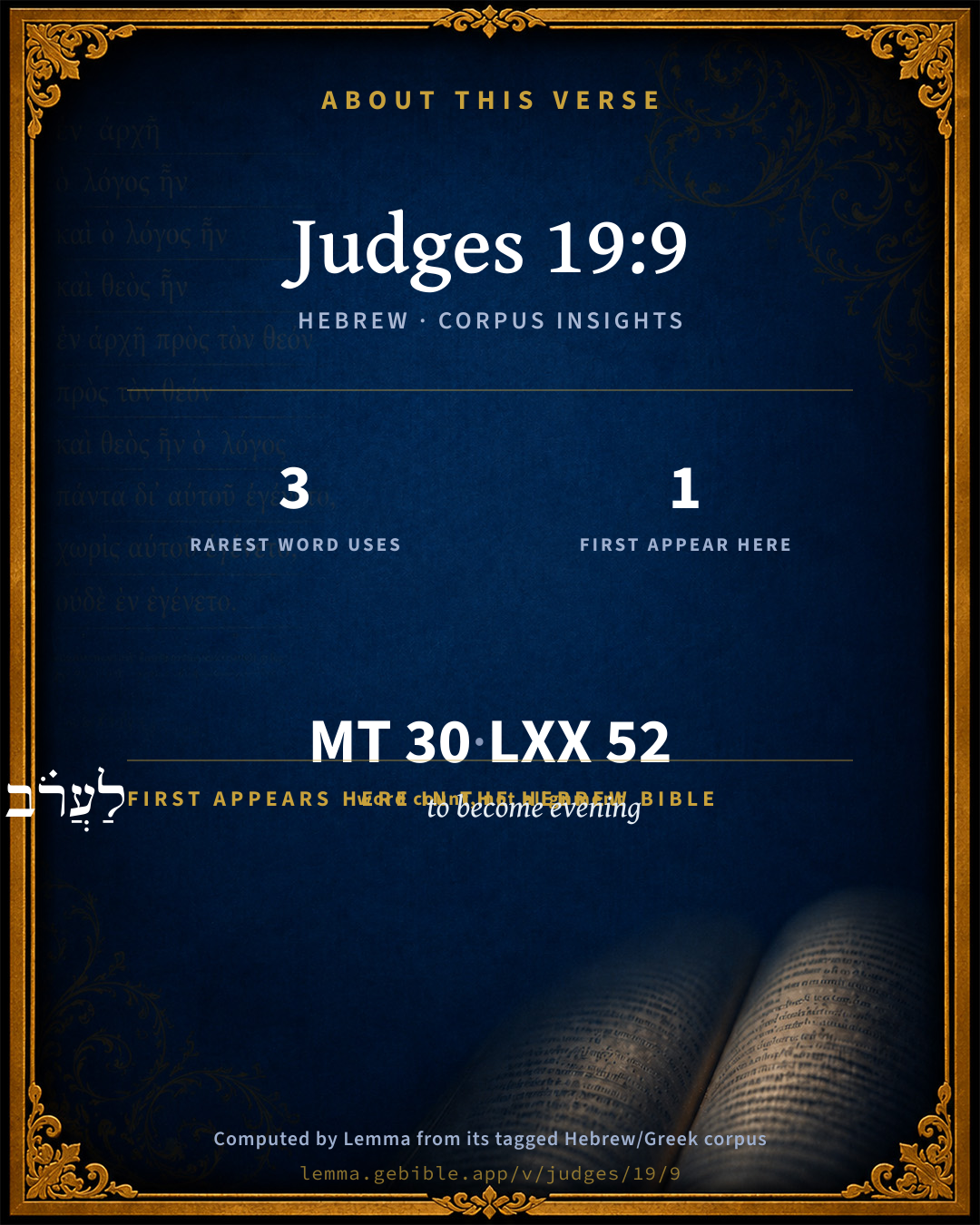
About this verse

These counts appear in no published source. They are computed here, from the morphology-tagged text and Lemma’s own curated glosses. What Lemma adds →

30
words
25
distinct lemmas
Historical
section

Notable vocabulary

The rarest word here is לַעֲרֹ֗ב to become evening H6150 — appearing just 3 times in the whole Hebrew Bible.

First appearance in Scripture

This word makes its first canonical appearance in the Hebrew Bible here:

  • לַעֲרֹ֗ב to become evening H6150

Shared distinctive vocabulary

לַעֲרֹ֗ב to become evening H6150 occurs in 3 verses of the Hebrew Bible. Also found in:

Grammatical profile

  • 12 verbs
  • 11 nouns
  • 1 pronoun
  • 1 preposition
  • 1 adverb
  • 4 particles

Verb forms

  • וַיָּ֤קָם Qal · Sequential Imperfect
  • לָלֶ֔כֶת Qal · Infinitive Construct
  • וַיֹּ֣אמֶר Qal · Sequential Imperfect
  • חֹתְנ֣וֹ Qal · Participle Active
  • רָפָ֨ה Qal · Perfect
  • לַעֲרֹ֗ב Qal · Infinitive Construct
  • לִֽינוּ Qal · Imperative
  • חֲנ֤וֹת Qal · Infinitive Construct
  • לִ֥ין Qal · Imperative
  • וְיִיטַ֣ב Qal · Imperfect
  • וְהִשְׁכַּמְתֶּ֤ם Hiphil · Sequential Perfect
  • וְהָלַכְתָּ֖ Qal · Sequential Perfect

Repetition

Words recur within this verse — often emphatic in Hebrew:

  • הִנֵּ֣ה behold H2009 ×2
  • נָא֩ please H4994 ×2
  • הַיּ֜וֹם day H3117 ×2
  • לִֽינוּ to lodge H3885 ×2

Hebrew & Septuagint length

In English translation the verse runs 62 words from the Hebrew and 57 from the Septuagint (LXX English) — closely comparable.

A rough comparison of the two English renderings, which tokenize alike — not a word-level alignment.

Word counts can differ between the Hebrew and the Greek without any difference in meaning — e.g. the Hebrew direct-object marker אֵת has no separate Greek word, and Greek often adds the article ὁ.

In the original languages it is 30 Hebrew tokens and 52 Greek tokens — but the two are counted differently (Hebrew bundles its prefixes and suffixes into one token; the Greek is in lemma form), so that isn’t a like-for-like length.

Cross-references

3

Topical passages linked to Judges 19:9 in the Treasury of Scripture Knowledge — connected by theme and wording, ordered by reader-vote popularity; previews shown in the World English Bible.

  • Proverbs 27:1 Don't boast about tomorrow; For you don't know what a day may bring forth.
  • James 4:13–14 Come now, you who say, "Today or tomorrow let's go into this city, and spend a year there, trade, and make a profit."
  • Luke 24:29 They urged him, saying, "Stay with us, for it is almost evening, and the day is almost over." He went in to stay with them.

Cross-references courtesy of OpenBible.info (CC BY 4.0).

Hebrew and Greek witnesses Masoretic Hebrew ↔ Greek Septuagint

The same verse in the two great witnesses to the Old Testament, shown verse-for-verse.

These are two independent witnesses, not word-aligned to each other, and the Septuagint is shown in lemma (dictionary) form.

Hebrew Judges 19:9 Masoretic · Westminster Leningrad Codex

וַיָּ֤קָם הָאִישׁ֙ לָלֶ֔כֶת ה֥וּא וּפִילַגְשׁ֖וֹ וְנַעֲר֑וֹ וַיֹּ֣אמֶר ל֣וֹ חֹתְנ֣וֹ אֲבִ֣י הַֽנַּעֲרָ֡ה הִנֵּ֣ה נָא֩ רָפָ֨ה הַיּ֜וֹם לַעֲרֹ֗ב לִֽינוּ נָ֞א הִנֵּ֨ה חֲנ֤וֹת הַיּוֹם֙ לִ֥ין פֹּה֙ וְיִיטַ֣ב לְבָבֶ֔ךָ וְהִשְׁכַּמְתֶּ֤ם מָחָר֙ לְדַרְכְּכֶ֔ם וְהָלַכְתָּ֖ לְאֹהָלֶֽךָ

When the man rose up to depart, he, and his concubine, and his servant, his father-in-law, the young lady's father, said to him, Behold, now the day draws toward evening, please stay all night: behold, the day grows to an end, lodge here, that your heart may be merry; and tomorrow get you early on your way, that you may go home.

World English Bible · Public Domain

Greek LXX Judges 19:9 Septuagint · lemma form

καί ἀναἵστημι ὁ ἀνήρ ὁ πορεύομαι αὐτός καί ὁ παλλακή αὐτός καί ὁ νεανίας αὐτός καί εἶπον αὐτός ὁ γαμβρός αὐτός ὁ πατήρ ὁ νεᾶνις ἰδού δή ἀσθενέω ὁ ἡμέρα εἰς ὁ ἑσπέρα αὐλίζω ὧδε καί ἀγαθύνω ὁ καρδία σύ καί ὀρθρίζω αὔριον εἰς ὁδός σύ καί πορεύομαι εἰς ὁ σκήνωμα σύ

And the man rose up to depart, he and his concubine, and his young man; but his father-in-law the father of the damsel said to him, Behold now, the day has declined toward evening; lodge here, an let your heart rejoice; and you⌃ shall rise early to-morrow for your journey, and you shall go to your habitation.

LXX2012 (modern English Septuagint) · Public Domain

On this verse, The Cambridge Bible for Schools and Colleges discusses the Septuagint’s reading. Read the note in Commentary ↓

Hebrew: Westminster Leningrad Codex (CC BY 4.0). Greek: Septuagint (public domain); English from LXX2012 (modern English Septuagint) (Public Domain). How the Septuagint differs from the Hebrew →

Targum (Aramaic paraphrase)

1

The Targum is the ancient Jewish Aramaic paraphrase of the Hebrew Scriptures — an interpretive translation, not the Hebrew text itself. Onkelos (literal) and Pseudo-Jonathan (expansive) render the Torah, and Jonathan the Prophets. Coverage is partial: where no permissively-licensed English translation exists for a verse, only the Aramaic is shown. This is verse-level text, not a word-by-word alignment to the Hebrew.

  1. Targum Jonathan Prophets (Joshua–Malachi)
    וְקָם גַבְרָא לְמֵיזַל הוּא וּלְחֵינָתֵיהּ וְעוּלֵימֵיהּ וַאֲמַר לֵיהּ חֲמוֹהִי אֲבוּהָא דְעוּלֶמְתָּא הָא כְעַן פְּנָא יוֹמָא לְמֶעֱרַב בִּיתוּ כְעַן הָכָא לְחוֹד יוֹמָא דֵין בִּית הָכָא וְיִשְׁפַּר לִבָּךְ וּתְקַדְמוּן מְחָר לְאוֹרְחַתְכוֹן וּתְהַךְ לְקִירְוָךְ:

    (no public-domain English translation for this verse)

    Targum Jonathan — Aramaic: “Mikraot Gedolot” (public domain). English: “Sefaria Community Translation” (CC0 1.0 (public-domain dedication)); “London "Chaldee Paraphrase," 1871” (public domain). Text via Sefaria.

Commentary

Notes on Judges 19:9 from classic Christian and Jewish commentators (each source and its license shown beneath its notes). The classic Christian expositions comment on the surrounding passage and are grouped to its opening verse, so a note may address several verses; the Jewish commentaries on the Tanakh (Rashi and others) are per-verse, so they appear only where the commentator wrote on this verse.

Lemma curates 59 commentaries, every one of them public domain or Creative Commons licensed, each selected and text-cleaned for this edition rather than reprinted as found. About our sources →

Trapp's Complete Commentary

John Trapp

Jdg 19:9 And when the man rose up to depart, he, and his concubine, and his servant, his father in law, the damsel’s father, said unto him, Behold, now the day draweth toward evening, I pray you tarry all night: behold, the day groweth to an end, lodge here, that thine heart may be merry; and to morrow get you early on your way, that thou mayest go home.

Ver. 9. And when the man rose up to depart.] As home is homely; neither is there any perfume so sweet to a traveller as his own smoke.

The day draweth toward evening.] Heb., Is weak and remiss.

The day groweth to an end.] Mansio diei, the sun is hastening to his lodging; for so it seemeth to do when it setteth.

Lodge here, that thine heart may be merry.] This importunity was an incivility. Homer’s rule in this case is very good:

“Cρη ξεινον παρεοντα φιλειν, εθελοντα δε πεμπειν.”

Show your stranger all courtesy while he is willing to stay, but send him away timeously, when desirous to be gone.

John Trapp, A Commentary or Exposition upon All the Books of the Old and New Testament (1647–1656) — public domain. Text from a community e-Sword module.

Geneva Bible (1599)

Geneva Bible translators

Hebrew, is weak.

Or, the day lodgeth.

To wit, to the town or city where he dwelt.

Geneva Bible (1599) marginal notes — public domain. Text via Bolls.life.

Jamieson, Fausset & Brown

Robert Jamieson, A. R. Fausset & David Brown

the day draweth toward evening--Hebrew, "the pitching time of day." Travellers who set out at daybreak usually halt about the middle of the afternoon the first day, to enjoy rest and refreshment. It was, then, too late a time to commence a journey. But duty, perhaps, obliged the Levite to indulge no further delay.

Jamieson, Fausset & Brown — Commentary Critical and Explanatory on the Whole Bible (1871) — public domain (CC PDM 1.0). Text via the HelloAO Bible API.

Adam Clarke's Commentary

Verse 9. The day groweth to an end] חנות היום chanoth haiyom, "the day is about to pitch its tent;" that is, it was near the time in which travellers ordinarily pitched their tents, to take up their lodging for the night.

Adam Clarke's Commentary on the Bible (1810–1826) — public domain. Text from a community e-Sword/MySword module.

Ellicott's Commentary for English Readers

(9) The day draweth toward evening.—Literally, is weak, or has slackened to evening. The father had purposely detained the Levite till late, in the hopes of inducing him to spend one more night under his roof. The forms of Eastern politeness would render it difficult for the Levite to resist these importunities.

The day groweth to an end.—Literally, it is the bending or declining of the day, not, as in the margin of our version, “the pitching time of the day.”

Home.—Literally, to thy tent, which may be something more than a mere reminiscence of the earlier stage of the national existence. (Comp. “To your tents, O Israel,” 1Ki_12:16, &c.) The Levite is conscious that if the father has been too pressing he has himself been too self-indulgent, and too fond of good living. “His experience is that of all weak and vacillating people: first, unnecessary delay, and then overstrained hurry.”

A Bible Commentary for English Readers, edited by Charles John Ellicott (1878–1897) — public domain. Text from a community e-Sword module.

The Cambridge Bible for Schools and Colleges

gen. ed. J. J. S. Perowne

9. Behold, now the day draweth toward evening … behold, the day groweth to an end] lit. the day sinks to become evening … the camping-time (?) of the day. The doubling of phrases points to a conflation of sources, while the phrases themselves are too high-flown for a prose narrative. Some mss. of the LXX read Behold, the day is declined (Jdg_19:8) toward evening, lodge thou here to-day also. Probably this is nearer to the original.

The Cambridge Bible for Schools and Colleges (gen. ed. J. J. S. Perowne; Cambridge University Press, 1878–1918) — public domain. Text from a community e-Sword module.

John Gill's Exposition

And when the man rose up to depart, he and his concubine, and his servant,.... Rose up from table, having comfortably refreshed themselves:

his father in law, the damsel's father, said unto him, behold, now the day draweth towards evening; or is "remiss", or "weak" (n); that is, the heat, light, and strength of the sun abated, and became weaker and more remiss, as it does the more it declines, and is nearer setting:

I pray you tarry all night; suggesting, it was a very improper time to set out in on a journey:

behold, the day groweth to an end; or "behold, it is the encampment of the day" (o), when the day or sun seems to be pitching its tent, and going to rest; or it being the time when an army on the march stops and pitches their tents, in order to continue all night; or when men go to their tents and habitations, and lie down and take their rest:

lodge here, that thine heart may be merry; and let us have another pleasant evening together, which cannot be had in an inn upon the road; you cannot be comfortable there, as here, and therefore be persuaded to stay, since it is not possible to get home tonight:

and tomorrow get you early on your way, that thou mayest go home; to thy city, as the Targum; signifying, that he should not insist upon their staying any longer, and then they might set out on their journey as soon as they pleased.

(n) "debilitata est", Pagninus, Vatablus; "remissus est", Junius & Tremellius. (o) "castrametatio diei", Drusius.

John Gill's Exposition of the Whole Bible (1746–1763) — public domain (CC PDM 1.0). Text via the HelloAO Bible API.

Albert Barnes' Notes on the Bible

This is a perfect picture of the manners of the time. It is probable that the father showed more than usual hospitality, in order to ensure the kind treatment of his daughter by her husband. These particulars are given to account for their journey running so far into the evening, which was the immediate cause of the horrible catastrophe which followed.

Albert Barnes' Notes on the Bible (1834–1885) — public domain. Text from a community e-Sword/MySword module.

Haydock's Catholic Bible Commentary

Depart. Hebrew and Septuagint add, "early," before the sun was up to render travelling incommodious. (Haydock)

George Leo Haydock (1774–1849), Haydock's Catholic Family Bible and Commentary, 1859 edition — public domain. Excludes Psalms (Douay-Rheims chapter numbering differs from Protestant) and Deuterocanonical books (Catholic canon only).

Matthew Poole's English Annotations

The day groweth to an end, Heb. it is the encamping time of the day, i.e. the evening, when armies having marched in the day, begin to pitch their camp; or, when the sun that makes the day begins to encamp himself and go toward rest; so it is a poetical expression taken from hence, that the sun, when he sets, seems to vulgar eyes to go to rest.

Matthew Poole's English Annotations on the Holy Bible (1683–1685) — public domain. Text from a community e-Sword/MySword module.

The Pulpit Commentary

Draweth toward evening. The Hebrew phrase, which is uncommon, is, The day is slackening to become evening, i.e. the heat and the light of the day are becoming slack and weak, and evening is coming on. The day groweth to an end. Another unusual phrase; literally, Behold the declining of the day, or, as some render it, the encamping of the day, as if the sun after his day"s journey was now pitching his tent for the night. Go home. Literally, to thy tent, as in Jud_1:20:8. So the phrase, To your tents, O Israel, means, Go home. (see 1Ki_12:16, etc.)

The Pulpit Commentary (1880–1919), ed. H.D.M. Spence-Jones & Joseph S. Exell — public domain. Text from a community e-Sword module.

Keil & Delitzsch

C. F. Keil & F. Delitzsch

When at length he rose up, with his concubine and his attendant, to go away, the father entreated his daughter once more: "Behold the day has slackened to become evening, spend the night here! Behold the declining of the day, spend the night here," etc. חנות inf. of חנה, to bend, incline. The interchange of the plural and singular may be explained from the simple fact that the Levite was about to depart with his wife and attendant, but that their remaining or departing depended upon the decision of the man alone. But the Levite did not consent to remain any longer, but set out upon the road, and came with his companions to before Jebus, i.e., Jerusalem, which is only two hours from Bethlehem (compare Rob. Pal. ii. 375 and 379). עד־נכח, to before Jebus, for the road from Bethlehem to Shiloh went past Jerusalem.

Keil & Delitzsch — Biblical Commentary on the Old Testament (1861–1891) — public domain (CC PDM 1.0). Text via the HelloAO Bible API. (Old Testament only.)

unfoldingWord translationNotes

Door43 World Missions Community

now the day is advancing toward evening

"the day is almost over" or "it is almost evening"

translationWords

Levi

concubine

servant

unfoldingWord translationNotes — © Distant Shores Media and the Door43 World Missions Community, licensed CC BY-SA 4.0. Source: git.door43.org/Door43/en_tn.

Rashi

Rabbi Shlomo Yitzchaki (Rashi)

Has waned. The sun [has waned] from full strength, and has begun setting.

It is the time of day for encamping. The time when all travellers turn in to encamp indoors.

Rashi on the Tanakh — English translations: “The Judaica Press complete Tanach with Rashi, translated by A. J. Rosenberg” (CC BY 4.0); “Pentateuch with Rashi's commentary by M. Rosenbaum and A.M. Silbermann, 1929-1934” (public domain); “The Metsudah Tanach series, Lakewood, N.J” (CC BY 4.0); and “The Book of Joshua, Metsudah Publications, 1997” (CC BY 4.0). Text via Sefaria.

Lesson kit

Teaching starters — assembled from the data on this page, not authored interpretation. Every prompt links to the verse data it draws on. Edit before teaching.

Judges, in the Historical, opens this verse with 30 words (25 distinct Hebrew lemmas). Its most distinctive word is ʻârab (“to become evening”). A historical commentator’s framing appears above. Read the whole chapter for the surrounding context.

Discussion questions

  1. The word ʻârab carries the sense “to become evening.” How does it shape the verse?
  2. This is the first place “to become evening” appears in Scripture (first appears here). What does its debut here establish?
  3. How does 1 Samuel 17:16, which shares the word «to become evening», read alongside this verse?
  4. What does the repetition of “behold” (2× in this one verse) do in this verse?
  5. These translations render this verse differently; the difference is in the English rendering, not the original. What questions does that raise?
  6. «וַיָּ֤קָם» is a Qal Sequential Imperfect verb. How does that grammatical form shape the action described?
  7. Compare how Trapp's Complete Commentary and Geneva Bible (1599) read this verse. Where do they agree or differ?

Things to notice

Reading settings

Reading text

Shown beneath each verse's original-language words.

Old Testament
Old Testament edition

Read the OT as the Masoretic Hebrew (MT) or the Greek Septuagint (LXX).

English shown for the Greek Septuagint (in the Hebrew ↔ Greek comparison).

Comparing translations? Open the Compare panel on any verse page to stack up to four side by side.