
1 Samuel 2:13

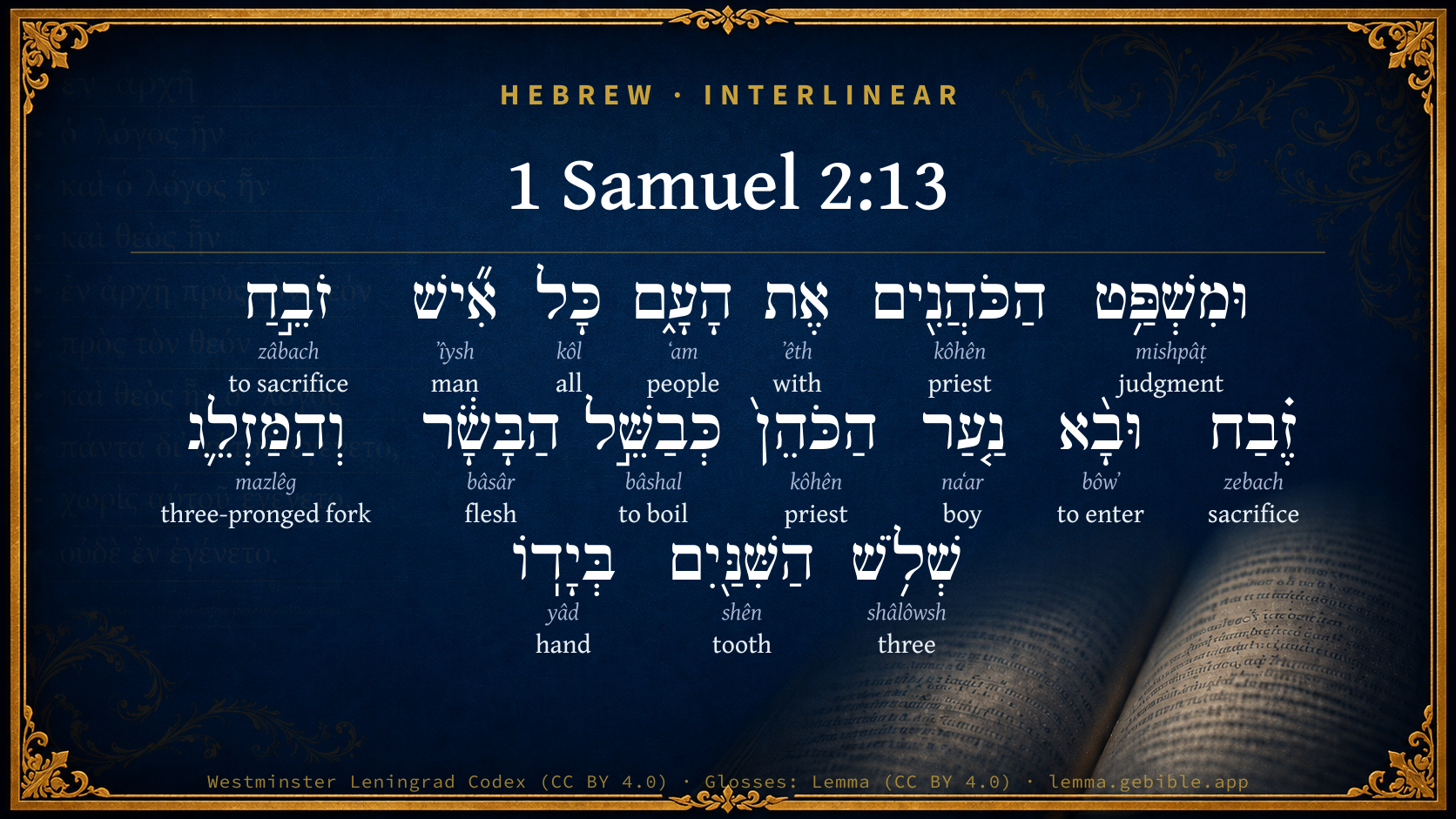
Hebrew (Westminster Leningrad Codex) 1 Samuel 2:13 appears in the Hebrew Old Testament. The text above is from the Westminster Leningrad Codex. Each word links to its Strong’s number, a concise gloss, and parsing drawn from the Open Scriptures Hebrew Bible morphology. Click any word for its full Brown-Driver-Briggs (BDB) entry.
Download image
Cite this verse

1 Samuel 2:13 (World English Bible). Public Domain. Lemma interlinear Bible study tool, https://lemma.gebible.app/v/1-samuel/2/13.

Show BibTeX & RIS
BibTeX
RIS
English Translation
The custom of the priests with the people was that when any man offered sacrifice, the priest's servant came, while the flesh was boiling, with a flesh-hook of three teeth in his hand;
World English Bible · Public Domain
Download a study sheet

One document with this verse’s original text, its word-by-word gloss line, the meaning frame, cross-references with their text, attributed commentary, and full source and license credits — printable, and it pastes into notes with its structure intact.

This verse Autodidact and up

Study sheet (.html) Plain text (.txt)

A passage Seminary Student

Up to 50 verses in one chapter. A passage sheet keeps up to 6 commentary sources and 12 cross-references per verse, in the order this page ranks them, and says so on the sheet whenever that leaves anything out. Ask for a single verse and you get the Autodidact verse sheet above.

Everything on this page stays free to read, with no account — the sheet is a download of what is already on screen, not access to it.

Want to remove ads? Support Godless Engineer
Compare translations 3

The same verse in 3 English versions, stacked beneath the original-language interlinear above. Click any original word for its lexicon entry.

Each is an independent rendering of the whole verse — the interlinear is not word-aligned to these translations.

Highlighted words mark where these versions differ — a whole-verse word diff, not a word-by-word alignment.

  • World English Bible Public Domain
    The custom of the priests with the people was that when any man offered sacrifice, the priest's servant came, while the flesh was boiling, with a flesh-hook of three teeth in his hand;
  • King James Version Public Domain
    And the priest's custom with the people was, that, when any man offered sacrifice, the priest's servant came, while the flesh was in seething, with a fleshhook of three teeth in his hand;
  • unfoldingWord Literal Text CC BY-SA 4.0
    Now the custom of the priests with the people, any man was sacrificing a sacrifice, that the servant of the priest would come at the boiling of the meat, and a fork three prongs in his hand,

unfoldingWord Literal Text — © unfoldingWord, licensed CC BY-SA 4.0. Word-aligned USFM3 via Door43 (git.door43.org/unfoldingWord/en_ult).

Versions to compare (up to 4)

3 of 4 selected

Show all 18 translations

Every available English version of this verse, each an independent rendering of the whole verse.

  • World English Bible Public Domain
    The custom of the priests with the people was that when any man offered sacrifice, the priest's servant came, while the flesh was boiling, with a flesh-hook of three teeth in his hand;
  • Berean Standard Bible Public Domain
    or for the custom of the priests with the people. When any man offered a sacrifice, the servant of the priest would come with a three-pronged meat fork while the meat was boiling
  • Majority Standard Bible Public Domain
    or for the custom of the priests with the people. When any man offered a sacrifice, the servant of the priest would come with a three-pronged meat fork while the meat was boiling
  • King James Version Public Domain
    And the priest's custom with the people was, that, when any man offered sacrifice, the priest's servant came, while the flesh was in seething, with a fleshhook of three teeth in his hand;
  • American Standard Version (1901) Public Domain
    And the custom of the priests with the people was, that, when any man offered sacrifice, the priest's servant came, while the flesh was boiling, with a flesh-hook of three teeth in his hand;
  • Revised Version (1885) Public Domain
    And the custom of the priests with the people was, that, when any man offered sacrifice, the priest’s servant came, while the flesh was in seething, with a fleshhook of three teeth in his hand;
  • Geneva Bible (1599) Public Domain
    For the Priestes custome towarde the people was this: when any man offered sacrifice, the Priestes boy came, while the flesh was seething, and a fleshhooke with three teeth, in his hand,
  • Douay-Rheims (1899) Public Domain
    Nor the office of the priests to the people: but whosoever had offered a sacrifice, the servant of the priest came, while the flesh was in boiling, with a fleshhook of three teeth in his hand,
  • Young's Literal Translation Public Domain
    And the custom of the priests with the people `is': any man sacrificing a sacrifice -- then hath the servant of the priest come in when the flesh is boiling, and the hook of three teeth in his hand,
  • Literal Standard Version CC BY-SA 4.0
    And the custom of the priests with the people [is that when] any man is sacrificing a sacrifice, then the servant of the priest has come in when the flesh is boiling, and [with] the hook of three teeth in his hand,
  • Unlocked Literal Bible CC BY-SA 4.0
    The custom of the priests with the people was that when any man offered a sacrifice, the priest's servant would come with a three-pronged fork in his hand, while the meat was boiling.
  • unfoldingWord Literal Text CC BY-SA 4.0
    Now the custom of the priests with the people, any man was sacrificing a sacrifice, that the servant of the priest would come at the boiling of the meat, and a fork three prongs in his hand,
  • Darby Bible Public Domain
    And the priests' custom with the people was, when any man sacrificed a sacrifice, the priest's servant came, when the flesh was cooked, with a flesh-hook of three prongs in his hand;
  • World Messianic Bible Public Domain
    The custom of the priests with the people was that when anyone offered a sacrifice, the priest’s servant came while the meat was boiling, with a fork of three teeth in his hand;
  • Webster's Bible Public Domain
    And the priest's custom with the people was, that, when any man offered sacrifice, the priest's servant came, while the flesh was in seething, with a flesh-hook of three teeth in his hand;
  • Free Bible Version CC BY-SA 4.0
    or their role as priests to the people. They would send one of their servants over with a fork when anyone came to offer a sacrifice.
  • Bible in Basic English Public Domain
    And the priests' way with the people was this: when any man made an offering, the priest's servant came while the flesh was being cooked, having in his hand a meat-hook with three teeth;
  • JPS Tanakh (1917) Public Domain
    And the custom of the priests with the people was, that, when any man offered sacrifice, the priest's servant came, while the flesh was in seething, with a flesh-hook of three teeth in his band;

Literal Standard Version (2020), Covenant Press — licensed CC BY-SA 4.0. Text via the HelloAO Bible API (eBible.org). Unlocked Literal Bible (unfoldingWord) — licensed CC BY-SA 4.0. Text via the HelloAO Bible API (eBible.org). unfoldingWord Literal Text — © unfoldingWord, licensed CC BY-SA 4.0. Word-aligned USFM3 via Door43 (git.door43.org/unfoldingWord/en_ult). Free Bible Version, Dr. Jonathan Gallagher — licensed CC BY-SA 4.0. Text via the HelloAO Bible API (eBible.org).

Word by word

More ways to search: Search by grammar → Find every occurrence → Compare this word →

Practice this passage: Drill this verse → Learn its vocabulary →

וְהַמַּזְלֵ֛ג
mazlêg
H4207
“and · the · three-pronged fork”
Conjunction + Particle, Definite Article + Noun, Common, Masculine, Singular, Absolute
Part of Speech
Conjunction + Particle + Noun
Type
Common
Gender
Masculine
Number
Singular
State
Absolute
Full BDB Definition

Origin: from an unused root meaning to draw up

TWOT: 552a

three-pronged fork - a sacrificial implement
  1. וּמִשְׁפַּ֥ט mishpâṭ H4941 “and · judgment of” Conjunction + Noun, Common, Masculine, Singular, Construct
  2. הַכֹּהֲנִ֖ים kôhên H3548 “the · priests” Particle, Definite Article + Noun, Common, Masculine, Plural, Absolute
  3. אֶת ʼêth H854 “with” Preposition
  4. הָעָ֑ם ʻam H5971 “the · people” Particle, Definite Article + Noun, Common, Masculine, Singular, Absolute
  5. כָּל kôl H3605 “all of” Noun, Common, Masculine, Singular, Construct
  6. אִ֞ישׁ ʼîysh H376 “man” Noun, Common, Masculine, Singular, Absolute
  7. זֹבֵ֣חַ zâbach H2076 “sacrificing” Verb, Qal, Participle Active, Masculine, Singular, Absolute
  8. זֶ֗בַח zebach H2077 “sacrifice” Noun, Common, Masculine, Singular, Absolute
  9. וּבָ֨א bôwʼ H935 “and · to enter” Conjunction + Verb, Qal, Sequential Perfect, 3rd Person, Masculine, Singular
  10. נַ֤עַר naʻar H5288 “boy of” Noun, Common, Masculine, Singular, Construct
  11. הַכֹּהֵן֙ kôhên H3548 “the · priest” Particle, Definite Article + Noun, Common, Masculine, Singular, Absolute
  12. כְּבַשֵּׁ֣ל bâshal H1310 “like/as · to boil” Preposition + Verb, Piel, Infinitive Construct
  13. הַבָּשָׂ֔ר bâsâr H1320 “the · flesh” Particle, Definite Article + Noun, Common, Masculine, Singular, Absolute
  14. שְׁלֹ֥שׁ shâlôwsh H7969 “three” Adjective, Cardinal number, Feminine, Singular, Absolute
  15. הַשִּׁנַּ֖יִם shên H8127 “the · teeth” Particle, Definite Article + Noun, Common, Both, Dual, Absolute
  16. בְּיָדֽוֹ yâd H3027 “in/at · hand · his” Preposition + Noun, Common, Both, Singular, Construct + Suffix, Personal, 3rd Person, Masculine, Singular

About this verse

These counts appear in no published source. They are computed here, from the morphology-tagged text and Lemma’s own curated glosses. What Lemma adds →

17
words
16
distinct lemmas
Historical
section

Notable vocabulary

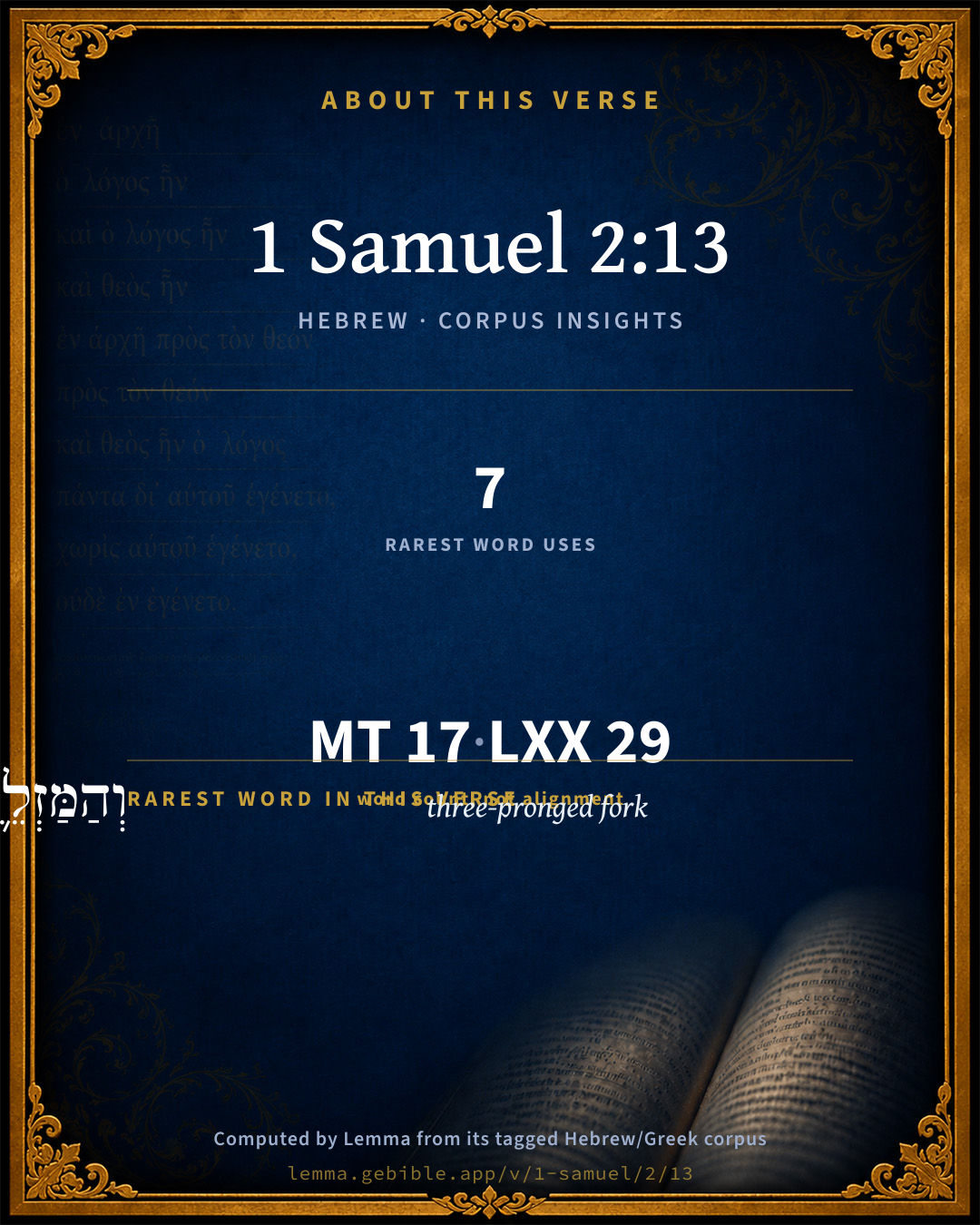
The rarest word here is וְהַמַּזְלֵ֛ג three-pronged fork H4207 — appearing just 7 times in the whole Hebrew Bible.

Shared distinctive vocabulary

וְהַמַּזְלֵ֛ג three-pronged fork H4207 occurs in 7 verses of the Hebrew Bible. Also found in:

Grammatical profile

  • 3 verbs
  • 12 nouns
  • 1 adjective
  • 1 preposition

Verb forms

  • זֹבֵ֣חַ Qal · Participle Active
  • וּבָ֨א Qal · Sequential Perfect
  • כְּבַשֵּׁ֣ל Piel · Infinitive Construct

Repetition

A word recurs within this verse — often emphatic in Hebrew:

  • הַכֹּהֲנִ֖ים priest H3548 ×2

Hebrew & Septuagint length

In English translation the verse runs 33 words from the Hebrew and 36 from the Septuagint (LXX English) — closely comparable.

A rough comparison of the two English renderings, which tokenize alike — not a word-level alignment.

Word counts can differ between the Hebrew and the Greek without any difference in meaning — e.g. the Hebrew direct-object marker אֵת has no separate Greek word, and Greek often adds the article ὁ.

In the original languages it is 17 Hebrew tokens and 29 Greek tokens — but the two are counted differently (Hebrew bundles its prefixes and suffixes into one token; the Greek is in lemma form), so that isn’t a like-for-like length.

Cross-references

1

Topical passages linked to 1 Samuel 2:13 in the Treasury of Scripture Knowledge — connected by theme and wording, ordered by reader-vote popularity; previews shown in the World English Bible.

  • Leviticus 7:29–34 "Speak to the children of Israel, saying, 'He who offers the sacrifice of his peace offerings to Yahweh shall bring his offering to Yahweh out of the sacrifice of his peace offerings.

Cross-references courtesy of OpenBible.info (CC BY 4.0).

Hebrew and Greek witnesses Masoretic Hebrew ↔ Greek Septuagint

The same verse in the two great witnesses to the Old Testament, shown verse-for-verse.

These are two independent witnesses, not word-aligned to each other, and the Septuagint is shown in lemma (dictionary) form.

Hebrew 1 Samuel 2:13 Masoretic · Westminster Leningrad Codex

וּמִשְׁפַּ֥ט הַכֹּהֲנִ֖ים אֶת הָעָ֑ם כָּל אִ֞ישׁ זֹבֵ֣חַ זֶ֗בַח וּבָ֨א נַ֤עַר הַכֹּהֵן֙ כְּבַשֵּׁ֣ל הַבָּשָׂ֔ר וְהַמַּזְלֵ֛ג שְׁלֹ֥שׁ הַשִּׁנַּ֖יִם בְּיָדֽוֹ

The custom of the priests with the people was that when any man offered sacrifice, the priest's servant came, while the flesh was boiling, with a flesh-hook of three teeth in his hand;

World English Bible · Public Domain

Greek LXX 1 Samuel 2:13 Septuagint · lemma form

καί ὁ δικαίωμα ὁ ἱερεύς παρά ὁ λαός πᾶς ὁ θύω καί ἄρχω ὁ παιδάριον ὁ ἱερεύς ὡς ἄν ἡψήθη ὁ κρέας καί κρεάγρα τριόδους ἐν ὁ χείρ αὐτός

And the priest's claim from every one of the people that sacrificed was this: the servant of the priest came when the flesh was in seething, and a flesh-hook of three teeth was in his hand.

LXX2012 (modern English Septuagint) · Public Domain

Hebrew: Westminster Leningrad Codex (CC BY 4.0). Greek: Septuagint (public domain); English from LXX2012 (modern English Septuagint) (Public Domain). How the Septuagint differs from the Hebrew →

Targum (Aramaic paraphrase)

1

The Targum is the ancient Jewish Aramaic paraphrase of the Hebrew Scriptures — an interpretive translation, not the Hebrew text itself. Onkelos (literal) and Pseudo-Jonathan (expansive) render the Torah, and Jonathan the Prophets. Coverage is partial: where no permissively-licensed English translation exists for a verse, only the Aramaic is shown. This is verse-level text, not a word-by-word alignment to the Hebrew.

  1. Targum Jonathan Prophets (Joshua–Malachi)
    וְנִימוּסָא דְכַהֲנַיָא מִן עַמָא כָּל גְבַר דְנָכֵיס נִכְסְתָא וְאָתֵי עוּלֵימָא דְכַהֲנָא כִּמְבַשֵׁל בִּסְרָא וּמַשִׁילְיָא דִי לֵיהּ תְּלַת שְׁנִין בִּידֵיהּ:

    (no public-domain English translation for this verse)

    Targum Jonathan — Aramaic: “Mikraot Gedolot” (public domain). English: “Sefaria Community Translation” (CC0 1.0 (public-domain dedication)); “London "Chaldee Paraphrase," 1871” (public domain). Text via Sefaria.

Commentary

Notes on 1 Samuel 2:13 from classic Christian and Jewish commentators (each source and its license shown beneath its notes). The classic Christian expositions comment on the surrounding passage and are grouped to its opening verse, so a note may address several verses; the Jewish commentaries on the Tanakh (Rashi and others) are per-verse, so they appear only where the commentator wrote on this verse.

Lemma curates 59 commentaries, every one of them public domain or Creative Commons licensed, each selected and text-cleaned for this edition rather than reprinted as found. About our sources →

Trapp's Complete Commentary

John Trapp

1Sa 2:13 And the priests’ custom with the people [was, that], when any man offered sacrifice, the priest’s servant came, while the flesh was in seething, with a fleshhook of three teeth in his hand;

Ver. 13. And the priest’s custom with the people was.] It was their custom, but not their right. Plus valet malum inolitum quam bonum insolitum. Here these priests are accused of sundry foul crimes, as ignorance, theft, sacrilege, luxury, adultery, obstinacy. A wicked priest is the worst creature upon earth. Who are devils, but they which were once angels of light?

John Trapp, A Commentary or Exposition upon All the Books of the Old and New Testament (1647–1656) — public domain. Text from a community e-Sword module.

Joseph Benson's Commentary

1Sa 2:13. When any man offered sacrifice — Brought his peace-offerings to be offered at the altar. While the flesh was in seething — Or boiling. As the Lord’s part of the peace-offerings was burned upon the altar, so the priests’ and offerers’ parts were to be boiled. And when the temple was built, there were certain rooms in the court of the people, wherein they had liberty to boil the flesh, in order that they might feast with God at his own house. And the like rooms, no doubt, there were in the outward court of the tabernacle.

Joseph Benson's Commentary on the Old and New Testaments (1811–1818) — public domain. Text from a community e-Sword module.

Tyndale Open Study Notes

Tyndale Open Resources

2:13-17 The priests were supposed to receive their portion of the meat only after it had been boiled (see Num 6:19). Eli’s sons disregarded God’s instructions (1 Sam 2:13-14, 17).

Tyndale Open Study Notes — © Tyndale Open Resources, licensed CC BY-SA 4.0. Text via the HelloAO Bible API.

Geneva Bible (1599)

Geneva Bible translators

Or, son.

Geneva Bible (1599) marginal notes — public domain. Text via Bolls.life.

Jamieson, Fausset & Brown

Robert Jamieson, A. R. Fausset & David Brown

the priests' custom with the people--When persons wished to present a sacrifice of peace offering on the altar, the offering was brought in the first instance to the priest, and as the Lord's part was burnt, the parts appropriated respectively to the priests and offerers were to be sodden. But Eli's sons, unsatisfied with the breast and shoulder, which were the perquisites appointed to them by the divine law (Exo 29:27; Lev 7:31-32), not only claimed part of the offerer's share, but rapaciously seized them previous to the sacred ceremony of heaving or waving (see on Lev 7:29); and moreover they committed the additional injustice of taking up with their fork those portions which they preferred, while still raw. Pious people revolted at such rapacious and profane encroachments on the dues of the altar, as well as what should have gone to constitute the family and social feast of the offerer. The truth is, the priests having become haughty and unwilling in many instances to accept invitations to those feasts, presents of meat were sent to them; and this, though done in courtesy at first, being, in course of time, established into a right, gave rise to all the rapacious keenness of Eli's sons.

Jamieson, Fausset & Brown — Commentary Critical and Explanatory on the Whole Bible (1871) — public domain (CC PDM 1.0). Text via the HelloAO Bible API.

Adam Clarke's Commentary

Verse 13. When any man offered sacrifice] That is, when a peace-offering was brought, the right shoulder and the breast belonged to the priest, the fat was burnt upon the altar, and the blood was poured at the bottom of the altar; the rest of the flesh belonged to the offerer. Under pretence of taking only their own part, they took the best of all they chose, and as much as they chose.

Adam Clarke's Commentary on the Bible (1810–1826) — public domain. Text from a community e-Sword/MySword module.

Ellicott's Commentary for English Readers

(13) The priest’s custom.—That is to say, the custom or practice introduced under these robber-priests, who were not content with the modest share of the offerings assigned to them by the Law of Moses. (See Lev_7:31; Lev_7:35; Deu_18:3.)

A Bible Commentary for English Readers, edited by Charles John Ellicott (1878–1897) — public domain. Text from a community e-Sword module.

The Cambridge Bible for Schools and Colleges

gen. ed. J. J. S. Perowne

13. the priests’ custom] The law directed the worshipper to present to the priest the fat of the victim along with the breast and shoulder (Lev_7:29-34). The fat was to be burned on the altar to Jehovah (Lev_3:3-5): the breast and shoulder, after being ‘waved’ and ‘heaved,’ a ceremony of dedication to Jehovah, became the priest’s portion. Hophni and Phinehas were guilty of a double sin. (a) They robbed the people: not content with the share assigned them, they sent a servant to interrupt the preparation of the sacrificial meal, and seize a further portion. (b) They insulted Jehovah by demanding their share before the parts consecrated to Him had been duly burned upon the altar (1Sa_2:15).

priests’] Misprinted priest’s in most editions of the Bible.

seething] i.e. boiling.

The Cambridge Bible for Schools and Colleges (gen. ed. J. J. S. Perowne; Cambridge University Press, 1878–1918) — public domain. Text from a community e-Sword module.

John Gill's Exposition

And he struck it into the pan, or kettle, or cauldron, or pot,.... Whatever vessel was made use of, larger or lesser, according to the quantity of flesh the owner boiled for himself and friends, the trident the priest's servants brought with him, he struck into the boiler to the bottom; of it:

all that the fleshhook brought up the priest took for himself; as his own property; whereas no part of it at all belonged to him, he having had the breast and shoulder delivered to him in the first place; and yet, by this method, all that he could drag up with this three forked instrument he claimed as his own; which might be much, that would hang upon three teeth of it, or in which they were fastened; and, according to Abarbinel, each of them would bring up a pound of flesh, and perhaps more:

so they did in Shiloh, unto all the Israelites that came thither; to offer their sacrifices, which was the proper place for them, the tabernacle and altar being there; and men of all ranks and degrees were treated alike, princes and people, rich and poor; the custom universally obtained, and all sorts of men met with the same usage.

John Gill's Exposition of the Whole Bible (1746–1763) — public domain (CC PDM 1.0). Text via the HelloAO Bible API.

Albert Barnes' Notes on the Bible

The Law of Moses defined exactly what was to be the priest’s portion of every peace offering Lev 7:31-35, as it also gave express directions about the burning of the fat Lev 7:23-25, Lev 7:31. It was therefore a gross act of disobedience and lawlessness on the part of Hophni and Phinehas to take more than the Law gave them. Incidental evidence is afforded by this passage to the existence of the Levitical law at this time.

Albert Barnes' Notes on the Bible (1834–1885) — public domain. Text from a community e-Sword/MySword module.

Haydock's Catholic Bible Commentary

Nor the office. The Vulgate repeats the negation from the preceding sentence. Others translate, "The priests’ custom with the people was," &c., or, "the pretended right of the priests," &c. They neither performed their duty towards God, (Calmet) nor were they content with what the law authorized them to receive from the people. (Haydock) --- Servant, or son; perhaps Ophni or Phinees. --- Boiling. In the heroic times, the meat was never boiled, but roasted. (Atheneus i. 10.; and Servius; though Hesiod asserts the contrary, ver. 748. (Calmet) --- Abulensis (q. 8.) observes that the person who offered the victim, boiled the parts which belonged to himself, as well as the priest’s share. But, whereas in the peace-offerings, only the breast and the right shoulder fell to the priest, these rapacious men took whatever they pleased. (Menochius)

George Leo Haydock (1774–1849), Haydock's Catholic Family Bible and Commentary, 1859 edition — public domain. Excludes Psalms (Douay-Rheims chapter numbering differs from Protestant) and Deuterocanonical books (Catholic canon only).

Matthew Poole's English Annotations

Offered, i.e. presented it to the Lord, to be offered by the priest.

While the flesh was in seething; for as the Lord’s part of the peace-offerings was burnt upon the altar, so the priest’s and offerer’s parts were to be sodden.

Matthew Poole's English Annotations on the Holy Bible (1683–1685) — public domain. Text from a community e-Sword/MySword module.

Whedon's Commentary on the Bible

Daniel D. Whedon

13. The priest’s custom with the people — The sacrilegious custom here described had been profanely introduced in the time of the Judges, and was a sad departure from the law, which gave only certain specified portions to the priests, and required the fat to be burned on the altar. Lev_7:29-34.

A fleshhook of three teeth — “The three-pronged fork which fishes up the seething flesh is the earliest type of grasping at pluralities and church-preferments by base means. For students of ecclesiastical history, Hophni and Phinehas are characters ‘of great and instructive wickedness.’ They are the true exemplars of the grasping and worldly clergy of all ages.” — Stanley.

Daniel D. Whedon (gen. ed.), Commentary on the Old and New Testaments (1874–1909) — public domain. Text from a community e-Sword module.

John Wesley's Explanatory Notes

Boiling - As the Lord's part of the peace-offerings was burnt upon the altar, so the priest's and offerer's parts were to be boiled.

John Wesley, Explanatory Notes Upon the Whole Bible (1754–1765) — public domain. Text via the GEBible commentary corpus.

Rashi

Rabbi Shlomo Yitzchaki (Rashi)

The custom of the kohanim. They established this law for themselves, since they rightfully inherited only the breast and the thigh of the peace offering.

Rashi on the Tanakh — English translations: “The Judaica Press complete Tanach with Rashi, translated by A. J. Rosenberg” (CC BY 4.0); “Pentateuch with Rashi's commentary by M. Rosenbaum and A.M. Silbermann, 1929-1934” (public domain); “The Metsudah Tanach series, Lakewood, N.J” (CC BY 4.0); and “The Book of Joshua, Metsudah Publications, 1997” (CC BY 4.0). Text via Sefaria.

Lesson kit

Teaching starters — assembled from the data on this page, not authored interpretation. Every prompt links to the verse data it draws on. Edit before teaching.

1 Samuel, in the Historical, opens this verse with 17 words (16 distinct Hebrew lemmas). Its most distinctive word is mazlêg (“three-pronged fork”). A historical commentator’s framing appears above. Read the whole chapter for the surrounding context.

Discussion questions

  1. How does “three-pronged fork” (mazlêg) shape what this verse is saying?
  2. Exodus 27:3 shares the word «three-pronged fork» with this verse. How do the two illuminate each other?
  3. “priest” occurs 2× in this one verse. What is the effect of the repetition?
  4. The translations on this page render this verse differently — a whole-verse word diff, not a word-by-word alignment. What might account for the different wordings?
  5. The verb «זֹבֵ֣חַ» is Qal Participle Active. How does its form color the action?
  6. Reading how Trapp's Complete Commentary and Joseph Benson's Commentary read this verse, where do the two commentators agree and where do they part?

Things to notice

Reading settings

Reading text

Shown beneath each verse's original-language words.

Old Testament
Old Testament edition

Read the OT as the Masoretic Hebrew (MT) or the Greek Septuagint (LXX).

English shown for the Greek Septuagint (in the Hebrew ↔ Greek comparison).

Comparing translations? Open the Compare panel on any verse page to stack up to four side by side.