
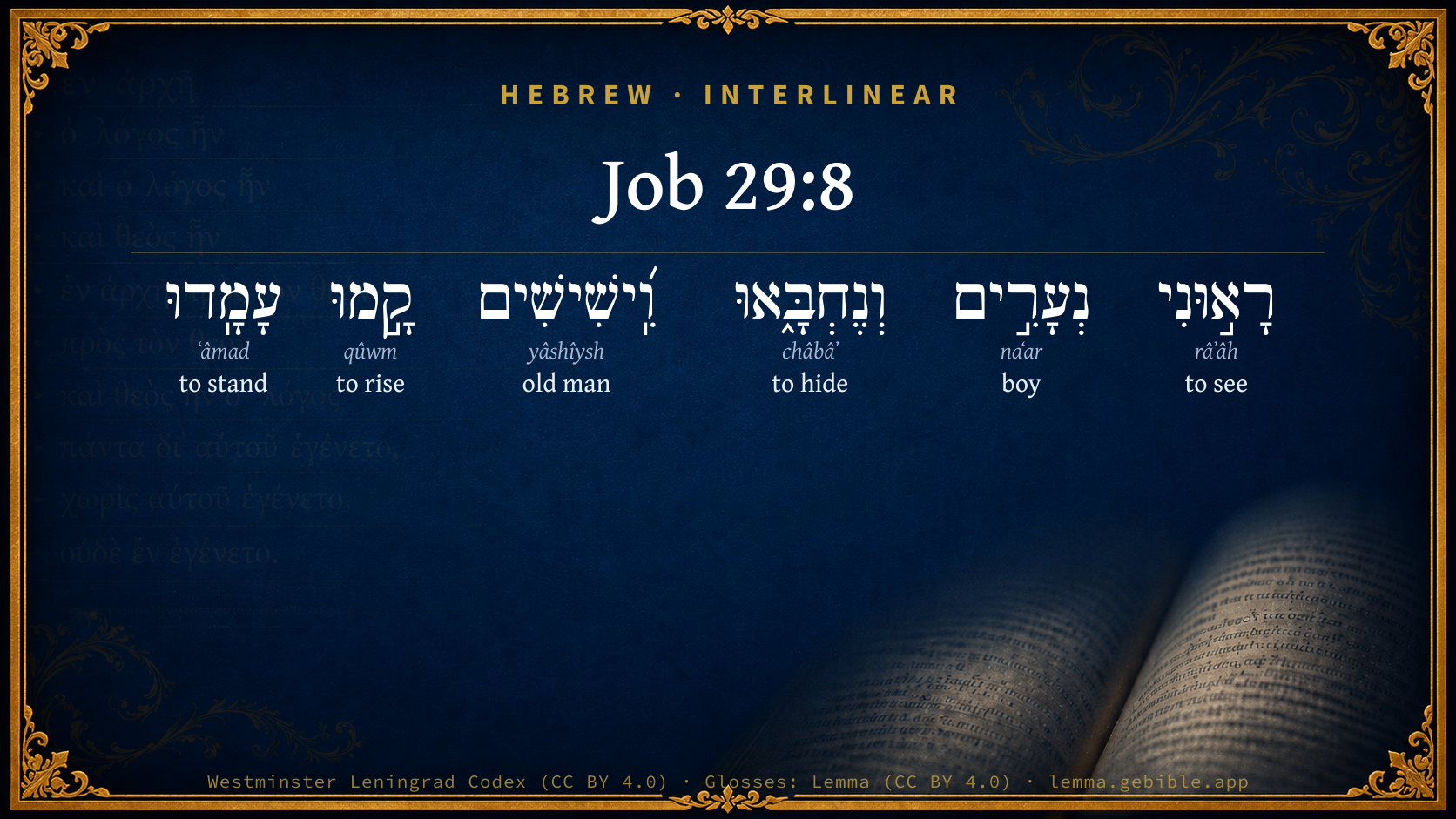
Job 29:8

Hebrew (Westminster Leningrad Codex) Job 29:8 appears in the Hebrew Old Testament. The text above is from the Westminster Leningrad Codex. Each word links to its Strong’s number, a concise gloss, and parsing drawn from the Open Scriptures Hebrew Bible morphology. Click any word for its full Brown-Driver-Briggs (BDB) entry.
Download image
Cite this verse

Job 29:8 (World English Bible). Public Domain. Lemma interlinear Bible study tool, https://lemma.gebible.app/v/job/29/8.

Show BibTeX & RIS
BibTeX
RIS
English Translation
The young men saw me and hid themselves, The aged rose up and stood;
World English Bible · Public Domain
Download a study sheet

One document with this verse’s original text, its word-by-word gloss line, the meaning frame, cross-references with their text, attributed commentary, and full source and license credits — printable, and it pastes into notes with its structure intact.

This verse Autodidact and up

Study sheet (.html) Plain text (.txt)

A passage Seminary Student

Up to 50 verses in one chapter. A passage sheet keeps up to 6 commentary sources and 12 cross-references per verse, in the order this page ranks them, and says so on the sheet whenever that leaves anything out. Ask for a single verse and you get the Autodidact verse sheet above.

Everything on this page stays free to read, with no account — the sheet is a download of what is already on screen, not access to it.

Want to remove ads? Support Godless Engineer
Compare translations 3

The same verse in 3 English versions, stacked beneath the original-language interlinear above. Click any original word for its lexicon entry.

Each is an independent rendering of the whole verse — the interlinear is not word-aligned to these translations.

Highlighted words mark where these versions differ — a whole-verse word diff, not a word-by-word alignment.

  • World English Bible Public Domain
    The young men saw me and hid themselves, The aged rose up and stood;
  • King James Version Public Domain
    The young men saw me, and hid themselves: and the aged arose, and stood up.
  • unfoldingWord Literal Text CC BY-SA 4.0
    young men saw me and hid themselves, and old men rose, they stood.

unfoldingWord Literal Text — © unfoldingWord, licensed CC BY-SA 4.0. Word-aligned USFM3 via Door43 (git.door43.org/unfoldingWord/en_ult).

Versions to compare (up to 4)

3 of 4 selected

Show all 18 translations

Every available English version of this verse, each an independent rendering of the whole verse.

  • World English Bible Public Domain
    The young men saw me and hid themselves, The aged rose up and stood;
  • Berean Standard Bible Public Domain
    the young men saw me and withdrew, and the old men rose to their feet.
  • Majority Standard Bible Public Domain
    the young men saw me and withdrew, and the old men rose to their feet.
  • King James Version Public Domain
    The young men saw me, and hid themselves: and the aged arose, and stood up.
  • American Standard Version (1901) Public Domain
    The young men saw me and hid themselves, And the aged rose up and stood;
  • Revised Version (1885) Public Domain
    The young men saw me and hid themselves, and the aged rose up and stood;
  • Geneva Bible (1599) Public Domain
    The yong men saw me, and hid themselues, and the aged arose, and stood vp.
  • Douay-Rheims (1899) Public Domain
    The young men saw me, and hid themselves: and the old men rose up and stood.
  • Young's Literal Translation Public Domain
    Seen me have youths, and they, been hidden, And the aged have risen -- they stood up.
  • Literal Standard Version CC BY-SA 4.0
    Youths have seen me, and they have been hidden, || And the aged have risen—they stood up.
  • Unlocked Literal Bible CC BY-SA 4.0
    the young men saw me and kept their distance from me in respect, and the aged people rose and stood for me.
  • unfoldingWord Literal Text CC BY-SA 4.0
    young men saw me and hid themselves, and old men rose, they stood.
  • Darby Bible Public Domain
    The young men saw me, and hid themselves; and the aged arose [and] stood up;
  • World Messianic Bible Public Domain
    The young men saw me and hid themselves. The aged rose up and stood.
  • Webster's Bible Public Domain
    The young men saw me, and hid themselves: and the aged arose, and stood up.
  • Free Bible Version CC BY-SA 4.0
    The young men saw me and moved out of the way; the elders would stand up for me.
  • Bible in Basic English Public Domain
    The young men saw me, and went away, and the old men got up from their seats;
  • JPS Tanakh (1917) Public Domain
    The young men saw me and hid themselves, and the aged rose up and stood;

Literal Standard Version (2020), Covenant Press — licensed CC BY-SA 4.0. Text via the HelloAO Bible API (eBible.org). Unlocked Literal Bible (unfoldingWord) — licensed CC BY-SA 4.0. Text via the HelloAO Bible API (eBible.org). unfoldingWord Literal Text — © unfoldingWord, licensed CC BY-SA 4.0. Word-aligned USFM3 via Door43 (git.door43.org/unfoldingWord/en_ult). Free Bible Version, Dr. Jonathan Gallagher — licensed CC BY-SA 4.0. Text via the HelloAO Bible API (eBible.org).

Word by word

More ways to search: Search by grammar → Find every occurrence → Compare this word →

Practice this passage: Drill this verse → Learn its vocabulary →

About this verse

These counts appear in no published source. They are computed here, from the morphology-tagged text and Lemma’s own curated glosses. What Lemma adds →

6
words
6
distinct lemmas
Wisdom
section

Notable vocabulary

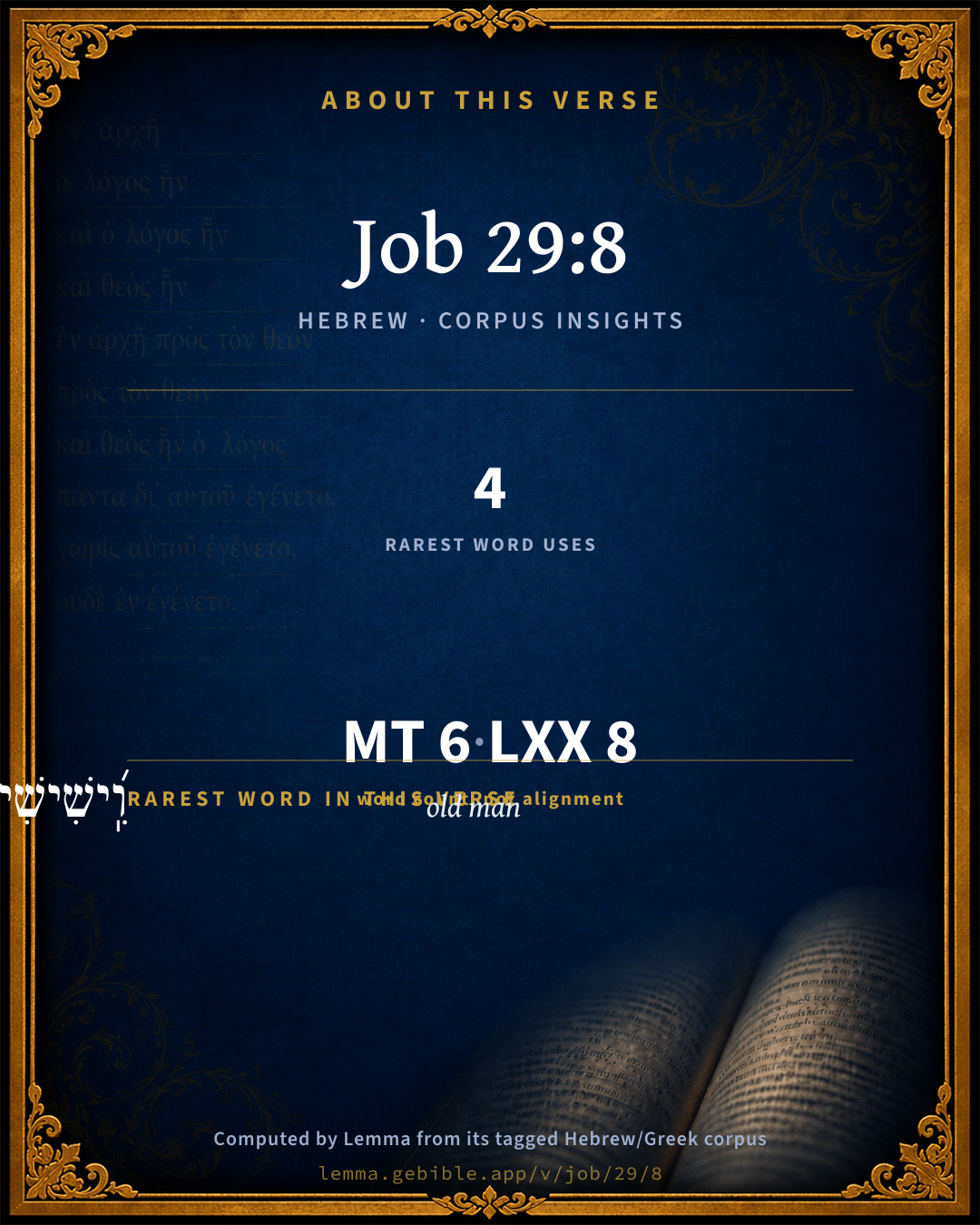
The rarest word here is וִֽ֝ישִׁישִׁים old man H3453 — appearing just 4 times in the whole Hebrew Bible.

Shared distinctive vocabulary

וִֽ֝ישִׁישִׁים old man H3453 occurs in 4 verses of the Hebrew Bible. Also found in:

Grammatical profile

  • 4 verbs
  • 1 noun
  • 1 adjective

Verb forms

  • רָא֣וּנִי Qal · Perfect
  • וְנֶחְבָּ֑אוּ Niphal · Perfect
  • קָ֣מוּ Qal · Perfect
  • עָמָֽדוּ Qal · Perfect

Hebrew & Septuagint length

In English translation the verse runs 14 words from the Hebrew and 15 from the Septuagint (LXX English) — closely comparable.

A rough comparison of the two English renderings, which tokenize alike — not a word-level alignment.

Word counts can differ between the Hebrew and the Greek without any difference in meaning — e.g. the Hebrew direct-object marker אֵת has no separate Greek word, and Greek often adds the article ὁ.

In the original languages it is 6 Hebrew tokens and 8 Greek tokens — but the two are counted differently (Hebrew bundles its prefixes and suffixes into one token; the Greek is in lemma form), so that isn’t a like-for-like length.

Cross-references

8

Topical passages linked to Job 29:8 in the Treasury of Scripture Knowledge — connected by theme and wording, ordered by reader-vote popularity; previews shown in the World English Bible.

  • Leviticus 19:32 You shall rise up before the gray head, and honor the face of an old man, and you shall fear your God. I am Yahweh.
  • Proverbs 16:31 Gray hair is a crown of glory. It is attained by a life of righteousness.
  • Romans 13:7 Give therefore to everyone what you owe: taxes to whom taxes are due; customs to whom customs; respect to whom respect; honor to whom honor.
  • Titus 3:1 Remind them to be in subjection to rulers and to authorities, to be obedient, to be ready for every good work,
  • 1 Peter 5:5 Likewise, you younger ones, be subject to the elder. Yes, all of you gird yourselves with humility, to subject yourselves to one another; for "God resists the proud, but gives grace to the humble."
  • Proverbs 20:8 A king who sits on the throne of judgment Scatters away all evil with his eyes.
  • Romans 13:3–4 For rulers are not a terror to the good work, but to the evil. Do you desire to have no fear of the authority? Do that which is good, and you will have praise from the same,
  • 1 Peter 2:17 Honor all men. Love the brotherhood. Fear God. Honor the king.

Cross-references courtesy of OpenBible.info (CC BY 4.0).

Hebrew and Greek witnesses Masoretic Hebrew ↔ Greek Septuagint

The same verse in the two great witnesses to the Old Testament, shown verse-for-verse.

These are two independent witnesses, not word-aligned to each other, and the Septuagint is shown in lemma (dictionary) form.

Hebrew Job 29:8 Masoretic · Westminster Leningrad Codex

רָא֣וּנִי נְעָרִ֣ים וְנֶחְבָּ֑אוּ וִֽ֝ישִׁישִׁים קָ֣מוּ עָמָֽדוּ

The young men saw me and hid themselves, The aged rose up and stood;

World English Bible · Public Domain

Greek LXX Job 29:8 Septuagint · lemma form

ὁράω ἐγώ νεανίσκος κρύπτω πρεσβύτης δέ πᾶς ἵστημι

The young men saw me, and hid themselves: and all the old men stood up.

LXX2012 (modern English Septuagint) · Public Domain

Hebrew: Westminster Leningrad Codex (CC BY 4.0). Greek: Septuagint (public domain); English from LXX2012 (modern English Septuagint) (Public Domain). How the Septuagint differs from the Hebrew →

Commentary

Notes on Job 29:8 from classic Christian and Jewish commentators (each source and its license shown beneath its notes). The classic Christian expositions comment on the surrounding passage and are grouped to its opening verse, so a note may address several verses; the Jewish commentaries on the Tanakh (Rashi and others) are per-verse, so they appear only where the commentator wrote on this verse.

Lemma curates 59 commentaries, every one of them public domain or Creative Commons licensed, each selected and text-cleaned for this edition rather than reprinted as found. About our sources →

Trapp's Complete Commentary

John Trapp

Job 29:8 The young men saw me, and hid themselves: and the aged arose, [and] stood up.

Ver. 8. The young men saw me, and hid themselves] As awed with my presence, and fearing the censure of my gravity. Valerius Maximus reporteth the like of Marcus Cato among the Romans (lib. 5, cap. 2), as being Vir rigidae innocentiae, saith Livy; Et virtuti quam simillimus, as Velleius hath it; that is, a most strict and very virtuous magistrate. Hence at their Floralia, those wanton sports, the youths could not play their pranks till he departed; they all crying unto him, Aut vultum deponas, aut discedas, Either lay down your grave looks or leave the place.

And the aged arose, and stood up] Performing that respect to me which was due to them, Lev 19:32, and saluting me as the Athenians did their Phocion, by the title of Bonus Good; or as the Romans did their Trajan, by the style of Optimus the best ruler that ever they had; and all both young and old crying out, as once they did at Rome to Severus, the emperor, All men do the better in all respects for thy good government, Pαντες παντα καλως ποιουσιν επειδαν συ καλως αρχεις (Dio). These acclamations and public honours, though Job sought not, yet it could not but be a comfort to him, as it was to David, that whatsoever he did pleased the people.

John Trapp, A Commentary or Exposition upon All the Books of the Old and New Testament (1647–1656) — public domain. Text from a community e-Sword module.

Joseph Benson's Commentary

Job 29:8-10. The young men saw me and hid themselves — Out of reverence to my person and dignity, or out of a consciousness of their guilt and folly, which they supposed I might understand either by information from others, or discover by their countenances, and for which they knew I would reprove them, and bring them to shame or other punishment. And the aged arose and stood up — While I either passed by them, or was present with them: so great was the veneration which they had for me, although you treat me with such contempt and scorn. The princes refrained talking — A general silence immediately ensued when I appeared, the great men themselves, who were high in office, breaking off their discourses, and not taking the liberty to speak a word till I had first given my opinion, which they readily approved of, and to which they fully assented. The nobles held their peace — Those who were distinguished by their birth and quality, and were superior to others in honour and dignity, could not have heard me with greater attention and stillness, if they had quite lost their voices, or their tongues had been tied to the roof of their mouths.

Joseph Benson's Commentary on the Old and New Testaments (1811–1818) — public domain. Text from a community e-Sword module.

Geneva Bible (1599)

Geneva Bible translators

Being ashamed of their lightness and afraid of my gravity.

Geneva Bible (1599) marginal notes — public domain. Text via Bolls.life.

Jamieson, Fausset & Brown

Robert Jamieson, A. R. Fausset & David Brown

hid--not literally; rather, "stepped backwards," reverentially. The aged, who were already seated, arose and remained standing (Hebrew) until Job seated himself. Oriental manners.

Jamieson, Fausset & Brown — Commentary Critical and Explanatory on the Whole Bible (1871) — public domain (CC PDM 1.0). Text via the HelloAO Bible API.

Adam Clarke's Commentary

Verse 8. The young men saw me, and hid themselves] From all classes of persons I had the most marked respect. The YOUNG, through modesty and bashfulness, shrunk back, and were afraid to meet the eye of their prince; and the AGED rose from their seats when I entered the place of judgment. These were the elders of the people, who also sat with the judge, and assisted in all legal cases.

Adam Clarke's Commentary on the Bible (1810–1826) — public domain. Text from a community e-Sword/MySword module.

The Cambridge Bible for Schools and Colleges

gen. ed. J. J. S. Perowne

8. hid themselves] The young men withdrew out of reverence, not knowing perhaps how to meet and rightly salute one so great as Job was.

arose, and stood up] The aged are supposed already met in the gate and seated; on Job’s approach they rise and remain standing till he has sat down.

The Cambridge Bible for Schools and Colleges (gen. ed. J. J. S. Perowne; Cambridge University Press, 1878–1918) — public domain. Text from a community e-Sword module.

John Gill's Exposition

The young men saw me, and hid themselves,.... Through a veneration of him; which was much, since young men, through a vain conceit and opinion of themselves, are apt to treat their superiors in age with slight, neglect, and contempt; or through fear, lest he should spy them, and call them to him, and examine them closely concerning their conduct and behaviour, and reprove them for their youthful follies he might have knowledge of:

and the aged arose and stood up; as he passed by them, to show their respect unto him; or when he came into court, they rose up, and continued standing until he had took his seat; and even then kept the same posture, attending to his counsel and instruction, to his definitive sentence and decision of matters in debate; though they were venerable persons themselves, and such as before whom young men were to arise, Lev 19:32; and were also men of wisdom and prudence, Job 12:12; yet these men rose and stood up, paying a deference to Job's superior sense and judgment.

John Gill's Exposition of the Whole Bible (1746–1763) — public domain (CC PDM 1.0). Text via the HelloAO Bible API.

Albert Barnes' Notes on the Bible

The young men saw me, and hid themselves - That is, they retired as if awed at my presence. They gave place to me, or reverently withdrew as I passed along.

And the aged arose, and stood up - They not merely rose, but they continued to stand still until I had passed by. “This is a most elegant description, and exhibits most correctly the great reverence and respect which was paid, even by the old and the decrepit, to the holy man, in passing along the streets, or when he sat in public. They not only rose, which in men so old was a great mark of distinction, but they stood; and they continued to do it, though the attempt was so difficult.” Lowth. The whole image presents a beautiful illustration of Oriental manners, and of the respect paid to a man of known excellence of character and distinction.

Albert Barnes' Notes on the Bible (1834–1885) — public domain. Text from a community e-Sword/MySword module.

Matthew Poole's English Annotations

Hid themselves; either out of a profound reverence to my person and dignity, or out of a conscience of their own guilt or folly, which they supposed I might either understand by information from others, or discover by their countenances or carriages in my presence, for which they knew I would reprove them, and bring them to shame, or other punishment.

Stood up, whilst I either passed by them, or as present with them. See Lev 19:32; 1Ki 2:19. So great a veneration they had for my person, in regard of that wisdom, and justice, and faithfulness which they discerned in me, and in all my proceedings. And therefore they judged quite otherwise of me than you now do.

Matthew Poole's English Annotations on the Holy Bible (1683–1685) — public domain. Text from a community e-Sword/MySword module.

Whedon's Commentary on the Bible

Daniel D. Whedon

8. Hid themselves — Evidently pointing to a primitive and Arcadian state of society.

Stood up — Remained standing. An elegant description, exhibiting most correctly the great reverence and respect which were paid, even by the old and decrepit, to the holy man as he passed along the streets or when he sat in public. They not only rose, which in men so old and infirm was a great mark of distinction, but they continued to do it, though the attempt was so difficult. — Lowth.

Daniel D. Whedon (gen. ed.), Commentary on the Old and New Testaments (1874–1909) — public domain. Text from a community e-Sword module.

The Pulpit Commentary

The young men saw me, and hid themselves; retired, i.e. withdrew to corners, that they might not obtrude themselves on one so much their superior. Compare the respect paid to age by the Spartans. And the aged arose, and stood up. Here the respect paid was not to age so much as to dignity. Men as old as himself, or older, paid Job the compliment of standing up until he was seated, in consideration of his rank and high office. So. in many assemblies, as in our own courts of justice, in Convocation, and elsewhere, when the president enters, all rise.

Vers. 8-12. The character that wins respect.

Job paints a glowing picture of his honoured condition in past days. Then he was more than prosperous. He was treated with great deference. Let us gather up the traits of the character that wins respect, and in order to do so let us distinguish them from false grounds of deference.

I FALSE GROUNDS OF DEFERENCE.

1. Power. Multitudes cringe before mere power, either in fear of giving offence or with a hope of gaining some advantage. The Oriental makes his humble salaam to the infidel whom in his heart he despises. This deference is no credit to either party.

2. Wealth. The worship of mammon may be less visibly cruel than the worship of Mars, and yet in some respects it is more degrading, for it calls out no heroic qualities. The deference shown to the rich simply because they are rich is one of the most unworthy characteristics of human weakness. It is not peculiar to our own age; this miserable sycophantic spirit was ridiculed by Roman satirists and reprobated by New Testament writers. (e.g. Jam_2:2) Its sordid meanness humiliates all who are enslaved by it.

3. Self-assertion. The world is often too easy in taking men at their own valuation of themselves. Because a great claim is made it is often tacitly assented to, simply because people are too indolent or too cowardly to question it. But self-importance is not greatness.

4. Success. There is more in this when it is not merely a business matter,when it indicates sterling qualities of ability and energy. Still, good fortune may have much to do with it, and conscientious scruples may have been trampled down in the fierce determination to win it at any cost. Then the failure that would not stoop to the lower and more easy means of success is infinitely more worthy of honour.

II THE TRUE CHARACTER THAT WINS RESPECT. it is portrayed in Job"s description of his own happy past. Why was this hushed deference of old men as well as young, of princes and nobles? The answer is to be found in the conduct of Job.

1. Active benevolence. "Job delivered the poor that cried," etc. Here was more than princely generosity. It costs a man absolutely nothing to leave a big legacy to the poor, and it does not hurt him much to give freely during his lifetime out of his superfluous cash. On the contrary, the money may be profitably laid out, even from a purely worldly and selfish point of view, in the honour of standing well in subscription-lists. But the greater honour is due to those who exert themselves for the good of their brother-men. Lord Shaftesbury was a man of small means. His fame is not founded on money gifts; it rests on the more solid foundation of self-denying labours.

2. Integrity. Job put on righteousness, and it clothed him. Without this, benevolence is of little value. We must be just before we are generous. A Christian man of business should see to it that his name is without reproach in the commercial world. Truth and honesty are primary conditions of respect.

3. Wisdom. "Unto me men gave ear, and waited, and kept silence at my counsel" (ver. 21). Had Job been a foolish, though a well-meaning man, deference to his counsel would have been a sign of weakness on the part of others. But he proved himself to be a man of strong mental power and of true wisdom. We owe respect to the "men of light and leading" when their leading is determined by their light. W.F.A.

The Pulpit Commentary (1880–1919), ed. H.D.M. Spence-Jones & Joseph S. Exell — public domain. Text from a community e-Sword module.

Rashi

Rabbi Shlomo Yitzchaki (Rashi)

Youths saw me They would see me and hide, and old men stood in my presence.

Rashi on the Tanakh — English translations: “The Judaica Press complete Tanach with Rashi, translated by A. J. Rosenberg” (CC BY 4.0); “Pentateuch with Rashi's commentary by M. Rosenbaum and A.M. Silbermann, 1929-1934” (public domain); “The Metsudah Tanach series, Lakewood, N.J” (CC BY 4.0); and “The Book of Joshua, Metsudah Publications, 1997” (CC BY 4.0). Text via Sefaria.

Lesson kit

Teaching starters — assembled from the data on this page, not authored interpretation. Every prompt links to the verse data it draws on. Edit before teaching.

Job, in the Wisdom, opens this verse with 6 words (6 distinct Hebrew lemmas). Its most distinctive word is yâshîysh (“old man”). A historical commentator’s framing appears above. Read the whole chapter for the surrounding context.

Discussion questions

  1. The word yâshîysh carries the sense “old man.” How does it shape the verse?
  2. Job 12:12 shares the word «old man» with this verse. How do the two illuminate each other?
  3. These translations render this verse differently. What is at stake in choosing one wording over another?
  4. The verb «רָא֣וּנִי» is Qal Perfect. How does its form color the action?
  5. Reading how Trapp's Complete Commentary and Joseph Benson's Commentary read this verse, where do the two commentators agree and where do they part?

Things to notice

Reading settings

Reading text

Shown beneath each verse's original-language words.

Old Testament
Old Testament edition

Read the OT as the Masoretic Hebrew (MT) or the Greek Septuagint (LXX).

English shown for the Greek Septuagint (in the Hebrew ↔ Greek comparison).

Comparing translations? Open the Compare panel on any verse page to stack up to four side by side.