
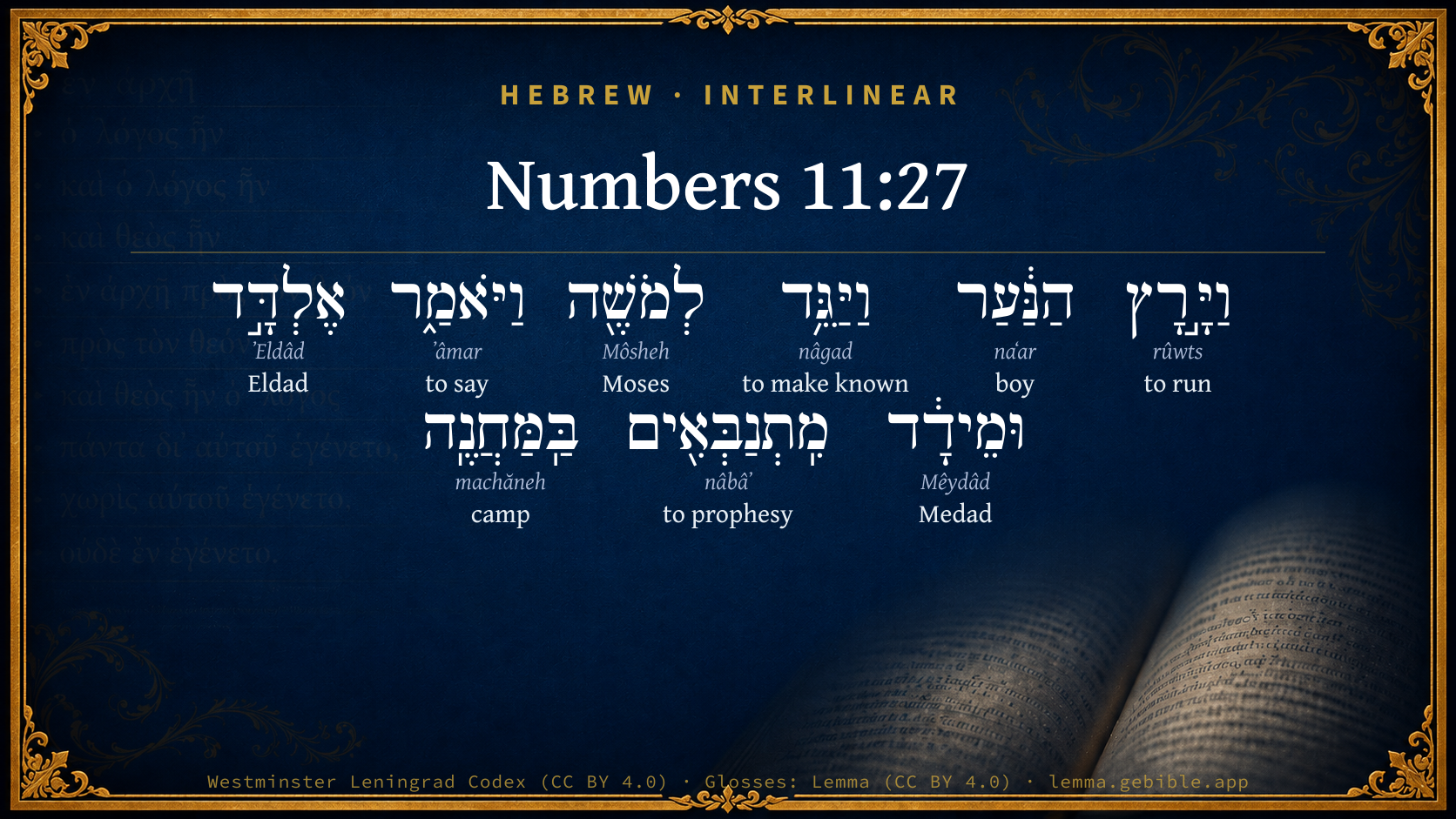
Numbers 11:27

Hebrew (Westminster Leningrad Codex) Numbers 11:27 appears in the Hebrew Old Testament. The text above is from the Westminster Leningrad Codex. Each word links to its Strong’s number, a concise gloss, and parsing drawn from the Open Scriptures Hebrew Bible morphology. Click any word for its full Brown-Driver-Briggs (BDB) entry.
Download image
Cite this verse

Numbers 11:27 (World English Bible). Public Domain. Lemma interlinear Bible study tool, https://lemma.gebible.app/v/numbers/11/27.

Show BibTeX & RIS
BibTeX
RIS
English Translation
There ran a young man, and told Moses, and said, Eldad and Medad do prophesy in the camp.
World English Bible · Public Domain
Download a study sheet

One document with this verse’s original text, its word-by-word gloss line, the meaning frame, cross-references with their text, attributed commentary, and full source and license credits — printable, and it pastes into notes with its structure intact.

This verse Autodidact and up

Study sheet (.html) Plain text (.txt)

A passage Seminary Student

Up to 50 verses in one chapter. A passage sheet keeps up to 6 commentary sources and 12 cross-references per verse, in the order this page ranks them, and says so on the sheet whenever that leaves anything out. Ask for a single verse and you get the Autodidact verse sheet above.

Everything on this page stays free to read, with no account — the sheet is a download of what is already on screen, not access to it.

Want to remove ads? Support Godless Engineer
Compare translations 3

The same verse in 3 English versions, stacked beneath the original-language interlinear above. Click any original word for its lexicon entry.

Each is an independent rendering of the whole verse — the interlinear is not word-aligned to these translations.

Highlighted words mark where these versions differ — a whole-verse word diff, not a word-by-word alignment.

  • World English Bible Public Domain
    There ran a young man, and told Moses, and said, Eldad and Medad do prophesy in the camp.
  • King James Version Public Domain
    And there ran a young man, and told Moses, and said, Eldad and Medad do prophesy in the camp.
  • unfoldingWord Literal Text CC BY-SA 4.0
    And the young man ran, and he told to Moses, and he said, “Eldad and Medad are prophesying in the camp.”

unfoldingWord Literal Text — © unfoldingWord, licensed CC BY-SA 4.0. Word-aligned USFM3 via Door43 (git.door43.org/unfoldingWord/en_ult).

Versions to compare (up to 4)

3 of 4 selected

Show all 18 translations

Every available English version of this verse, each an independent rendering of the whole verse.

  • World English Bible Public Domain
    There ran a young man, and told Moses, and said, Eldad and Medad do prophesy in the camp.
  • Berean Standard Bible Public Domain
    A young man ran and reported to Moses, “Eldad and Medad are prophesying in the camp.”
  • Majority Standard Bible Public Domain
    A young man ran and reported to Moses, “Eldad and Medad are prophesying in the camp.”
  • King James Version Public Domain
    And there ran a young man, and told Moses, and said, Eldad and Medad do prophesy in the camp.
  • American Standard Version (1901) Public Domain
    And there ran a young man, and told Moses, and said, Eldad and Medad do prophesy in the camp.
  • Revised Version (1885) Public Domain
    And there ran a young man, and told Moses, and said, Eldad and Medad do prophesy in the camp.
  • Geneva Bible (1599) Public Domain
    Then there ranne a yong man, and tolde Moses, and saide, Eldad and Medad doe prophesie in the hoste.
  • Douay-Rheims (1899) Public Domain
    And when they prophesied in the camp, there ran a young man, and told Moses, saying: Eldad and Medad prophesy in the camp.
  • Young's Literal Translation Public Domain
    and the young man runneth, and declareth to Moses, and saith, `Eldad and Medad are prophesying in the camp.'
  • Literal Standard Version CC BY-SA 4.0
    and the young man runs, and declares [it] to Moses, and says, “Eldad and Medad are prophesying in the camp.”
  • Unlocked Literal Bible CC BY-SA 4.0
    A young man in the camp ran and told Moses, “Eldad and Medad are prophesying in the camp.”
  • unfoldingWord Literal Text CC BY-SA 4.0
    And the young man ran, and he told to Moses, and he said, “Eldad and Medad are prophesying in the camp.”
  • Darby Bible Public Domain
    And there ran a youth, and told Moses, and said, Eldad and Medad are prophesying in the camp.
  • World Messianic Bible Public Domain
    A young man ran, and told Moses, and said, “Eldad and Medad are prophesying in the camp!”
  • Webster's Bible Public Domain
    And there ran a young man, and told Moses, and said, Eldad and Medad do prophesy in the camp.
  • Free Bible Version CC BY-SA 4.0
    A young lad ran and told Moses, “Eldad and Medad are prophesying in the camp.”
  • Bible in Basic English Public Domain
    And a young man went running to Moses and said, Eldad and Medad are acting as prophets in the tent-circle.
  • JPS Tanakh (1917) Public Domain
    And there ran a young man, and told Moses, and said: 'Eldad and Medad are prophesying in the camp.'

Literal Standard Version (2020), Covenant Press — licensed CC BY-SA 4.0. Text via the HelloAO Bible API (eBible.org). Unlocked Literal Bible (unfoldingWord) — licensed CC BY-SA 4.0. Text via the HelloAO Bible API (eBible.org). unfoldingWord Literal Text — © unfoldingWord, licensed CC BY-SA 4.0. Word-aligned USFM3 via Door43 (git.door43.org/unfoldingWord/en_ult). Free Bible Version, Dr. Jonathan Gallagher — licensed CC BY-SA 4.0. Text via the HelloAO Bible API (eBible.org).

Word by word

More ways to search: Search by grammar → Find every occurrence → Compare this word →

Practice this passage: Drill this verse → Learn its vocabulary →

About this verse

These counts appear in no published source. They are computed here, from the morphology-tagged text and Lemma’s own curated glosses. What Lemma adds →

9
words
9
distinct lemmas
Pentateuch
section

Notable vocabulary

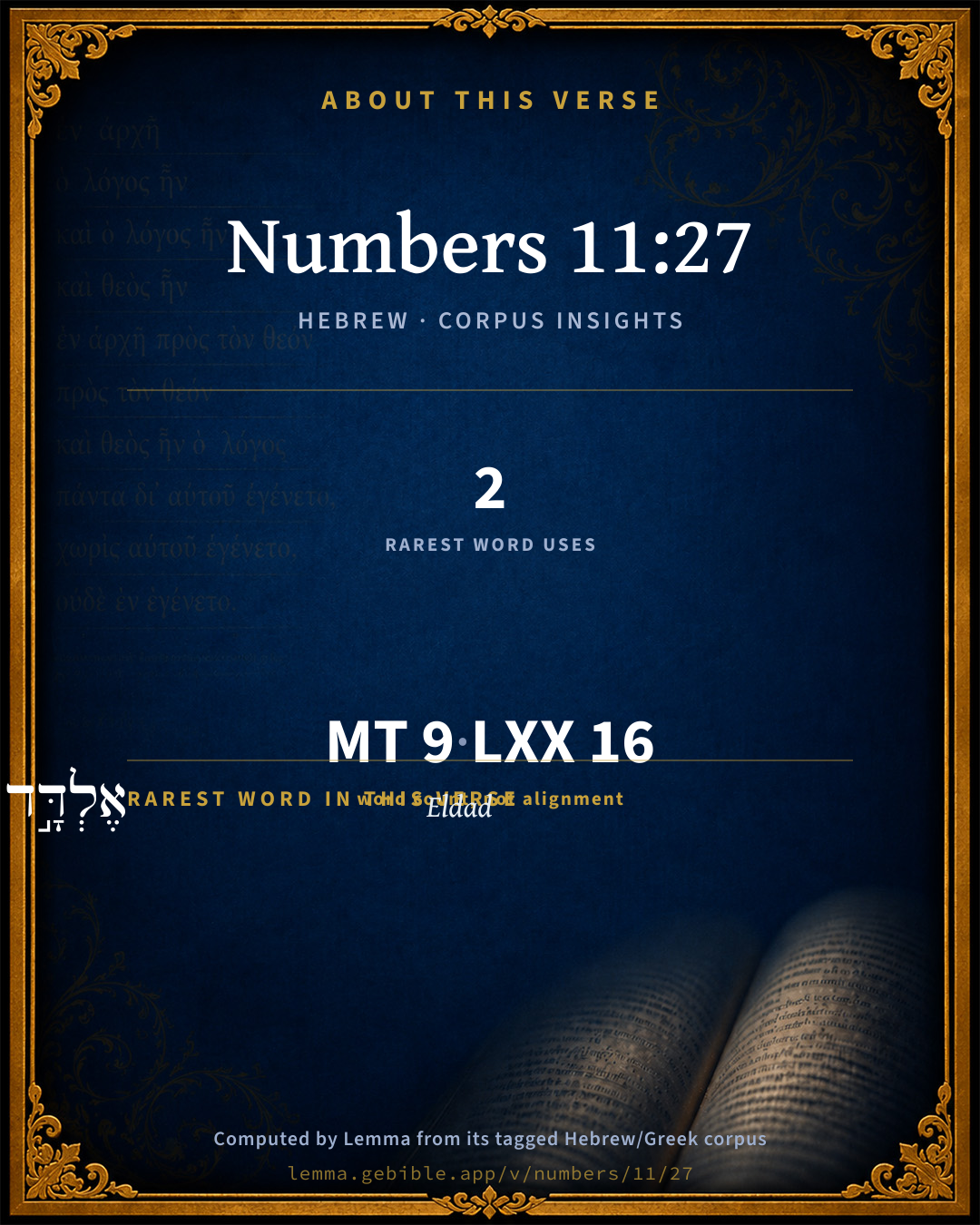
The rarest word here is אֶלְדָּ֣ד Eldad H419 — appearing just 2 times in the whole Hebrew Bible.

Shared distinctive vocabulary

אֶלְדָּ֣ד Eldad H419 occurs in 2 verses of the Hebrew Bible. Also found in:

Grammatical profile

  • 4 verbs
  • 5 nouns

Verb forms

  • וַיָּ֣רָץ Qal · Sequential Imperfect
  • וַיַּגֵּ֥ד Hiphil · Sequential Imperfect
  • וַיֹּאמַ֑ר Qal · Sequential Imperfect
  • מִֽתְנַבְּאִ֖ים Hithpael · Participle Active

Hebrew & Septuagint length

In English translation the verse runs 18 words from the Hebrew and 18 from the Septuagint (LXX English) — the same length.

A rough comparison of the two English renderings, which tokenize alike — not a word-level alignment.

Word counts can differ between the Hebrew and the Greek without any difference in meaning — e.g. the Hebrew direct-object marker אֵת has no separate Greek word, and Greek often adds the article ὁ.

In the original languages it is 9 Hebrew tokens and 16 Greek tokens — but the two are counted differently (Hebrew bundles its prefixes and suffixes into one token; the Greek is in lemma form), so that isn’t a like-for-like length.

Hebrew and Greek witnesses Masoretic Hebrew ↔ Greek Septuagint

The same verse in the two great witnesses to the Old Testament, shown verse-for-verse.

These are two independent witnesses, not word-aligned to each other, and the Septuagint is shown in lemma (dictionary) form.

Hebrew Numbers 11:27 Masoretic · Westminster Leningrad Codex

וַיָּ֣רָץ הַנַּ֔עַר וַיַּגֵּ֥ד לְמֹשֶׁ֖ה וַיֹּאמַ֑ר אֶלְדָּ֣ד וּמֵידָ֔ד מִֽתְנַבְּאִ֖ים בַּֽמַּחֲנֶֽה

There ran a young man, and told Moses, and said, Eldad and Medad do prophesy in the camp.

World English Bible · Public Domain

Greek LXX Numbers 11:27 Septuagint · lemma form

καί προςτρέχω ὁ νεανίσκος ἀποἀγγέλλω μωυσῆς καί εἶπον λέγω ελδαδ καί μωδαδ προφητεύω ἐν ὁ παρεμβολή

And a young man ran and told Moses, and spoke, saying, Eldad and Modad prophesy in the camp.

LXX2012 (modern English Septuagint) · Public Domain

On this verse, The Pulpit Commentary discusses the Septuagint’s reading. Read the note in Commentary ↓

Hebrew: Westminster Leningrad Codex (CC BY 4.0). Greek: Septuagint (public domain); English from LXX2012 (modern English Septuagint) (Public Domain). How the Septuagint differs from the Hebrew →

Targum (Aramaic paraphrase)

2

The Targum is the ancient Jewish Aramaic paraphrase of the Hebrew Scriptures — an interpretive translation, not the Hebrew text itself. Onkelos (literal) and Pseudo-Jonathan (expansive) render the Torah, and Jonathan the Prophets. Coverage is partial: where no permissively-licensed English translation exists for a verse, only the Aramaic is shown. This is verse-level text, not a word-by-word alignment to the Hebrew.

  1. Targum Onkelos Torah (Genesis–Deuteronomy)
    וּרְהַט עוּלֵמָא וְחַוֵי לְמשֶׁה וַאֲמַר אֶלְדָד וּמֵידָד מִתְנַבְּאִין בְּמַשְׁרִיתָא

    (no public-domain English translation for this verse)

    Targum Onkelos — Aramaic: “Onkelos Genesis” (public domain); “Onkelos Exodus” (public domain); “Onkelos Leviticus” (public domain); “Onkelos Numbers” (public domain); “Onkelos Deuteronomy” (public domain). English: “Sefaria Community Translation” (CC0 1.0 (public-domain dedication)); “J.W. Etheridge. The Targums of Onkelos and Jonathan Ben Uzziel on the Pentateuch. London: Longmans, Green, 1862” (public domain). Text via Sefaria.

  2. Targum Pseudo-Jonathan Torah (Genesis–Deuteronomy)
    וּרְהַט טַלְיָא חַד וּתְנֵי לְמשֶׁה וַאֲמַר אֶלְדָד וּמֵידָד מִתְנַבְּיָין הָכֵין בְּמַשְׁרִיתָא

    And a certain young man ran, and told to Mosheh, and said: Eldad and Medad are prophesying thus in the camp.

    Targum Pseudo-Jonathan — Aramaic: “Targum Jonathan on Genesis” (public domain); “Targum Jonathan on Exodus” (public domain); “Targum Jonathan on Leviticus” (public domain); “Targum Jonathan on Numbers” (public domain); “Targum Jonathan on Deuteronomy” (public domain). English: “The Targum of Jonathan ben Uzziel, trans. J. W. Etheridge, London, 1862” (public domain). Text via Sefaria.

Commentary

Notes on Numbers 11:27 from classic Christian and Jewish commentators (each source and its license shown beneath its notes). The classic Christian expositions comment on the surrounding passage and are grouped to its opening verse, so a note may address several verses; the Jewish commentaries on the Tanakh (Rashi and others) are per-verse, so they appear only where the commentator wrote on this verse.

Lemma curates 59 commentaries, every one of them public domain or Creative Commons licensed, each selected and text-cleaned for this edition rather than reprinted as found. About our sources →

Trapp's Complete Commentary

John Trapp

Num 11:27 And there ran a young man, and told Moses, and said, Eldad and Medad do prophesy in the camp.

Ver. 27. And there ran a young man.] Three manner of persons, said Mr Latimer, can make no credible information: (1.) Adversaries and enemies; (2.) Ignorant persons and without judgment; (3.) Whisperers and blowers in men’s ears, that will utter in secret more than they dare avow openly.

John Trapp, A Commentary or Exposition upon All the Books of the Old and New Testament (1647–1656) — public domain. Text from a community e-Sword module.

The Biblical Illustrator

Joseph S. Exell

Num_11:27-30

Eldad and Medad do prophesy.

Eldad and Medad

Eldad and Medad seem instances of unlicensed preaching and prophesying; and this, at a time of scanty knowledge and rare spiritual illumination, was not without its dangers. So thought Joshua, and, jealous for Moses supremacy, besought him to rebuke them. But the great prophet, wholly wanting in the thought of self, rebuked Joshua instead. Enviest thou, he said, for my sake? and then added, in words of noble hyperbole, Would God that all the Lords people were prophets!

I. The first thought that occurs to us in reading this scene is the good, felt by the greatest, of zeal and enthusiasm. And the second is, how to discover it, how to encourage it in Gods service. But then comes the further question, Have these men the prophets capacity? Have they that primary want, the prophets faith? Have they fire, perseverance, and courage?

1. The prophets faith. Take away from the prophet this faith in the living God, speaking to him, teaching him, encouraging him, in the midst of lifes sorrows and temptations, and he is nothing. Give him that belief, and his confidence, his courage is unshaken.

2. There is the prophets belief in the moral order underlying the established order of things, as the only safe and sure foundation on which peace and prosperity in a nation can be built.

II. The prophetic message, however varied its tone, however startling its communication, is always in substance, as of old, the same: He hath showed thee, O man, what is good; and what doth the Lord require of thee, but to do justly, and to love mercy, and to walk humbly with thy God?

III. Would that the people of the Lord were all prophets! Would that we had all more of the fire of enthusiasm, leading us to go forth and act, and learn in acting, not waiting till we have solved all doubts or perfected some scheme of action!

IV. Zeal may often make mistakes, but it is better than no zeal. Truth is not merely correctness, accuracy, the absence of error, nor even the knowledge of the laws of nature. It is also the recognition of the moral and spiritual bases of life, and the desire to promote and teach these among men. (A. G. Butler, D. D.)

Noble to the core

I do not agree with those who think that there was any diminution of the spirit that rested upon Moses. It is very difficult to speak of the subdivision of spirit. You cannot draw it off from one man to others, as you draw off water. The whole Spirit of God is in each man, waiting to fill him to the uttermost of his capacity. It seems to me, therefore, that nothing more is intended than to affirm that the seventy were clothed upon with the same kind of spiritual force as that which rested upon Moses. For sixty-eight of them the power of utterance was only spasmodic and temporary. They prophesied, but they did so no more. Emblems are they of those who, beneath some special influence like that which cast Saul down among the prophets, suddenly break out into speech and act, and give promises not destined to be fulfilled. Two, however, of the selected number, who, for some reason, had remained in the camp, suddenly became conscious of their reception of that same spirit, and they, too, broke out into prophecy and appeared to have continued to do so. Instantly a young man, jealous for the honour of Moses, carried to him the startling tidings, Eldad and Medad do prophesy in the camp; and as he heard the announcement Joshua, equally chivalrous, exclaimed, My lord Moses, forbid them! eliciting the magnificent answer, Art thou jealous for my sake? Would God that all the Lords people were prophets--that the Lord would put His Spirit upon them! It was as if he said, Do you think that I alone am the channel through which the Divine influences can pour? Do you suppose that the supplies in the being of God are so meagre, that He must stint what He gives through me, when He gives through others? If it should please Him to create new stars, must He rob the sun of its light to give them brilliance? Is the gratification of a mean motive of vanity a matter of any moment to me, who have gazed on the face of God? Besides, what am I, or what is my position, amongst this people, compared with the benefit which would accrue to them, and the glory which would redound to God, if He did for each of them all that He has done for me? This is the spirit of true magnanimity. A spirit of self aggrandisement is set on retaining its exclusive position as the sole depository of the Divine blessing, and this has the certain effect of forfeiting it, so that fresh supplies cease to pass through. There is no test more searching than this. Am I as eager for Gods kingdom to come through others as through myself? And yet, in so far as we fall short of that position, do we not betray the earthly ingredients which have mingled, and mingle still, in our holy service? (F. B. Meyer, B. A.)

Young men are ordinarily rash in judging others

The doctrine from hence is that young men are ordinarily rash in judging others, yea, more rash than elder men, and consequently more apt to judge amiss, and to give evil counsel and sentence of such things as are well done. Such were Rehoboams green heads; they gave green counsel, and such as cost him the loss of the greatest part of his kingdom (1Ki_12:8; 1Ki_12:13-14). The reasons are plain. First, age and years bring experience and ripeness of judgment and so wisdom. Youth is as green timber; age as that which is seasoned (Job_32:7). Again, their affections being hotter and stronger are more inconstant and unbridled, realty to run into extremities, as untamed heifers not used to the yoke. Lastly, they put far from them the evil day; they think themselves privileged by their age, and make account they have time enough hereafter to enter into better courses. The uses:

1. This teacheth us not to rest in the judgment, nor to follow the counsel of young men, except they have old mens gifts and graces in them. For touching gifts, it is true which Elihu testifieth (Job_32:9).

2. Let young men suffer their elders to speak before them, especially in censuring things that are strange.

3. Seeing rashness and unadvisedness are specially incident to youth, let them learn to season their years with the Word of God, let them make it their meditation, whereby they may repress such hot and hasty and headstrong passions. (W. Attersoll.)

Enviest thou for my sake?--

The increase of the Redeemers kingdom

Moses had no share in the narrow feelings which Joshua had displayed, feelings of envy and jealous. He had no wish to engross the distinctions of Israel, but, on the contrary, he would have greatly rejoiced had all the congregation been richly endowed from above, though he himself might have ceased to have been conspicuous in Israel. We consider that the lawgiver Moses, when so finely reproving Joshua for envying for his sake, is worthy of being admired and earnestly imitated; for that, in thus showing himself above all littleness of mind and contempt of this world, so that God might be magnified and His cause advanced, he reached a point of moral heroism--aye, far loftier than that at which he stood when, in the exercise of superhuman power, he bade darkness cover the land of Egypt, or the waters of the Red Sea divide before Israel. We are not bound to expatiate at any length on the magnanimity thus displayed by Moses. We have adopted the instance in order to show you how direct a parallel may be found in the history of the forerunner of our Lord, John the Baptist. So soon as the Saviour entered on the ministry, the great office of John was at an end. John still continued to baptize, and thus prepare men for the disclosures of that fuller revelation with which Christ was charged. In this way the ministry of our Lord and that of His forerunner were for a while discharged together; though, inasmuch as Christ wrought miracles, and John did not, there was quickly, as might be expected, more attendance on the preaching of the Redeemer than on that of the Baptist. Now, this appears exactly the point when in truth Johns disciples, who, like Joshua, were jealous of the honour of their Master, thought Jesus intrenching upon his province. But, however galling it might be to his followers thus to see their master neglected, to John himself it was matter of great gladness that He whom he had heralded was thus drawing all men towards Him. And the Baptist takes occasion to assure his disciples that what had moved their jealousy and displeasure was but the beginning--the first display of a growing spirit to which no bounds could be set. They were not to imagine that there could be any alteration in the relative positions of Jesus and John; nor that John would ever take that part of which, in strange forgetfulness of his own sayings, they seemed to wish to come to pass. On the contrary, he wished them distinctly to understand that, being only of earth--a mere man like one of themselves--he must decline in importance, and at length shrink altogether into insignificance. Whereas Christ, as coming from above, and therefore being above all--possessing a Divine nature as well as a human, and consequently liable to no decay--would go on discharging His high office, enlarging His sway according to the prediction of Isaiah, To the increase of His government and peace there shall be no end upon the throne of David, and upon his kingdom. And all this gradual fading away of himself, and this continued exaltation of Christ, the Baptist gathers into one powerful and comprehensive sentence, saying of our blessed Lord, He must increase, but I must decrease. And now consider more distinctly how character was here put to the proof; or in what respects either Moses or John deserve imitation. The truth is, that it is natural to all of us to envy the growing reputation of others; and to be jealous where it seems likely to trench upon our own. The courtier, for example, who has long sought to stand high in the favour of his sovereign; and who perceives that a younger candidate, who has just entered the field, is fast outstripping him, so that the probability is that he will soon be widely distanced; we cannot marvel if he regard the youthful competitor with irritated feelings in place of generously rejoicing in his rapid success. It would be a very fine instance of magnanimity if this courtier were to cede gracefully the place to his rival, and offer him, with marks of sincerity which could not be mistaken, his congratulations on having passed him in the race. But we could not look for such magnanimity. The case, however, is widely different when it is in the service of God, and not of an earthly king, that the two men engage. Here by the very nature of the service, the grand thing aimed at is the glory of God and not personal aggrandisement; and there is therefore ground for expecting that if Gods glory be promoted, there will be gladness of heart in all Christians, whoever the agent who has been specially honoured. But, alas! for the infirmity of human nature; there is no room for questioning that even Christians can be jealous of each other, and feel it a sore trial when they are distanced and eclipsed in being instrumental in promoting Christianity. We are far enough from regarding it as a matter of course, that a veteran in the missionary work would feel contented and pleased at seeing that work which had gone on so slowly with himself, progress with amazing rapidity when undertaken by a younger labourer; on the contrary, arguing from the known tendencies of our nature, we assume that he must have had a hard battle with himself before he could really rejoice in the sudden advance of Christianity; and we should regard him as having won, through the assistance of Divine grace, a noble victory over some of the strongest cravings of the heart when he frankly bade the stripling, God speed! and rejoiced as he saw the idols fall prostrate before him. (H. Melvill, B. D.)

All Gods people must beware of envy

Envy is an affection compounded of sorrow and malice. For such persons are malicious, always repining and grudging at the gifts of God bestowed upon others, and, as it were, look asquint at them (as Gen_26:12-14; Gen_26:27; Gen_30:1; Gen_31:1; Mar_9:38; Joh_3:26-27).

1. Because it is a fruit of the flesh (Gal_5:21), as carnal grief and hatred are, of which it is compounded: for it maketh men repine at the prosperity of others, and that which is worst of all, to hate the persons that have those gifts. This appeareth in the Pharisees (Mat_27:18).

2. God bestoweth His gifts where He will, and to whom He will, and in what measure He will (Mat_20:15).

3. It procureth the wrath of God, and is never left without punishment, as appeareth in the next chapter, where Miriam, the sister of Moses, is stricken with the leprosy, because she envied the gifts of Moses; God showing thereby how greatly He detested this sin.

4. Whatsoever is bestowed upon any member, is bestowed upon the whole body (1Co_12:1-31.). Whatsoever is given to any part, is giving for the benefit of the whole Church: why, then, should we envy any, seeing we have our portion in it?

5. It is a devilish vice; it is worse than fleshly, and yet if it were no more, it were sufficient to make us to detest it: and it transformeth us into the image of Satan, who envied the happiness of our first parents in the garden (Gen_3:5). So Cain was of that evil one (1Jn_3:12), and envied his brother, because God accepted him and his sacrifice (Gen_4:5).

6. It crosseth and controlleth the wisdom of God in the distribution of His gifts and graces, as if God had done them wrong and been too good to others: we can challenge nothing as due to ourselves, but whatsoever we have we have it freely: howbeit, the envious like not His administration, but dislike that others should enjoy that which they want.

7. It is against the rule of charity which rejoiceth at the good of others (1Co_13:1-13.), and is ready to bestow and communicate good things where is want of them. So, then, where envy is, there charity is not; and where charity is, there envy is not.

Uses:

1. This teacheth us that all are subject to this evil, even they that are godly, and in a great measure sanctified, are apt to envy at others excelling in the graces of God. The best things are subject to be abused through our corruption.

2. It serveth to reprove many malicious persons: some envy others temporal blessings: others envy them the grace of God. If they have more knowledge than themselves they cannot abide them, but speak all manner of evil against them. Hence it is that Solomon opposeth envy and the fear of God as things that cannot possibly stand together (Pro_23:17), and in another place a sound heart and envy (Pro_14:30).

3. Let us use all holy and sanctified means to prevent it, or to purge it away if it has seized upon us. Store of charity and humility tempered together will make a notable defence and preservative against this malady. (W. Attersoll.)

Needless envy

Moses wondered that Joshua should be so excited about this matter. He correctly estimated the young mans temper; he said, This is envy: why this envy, Joshua? is it for my sake that thou art making a grievous miscalculation of my spirit? do not be envious on my account. Contrast the spirit of Moses with the spirit of Joshua. From the greater expect more. Thus is the quality of men revealed. Our judgments are ourselves put into words. Not that this was necessarily what might be termed the most wicked jealousy or envy. There is a kind of envy that may be regarded as almost chivalrous. That may be the most dangerous envy of all. Let us get at the root of this matter. Moses certainly delivered himself from all imputations of the kind, for instead of wanting the prophecy to be confined to himself he would have it multiplied over the whole host of the people of God. Great men do not want to be great at the expense of others. The text, though an inquiry, is as much a revelation of the quality of Moses as it is of the quality of Joshua. The most dangerous envy is often envy by proxy. Two men are at deadly feud; circumstances arise which lead to explanation; explanation leads to adjustment; adjustment soon becomes hearty reconciliation; the two principals are satisfied. But what is all this tumult in the air? what all this petty criticism? The two principals are satisfied, but there are others that are fighting the battle over again, and professedly in the name of one of the reconciled men or the other. This is folly. We should rather anticipate reconciliation and make the most of it than say, through wickedness of heart, Though you may be satisfied, we are not, and we mean to continue the battle. That may be high temper, but it is the temper of the devil. Along the same line of illustration we come upon over-zeal. The Jehua rose up a million thick on the road. What are they doing? Converting men by force. They are going to stand this no longer; if men will not go to church, then they shall go to gaol; if men will not obey spontaneously, they shall obey coercively; they shall have no longer any parleying with the enemy. The only compulsion that is as everlasting as it is beneficent is the compulsion of persuasion. Knowing the terror of the Lord, we persuade men. Herein is the dignity and herein is the assured duration of the kingdom of Christ; it is a kingdom of light and love and truth and reason. Love is the everlasting--and I will add, is the invincible--law. What was Joshuas motive? Was he afraid that other men would rise and be as lofty as Moses? That was not the view which Moses himself took of the occasion. Moses was not afraid of competition. Moses proved his right to the leadership by the nobleness of his spirit. Would God that this proof of Divine election attended all our policy! No man can pull you down but yourself. Moses knew that what was lacking in appreciation of himself would be made up in proportion as the people themselves became prophets. The more the people prophesied the more they would appreciate Moses. They would know what he had to bear; what occasional torment of soul. Have pity upon one another; believe, and be kind, and hope; let the devil do all the bad work, you get to your knees and to the work of brotherly sympathy and help. Moses saw what Joshua did not discern. Moses saw that it is part of the prophets function to make other people prophets. Great men are not sent to create little men. Wherever there is a great prophet there will be a prophetic church; the whole level of life and thought will be elevated. Not that the leader can always command this kind of evidence and credential. It may come after his death. Some men have to die that they may be known. Great men are inspirations, not discouragements. That is the difference between real greatness and factitious greatness. Where there is real greatness it acts as an inspiration, as a welcome; there is a benign and generous hospitality about it. Real greatness can condescend without appearing to stoop; real greatness can be humble without being oppressive to those to whom it bows itself; real greatness encourages rising power just as the sun encourages every flower in the garden. The Church of Christ is not afraid of rival institutions. The Church says, Enviest thou for my sake?--nothing can put me down; I am founded by Christ, saith the Church, I am built upon a rock; the gates of hell cannot prevail against me--Enviest thou for my sake?--cease thine envying, it is wasted energy. We are building up all kinds of rival institutions, and yet the Church rises above them all. Let the Church have time and opportunity to utter her gospel and declare herself; and let her be faithful to her own charter, and all will be well. Truth always wins, and wins often at once; not in the palpable and vulgar way called winning, but by a subtle, profound, mysterious, eternal way that asks ages by which to justify its certainty and its completeness. (J. Parker, D. D.)

Would God that all the Lords people were prophets.

The prophets work

The prophets were not mainly foretellers of future events, but interpreters and forthtellers of Gods will; not minute historical soothsayers, but essentially patriots, statesmen, moral teacher,, chosen vessels of spiritual revelation. In each of their duties they were great. As statesmen they were intensely practical, gloriously fearless; seeing that there was no distinction between national and individual morality; recognising that what is morally wrong can never be politically right. As patriots they were men of the people; pleading against oppression, robbery, and wrong; braving the anger of corrupted multitudes; reproving the crimes of guilty kings. As spiritual teachers they fostered in Israel the conviction of their lofty destiny by upholding the majesty of Gods law, by preserving the authority of His worship, by pointing to the revelation of His Son. In each of these functions they have an eternal value for the human race. Every reformation has been effected by following in the path which they trod as pioneers. The Hebrew prophets were marked by three great characteristics--Heroic Faith, Unswerving Hope, and Absolute Belief in Righteousness.

1. I shall name their heroic faith. All men have not faith. They either openly deny and disbelieve, or more often saying they believe act as though they did not. They are cowed by the power of wickedness, or tempted by its seductions. If they begin to make an effort for good, they fling up the contest as soon as they find that it will compromise their interests. Most often they will brave no danger, expose no falsehood, stand up against no wrong; they will spread their sails to every veering breeze; they will swim with the stream; they will look on success and popularity as the ends of living and the tests of truth. Not so the prophets. They will not be deceived by the vain shows of the world, nor seduced by its bribes, nor blunt the edge of their moral sense with its manifold conventions. Terror will not daunt, nor flattery lure them. Through lives of loss and persecution they will go on with an intense and quiet perseverance, which no success will cause them to relax, and no reverse subdue. They will devote every energy and possession to the cause of God, and the service of the most helpless of mankind.

2. They saw beyond. Over and around them towered the colossal kingdoms of the heathen. The giant forms of empires around them were but on their way to ruin, because they were not founded on righteousness. Kings, priests and mobs might be against them; they were but vain and idle men (Jer_1:17-19). And if they had the faith which looked beyond the little grandeurs of men, they also had the hope which looked beyond their sorrows, and this hope spread outwards in ever-widening circles. Amid the apostacy of Israel they always prophesied that Israel should not be utterly destroyed. And this hope was concentrated in their greatest and most unfaltering prophecy of an Anointed Deliverer, a coming Saviour for all mankind: a Man who should be a hiding-place from the wind; and a covert from the tempest; the shadow of a great rock in a weary land.

3. The third great characteristic of the Hebrew prophets is their sense that the very end and aim of all religion is simply righteousness: that there is an abysmal difference between a mere correct worship and a living faith. Such was the spirit of the prophets. Let us conclude by considering the way in which we too, in our measure, are called to share in their spirit, and to continue their work.

(1) We must try to do so, first, by escaping the average. He who has an unswerving faith in a few great moral principles to which, through evil report and good report, he clings; he who will only look on opinions and practices as he believes they must appear in the sight and before the tribunal of God; he who in politics knows no principle but truth and right; he who in the path of duty is indifferent to human praise or human blame; he who will stand firm when others fail; he who because the house of his life is built on a rock will do what God has given him to do, and say what God has given him to say, holding his own against chances and accident, against popular clamour and popular favour, against the anger and prejudices of the circle among whom he moves, that is the true prophet, that is the strong Christian man.

(2) And as ours should be the aim of the prophet, ours should be the qualities of his mind and heart. Something at least we must have of their enthusiasm, something of their devotion, something of their indignation against wrong; something, too, of their courage. (Archdeacon Farrar.)

God calls all His people to be prophets

As of old, He calls His Gideon from the threshing-floor, and His Amos from the sycamore fruit; His Moses from the flocks; His Matthew from the receipt of custom; His John from the priestly family; His Peter from the fishing-net, and His Paul from the rabbis school; so now He calls us from the farm and from the merchandise, from the shop and from the office, from the profession and from the trade, from the priests pulpit and from the servants hall. He calls us in boyhood, He calls us in manhood, He calls us in old age. In His sight there is not an inch-high difference between the stage on which the prince and the stage on which the pauper plays his part. Both alike are called, and called only to be good men and true, brave and faithful. Both have a like mission, and both alike shall, if they do Christs work, receive His hundred-fold reward. The boy at school who will not join in the bad language of his companions; the soldier in the barracks who will kneel down and pray, though all his comrades jeer; the tradesman who will hold out against a dishonest custom of his guild the tenant who in the teeth of his interests will give his vote at the dictates of conscience; the Churchman who for truths sake will try to break the tyrannous fetters of false opinion; the philanthropist who will bear the unscrupulous taunts of the base, because he denounces a nations guilt--these, too, have in them something of the prophet. They help to save the world from corruption and society from spiritual death. This was the example that Christ set us all. That man is most a prophet of Christ who loves Him best. And he loves Him best who keeps His commandments. His commandments were but two: Love God; Love one another. (Archdeacon Farrar.)

Monopoly and freedom in religious teaching

I. A protest against monopoly in religious teaching.

1. The prevalence of this monopoly.

2. The causes of this monopoly.

(1) Love of power.

(2) The love of money.

3. The iniquity of this monopoly. What arrogancy! Is not one mind as near the fountain of knowledge, the source of inspiration, as another?

II. An authority for freedom in religious teaching.

1. All the Lords people ought to be teachers. The possession of superior knowledge implies the obligation to disseminate it.

2. All the Lords people might be teachers. All that is wanted is that the Lord would put His Spirit upon them; and this Spirit is free alike to all. (Homilist.)

The Spirit given to all

Would God, was the longing of Moses, that all the Lords people were prophets, and that the Lord would put His Spirit upon them! His desire was fulfilled at Pentecost, and is realised now. Every believer possesses the Holy Spirit, not for his own spiritual life only, but to be a witness for Christ, as were the hundred and twenty at Pentecost. Equally does the charge to publish the glad tidings, and the promise of adequate power come to every one, according to that closing command of inspiration, Let him that heareth say, Come! Nay, more, the tongue of fire, the gift of utterance in its fitting measure, is always bestowed upon the kindled heart. Every one who seeks humbly and prayerfully to be a witness for Christ, in the home, in the ways of toil, in the spheres of infer-course, in the house of prayer, by the printed page, with the lips, and by the life, every such faithful disciple of the living Master shall receive His promised gift, the Pentecostal power of the Holy Ghost! (J. G. Butler, D. D.)

Divine inspiration

In different forms and in different degrees that noble wish was fulfilled. The acts of the hero, the songs of the poet, the skill of the artificer, Samsons strength, the music of David, the architecture of Bezaleel and Solomon, are all ascribed to the inspiration of the Divine Spirit. It was not a holy tribe, but holy men of every tribe, that spake as they were moved, carried to and fro out of themselves, by the Spirit of God. The prophets, of whom this might be said, in the strictest sense, were confined to no family or caste, station, or sex. They rose, indeed, above their countrymen; their words were to their countrymen, in a peculiar sense, the words of God. But they were to be found everywhere. Like the springs of their own land, there was no hill or valley where the prophetic gift might not be expected to break forth. Miriam and Deborah, no less than Moses and Barak; in Judah and in Ephraim, no less than in Levi; in Tekoah and Gilead, and, as the climax of all, in Nazareth, no less than in Shiloh and Jerusalem, Gods present counsel might be looked for. By this constant attitude of expectation, if one may so call it, the ears of the whole nation were kept open for the intimations of the Divine Ruler, under whom they lived. None knew beforehand who would be called . . . In the dead of night, as to Samuel; in the ploughing of the field, as Elisha: in the gathering of the sycamore figs, as to Amos; the call might come . . . Moses was but the beginning; he was not, he could not be the end. (Dean Stanley.)

The Biblical Illustrator, edited by Joseph S. Exell (c. 1880s–1900s) — public domain. Text from a community e-Sword module.

Joseph Benson's Commentary

Num 11:27-28. There ran a young man and told Moses — Fearing lest his authority should be diminished by their prophesying, and thereby taking power to themselves without his consent. Joshua, the servant of Moses — Who ministered to him as his constant attendant. One of his young men — Hebrew, מבחריו, mibechuraiv, one of his chosen ones; which may be emphatically added to signify that even great and good men may mistake about the works of God. My lord Moses, forbid them — It would seem that he thought their prophesying or teaching in the camp tended to make those gifts common, and to disparage Moses in the eyes of the people; or, perhaps, he thought it tended to breed a schism, by calling the people away from the tabernacle, the appointed place of public worship, where the rest of the seventy elders were regularly assembled. Thus the disciples forbade one who cast out devils in Christ’s name, because he followed not with them, Luk 9:49-50.

Joseph Benson's Commentary on the Old and New Testaments (1811–1818) — public domain. Text from a community e-Sword module.

Adam Clarke's Commentary

Verse 27. Eldad and Medad do prophesy, &c.]

ELDAD, they said, and MEDAD there,

Irregularly bold,

By Moses uncommission'd, dare

A separate meeting hold!

And still whom none but heaven will own.

Men whom the world decry,

Men authorized by GOD alone,

Presume to prophesy!

Adam Clarke's Commentary on the Bible (1810–1826) — public domain. Text from a community e-Sword/MySword module.

John Gill's Exposition

And there ran a young man,.... From the camp to the tabernacle, who had heard Eldad and Medad prophesy; which he thought was not right, being done without the knowledge and approbation of Moses, and in a private tent in the tabernacle, not among the elders, but the common people: who this young than was is not material to know; some of the Rabbins, as Jarchi says, affirm he was Gershon the son of Moses; whoever he was, no doubt, it was with a good design, consulting the glory of God and the honour of Moses, and therefore in great haste ran to him with the information:

and told Moses, and said, Eldad and Medad do prophesy in the camp; who seem by this, to be persons well known, and of some note and figure; since not only the young man could call them by their names, but there needed no other description of them to Moses and those with him.

John Gill's Exposition of the Whole Bible (1746–1763) — public domain (CC PDM 1.0). Text via the HelloAO Bible API.

Haydock's Catholic Bible Commentary

Man. The Rabbins say, without proof, that he was Gersom, the son of Moses, and that the two prophets were half-brothers of the lawgiver, and foretold his death and the persecutions of Gog, &c. (Calmet) --- Hermas (11. 2.) refers to some of their predictions: "The Lord is nigh to those who are converts." See Psalm xxxiii. 19. (Haydock) --- But they prophesied probably, by announcing only, as men inspired, the praises of God and sentiments of piety, without diving into futurity. (Calmet) --- Theodoret (q. 21) thinks they were not of the 70 judges, but equal in dignity to them. (Cotelier.)

George Leo Haydock (1774–1849), Haydock's Catholic Family Bible and Commentary, 1859 edition — public domain. Excludes Psalms (Douay-Rheims chapter numbering differs from Protestant) and Deuterocanonical books (Catholic canon only).

Matthew Poole's English Annotations

Fearing lest his authority should be diminished by their prophesying; and thereby, as by the signal given at this time, taking authority to themselves without his knowledge and consent.

Matthew Poole's English Annotations on the Holy Bible (1683–1685) — public domain. Text from a community e-Sword/MySword module.

The Pulpit Commentary

And there ran a young man. Literally, "the young man, rNh; oo neaniskov , Septuagint, by which some understand the young men of the camp collectively, but this is doubtful in grammar and unsatisfactory in sense. If this book was compiled from previous records, of which there are many apparent traces, we may suppose that the name of this young man was there given, but here for some reason omitted.

The Pulpit Commentary (1880–1919), ed. H.D.M. Spence-Jones & Joseph S. Exell — public domain. Text from a community e-Sword module.

John Wesley's Explanatory Notes

Told Moses - Fearing lest his authority should be diminished by their prophesying; and thereby taking authority to themselves without his consent.

John Wesley, Explanatory Notes Upon the Whole Bible (1754–1765) — public domain. Text via the GEBible commentary corpus.

Rashi

Rabbi Shlomo Yitzchaki (Rashi)

וירץ הנער THERE RAN THE LAD — There are some who say that it was Gershom, the son of Moses (Midrash Tanchuma, Beha'alotcha 12).

Rashi on the Tanakh — English translations: “The Judaica Press complete Tanach with Rashi, translated by A. J. Rosenberg” (CC BY 4.0); “Pentateuch with Rashi's commentary by M. Rosenbaum and A.M. Silbermann, 1929-1934” (public domain); “The Metsudah Tanach series, Lakewood, N.J” (CC BY 4.0); and “The Book of Joshua, Metsudah Publications, 1997” (CC BY 4.0). Text via Sefaria.

Lesson kit

Teaching starters — assembled from the data on this page, not authored interpretation. Every prompt links to the verse data it draws on. Edit before teaching.

Numbers, in the Pentateuch, opens this verse with 9 words (9 distinct Hebrew lemmas). Its most distinctive word is ʼEldâd (“Eldad”). A historical commentator’s framing appears above. Read the whole chapter for the surrounding context.

Discussion questions

  1. How does “Eldad” (ʼEldâd) shape what this verse is saying?
  2. How does Numbers 11:26, which shares the word «Eldad», read alongside this verse?
  3. These translations render this verse differently; the difference is in the English rendering, not the original. What questions does that raise?
  4. «וַיָּ֣רָץ» is a Qal Sequential Imperfect verb. How does that grammatical form shape the action described?
  5. Compare how Trapp's Complete Commentary and The Biblical Illustrator read this verse. Where do they agree or differ?

Things to notice

Reading settings

Reading text

Shown beneath each verse's original-language words.

Old Testament
Old Testament edition

Read the OT as the Masoretic Hebrew (MT) or the Greek Septuagint (LXX).

English shown for the Greek Septuagint (in the Hebrew ↔ Greek comparison).

Comparing translations? Open the Compare panel on any verse page to stack up to four side by side.