
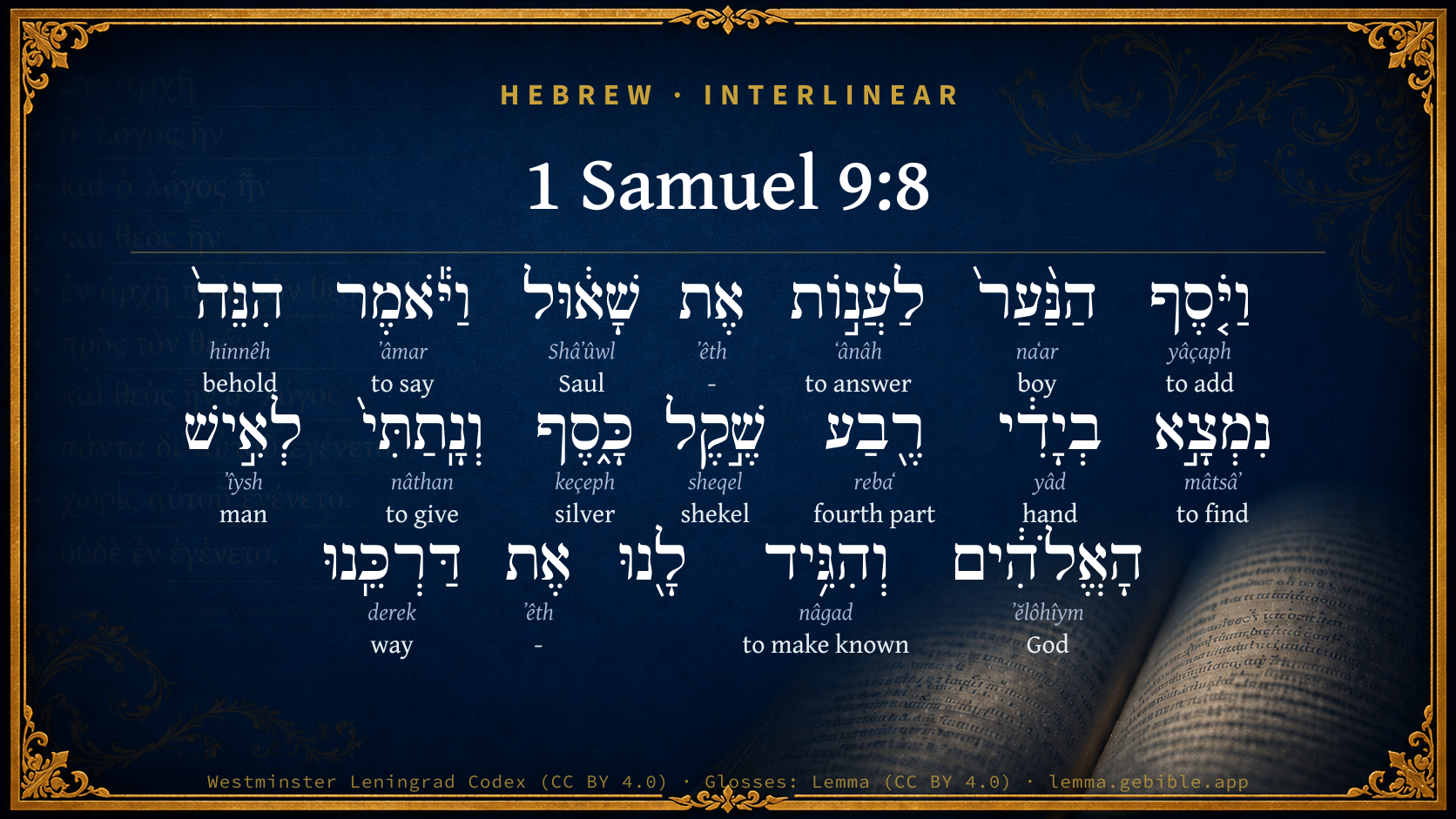
1 Samuel 9:8

Hebrew (Westminster Leningrad Codex) 1 Samuel 9:8 appears in the Hebrew Old Testament. The text above is from the Westminster Leningrad Codex. Each word links to its Strong’s number, a concise gloss, and parsing drawn from the Open Scriptures Hebrew Bible morphology. Click any word for its full Brown-Driver-Briggs (BDB) entry.
Download image
Cite this verse

1 Samuel 9:8 (World English Bible). Public Domain. Lemma interlinear Bible study tool, https://lemma.gebible.app/v/1-samuel/9/8.

Show BibTeX & RIS
BibTeX
RIS
English Translation
The servant answered Saul again, and said, Behold, I have in my hand the fourth part of a shekel of silver: that will I give to the man of God, to tell us our way.
World English Bible · Public Domain
Download a study sheet

One document with this verse’s original text, its word-by-word gloss line, the meaning frame, cross-references with their text, attributed commentary, and full source and license credits — printable, and it pastes into notes with its structure intact.

This verse Autodidact and up

Study sheet (.html) Plain text (.txt)

A passage Seminary Student

Up to 50 verses in one chapter. A passage sheet keeps up to 6 commentary sources and 12 cross-references per verse, in the order this page ranks them, and says so on the sheet whenever that leaves anything out. Ask for a single verse and you get the Autodidact verse sheet above.

Everything on this page stays free to read, with no account — the sheet is a download of what is already on screen, not access to it.

Want to remove ads? Support Godless Engineer
Compare translations 3

The same verse in 3 English versions, stacked beneath the original-language interlinear above. Click any original word for its lexicon entry.

Each is an independent rendering of the whole verse — the interlinear is not word-aligned to these translations.

Highlighted words mark where these versions differ — a whole-verse word diff, not a word-by-word alignment.

  • World English Bible Public Domain
    The servant answered Saul again, and said, Behold, I have in my hand the fourth part of a shekel of silver: that will I give to the man of God, to tell us our way.
  • King James Version Public Domain
    And the servant answered Saul again, and said, Behold, I have here at hand the fourth part of a shekel of silver: that will I give to the man of God, to tell us our way.
  • unfoldingWord Literal Text CC BY-SA 4.0
    And the servant resumed to answer Saul, and he said, “Behold, one fourth of a shekel of silver has been found in my hand. And I will give to the man of God, and he will declare to us our way.”

unfoldingWord Literal Text — © unfoldingWord, licensed CC BY-SA 4.0. Word-aligned USFM3 via Door43 (git.door43.org/unfoldingWord/en_ult).

Versions to compare (up to 4)

3 of 4 selected

Show all 18 translations

Every available English version of this verse, each an independent rendering of the whole verse.

  • World English Bible Public Domain
    The servant answered Saul again, and said, Behold, I have in my hand the fourth part of a shekel of silver: that will I give to the man of God, to tell us our way.
  • Berean Standard Bible Public Domain
    The servant answered him again. “Look,” he said, “I have here in my hand a quarter shekel of silver. I will give it to the man of God, and he will tell us our way.”
  • Majority Standard Bible Public Domain
    The servant answered him again. “Look,” he said, “I have here in my hand a quarter shekel of silver. I will give it to the man of God, and he will tell us our way.”
  • King James Version Public Domain
    And the servant answered Saul again, and said, Behold, I have here at hand the fourth part of a shekel of silver: that will I give to the man of God, to tell us our way.
  • American Standard Version (1901) Public Domain
    And the servant answered Saul again, and said, Behold, I have in my hand the fourth part of a shekel of silver: that will I give to the man of God, to tell us our way.
  • Revised Version (1885) Public Domain
    And the servant answered Saul again, and said, Beheld, I have in my hand the fourth part of a shekel of silver: that will I give to the man of God, to tell us our way.
  • Geneva Bible (1599) Public Domain
    And the seruant answered Saul againe, and said, Beholde, I haue founde about me the fourth part of a shekell of siluer: that will I giue the man of God, to tell vs our way.
  • Douay-Rheims (1899) Public Domain
    The servant answered Saul again, and said: Behold there is found in my hand the fourth part of a sicle of silver, let us give it to the man of God, that he may tell us our way.
  • Young's Literal Translation Public Domain
    And the young man addeth to answer Saul, and saith, `Lo, there is found with me a fourth of a shekel of silver: and I have given to the man of God, and he hath declared to us our way.'
  • Literal Standard Version CC BY-SA 4.0
    And the young man adds to answer Saul and says, “Behold, there is found a fourth of a shekel of silver with me: and I have given to the man of God, and he has declared our way to us.”
  • Unlocked Literal Bible CC BY-SA 4.0
    The servant answered Saul and said, “Here, I have with me one-fourth of a shekel of silver that I will give to the man of God, to tell us which way we should go.”
  • unfoldingWord Literal Text CC BY-SA 4.0
    And the servant resumed to answer Saul, and he said, “Behold, one fourth of a shekel of silver has been found in my hand. And I will give to the man of God, and he will declare to us our way.”
  • Darby Bible Public Domain
    And the servant answered Saul again and said, Behold, I have here at hand the fourth part of a shekel of silver; that will I give to the man of God, to tell us our way.
  • World Messianic Bible Public Domain
    The servant answered Saul again and said, “Behold, I have in my hand the fourth part of a shekel of silver. I will give that to the man of God, to tell us our way.”
  • Webster's Bible Public Domain
    And the servant answered Saul again, and said, Behold, I have here at hand the fourth part of a shekel of silver: that will I give to the man of God, to tell us our way.
  • Free Bible Version CC BY-SA 4.0
    “Look, I've got a quarter shekel of silver with me. I'll give it to the man of God so he can tell us the way we should take,” the servant told Saul.
  • Bible in Basic English Public Domain
    But the servant said in answer, I have here a fourth part of a shekel of silver: I will give that to the man of God, and he will give us directions about our way.
  • JPS Tanakh (1917) Public Domain
    And the servant answered Saul again, and said: 'Behold, I have in my hand the fourth part of a shekel of silver, that will I give to the man of God, to tell us our way.' —

Literal Standard Version (2020), Covenant Press — licensed CC BY-SA 4.0. Text via the HelloAO Bible API (eBible.org). Unlocked Literal Bible (unfoldingWord) — licensed CC BY-SA 4.0. Text via the HelloAO Bible API (eBible.org). unfoldingWord Literal Text — © unfoldingWord, licensed CC BY-SA 4.0. Word-aligned USFM3 via Door43 (git.door43.org/unfoldingWord/en_ult). Free Bible Version, Dr. Jonathan Gallagher — licensed CC BY-SA 4.0. Text via the HelloAO Bible API (eBible.org).

Word by word

More ways to search: Search by grammar → Find every occurrence → Compare this word →

Practice this passage: Drill this verse → Learn its vocabulary →

רֶ֖בַע
rebaʻ
H7253
“fourth part of”
Noun, Common, Masculine, Singular, Construct
Part of Speech
Noun
Type
Common
Gender
Masculine
Number
Singular
State
Construct
Full BDB Definition

Origin: from H7251

TWOT: 2107a

fourth part, four sides - fourth part - four sides
  1. וַיֹּ֤סֶף yâçaph H3254 “and · to add” Conjunction + Verb, Hiphil, Sequential Imperfect, 3rd Person, Masculine, Singular
  2. הַנַּ֨עַר֙ naʻar H5288 “the · boy” Particle, Definite Article + Noun, Common, Masculine, Singular, Absolute
  3. לַעֲנ֣וֹת ʻânâh H6030 “to answer” Preposition + Verb, Qal, Infinitive Construct
  4. אֶת ʼêth H853 “-” Particle, Direct Object
  5. שָׁא֔וּל Shâʼûwl H7586 “Saul” Noun, Proper
  6. וַיֹּ֕אמֶר ʼâmar H559 “and · to say” Conjunction + Verb, Qal, Sequential Imperfect, 3rd Person, Masculine, Singular
  7. הִנֵּה֙ hinnêh H2009 “behold” Particle, Demonstrative
  8. נִמְצָ֣א mâtsâʼ H4672 “to find” Verb, Niphal, Perfect, 3rd Person, Masculine, Singular
  9. בְיָדִ֔י yâd H3027 “in/at · hand · my” Preposition + Noun, Common, Both, Singular, Construct + Suffix, Personal, 1st Person, Common, Singular
  10. שֶׁ֣קֶל sheqel H8255 “shekel of” Noun, Common, Masculine, Singular, Construct
  11. כָּ֑סֶף keçeph H3701 “silver” Noun, Common, Masculine, Singular, Absolute
  12. וְנָֽתַתִּי֙ nâthan H5414 “and · to give” Conjunction + Verb, Qal, Sequential Perfect, 1st Person, Common, Singular
  13. לְאִ֣ישׁ ʼîysh H376 “to/for · man of” Preposition + Noun, Common, Masculine, Singular, Construct
  14. הָאֱלֹהִ֔ים ʼĕlôhîym H430 “the · God(s)” Particle, Definite Article + Noun, Common, Masculine, Plural, Absolute
  15. וְהִגִּ֥יד nâgad H5046 “and · to make known” Conjunction + Verb, Hiphil, Sequential Perfect, 3rd Person, Masculine, Singular
  16. אֶת ʼêth H853 “-” Particle, Direct Object
  17. דַּרְכֵּֽנוּ derek H1870 “way · our” Noun, Common, Both, Singular, Construct + Suffix, Personal, 1st Person, Common, Plural

About this verse

These counts appear in no published source. They are computed here, from the morphology-tagged text and Lemma’s own curated glosses. What Lemma adds →

19
words
17
distinct lemmas
Historical
section

Notable vocabulary

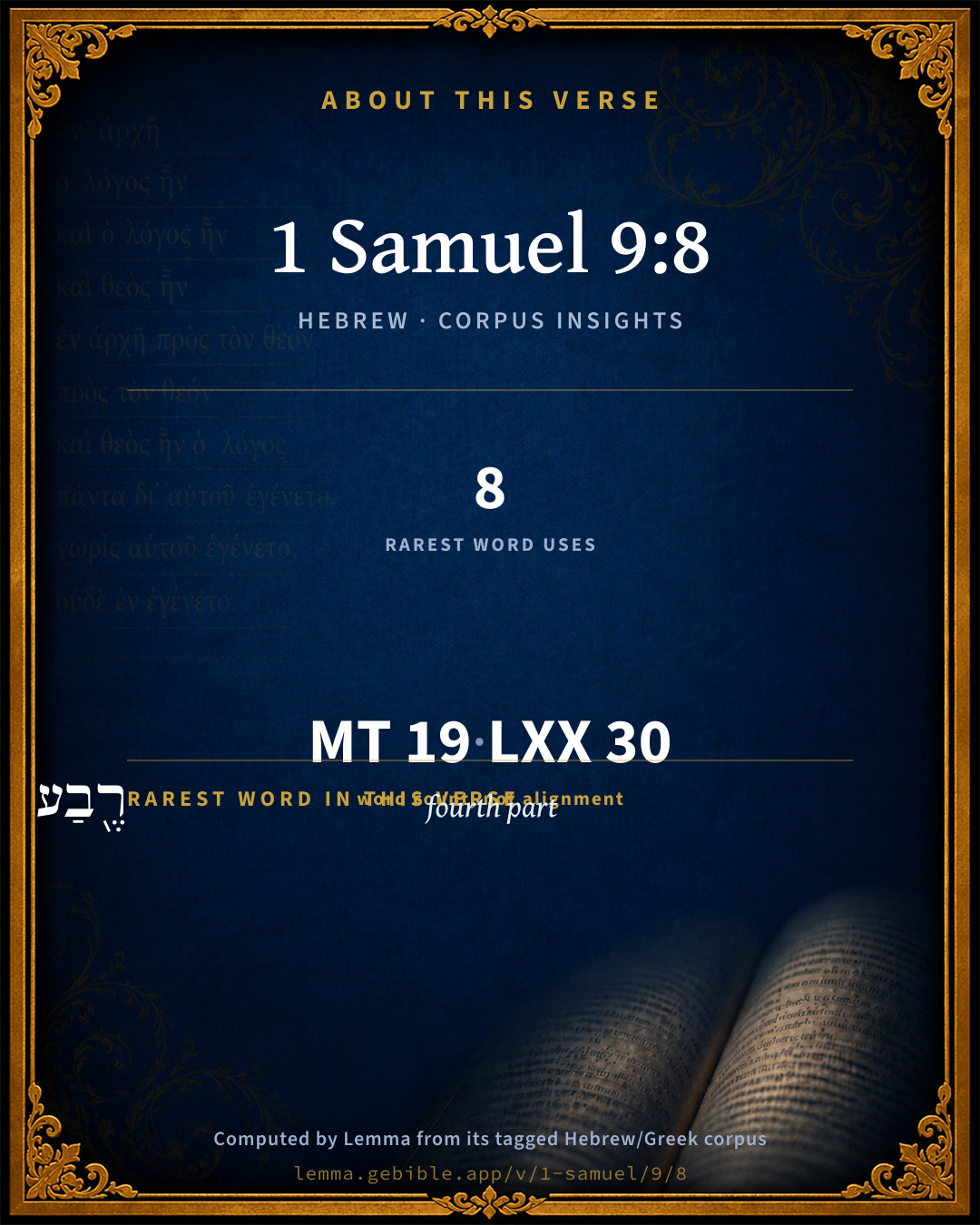
The rarest word here is רֶ֖בַע fourth part H7253 — appearing just 8 times in the whole Hebrew Bible.

Shared distinctive vocabulary

רֶ֖בַע fourth part H7253 occurs in 7 verses of the Hebrew Bible. Also found in:

Grammatical profile

  • 6 verbs
  • 9 nouns
  • 1 preposition
  • 3 particles

Verb forms

  • וַיֹּ֤סֶף Hiphil · Sequential Imperfect
  • לַעֲנ֣וֹת Qal · Infinitive Construct
  • וַיֹּ֕אמֶר Qal · Sequential Imperfect
  • נִמְצָ֣א Niphal · Perfect
  • וְנָֽתַתִּי֙ Qal · Sequential Perfect
  • וְהִגִּ֥יד Hiphil · Sequential Perfect

Hebrew & Septuagint length

In English translation the verse runs 35 words from the Hebrew and 41 from the Septuagint (LXX English) — closely comparable.

A rough comparison of the two English renderings, which tokenize alike — not a word-level alignment.

Word counts can differ between the Hebrew and the Greek without any difference in meaning — e.g. the Hebrew direct-object marker אֵת has no separate Greek word, and Greek often adds the article ὁ.

In the original languages it is 19 Hebrew tokens and 30 Greek tokens — but the two are counted differently (Hebrew bundles its prefixes and suffixes into one token; the Greek is in lemma form), so that isn’t a like-for-like length.

Hebrew and Greek witnesses Masoretic Hebrew ↔ Greek Septuagint

The same verse in the two great witnesses to the Old Testament, shown verse-for-verse.

These are two independent witnesses, not word-aligned to each other, and the Septuagint is shown in lemma (dictionary) form.

Hebrew 1 Samuel 9:8 Masoretic · Westminster Leningrad Codex

וַיֹּ֤סֶף הַנַּ֨עַר֙ לַעֲנ֣וֹת אֶת שָׁא֔וּל וַיֹּ֕אמֶר הִנֵּה֙ נִמְצָ֣א בְיָדִ֔י רֶ֖בַע שֶׁ֣קֶל כָּ֑סֶף וְנָֽתַתִּי֙ לְאִ֣ישׁ הָאֱלֹהִ֔ים וְהִגִּ֥יד לָ֖נוּ אֶת דַּרְכֵּֽנוּ

The servant answered Saul again, and said, Behold, I have in my hand the fourth part of a shekel of silver: that will I give to the man of God, to tell us our way.

World English Bible · Public Domain

Greek LXX 1 Samuel 9:8 Septuagint · lemma form

καί προςτίθημι ὁ παιδάριον ἀποκρίνω ὁ σαούλ καί εἶπον ἰδού εὑρίσκω ἐν ὁ χείρ ἐγώ τέταρτος σίκλος ἀργύριον καί δίδωμι ὁ ἄνθρωπος ὁ θεός καί ἀποἀγγέλλω ἐγώ ὁ ὁδός ἐγώ

And the young man answered Saul again, and said, Behold, there is found in my hand a fourth part of a shekel of silver; and you shall give it to the man of God, and he shall tell us our way.

LXX2012 (modern English Septuagint) · Public Domain

Hebrew: Westminster Leningrad Codex (CC BY 4.0). Greek: Septuagint (public domain); English from LXX2012 (modern English Septuagint) (Public Domain). How the Septuagint differs from the Hebrew →

Targum (Aramaic paraphrase)

1

The Targum is the ancient Jewish Aramaic paraphrase of the Hebrew Scriptures — an interpretive translation, not the Hebrew text itself. Onkelos (literal) and Pseudo-Jonathan (expansive) render the Torah, and Jonathan the Prophets. Coverage is partial: where no permissively-licensed English translation exists for a verse, only the Aramaic is shown. This is verse-level text, not a word-by-word alignment to the Hebrew.

  1. Targum Jonathan Prophets (Joshua–Malachi)
    וְאוֹסִיף עוּלֵימָא לְמַעֲנֵי יַת שָׁאוּל וַאֲמַר הָא אִשְׁתְּכַח בִּידִי זוּזָא חֲדָא דְכַסְפָּא וְנִתֵּן לִנְבִיָא דַייָ וִיחַוֵי לָנָא יַת אָרְחָנָא:

    (no public-domain English translation for this verse)

    Targum Jonathan — Aramaic: “Mikraot Gedolot” (public domain). English: “Sefaria Community Translation” (CC0 1.0 (public-domain dedication)); “London "Chaldee Paraphrase," 1871” (public domain). Text via Sefaria.

Commentary

Notes on 1 Samuel 9:8 from classic Christian and Jewish commentators (each source and its license shown beneath its notes). The classic Christian expositions comment on the surrounding passage and are grouped to its opening verse, so a note may address several verses; the Jewish commentaries on the Tanakh (Rashi and others) are per-verse, so they appear only where the commentator wrote on this verse.

Lemma curates 59 commentaries, every one of them public domain or Creative Commons licensed, each selected and text-cleaned for this edition rather than reprinted as found. About our sources →

Trapp's Complete Commentary

John Trapp

1Sa 9:8 And the servant answered Saul again, and said, Behold, I have here at hand the fourth part of a shekel of silver: [that] will I give to the man of God, to tell us our way.

Ver. 8. Behold, I have here at hand the fourth part of a shekel.] That was but a little, to the value of about our fivepence. But they knew that thankfulness was not to be measured of good men by the weight, but by the will of the retributor. That Persian monarch took in good part a handful of water presented to him by a poor peasant his subject, who had no better. Queen Elizabeth cheerfully received nosegays, {A bunch of flowers or herbs, esp. sweet-smelling flowers; a bouquet, a posy.} flowers, rosemary, from mean persons. Two mites from that poor widow went farther than two millions from some others.

John Trapp, A Commentary or Exposition upon All the Books of the Old and New Testament (1647–1656) — public domain. Text from a community e-Sword module.

The Biblical Illustrator

Joseph S. Exell

1Sa_9:8

Go seek the asses.

The lost asses

Though God gave the Israelites their own way, when they would not be convinced of their error, it was not till the very last--not until He had allowed them a further opportunity of reviewing their course. Sometimes arguments which have failed to convince amidst the excitement and warmth of a public assembly, will recur with power and impressiveness in the quietude and retirement of home. We have felt, many a time, that we could not give our friends a better piece of advice than to think again before they acted; and we ourselves, probably, are no strangers to the advantages of acting upon second thoughts, rather than upon first impressions. The Israelites accordingly were dismissed to their homes: Go ye every man unto his city. If conscience were awake and faithful, it would hear God saying, Sinner, I stand between thee and thy ruin a few days longer; I give thee the mercy of a few hours delay. Go home; go and consider. Go to thy Bible; go to thy closet; go to the mercy seat; go, ere it be too late; and pause ere thou dost resolve on persistence in thy unholy desire--in thy ungodly plan. We may be disposed to think that a more dignified form of introducing Saul might have been selected--which greater dignity would have been attained by an entire omission of the mention of such trifles as Sauls father losing his asses, and sending his son to seek them.

I. The study of this feature of Sauls history demands that a thought or two should be expended upon the subject of the introduction into Scripture of these trivial incidents, these homely occurrences--for the recollection of every reader of the Bible will immediately suggest that this is not the only instance in which the same feature meets us in its manifold narratives. A writer who, merely to answer some private end, makes up a tale, purposely avoids minute incidents. He deals in generalities; because he feels that if he should descend into particulars he will but multiply the chances of detection. The minutely circumstantial character, therefore, of many of the narratives in the Bible is so far most favourable to our reception of the Scriptures as written under Divine influence, that it guarantees their truthfulness--a characteristic, the absence of which would at once constrain us to deny their inspiration. Still further--it must be acknowledged that matters which, in themselves and separately considered, appear trivial, turn out often, in their connexion and consequences, to be most momentous. It is the habit with God to associate the most important results with that which, in its origin, appears most insignificant. Nor only so--the purpose of a Divine revelation could only be answered consistently with the dictates of the highest wisdom, as the leading features of such a revelation were conformed to the facts and features of our own everyday history. In order to accomplish its professed purpose of being a guide and directory to man, it must be a faithful picture of human life. Were the aspects under which it presented human life materially different from those under which we ourselves view it, and even participate in it, we should be tempted to say, This is not the book for us.

II. The incidents connected with Sauls appointment as king were not only trivial, but they possessed in combination with this characteristic another feature--they were of a class to which, in the ordinary way of speaking, we should give the name of accidental. And in this respect, the history appears framed so as to teach us the simple but emphatic lesson, that there is a God of Providence, and that where, to the human eye, there may appear nothing but an accidental connexion between two or more circumstances, there exists, in the mind of God, the most clearly-intentioned, complete, and beautiful arrangement and harmony. As we look back upon our own lives there stays by us the recollection of many incidents which once appeared not only trivial, but accidental. Their occurrence was the result of no premeditation of ours. They were such as arose seemingly in the ordinary course of events; such as suggested no idea of any special purpose being involved, or such as no human foresight could have prevented. But why do they stay by us thus? What is the power which has lodged firmly in our memory things which in themselves seemed to have no claim to so long-enduring a recollection? Why have we not forgotten them long ago? For this good reason: that these very incidents constituted, as we can now see, the springs out of which flowed the most important events in the whole of our history. Such views as those which have now passed before us of a thread of Divine arrangement and plan passing through all the varied incidents of our everyday life, should incite to the habitual acknowledgment of God in all our ways. Repeated lessons discover to us our own incompetency to direct our steps rightly amid the puzzling and perplexing paths of life. For notwithstanding that which meets our eye, it is still a fact that all is arranged. The chart of the Divine purposes is gradually unfolding; but the measure and the manner of that unfolding we must leave in the hands of the great Contriver.

III. Another thought suggested by that portion of the narrative now under consideration is this--that since, from Gods concealment of the future, we cannot tell what He may intend to do with us and by us, it is our duty to hold ourselves in readiness to undertake any service which He may require us to render, to enter upon any position He may call upon us to fill. Of all the possible or probable events which might have happened to Saul, that of becoming king would most certainly have been set down by himself and by others as the least likely ever to occur. But how, it may be asked, can we be prepared for that which is as yet entirely concealed from us--that which we cannot even anticipate? To this it may be replied, that there are certain qualifications which are requisite alike for all positions, and which render us, in a good measure, ready for any service. Such, for instance, are diligence and fidelity in meeting the claims of our present condition, whatever it may be. Such is the effort at mental cultivation, by the acquisition of useful knowledge, and by the employment of our thoughts upon the information thus gained. To these we may add that habit of working from principle which will ever be found the best aid to perseverance, because it stands opposed to all fitful excitement. The more self-acquaintance, too, which has been gained--the more dependence upon God--the more prayerfulness, watchfulness, and concern for Gods glory--the more real religion, in fact, which a man possesses, the more satisfied will he be in any position, however lowly--the more prepared for service, however exalted. God can turn all your acquisitions to profit. Saul, in the pursuit of a lesser good, met with the offer and promise of a crown. We say he was fortunate. But there is a better fortune which meets us wandering through this desert land, and often in pursuit of objects of inferior worth. An offer of a crown is made us, but it is one of imperishable material. An offer of a kingdom is made us, but it is of a kingdom which cannot be moved. (J. A. Miller.)

The lost asses

Who would have thought that upon the straying of asses was linked the anointing of the first king of Israel! But you must recollect there can be nothing like what we call chance in Gods kingdom of Providence. Had some very wise and skilful mechanic made a beautiful piece of machinery, and, in explaining to you the different parts, were he to say of only one little wheel, I have left that to work as it happens--I cant, say what that will do; tell me would not your opinion of his wisdom instantly sink very much? and would not there be a secret misgiving that that one wheel, however small, might bring disorder into the whole piece of machinery? Never, then, think that He, whose work is perfect, can have left the least thing without design; nay, so wondrous is His work that often greatest events hang upon, what, we should think, very small things. It is a blessed thing when the servant of God is enquired for, and it is found that he is about his Masters business. Beautiful is the account here given of Samuel. (1Sa_9:12-13.) And here you find, while Saul was diligently seeking Samuel, Samuel stood before him. It is a great mercy to be kept in the use of means. When we have obtained mercy to seek any good thing of the Lord, we may be very sure He is waiting to give the mercy he has taught us to seek. Samuel could tell Saul that the asses were found; but he would fain draw his thoughts from such concerns to the higher matters of a kingdom. In that beautiful book, Pilgrims Progress, you have read about the poor man who was so busy raking among the rubbish that he never lifted up his eyes to the beautiful crown which was just over his head. What a picture of poor sinners! so taken up with seeking the things of earth that they have no eyes, no heart for heavenly things: a throne, a crown, a kingdom, go for nothing. Oh! leave caring for asses, your toys, your empty pleasures and pursuits: come to Him Who shall tell thee all that is in thy heart; yea. Who is able and willing to fill that large craving void, which all creation could not fill, but which Jesus can fill to overflowing. (Helen Plumptre.)

A trivial incident the herald of a momentous future

In the second verse we find the first mention of a great man. Some names are not worthy to receive the honour of historical immortality. Seeing that they represent injury and injustice, it is better that they should fade into unknown oblivion than stand as the patrons of evil and stimulus to crime for succeeding generations.

1. Saul is introduced in connection with his ancestry. We are informed of his nationality and parentage. If we thought more of our homes and ancestors, national life would be swept of the political and filled with the domestic. How apt are young men in times of advancement to forget their poor relations. But it sometimes happens that God fastens a young man to his fathers home by recording him in connection with his ancestry.

2. Saul is introduced in connection with the meaner duties of life. See the simplicity and mystery of the divine plan!

3. The light which this incident throws upon Sauls domestic character:

(1) Saul was an obedient son.

(2) Saul was a persevering and patient son Yet he continued the search along the plain, mile after mile, uselessly.

(3) Saul wag a considerate son. (1Sa_9:5.) Thus he feared lest their absence should be of more grief to his parent than the loss of the animals. If every young man had such tender regard for the feelings of his father, how many homes would be cheered end how many hearts solaced!

(4) Saul was somewhat indebted to the social condition of the times for his elevation. The nation was in a state of unrest, the people were impatient; their request for a king had been communicated to Samuel, and they were anxiously awaiting the result. Yet, while the political state of the nation exercised a power in drawing Saul to kingship, it was only in a subsidiary sense. People, and especially jealous folk, are never tired of attributing the greatness and position of certain individuals to the call of the times. True, the times do influence men, as if no king had been wanted Saul could not have been made one. The vacancy was occasioned by the unhappy combination of the times, but Saul was not so made to fill it. The times call forth! Alas, we have known times call loudly enough for their great man, but not find him when they called! He was not there; Providence had not sent him; the time, calling its loudest, had to go down to confusion and wreck because he would not come when called. But I liken common languid times with their embarrassed circumstances, impotently crumbling down into ever worse distress towards final ruin:--all this I liken to dry, dead fuel, waiting for the lightning out of heaven that shall kindle it. The great man, with his free force direct out of Gods own hand, is the lightning. All blazes round him now, when he has once struck on it, into fire like his own. The dry, mouldering sticks are thought to have called him forth. They did want him greatly; but, as to calling him forth! These are critics of smaller vision, I think, who cry, See, is it not the sticks that made the fire?* *(Thomas Carlyle). See in this narrative:--

I. The mysterious powers which guide our lives. These forces are two-fold: the minor or secondary influences which touch us.

1. Events. Life is so mysterious to us because we only see one side of it. Like those beautiful laurel designs which decorate the church--behind there are ugly ends of stick, there is no design, but deepest confusion: but in front there are words of hope composed of leaves and flowers. So here we only see the behind of life; in heaven we shall behold its twofold aspect, and be thrilled by its harmony rather than awed by its mystery. The mysterious event which had such an influence in shaping the future of Saul was

(1) trivial. It was simply the loss of some asses. So we little know how potently the small events of everyday life touch our souls.

(2) Casual. It was quite a casual thing for Samuel to go in search of lost property. God takes hold of all the casualties of life, and makes them work the purposes of His will.

(3) At critical junctures. How the Divine Being links the separate events of life. He joined the loss of asses to Israels desire for a king, and made the one subservient to the other. Not only are events among the minor forces which shape our lives, but also:--

2. Persons. And he said unto him, Behold now, there is in this city a man of God (1Sa_9:6). This shows that we are influenced

(1) by persons of inferior rank. We little know the shaping power which even servants exercise upon us.

(2) Unconsciously. The servant little knew that in leading Saul to Samuel he was conducting him to kingship.

2. The primary or Supreme influences which shape our lives. God is the Supreme power of life.

(1) Their influence upon prophetic life. God told Samuel the person who was to be king (1Sa_9:15) the time he would appear (1Sa_9:15) the purpose he had in view (1Sa_9:16)

(2) Their influence upon unfolding life. A marvellous coincidence (1Sa_9:18-19); a mysterious assurance (1Sa_9:20); a consoling statement (1Sa_9:20).

II. The important issues to which they tend.

1. Spiritual in their nature. They lead to the prophet.

2. Social in their bearing. Lead to kingships.

(1) Predilection (1Sa_9:19);

(2) Modest credulity (1Sa_9:21);

(2) A typical preferment (1Sa_9:22)

3. Samuels communications to Saul.

(1) Many unrecorded;

(2) Privately received (1Sa_9:27).

Lessons:--

1. If God wants a king he knows where to get him.

2. That obedient sons are likely to be Divinely honoured.

3. The mysterious power of human association.

4. The Divine casuistry of everyday life.

5. The harmonious working of Divine Providence.

6. The relationship of human governments to the Divine. (J. S. Exell, M. A.)

The Biblical Illustrator, edited by Joseph S. Exell (c. 1880s–1900s) — public domain. Text from a community e-Sword module.

Geneva Bible (1599)

Geneva Bible translators

Which is about five pence, read Gen. 23:15.

Geneva Bible (1599) marginal notes — public domain. Text via Bolls.life.

Jamieson, Fausset & Brown

Robert Jamieson, A. R. Fausset & David Brown

the fourth part of a shekel of silver--rather more than sixpence. Contrary to our Western notions, money is in the East the most acceptable form in which a present can be made to a man of rank.

Jamieson, Fausset & Brown — Commentary Critical and Explanatory on the Whole Bible (1871) — public domain (CC PDM 1.0). Text via the HelloAO Bible API.

Adam Clarke's Commentary

Verse 8. The fourth part of a shekel of silver] We find from the preceding verse, that the bread or provisions which they had brought with them for their journey was expended, else a part of that would have been thought a suitable present; and here the fourth part of a shekel of silver, about ninepence of our money, was deemed sufficient: therefore the present was intended more as a token of respect than as an emolument.

Adam Clarke's Commentary on the Bible (1810–1826) — public domain. Text from a community e-Sword/MySword module.

Ellicott's Commentary for English Readers

(8) The fourth part of a shekel of silver.—“Probably this shekel of silver was roughly stamped, and divided into four quarters by a cross, and broken when needed. What was its proportionate value in Samuel’s days we cannot tell, for silver then was rare.”—Dean Payne Smith.

A Bible Commentary for English Readers, edited by Charles John Ellicott (1878–1897) — public domain. Text from a community e-Sword module.

The Cambridge Bible for Schools and Colleges

gen. ed. J. J. S. Perowne

8. the fourth part of a shekel of silver] Worth rather more than sixpence according to the present price of silver: but we have no clue to its real value in the time of Samuel.

that will I give] Sept. “And thou Shalt give it;” certainly a more natural reading, as the present would be made by the master.

The Cambridge Bible for Schools and Colleges (gen. ed. J. J. S. Perowne; Cambridge University Press, 1878–1918) — public domain. Text from a community e-Sword module.

John Gill's Exposition

And the servant answered Saul again, and said,.... As he had answered him before, when Saul proposed to return home, by telling him there was an honourable man of God in the city near at hand, that might possibly be able to direct them which way they should go to find the asses: so he answers him again with respect to the present it was proper to carry with them, and what he had in his hands to make:

behold, I have here at hand the fourth part of a shekel of silver: a "zuze" of silver, as the Targum, four of which made a shekel, about seven pence halfpenny of our money, and scarce so much:

that will I give to the man of God to tell us our way; that they should go to find the asses: which he would give him very freely for that purpose: both Saul and his servant must entertain a mean opinion of prophets, and men of God, and especially of so great a man as Samuel, that he should be employed at any time in directing persons in such cases, and take money for so doing, and so small a gratuity as this before mentioned; though it seems as if, at some times, something of this kind was done by prophets, and men of God, which might be permitted to keep the people from going to diviners and soothsayers.

John Gill's Exposition of the Whole Bible (1746–1763) — public domain (CC PDM 1.0). Text via the HelloAO Bible API.

Albert Barnes' Notes on the Bible

The fourth part of a shekel - In value about sixpence. Probably the shekel, like our early English silver coins, was divided into four quarters by a cross, and actually subdivided, when required, into half and quarter shekels.

Albert Barnes' Notes on the Bible (1834–1885) — public domain. Text from a community e-Sword/MySword module.

Haydock's Catholic Bible Commentary

Silver. About seven-pence English. --- Stater, (Haydock) is put instead of Hebrew, "sicle." (Menochius)

George Leo Haydock (1774–1849), Haydock's Catholic Family Bible and Commentary, 1859 edition — public domain. Excludes Psalms (Douay-Rheims chapter numbering differs from Protestant) and Deuterocanonical books (Catholic canon only).

Matthew Poole's English Annotations

The fourth part of a shekel of silver was near a groat; which, though now it may seem a contemptible gift, yet in those ancient times it was certainly of far more worth, and better accepted than now it would be, when the covetousness, and pride, and luxury of men have raised their expectations and desires to far greater things.

Matthew Poole's English Annotations on the Holy Bible (1683–1685) — public domain. Text from a community e-Sword/MySword module.

Whedon's Commentary on the Bible

Daniel D. Whedon

8. The fourth part of a shekel of silver — About fifteen cents.

Daniel D. Whedon (gen. ed.), Commentary on the Old and New Testaments (1874–1909) — public domain. Text from a community e-Sword module.

The Pulpit Commentary

The fourth part of a shekel. Apparently the shekel, roughly stamped, was divided into four quarters by a cross, and broken when needed. What was its proportionate value in Samuel"s days we cannot tell, for silver was rare; but in size it would be somewhat bigger than a sixpence, and would be a very large fee, while the bread would have been a small one. It very well marks the eagerness of the servant that he is ready to part with the considerable sum of money in his possession in order to consult the seer. The whole conversation is given in a very lively and natural manner.

The Pulpit Commentary (1880–1919), ed. H.D.M. Spence-Jones & Joseph S. Exell — public domain. Text from a community e-Sword module.

Rashi

Rabbi Shlomo Yitzchaki (Rashi)

A quarter shekel. One zuz of silver.

Rashi on the Tanakh — English translations: “The Judaica Press complete Tanach with Rashi, translated by A. J. Rosenberg” (CC BY 4.0); “Pentateuch with Rashi's commentary by M. Rosenbaum and A.M. Silbermann, 1929-1934” (public domain); “The Metsudah Tanach series, Lakewood, N.J” (CC BY 4.0); and “The Book of Joshua, Metsudah Publications, 1997” (CC BY 4.0). Text via Sefaria.

Lesson kit

Teaching starters — assembled from the data on this page, not authored interpretation. Every prompt links to the verse data it draws on. Edit before teaching.

1 Samuel, in the Historical, opens this verse with 19 words (17 distinct Hebrew lemmas). Its most distinctive word is rebaʻ (“fourth part”). A historical commentator’s framing appears above. Read the whole chapter for the surrounding context.

Discussion questions

  1. How does “fourth part” (rebaʻ) shape what this verse is saying?
  2. How does Exodus 29:40, which shares the word «fourth part», read alongside this verse?
  3. These translations render this verse differently. What is at stake in choosing one wording over another?
  4. «וַיֹּ֤סֶף» is a Hiphil Sequential Imperfect verb. How does that grammatical form shape the action described?
  5. Compare how Trapp's Complete Commentary and The Biblical Illustrator read this verse. Where do they agree or differ?

Things to notice

Reading settings

Reading text

Shown beneath each verse's original-language words.

Old Testament
Old Testament edition

Read the OT as the Masoretic Hebrew (MT) or the Greek Septuagint (LXX).

English shown for the Greek Septuagint (in the Hebrew ↔ Greek comparison).

Comparing translations? Open the Compare panel on any verse page to stack up to four side by side.