
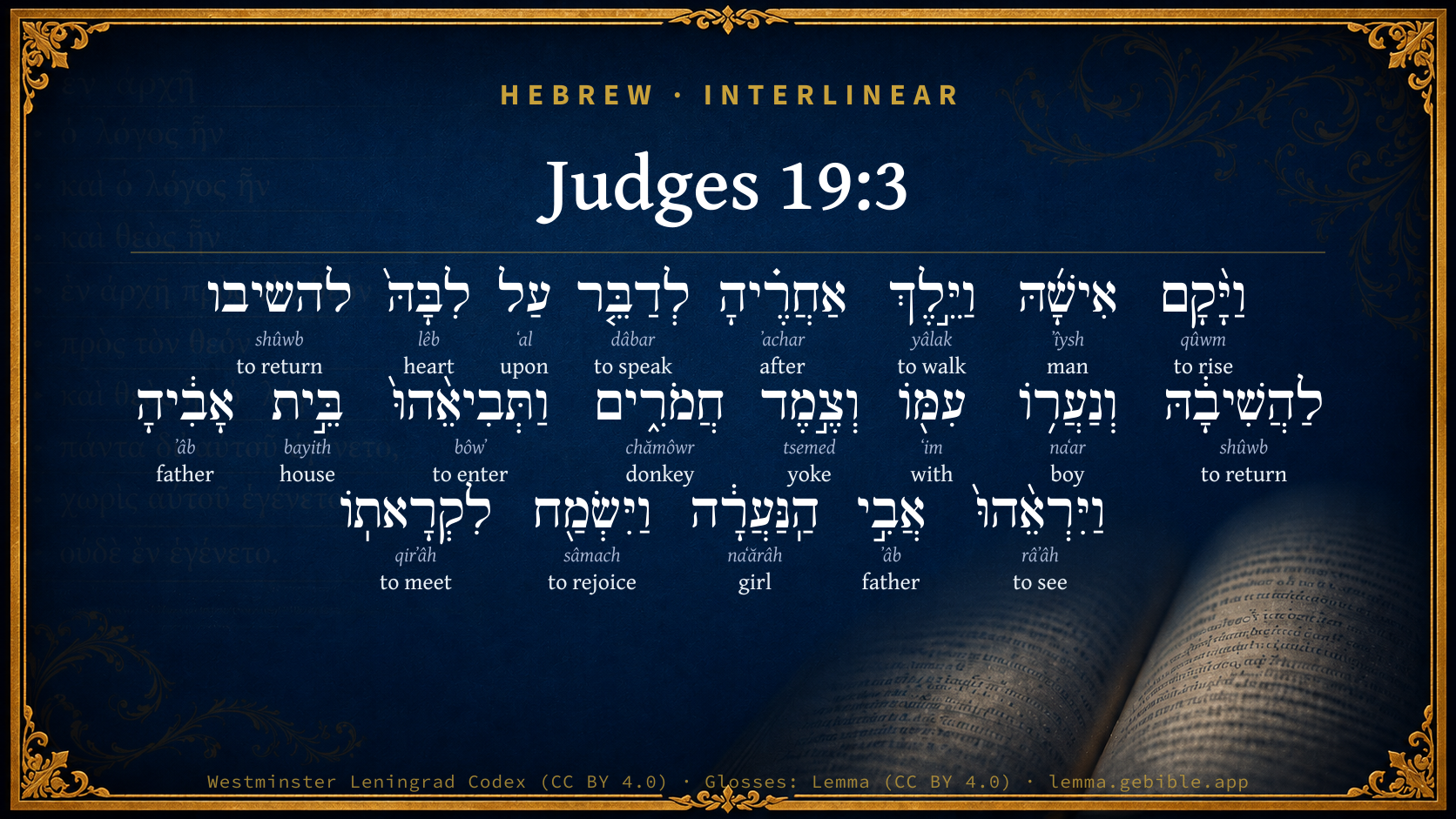
Judges 19:3

Hebrew (Westminster Leningrad Codex) Judges 19:3 appears in the Hebrew Old Testament. The text above is from the Westminster Leningrad Codex. Each word links to its Strong’s number, a concise gloss, and parsing drawn from the Open Scriptures Hebrew Bible morphology. Click any word for its full Brown-Driver-Briggs (BDB) entry.
Download image
Cite this verse

Judges 19:3 (World English Bible). Public Domain. Lemma interlinear Bible study tool, https://lemma.gebible.app/v/judges/19/3.

Show BibTeX & RIS
BibTeX
RIS
English Translation
Her husband arose, and went after her, to speak kindly to her, to bring her again, having his servant with him, and a couple of donkeys: and she brought him into her father's house; and when the father of the young lady saw him, he rejoiced to meet him.
World English Bible · Public Domain
Highlights
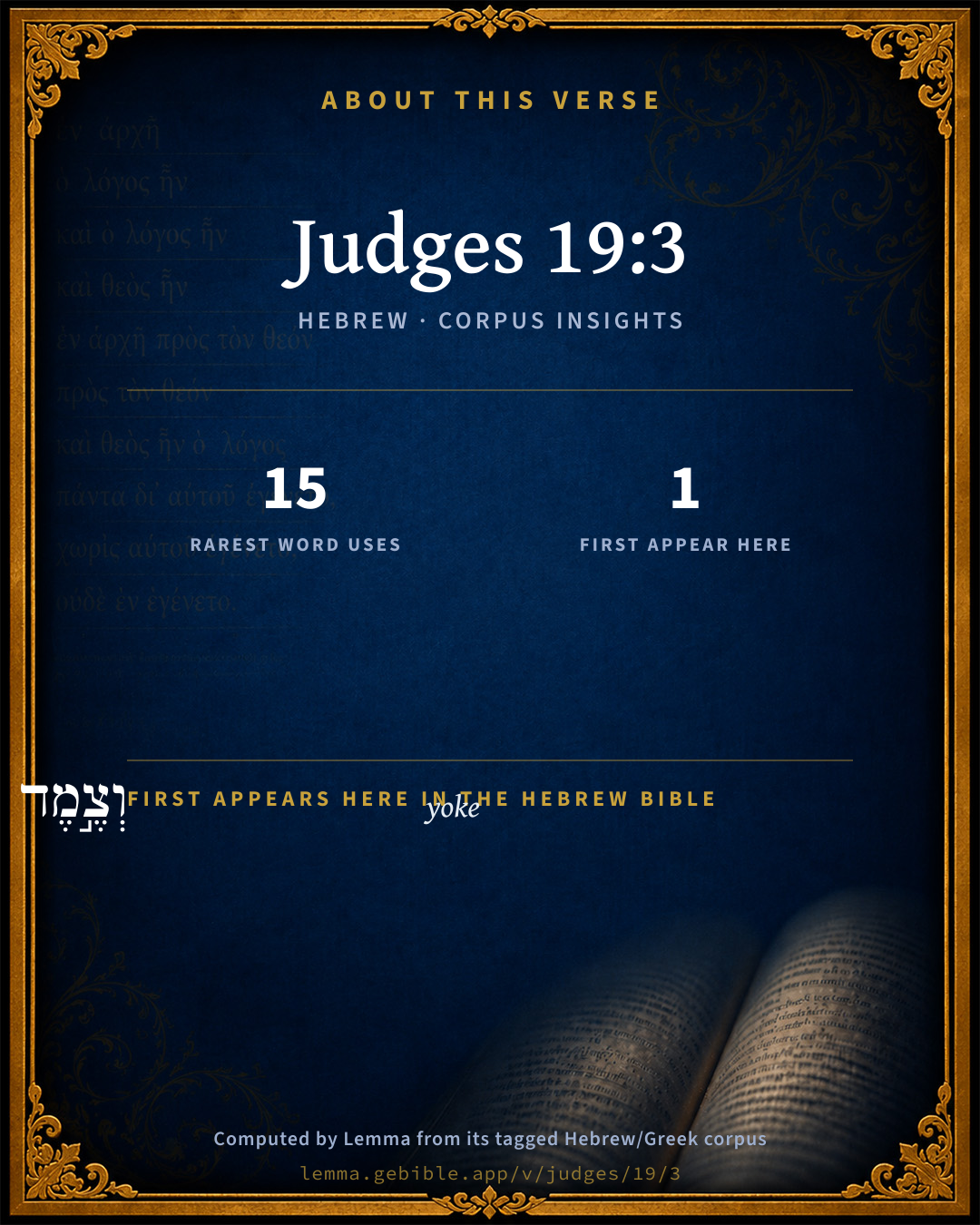
  • 1 first appearance in the Hebrew Bible
Full analysis ↓
Download a study sheet

One document with this verse’s original text, its word-by-word gloss line, the meaning frame, cross-references with their text, attributed commentary, and full source and license credits — printable, and it pastes into notes with its structure intact.

This verse Autodidact and up

Study sheet (.html) Plain text (.txt)

A passage Seminary Student

Up to 50 verses in one chapter. A passage sheet keeps up to 6 commentary sources and 12 cross-references per verse, in the order this page ranks them, and says so on the sheet whenever that leaves anything out. Ask for a single verse and you get the Autodidact verse sheet above.

Everything on this page stays free to read, with no account — the sheet is a download of what is already on screen, not access to it.

Want to remove ads? Support Godless Engineer
Compare translations 3

The same verse in 3 English versions, stacked beneath the original-language interlinear above. Click any original word for its lexicon entry.

Each is an independent rendering of the whole verse — the interlinear is not word-aligned to these translations.

Highlighted words mark where these versions differ — a whole-verse word diff, not a word-by-word alignment.

  • World English Bible Public Domain
    Her husband arose, and went after her, to speak kindly to her, to bring her again, having his servant with him, and a couple of donkeys: and she brought him into her father's house; and when the father of the young lady saw him, he rejoiced to meet him.
  • King James Version Public Domain
    And her husband arose, and went after her, to speak friendly unto her, and to bring her again, having his servant with him, and a couple of asses: and she brought him into her father's house: and when the father of the damsel saw him, he rejoiced to meet him.
  • unfoldingWord Literal Text CC BY-SA 4.0
    And her husband arose and went after her to speak to her heart to cause her to return. And his young man with him, and a pair of donkeys. And she brought him into the house of her father, and the father of the young woman saw him, and he was glad to meet him.

unfoldingWord Literal Text — © unfoldingWord, licensed CC BY-SA 4.0. Word-aligned USFM3 via Door43 (git.door43.org/unfoldingWord/en_ult).

Versions to compare (up to 4)

3 of 4 selected

Show all 18 translations

Every available English version of this verse, each an independent rendering of the whole verse.

  • World English Bible Public Domain
    Her husband arose, and went after her, to speak kindly to her, to bring her again, having his servant with him, and a couple of donkeys: and she brought him into her father's house; and when the father of the young lady saw him, he rejoiced to meet him.
  • Berean Standard Bible Public Domain
    her husband got up and went after her to speak kindly to her and bring her back, taking his servant and a pair of donkeys. So the girl brought him into her father’s house, and when her father saw him, he gladly welcomed him.
  • Majority Standard Bible Public Domain
    her husband got up and went after her to speak kindly to her and bring her back, taking his servant and a pair of donkeys. So the girl brought him into her father’s house, and when her father saw him, he gladly welcomed him.
  • King James Version Public Domain
    And her husband arose, and went after her, to speak friendly unto her, and to bring her again, having his servant with him, and a couple of asses: and she brought him into her father's house: and when the father of the damsel saw him, he rejoiced to meet him.
  • American Standard Version (1901) Public Domain
    And her husband arose, and went after her, to speak kindly unto her, to bring her again, having his servant with him, and a couple of asses: and she brought him into her father's house; and when the father of the damsel saw him, he rejoiced to meet him.
  • Revised Version (1885) Public Domain
    And her husband arose, and went after her, to speak kindly unto her, to bring her again, having his servant with him, and a couple of asses: and she brought him into her father’s house: and when the father of the damsel saw him, he rejoiced to meet him.
  • Geneva Bible (1599) Public Domain
    And her husband arose and went after her, to speake friendly vnto her, and to bring her againe: he had also his seruant with him, and a couple of asses: and she brought him vnto her fathers house, and when the yong womans father sawe him, he reioyced of his comming.
  • Douay-Rheims (1899) Public Domain
    And her husband followed her, willing to be reconciled with her, and to speak kindly to her, and to bring her back with him, having with him a servant and two asses: and she received him, and brought him into her father's house. And when his father in law had heard this, and had seen him, he met him with joy,
  • Young's Literal Translation Public Domain
    And her husband riseth and goeth after her, to speak unto her heart, to bring her back, and his young man `is' with him, and a couple of asses; and she bringeth him into the house of her father, and the father of the young woman seeth him, and rejoiceth to meet him.
  • Literal Standard Version CC BY-SA 4.0
    And her husband rises and goes after her, to speak to her heart, to bring her back, and his young man [is] with him, and a couple of donkeys; and she brings him into the house of her father, and the father of the young woman sees him, and rejoices to meet him.
  • Unlocked Literal Bible CC BY-SA 4.0
    Then her husband got up and went after her in order to persuade her to come back. His servant was with him, and a pair of donkeys. She brought him into her father's house. When the girl's father saw him, he was glad.
  • unfoldingWord Literal Text CC BY-SA 4.0
    And her husband arose and went after her to speak to her heart to cause her to return. And his young man with him, and a pair of donkeys. And she brought him into the house of her father, and the father of the young woman saw him, and he was glad to meet him.
  • Darby Bible Public Domain
    Then her husband arose and went after her, to speak kindly to her and bring her back. He had with him his servant and a couple of asses. And he came to her father's house; and when the girl's father saw him, he came with joy to meet him.
  • World Messianic Bible Public Domain
    Her husband arose and went after her to speak kindly to her, to bring her again, having his servant with him and a couple of donkeys. She brought him into her father’s house; and when the father of the young lady saw him, he rejoiced to meet him.
  • Webster's Bible Public Domain
    And her husband arose, and went after her, to speak kindly to her, and to bring her again, having his servant with him, and a couple of asses: and she brought him into her father's house: and when the father of the damsel saw him, he rejoiced to meet him.
  • Free Bible Version CC BY-SA 4.0
    Then her husband went after her, to talk kindly with her and bring her back home. With him went his servant and two donkeys. She took him to her father's house and when her father met him, he gladly welcomed him.
  • Bible in Basic English Public Domain
    Then her husband got up and went after her, with the purpose of talking kindly to her, and taking her back with him; he had with him his young man and two asses: and she took him into her father's house, and her father, when he saw him, came forward to him with joy.
  • JPS Tanakh (1917) Public Domain
    And her husband arose, and went after her, to speak kindly unto her, to bring her back, having his servant with him, and a couple of asses; and she brought him into her father's house; and when the father of the damsel saw him, he rejoiced to meet him.

Literal Standard Version (2020), Covenant Press — licensed CC BY-SA 4.0. Text via the HelloAO Bible API (eBible.org). Unlocked Literal Bible (unfoldingWord) — licensed CC BY-SA 4.0. Text via the HelloAO Bible API (eBible.org). unfoldingWord Literal Text — © unfoldingWord, licensed CC BY-SA 4.0. Word-aligned USFM3 via Door43 (git.door43.org/unfoldingWord/en_ult). Free Bible Version, Dr. Jonathan Gallagher — licensed CC BY-SA 4.0. Text via the HelloAO Bible API (eBible.org).

Word by word

More ways to search: Search by grammar → Find every occurrence → Compare this word →

Practice this passage: Drill this verse → Learn its vocabulary →

וְצֶ֣מֶד
tsemed
H6776
“and · yoke of”
Conjunction + Noun, Common, Masculine, Singular, Construct
Part of Speech
Conjunction + Noun
Type
Common
Gender
Masculine
Number
Singular
State
Construct
Full BDB Definition

Origin: a yoke or team (ie pair)

TWOT: 1927a

couple, pair, team, yoke - couple, pair, span (usually of animals) - acre - the amount of land a span of oxen could plow in one day
  1. וַיָּ֨קָם qûwm H6965 “and · to rise” Conjunction + Verb, Qal, Sequential Imperfect, 3rd Person, Masculine, Singular
  2. אִישָׁ֜הּ ʼîysh H376 “man · her” Noun, Common, Masculine, Singular, Construct + Suffix, Personal, 3rd Person, Feminine, Singular
  3. וַיֵּ֣לֶךְ yâlak H3212 “and · to walk” Conjunction + Verb, Qal, Sequential Imperfect, 3rd Person, Masculine, Singular
  4. אַחֲרֶ֗יהָ ʼachar H310 “after · her” Preposition + Suffix, Personal, 3rd Person, Feminine, Singular
  5. לְדַבֵּ֤ר dâbar H1696 “to speak” Preposition + Verb, Piel, Infinitive Construct
  6. עַל ʻal H5921 “upon” Preposition
  7. לִבָּהּ֙ lêb H3820 “heart · her” Noun, Common, Masculine, Singular, Construct + Suffix, Personal, 3rd Person, Feminine, Singular
  8. להשיבו shûwb H7725 “to return · him” Preposition + Verb, Hiphil, Infinitive Construct + Suffix, Personal, 3rd Person, Masculine, Singular
  9. לַהֲשִׁיבָ֔הּ shûwb H7725 “to return · her” Preposition + Verb, Hiphil, Infinitive Construct + Suffix, Personal, 3rd Person, Feminine, Singular
  10. וְנַעֲר֥וֹ naʻar H5288 “and · boy · his” Conjunction + Noun, Common, Masculine, Singular, Construct + Suffix, Personal, 3rd Person, Masculine, Singular
  11. עִמּ֖וֹ ʻim H5973 “with · him” Preposition + Suffix, Personal, 3rd Person, Masculine, Singular
  12. חֲמֹרִ֑ים chămôwr H2543 “donkeys” Noun, Common, Both, Plural, Absolute
  13. וַתְּבִיאֵ֨הוּ֙ bôwʼ H935 “and · to enter · him” Conjunction + Verb, Hiphil, Sequential Imperfect, 3rd Person, Feminine, Singular + Suffix, Personal, 3rd Person, Masculine, Singular
  14. בֵּ֣ית bayith H1004 “house of” Noun, Common, Masculine, Singular, Construct
  15. אָבִ֔יהָ ʼâb H1 “father · her” Noun, Common, Masculine, Singular, Construct + Suffix, Personal, 3rd Person, Feminine, Singular
  16. וַיִּרְאֵ֨הוּ֙ râʼâh H7200 “and · to see · him” Conjunction + Verb, Qal, Sequential Imperfect, 3rd Person, Masculine, Singular + Suffix, Personal, 3rd Person, Masculine, Singular
  17. אֲבִ֣י ʼâb H1 “father of” Noun, Common, Masculine, Singular, Construct
  18. הַֽנַּעֲרָ֔ה naʻărâh H5291 “the · girl” Particle, Definite Article + Noun, Common, Feminine, Singular, Absolute
  19. וַיִּשְׂמַ֖ח sâmach H8055 “and · to rejoice” Conjunction + Verb, Qal, Sequential Imperfect, 3rd Person, Masculine, Singular
  20. לִקְרָאתֽוֹ qirʼâh H7125 “to meet · him” Preposition + Verb, Qal, Infinitive Construct + Suffix, Personal, 3rd Person, Masculine, Singular

About this verse

These counts appear in no published source. They are computed here, from the morphology-tagged text and Lemma’s own curated glosses. What Lemma adds →

21
words
19
distinct lemmas
Historical
section

Notable vocabulary

The rarest word here is וְצֶ֣מֶד yoke H6776 — appearing just 15 times in the whole Hebrew Bible.

First appearance in Scripture

This word makes its first canonical appearance in the Hebrew Bible here:

  • וְצֶ֣מֶד yoke H6776

Shared distinctive vocabulary

וְצֶ֣מֶד yoke H6776 occurs in 15 verses of the Hebrew Bible. Also found in:

Grammatical profile

  • 9 verbs
  • 9 nouns
  • 3 prepositions

Verb forms

  • וַיָּ֨קָם Qal · Sequential Imperfect
  • וַיֵּ֣לֶךְ Qal · Sequential Imperfect
  • לְדַבֵּ֤ר Piel · Infinitive Construct
  • להשיבו Hiphil · Infinitive Construct
  • לַהֲשִׁיבָ֔הּ Hiphil · Infinitive Construct
  • וַתְּבִיאֵ֨הוּ֙ Hiphil · Sequential Imperfect
  • וַיִּרְאֵ֨הוּ֙ Qal · Sequential Imperfect
  • וַיִּשְׂמַ֖ח Qal · Sequential Imperfect
  • לִקְרָאתֽוֹ Qal · Infinitive Construct

Repetition

Words recur within this verse — often emphatic in Hebrew:

  • להשיבו to return H7725 ×2
  • אָבִ֔יהָ father H1 ×2

Hebrew & Septuagint length

In English translation the verse runs 49 words from the Hebrew and 57 from the Septuagint (LXX English) — closely comparable.

A rough comparison of the two English renderings, which tokenize alike — not a word-level alignment.

Word counts can differ between the Hebrew and the Greek without any difference in meaning — e.g. the Hebrew direct-object marker אֵת has no separate Greek word, and Greek often adds the article ὁ.

Cross-references

12

Topical passages linked to Judges 19:3 in the Treasury of Scripture Knowledge — connected by theme and wording, ordered by reader-vote popularity; previews shown in the World English Bible.

  • Genesis 34:3 His soul joined to Dinah, the daughter of Jacob, and he loved the young lady, and spoke kindly to the young lady.
  • Genesis 50:21 Now therefore don't be afraid. I will nourish you and your little ones." He comforted them, and spoke kindly to them.
  • John 8:11 She said, "No one, Lord." Jesus said, "Neither do I condemn you. Go your way. From now on, sin no more."
  • Leviticus 19:17 "'You shall not hate your brother in your heart. You shall surely rebuke your neighbor, and not bear sin because of him.
  • Leviticus 20:10 "'The man who commits adultery with another man's wife, even he who commits adultery with his neighbor's wife, the adulterer and the adulteress shall surely be put to death.
  • Numbers 22:22 God's anger was kindled because he went; and the angel of Yahweh placed himself in the way for an adversary against him. Now he was riding on his donkey, and his two servants were with him.
  • Judges 15:1 But it happened after a while, in the time of wheat harvest, that Samson visited his wife with a kid; and he said, I will go in to my wife into the chamber. But her father wouldn't allow him to go in.
  • Jeremiah 3:1 They say, If a man put away his wife, and she go from him, and become another man's, will he return to her again? Won't that land be greatly polluted? But you have played the prostitute with many lovers; yet return again to me, says Yahweh.
  • Hosea 2:14 "Therefore, behold, I will allure her, And bring her into the wilderness, And speak tenderly to her.
  • Matthew 1:19 Joseph, her husband, being a righteous man, and not willing to make her a public example, intended to put her away secretly.
  • John 8:4–5 they told him, "Teacher, we found this woman in adultery, in the very act.
  • Galatians 6:1 Brothers, even if a man is caught in some fault, you who are spiritual must restore such a one in a spirit of gentleness; looking to yourself so that you also aren't tempted.

Cross-references courtesy of OpenBible.info (CC BY 4.0).

Hebrew and Greek witnesses Masoretic Hebrew ↔ Greek Septuagint

The same verse in the two great witnesses to the Old Testament, shown verse-for-verse.

These are two independent witnesses, not word-aligned to each other, and the Septuagint is shown in lemma (dictionary) form.

Hebrew Judges 19:3 Masoretic · Westminster Leningrad Codex

וַיָּ֨קָם אִישָׁ֜הּ וַיֵּ֣לֶךְ אַחֲרֶ֗יהָ לְדַבֵּ֤ר עַל לִבָּהּ֙ להשיבו לַהֲשִׁיבָ֔הּ וְנַעֲר֥וֹ עִמּ֖וֹ וְצֶ֣מֶד חֲמֹרִ֑ים וַתְּבִיאֵ֨הוּ֙ בֵּ֣ית אָבִ֔יהָ וַיִּרְאֵ֨הוּ֙ אֲבִ֣י הַֽנַּעֲרָ֔ה וַיִּשְׂמַ֖ח לִקְרָאתֽוֹ

Her husband arose, and went after her, to speak kindly to her, to bring her again, having his servant with him, and a couple of donkeys: and she brought him into her father's house; and when the father of the young lady saw him, he rejoiced to meet him.

World English Bible · Public Domain

Greek LXX Judges 19:3 Septuagint · lemma form

καί ἀναἵστημι ὁ ἀνήρ αὐτός καί πορεύομαι ὀπίσω αὐτός ὁ λαλέω ἐπί καρδία αὐτός ὁ ἐπιστρέφω αὐτός αὐτός καί νεανίας αὐτός μετά αὐτός καί ζεῦγος ὄνος καί ὅδε εἰςφέρω αὐτός εἰς οἶκος πατήρ αὐτός καί ὁράω αὐτός ὁ πατήρ ὁ νεᾶνις καί εὐφραίνω εἰς συνάντησις αὐτός

And her husband rose up, and went after her to speak kindly to her, to recover her to himself; and he had his young man with him, and a pair of asses; and she brought him into the house of her father; and the father of the damsel saw him, and was well pleased to meet him.

LXX2012 (modern English Septuagint) · Public Domain

On this verse, The Cambridge Bible for Schools and Colleges discusses the Septuagint’s reading. Read the note in Commentary ↓

Hebrew: Westminster Leningrad Codex (CC BY 4.0). Greek: Septuagint (public domain); English from LXX2012 (modern English Septuagint) (Public Domain). How the Septuagint differs from the Hebrew →

Targum (Aramaic paraphrase)

1

The Targum is the ancient Jewish Aramaic paraphrase of the Hebrew Scriptures — an interpretive translation, not the Hebrew text itself. Onkelos (literal) and Pseudo-Jonathan (expansive) render the Torah, and Jonathan the Prophets. Coverage is partial: where no permissively-licensed English translation exists for a verse, only the Aramaic is shown. This is verse-level text, not a word-by-word alignment to the Hebrew.

  1. Targum Jonathan Prophets (Joshua–Malachi)
    וְּקָם בַּעֲלָהּ וַאֲזַל בַּתְרָהָא לְמַלֵיל עַל לִבָּהּ לַאֲתָבוּתָהּ וְעוּלֵימֵיהּ עִמֵיהּ וְזוּג חֲמָרִין וְאַעֲלָתֵיהּ לְבֵית אֲבוּהָא וַחֲזָהוּ אֲבוּהָא דְעוּלֶמְתָּא וַחֲדִי לָקֳדָמוּתֵיהּ:

    (no public-domain English translation for this verse)

    Targum Jonathan — Aramaic: “Mikraot Gedolot” (public domain). English: “Sefaria Community Translation” (CC0 1.0 (public-domain dedication)); “London "Chaldee Paraphrase," 1871” (public domain). Text via Sefaria.

Commentary

Notes on Judges 19:3 from classic Christian and Jewish commentators (each source and its license shown beneath its notes). The classic Christian expositions comment on the surrounding passage and are grouped to its opening verse, so a note may address several verses; the Jewish commentaries on the Tanakh (Rashi and others) are per-verse, so they appear only where the commentator wrote on this verse.

Lemma curates 59 commentaries, every one of them public domain or Creative Commons licensed, each selected and text-cleaned for this edition rather than reprinted as found. About our sources →

Trapp's Complete Commentary

John Trapp

Jdg 19:3 And her husband arose, and went after her, to speak friendly unto her, [and] to bring her again, having his servant with him, and a couple of asses: and she brought him into her father’s house: and when the father of the damsel saw him, he rejoiced to meet him.

Ver. 3. And her husband arose, and went after her.] Either out of pity to her, or want of her company. She should have sought to him first, as being the peccant party; but she could not bring her heart to it.

“ Fastus inest pulchris, &c. ”

Having his servant with him.] This Levite had one servant. Balaam the false prophet rode with two. {Num 22:22} Oh, let not Christ’s true ministers be slaves to others, servants to themselves.

He rejoiced to meet him.] The father and daughter made no means for reconciliation; but when remission came home to them, none could entertain it more thankfully. The nature of many men is forward to accept, and negligent to sue for; they can spend secret wishes upon that which shall cost them no endeavour.

John Trapp, A Commentary or Exposition upon All the Books of the Old and New Testament (1647–1656) — public domain. Text from a community e-Sword module.

Geneva Bible (1599)

Geneva Bible translators

Or, at his meeting.

Hebrew, to her heart.

Geneva Bible (1599) marginal notes — public domain. Text via Bolls.life.

Jamieson, Fausset & Brown

Robert Jamieson, A. R. Fausset & David Brown

And her husband arose, and went after her, to speak friendly unto her--Hebrew, "speak to her heart," in a kindly and affectionate manner, so as to rekindle her affection. Accompanied by a servant, he arrived at the house of his father-in-law, who rejoiced to meet him, in the hope that a complete reconciliation would be brought about between his daughter and her husband. The Levite, yielding to the hospitable importunities of his father-in-law, prolonged his stay for days.

Jamieson, Fausset & Brown — Commentary Critical and Explanatory on the Whole Bible (1871) — public domain (CC PDM 1.0). Text via the HelloAO Bible API.

Adam Clarke's Commentary

Verse 3. He rejoiced to meet him.] He hoped to be able completely to reconcile his daughter and her husband.

Adam Clarke's Commentary on the Bible (1810–1826) — public domain. Text from a community e-Sword/MySword module.

Ellicott's Commentary for English Readers

(3) To speak friendly unto her.—Literally, to speak to her heart—i.e., to bring about a kindly reconciliation (Gen_34:3; Gen_1:21; Rth_2:13).

A couple of asses.—One was meant to convey back his wife on her return.

A Bible Commentary for English Readers, edited by Charles John Ellicott (1878–1897) — public domain. Text from a community e-Sword module.

The Cambridge Bible for Schools and Colleges

gen. ed. J. J. S. Perowne

3. to speak kindly unto her] See marg., and cf. Gen_34:3; Gen_50:21, Isa_40:2.

to bring her again] More natural than the alternative reading given in the marg.

a couple of asses] for the necessaries of the journey; by Eastern custom the woman would be expected to walk, Jdg_19:10.

and she brought him] implies that the reconciliation has taken place; but as nothing is said about this, many prefer to read with LXX. cod. A and he went.

he rejoiced] Evidently the Levite was considered to be a desirable son in law, and he had come back to claim his property.

The Cambridge Bible for Schools and Colleges (gen. ed. J. J. S. Perowne; Cambridge University Press, 1878–1918) — public domain. Text from a community e-Sword module.

John Gill's Exposition

And her husband arose,.... From the place where he lived:

and went after her; to Bethlehemjudah, where her father lived:

to speak comfortably to her "or to her heart" (l); having heard perhaps that she repented of her sin, or if it was only upon a quarrel between them, his anger might cool and subside, and therefore sought for a reconciliation; and which was the more commendable in him, as he did not put her away, but she departed from him: and

to bring her again; to his own city, and to his own house and bed, as before:

having his servant with him, and a couple of asses; one of them for her to ride upon, and the other to carry provisions on:

and she brought him into her father's house; it seems she met with him before he came thither, in the fields, or in the street; and by this it appears that she was glad to see him, and received him in a loving manner, and introduced him into her father's house, so that things looked well, and promised success:

and when the father of the damsel saw him, he rejoiced to meet him; having a good opinion of him, and perhaps understood, even by his daughter's story, that she was most in fault, and therefore was well pleased to see him come after her; though he ought before this time to have sent her home, or sought for a reconciliation of her to her husband.

(l) "ad cor", Pagninus.

John Gill's Exposition of the Whole Bible (1746–1763) — public domain (CC PDM 1.0). Text via the HelloAO Bible API.

Haydock's Catholic Bible Commentary

With him. Hebrew, "her husband arose and followed her to speak to her heart, to bring her back," Genesis xxxiv. 3. He shewed great condescension and love, (Haydock) and she received him with suitable sentiments of regard, and did not become more haughty, as women, who perceive themselves to be courted, frequently do. If she had been married to another, she could not have been received by her former husband.

George Leo Haydock (1774–1849), Haydock's Catholic Family Bible and Commentary, 1859 edition — public domain. Excludes Psalms (Douay-Rheims chapter numbering differs from Protestant) and Deuterocanonical books (Catholic canon only).

Matthew Poole's English Annotations

To speak friendly unto her, or, to speak to her heart, i.e. kindly and comfortably, as that phrase is taken, Ge 1 21; Ho 2:14, to offer, her pardon and reconciliation, and restitution to her former state.

To bring her again, to wit, to his own house.

A couple of asses; partly for himself or his wife to ride upon, as there was occasion; and partly for carrying their provision, as appears from Jdg 19:19.

He rejoiced to meet him, hoping the breach would be made up by this means.

Matthew Poole's English Annotations on the Holy Bible (1683–1685) — public domain. Text from a community e-Sword/MySword module.

Whedon's Commentary on the Bible

Daniel D. Whedon

3. To speak friendly unto her — Literally, to speak to her heart. “To conciliate her affection, to rekindle her tenderness, to whisper forgiveness to her, and to implore her to return to the home she had left desolate. He had, perhaps, heard that she was penitent; for the phrase often denotes the giving of comfort to one who is in sorrow.” — Kitto.

Rejoiced to meet him — To meet him on such an errand, for he might have come not to speak friendly to her, but to scourge her for her crime of conjugal infidelity. Lev_19:20.

Daniel D. Whedon (gen. ed.), Commentary on the Old and New Testaments (1874–1909) — public domain. Text from a community e-Sword module.

The Pulpit Commentary

To bring her again. So the Keri. But the Cethib has to bring him, i.e. it, again, viz. , her heart. But the phrase to speak to her heart is such a common one for to speak friendly or kindly to any one that it is not likely that it should here be used otherwise, so that the pronoun should refer to heart. If the masculine is here the right reading, it may be an archaism making the suffix of the common gender like the plural suffix in ver. 24, which is masculine, though applied to women, and like the masculine pronoun itself, which is so used throughout the Pentateuch and elsewhere. (see also Jud_1:21:12 Exo_1:21) A couple of asses. One for himself and one for her. He rejoiced. No doubt, in part at least, because the expense of his daughter"s maintenance would be transferred from himself to his daughter"s husband.

The Pulpit Commentary (1880–1919), ed. H.D.M. Spence-Jones & Joseph S. Exell — public domain. Text from a community e-Sword module.

John Wesley's Explanatory Notes

Friendly - To offer her pardon and reconciliation.

John Wesley, Explanatory Notes Upon the Whole Bible (1754–1765) — public domain. Text via the GEBible commentary corpus.

Keil & Delitzsch

C. F. Keil & F. Delitzsch

Some time afterwards, namely at the end of four months (הדשׁים ארבּעה is in apposition to ימים, and defines more precisely the ימים, or days), her husband went after her, "to speak to her to the heart," i.e., to talk to her in a friendly manner (see Gen 34:3), and to reconcile her to himself again, so that she might return; taking with him his attendant and a couple of asses, for himself and his wife to ride upon. The suffix attached to להשׁיבו refers to לבּה, "to bring back her heart," to turn her to himself again. The Keri השׁיבהּ is a needless conjecture. "And she brought him into her father's house, and her father received his son-in-law with joy, and constrained him (יהזק־בּו, lit. held him fast) to remain there three days." It is evident from this that the Levite had succeeded in reconciling his wife.

Keil & Delitzsch — Biblical Commentary on the Old Testament (1861–1891) — public domain (CC PDM 1.0). Text via the HelloAO Bible API. (Old Testament only.)

unfoldingWord translationNotes

Door43 World Missions Community

His servant was with him, and a pair of donkeys

"He took with him his servant and two donkeys"

His father-in-law, the girl's father, persuaded

"His father-in-law, that is, the girl's father, persuaded" or "The girl's father persuaded"

persuaded him to stay

"spoke to him so he decided to stay"

translationWords

servant

donkey

unfoldingWord translationNotes — © Distant Shores Media and the Door43 World Missions Community, licensed CC BY-SA 4.0. Source: git.door43.org/Door43/en_tn.

Lesson kit

Teaching starters — assembled from the data on this page, not authored interpretation. Every prompt links to the verse data it draws on. Edit before teaching.

Judges, in the Historical, opens this verse with 21 words (19 distinct Hebrew lemmas). Its most distinctive word is tsemed (“yoke”). A historical commentator’s framing appears above. Read the whole chapter for the surrounding context.

Discussion questions

  1. The word tsemed carries the sense “yoke.” How does it shape the verse?
  2. This is the first place “yoke” appears in Scripture (first appears here). What does its debut here establish?
  3. How does Judges 19:10, which shares the word «yoke», read alongside this verse?
  4. What does the repetition of “to return” (2× in this one verse) do in this verse?
  5. These translations render this verse differently. What is at stake in choosing one wording over another?
  6. «וַיָּ֨קָם» is a Qal Sequential Imperfect verb. How does that grammatical form shape the action described?
  7. Compare how Trapp's Complete Commentary and Geneva Bible (1599) read this verse. Where do they agree or differ?

Things to notice

  • 1 word makes its first canonical appearance in Scripture here.
  • These translations choose different wording for 22 words in this verse.
  • “to return” occurs 2× in this single verse.
  • 19 distinct Hebrew lemmas span 21 words in this verse.

Reading settings

Reading text

Shown beneath each verse's original-language words.

Old Testament
Old Testament edition

Read the OT as the Masoretic Hebrew (MT) or the Greek Septuagint (LXX).

English shown for the Greek Septuagint (in the Hebrew ↔ Greek comparison).

Comparing translations? Open the Compare panel on any verse page to stack up to four side by side.