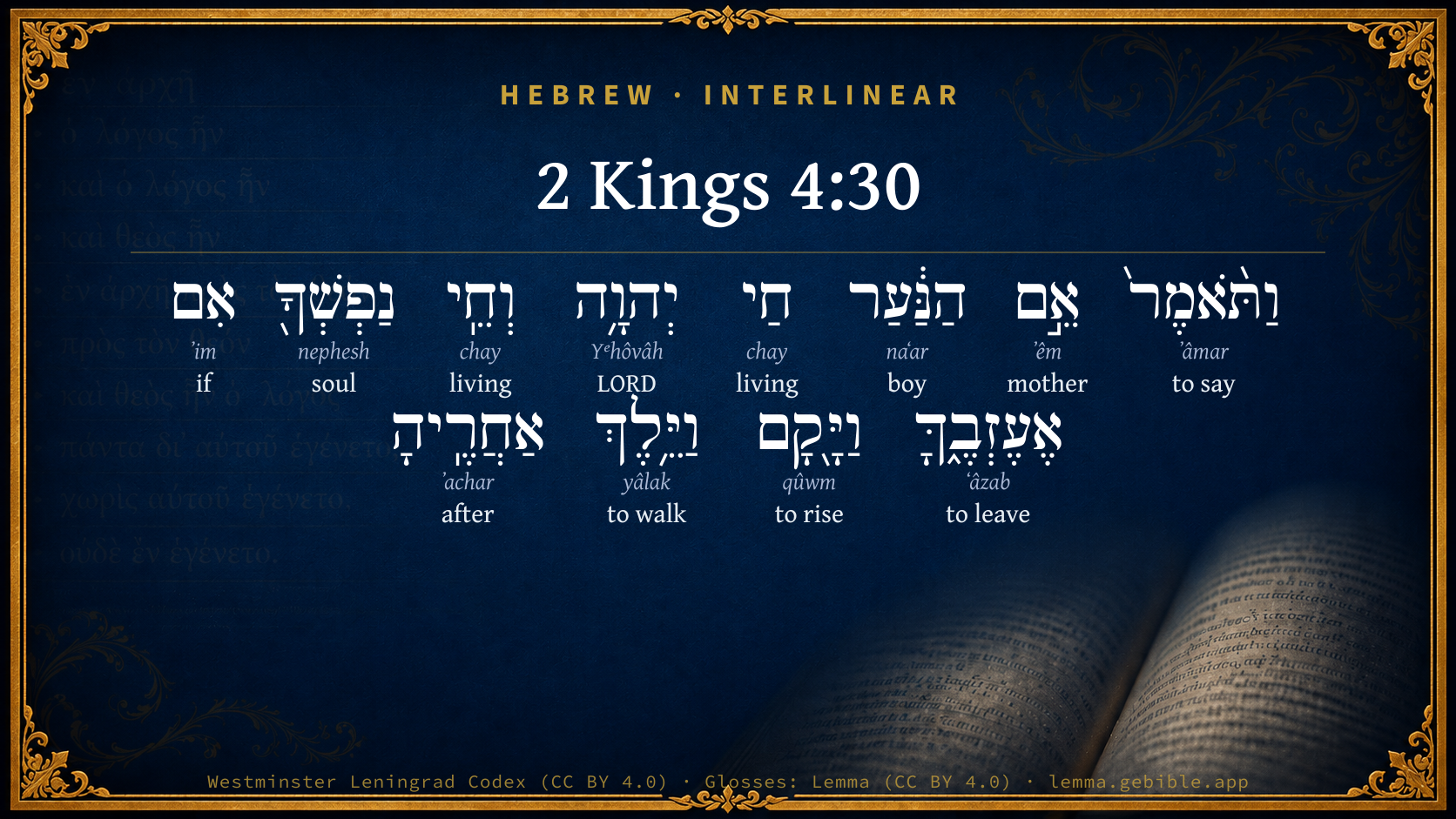
2 Kings 4:30

Hebrew (Westminster Leningrad Codex) 2 Kings 4:30 appears in the Hebrew Old Testament. The text above is from the Westminster Leningrad Codex. Each word links to its Strong’s number, a concise gloss, and parsing drawn from the Open Scriptures Hebrew Bible morphology. Click any word for its full Brown-Driver-Briggs (BDB) entry.
Download image
Cite this verse

2 Kings 4:30 (World English Bible). Public Domain. Lemma interlinear Bible study tool, https://lemma.gebible.app/v/2-kings/4/30.

Show BibTeX & RIS
BibTeX
RIS
English Translation
The mother of the child said, As Yahweh lives, and as your soul lives, I will not leave you. He arose, and followed her.
World English Bible · Public Domain
Download a study sheet

One document with this verse’s original text, its word-by-word gloss line, the meaning frame, cross-references with their text, attributed commentary, and full source and license credits — printable, and it pastes into notes with its structure intact.

This verse Autodidact and up

Study sheet (.html) Plain text (.txt)

A passage Seminary Student

Up to 50 verses in one chapter. A passage sheet keeps up to 6 commentary sources and 12 cross-references per verse, in the order this page ranks them, and says so on the sheet whenever that leaves anything out. Ask for a single verse and you get the Autodidact verse sheet above.

Everything on this page stays free to read, with no account — the sheet is a download of what is already on screen, not access to it.

Want to remove ads? Support Godless Engineer
Compare translations 3

The same verse in 3 English versions, stacked beneath the original-language interlinear above. Click any original word for its lexicon entry.

Each is an independent rendering of the whole verse — the interlinear is not word-aligned to these translations.

Highlighted words mark where these versions differ — a whole-verse word diff, not a word-by-word alignment.

  • World English Bible Public Domain
    The mother of the child said, As Yahweh lives, and as your soul lives, I will not leave you. He arose, and followed her.
  • King James Version Public Domain
    And the mother of the child said, As the LORD liveth, and as thy soul liveth, I will not leave thee. And he arose, and followed her.
  • unfoldingWord Literal Text CC BY-SA 4.0
    And the mother of the young man said, “The life of Yahweh and the life of your soul, if I should leave you.” And he arose, and he went after her.

unfoldingWord Literal Text — © unfoldingWord, licensed CC BY-SA 4.0. Word-aligned USFM3 via Door43 (git.door43.org/unfoldingWord/en_ult).

Versions to compare (up to 4)

3 of 4 selected

Show all 18 translations

Every available English version of this verse, each an independent rendering of the whole verse.

  • World English Bible Public Domain
    The mother of the child said, As Yahweh lives, and as your soul lives, I will not leave you. He arose, and followed her.
  • Berean Standard Bible Public Domain
    And the mother of the boy said, “As surely as the LORD lives and as you yourself live, I will not leave you.” So he got up and followed her.
  • Majority Standard Bible Public Domain
    And the mother of the boy said, “As surely as the LORD lives and as you yourself live, I will not leave you.” So he got up and followed her.
  • King James Version Public Domain
    And the mother of the child said, As the LORD liveth, and as thy soul liveth, I will not leave thee. And he arose, and followed her.
  • American Standard Version (1901) Public Domain
    And the mother of the child said, As Jehovah liveth, and as thy soul liveth, I will not leave thee. And he arose, and followed her.
  • Revised Version (1885) Public Domain
    And the mother of the child said, As the LORD liveth, and as thy soul liveth, I will not leave thee. And he arose, and followed her.
  • Geneva Bible (1599) Public Domain
    And the mother of the childe sayde, As the Lord liueth, and as thy soule liueth, I will not leaue thee. Therefore he arose, and followed her.
  • Douay-Rheims (1899) Public Domain
    But the mother of the child said: As the Lord liveth, and as thy soul liveth, I will not leave thee. He arose, therefore, and followed her.
  • Young's Literal Translation Public Domain
    And the mother of the youth saith, `Jehovah liveth, and thy soul liveth -- if I leave thee;' and he riseth and goeth after her.
  • Literal Standard Version CC BY-SA 4.0
    And the mother of the youth says, “YHWH lives, and your soul lives—if I leave you”; and he rises and goes after her.
  • Unlocked Literal Bible CC BY-SA 4.0
    But the mother of the child said, “As Yahweh lives, and as you live, I will not leave you.” So Elisha arose and followed her.
  • unfoldingWord Literal Text CC BY-SA 4.0
    And the mother of the young man said, “The life of Yahweh and the life of your soul, if I should leave you.” And he arose, and he went after her.
  • Darby Bible Public Domain
    And the mother of the lad said, As Jehovah liveth, and as thy soul liveth, I will not leave thee! And he rose up and followed her.
  • World Messianic Bible Public Domain
    The child’s mother said, “As the LORD lives, and as your soul lives, I will not leave you.” So he arose, and followed her.
  • Webster's Bible Public Domain
    And the mother of the child said, As the LORD liveth, and as thy soul liveth, I will not leave thee. And he arose, and followed her.
  • Free Bible Version CC BY-SA 4.0
    But the boy's mother said, “As the Lord lives and as you live, I'm not leaving without you!” So he got up and went with her.
  • Bible in Basic English Public Domain
    But the mother of the child said, As the Lord is living and as your soul is living, I will not go back without you. So he got up and went with her.
  • JPS Tanakh (1917) Public Domain
    And the mother of the child said: 'As the LORD liveth, and as thy soul liveth, I will not leave thee.' And he arose, and followed her.

Literal Standard Version (2020), Covenant Press — licensed CC BY-SA 4.0. Text via the HelloAO Bible API (eBible.org). Unlocked Literal Bible (unfoldingWord) — licensed CC BY-SA 4.0. Text via the HelloAO Bible API (eBible.org). unfoldingWord Literal Text — © unfoldingWord, licensed CC BY-SA 4.0. Word-aligned USFM3 via Door43 (git.door43.org/unfoldingWord/en_ult). Free Bible Version, Dr. Jonathan Gallagher — licensed CC BY-SA 4.0. Text via the HelloAO Bible API (eBible.org).

Word by word

More ways to search: Search by grammar → Find every occurrence → Compare this word →

Practice this passage: Drill this verse → Learn its vocabulary →

אֶעֶזְבֶ֑ךָּ
ʻâzab
H5800
“to leave · you”
Verb, Qal, Imperfect, 1st Person, Common, Singular + Suffix, Personal, 2nd Person, Masculine, Singular
Part of Speech
Verb
Stem
Qal
Form
Imperfect
Person
1st Person
Gender
Common
Number
Singular
Full BDB Definition

Origin: a primitive root

TWOT: 1594 , 1595

to leave, loose, forsake - (Qal) to leave - to depart from, leave behind, leave, let alone - to leave, abandon, forsake, neglect, apostatise - to let loose, set free, let go, free - (Niphal) - to be left to - to be forsaken - (Pual) to be deserted - to restore, repair - (Qal) to repair
  1. וַתֹּ֨אמֶר֙ ʼâmar H559 “and · to say” Conjunction + Verb, Qal, Sequential Imperfect, 3rd Person, Feminine, Singular
  2. אֵ֣ם ʼêm H517 “mother of” Noun, Common, Feminine, Singular, Construct
  3. הַנַּ֔עַר naʻar H5288 “the · boy” Particle, Definite Article + Noun, Common, Masculine, Singular, Absolute
  4. חַי chay H2416 “living” Adjective, Adjective, Masculine, Singular, Absolute
  5. יְהוָ֥ה Yᵉhôvâh H3068 “LORD” Noun, Proper
  6. וְחֵֽי chay H2416 “and · living” Conjunction + Adjective, Adjective, Masculine, Singular, Absolute
  7. נַפְשְׁךָ֖ nephesh H5315 “soul · your” Noun, Common, Both, Singular, Construct + Suffix, Personal, 2nd Person, Masculine, Singular
  8. אִם ʼim H518 “if” Conjunction
  9. וַיָּ֖קָם qûwm H6965 “and · to rise” Conjunction + Verb, Qal, Sequential Imperfect, 3rd Person, Masculine, Singular
  10. וַיֵּ֥לֶךְ yâlak H3212 “and · to walk” Conjunction + Verb, Qal, Sequential Imperfect, 3rd Person, Masculine, Singular
  11. אַחֲרֶֽיהָ ʼachar H310 “after · her” Preposition + Suffix, Personal, 3rd Person, Feminine, Singular

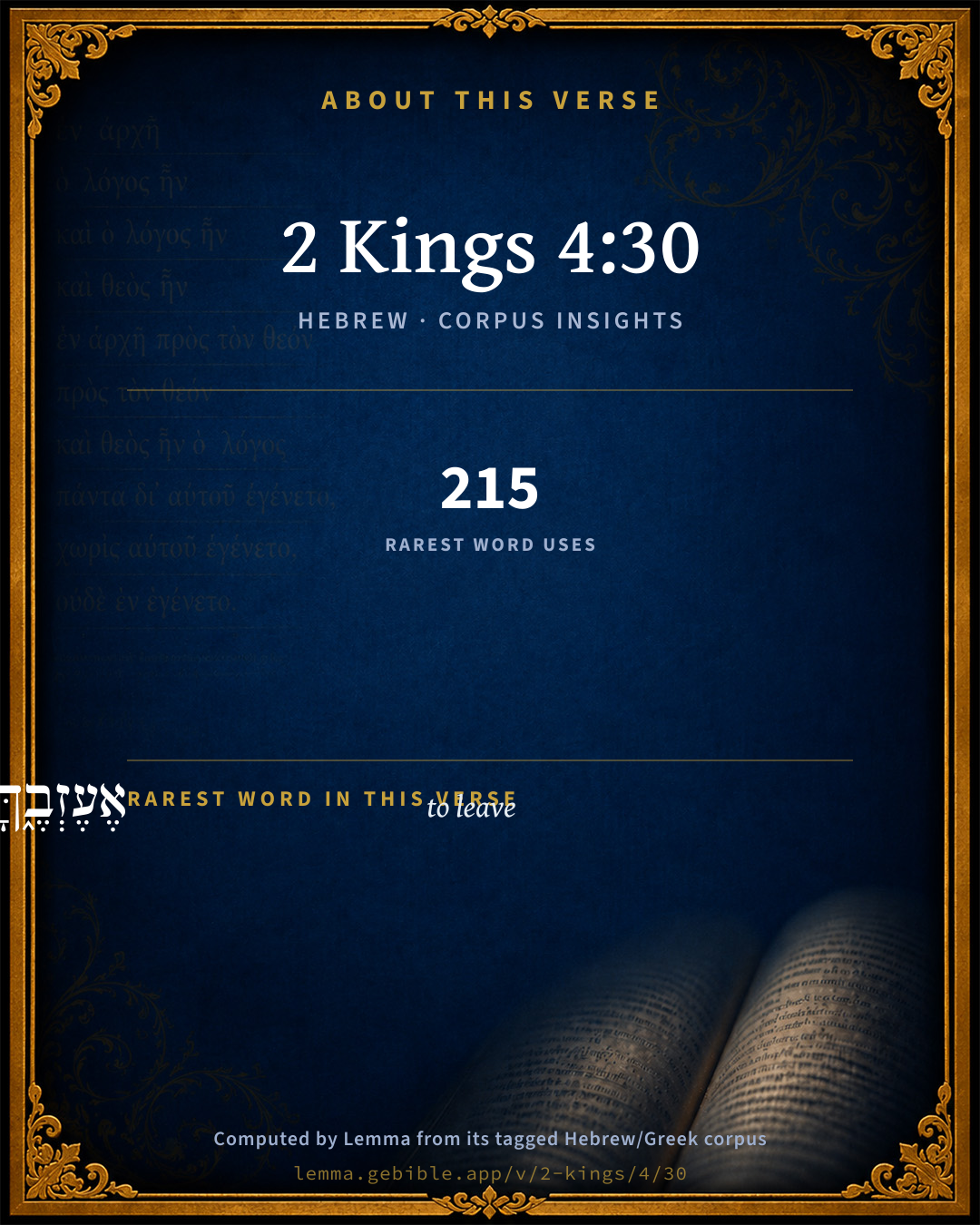
About this verse

These counts appear in no published source. They are computed here, from the morphology-tagged text and Lemma’s own curated glosses. What Lemma adds →

12
words
11
distinct lemmas
Historical
section

Grammatical profile

  • 4 verbs
  • 4 nouns
  • 2 adjectives
  • 1 preposition
  • 1 conjunction

Verb forms

  • וַתֹּ֨אמֶר֙ Qal · Sequential Imperfect
  • אֶעֶזְבֶ֑ךָּ Qal · Imperfect
  • וַיָּ֖קָם Qal · Sequential Imperfect
  • וַיֵּ֥לֶךְ Qal · Sequential Imperfect

Repetition

A word recurs within this verse — often emphatic in Hebrew:

  • חַי living H2416 ×2

Hebrew & Septuagint length

In English translation the verse runs 24 words from the Hebrew and 28 from the Septuagint (LXX English) — closely comparable.

A rough comparison of the two English renderings, which tokenize alike — not a word-level alignment.

Word counts can differ between the Hebrew and the Greek without any difference in meaning — e.g. the Hebrew direct-object marker אֵת has no separate Greek word, and Greek often adds the article ὁ.

Cross-references

4

Topical passages linked to 2 Kings 4:30 in the Treasury of Scripture Knowledge — connected by theme and wording, ordered by reader-vote popularity; previews shown in the World English Bible.

  • 2 Kings 2:2 Elijah said to Elisha, Please wait here, for Yahweh has sent me as far as Bethel. Elisha said, As Yahweh lives, and as your soul lives, I will not leave you. So they went down to Bethel.
  • Ruth 1:16–18 Ruth said, "Don't entreat me to leave you, and to return from following after you, for where you go, I will go; and where you lodge, I will lodge; your people shall be my people, and your God my God;
  • Exodus 33:12–16 Moses said to Yahweh, "Behold, you tell me, 'Bring up this people:' and you haven't let me know whom you will send with me. Yet you have said, 'I know you by name, and you have also found favor in my sight.'
  • 2 Kings 2:4 Elijah said to him, Elisha, please wait here, for Yahweh has sent me to Jericho. He said, As Yahweh lives, and as your soul lives, I will not leave you. So they came to Jericho.

Cross-references courtesy of OpenBible.info (CC BY 4.0).

Hebrew and Greek witnesses Masoretic Hebrew ↔ Greek Septuagint

The same verse in the two great witnesses to the Old Testament, shown verse-for-verse.

These are two independent witnesses, not word-aligned to each other, and the Septuagint is shown in lemma (dictionary) form.

Hebrew 2 Kings 4:30 Masoretic · Westminster Leningrad Codex

וַתֹּ֨אמֶר֙ אֵ֣ם הַנַּ֔עַר חַי יְהוָ֥ה וְחֵֽי נַפְשְׁךָ֖ אִם אֶעֶזְבֶ֑ךָּ וַיָּ֖קָם וַיֵּ֥לֶךְ אַחֲרֶֽיהָ

The mother of the child said, As Yahweh lives, and as your soul lives, I will not leave you. He arose, and followed her.

World English Bible · Public Domain

Greek LXX 2 Kings 4:30 Septuagint · lemma form

καί εἶπον ὁ μήτηρ ὁ παιδάριον ζάω κύριος καί ζάω ὁ ψυχή σύ εἰ ἐν καταλείπω σύ καί ἀναἵστημι ελισαιε καί πορεύομαι ὀπίσω αὐτός

And the mother of the child said, As the Lord lives and as your soul lives, I will not leave you. And Elisaie arose, and went after her.

LXX2012 (modern English Septuagint) · Public Domain

Hebrew: Westminster Leningrad Codex (CC BY 4.0). Greek: Septuagint (public domain); English from LXX2012 (modern English Septuagint) (Public Domain). How the Septuagint differs from the Hebrew →

Targum (Aramaic paraphrase)

1

The Targum is the ancient Jewish Aramaic paraphrase of the Hebrew Scriptures — an interpretive translation, not the Hebrew text itself. Onkelos (literal) and Pseudo-Jonathan (expansive) render the Torah, and Jonathan the Prophets. Coverage is partial: where no permissively-licensed English translation exists for a verse, only the Aramaic is shown. This is verse-level text, not a word-by-word alignment to the Hebrew.

  1. Targum Jonathan Prophets (Joshua–Malachi)
    וַאֲמַרַת אִמֵיהּ דְרַבְיָא קַיָם הוּא יְיָ וְחַי נַפְשָׁךְ אִם אֶשְׁבְּקִינָךְ וְקָם וַאֲזַל בַּתְרָאָה:

    (no public-domain English translation for this verse)

    Targum Jonathan — Aramaic: “Mikraot Gedolot” (public domain). English: “Sefaria Community Translation” (CC0 1.0 (public-domain dedication)); “London "Chaldee Paraphrase," 1871” (public domain). Text via Sefaria.

Commentary

Notes on 2 Kings 4:30 from classic Christian and Jewish commentators (each source and its license shown beneath its notes). The classic Christian expositions comment on the surrounding passage and are grouped to its opening verse, so a note may address several verses; the Jewish commentaries on the Tanakh (Rashi and others) are per-verse, so they appear only where the commentator wrote on this verse.

Lemma curates 59 commentaries, every one of them public domain or Creative Commons licensed, each selected and text-cleaned for this edition rather than reprinted as found. About our sources →

Trapp's Complete Commentary

John Trapp

2Ki 4:30 And the mother of the child said, [As] the LORD liveth, and [as] thy soul liveth, I will not leave thee. And he arose, and followed her.

Ver. 30. And he arose, and followed her.] As our Saviour also, upon a like occasion, arose and followed Jairus, {Mat 9:18-19} not taking offence at his weak faith, nor turning him off, as presuming to prescribe.

John Trapp, A Commentary or Exposition upon All the Books of the Old and New Testament (1647–1656) — public domain. Text from a community e-Sword module.

Joseph Benson's Commentary

2Ki 4:30. And the mother of the child said, I will not leave thee — Until thou goest with me; for she had no great confidence in Gehazi, nor was her faith so strong as to think that the prophet could work so great a miracle at that distance, and by his staff. And he arose, and followed her — Being overcome by her importunity, and his tenderness toward so great a friend.

Joseph Benson's Commentary on the Old and New Testaments (1811–1818) — public domain. Text from a community e-Sword module.

Adam Clarke's Commentary

Verse 30. I will not leave thee.] The prophet it seems had no design to accompany her; he intended to wait for Gehazi's return; but as the woman was well assured the child was dead, she was determined not to return till she brought the prophet with her.

Adam Clarke's Commentary on the Bible (1810–1826) — public domain. Text from a community e-Sword/MySword module.

Ellicott's Commentary for English Readers

(30) I will not leave thee.—She wished the prophet himself to go to her child. The writer appropriately substitutes “the mother of the child” for “the Shunammite” or “the woman” in connection with this impassioned utterance, which induced the prophet to yield to her wishes.

A Bible Commentary for English Readers, edited by Charles John Ellicott (1878–1897) — public domain. Text from a community e-Sword module.

The Cambridge Bible for Schools and Colleges

gen. ed. J. J. S. Perowne

30. I will not leave thee] Whether the staff sent by Gehazi may have an effect, she cannot know. Her only security is in Elisha’s presence, and with him she will return to her desolated home. It seems as though the prophet had not at first intended to go with her, but she will take no refusal, so he prepares for the journey. ‘She, not regarding the staff or the man, holds fast to Elisha. No hopes of his message can loose her fingers. She imagined that the servant, the staff, might be severed from Elisha: she knew that wherever the prophet was, there was power’ (Bp Hall).

The Cambridge Bible for Schools and Colleges (gen. ed. J. J. S. Perowne; Cambridge University Press, 1878–1918) — public domain. Text from a community e-Sword module.

John Gill's Exposition

And the mother of the child said,.... Having no faith in what the servant was to do, or could do:

as the Lord liveth, and as thy soul liveth, I will not leave thee; signifying she would not go with his servant, but insisted upon it that he himself went with her, or she would not depart:

and he arose, and followed her; influenced by her importunity, and a sense of favours he had received from her, and more especially by the Spirit of God.

John Gill's Exposition of the Whole Bible (1746–1763) — public domain (CC PDM 1.0). Text via the HelloAO Bible API.

Matthew Poole's English Annotations

I will not leave thee, until thou goest home with me. For she had no great confidence in Gehazi, nor was her faith so strong as to think that the prophet could work so great a miracle at this distance, and by his staff; which possibly was one reason why this did no good. Compare Mat 9:18; 13:58; 17:20.

Matthew Poole's English Annotations on the Holy Bible (1683–1685) — public domain. Text from a community e-Sword/MySword module.

Whedon's Commentary on the Bible

Daniel D. Whedon

30. I will not leave thee — After the heartless attempt of Gehazi to thrust her away from the prophet’s presence, (2Ki_4:27,) she has no confidence in his ministry, even though he carry the staff of Elisha. Sacred vestments and a holy commission will not command the confidence of earnest souls, unless they be associated with a minister who himself gives evidence of a true and tender heart.

Daniel D. Whedon (gen. ed.), Commentary on the Old and New Testaments (1874–1909) — public domain. Text from a community e-Sword module.

The Pulpit Commentary

And the mother of the child said, As the Lord liveth, and as thy soul liveth, (comp. 2Ki_3:2, 2Ki_3:4, 2Ki_3:6) I will not leave thee. Apparently, the woman supposed that Elisha intended to do nothing more, but trust the child"s recovery to such virtue as might inhere in his staff. But her own resolution was long ago taken she would be content with nothing less than bringing the prophet face to face with her dead child. She "will not leave" him till he consents to accompany her to her home. And he arose, and followed her; as, no doubt, he had intended from the first.

The Pulpit Commentary (1880–1919), ed. H.D.M. Spence-Jones & Joseph S. Exell — public domain. Text from a community e-Sword module.

John Wesley's Explanatory Notes

Will not leave thee - Until thou goest home with me. For she had no great confidence in Gehazi, nor was her faith so strong as to think that the prophet could work so great a miracle at this distance.

John Wesley, Explanatory Notes Upon the Whole Bible (1754–1765) — public domain. Text via the GEBible commentary corpus.

unfoldingWord translationNotes

Door43 World Missions Community

As Yahweh lives, and as you live

"As surely as Yahweh lives and as you live." This shows that the mother is taking an oath. The mother compares the certainty that Yahweh and Elisha are alive to the certainty of what she is saying. This is a way of making a solemn promise. AT: "I solemnly promise that"

but the child did not speak or hear

This means that the child was not alive. The full meaning of this statement can be made explicit. AT: "but the child did not show any signs of being alive" (See: Assumed Knowledge and Implicit Information)

has not awakened

Here being dead is spoken of as being asleep. AT: "is still dead" (See: Euphemism)

translationWords

life

raise

unfoldingWord translationNotes — © Distant Shores Media and the Door43 World Missions Community, licensed CC BY-SA 4.0. Source: git.door43.org/Door43/en_tn.

Lesson kit

Teaching starters — assembled from the data on this page, not authored interpretation. Every prompt links to the verse data it draws on. Edit before teaching.

2 Kings, in the Historical, opens this verse with 12 words (11 distinct Hebrew lemmas). Its most distinctive word is ʻâzab (“to leave”). A historical commentator’s framing appears above. Read the whole chapter for the surrounding context.

Discussion questions

  1. What does “to leave” (ʻâzab) contribute to the verse as a whole?
  2. How does 2 Kings 2:2, which shares this passage’s theme, read alongside this verse?
  3. What does the repetition of “living” (2× in this one verse) do in this verse?
  4. These translations render this verse differently. What is at stake in choosing one wording over another?
  5. «וַתֹּ֨אמֶר֙» is a Qal Sequential Imperfect verb. How does that grammatical form shape the action described?
  6. Compare how Trapp's Complete Commentary and Joseph Benson's Commentary read this verse. Where do they agree or differ?

Things to notice

Reading settings

Reading text

Shown beneath each verse's original-language words.

Old Testament
Old Testament edition

Read the OT as the Masoretic Hebrew (MT) or the Greek Septuagint (LXX).

English shown for the Greek Septuagint (in the Hebrew ↔ Greek comparison).

Comparing translations? Open the Compare panel on any verse page to stack up to four side by side.