
2 Kings 4:25

Hebrew (Westminster Leningrad Codex) 2 Kings 4:25 appears in the Hebrew Old Testament. The text above is from the Westminster Leningrad Codex. Each word links to its Strong’s number, a concise gloss, and parsing drawn from the Open Scriptures Hebrew Bible morphology. Click any word for its full Brown-Driver-Briggs (BDB) entry.
Download image
Cite this verse

2 Kings 4:25 (World English Bible). Public Domain. Lemma interlinear Bible study tool, https://lemma.gebible.app/v/2-kings/4/25.

Show BibTeX & RIS
BibTeX
RIS
English Translation
So she went, and came to the man of God to Mount Carmel. It happened, when the man of God saw her afar off, that he said to Gehazi his servant, Behold, yonder is the Shunammite:
World English Bible · Public Domain
Download a study sheet

One document with this verse’s original text, its word-by-word gloss line, the meaning frame, cross-references with their text, attributed commentary, and full source and license credits — printable, and it pastes into notes with its structure intact.

This verse Autodidact and up

Study sheet (.html) Plain text (.txt)

A passage Seminary Student

Up to 50 verses in one chapter. A passage sheet keeps up to 6 commentary sources and 12 cross-references per verse, in the order this page ranks them, and says so on the sheet whenever that leaves anything out. Ask for a single verse and you get the Autodidact verse sheet above.

Everything on this page stays free to read, with no account — the sheet is a download of what is already on screen, not access to it.

Want to remove ads? Support Godless Engineer
Compare translations 3

The same verse in 3 English versions, stacked beneath the original-language interlinear above. Click any original word for its lexicon entry.

Each is an independent rendering of the whole verse — the interlinear is not word-aligned to these translations.

Highlighted words mark where these versions differ — a whole-verse word diff, not a word-by-word alignment.

  • World English Bible Public Domain
    So she went, and came to the man of God to Mount Carmel. It happened, when the man of God saw her afar off, that he said to Gehazi his servant, Behold, yonder is the Shunammite:
  • King James Version Public Domain
    So she went and came unto the man of God to mount Carmel. And it came to pass, when the man of God saw her afar off, that he said to Gehazi his servant, Behold, yonder is that Shunammite:
  • unfoldingWord Literal Text CC BY-SA 4.0
    And she went, and she came to the man of God at Mount Carmel. And it happened, when the man of God saw her from opposite, that he said to Gehazi his servant, “Behold, that Shunammitess.

unfoldingWord Literal Text — © unfoldingWord, licensed CC BY-SA 4.0. Word-aligned USFM3 via Door43 (git.door43.org/unfoldingWord/en_ult).

Versions to compare (up to 4)

3 of 4 selected

Show all 18 translations

Every available English version of this verse, each an independent rendering of the whole verse.

  • World English Bible Public Domain
    So she went, and came to the man of God to Mount Carmel. It happened, when the man of God saw her afar off, that he said to Gehazi his servant, Behold, yonder is the Shunammite:
  • Berean Standard Bible Public Domain
    So she set out and went to the man of God at Mount Carmel. When the man of God saw her at a distance, he said to his servant Gehazi, “Look, there is the Shunammite woman.
  • Majority Standard Bible Public Domain
    So she set out and went to the man of God at Mount Carmel. When the man of God saw her at a distance, he said to his servant Gehazi, “Look, there is the Shunammite woman.
  • King James Version Public Domain
    So she went and came unto the man of God to mount Carmel. And it came to pass, when the man of God saw her afar off, that he said to Gehazi his servant, Behold, yonder is that Shunammite:
  • American Standard Version (1901) Public Domain
    So she went, and came unto the man of God to mount Carmel. And it came to pass, when the man of God saw her afar off, that he said to Gehazi his servant, Behold, yonder is the Shunammite:
  • Revised Version (1885) Public Domain
    So she went, and came unto the man of God to mount Carmel. And it came to pass, when the man of God saw her afar off, that he said to Gehazi his servant, Behold, yonder is the Shunammite:
  • Geneva Bible (1599) Public Domain
    So she went, and came vnto the man of God to mount Carmel. And when the man of God sawe her ouer against him, he sayd to Gehazi his seruant, Beholde, the Shunammite.
  • Douay-Rheims (1899) Public Domain
    So she went forward, and came to the man of God to mount Carmel: and when the mall of God saw her coming towards, he said to Giezi his servant: Behold that Sunamitess.
  • Young's Literal Translation Public Domain
    And she goeth, and cometh in unto the man of God, unto the hill of Carmel, and it cometh to pass, at the man of God's seeing her from over-against, that he saith unto Gehazi his young man, `Lo, this Shunammite;
  • Literal Standard Version CC BY-SA 4.0
    And she goes, and comes to the man of God, to the hill of Carmel, and it comes to pass, at the man of God’s seeing her from within view, that he says to his young man Gehazi, “Behold, this Shunammite;
  • Unlocked Literal Bible CC BY-SA 4.0
    So she went and came to the man of God at Mount Carmel. So when the man of God saw her in the distance, he said to Gehazi his servant, “Look, here comes the Shunammite woman.
  • unfoldingWord Literal Text CC BY-SA 4.0
    And she went, and she came to the man of God at Mount Carmel. And it happened, when the man of God saw her from opposite, that he said to Gehazi his servant, “Behold, that Shunammitess.
  • Darby Bible Public Domain
    And she went and came to the man of God, to mount Carmel. And it came to pass when the man of God saw her afar off, that he said to Gehazi his servant, Behold, there is the Shunammite:
  • World Messianic Bible Public Domain
    So she went, and came to the man of God to Mount Carmel. When the man of God saw her afar off, he said to Gehazi his servant, “Behold, there is the Shunammite.
  • Webster's Bible Public Domain
    So she went and came to the man of God to mount Carmel. And it came to pass, when the man of God saw her afar off, that he said to Gehazi his servant, Behold, yonder is that Shunamite:
  • Free Bible Version CC BY-SA 4.0
    So she set off, and went to the man of God who was at Mount Carmel. When he saw her way in the distance, the man of God told his servant Gehazi, “Look! There's the Shunammite woman!
  • Bible in Basic English Public Domain
    So she went, and came to Mount Carmel, to the man of God. And when the man of God saw her coming in his direction, he said to Gehazi, his servant, See, there is the Shunammite;
  • JPS Tanakh (1917) Public Domain
    So she went, and came unto the man of God to mount Carmel. And it came to pass, when the man of God saw her afar off, that he said to Gehazi his servant: 'Behold, yonder is that Shunammite.

Literal Standard Version (2020), Covenant Press — licensed CC BY-SA 4.0. Text via the HelloAO Bible API (eBible.org). Unlocked Literal Bible (unfoldingWord) — licensed CC BY-SA 4.0. Text via the HelloAO Bible API (eBible.org). unfoldingWord Literal Text — © unfoldingWord, licensed CC BY-SA 4.0. Word-aligned USFM3 via Door43 (git.door43.org/unfoldingWord/en_ult). Free Bible Version, Dr. Jonathan Gallagher — licensed CC BY-SA 4.0. Text via the HelloAO Bible API (eBible.org).

Word by word

More ways to search: Search by grammar → Find every occurrence → Compare this word →

Practice this passage: Drill this verse → Learn its vocabulary →

הַלָּֽז
hallâz
H1975
“this”
Pronoun, Demonstrative, Masculine, Singular
Part of Speech
Pronoun
Type
Demonstrative
Gender
Masculine
Number
Singular
Full BDB Definition

Origin: from H1976

TWOT: 497

this, this one (without subst), yonder
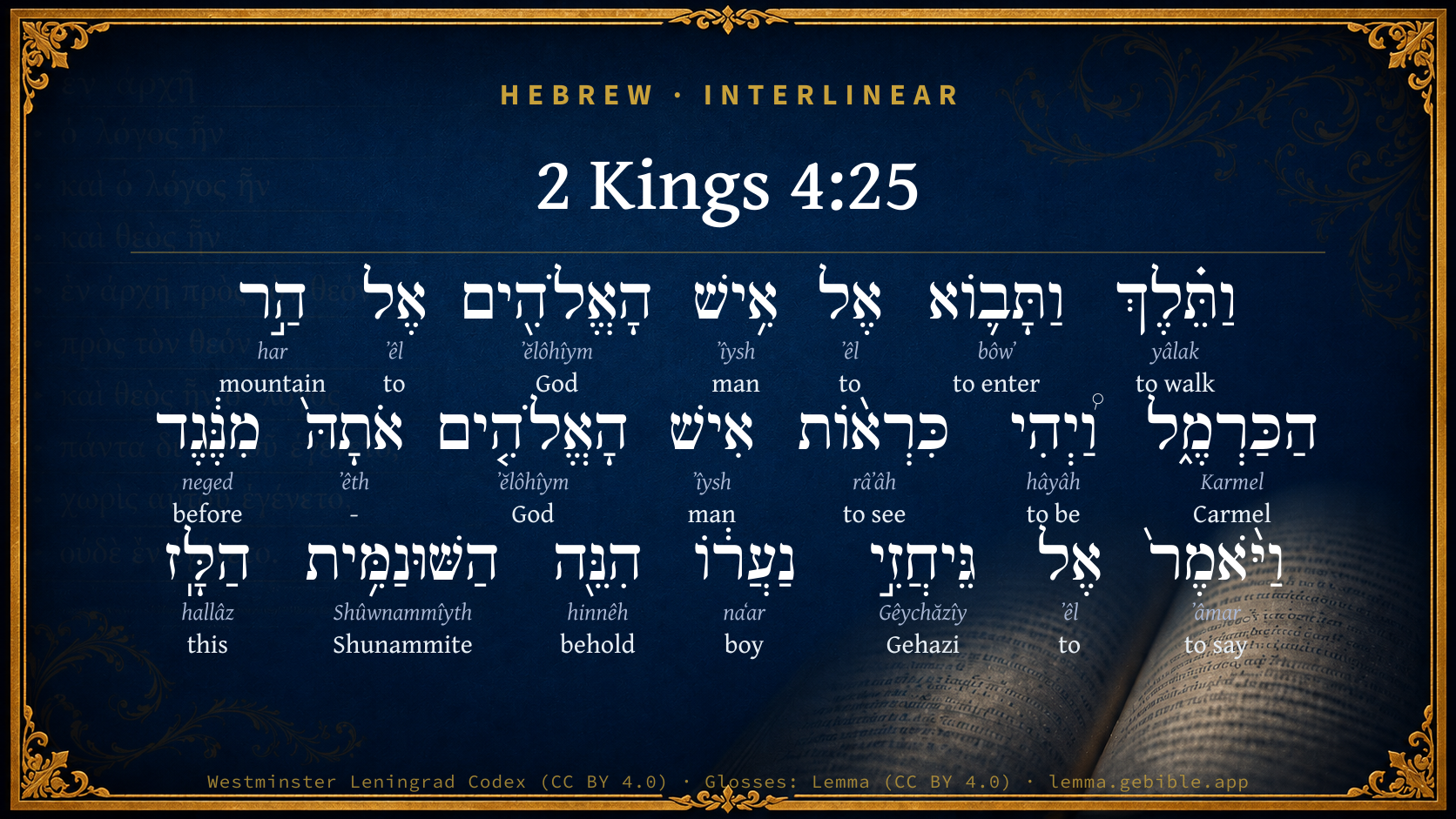
  1. וַתֵּ֗לֶךְ yâlak H3212 “and · to walk” Conjunction + Verb, Qal, Sequential Imperfect, 3rd Person, Feminine, Singular
  2. וַתָּב֛וֹא bôwʼ H935 “and · to enter” Conjunction + Verb, Qal, Sequential Imperfect, 3rd Person, Feminine, Singular
  3. אֶל ʼêl H413 “to” Preposition
  4. אִ֥ישׁ ʼîysh H376 “man of” Noun, Common, Masculine, Singular, Construct
  5. הָאֱלֹהִ֖ים ʼĕlôhîym H430 “the · God(s)” Particle, Definite Article + Noun, Common, Masculine, Plural, Absolute
  6. אֶל ʼêl H413 “to” Preposition
  7. הַ֣ר har H2022 “mountain of” Noun, Common, Masculine, Singular, Construct
  8. הַכַּרְמֶ֑ל Karmel H3760 “the · Carmel” Particle, Definite Article + Noun, Proper
  9. וַ֠יְהִי hâyâh H1961 “and · to be” Conjunction + Verb, Qal, Sequential Imperfect, 3rd Person, Masculine, Singular
  10. כִּרְא֨וֹת râʼâh H7200 “like/as · to see” Preposition + Verb, Qal, Infinitive Construct
  11. אִישׁ ʼîysh H376 “man of” Noun, Common, Masculine, Singular, Construct
  12. הָאֱלֹהִ֤ים ʼĕlôhîym H430 “the · God(s)” Particle, Definite Article + Noun, Common, Masculine, Plural, Absolute
  13. אֹתָהּ֙ ʼêth H853 “- · her” Particle, Direct Object + Suffix, Personal, 3rd Person, Feminine, Singular
  14. מִנֶּ֔גֶד neged H5048 “from · before” Preposition + Preposition
  15. וַיֹּ֨אמֶר֙ ʼâmar H559 “and · to say” Conjunction + Verb, Qal, Sequential Imperfect, 3rd Person, Masculine, Singular
  16. אֶל ʼêl H413 “to” Preposition
  17. גֵּיחֲזִ֣י Gêychăzîy H1522 “Gehazi” Noun, Proper
  18. נַעֲר֔וֹ naʻar H5288 “boy · his” Noun, Common, Masculine, Singular, Construct + Suffix, Personal, 3rd Person, Masculine, Singular
  19. הִנֵּ֖ה hinnêh H2009 “behold” Particle, Demonstrative
  20. הַשּׁוּנַמִּ֥ית Shûwnammîyth H7767 “the · Shunammite” Particle, Definite Article + Noun, Gentilic, Feminine, Singular, Absolute

About this verse

These counts appear in no published source. They are computed here, from the morphology-tagged text and Lemma’s own curated glosses. What Lemma adds →

21
words
17
distinct lemmas
Historical
section

Notable vocabulary

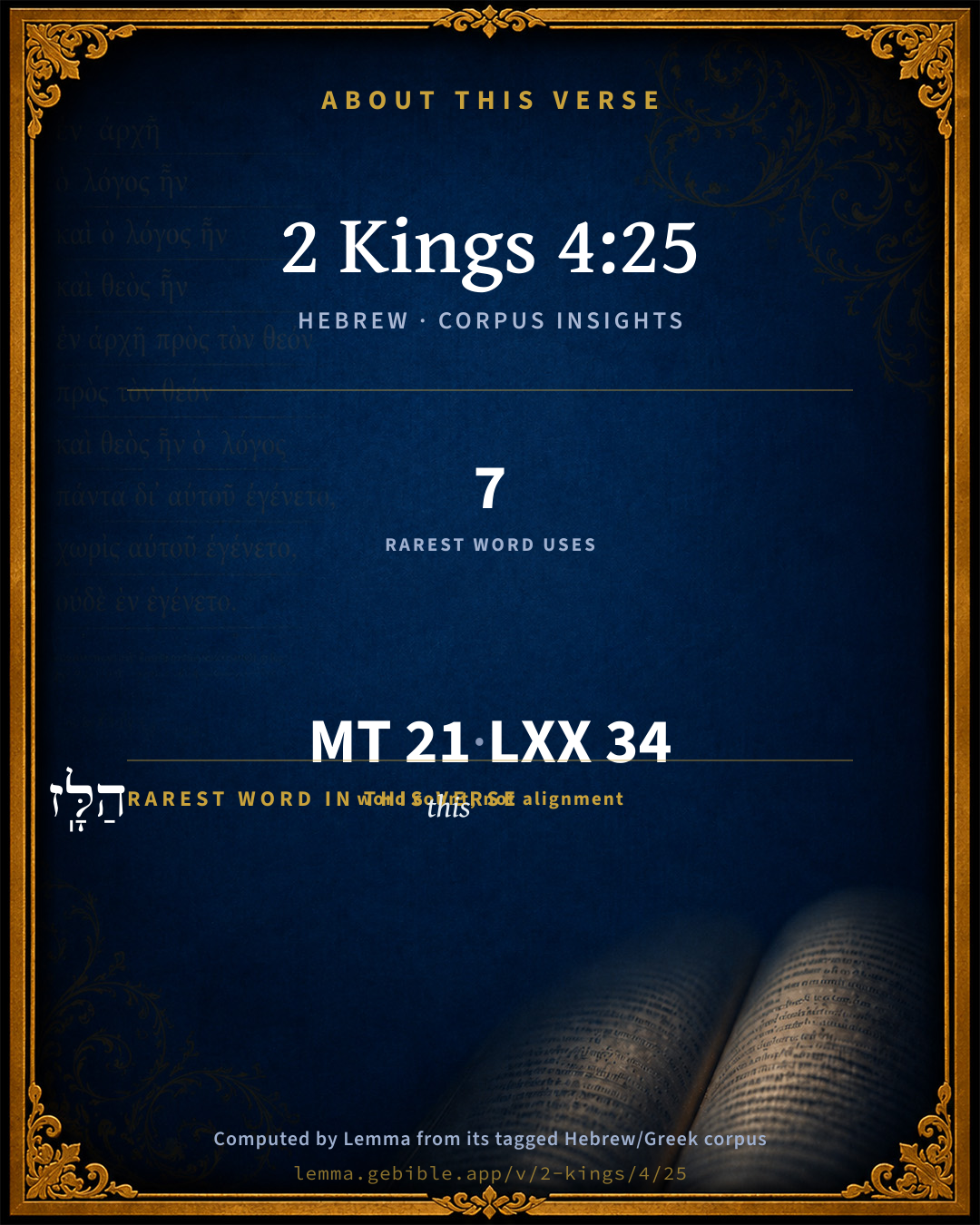
The rarest word here is הַלָּֽז this H1975 — appearing just 7 times in the whole Hebrew Bible.

Shared distinctive vocabulary

הַלָּֽז this H1975 occurs in 7 verses of the Hebrew Bible. Also found in:

Grammatical profile

  • 5 verbs
  • 9 nouns
  • 1 pronoun
  • 4 prepositions
  • 2 particles

Verb forms

  • וַתֵּ֗לֶךְ Qal · Sequential Imperfect
  • וַתָּב֛וֹא Qal · Sequential Imperfect
  • וַ֠יְהִי Qal · Sequential Imperfect
  • כִּרְא֨וֹת Qal · Infinitive Construct
  • וַיֹּ֨אמֶר֙ Qal · Sequential Imperfect

Repetition

Words recur within this verse — often emphatic in Hebrew:

  • אִ֥ישׁ man H376 ×2
  • הָאֱלֹהִ֖ים God H430 ×2
  • אֶל to H413 ×3

Hebrew & Septuagint length

In English translation the verse runs 36 words from the Hebrew and 35 from the Septuagint (LXX English) — closely comparable.

A rough comparison of the two English renderings, which tokenize alike — not a word-level alignment.

Word counts can differ between the Hebrew and the Greek without any difference in meaning — e.g. the Hebrew direct-object marker אֵת has no separate Greek word, and Greek often adds the article ὁ.

In the original languages it is 21 Hebrew tokens and 34 Greek tokens — but the two are counted differently (Hebrew bundles its prefixes and suffixes into one token; the Greek is in lemma form), so that isn’t a like-for-like length.

Cross-references

4

Topical passages linked to 2 Kings 4:25 in the Treasury of Scripture Knowledge — connected by theme and wording, ordered by reader-vote popularity; previews shown in the World English Bible.

  • 2 Kings 2:25 He went from there to Mount Carmel, and from there he returned to Samaria.
  • 1 Kings 18:19 Now therefore send, and gather to me all Israel to Mount Carmel, and the prophets of Baal four hundred fifty, and the prophets of the Asherah four hundred, who eat at Jezebel's table.
  • 1 Kings 18:42 So Ahab went up to eat and to drink. Elijah went up to the top of Carmel; and he bowed himself down on the earth, and put his face between his knees.
  • Isaiah 35:2 It shall blossom abundantly, and rejoice even with joy and singing; the glory of Lebanon shall be given to it, the excellency of Carmel and Sharon: they shall see the glory of Yahweh, the excellency of our God.

Cross-references courtesy of OpenBible.info (CC BY 4.0).

Hebrew and Greek witnesses Masoretic Hebrew ↔ Greek Septuagint

The same verse in the two great witnesses to the Old Testament, shown verse-for-verse.

These are two independent witnesses, not word-aligned to each other, and the Septuagint is shown in lemma (dictionary) form.

Hebrew 2 Kings 4:25 Masoretic · Westminster Leningrad Codex

וַתֵּ֗לֶךְ וַתָּב֛וֹא אֶל אִ֥ישׁ הָאֱלֹהִ֖ים אֶל הַ֣ר הַכַּרְמֶ֑ל וַ֠יְהִי כִּרְא֨וֹת אִישׁ הָאֱלֹהִ֤ים אֹתָהּ֙ מִנֶּ֔גֶד וַיֹּ֨אמֶר֙ אֶל גֵּיחֲזִ֣י נַעֲר֔וֹ הִנֵּ֖ה הַשּׁוּנַמִּ֥ית הַלָּֽז

So she went, and came to the man of God to Mount Carmel. It happened, when the man of God saw her afar off, that he said to Gehazi his servant, Behold, yonder is the Shunammite:

World English Bible · Public Domain

Greek LXX 2 Kings 4:25 Septuagint · lemma form

δεῦρο καί πορεύομαι καί ἔρχομαι πρός ὁ ἄνθρωπος ὁ θεός εἰς ὁ ὄρος ὁ καρμήλιος καί γίγνομαι ὡς ὁράω ελισαιε ἔρχομαι αὐτός καί εἶπον πρός γιεζι ὁ παιδάριον αὐτός ἰδού δή ὁ σωμανῖτις ἐκεῖνος

And she rode and came to the man of God to the mountain: and it came to pass when Elisaie saw her coming, that he said to Giezi his servant, See now, that Somanite comes.

LXX2012 (modern English Septuagint) · Public Domain

On this verse, The Cambridge Bible for Schools and Colleges discusses the Septuagint’s reading. Read the note in Commentary ↓

Hebrew: Westminster Leningrad Codex (CC BY 4.0). Greek: Septuagint (public domain); English from LXX2012 (modern English Septuagint) (Public Domain). How the Septuagint differs from the Hebrew →

Targum (Aramaic paraphrase)

1

The Targum is the ancient Jewish Aramaic paraphrase of the Hebrew Scriptures — an interpretive translation, not the Hebrew text itself. Onkelos (literal) and Pseudo-Jonathan (expansive) render the Torah, and Jonathan the Prophets. Coverage is partial: where no permissively-licensed English translation exists for a verse, only the Aramaic is shown. This is verse-level text, not a word-by-word alignment to the Hebrew.

  1. Targum Jonathan Prophets (Joshua–Malachi)
    וַאֲזַלַת וַאֲתַת לְוַת נְבִיָא דַייָ לְטוּר כַּרְמְלָא וַהֲוָה כַּד חֲזָא נְבִיָא דַייָ יָתָהּ מְקֳבֵיל וַאֲמַר לְגֵיחֲזִי עוּלֵימֵיהּ הָא שׁוּנַמִית דֵיכִי:

    (no public-domain English translation for this verse)

    Targum Jonathan — Aramaic: “Mikraot Gedolot” (public domain). English: “Sefaria Community Translation” (CC0 1.0 (public-domain dedication)); “London "Chaldee Paraphrase," 1871” (public domain). Text via Sefaria.

Commentary

Notes on 2 Kings 4:25 from classic Christian and Jewish commentators (each source and its license shown beneath its notes). The classic Christian expositions comment on the surrounding passage and are grouped to its opening verse, so a note may address several verses; the Jewish commentaries on the Tanakh (Rashi and others) are per-verse, so they appear only where the commentator wrote on this verse.

Lemma curates 59 commentaries, every one of them public domain or Creative Commons licensed, each selected and text-cleaned for this edition rather than reprinted as found. About our sources →

Trapp's Complete Commentary

John Trapp

2Ki 4:25 So she went and came unto the man of God to mount Carmel. And it came to pass, when the man of God saw her afar off, that he said to Gehazi his servant, Behold, [yonder is] that Shunammite:

Ver. 25. Behold, yonder is that Shunammite.] That good Shunammite, which "showeth out of a good conversation her works with meekness of wisdom." Sir Thomas Moore was out when he said, Men commit faults often, women only twice, that they neither speak well nor do well.

John Trapp, A Commentary or Exposition upon All the Books of the Old and New Testament (1647–1656) — public domain. Text from a community e-Sword module.

Joseph Benson's Commentary

2Ki 4:25-26. She came to the man of God to mount Carmel — This was a place which both he and Elijah much frequented; and it is probable there was a school of the prophets here, it being a mountain full of trees, and therefore a place proper for retirement and sacred exercises. Run now, I pray thee, to meet her — This he ordered, to show his respect for her. She answered, It is well — So it was in some respects, because it was the will of a wise and good God, and therefore best for her. When God calls away our dearest relations by death, it becomes us to say, it is well both with us and them. It is well, for all is well that God doth: all is well with them that are gone, if they are gone to heaven: and all is well with us that stay behind, if by the affliction we are furthered in our way thither.

Joseph Benson's Commentary on the Old and New Testaments (1811–1818) — public domain. Text from a community e-Sword module.

MacLaren's Expositions of Holy Scripture

Alexander MacLaren

2 Kings

A MIRACLE NEEDING EFFORT

2Ki 4:25 - 2Ki 4:37.

The story of Elisha is almost entirely a record of his miracles, and the story of his miracles is almost entirely a record of deeds of beneficence. Exception has been taken to it on the ground of the strange accumulation of supernatural works, which have been said to make it like some mediaeval saint’s legend. But why should it not be true that, after Elijah had proclaimed the truth, his successor’s function was to enforce it chiefly by his acts, and to seek to draw Israel back to God by ‘the cords of love’ and the gentle compulsion of mercies? The careful consideration of the work of the two prophets makes the peculiarities of Elisha’s perfectly intelligible. This story of the great lady at Shunem, her joy over her only child and his piteous death ‘on her knees,’ is one of the tenderest and sweetest pages in the history. Late won and early lost, the poor boy lies pale and dead on Elisha’s bed at Shunem, while the mother hurries across the plain of Jezreel to Carmel,-a distance of some fifteen or sixteen miles,-where Elisha was then living, probably near the place of Elijah’s sacrifice. This passage begins with her approach.

I. Note first the meeting {2Ki 4:25 - 2Ki 4:28}. Somewhere on the slopes of Carmel, commanding a view of the plain stretching away in the blue distance eastward, sat the prophet. His eye was keen, though probably he was now old, and he recognised the lady at a distance, as she rode swiftly towards the mountain. He appears to have suspected that this unusual visit meant some calamity, and his gentle heart went out towards his hostess and friend. Gehazi could not get back sooner than she could come, but sympathy could not sit passive and watch her approach. So the instinctively despatched message beautifully witnesses the prophet’s keen affection, and, as it were, the eager leap of his sympathy. So swift and ready to flash into act is the fellow-feeling of the Highest with the sorrows of us all; so should be the compassion of each with another. The higher in gifts or office in the kingdom a man is, the more is he bound to carry his sympathy in an outstretched hand. It is worth very little when it comes slowly. It is priceless when it runs to meet the mourner before she speaks.

The detailed question put into Gehazi’s mouth describes the circle within which this woman’s heart moved,-her husband, her child, herself. If these were well, nothing could be very ill; if ill, nothing could be well. But the message, which came so warm from Elisha’s lips, had been cooled on the road, and sounded formal from Gehazi. It is hard for selfish indifference to carry tender words without freezing them. The bearer of sympathy must be sympathetic. As Gehazi spoiled Elisha’s message, so we Christians too often do our Master’s, and cool it down to our own temperature. The fact that Gehazi had done so is suggested by the curt answer, ‘Peace!’ It is often quoted as the language of resignation, but it seems much rather to be evasion of the question, and that because her sorrow shrank from unveiling itself to the questioner. Nothing makes grief dumb so surely as prying and yet indifferent intrusion. A tenderer hand than Gehazi’s is needed to unlock the sad secret of that burdened breast.

It was perhaps partly pique at her silencing him, and partly mere unfeeling attention to ‘propriety,’ which made the servant wish to check the convulsive grasp of the feet, which the master allowed. Underlings are more careful of what they suppose to be their superior’s dignity than he is. Much is permitted to love and sorrow, by a prophet, which would be repressed by smaller men. ‘Her soul is bitter within her’ pardons much, and only unfeeling critics will be punctilious in dealing with even the extravagances of grief. But Elisha had another reason than pity. He wished to know her pain, and therefore he let her cling to his feet; for only there would she find her tongue. Does there not shine through the figure of the gentle prophet the image of the gentler Christ, who will not have the poorest and foulest spurned from His feet, though it be ‘a woman who was a sinner,’ and lets us come as close to Him as we will, even to hide our faces on His breast, that we may pour out all our sorrows and sins to Him?

The limitations of the prophet’s knowledge he frankly owns. How much better would it have been for the Church if its teachers had been more willing to copy his modesty, and said about a great many things, ‘The Lord hath hid it from me’!

The mother’s answer is indeed the cry of a ‘bitter’ heart. Its abrupt questions and its reticence as to the child’s death are pathetically true to nature, and sound yet across all these centuries as if the bitter cry were for a grief of to-day. ‘Did I desire a son?’ She upbraids Elisha and Elisha’s God for having forced on her an unasked blessing. ‘Did I not say, Do not deceive me?’ She did {2Ki 4:16}; and she upbraids Elisha again for a worse deceit than she had meant then, by mocking her with a gift which was wrenched from her hands so suddenly and soon. How many a sad heart is to-day tempted to raise this cry of anguish! And how patient is Elisha with wild words, and how he discerns, beneath the apparent rough reproach, the misery which it implies and the petition which it veils! Elisha’s Lord is no less tender in His judgment of our hasty, whirlwind words, when our hearts are sore; and if only we speak them to Him and cling to His feet, He translates them into the petitions which they mean, and is swift to answer the meaning and pass by the sound of our bitter cry.

II. We note the ineffectual experiment of the staff {2Ki 4:29 - 2Ki 4:31}. The supposition that Gehazi was sent in such haste with the hope that the touch of the staff might bring back life, is dismissed as ‘impossible’ by most commentators, who have therefore some difficulty in saying what he was sent for. Some of the Rabbis answered, ‘To prevent putrefaction,’ which would set in soon on that harvest day. Others say that the intention was to ‘prevent more life escaping from him.’ But ‘dead’ is not usually supposed to be an adjective admitting of comparison. Others find the reason in the wish to deliver Israel from the superstitious veneration of such things as the staff, by showing that it was powerless. But 2Ki 4:31 plainly implies that the result of Gehazi’s attempt was not what had been expected. Why need there be any hesitation in taking the natural meaning, and supposing that Elisha sent his servant quickly, ‘if peradventure’ the touch of his staff might suffice, and followed in person, because he did not know whether it would. There is nothing unworthy of a prophet who had just confessed his ignorance in the supposition. His unobtrusive spirit delighted to hide its power behind material vehicles, as is seen in most of his miracles; and, if he remembered how he himself, in his early days, had parted the waters with his master’s cloak, he might think it possible that his servant should work a miracle with his staff.

The Shunemite quotes his own words on that far-off day; and perhaps she was reminded of them by perceiving the analogy of the two incidents. But her clinging to Elisha shows her doubt of the success of the attempt; and she was right. Why did the staff fail? Perhaps because of its bearer. Gehazi always appears unfavourably, and Elisha’s staff loses its power in such hands. The mightiest instruments are weak when selfishness and coldness wield them. An unworthy minister can make the Gospel itself impotent. It is an awful thing to carry ‘the rod of Thy strength’ and to hinder its exerting its energy. But possibly the non-success of the attempt was meant to teach Elisha and us that miracles of life-giving are not to be wrought so easily, but need the effort of the prophet himself. We cannot delegate the work of God, and no sending of others will do instead of going ourselves. Such things are not achieved without much personal toil, pains, and self-sacrifice.

III. So we come to the last step, the communication of life {2Ki 4:32 - 2Ki 4:37}. It was noon when the child died. The mother’s journey would take three or four hours, and the return at least as much. It would then be dark when the two reached her desolate home. She had laid the boy on Elisha’s bed, as if even that brought her some comfort. It is difficult to say whether ‘them twain’ {2Ki 4:33} means him and the mother, or him and the child; but the expression of the next verse, ‘went up,’ suggests that the prayer with shut door was in the lower part of the house, and that the mother’s cry was joined to the prophet’s petitions. Such prayer is the true preparation for such a miracle. Beautiful consideration, born of sympathy, led him to shut out curious onlookers, and then to go up alone to the little chamber where that pale, tiny corpse lay. No eye but a mother’s could have seen what followed without profanation; and a mother’s heart would have been torn by hopes and fears if she had seen.

The actual miracle is remarkable for two peculiarities-the effort required and the slowness of the process. Of course, there is a profound and beautiful use to be made of the prophet’s action in laying himself upon the dead child, mouth to mouth, and hand to hand, if we regard it as symbolic of that closeness of approach to our nature, dead in sins, which the Lord of life makes in His incarnation and in His continual drawing near. It is His own life which Jesus imparts, and it is imparted because He comes near and touches us. It is the warmth of His own heart which passes into those who live by derivation of life from Him. And Elisha may well stand as symbol of Jesus in this miracle. But besides that use of the narrative, which is no mere fanciful playing with it, we should also note the difference between the prophet and Christ in their miracles. Jesus raises the dead by His bare word. His expressed will is all-sufficient. Elisha prays, and then puts forth somewhat prolonged efforts, from which at first there is no effect, and which drain him of force, so that he is obliged to pause and leave the chamber, and gather himself together for a renewal of them. The ease of the one sets the difficulty of the other in a strong light. And the life which came back with a rush, in full stream, at Christ’s bidding, comes only by degrees at Elisha’s prayer and work. The one worker is the Lord of life, who speaks and it is done; the other is but the channel of power, and the appearance of effort and gradualness in result is owing to the narrowness of the channel, not to the inadequacy of the power.

In all Elisha’s gentleness and lowliness there is yet a certain dignity as God’s prophet; and it was not fitting that he should come from the scene of such a miracle with the glow of it upon him, to seek for the mother. So he summons her by Gehazi, and then, with beautiful delicacy, leaves her to go alone into the chamber. None are to see the transports of her joy, not even the author of it. How beautiful, too, are the quiet words, ‘Take up thy son’! She has no words; but, for all answer, comes close to him {there is no ‘in’ in 2Ki 4:37}, and once again, but with what different feelings, clasps his feet. Not even Gehazi, or any other stickler for propriety, has the heart to thrust her back this time. The story draws a curtain over that meeting in the prophet’s chamber. Sad hearts who have vainly longed for such a moment, can fancy the rapture. But the day will come, not here, but in the upper chamber, when parted ones shall clasp each other again; and many a mourner shall hear Jesus say from the throne what He once said from the Cross, ‘Woman, behold thy son; son, behold thy mother.’

Alexander MacLaren, Expositions of Holy Scripture (1904–1910) — public domain. Text from a community e-Sword module.

Geneva Bible (1599)

Geneva Bible translators

Or, far off.

Geneva Bible (1599) marginal notes — public domain. Text via Bolls.life.

Ellicott's Commentary for English Readers

(25) To mount Carmel.—Elisha, then, must have dwelt there at least occasionally. (Comp. 2Ki_4:9.) Carmel probably served as a fixed centre of prophetic teaching for the north, as Gilgal, Beth-el, and Jericho for the south. (Comp. also Elisha’s sacrifice there, 1Ki_18:31 seq.)

Afar off.—The same word (minnèged) as to view (chap 2Ki_2:7; 2Ki_2:15).

Shunammite.—Syriac, Shulamite.

A Bible Commentary for English Readers, edited by Charles John Ellicott (1878–1897) — public domain. Text from a community e-Sword module.

The Cambridge Bible for Schools and Colleges

gen. ed. J. J. S. Perowne

25. to mount Carmel] The distance would occupy five or six hours riding. (Bunsen, Bibelwerk.) The LXX. inserts at the beginning of this verse a further direction to the servant. ‘Come, set forth and go to the man of God to Mount Carmel’. This is a result of reading the Hebrew words twice over.

Probably from previous visits both the Shunammite and her servant were familiar with the road; for the whole narrative gives the impression that on Carmel there was a centre of prophetic teaching and religious worship, and that the family from Shunem were among the frequenters thereof. Elisha discerns her coming in the distance and is able to say to Gehazi who she is some time before she arrives.

that [R.V. the] Shunammite] The pronoun of the original is, except in this instance, connected with masculine nouns. It is better to consider it here as rendered by ‘yonder’, which the A.V. puts in italics. It is demonstrative in force, and the noun has its own article.

The Cambridge Bible for Schools and Colleges (gen. ed. J. J. S. Perowne; Cambridge University Press, 1878–1918) — public domain. Text from a community e-Sword module.

John Gill's Exposition

So she went and came unto the man of God at Mount Carmel,.... Where Elijah used to be, and where, perhaps, was a school of the prophets; this, according to Bunting (x), was sixteen miles from Shunem:

and it came to pass, when the man of God saw her afar off; as he might from the eminence of the mountain:

that he said to Gehazi his servant, behold, yonder is that Shunammite; that has so often and so hospitably entertained us at her house.

(x) Travels, &c. p. 207.

John Gill's Exposition of the Whole Bible (1746–1763) — public domain (CC PDM 1.0). Text via the HelloAO Bible API.

Albert Barnes' Notes on the Bible

The distance was about sixteen or seventeen miles.

Albert Barnes' Notes on the Bible (1834–1885) — public domain. Text from a community e-Sword/MySword module.

Whedon's Commentary on the Bible

Daniel D. Whedon

25. She went, and came… to Mount Carmel — Some ten or twelve miles from Shunem, a distance which she doubtless travelled in a few hours.

Daniel D. Whedon (gen. ed.), Commentary on the Old and New Testaments (1874–1909) — public domain. Text from a community e-Sword module.

The Pulpit Commentary

So she went and came unto the man of God to Mount Carmel. Carmel was to Elisha what Gilead had been to Elijah in his early days a place for solitary retirement and meditation, where, free from disturbance, he might hold communion with nature and with God. It was not usual for his disciples to intrude upon him there, except at stated times, when gatherings were held at his residence for edification and for worship. And it came to pass, when the man of God saw her afar off literally, over against him; i.e. coming towards him (ejrcomenhn, LXX)that he said to Gehazi his servant, Behold, yonder is that Shunammite. The prophet knew her at a distance, probably by her attire and carriage. We may gather, from her husband"s words in ver. 23, that she was one of those who had been accustomed to attend the gatherings on new moons and sabbaths.

The Pulpit Commentary (1880–1919), ed. H.D.M. Spence-Jones & Joseph S. Exell — public domain. Text from a community e-Sword module.

unfoldingWord translationNotes

Door43 World Missions Community

So she went and came to the man of God at Mount Carmel

"So she traveled toward Mount Carmel where Elisha, the man of God, was"

So when the man of God saw her in the distance

"While she was still far off, and Elisha saw her coming"

It is alright

"It is well" or "Yes, everything is fine"

translationWords

Carmel

unfoldingWord translationNotes — © Distant Shores Media and the Door43 World Missions Community, licensed CC BY-SA 4.0. Source: git.door43.org/Door43/en_tn.

Lesson kit

Teaching starters — assembled from the data on this page, not authored interpretation. Every prompt links to the verse data it draws on. Edit before teaching.

2 Kings, in the Historical, opens this verse with 21 words (17 distinct Hebrew lemmas). Its most distinctive word is hallâz (“this”). A historical commentator’s framing appears above. Read the whole chapter for the surrounding context.

Discussion questions

  1. How does “this” (hallâz) shape what this verse is saying?
  2. How does Judges 6:20, which shares the word «this», read alongside this verse?
  3. What does the repetition of “man” (2× in this one verse) do in this verse?
  4. These translations render this verse differently. What is at stake in choosing one wording over another?
  5. «וַתֵּ֗לֶךְ» is a Qal Sequential Imperfect verb. How does that grammatical form shape the action described?
  6. Compare how Trapp's Complete Commentary and Joseph Benson's Commentary read this verse. Where do they agree or differ?

Things to notice

Reading settings

Reading text

Shown beneath each verse's original-language words.

Old Testament
Old Testament edition

Read the OT as the Masoretic Hebrew (MT) or the Greek Septuagint (LXX).

English shown for the Greek Septuagint (in the Hebrew ↔ Greek comparison).

Comparing translations? Open the Compare panel on any verse page to stack up to four side by side.