Nehemiah 5:10

Hebrew (Westminster Leningrad Codex) Nehemiah 5:10 appears in the Hebrew Old Testament. The text above is from the Westminster Leningrad Codex. Each word links to its Strong’s number, a concise gloss, and parsing drawn from the Open Scriptures Hebrew Bible morphology. Click any word for its full Brown-Driver-Briggs (BDB) entry.
Download image
Cite this verse

Nehemiah 5:10 (World English Bible). Public Domain. Lemma interlinear Bible study tool, https://lemma.gebible.app/v/nehemiah/5/10.

Show BibTeX & RIS
BibTeX
RIS
English Translation
I likewise, my brothers and my servants, do lend them money and grain. Please let us leave off this usury.
World English Bible · Public Domain
Download a study sheet

One document with this verse’s original text, its word-by-word gloss line, the meaning frame, cross-references with their text, attributed commentary, and full source and license credits — printable, and it pastes into notes with its structure intact.

This verse Autodidact and up

Study sheet (.html) Plain text (.txt)

A passage Seminary Student

Up to 50 verses in one chapter. A passage sheet keeps up to 6 commentary sources and 12 cross-references per verse, in the order this page ranks them, and says so on the sheet whenever that leaves anything out. Ask for a single verse and you get the Autodidact verse sheet above.

Everything on this page stays free to read, with no account — the sheet is a download of what is already on screen, not access to it.

Want to remove ads? Support Godless Engineer
Compare translations 3

The same verse in 3 English versions, stacked beneath the original-language interlinear above. Click any original word for its lexicon entry.

Each is an independent rendering of the whole verse — the interlinear is not word-aligned to these translations.

Highlighted words mark where these versions differ — a whole-verse word diff, not a word-by-word alignment.

  • World English Bible Public Domain
    I likewise, my brothers and my servants, do lend them money and grain. Please let us leave off this usury.
  • King James Version Public Domain
    I likewise, and my brethren, and my servants, might exact of them money and corn: I pray you, let us leave off this usury.
  • unfoldingWord Literal Text CC BY-SA 4.0
    Also, even I, my brothers, and my young men are lending against them silver and grain. Please, let us forsake this interest!

unfoldingWord Literal Text — © unfoldingWord, licensed CC BY-SA 4.0. Word-aligned USFM3 via Door43 (git.door43.org/unfoldingWord/en_ult).

Versions to compare (up to 4)

3 of 4 selected

Show all 18 translations

Every available English version of this verse, each an independent rendering of the whole verse.

  • World English Bible Public Domain
    I likewise, my brothers and my servants, do lend them money and grain. Please let us leave off this usury.
  • Berean Standard Bible Public Domain
    I, as well as my brothers and my servants, have been lending the people money and grain. Please, let us stop this usury.
  • Majority Standard Bible Public Domain
    I, as well as my brothers and my servants, have been lending the people money and grain. Please, let us stop this usury.
  • King James Version Public Domain
    I likewise, and my brethren, and my servants, might exact of them money and corn: I pray you, let us leave off this usury.
  • American Standard Version (1901) Public Domain
    And I likewise, my brethren and my servants, do lend them money and grain. I pray you, let us leave off this usury.
  • Revised Version (1885) Public Domain
    And I likewise, my brethren and my servants, do lend them money and corn on usury. I pray you, let us leave off this usury.
  • Geneva Bible (1599) Public Domain
    For euen I, my brethren, and my seruants doe lende them money and corne: I pray you, let vs leaue off this burden.
  • Douay-Rheims (1899) Public Domain
    Both I and my brethren, and my servants, have lent money and corn to many: let us all agree not to call for it again; let us forgive the debt that is owing to us.
  • Young's Literal Translation Public Domain
    And also, I, my brethren, and my servants, are exacting of them silver and corn; let us leave off, I pray you, this usury.
  • Literal Standard Version CC BY-SA 4.0
    And also, I, my brothers, and my servants, are exacting silver and grain on them; please let us leave off this usury.
  • Unlocked Literal Bible CC BY-SA 4.0
    I and my brothers and my servants are lending them money and grain. But we must stop charging interest on these loans.
  • unfoldingWord Literal Text CC BY-SA 4.0
    Also, even I, my brothers, and my young men are lending against them silver and grain. Please, let us forsake this interest!
  • Darby Bible Public Domain
    I also, my brethren and my servants, we might exact usury of them, money and corn. I pray you, let us leave off this usury.
  • World Messianic Bible Public Domain
    I likewise, my brothers and my servants, lend them money and grain. Please let us stop this usury.
  • Webster's Bible Public Domain
    I likewise, my brethren, and my servants, might exact of them money and corn: I pray you, let us leave off this usury.
  • Free Bible Version CC BY-SA 4.0
    I, as well as my brothers and my men have been have been lending the people money and food. Please, let's stop this business of charging interest!
  • Bible in Basic English Public Domain
    Even I and my servants have been taking interest for the money and the grain we have let them have. So now, let us give up this thing.
  • JPS Tanakh (1917) Public Domain
    And I likewise, my brethren and my servants, have lent them money and corn. I pray you, let us leave off this exaction.

Literal Standard Version (2020), Covenant Press — licensed CC BY-SA 4.0. Text via the HelloAO Bible API (eBible.org). Unlocked Literal Bible (unfoldingWord) — licensed CC BY-SA 4.0. Text via the HelloAO Bible API (eBible.org). unfoldingWord Literal Text — © unfoldingWord, licensed CC BY-SA 4.0. Word-aligned USFM3 via Door43 (git.door43.org/unfoldingWord/en_ult). Free Bible Version, Dr. Jonathan Gallagher — licensed CC BY-SA 4.0. Text via the HelloAO Bible API (eBible.org).

Word by word

More ways to search: Search by grammar → Find every occurrence → Compare this word →

Practice this passage: Drill this verse → Learn its vocabulary →

הַמַּשָּׁ֥א
mashshâʼ
H4855
“the · usury”
Particle, Definite Article + Noun, Common, Masculine, Singular, Absolute
Part of Speech
Particle + Noun
Type
Common
Gender
Masculine
Number
Singular
State
Absolute
Full BDB Definition

Origin: from H5383

TWOT: 1424a

lending on interest, usury - in Neh 5:11 , the rate of " usury" was only one per cent
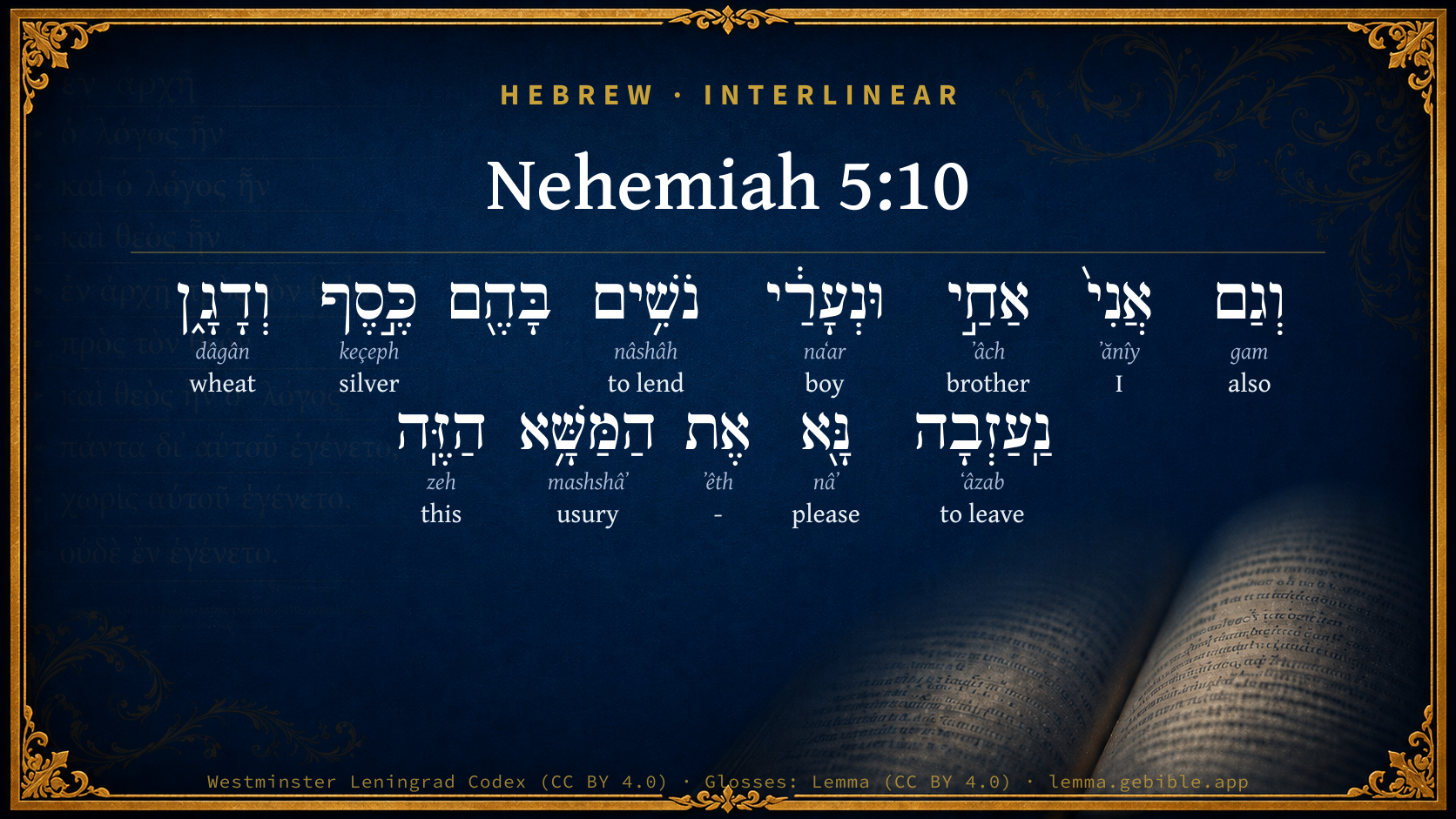
  1. וְגַם gam H1571 “and · also” Conjunction + Particle, Accusative
  2. אֲנִי֙ ʼănîy H589 “I” Pronoun, Personal, 1st Person, Common, Singular
  3. אַחַ֣י ʼâch H251 “brothers · my” Noun, Common, Masculine, Plural, Construct + Suffix, Personal, 1st Person, Common, Singular
  4. וּנְעָרַ֔י naʻar H5288 “and · boys · my” Conjunction + Noun, Common, Masculine, Plural, Construct + Suffix, Personal, 1st Person, Common, Singular
  5. נֹשִׁ֥ים nâshâh H5383 “lending” Verb, Qal, Participle Active, Masculine, Plural, Absolute
  6. כֶּ֣סֶף keçeph H3701 “silver” Noun, Common, Masculine, Singular, Absolute
  7. וְדָגָ֑ן dâgân H1715 “and · wheat” Conjunction + Noun, Common, Masculine, Singular, Absolute
  8. נַֽעַזְבָה ʻâzab H5800 “to leave” Verb, Qal, Cohortative, 1st Person, Common, Plural
  9. נָּ֖א nâʼ H4994 “please” Particle, Interjection
  10. אֶת ʼêth H853 “-” Particle, Direct Object
  11. הַזֶּֽה zeh H2088 “the · this” Particle, Definite Article + Pronoun, Demonstrative, Masculine, Singular

About this verse

These counts appear in no published source. They are computed here, from the morphology-tagged text and Lemma’s own curated glosses. What Lemma adds →

13
words
12
distinct lemmas
Historical
section

Notable vocabulary

The rarest word here is הַמַּשָּׁ֥א usury H4855 — appearing just 3 times in the whole Hebrew Bible.

Shared distinctive vocabulary

הַמַּשָּׁ֥א usury H4855 occurs in 3 verses of the Hebrew Bible. Also found in:

Grammatical profile

  • 2 verbs
  • 5 nouns
  • 2 pronouns
  • 1 preposition
  • 3 particles

Verb forms

  • נֹשִׁ֥ים Qal · Participle Active
  • נַֽעַזְבָה Qal · Cohortative

Cross-references

12

Topical passages linked to Nehemiah 5:10 in the Treasury of Scripture Knowledge — connected by theme and wording, ordered by reader-vote popularity; previews shown in the World English Bible.

  • 2 Corinthians 6:1 Working together, we entreat also that you not receive the grace of God in vain,
  • Exodus 22:25–27 "If you lend money to any of my people with you who is poor, you shall not be to him as a creditor; neither shall you charge him interest.
  • Nehemiah 5:7 Then I consulted with myself, and contended with the nobles and the rulers, and said to them, You exact usury, everyone of his brother. I held a great assembly against them.
  • Psalms 15:5 He who doesn't lend out his money for usury, Nor take a bribe against the innocent. He who does these things shall never be shaken.
  • Ezekiel 18:8 he who has not given forth on interest, neither has taken any increase, who has withdrawn his hand from iniquity, has executed true justice between man and man,
  • Ezekiel 18:13 has given forth on interest, and has taken increase; shall he then live? he shall not live: he has done all these abominations; he shall surely die; his blood shall be on him.
  • Micah 2:1 Woe to those who devise iniquity And work evil on their beds! When the morning is light, they practice it, Because it is in the power of their hand.
  • Luke 3:13–14 He said to them, "Collect no more than that which is appointed to you."
  • 1 Corinthians 9:12–18 If others partake of this right over you, don't we yet more? Nevertheless we did not use this right, but we bear all things, that we may cause no hindrance to the Gospel of Christ.
  • 2 Corinthians 5:11 Knowing therefore the fear of the Lord, we persuade men, but we are revealed to God; and I hope that we are revealed also in your consciences.
  • 2 Corinthians 5:20 We are therefore ambassadors on behalf of Christ, as though God were entreating by us. We beg you on behalf of Christ, be reconciled to God.
  • Philemon 1:8–9 Therefore, though I have all boldness in Christ to command you that which is appropriate,

Cross-references courtesy of OpenBible.info (CC BY 4.0).

Hebrew and Greek witnesses Masoretic Hebrew ↔ Greek Septuagint

The same verse in the two great witnesses to the Old Testament, shown verse-for-verse.

These are two independent witnesses, not word-aligned to each other, and the Septuagint is shown in lemma (dictionary) form.

Hebrew Nehemiah 5:10 Masoretic · Westminster Leningrad Codex

וְגַם אֲנִי֙ אַחַ֣י וּנְעָרַ֔י נֹשִׁ֥ים בָּהֶ֖ם כֶּ֣סֶף וְדָגָ֑ן נַֽעַזְבָה נָּ֖א אֶת הַמַּשָּׁ֥א הַזֶּֽה

I likewise, my brothers and my servants, do lend them money and grain. Please let us leave off this usury.

World English Bible · Public Domain

Greek LXX Structure differs

The Septuagint has no separate book of Nehemiah. Its Greek text is the second half of Esdras B (2 Esdras), chapters 11–23; Ezra is the first half (1–10).

A verse-for-verse comparison isn’t shown here because the chapters and verses don’t line up. Switch to the LXX edition with the MT / LXX toggle above to read the Greek directly.

On this verse, The Cambridge Bible for Schools and Colleges discusses the Septuagint’s reading. Read the note in Commentary ↓

Hebrew: Westminster Leningrad Codex (CC BY 4.0). Greek: Septuagint (public domain); English from a public-domain English Septuagint. How the Septuagint differs from the Hebrew →

Commentary

Notes on Nehemiah 5:10 from classic Christian and Jewish commentators (each source and its license shown beneath its notes). The classic Christian expositions comment on the surrounding passage and are grouped to its opening verse, so a note may address several verses; the Jewish commentaries on the Tanakh (Rashi and others) are per-verse, so they appear only where the commentator wrote on this verse.

Lemma curates 59 commentaries, every one of them public domain or Creative Commons licensed, each selected and text-cleaned for this edition rather than reprinted as found. About our sources →

Trapp's Complete Commentary

John Trapp

Neh 5:10 I likewise, [and] my brethren, and my servants, might exact of them money and corn: I pray you, let us leave off this usury.

Ver. 10. I likewise, and my brethren … might exact money] To wit, for money we have lent them; or as a recompense of our public employments. But posse et nolle, nobile est to be able and willing is noble. (Seneca).

I pray you, leave off this usury] Who can resist this sweet and sovereign admonition? See Neh 5:9. They had somewhat to say, no doubt, in defence of their usury; as also many have at this day. But let them consider, that usury is here and elsewhere cried down without distinction, Psa 15:5 Eze 18:8; Eze 18:13. That the lender dealeth not as he would be dealt withal; that St Luke maketh him worse than other sinners, when he saith, Sinners lend to sinners to receive the like, but these to receive more, Luk 6:34. That heathens condemned usury, as Aristotle in his Ethics, and Agis, the general of the Athenians, Agesilaus, king of Spartans; who, when he saw the usurers’ bills and bonds set on fire by Agis, said, That he never saw a clearer fire burn (Plut. in Solone). And lastly, that at Rome itself usurers are excommunicated monthly.

John Trapp, A Commentary or Exposition upon All the Books of the Old and New Testament (1647–1656) — public domain. Text from a community e-Sword module.

The Biblical Illustrator

Joseph S. Exell

Neh_5:10

Let us leave off this usury.

Wise rebuke

He did not stand on a pedestal and look down on them with scorn and contempt; he rather placed himself alongside of the offenders, that he might lift them to a higher level. Let us learn from this beautiful example how best to rebuke and restore an erring brother or sister. (W. P. Lockhart.)

The Biblical Illustrator, edited by Joseph S. Exell (c. 1880s–1900s) — public domain. Text from a community e-Sword module.

Joseph Benson's Commentary

Neh 5:10. I likewise, and my brethren — In office; who are employed with me in the government of this people; and my servants — In my name and for my use; might exact of them money and corn — As a just recompense for our pains and care for the public good, to which we wholly devote ourselves, even to the neglect of all our private concerns. But I freely remit my own right, and therefore you also ought to remit yours, seeing I lay no burden upon you but what I am willing to bear a part of upon my own shoulders.

Joseph Benson's Commentary on the Old and New Testaments (1811–1818) — public domain. Text from a community e-Sword module.

Tyndale Open Study Notes

Tyndale Open Resources

5:10 I myself . . . have been lending: Nehemiah and his associates were evidently making loans without burdening people. Nehemiah’s example was the solution: to give financial help without pushing people further into debt by charging interest (see Deut 15:7-11).

Tyndale Open Study Notes — © Tyndale Open Resources, licensed CC BY-SA 4.0. Text via the HelloAO Bible API.

Geneva Bible (1599)

Geneva Bible translators

Or, usury.

Geneva Bible (1599) marginal notes — public domain. Text via Bolls.life.

Ellicott's Commentary for English Readers

(10) Might exact.—We have lent them money and corn. By his own example the governor pleads with them: not “let us leave off this usury,” but let us all and together “remit the loans.”

A Bible Commentary for English Readers, edited by Charles John Ellicott (1878–1897) — public domain. Text from a community e-Sword module.

The Cambridge Bible for Schools and Colleges

gen. ed. J. J. S. Perowne

10. I likewise, and my brethren, and my servants] R.V. And I likewise, my brethren and my servants. We must conclude from this verse that Nehemiah himself lent ‘on usury’ to his countrymen. The words are not, as A.V., ‘I … and my brethren, &c.’, but ‘I, my brethren, &c.’ Nehemiah takes the reply out of the mouth of his opponents. He confesses he is himself not free from blame. For ‘his own kinsfolk and dependants’ lent ‘on usury,’ and he their head and representative was responsible for them. They may have been generous and forbearing, but they had violated the principle, which he was upholding: and in so far, Nehemiah accepted the blame of his house. Some suppose that Nehemiah in lending did not require a pledge, and thus differed from the regular money-lenders. ‘Brethren,’ ‘servants.’ See note on Neh_4:23.

might exact of them money and corn] R.V. do lend them money and corn on usury. The rendering of the A.V. ‘might exact’ seems to be dictated by the desire to save the honour of Nehemiah and of his house. But the clause does not claim a privilege, but states a fact. By diplomatically accepting the responsibility of a share in the general guilt, he conciliates his hearers and disarms them of a retort. Nevertheless we gather from the clause that it was not so much ‘usury’ as the abuse of usury, the excessive and tyrannical rate of interest exacted from the poor, which excited his indignation against the rich.

I pray you] These words render a Hebrew particle adding urgency to the request, without introducing the idea of supplication, cf. Neh_1:5. It might be rendered ‘Come now, let us leave off, &c.’

let us leave off this usury] Nehemiah invites his hearers to join with him in abandoning a custom which had been productive of such evil results. ‘This usury,’ i.e. requiring of interest or of pledges. LXX. ἀπαίτησιν. Not the lending but the plan of making a gain out of loans to the poor, whether by demanding interest upon loans or seizing the pledge which had been the security for an advance, is condemned.

The Cambridge Bible for Schools and Colleges (gen. ed. J. J. S. Perowne; Cambridge University Press, 1878–1918) — public domain. Text from a community e-Sword module.

John Gill's Exposition

Restore, I pray you, even this day, their lands, their vineyards, their oliveyards, and their houses,.... Which they had made over to them for corn they had had, or money they borrowed of them; it is entreated that an immediate restitution be made, and the rather, if what Aben Ezra observes is true, that this was the year of release, when debts were not to be exacted, but forgiven, Deu 15:1,

also the hundredth part of the money, and of the corn, the wine, and the oil, that ye exact of them; the hundredth part of the money might be what they took for usury, as the Romans did in later times, even so much a month; so that if the loan was one hundred pounds, a pound was given every month for it, and so one hundred and twelve pounds in the year; and the hundredth part of the corn, wine, and oil, might be the hundredth part of those fruits of the earth which the rulers demanded for their salary, see Neh 5:15.

John Gill's Exposition of the Whole Bible (1746–1763) — public domain (CC PDM 1.0). Text via the HelloAO Bible API.

Albert Barnes' Notes on the Bible

I ... might exact - Nehemiah had lent, but not upon pledge.

Albert Barnes' Notes on the Bible (1834–1885) — public domain. Text from a community e-Sword/MySword module.

Matthew Poole's English Annotations

My brethren, to wit, in office; those who are employed with me in the government of this people.

My servants; in my name, and for my use.

Might exact of them money and corn, as a just recompence for our pains and care for the public good, to which we wholly devote ourselves, even to the neglect of all our private concerns. But I will not rigorously exact, but do freely remit my own right, which, in those circumstances, it is my duty to do; and therefore you also ought to do so, seeing I lay no burden upon you but what I am willing to bear a part of upon my own shoulders.

Matthew Poole's English Annotations on the Holy Bible (1683–1685) — public domain. Text from a community e-Sword/MySword module.

Whedon's Commentary on the Bible

Daniel D. Whedon

10. I likewise — Nehemiah, like the true God-fearing ruler, conscious of integrity and honour, pleads his own example as one worthy of his people’s notice.

My brethren, and my servants — See notes on chap. Neh_4:16; Neh_4:23.

Might exact — Nehemiah and those whom he associates with himself had the same opportunity to oppress their poor brethren by usury as they, but he assumes that such action would grossly unfit him and them for the position they occupied.

Daniel D. Whedon (gen. ed.), Commentary on the Old and New Testaments (1874–1909) — public domain. Text from a community e-Sword module.

The Pulpit Commentary

I likewise... might exact of them. Rather, "have lent them." I and mine have advanced to the poorer classes, in this period of their distress, money and corn; but not as you have, not upon security. Let us then, all of us, you as well as I, henceforth relinquish this practice of mortgaging and pledge-taking.

The Pulpit Commentary (1880–1919), ed. H.D.M. Spence-Jones & Joseph S. Exell — public domain. Text from a community e-Sword module.

John Wesley's Explanatory Notes

Brethren - In office; these who are employed with me in the government of this people. Servants - In my name, and for my use. Exact - As a just recompense for our pains and care for the publick good, to which we wholly devote ourselves, even to the neglect of all our private concerns. But I freely remit my own right, and therefore you also ought to do so, seeing I lay no burden upon you, but what I am willing to bear a part of upon my own shoulders.

John Wesley, Explanatory Notes Upon the Whole Bible (1754–1765) — public domain. Text via the GEBible commentary corpus.

Rashi

Rabbi Shlomo Yitzchaki (Rashi)

I, too, and my brothers and my servants I, too, and my colleagues lent them money, and we shall abandon and relinquish to them all these loans.

have lent Heb. נֹשִׁים, like (II Kings 4:1): “...and the creditor (וְהַנֹשֶּׁה) has come to take.”

Rashi on the Tanakh — English translations: “The Judaica Press complete Tanach with Rashi, translated by A. J. Rosenberg” (CC BY 4.0); “Pentateuch with Rashi's commentary by M. Rosenbaum and A.M. Silbermann, 1929-1934” (public domain); “The Metsudah Tanach series, Lakewood, N.J” (CC BY 4.0); and “The Book of Joshua, Metsudah Publications, 1997” (CC BY 4.0). Text via Sefaria.

Lesson kit

Teaching starters — assembled from the data on this page, not authored interpretation. Every prompt links to the verse data it draws on. Edit before teaching.

Nehemiah, in the Historical, opens this verse with 13 words (12 distinct Hebrew lemmas). Its most distinctive word is mashshâʼ (“usury”). A historical commentator’s framing appears above. Read the whole chapter for the surrounding context.

Discussion questions

  1. The word mashshâʼ carries the sense “usury.” How does it shape the verse?
  2. How does Nehemiah 5:7, which shares the word «usury», read alongside this verse?
  3. The translations on this page render this verse differently — a whole-verse word diff, not a word-by-word alignment. What might account for the different wordings?
  4. «נֹשִׁ֥ים» is a Qal Participle Active verb. How does that grammatical form shape the action described?
  5. Compare how Trapp's Complete Commentary and The Biblical Illustrator read this verse. Where do they agree or differ?

Things to notice

Reading settings

Reading text

Shown beneath each verse's original-language words.

Old Testament
Old Testament edition

Read the OT as the Masoretic Hebrew (MT) or the Greek Septuagint (LXX).

English shown for the Greek Septuagint (in the Hebrew ↔ Greek comparison).

Comparing translations? Open the Compare panel on any verse page to stack up to four side by side.