Esther 6:5

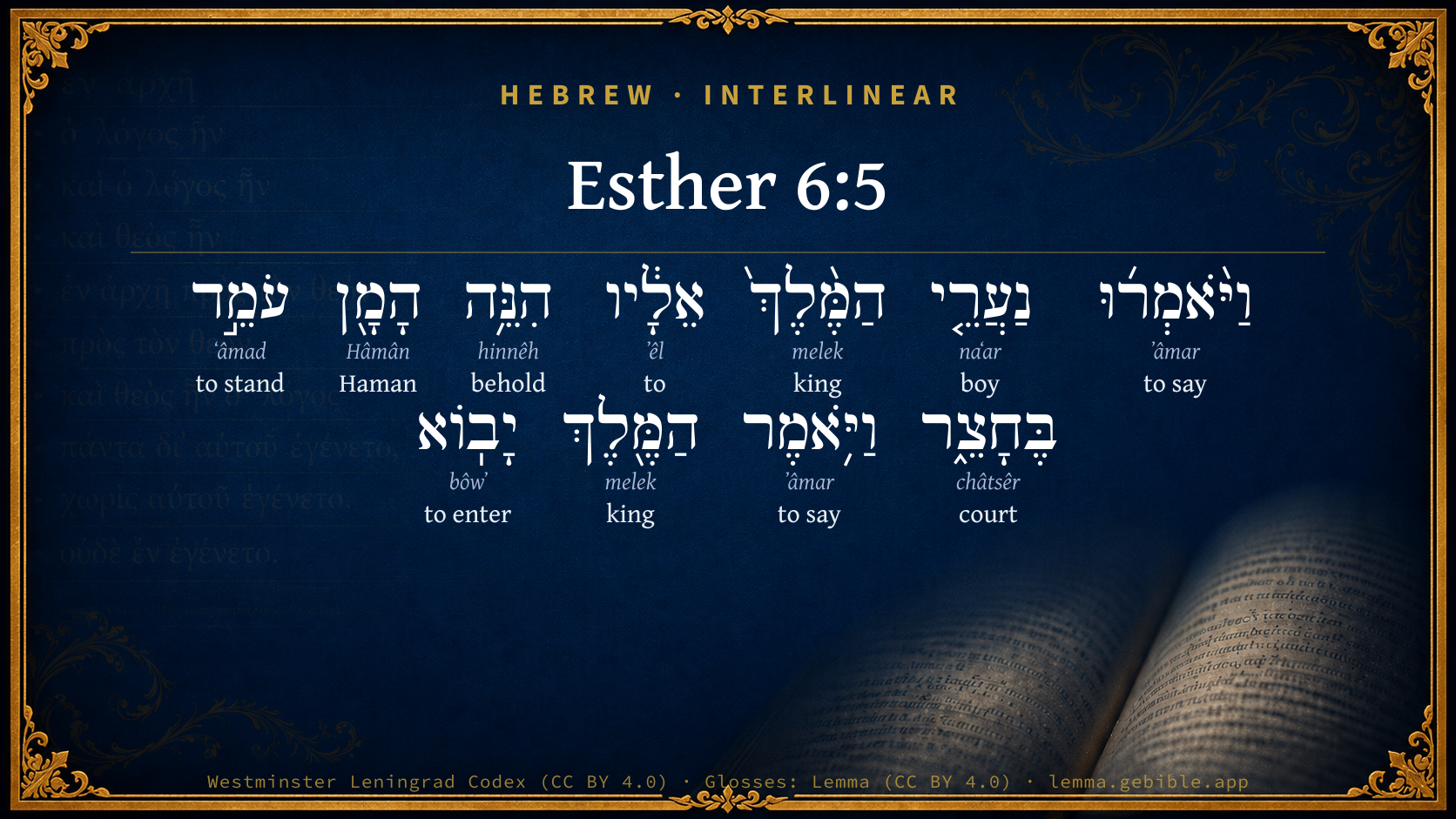
Hebrew (Westminster Leningrad Codex) Esther 6:5 appears in the Hebrew Old Testament. The text above is from the Westminster Leningrad Codex. Each word links to its Strong’s number, a concise gloss, and parsing drawn from the Open Scriptures Hebrew Bible morphology. Click any word for its full Brown-Driver-Briggs (BDB) entry.
Download image
Cite this verse

Esther 6:5 (World English Bible). Public Domain. Lemma interlinear Bible study tool, https://lemma.gebible.app/v/esther/6/5.

Show BibTeX & RIS
BibTeX
RIS
English Translation
The king's servants said to him, Behold, Haman stands in the court. The king said, Let him come in.
World English Bible · Public Domain
Download a study sheet

One document with this verse’s original text, its word-by-word gloss line, the meaning frame, cross-references with their text, attributed commentary, and full source and license credits — printable, and it pastes into notes with its structure intact.

This verse Autodidact and up

Study sheet (.html) Plain text (.txt)

A passage Seminary Student

Up to 50 verses in one chapter. A passage sheet keeps up to 6 commentary sources and 12 cross-references per verse, in the order this page ranks them, and says so on the sheet whenever that leaves anything out. Ask for a single verse and you get the Autodidact verse sheet above.

Everything on this page stays free to read, with no account — the sheet is a download of what is already on screen, not access to it.

Want to remove ads? Support Godless Engineer
Compare translations 3

The same verse in 3 English versions, stacked beneath the original-language interlinear above. Click any original word for its lexicon entry.

Each is an independent rendering of the whole verse — the interlinear is not word-aligned to these translations.

Highlighted words mark where these versions differ — a whole-verse word diff, not a word-by-word alignment.

  • World English Bible Public Domain
    The king's servants said to him, Behold, Haman stands in the court. The king said, Let him come in.
  • King James Version Public Domain
    And the king's servants said unto him, Behold, Haman standeth in the court. And the king said, Let him come in.
  • unfoldingWord Literal Text CC BY-SA 4.0
    And the young men of the king said to him, “Behold, Haman is standing in the courtyard.” And the king said, “Let him come.”

unfoldingWord Literal Text — © unfoldingWord, licensed CC BY-SA 4.0. Word-aligned USFM3 via Door43 (git.door43.org/unfoldingWord/en_ult).

Versions to compare (up to 4)

3 of 4 selected

Show all 18 translations

Every available English version of this verse, each an independent rendering of the whole verse.

  • World English Bible Public Domain
    The king's servants said to him, Behold, Haman stands in the court. The king said, Let him come in.
  • Berean Standard Bible Public Domain
    So the king’s attendants answered him, “Haman is there, standing in the court.” “Bring him in,” ordered the king.
  • Majority Standard Bible Public Domain
    So the king’s attendants answered him, “Haman is there, standing in the court.” “Bring him in,” ordered the king.
  • King James Version Public Domain
    And the king's servants said unto him, Behold, Haman standeth in the court. And the king said, Let him come in.
  • American Standard Version (1901) Public Domain
    And the king's servants said unto him, Behold, Haman standeth in the court. And the king said, Let him come in.
  • Revised Version (1885) Public Domain
    And the king’s servants said unto him, Behold, Haman standeth in the court. And the king said, Let him come in.
  • Geneva Bible (1599) Public Domain
    And the Kings seruants said vnto him, Behold, Haman standeth in the court. And the King sayd, Let him come in.
  • Douay-Rheims (1899) Public Domain
    The servants answered: Aman standeth in the court, and the king said: Let him come in.
  • Young's Literal Translation Public Domain
    and the servants of the king say unto him, `Lo, Haman is standing in the court;' and the king saith, `Let him come in.'
  • Literal Standard Version CC BY-SA 4.0
    And the servants of the king say to him, “Behold, Haman is standing in the court”; and the king says, “Let him come in.”
  • Unlocked Literal Bible CC BY-SA 4.0
    The king's servants said to him, “Haman is standing in the courtyard.” The king said, “Let him come in.”
  • unfoldingWord Literal Text CC BY-SA 4.0
    And the young men of the king said to him, “Behold, Haman is standing in the courtyard.” And the king said, “Let him come.”
  • Darby Bible Public Domain
    And the king's servants said to him, Behold, Haman is standing in the court. And the king said, Let him come in.
  • World Messianic Bible Public Domain
    The king’s servants said to him, “Behold, Haman stands in the court.” The king said, “Let him come in.”
  • Webster's Bible Public Domain
    And the king's servants said to him, Behold, Haman standeth in the court. And the king said, Let him come in.
  • Free Bible Version CC BY-SA 4.0
    The king's attendants told him, “Haman is waiting in the court.” “Tell him to come in,” the king ordered.
  • Bible in Basic English Public Domain
    And the king's servants said to him, See, Haman is waiting in the outer room. And the king said, Let him come in.
  • JPS Tanakh (1917) Public Domain
    And the king's servants said unto him: 'Behold, Haman standeth in the court.' And the king said: 'Let him come in.'

Literal Standard Version (2020), Covenant Press — licensed CC BY-SA 4.0. Text via the HelloAO Bible API (eBible.org). Unlocked Literal Bible (unfoldingWord) — licensed CC BY-SA 4.0. Text via the HelloAO Bible API (eBible.org). unfoldingWord Literal Text — © unfoldingWord, licensed CC BY-SA 4.0. Word-aligned USFM3 via Door43 (git.door43.org/unfoldingWord/en_ult). Free Bible Version, Dr. Jonathan Gallagher — licensed CC BY-SA 4.0. Text via the HelloAO Bible API (eBible.org).

Word by word

More ways to search: Search by grammar → Find every occurrence → Compare this word →

Practice this passage: Drill this verse → Learn its vocabulary →

הָמָ֖ן
Hâmân
H2001
“Haman”
Noun, Proper
Part of Speech
Noun
Type
Proper
Full BDB Definition

Origin: of foreign derivation

TWOT: None

Haman = "magnificent" - chief minister of Ahasuerus, enemy of Mordecai and the Jews, who plotted to kill the Jews but, being foiled by Esther, was hanged, with his family, on the gallows he had made for Mordecai
  1. וַיֹּ֨אמְר֜וּ ʼâmar H559 “and · to say” Conjunction + Verb, Qal, Sequential Imperfect, 3rd Person, Masculine, Plural
  2. נַעֲרֵ֤י naʻar H5288 “boys of” Noun, Common, Masculine, Plural, Construct
  3. הַמֶּ֨לֶךְ֙ melek H4428 “the · king” Particle, Definite Article + Noun, Common, Masculine, Singular, Absolute
  4. אֵלָ֔יו ʼêl H413 “to · him” Preposition + Suffix, Personal, 3rd Person, Masculine, Singular
  5. הִנֵּ֥ה hinnêh H2009 “behold” Particle, Demonstrative
  6. עֹמֵ֣ד ʻâmad H5975 “standing” Verb, Qal, Participle Active, Masculine, Singular, Absolute
  7. בֶּחָצֵ֑ר châtsêr H2691 “in/at the · court” Preposition, Determined + Noun, Common, Both, Singular, Absolute
  8. וַיֹּ֥אמֶר ʼâmar H559 “and · to say” Conjunction + Verb, Qal, Sequential Imperfect, 3rd Person, Masculine, Singular
  9. הַמֶּ֖לֶךְ melek H4428 “the · king” Particle, Definite Article + Noun, Common, Masculine, Singular, Absolute
  10. יָבֽוֹא bôwʼ H935 “to enter” Verb, Qal, Imperfect, 3rd Person, Masculine, Singular

About this verse

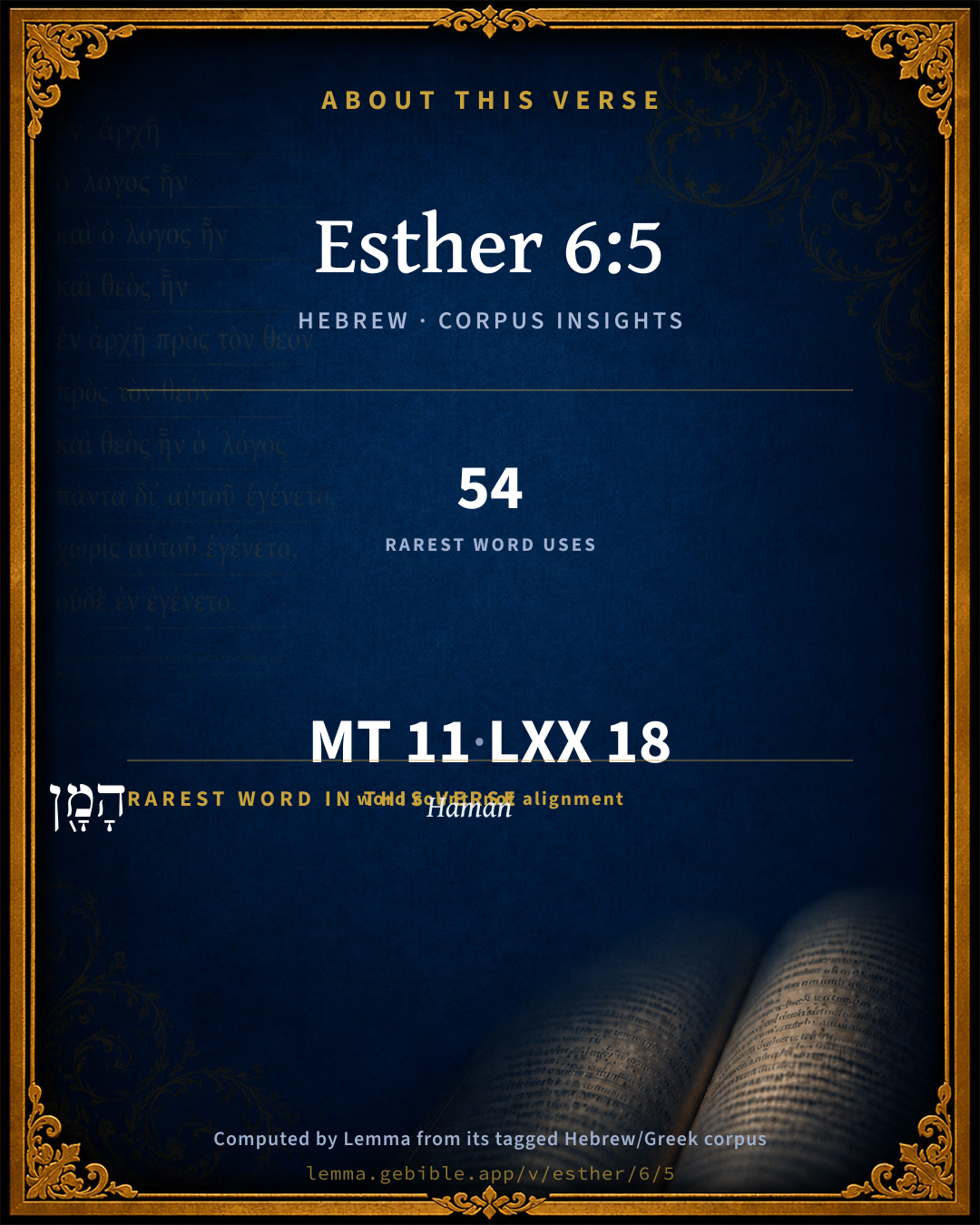
These counts appear in no published source. They are computed here, from the morphology-tagged text and Lemma’s own curated glosses. What Lemma adds →

11
words
9
distinct lemmas
Historical
section

Shared distinctive vocabulary

הָמָ֖ן Haman H2001 occurs in 45 verses of the Hebrew Bible. Also found in:

Grammatical profile

  • 4 verbs
  • 5 nouns
  • 1 preposition
  • 1 particle

Verb forms

  • וַיֹּ֨אמְר֜וּ Qal · Sequential Imperfect
  • עֹמֵ֣ד Qal · Participle Active
  • וַיֹּ֥אמֶר Qal · Sequential Imperfect
  • יָבֽוֹא Qal · Imperfect

Repetition

Words recur within this verse — often emphatic in Hebrew:

  • וַיֹּ֨אמְר֜וּ to say H559 ×2
  • הַמֶּ֨לֶךְ֙ king H4428 ×2

Hebrew & Septuagint length

In English translation the verse runs 19 words from the Hebrew and 17 from the Septuagint (LXX English) — closely comparable.

A rough comparison of the two English renderings, which tokenize alike — not a word-level alignment.

Word counts can differ between the Hebrew and the Greek without any difference in meaning — e.g. the Hebrew direct-object marker אֵת has no separate Greek word, and Greek often adds the article ὁ.

In the original languages it is 11 Hebrew tokens and 18 Greek tokens — but the two are counted differently (Hebrew bundles its prefixes and suffixes into one token; the Greek is in lemma form), so that isn’t a like-for-like length.

Hebrew and Greek witnesses Masoretic Hebrew ↔ Greek Septuagint

The same verse in the two great witnesses to the Old Testament, shown verse-for-verse.

These are two independent witnesses, not word-aligned to each other, and the Septuagint is shown in lemma (dictionary) form.

Hebrew Esther 6:5 Masoretic · Westminster Leningrad Codex

וַיֹּ֨אמְר֜וּ נַעֲרֵ֤י הַמֶּ֨לֶךְ֙ אֵלָ֔יו הִנֵּ֥ה הָמָ֖ן עֹמֵ֣ד בֶּחָצֵ֑ר וַיֹּ֥אמֶר הַמֶּ֖לֶךְ יָבֽוֹא

The king's servants said to him, Behold, Haman stands in the court. The king said, Let him come in.

World English Bible · Public Domain

Greek LXX Esther 6:5 Septuagint · lemma form

καί εἶπον ὁ διάκονος ὁ βασιλεύς ἰδού αμαν ἵστημι ἐν ὁ αὐλή καί εἶπον ὁ βασιλεύς καλέω αὐτός

And the king's servants said, Behold, Aman stands in the court. And the king said, Call him.

LXX2012 (modern English Septuagint) · Public Domain

Hebrew: Westminster Leningrad Codex (CC BY 4.0). Greek: Septuagint (public domain); English from LXX2012 (modern English Septuagint) (Public Domain). How the Septuagint differs from the Hebrew →

Commentary

Notes on Esther 6:5 from classic Christian and Jewish commentators (each source and its license shown beneath its notes). The classic Christian expositions comment on the surrounding passage and are grouped to its opening verse, so a note may address several verses; the Jewish commentaries on the Tanakh (Rashi and others) are per-verse, so they appear only where the commentator wrote on this verse.

Lemma curates 59 commentaries, every one of them public domain or Creative Commons licensed, each selected and text-cleaned for this edition rather than reprinted as found. About our sources →

Trapp's Complete Commentary

John Trapp

Est 6:5 And the king’s servants said unto him, Behold, Haman standeth in the court. And the king said, Let him come in.

Ver. 5. Behold, Haman standeth in the court] For into the presence he might not come uncalled. And to be thus called in he held it no small happiness; but was soon confuted. He came into the room (as men come to a lottery) with his head full of hopes, but he went thence with his heart full of blanks.

And the king said, Let him come in] See here, saith Merlin, a sweet and special providence of God in this, that Ahasuerus should take advice about honouring Mordecai, and not of his servants that attended upon his person, but of Haman then present (though for another purpose), and concealing the man he means, should make Haman say what was fit to be done, and then do it accordingly. Neither the king nor his servants, likely, would ever have thought of doing Mordecai so great honour as Haman prescribed. See here, as in a mirror, how the Lord by a secret providence bringeth about and overruleth the wiles of men, their affairs, times, counsels, words, and speeches, to the fulfilling of his own will and decree; and this when they think least of doing God’s will or serving his providence.

John Trapp, A Commentary or Exposition upon All the Books of the Old and New Testament (1647–1656) — public domain. Text from a community e-Sword module.

Joseph Benson's Commentary

Est 6:5-6. The king said, Let him come in — The king thought him the fittest man he had to be made use of, both in directing and in dispensing his favour, knowing nothing of any quarrel he had with Mordecai. So Haman came in — Proud of the honour done him, in being admitted into the king’s bed-chamber, before he was up; for it is likely the king only wished to give orders for the honouring of Mordecai, and then he would be easy in his mind, and try to sleep. Haman, however, thinks of finding the king alone, and unengaged, and that this was the fairest opportunity he could wish for, to solicit for Mordecai’s execution. And the king — Whose heart was as full as his, and who, as was fit, spoke first; said unto him, What shall be done unto the man whom the king delighteth to honour? — He names no one, because he would have the more impartial answer. It is a good property in kings and other superiors, to delight in bestowing rewards, and not to delight in punishing. Now Haman thought in his heart — As he had great reason to do, because of the favour which the king had showed to him above all others; To whom would the king delight to do honour more than myself? — No one deserves to be honoured so much as I, nor stands so fair for it. See how men’s pride deceives them! The deceitfulness of our own hearts appears in nothing so much as in the good opinion we are wont to have of ourselves, and of our own performances, against which we should therefore constantly watch and pray. Haman thought the king loved and valued no one but himself, but he was deceived.

Joseph Benson's Commentary on the Old and New Testaments (1811–1818) — public domain. Text from a community e-Sword module.

John Gill's Exposition

And the king's servants said unto him, behold, Haman standeth in the court,.... In the outward court; for into the inward court none might enter without being called, for which he was waiting:

and the king said, let him come in; into his bedchamber; and it was of God, no doubt, that Haman should be on the spot at this very time, when the king was in the humour to do honour to Mordecai, and by him.

John Gill's Exposition of the Whole Bible (1746–1763) — public domain (CC PDM 1.0). Text via the HelloAO Bible API.

The Pulpit Commentary

And the king"s servants said unto him, Behold, Haman standeth in the court. The servants looked into the court, and seeing, somewhat to their surprise, Haman there, mentioned him to the king. They would naturally mention the highest official whom they saw in attendance.

The Pulpit Commentary (1880–1919), ed. H.D.M. Spence-Jones & Joseph S. Exell — public domain. Text from a community e-Sword module.

Lesson kit

Teaching starters — assembled from the data on this page, not authored interpretation. Every prompt links to the verse data it draws on. Edit before teaching.

Esther, in the Historical, opens this verse with 11 words (9 distinct Hebrew lemmas). Its most distinctive word is Hâmân (“Haman”). A historical commentator’s framing appears above. Read the whole chapter for the surrounding context.

Discussion questions

  1. How does “Haman” (Hâmân) shape what this verse is saying?
  2. Esther 3:1 shares the word «Haman» with this verse. How do the two illuminate each other?
  3. “to say” occurs 2× in this one verse. What is the effect of the repetition?
  4. The translations on this page render this verse differently — a whole-verse word diff, not a word-by-word alignment. What might account for the different wordings?
  5. The verb «וַיֹּ֨אמְר֜וּ» is Qal Sequential Imperfect. How does its form color the action?
  6. Reading how Trapp's Complete Commentary and Joseph Benson's Commentary read this verse, where do the two commentators agree and where do they part?

Things to notice

Reading settings

Reading text

Shown beneath each verse's original-language words.

Old Testament
Old Testament edition

Read the OT as the Masoretic Hebrew (MT) or the Greek Septuagint (LXX).

English shown for the Greek Septuagint (in the Hebrew ↔ Greek comparison).

Comparing translations? Open the Compare panel on any verse page to stack up to four side by side.