

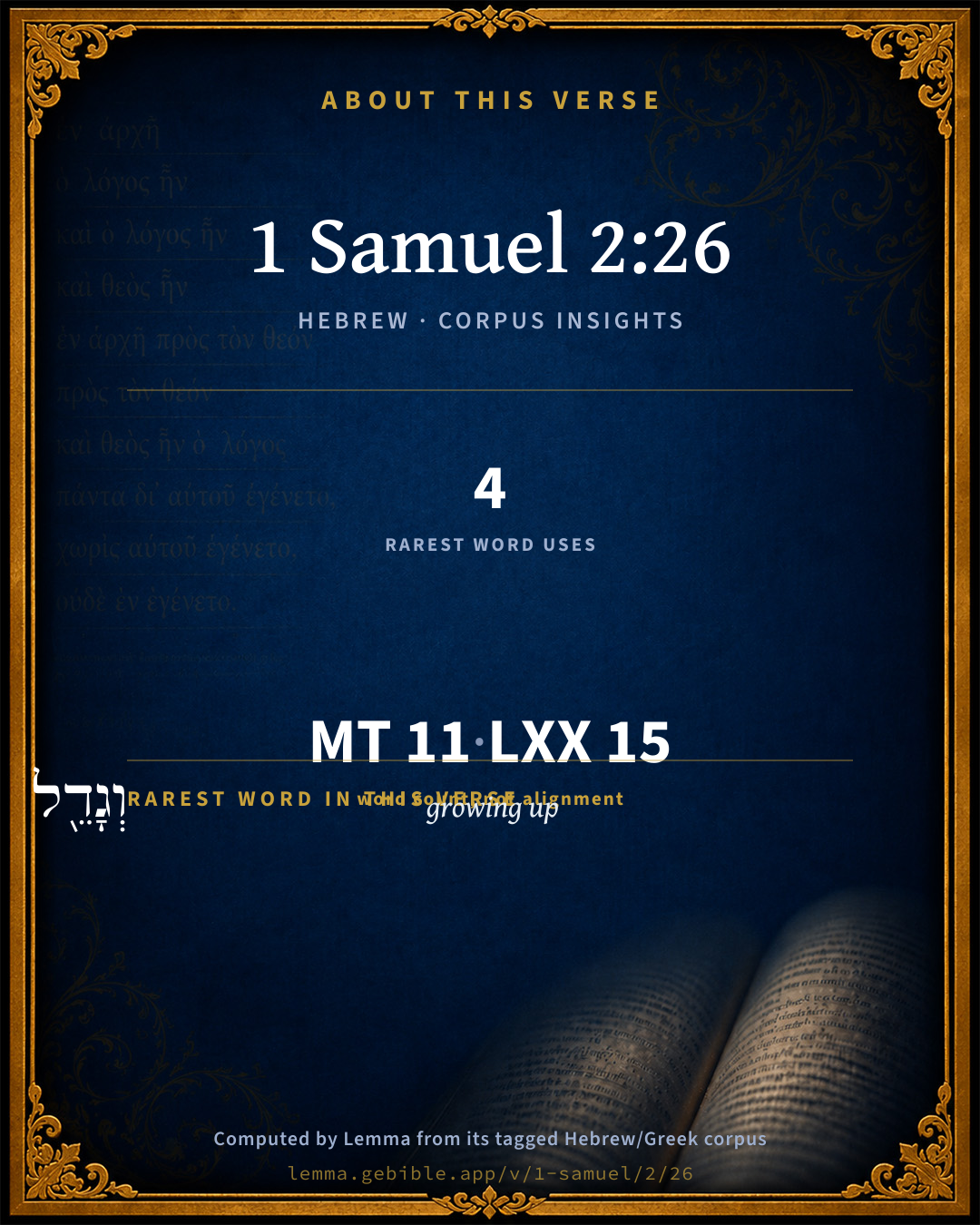
1 Samuel 2:26

Hebrew (Westminster Leningrad Codex) 1 Samuel 2:26 appears in the Hebrew Old Testament. The text above is from the Westminster Leningrad Codex. Each word links to its Strong’s number, a concise gloss, and parsing drawn from the Open Scriptures Hebrew Bible morphology. Click any word for its full Brown-Driver-Briggs (BDB) entry.
Download image
Cite this verse

1 Samuel 2:26 (World English Bible). Public Domain. Lemma interlinear Bible study tool, https://lemma.gebible.app/v/1-samuel/2/26.

Show BibTeX & RIS
BibTeX
RIS
English Translation
The child Samuel grew on, and increased in favor both with Yahweh, and also with men.
World English Bible · Public Domain
Download a study sheet

One document with this verse’s original text, its word-by-word gloss line, the meaning frame, cross-references with their text, attributed commentary, and full source and license credits — printable, and it pastes into notes with its structure intact.

This verse Autodidact and up

Study sheet (.html) Plain text (.txt)

A passage Seminary Student

Up to 50 verses in one chapter. A passage sheet keeps up to 6 commentary sources and 12 cross-references per verse, in the order this page ranks them, and says so on the sheet whenever that leaves anything out. Ask for a single verse and you get the Autodidact verse sheet above.

Everything on this page stays free to read, with no account — the sheet is a download of what is already on screen, not access to it.

Want to remove ads? Support Godless Engineer
Compare translations 3

The same verse in 3 English versions, stacked beneath the original-language interlinear above. Click any original word for its lexicon entry.

Each is an independent rendering of the whole verse — the interlinear is not word-aligned to these translations.

Highlighted words mark where these versions differ — a whole-verse word diff, not a word-by-word alignment.

  • World English Bible Public Domain
    The child Samuel grew on, and increased in favor both with Yahweh, and also with men.
  • King James Version Public Domain
    And the child Samuel grew on, and was in favor both with the LORD, and also with men.
  • unfoldingWord Literal Text CC BY-SA 4.0
    But the boy Samuel was going and growing and good both with Yahweh and also with men.

unfoldingWord Literal Text — © unfoldingWord, licensed CC BY-SA 4.0. Word-aligned USFM3 via Door43 (git.door43.org/unfoldingWord/en_ult).

Versions to compare (up to 4)

3 of 4 selected

Show all 18 translations

Every available English version of this verse, each an independent rendering of the whole verse.

  • World English Bible Public Domain
    The child Samuel grew on, and increased in favor both with Yahweh, and also with men.
  • Berean Standard Bible Public Domain
    And the boy Samuel continued to grow in stature and in favor with the LORD and with man.
  • Majority Standard Bible Public Domain
    And the boy Samuel continued to grow in stature and in favor with the LORD and with man.
  • King James Version Public Domain
    And the child Samuel grew on, and was in favor both with the LORD, and also with men.
  • American Standard Version (1901) Public Domain
    And the child Samuel grew on, and increased in favor both with Jehovah, and also with men.
  • Revised Version (1885) Public Domain
    And the child Samuel grew on, and was in favour both with the LORD, and also with men.
  • Geneva Bible (1599) Public Domain
    (Nowe the childe Samuel profited and grewe, and was in fauour both with the Lord and also with men)
  • Douay-Rheims (1899) Public Domain
    But the child Samuel advanced, and grew on, and pleased both the Lord and men.
  • Young's Literal Translation Public Domain
    And the youth Samuel is going on and growing up, and `is' good both with Jehovah, and also with men.
  • Literal Standard Version CC BY-SA 4.0
    And the youth Samuel is going on and growing up, and [is] good with both YHWH, and also with men.
  • Unlocked Literal Bible CC BY-SA 4.0
    The child Samuel grew up, and increased in favor with Yahweh and also with men.
  • unfoldingWord Literal Text CC BY-SA 4.0
    But the boy Samuel was going and growing and good both with Yahweh and also with men.
  • Darby Bible Public Domain
    And the boy Samuel grew on, and was in favour both with Jehovah and also with men.
  • World Messianic Bible Public Domain
    The child Samuel grew on, and increased in favor both with the LORD and also with men.
  • Webster's Bible Public Domain
    And the child Samuel continued to grow, and was in favor both with the LORD, and also with men.
  • Free Bible Version CC BY-SA 4.0
    The boy Samuel grew physically, and also grew in the approval of both the Lord and the people.
  • Bible in Basic English Public Domain
    And the young Samuel, becoming older, had the approval of the Lord and of men.
  • JPS Tanakh (1917) Public Domain
    And the child Samuel grew on, and increased in favour both with the LORD, and also with men.

Literal Standard Version (2020), Covenant Press — licensed CC BY-SA 4.0. Text via the HelloAO Bible API (eBible.org). Unlocked Literal Bible (unfoldingWord) — licensed CC BY-SA 4.0. Text via the HelloAO Bible API (eBible.org). unfoldingWord Literal Text — © unfoldingWord, licensed CC BY-SA 4.0. Word-aligned USFM3 via Door43 (git.door43.org/unfoldingWord/en_ult). Free Bible Version, Dr. Jonathan Gallagher — licensed CC BY-SA 4.0. Text via the HelloAO Bible API (eBible.org).

Word by word

More ways to search: Search by grammar → Find every occurrence → Compare this word →

Practice this passage: Drill this verse → Learn its vocabulary →

וְגָדֵ֖ל
gâdêl
H1432
“and · growing up”
Conjunction + Verb, Qal, Participle Active, Masculine, Singular, Absolute
Part of Speech
Conjunction + Verb
Stem
Qal
Form
Participle Active
Gender
Masculine
Number
Singular
State
Absolute
Full BDB Definition

Origin: from H1431

TWOT: 315a

becoming great, growing up
  1. וְהַנַּ֣עַר naʻar H5288 “and · the · boy” Conjunction + Particle, Definite Article + Noun, Common, Masculine, Singular, Absolute
  2. שְׁמוּאֵ֔ל Shᵉmûwʼêl H8050 “Samuel” Noun, Proper
  3. הֹלֵ֥ךְ hâlak H1980 “walking” Verb, Qal, Participle Active, Masculine, Singular, Absolute
  4. וָט֑וֹב ṭôwb H2896 “and · good” Conjunction + Adjective, Adjective, Masculine, Singular, Absolute
  5. גַּ֚ם gam H1571 “also” Particle, Accusative
  6. עִם ʻim H5973 “with” Preposition
  7. יְהוָ֔ה Yᵉhôvâh H3068 “LORD” Noun, Proper
  8. וְגַ֖ם gam H1571 “and · also” Conjunction + Particle, Accusative
  9. עִם ʻim H5973 “with” Preposition
  10. אֲנָשִֽׁים ʼîysh H376 “men” Noun, Common, Masculine, Plural, Absolute

About this verse

These counts appear in no published source. They are computed here, from the morphology-tagged text and Lemma’s own curated glosses. What Lemma adds →

11
words
9
distinct lemmas
Historical
section

Notable vocabulary

The rarest word here is וְגָדֵ֖ל growing up H1432 — appearing just 4 times in the whole Hebrew Bible.

Shared distinctive vocabulary

וְגָדֵ֖ל growing up H1432 occurs in 4 verses of the Hebrew Bible. Also found in:

Grammatical profile

  • 2 verbs
  • 4 nouns
  • 1 adjective
  • 2 prepositions
  • 2 particles

Verb forms

  • הֹלֵ֥ךְ Qal · Participle Active
  • וְגָדֵ֖ל Qal · Participle Active

Repetition

Words recur within this verse — often emphatic in Hebrew:

Hebrew & Septuagint length

In English translation the verse runs 16 words from the Hebrew and 14 from the Septuagint (LXX English) — closely comparable.

A rough comparison of the two English renderings, which tokenize alike — not a word-level alignment.

Word counts can differ between the Hebrew and the Greek without any difference in meaning — e.g. the Hebrew direct-object marker אֵת has no separate Greek word, and Greek often adds the article ὁ.

In the original languages it is 11 Hebrew tokens and 15 Greek tokens — but the two are counted differently (Hebrew bundles its prefixes and suffixes into one token; the Greek is in lemma form), so that isn’t a like-for-like length.

Cross-references

7

Topical passages linked to 1 Samuel 2:26 in the Treasury of Scripture Knowledge — connected by theme and wording, ordered by reader-vote popularity; previews shown in the World English Bible.

  • Luke 2:52 And Jesus increased in wisdom and stature, and in favor with God and men.
  • Luke 2:40 The child was growing, and was becoming strong in spirit, being filled with wisdom, and the grace of God was upon him.
  • 1 Samuel 2:21 Yahweh visited Hannah, and she conceived, and bore three sons and two daughters. The child Samuel grew before Yahweh.
  • Luke 1:80 The child was growing, and becoming strong in spirit, and was in the desert until the day of his public appearance to Israel.
  • Acts 2:47 praising God, and having favor with all the people. The Lord added to the assembly day by day those who were being saved.
  • Romans 14:18 For he who serves Christ in these things is acceptable to God and approved by men.
  • Proverbs 3:3 Don't let kindness and truth forsake you. Bind them around your neck. Write them on the tablet of your heart.

Cross-references courtesy of OpenBible.info (CC BY 4.0).

Hebrew and Greek witnesses Masoretic Hebrew ↔ Greek Septuagint

The same verse in the two great witnesses to the Old Testament, shown verse-for-verse.

These are two independent witnesses, not word-aligned to each other, and the Septuagint is shown in lemma (dictionary) form.

Hebrew 1 Samuel 2:26 Masoretic · Westminster Leningrad Codex

וְהַנַּ֣עַר שְׁמוּאֵ֔ל הֹלֵ֥ךְ וְגָדֵ֖ל וָט֑וֹב גַּ֚ם עִם יְהוָ֔ה וְגַ֖ם עִם אֲנָשִֽׁים

The child Samuel grew on, and increased in favor both with Yahweh, and also with men.

World English Bible · Public Domain

Greek LXX 1 Samuel 2:26 Septuagint · lemma form

καί ὁ παιδάριον σαμουηλ πορεύομαι καί μεγαλύνω καί ἀγαθός καί μετά κύριος καί μετά ἄνθρωπος

And the child Samuel advanced, and was in favor with God and with men.

LXX2012 (modern English Septuagint) · Public Domain

Hebrew: Westminster Leningrad Codex (CC BY 4.0). Greek: Septuagint (public domain); English from LXX2012 (modern English Septuagint) (Public Domain). How the Septuagint differs from the Hebrew →

Targum (Aramaic paraphrase)

1

The Targum is the ancient Jewish Aramaic paraphrase of the Hebrew Scriptures — an interpretive translation, not the Hebrew text itself. Onkelos (literal) and Pseudo-Jonathan (expansive) render the Torah, and Jonathan the Prophets. Coverage is partial: where no permissively-licensed English translation exists for a verse, only the Aramaic is shown. This is verse-level text, not a word-by-word alignment to the Hebrew.

  1. Targum Jonathan Prophets (Joshua–Malachi)
    וְרַבְיָא שְׁמוּאֵל אָזִיל וְסַגִי וּשְׁמֵיהּ טָב וְתַקְנָן אוֹרְחָתֵיהּ קֳדָם יְיָ וּתְרִיצִין עוֹבָדוֹהִי בְּגוֹ בְּנֵי אֱנָשָׁא:

    (no public-domain English translation for this verse)

    Targum Jonathan — Aramaic: “Mikraot Gedolot” (public domain). English: “Sefaria Community Translation” (CC0 1.0 (public-domain dedication)); “London "Chaldee Paraphrase," 1871” (public domain). Text via Sefaria.

Commentary

Notes on 1 Samuel 2:26 from classic Christian and Jewish commentators (each source and its license shown beneath its notes). The classic Christian expositions comment on the surrounding passage and are grouped to its opening verse, so a note may address several verses; the Jewish commentaries on the Tanakh (Rashi and others) are per-verse, so they appear only where the commentator wrote on this verse.

Lemma curates 59 commentaries, every one of them public domain or Creative Commons licensed, each selected and text-cleaned for this edition rather than reprinted as found. About our sources →

Trapp's Complete Commentary

John Trapp

1Sa 2:26 And the child Samuel grew on, and was in favour both with the LORD, and also with men.

Ver. 26. And the child Samuel grew on, &c.] The worse Eli’s graceless sons were, the better Samuel was: the more amiable and acceptable both to God and men. Bad company to good people is, or ought to be, as the dirt of oysters, whose mud hath soap in it, and doth rather scour than defile.

And also with men.] This was a great mercy to him, as it was afterwards to David, that "whatsoever he did pleased the people."

John Trapp, A Commentary or Exposition upon All the Books of the Old and New Testament (1647–1656) — public domain. Text from a community e-Sword module.

The Biblical Illustrator

Joseph S. Exell

1Sa_2:26

And the child Samuel grew on, and was in favour both with the Lord, and also with men.

Child growth

One of the most beautiful things that God has made in the world is growth, and the world is full of it. God did not make a great Samuel at once, but a little child Samuel, who grew before Him. I will speak of four thoughts as included in growing before the Lord.

I. Samuel grew at the Lords house. At this time there was no temple. There was no tabernacle, with the court round about, where the burnt offerings were consumed on the altar.

II. Samuel grew is the Lords sight. This means that the Lord was pleased to see Samuel grow as he did. Grow in grace is the Apostles word. Growth in love is the true progress; for love is holiness, and holiness is light, and light is God.

III. Samuel grew by the Lords grace. His mother had lent him to the Lord, and the Lord saw to his growing.

IV. Samuel grew for the Lords service.

1. Little services from little people are acceptable to God.

2. The little grows by and by to the great. (J. Edmond.)

The training of a prophet

The Bible tells us very little about the childhood of its great men. We know nothing of the early days of Abraham, or of the child life of Moses, David, St. Peter, and St. Paul. Even of Jesus there is only one beautiful picture given of His young bright days. The only exception which the Bible makes is the instance of Samuel. The account of his early life is really the only thing of the kind which the sacred pages contain. It is the story of a childs growth, of a childs education, of a childs first prayers and religious beginnings, of a childs shaping into a man of God.

I. It tells us of his mother. No biography is complete without that. The father is not of so much consequence in the story; the mother is indispensable. Paint her moral portrait for me, and I can guess what the child will be like. Samuels life began well, with a praying mother kneeling beside his cradle, and praying lips teaching him the first words he knew. She laid her dearest treasure upon the altar, and prayed, Take him, O God, and make him Thine and make him worthy. And the Lord answered, as Jesus might have answered, O, woman, great is thy faith; be it unto thee even as thou wilt. Our children will become in the main features what their mothers prayerfully and persistently determine they shall be. The picture of life which the mother always holds up before them will be the end, the ideal towards which they strive, and her daily habitual thoughts, her dominant and ruling thoughts will shape and colour their hopes and dreams.

II. We are told about his schoolmaster. He was the one pupil of a sad-hearted old man. There is a touch of pathos in that part of the story, This child became the one joy of a lonely house, the music in its silent chambers. He came to Eli as the sunbeams come into a prison, or the smell of flowers to a sick man on his bed. He was a joyless old man, wearied and disappointed, who trailed behind him the broken threads of all his lifes hopes. His own sons had become his shame, so that he wished he had buried them when they were little ones. His country was in danger, for the people had forsaken God and all good things, and were on the downgrade towards ruin. He was a gentle and kindly old man, but with no strength for the position which he filled. His hands were weak and his eyes dim. Dark was the outlook, and his life was going down with sorrow to the grave. And now see the goodness of the Lord. There comes into his house this sunbeam, this ripple of laughter on the sullen stream, this song in the night. A child whose feet ran in the way of his commandments, a child whom it was good to love and a joy to teach, a child who would take the place of his lost sons and provide new interests and create new hopes. There was something to live for and work for again. The childs presence brought summer into the drear winter, and warmth and cheerfulness into the cold desolate heart. On that child the old man poured his affection and gave all his remaining strength, and the child took lovely shape under these worn but tender hands. He must have been a good schoolmaster though he was no great good at anything else. He was no prophet, but he helped to make a prophet. He had no greatness of his own, but he developed the greatness of another. If Israel owed him nothing else, it owed him a Samuel: and that was no small debt. His life bore that magnificent fruit in its old age, and many a successful life has far less to show at the end. Call no man or woman a failure who has sent out one brave true life to enrich the world. When you think of Samuel do not forget the gentle, tired, old man who was his schoolmaster.

III. We are told of his growth. But there are different kinds of growth. Some children grow taller and stronger, but they do not improve in other things. They get a little more knowledge, hut they do not get much wiser. They increase in stature, years, and strength; but they seem to lose, bit by bit, all their goodness, and what was beautiful in them becomes ugly, and what was kind and gentle and innocent becomes selfish and peevish and hard and unlovely. Samuel grew in favour with God and also with man. He grew by prayer. God heard him, and for every prayer gave him a little more wisdom and a little more goodness. And so he grew in obedience, in truthfulness, in modesty, in kindness of heart, in helpfulness. And everybody saw that he was shaping well. For just as we can felt from the first signs whether a tree will grow crooked or straight, and whether a plant will grow into poisonous nightshade or into a fragrant rose bush, and whether the glittering particles under the sea will form a common oyster shell or crystallise into a pearl, so can those who watch a childs life today know what the coming man or woman will be. Samuel was steadily shaping into the life which God had designed for him.

IV. That he was the rising star in a dark sky and the hope of a godless land. It was a dreary and desperate time. The few who, like old Eli, still believed in God and righteousness were at their wits end. They saw no tiniest rift in the black storm cloud which darkened the sky. And yet, in the midst of all that, God was training this child as a teacher and deliverer, keeping him outside all the impurity and unbelief, giving him a big heart and a wise mind, and fitting him for great leadership. If you read these three chapters, you seem to hear two distinct voices speaking. One is a voice of groaning complaint, sad foreboding; the other, a voice of hope, promise, and good cheer. One tells of greedy priests who were robbing the people and plundering the sanctuary; and then the other voice breaks in, But the child Samuel grew and ministered before the Lord. Once more the doleful lips take up the strain, and tell again how the ruling men are wallowing in the filthiest sins and the people mocking at religion, and all the wisdom turned to folly; and again the other voice replies, But the child grew on, grew in favour with God and man. Clouds thickening above, and danger and ruin threatening on every side. Still the child grows, and God is with him. And so God is training our children today. There are always new hopes given to us when we see child life, for in every group of children, especially if they are God-taught children, there are the bright and great possibilities of the future. Instead of the fathers shall come up the children. When there is a dearth of great men there is often a larger abundance of young souls slowly growing into greatness. The seed has been sown and the harvest will be reaped further on. We shall have them again, never fear. The Samuels, the brave leaders, the men made mighty by faith and prayer, they are growing in many a godly home today. The Lord knows them though we do not. (J. G. Greenough, M. A.)

The child Samuel

I. Now, first of all, what was Samuel, as described in the Word of God? There are among others three things about him, which I want to tell you of his character, his conduct, and his circumstances. First of all, about his character. God loved him, and men loved him too; everybody that knew him could not help loving him. That was his character. The first thing was, that he had Gods love. That is of the utmost importance, dear children; because if everybody in the world loved us, and we had not the love of God, we could not be truly happy. Now, one proof of being accepted of God is, that our conduct will be that which is right. We read that Samuel had the character before men of being a good boy. He was in favour with men. If Samuel had been accustomed to tell lies, do yea think that men would have liked him? But I dare say you would like me to tell you something more particularly respecting Samuels conduct.

1. In the first place, then, Samuel was very obedient. He was obedient to Elis will. Eli had only to tell him what to do, and Samuel ran as hard as he could to do it.

2. The second is, respect and affection for an old man. Now, there are net many children that are disposed to find their pleasure in showing respect and affection to old people. Little children very often are inclined to treat old people with neglect--not to show them proper attention.

3. But another thing in Samuels conduct was his humility. It pleased God to reveal Himself to Samuel. Now, many children would have been puffed up with pride at this.

4. There is one thing more in Samuels conduct that you ought to notice; and that is his truthfulness. Samuel told him every whir, and hid not the whole truth from him. When he was examined, he kept nothing back. There was no deceit, no guile, nothing of this kind to spoil his character, or to cause him to lose that favour which he had with all that knew him. But we must say a word about Samuels circumstances; because perhaps there are some children present who think that he had everything to favour him--that he had no temptations to do wrong. They may think that he had a pious mother, and perhaps a pious father too, and that Eli, with whom he lived, was Gods minister, and that he was employed in Gods house, and that there were therefore around him circumstances that all tended to make him good. But, if God had not given Samuel a new heart, all these circumstances would not have made him good. But Samuels circumstances were not all favourable. The two sons of Eli that Samuel had to do with every day were very bad young men.

II. How are you to become like little Samuel? I think I ought to ask you, in the first place, whether you wish to become like little Samuel. In order to be like Jesus, to be in favour with God and men, you must have the mind which was in Christ Jesus. I have told you that you must pray to be like Jesus: then, secondly, you must pray to remember the truth of your Bibles. My son, forget not my law, but let thine heart keep My commandments. Let not mercy and truth forsake thee; bind them about thy neck; write them upon the table of thine heart. So shalt thou find favour and good understanding in the sight of God and men. Now, in order to remember Gods Word you must know it--you must learn it. Let me advise you, then, never to let a single day pass without learning some one text of Scripture. The third thing is be go and practise what you know immediately. Our blessed Lord says, If ye know these things, happy are ye if ye do them. (W. Cadman, M. A.)

The Biblical Illustrator, edited by Joseph S. Exell (c. 1880s–1900s) — public domain. Text from a community e-Sword module.

Tyndale Open Study Notes

Tyndale Open Resources

2:26 As children, both Samuel and Jesus possessed extraordinary qualities (2:21; see also Luke 2:40, 52). Samuel was one of Christ’s forerunners.

Tyndale Open Study Notes — © Tyndale Open Resources, licensed CC BY-SA 4.0. Text via the HelloAO Bible API.

Ellicott's Commentary for English Readers

(26) Grew on, and was in favour.—The very expressions of the biographer of Samuel were adopted by St. Luke when, in the early chapters of his Gospel, he wishes to describe in a few striking words the boyhood and youth of Him who was far greater than the child-prophet of Israel.

A Bible Commentary for English Readers, edited by Charles John Ellicott (1878–1897) — public domain. Text from a community e-Sword module.

The Cambridge Bible for Schools and Colleges

gen. ed. J. J. S. Perowne

26. grew on, and was in favour] A childhood like that of Jesus (Luk_2:52). Again Samuel’s progress is contrasted with the declension of Hophni and Phinehas.

The Cambridge Bible for Schools and Colleges (gen. ed. J. J. S. Perowne; Cambridge University Press, 1878–1918) — public domain. Text from a community e-Sword module.

John Gill's Exposition

And there came a man of God unto Eli,.... A prophet, as the Targum; he had gifts and graces bestowed on him by the Lord, qualifying him for that office; he came from God, and spoke in his name, as prophets used to do: who this was is not said, nor can it be known with certainty; many conjectures are made; some think he might he Phinehas, as Ben Gersom and Abarbinel (a), which is not at all likely; it is not probable that he was living, for if he had been alive, Eli would not have been high priest; the more ancient Jews say (b) he was Elkanah, the father of Samuel; and so Jarchi; and he is said in the Targum on Sa1 1:1, to be one of the disciples of the prophets, and was reckoned by them among the two hundred prophets that prophesied in Israel (c); but of his prophecy we nowhere read in Scripture, or that he was one: other's (d) think he was Samuel himself, who through modesty conceals his name; but he was now a child, as in the preceding verse; indeed, some are of opinion that what follows is recorded in this chapter by way of anticipation, and properly belongs to, and is a part of the message sent from the Lord by Samuel to Eli, in the following chapter:

and said unto him, thus saith the Lord; using the language prophets in later times did, who spake not of themselves, but in the name of the Lord; and from whence it appears that this was not a divine Person, the Son of God in human form, since he never used to speak in this manner when he appeared:

did I plainly appear to the house of thy father, when they were in Egypt in Pharaoh's house? he did; this was evident and certain, and a wonderful instance of condescending goodness: the house of his father is the house of Aaron, who, and all his sons, were born in Egypt, from whose youngest son, Ithamar, Eli descended; and to whom the Lord appeared when in Egypt, and sent him to meet Moses, whose spokesman he appointed him to be; and who prophesied in Egypt, and reproved the Israelites, which is recorded in Eze 20:1 as say the Jews (e).

(a) Judaei apud Hieron. Trad. Heb. in lib. Reg. fol. 75. A. (b) Seder Olam Rabba, c. 20. p. 53. (c) T. Bab. Megillah, fol. 14. 1. (d) See Weemse's Christ. Synagog. l. 2. c. 3. p. 250. (e) Jarchi & Ben Gersom in loc.

John Gill's Exposition of the Whole Bible (1746–1763) — public domain (CC PDM 1.0). Text via the HelloAO Bible API.

Albert Barnes' Notes on the Bible

And the child Samuel ... - The account of our Lord’s growth Luk 2:52 is very similar; “And Jesus increased in wisdom and stature, and in favor with God and man.” The literal version of the passage before us is, “The child Samuel advanced and grew and was good (or acceptable), both with the Lord, and also with men.”

Albert Barnes' Notes on the Bible (1834–1885) — public domain. Text from a community e-Sword/MySword module.

Haydock's Catholic Bible Commentary

And men. Thus he is, in some degree, compared with our Saviour, Luke ii. 52. When one minister prevaricates, God presently raises up another, so that he never abandons his Church. (Haydock)

George Leo Haydock (1774–1849), Haydock's Catholic Family Bible and Commentary, 1859 edition — public domain. Excludes Psalms (Douay-Rheims chapter numbering differs from Protestant) and Deuterocanonical books (Catholic canon only).

Matthew Poole's English Annotations

He grew better in bad times, which is remembered to his commendation.

Matthew Poole's English Annotations on the Holy Bible (1683–1685) — public domain. Text from a community e-Sword/MySword module.

Whedon's Commentary on the Bible

Daniel D. Whedon

26. The child Samuel grew — Whilst Eli’s sons grew in wickedness, Samuel grew in grace and wisdom. See introductory note before 1Sa_2:11.

Daniel D. Whedon (gen. ed.), Commentary on the Old and New Testaments (1874–1909) — public domain. Text from a community e-Sword module.

Keil & Delitzsch

C. F. Keil & F. Delitzsch

The youthful Samuel, on the other hand, continued to grow in stature, and in favour with God and man (see Luk 2:52).

Keil & Delitzsch — Biblical Commentary on the Old Testament (1861–1891) — public domain (CC PDM 1.0). Text via the HelloAO Bible API. (Old Testament only.)

Lesson kit

Teaching starters — assembled from the data on this page, not authored interpretation. Every prompt links to the verse data it draws on. Edit before teaching.

1 Samuel, in the Historical, opens this verse with 11 words (9 distinct Hebrew lemmas). Its most distinctive word is gâdêl (“growing up”). A historical commentator’s framing appears above. Read the whole chapter for the surrounding context.

Discussion questions

  1. The word gâdêl carries the sense “growing up.” How does it shape the verse?
  2. Genesis 26:13 shares the word «growing up» with this verse. How do the two illuminate each other?
  3. “also” occurs 2× in this one verse. What is the effect of the repetition?
  4. These translations render this verse differently. What is at stake in choosing one wording over another?
  5. The verb «הֹלֵ֥ךְ» is Qal Participle Active. How does its form color the action?
  6. Reading how Trapp's Complete Commentary and The Biblical Illustrator read this verse, where do the two commentators agree and where do they part?

Things to notice

Reading settings

Reading text

Shown beneath each verse's original-language words.

Old Testament
Old Testament edition

Read the OT as the Masoretic Hebrew (MT) or the Greek Septuagint (LXX).

English shown for the Greek Septuagint (in the Hebrew ↔ Greek comparison).

Comparing translations? Open the Compare panel on any verse page to stack up to four side by side.