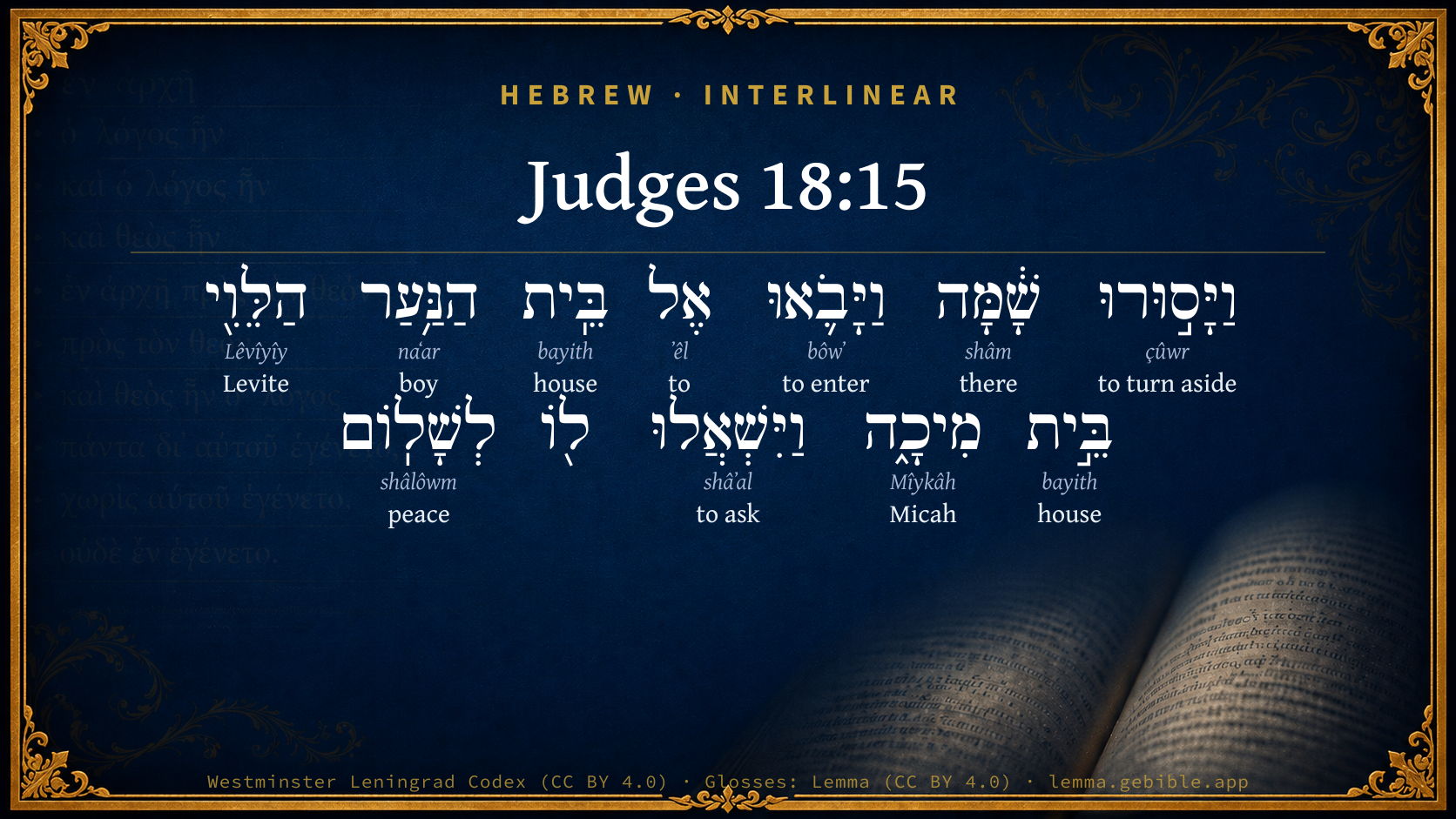
Judges 18:15

Hebrew (Westminster Leningrad Codex) Judges 18:15 appears in the Hebrew Old Testament. The text above is from the Westminster Leningrad Codex. Each word links to its Strong’s number, a concise gloss, and parsing drawn from the Open Scriptures Hebrew Bible morphology. Click any word for its full Brown-Driver-Briggs (BDB) entry.
Download image
Cite this verse

Judges 18:15 (World English Bible). Public Domain. Lemma interlinear Bible study tool, https://lemma.gebible.app/v/judges/18/15.

Show BibTeX & RIS
BibTeX
RIS
English Translation
They turned aside there, and came to the house of the young man the Levite, even to the house of Micah, and asked him of his welfare.
World English Bible · Public Domain
Download a study sheet

One document with this verse’s original text, its word-by-word gloss line, the meaning frame, cross-references with their text, attributed commentary, and full source and license credits — printable, and it pastes into notes with its structure intact.

This verse Autodidact and up

Study sheet (.html) Plain text (.txt)

A passage Seminary Student

Up to 50 verses in one chapter. A passage sheet keeps up to 6 commentary sources and 12 cross-references per verse, in the order this page ranks them, and says so on the sheet whenever that leaves anything out. Ask for a single verse and you get the Autodidact verse sheet above.

Everything on this page stays free to read, with no account — the sheet is a download of what is already on screen, not access to it.

Want to remove ads? Support Godless Engineer
Compare translations 3

The same verse in 3 English versions, stacked beneath the original-language interlinear above. Click any original word for its lexicon entry.

Each is an independent rendering of the whole verse — the interlinear is not word-aligned to these translations.

Highlighted words mark where these versions differ — a whole-verse word diff, not a word-by-word alignment.

  • World English Bible Public Domain
    They turned aside there, and came to the house of the young man the Levite, even to the house of Micah, and asked him of his welfare.
  • King James Version Public Domain
    And they turned thitherward, and came to the house of the young man the Levite, even unto the house of Micah, and saluted him.
  • unfoldingWord Literal Text CC BY-SA 4.0
    So they turned aside there, and they entered into the house of the young man, the Levite, at the house of Micah, and they asked of him concerning peace.

unfoldingWord Literal Text — © unfoldingWord, licensed CC BY-SA 4.0. Word-aligned USFM3 via Door43 (git.door43.org/unfoldingWord/en_ult).

Versions to compare (up to 4)

3 of 4 selected

Show all 18 translations

Every available English version of this verse, each an independent rendering of the whole verse.

  • World English Bible Public Domain
    They turned aside there, and came to the house of the young man the Levite, even to the house of Micah, and asked him of his welfare.
  • Berean Standard Bible Public Domain
    So they turned aside there and went to the home of the young Levite, the house of Micah, and greeted him.
  • Majority Standard Bible Public Domain
    So they turned aside there and went to the home of the young Levite, the house of Micah, and greeted him.
  • King James Version Public Domain
    And they turned thitherward, and came to the house of the young man the Levite, even unto the house of Micah, and saluted him.
  • American Standard Version (1901) Public Domain
    And they turned aside thither, and came to the house of the young man the Levite, even unto the house of Micah, and asked him of his welfare.
  • Revised Version (1885) Public Domain
    And they turned aside thither, and came to the house of the young man the Levite, even unto the house of Micah, and asked him of his welfare.
  • Geneva Bible (1599) Public Domain
    And they turned thitherward and came to the house of the yong man the Leuite, euen vnto the house of Michah, and saluted him peaceably.
  • Douay-Rheims (1899) Public Domain
    And when they had turned a little aside, they went into the house of the young man the Levite, who was in the house of Michas: and they saluted him with words of peace.
  • Young's Literal Translation Public Domain
    And they turn aside thither, and come in unto the house of the young man the Levite, the house of Micah, and ask of him of welfare, --
  • Literal Standard Version CC BY-SA 4.0
    And they turn aside there, and come to the house of the young man, the Levite, the house of Micah, and ask of him of welfare—
  • Unlocked Literal Bible CC BY-SA 4.0
    So they turned in there and came to the house of the young Levite, at the house of Micah, and they greeted him.
  • unfoldingWord Literal Text CC BY-SA 4.0
    So they turned aside there, and they entered into the house of the young man, the Levite, at the house of Micah, and they asked of him concerning peace.
  • Darby Bible Public Domain
    And they turned aside thither, and came to the house of the young Levite, at the home of Micah, and asked him of his welfare.
  • World Messianic Bible Public Domain
    They went over there and came to the house of the young Levite man, even to the house of Micah, and asked him how he was doing.
  • Webster's Bible Public Domain
    And they turned thitherward, and came to the house of the young man the Levite, even to the house of Micah, and saluted him.
  • Free Bible Version CC BY-SA 4.0
    The five men left the road and went to where the young Levite was living in Micah's home to ask how he was.
  • Bible in Basic English Public Domain
    And turning from their road they came to the house of the young Levite, the house of Micah, and said to him, Is it well with you?
  • JPS Tanakh (1917) Public Domain
    And they turned aside thither, and came to the house of the young man the Levite, even unto the house of Micah, and asked him of his welfare.

Literal Standard Version (2020), Covenant Press — licensed CC BY-SA 4.0. Text via the HelloAO Bible API (eBible.org). Unlocked Literal Bible (unfoldingWord) — licensed CC BY-SA 4.0. Text via the HelloAO Bible API (eBible.org). unfoldingWord Literal Text — © unfoldingWord, licensed CC BY-SA 4.0. Word-aligned USFM3 via Door43 (git.door43.org/unfoldingWord/en_ult). Free Bible Version, Dr. Jonathan Gallagher — licensed CC BY-SA 4.0. Text via the HelloAO Bible API (eBible.org).

Word by word

More ways to search: Search by grammar → Find every occurrence → Compare this word →

Practice this passage: Drill this verse → Learn its vocabulary →

מִיכָ֑ה
Mîykâh
H4318
“Micah”
Noun, Proper
Part of Speech
Noun
Type
Proper
Full BDB Definition

Origin: an abbrev. of H4320

TWOT: None

Micah or Micaiah or Michah = "who is like God" - the 6th in order of the minor prophets; a native of Moresheth, he prophesied during the reigns of Jotham, Ahaz, and Hezekiah of Judah, and was contemporary with the prophets Hosea, Amos, and Isaiah - an Ephraimite during the period of the judges - a descendant of Joel the Reubenite - son of Meribbaal and grandson of Jonathan - a Kohathite Levite, the eldest son of Uzziel the brother of Amram - father of Abdon, a man of high station in the reign of Josiah - son of Imlah and a prophet of Samaria who predicted the defeat and death of king Ahab of Israel
  1. וַיָּס֣וּרוּ çûwr H5493 “and · to turn aside” Conjunction + Verb, Qal, Sequential Imperfect, 3rd Person, Masculine, Plural
  2. שָׁ֔מָּה shâm H8033 “there · toward” Adverb + Suffix, Demonstrative
  3. וַיָּבֹ֛אוּ bôwʼ H935 “and · to enter” Conjunction + Verb, Qal, Sequential Imperfect, 3rd Person, Masculine, Plural
  4. אֶל ʼêl H413 “to” Preposition
  5. בֵּֽית bayith H1004 “house of” Noun, Common, Masculine, Singular, Construct
  6. הַנַּ֥עַר naʻar H5288 “the · boy” Particle, Definite Article + Noun, Common, Masculine, Singular, Absolute
  7. הַלֵּוִ֖י Lêvîyîy H3881 “the · Levite” Particle, Definite Article + Noun, Gentilic, Masculine, Singular, Absolute
  8. בֵּ֣ית bayith H1004 “house of” Noun, Common, Masculine, Singular, Construct
  9. וַיִּשְׁאֲלוּ shâʼal H7592 “and · to ask” Conjunction + Verb, Qal, Sequential Imperfect, 3rd Person, Masculine, Plural
  10. לְשָׁלֽוֹם shâlôwm H7965 “to/for · peace” Preposition + Noun, Common, Masculine, Singular, Absolute

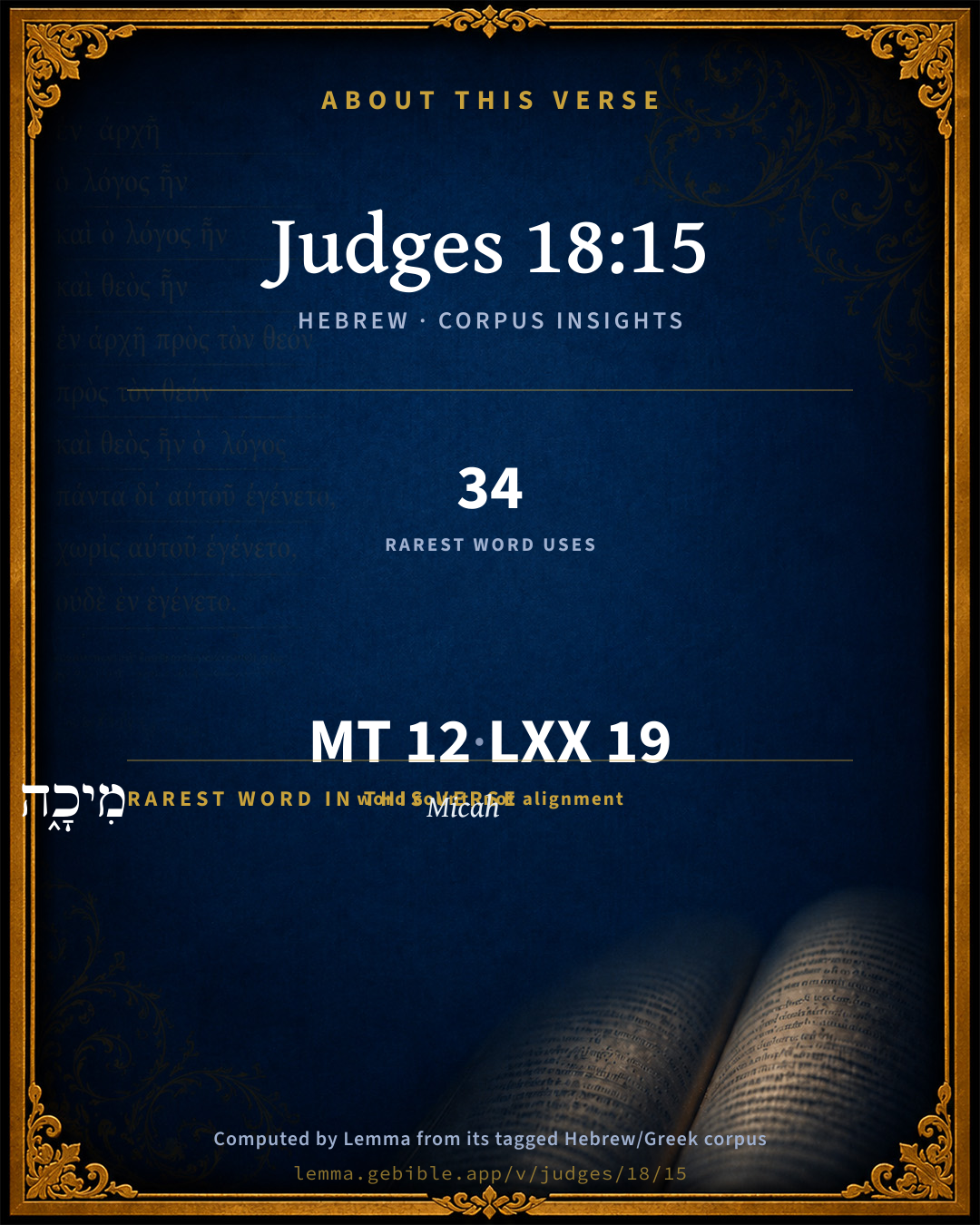
About this verse

These counts appear in no published source. They are computed here, from the morphology-tagged text and Lemma’s own curated glosses. What Lemma adds →

12
words
10
distinct lemmas
Historical
section

Shared distinctive vocabulary

מִיכָ֑ה Micah H4318 occurs in 31 verses of the Hebrew Bible. Also found in:

Grammatical profile

  • 3 verbs
  • 6 nouns
  • 2 prepositions
  • 1 adverb

Verb forms

  • וַיָּס֣וּרוּ Qal · Sequential Imperfect
  • וַיָּבֹ֛אוּ Qal · Sequential Imperfect
  • וַיִּשְׁאֲלוּ Qal · Sequential Imperfect

Repetition

A word recurs within this verse — often emphatic in Hebrew:

  • בֵּֽית house H1004 ×2

Hebrew & Septuagint length

In English translation the verse runs 27 words from the Hebrew and 28 from the Septuagint (LXX English) — closely comparable.

A rough comparison of the two English renderings, which tokenize alike — not a word-level alignment.

Word counts can differ between the Hebrew and the Greek without any difference in meaning — e.g. the Hebrew direct-object marker אֵת has no separate Greek word, and Greek often adds the article ὁ.

In the original languages it is 12 Hebrew tokens and 19 Greek tokens — but the two are counted differently (Hebrew bundles its prefixes and suffixes into one token; the Greek is in lemma form), so that isn’t a like-for-like length.

Cross-references

7

Topical passages linked to Judges 18:15 in the Treasury of Scripture Knowledge — connected by theme and wording, ordered by reader-vote popularity; previews shown in the World English Bible.

  • Genesis 43:27 He asked them of their welfare, and said, "Is your father well, the old man of whom you spoke? Is he yet alive?"
  • John 14:27 Peace I leave with you. My peace I give to you; not as the world gives, give I to you. Don't let your heart be troubled, neither let it be fearful.
  • Genesis 37:14 He said to him, "Go now, see whether it is well with your brothers, and well with the flock; and bring me word again." So he sent him out of the valley of Hebron, and he came to Shechem.
  • 1 Samuel 17:22 David left his baggage in the hand of the keeper of the baggage, and ran to the army, and came and greeted his brothers.
  • 2 Kings 4:26 please run now to meet her, and ask her, Is it well with you? is it well with your husband? is it well with the child? She answered, It is well.
  • Matthew 10:12–13 As you enter into the household, greet it.
  • Luke 10:4–6 Carry no purse, nor wallet, nor sandals. Greet no one on the way.

Cross-references courtesy of OpenBible.info (CC BY 4.0).

Hebrew and Greek witnesses Masoretic Hebrew ↔ Greek Septuagint

The same verse in the two great witnesses to the Old Testament, shown verse-for-verse.

These are two independent witnesses, not word-aligned to each other, and the Septuagint is shown in lemma (dictionary) form.

Hebrew Judges 18:15 Masoretic · Westminster Leningrad Codex

וַיָּס֣וּרוּ שָׁ֔מָּה וַיָּבֹ֛אוּ אֶל בֵּֽית הַנַּ֥עַר הַלֵּוִ֖י בֵּ֣ית מִיכָ֑ה וַיִּשְׁאֲלוּ ל֖וֹ לְשָׁלֽוֹם

They turned aside there, and came to the house of the young man the Levite, even to the house of Micah, and asked him of his welfare.

World English Bible · Public Domain

Greek LXX Judges 18:15 Septuagint · lemma form

καί ἐκκλίνω ἐκεῖ καί εἰςἔρχομαι εἰς ὁ οἶκος ὁ νεανίσκος ὁ λευίτης οἶκος μιχαιας καί ἐρωτάω αὐτός εἰς εἰρήνη

And they turned aside there, and went into the house of the young man, the Levite, even into the house of Michaias, and asked him how he was.

LXX2012 (modern English Septuagint) · Public Domain

On this verse, The Cambridge Bible for Schools and Colleges discusses the Septuagint’s reading. Read the note in Commentary ↓

Hebrew: Westminster Leningrad Codex (CC BY 4.0). Greek: Septuagint (public domain); English from LXX2012 (modern English Septuagint) (Public Domain). How the Septuagint differs from the Hebrew →

Targum (Aramaic paraphrase)

1

The Targum is the ancient Jewish Aramaic paraphrase of the Hebrew Scriptures — an interpretive translation, not the Hebrew text itself. Onkelos (literal) and Pseudo-Jonathan (expansive) render the Torah, and Jonathan the Prophets. Coverage is partial: where no permissively-licensed English translation exists for a verse, only the Aramaic is shown. This is verse-level text, not a word-by-word alignment to the Hebrew.

  1. Targum Jonathan Prophets (Joshua–Malachi)
    וְזָרוּ לְתַמָן וְעָלוּ לְבֵית עוּלֵימָא לְוָאָה בֵּית מִיכָה וּשְׁאִילוּ לֵיהּ לִשְׁלָם:

    (no public-domain English translation for this verse)

    Targum Jonathan — Aramaic: “Mikraot Gedolot” (public domain). English: “Sefaria Community Translation” (CC0 1.0 (public-domain dedication)); “London "Chaldee Paraphrase," 1871” (public domain). Text via Sefaria.

Commentary

Notes on Judges 18:15 from classic Christian and Jewish commentators (each source and its license shown beneath its notes). The classic Christian expositions comment on the surrounding passage and are grouped to its opening verse, so a note may address several verses; the Jewish commentaries on the Tanakh (Rashi and others) are per-verse, so they appear only where the commentator wrote on this verse.

Lemma curates 59 commentaries, every one of them public domain or Creative Commons licensed, each selected and text-cleaned for this edition rather than reprinted as found. About our sources →

Trapp's Complete Commentary

John Trapp

Jdg 18:15 And they turned thitherward, and came to the house of the young man the Levite, [even] unto the house of Micah, and saluted him.

Ver. 15. The house of the young man the Levite.] {See Trapp on "Jdg 18:3"}

And saluted him.] And so did soon insinuate into him who - levitate plus quam desultoria - might be won with an apple, and lost with a nut. These Danites, with their salutations and fair promises, win this hireling Levite insalutato hero suo dacedere, to leave Micah his master without leave taken of him; who yet had used him as one of his sons.

John Trapp, A Commentary or Exposition upon All the Books of the Old and New Testament (1647–1656) — public domain. Text from a community e-Sword module.

Ellicott's Commentary for English Readers

(15-18) In these verses we have a graphic description of the whole nefarious proceeding. The five spies, knowing Jonathan, salute him, and inveigle him to the entrance of the court to talk to their six hundred companions. While the chiefs of this little army detain him in conversation, without any show of violence the five slip away unobserved to the alîyah, or upper room, which serves as the chapel, and steal all the essentials of the worship—namely, (1) the ephod; (2) the teraphim; (3) the graven image; (4) the molten image. It is true that in Jdg_18:20-30 the massecah is not mentioned; but it may be regarded as belonging to the pesel. It is only when he sees them in actual possession of these that Jonathan asks the alarmed question, “What do ye?”

A Bible Commentary for English Readers, edited by Charles John Ellicott (1878–1897) — public domain. Text from a community e-Sword module.

The Cambridge Bible for Schools and Colleges

gen. ed. J. J. S. Perowne

15. even unto the house of Micah] A gloss inserted to identify the young Levite’s house with that of Micah; see on Jdg_17:7. LXX. Luc omits the house of the young man the Levite.

The Cambridge Bible for Schools and Colleges (gen. ed. J. J. S. Perowne; Cambridge University Press, 1878–1918) — public domain. Text from a community e-Sword module.

John Gill's Exposition

And they turned thitherward,.... It seems as if the house lay a little out of their way, and therefore they turned on one hand to go unto it:

and came to the house of the young man the Levite, even unto the house of Micah; for the young man's house was only an apartment of Micah's, and lay very probably next to that in which the images, and oracle were; and they made up to the young man's apartment, rather than to Micah's, because the above things were under his care:

and saluted him; asked him of his welfare in a kind and obliging manner, the rather to ingratiate themselves unto him.

John Gill's Exposition of the Whole Bible (1746–1763) — public domain (CC PDM 1.0). Text via the HelloAO Bible API.

Matthew Poole's English Annotations

Heb. asked him of peace, i.e. if he were in peace, peace being commonly put for health and prosperity.

Matthew Poole's English Annotations on the Holy Bible (1683–1685) — public domain. Text from a community e-Sword/MySword module.

The Pulpit Commentary

Even unto the house, etc. Rather, at Beth-Micah.

The Pulpit Commentary (1880–1919), ed. H.D.M. Spence-Jones & Joseph S. Exell — public domain. Text from a community e-Sword module.

Keil & Delitzsch

C. F. Keil & F. Delitzsch

Then they turned from the road thither, and went to the house of the young Levite, the house of Micah, and asked him (the Levite) concerning his health, i.e., saluted him in a friendly manner (see Gen 43:27; Exo 18:7, etc.).

Keil & Delitzsch — Biblical Commentary on the Old Testament (1861–1891) — public domain (CC PDM 1.0). Text via the HelloAO Bible API. (Old Testament only.)

unfoldingWord translationNotes

Door43 World Missions Community

they turned in there

"they turned"

they greeted him

The word "him" refers to the Levite.

six hundred Danites

"600 Danites" (See: Numbers)

translationWords

Levi

Dan

gate

unfoldingWord translationNotes — © Distant Shores Media and the Door43 World Missions Community, licensed CC BY-SA 4.0. Source: git.door43.org/Door43/en_tn.

Lesson kit

Teaching starters — assembled from the data on this page, not authored interpretation. Every prompt links to the verse data it draws on. Edit before teaching.

Judges, in the Historical, opens this verse with 12 words (10 distinct Hebrew lemmas). Its most distinctive word is Mîykâh (“Micah”). A historical commentator’s framing appears above. Read the whole chapter for the surrounding context.

Discussion questions

  1. How does “Micah” (Mîykâh) shape what this verse is saying?
  2. How does Judges 17:5, which shares the word «Micah», read alongside this verse?
  3. What does the repetition of “house” (2× in this one verse) do in this verse?
  4. These translations render this verse differently; the difference is in the English rendering, not the original. What questions does that raise?
  5. «וַיָּס֣וּרוּ» is a Qal Sequential Imperfect verb. How does that grammatical form shape the action described?
  6. Compare how Trapp's Complete Commentary and Ellicott's Commentary for English Readers read this verse. Where do they agree or differ?

Things to notice

Reading settings

Reading text

Shown beneath each verse's original-language words.

Old Testament
Old Testament edition

Read the OT as the Masoretic Hebrew (MT) or the Greek Septuagint (LXX).

English shown for the Greek Septuagint (in the Hebrew ↔ Greek comparison).

Comparing translations? Open the Compare panel on any verse page to stack up to four side by side.