Exodus 2:6

Hebrew (Westminster Leningrad Codex) Exodus 2:6 appears in the Hebrew Old Testament. The text above is from the Westminster Leningrad Codex. Each word links to its Strong’s number, a concise gloss, and parsing drawn from the Open Scriptures Hebrew Bible morphology. Click any word for its full Brown-Driver-Briggs (BDB) entry.
Download image
Cite this verse

Exodus 2:6 (World English Bible). Public Domain. Lemma interlinear Bible study tool, https://lemma.gebible.app/v/exodus/2/6.

Show BibTeX & RIS
BibTeX
RIS
English Translation
She opened it, and saw the child, and, behold, the baby cried. She had compassion on him, and said, "This is one of the Hebrews' children."
World English Bible · Public Domain
Highlights
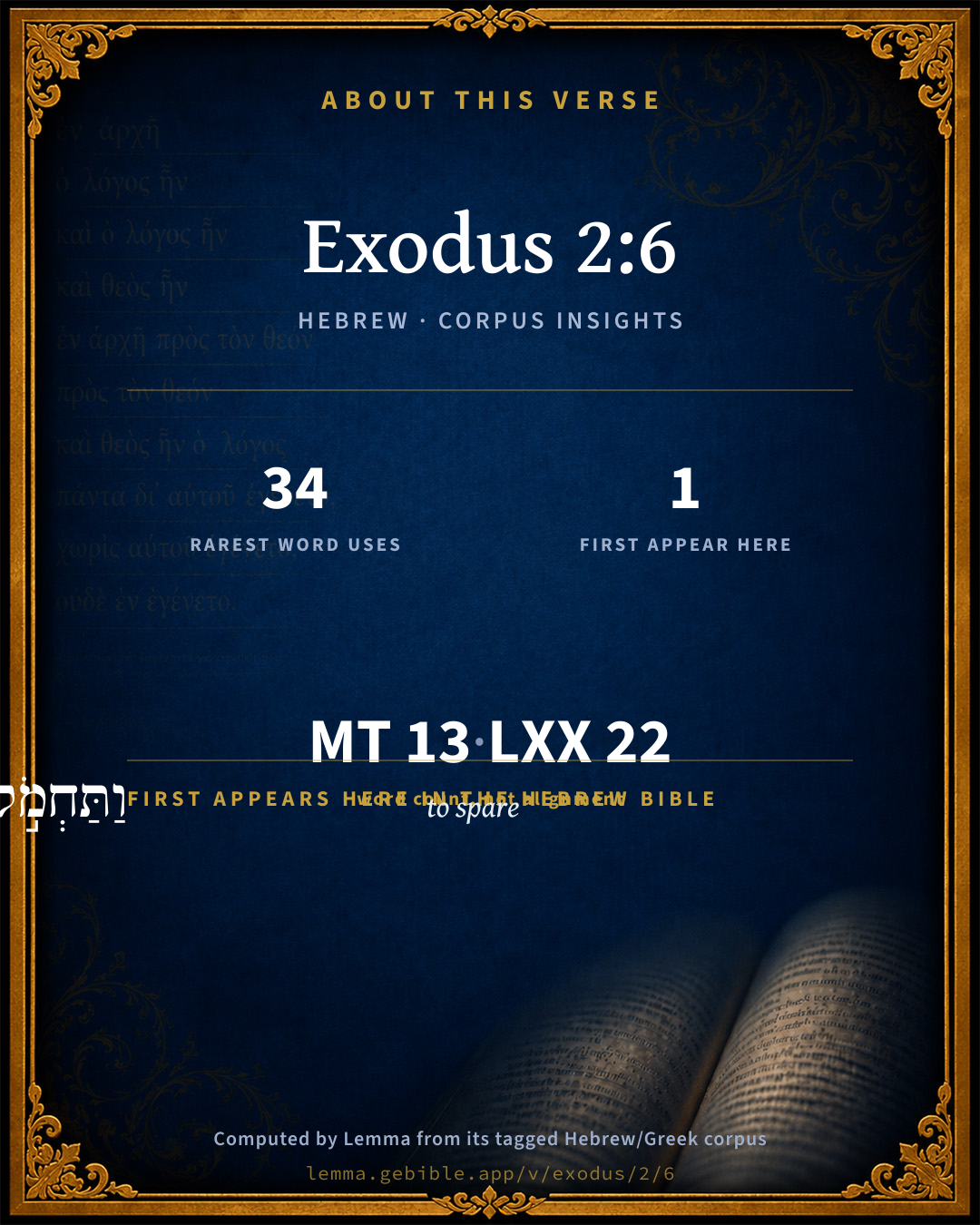
  • 1 first appearance in the Hebrew Bible
Full analysis ↓
Download a study sheet

One document with this verse’s original text, its word-by-word gloss line, the meaning frame, cross-references with their text, attributed commentary, and full source and license credits — printable, and it pastes into notes with its structure intact.

This verse Autodidact and up

Study sheet (.html) Plain text (.txt)

A passage Seminary Student

Up to 50 verses in one chapter. A passage sheet keeps up to 6 commentary sources and 12 cross-references per verse, in the order this page ranks them, and says so on the sheet whenever that leaves anything out. Ask for a single verse and you get the Autodidact verse sheet above.

Everything on this page stays free to read, with no account — the sheet is a download of what is already on screen, not access to it.

Want to remove ads? Support Godless Engineer
Compare translations 3

The same verse in 3 English versions, stacked beneath the original-language interlinear above. Click any original word for its lexicon entry.

Each is an independent rendering of the whole verse — the interlinear is not word-aligned to these translations.

Highlighted words mark where these versions differ — a whole-verse word diff, not a word-by-word alignment.

  • World English Bible Public Domain
    She opened it, and saw the child, and, behold, the baby cried. She had compassion on him, and said, "This is one of the Hebrews' children."
  • King James Version Public Domain
    And when she had opened it, she saw the child: and, behold, the babe wept. And she had compassion on him, and said, This is one of the Hebrews' children.
  • unfoldingWord Literal Text CC BY-SA 4.0
    and opened, and she saw him, the child—and behold, a crying boy. And she had compassion on him, and she said, “This one is from the children of the Hebrews.”

unfoldingWord Literal Text — © unfoldingWord, licensed CC BY-SA 4.0. Word-aligned USFM3 via Door43 (git.door43.org/unfoldingWord/en_ult).

Versions to compare (up to 4)

3 of 4 selected

Show all 18 translations

Every available English version of this verse, each an independent rendering of the whole verse.

  • World English Bible Public Domain
    She opened it, and saw the child, and, behold, the baby cried. She had compassion on him, and said, "This is one of the Hebrews' children."
  • Berean Standard Bible Public Domain
    When she opened it, she saw the child, and behold, the little boy was crying. So she had compassion on him and said, “This is one of the Hebrew children.”
  • Majority Standard Bible Public Domain
    When she opened it, she saw the child, and behold, the little boy was crying. So she had compassion on him and said, “This is one of the Hebrew children.”
  • King James Version Public Domain
    And when she had opened it, she saw the child: and, behold, the babe wept. And she had compassion on him, and said, This is one of the Hebrews' children.
  • American Standard Version (1901) Public Domain
    And she opened it, and saw the child: and, behold, the babe wept. And she had compassion on him, and said, This is one of the Hebrews' children.
  • Revised Version (1885) Public Domain
    And she opened it, and saw the child: and, behold, the babe wept. And she had compassion on him, and said, This is one of the Hebrews’ children.
  • Geneva Bible (1599) Public Domain
    Then she opened it, and sawe it was a childe: and beholde, the babe wept: so she had compassion on it, and sayde, This is one of the Ebrewes children.
  • Douay-Rheims (1899) Public Domain
    She opened it and seeing within it an infant crying, having compassion on it she said: This is one of the babes of the Hebrews.
  • Young's Literal Translation Public Domain
    and openeth, and seeth him -- the lad, and lo, a child weeping! and she hath pity on him, and saith, `This is `one' of the Hebrews' children.'
  • Literal Standard Version CC BY-SA 4.0
    and opens, and sees him—the boy, and behold, a child weeping! And she has pity on him and says, “This is [one] of the Hebrews’ children.”
  • Unlocked Literal Bible CC BY-SA 4.0
    When she opened it, she saw the child. Behold, the baby was crying. She had compassion on him and said, “This is certainly one of the Hebrews' children.”
  • unfoldingWord Literal Text CC BY-SA 4.0
    and opened, and she saw him, the child—and behold, a crying boy. And she had compassion on him, and she said, “This one is from the children of the Hebrews.”
  • Darby Bible Public Domain
    And she opened [it], and saw the child, and behold, the boy wept. And she had compassion on him, and said, This is [one] of the Hebrews' children.
  • World Messianic Bible Public Domain
    She opened it, and saw the child, and behold, the baby cried. She had compassion on him, and said, “This is one of the Hebrews’ children.”
  • Webster's Bible Public Domain
    And when she had opened it, she saw the child: and behold, the babe wept. And she had compassion on him, and said, This is one of the Hebrews' children.
  • Free Bible Version CC BY-SA 4.0
    When she opened it she saw the baby boy. He was crying and she felt sorry for him. “This must be one of the Hebrew boys,” she said.
  • Bible in Basic English Public Domain
    And opening it, she saw the child, and he was crying. And she had pity on him, and said, This is one of the Hebrews' children.
  • JPS Tanakh (1917) Public Domain
    And she opened it, and saw it, even the child; and behold a boy that wept. And she had compassion on him, and said: 'This is one of the Hebrews' children.'

Literal Standard Version (2020), Covenant Press — licensed CC BY-SA 4.0. Text via the HelloAO Bible API (eBible.org). Unlocked Literal Bible (unfoldingWord) — licensed CC BY-SA 4.0. Text via the HelloAO Bible API (eBible.org). unfoldingWord Literal Text — © unfoldingWord, licensed CC BY-SA 4.0. Word-aligned USFM3 via Door43 (git.door43.org/unfoldingWord/en_ult). Free Bible Version, Dr. Jonathan Gallagher — licensed CC BY-SA 4.0. Text via the HelloAO Bible API (eBible.org).

Word by word

More ways to search: Search by grammar → Find every occurrence → Compare this word →

Practice this passage: Drill this verse → Learn its vocabulary →

הָֽעִבְרִ֖ים
ʻIbrîy
H5680
“the · Hebrews”
Particle, Definite Article + Noun, Gentilic, Masculine, Plural, Absolute
Part of Speech
Particle + Noun
Type
Gentilic
Gender
Masculine
Number
Plural
State
Absolute
Full BDB Definition

Origin: patronymic from H5677

TWOT: None

Hebrew = "one from beyond" - a designation of the patriarchs and the Israelites (noun proper) - a designation of the patriarchs and the Israelites (adjective)
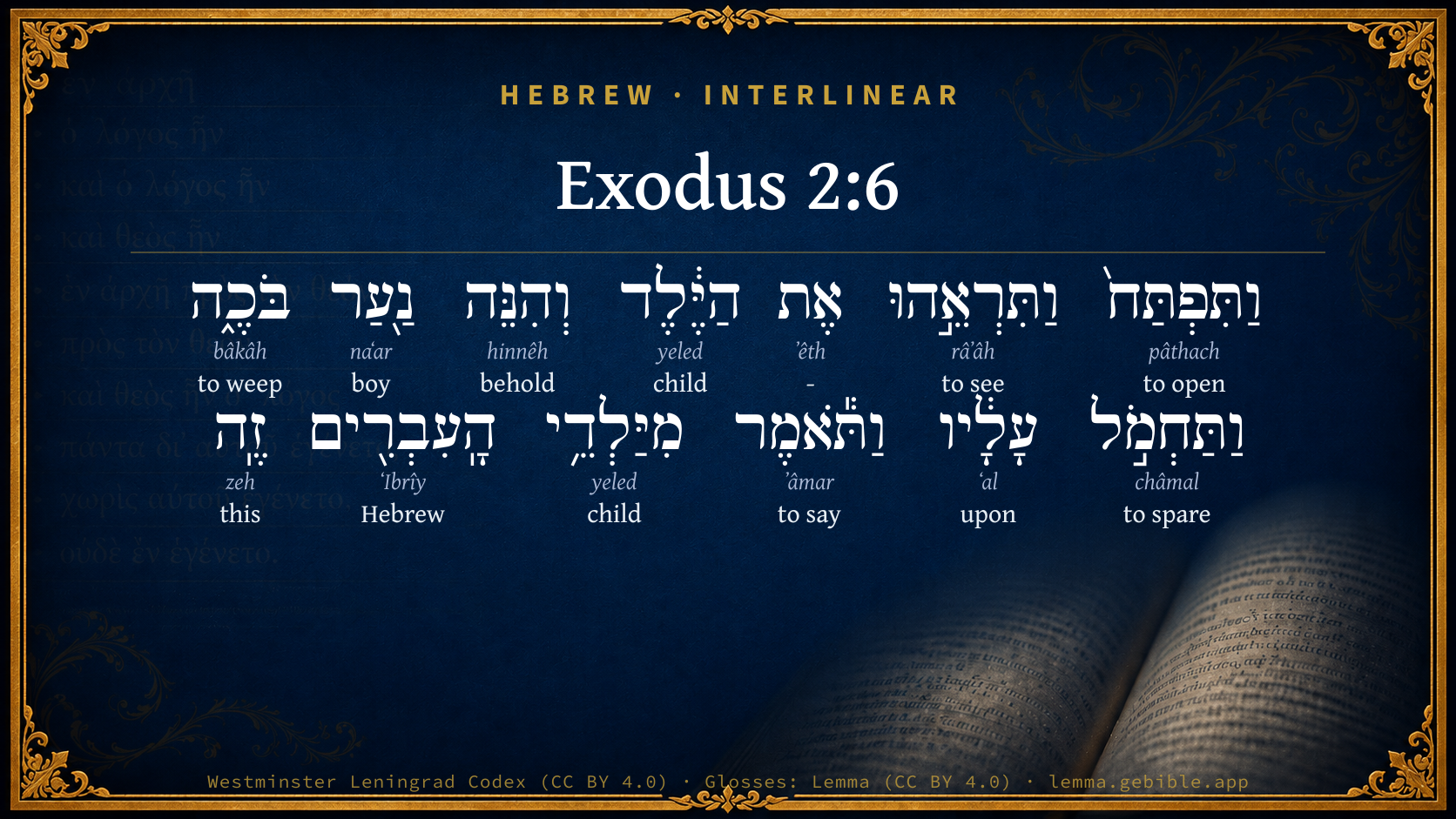
  1. וַתִּפְתַּח֙ pâthach H6605 “and · to open” Conjunction + Verb, Qal, Sequential Imperfect, 3rd Person, Feminine, Singular
  2. וַתִּרְאֵ֣הוּ râʼâh H7200 “and · to see · him” Conjunction + Verb, Qal, Sequential Imperfect, 3rd Person, Feminine, Singular + Suffix, Personal, 3rd Person, Masculine, Singular
  3. אֶת ʼêth H853 “-” Particle, Direct Object
  4. הַיֶּ֔לֶד yeled H3206 “the · child” Particle, Definite Article + Noun, Common, Masculine, Singular, Absolute
  5. וְהִנֵּה hinnêh H2009 “and · behold” Conjunction + Particle, Demonstrative
  6. נַ֖עַר naʻar H5288 “boy” Noun, Common, Masculine, Singular, Absolute
  7. בֹּכֶ֑ה bâkâh H1058 “weeping” Verb, Qal, Participle Active, Masculine, Singular, Absolute
  8. וַתַּחְמֹ֣ל châmal H2550 “and · to spare” Conjunction + Verb, Qal, Sequential Imperfect, 3rd Person, Feminine, Singular
  9. עָלָ֔יו ʻal H5921 “upon · him” Preposition + Suffix, Personal, 3rd Person, Masculine, Singular
  10. וַתֹּ֕אמֶר ʼâmar H559 “and · to say” Conjunction + Verb, Qal, Sequential Imperfect, 3rd Person, Feminine, Singular
  11. מִיַּלְדֵ֥י yeled H3206 “from · children of” Preposition + Noun, Common, Masculine, Plural, Construct
  12. זֶֽה zeh H2088 “this” Pronoun, Demonstrative, Masculine, Singular

About this verse

These counts appear in no published source. They are computed here, from the morphology-tagged text and Lemma’s own curated glosses. What Lemma adds →

13
words
12
distinct lemmas
Pentateuch
section

First appearance in Scripture

This word makes its first canonical appearance in the Hebrew Bible here:

  • וַתַּחְמֹ֣ל to spare H2550

Shared distinctive vocabulary

הָֽעִבְרִ֖ים Hebrew H5680 occurs in 32 verses of the Hebrew Bible. Also found in:

Grammatical profile

  • 5 verbs
  • 4 nouns
  • 1 pronoun
  • 1 preposition
  • 2 particles

Verb forms

  • וַתִּפְתַּח֙ Qal · Sequential Imperfect
  • וַתִּרְאֵ֣הוּ Qal · Sequential Imperfect
  • בֹּכֶ֑ה Qal · Participle Active
  • וַתַּחְמֹ֣ל Qal · Sequential Imperfect
  • וַתֹּ֕אמֶר Qal · Sequential Imperfect

Repetition

A word recurs within this verse — often emphatic in Hebrew:

  • הַיֶּ֔לֶד child H3206 ×2

Hebrew & Septuagint length

In English translation the verse runs 26 words from the Hebrew and 30 from the Septuagint (LXX English) — closely comparable.

A rough comparison of the two English renderings, which tokenize alike — not a word-level alignment.

Word counts can differ between the Hebrew and the Greek without any difference in meaning — e.g. the Hebrew direct-object marker אֵת has no separate Greek word, and Greek often adds the article ὁ.

In the original languages it is 13 Hebrew tokens and 22 Greek tokens — but the two are counted differently (Hebrew bundles its prefixes and suffixes into one token; the Greek is in lemma form), so that isn’t a like-for-like length.

Cross-references

6

Topical passages linked to Exodus 2:6 in the Treasury of Scripture Knowledge — connected by theme and wording, ordered by reader-vote popularity; previews shown in the World English Bible.

  • 1 Kings 8:50 and forgive your people who have sinned against you, and all their transgressions in which they have transgressed against you; and give them compassion before those who carried them captive, that they may have compassion on them
  • Acts 7:21 When he was thrown out, Pharaoh's daughter took him up, and reared him as her own son.
  • 1 Peter 3:8 Finally, be all like-minded, compassionate, loving as brothers, tenderhearted, courteous,
  • Nehemiah 1:11 Lord, I beg you, let now your ear be attentive to the prayer of your servant, and to the prayer of your servants, who delight to fear your name; and please prosper your servant this day, and grant him mercy in the sight of this man. Now I was cup bearer to the king.
  • Psalms 106:46 He made them also to be pitied By all those who carried them captive.
  • Proverbs 21:1 The king's heart is in Yahweh's hand like the watercourses. He turns it wherever he desires.

Cross-references courtesy of OpenBible.info (CC BY 4.0).

Hebrew and Greek witnesses Masoretic Hebrew ↔ Greek Septuagint

The same verse in the two great witnesses to the Old Testament, shown verse-for-verse.

These are two independent witnesses, not word-aligned to each other, and the Septuagint is shown in lemma (dictionary) form.

Hebrew Exodus 2:6 Masoretic · Westminster Leningrad Codex

וַתִּפְתַּח֙ וַתִּרְאֵ֣הוּ אֶת הַיֶּ֔לֶד וְהִנֵּה נַ֖עַר בֹּכֶ֑ה וַתַּחְמֹ֣ל עָלָ֔יו וַתֹּ֕אמֶר מִיַּלְדֵ֥י הָֽעִבְרִ֖ים זֶֽה

She opened it, and saw the child, and, behold, the baby cried. She had compassion on him, and said, "This is one of the Hebrews' children."

World English Bible · Public Domain

Greek LXX Exodus 2:6 Septuagint · lemma form

ἀναοἴγω δέ ὁράω παιδίον κλαίω ἐν ὁ θῖβις καί φείδομαι αὐτός ὁ θυγάτηρ φαραώ καί φημί ἀπό ὁ παιδίον ὁ εβραῖος οὗτος

And having opened it, she sees the babe weeping in the ark: and the daughter of Pharao had compassion on it, and said, This is one of the Hebrew's children.

LXX2012 (modern English Septuagint) · Public Domain

Hebrew: Westminster Leningrad Codex (CC BY 4.0). Greek: Septuagint (public domain); English from LXX2012 (modern English Septuagint) (Public Domain). How the Septuagint differs from the Hebrew →

Targum (Aramaic paraphrase)

2

The Targum is the ancient Jewish Aramaic paraphrase of the Hebrew Scriptures — an interpretive translation, not the Hebrew text itself. Onkelos (literal) and Pseudo-Jonathan (expansive) render the Torah, and Jonathan the Prophets. Coverage is partial: where no permissively-licensed English translation exists for a verse, only the Aramaic is shown. This is verse-level text, not a word-by-word alignment to the Hebrew.

  1. Targum Onkelos Torah (Genesis–Deuteronomy)
    וּפְתָחַת וַחֲזַת יָת רַבְיָא וְהָא עוּלֵימָא בָּכֵי וְחָסַת עֲלוֹהִי וַאֲמֶרֶת מִבְּנֵי יְהוּדָאֵי הוּא דֵין:

    (no public-domain English translation for this verse)

    Targum Onkelos — Aramaic: “Onkelos Genesis” (public domain); “Onkelos Exodus” (public domain); “Onkelos Leviticus” (public domain); “Onkelos Numbers” (public domain); “Onkelos Deuteronomy” (public domain). English: “Sefaria Community Translation” (CC0 1.0 (public-domain dedication)); “J.W. Etheridge. The Targums of Onkelos and Jonathan Ben Uzziel on the Pentateuch. London: Longmans, Green, 1862” (public domain). Text via Sefaria.

  2. Targum Pseudo-Jonathan Torah (Genesis–Deuteronomy)
    וּפְתָחַת וְחָמַת יַת רַבְיָא וְהָא טַלְיָא בָּכֵי וְחָסַת עֲלוֹי וַאֲמָרַת מִן בְּנֵי יְהוּדָאֵי הוּא דֵין

    And she opened, and saw the child, and, behold, the babe wept; and she had compassion upon him, and said, This is one of the children of the Jehudaee.

    Targum Pseudo-Jonathan — Aramaic: “Targum Jonathan on Genesis” (public domain); “Targum Jonathan on Exodus” (public domain); “Targum Jonathan on Leviticus” (public domain); “Targum Jonathan on Numbers” (public domain); “Targum Jonathan on Deuteronomy” (public domain). English: “The Targum of Jonathan ben Uzziel, trans. J. W. Etheridge, London, 1862” (public domain). Text via Sefaria.

Commentary

Notes on Exodus 2:6 from classic Christian and Jewish commentators (each source and its license shown beneath its notes). The classic Christian expositions comment on the surrounding passage and are grouped to its opening verse, so a note may address several verses; the Jewish commentaries on the Tanakh (Rashi and others) are per-verse, so they appear only where the commentator wrote on this verse.

Lemma curates 59 commentaries, every one of them public domain or Creative Commons licensed, each selected and text-cleaned for this edition rather than reprinted as found. About our sources →

Trapp's Complete Commentary

John Trapp

Exo 2:6 And when she had opened [it], she saw the child: and, behold, the babe wept. And she had compassion on him, and said, This [is one] of the Hebrews’ children.

Ver. 6. One of the Hebrews’ children.] So called of Heber. {See Trapp on "Gen 13:14"}

John Trapp, A Commentary or Exposition upon All the Books of the Old and New Testament (1647–1656) — public domain. Text from a community e-Sword module.

Jamieson, Fausset & Brown

Robert Jamieson, A. R. Fausset & David Brown

when she had opened it, she saw the child--The narrative is picturesque. No tale of romance ever described a plot more skilfully laid or more full of interest in the development. The expedient of the ark, the slime and pitch, the choice of the time and place, the appeal to the sensibilities of the female breast, the stationing of the sister as a watch of the proceedings, her timely suggestion of a nurse, and the engagement of the mother herself--all bespeak a more than ordinary measure of ingenuity as well as intense solicitude on the part of the parents. But the origin of the scheme was most probably owing to a divine suggestion, as its success was due to an overruling Providence, who not only preserved the child's life, but provided for his being trained in the nurture and admonition of the Lord. Hence it is said to have been done by faith (Heb 11:23), either in the general promise of deliverance, or some special revelation made to Amram and Jochebed--and in this view, the pious couple gave a beautiful example of a firm reliance on the word of God, united with an active use of the most suitable means.

Jamieson, Fausset & Brown — Commentary Critical and Explanatory on the Whole Bible (1871) — public domain (CC PDM 1.0). Text via the HelloAO Bible API.

Adam Clarke's Commentary

Verse 6. She had compassion on him] The sight of a beautiful babe in distress could not fail to make the impression here mentioned; See Clarke on Ex 2:2. It has already been conjectured that the cruel edict of the Egyptian king did not continue long in force; see Ex 1:22. And it will not appear unreasonable to suppose that the circumstance related here might have brought about its abolition. The daughter of Pharaoh, struck with the distressed state of the Hebrew children from what she had seen in the case of Moses, would probably implore her father to abolish this sanguinary edict.

Adam Clarke's Commentary on the Bible (1810–1826) — public domain. Text from a community e-Sword/MySword module.

Ellicott's Commentary for English Readers

(6) When she had opened it.—The princess opened the ark herself, perhaps suspecting what was inside, perhaps out of mere curiosity.

The babe (rather, the boy) wept. Through hunger, or cold, or perhaps general discomfort. An ark of bulrushes could not have been a very pleasant cradle.

She had compassion on him.—The babe’s tears moved her to pity; and her pity prompted her to save it. She must have shown some sign of her intention—perhaps by taking the child from the ark and fondling it—before Miriam could have ventured to make her suggestion. (See the next verse.)

This is one of the Hebrews’ children.—The circumstances spoke for themselves. No mother would have exposed such a “goodly child” (Exo_2:2) to so sad a death but one with whom it was a necessity.

A Bible Commentary for English Readers, edited by Charles John Ellicott (1878–1897) — public domain. Text from a community e-Sword module.

The Cambridge Bible for Schools and Colleges

gen. ed. J. J. S. Perowne

6. and behold, &c.] Heb. and, behold, a weeping boy. The sight moved her compassion; and despite the Pharaoh’s orders, she determined to spare the child, and bring it up.

The Cambridge Bible for Schools and Colleges (gen. ed. J. J. S. Perowne; Cambridge University Press, 1878–1918) — public domain. Text from a community e-Sword module.

John Gill's Exposition

And when she had opened it,.... The ark, for it was shut or covered over, though doubtless there were some apertures for respiration:

she saw the child in it, and, behold, the babe wept; and which was a circumstance, it is highly probable, greatly affected the king's daughter, and moved her compassion to it; though an Arabic writer says (p), she heard the crying of the child in the ark, and therefore sent for it:

and she had compassion on him, and said, this is one of the Hebrews' children; which she might conclude from its being thus exposed, knowing her father's edict, and partly from the form and beauty of it, Hebrew children not being swarthy and tawny as Egyptian ones: the Jewish writers (q) say, she knew it by its being circumcised, the Egyptians not yet using circumcision.

(p) Patricides apud Hottinger. p 401. (q) T. Bab. Sotah, fol. 12. 2. Aben Ezra in loc.

John Gill's Exposition of the Whole Bible (1746–1763) — public domain (CC PDM 1.0). Text via the HelloAO Bible API.

Albert Barnes' Notes on the Bible

She had compassion on him - The Egyptians regarded such tenderness as a condition of acceptance on the day of reckoning. In the presence of the Lord of truth each spirit had to answer, “I have not afflicted any man, I have not made any man weep, I have not withheld milk from the mouths of sucklings” (‘Funeral Ritual’). There was special ground for mentioning the feeling, since it led the princess to save and adopt the child in spite of her father’s commands.

Albert Barnes' Notes on the Bible (1834–1885) — public domain. Text from a community e-Sword/MySword module.

Haydock's Catholic Bible Commentary

Hebrews, against whom the persecution raged. She saw it had received circumcision. (Theodoret, q. in Exodus)

George Leo Haydock (1774–1849), Haydock's Catholic Family Bible and Commentary, 1859 edition — public domain. Excludes Psalms (Douay-Rheims chapter numbering differs from Protestant) and Deuterocanonical books (Catholic canon only).

Matthew Poole's English Annotations

This she might very probably guess, both from the circumstances in which she found him, and from the singular fairness and beauty of the child, far differing from the Egyptian hue; and she might certainly know it by its circumcision.

Matthew Poole's English Annotations on the Holy Bible (1683–1685) — public domain. Text from a community e-Sword/MySword module.

Whedon's Commentary on the Bible

Daniel D. Whedon

6-9. There is a pathos in this description which shows that the writer’s heart was in it. That princess was his adopting mother. The self-reliant action of the king’s daughter, notwithstanding her father’s cruel and absolute command, well illustrates the independence in character and action which distinguished the Egyptian women, at least the high-born.

The Egyptians were taught also to regard mercy as one of the conditions of acceptance in the day of judgment. In the Funeral Ritual, or Book of the Dead, recently translated from a papyrus by Birch, the human spirit is represented as answering to the judge, “I have not afflicted any man; I have not made any man weep; I have not withheld milk from the mouths of sucklings.”

Daniel D. Whedon (gen. ed.), Commentary on the Old and New Testaments (1874–1909) — public domain. Text from a community e-Sword module.

The Pulpit Commentary

The princess herself opened the "ark," which was a sort of covered basket. Perhaps she suspected what she would find inside; but would it be a living or a dead child? This she could not know. She opened, and looked. It was a living babe, and it wept. At once her woman"s heart, heathen as she was, went out to the child its tears reached the common humanity that lies below all differences of race and creed and she pitied it. "One touch of nature makes the whole world kin." This is one of the Hebrews" children. Hebrew characteristics were perhaps stamped even upon the infant visage. Or she formed her conclusion merely from the circumstances. No Egyptian woman had any need to expose her child, or would be likely to do so; but it was just what a Hebrew mother, under the cruel circumstances of the time, might have felt herself forced to do. So she drew her conclusion, rapidly and decidedly, as is the way of woman.

The Pulpit Commentary (1880–1919), ed. H.D.M. Spence-Jones & Joseph S. Exell — public domain. Text from a community e-Sword module.

Rashi

Rabbi Shlomo Yitzchaki (Rashi)

ותפתח ותראהו lit., AND SHE OPENED IT AND SHE SAW HIM — whom did she see? את הילד THE CHILD. This is the literal sense of the suffix in ותראהו. A Midrashic explanation is (taking את in the sense of “with”— she saw Him with the child): she saw the Shechina with him (cf. Sotah 12b).

והנה נער בכה lit., AND BEHOLD A BOY WEEPING — Although he was a ילד, “a child”, his voice was like that of a נער, a grown up boy (cf. Sotah 12b).

Rashi on the Tanakh — English translations: “The Judaica Press complete Tanach with Rashi, translated by A. J. Rosenberg” (CC BY 4.0); “Pentateuch with Rashi's commentary by M. Rosenbaum and A.M. Silbermann, 1929-1934” (public domain); “The Metsudah Tanach series, Lakewood, N.J” (CC BY 4.0); and “The Book of Joshua, Metsudah Publications, 1997” (CC BY 4.0). Text via Sefaria.

Ramban (Nachmanides)

Rabbi Moshe ben Nachman (Ramban / Nachmanides)

AND BEHOLD IT WAS A WEEPING LAD. “His voice sounded like that of a grown lad.”. Hence, in accordance with Rabbi Yehudah’s opinion in Sotah 12 b, Rashi construed that he was a child with the voice of a young lad. Thus the language of Rabbeinu Shlomo. Now the Rabbis have already rejected this opinion, saying, ). “If so, you have made Moses our teacher appear as having a blemish [and being unfit for Levitical service in the Tabernacle].” Besides, what reason is there for Scripture to mention his unnatural voice?And Rabbi Abraham ibn Ezra said that his limbs were developed as that of a young lad. Perhaps Scripture mentioned this in order to denote the child’s beauty. It was due to his exquisite beautiful appearance that she [the princess] had compassion for him since she recognized that he had been recently born and yet his limbs were well-developed like those of a lad.A more correct interpretation is that his was a strong and unrelenting cry like that of a lad, and therefore she had compassion for him. A homiletic exposition has it: “A weeping lad. He was a child whose behavior was that of a lad [who is not prone to crying]. At that moment, the angel Gabriel came and struck him so that he would cry and she would be compassionate towards him.”In my opinion there is no need for all this. From the day of his birth, a child is called na’ar (lad) [in Scripture], as it is said, What shall we do ‘lana’ar’ (to the lad) that shall be born? Similarly, And David besought G-d for ‘hana’ar’ (the lad). Conversely, Scripture calls a grown lad yeled (child), as it is said in the case of Ishmael. (Genesis 21:15). At that time, Ishmael was seventeen years old. (See Ramban, Vol. I, p. 270, and Note 329, ibid.). Yet he is called yeled. Similarly, ‘v’hana’ar na’ar’ (and the lad was young),. meaning that he [Samuel] was a young child of twenty-four months. As soon as she [his mother, Hannah] had weaned him, she brought him up to Shiloh, as it is written, And she gave her son suck until she weaned him. And when she had weaned him, she took him up with her., Verses 23-24.

AND SHE SAID, THIS IS ONE OF THE HEBREWS’ CHILDREN. [She came to this conclusion because] contemplating what happened, she said [that his mother had done it] in order to save him or that she had placed him there so that she might not look upon the death of her child, and why should an Egyptian do that? Some Rabbis say that [she knew he was a Hebrew because] she saw that he was circumcised. If so, [we must assume that] she removed his clothes and examined him. But there is no need for this.

Ramban (Nachmanides) on the Tanakh — English translation: “Commentary on the Torah by Ramban (Nachmanides). Translated and annotated by Charles B. Chavel. New York, Shilo Pub. House, 1971-1976” (CC BY 4.0). Text via Sefaria.

Lesson kit

Teaching starters — assembled from the data on this page, not authored interpretation. Every prompt links to the verse data it draws on. Edit before teaching.

Exodus, in the Pentateuch, opens this verse with 13 words (12 distinct Hebrew lemmas). Its most distinctive word is ʻIbrîy (“Hebrew”). A historical commentator’s framing appears above. Read the whole chapter for the surrounding context.

Discussion questions

  1. The word ʻIbrîy carries the sense “Hebrew.” How does it shape the verse?
  2. The word “to spare” first appears here in Scripture. What is being introduced at this debut?
  3. Genesis 14:13 shares the word «Hebrew» with this verse. How do the two illuminate each other?
  4. “child” occurs 2× in this one verse. What is the effect of the repetition?
  5. The translations on this page render this verse differently — a whole-verse word diff, not a word-by-word alignment. What might account for the different wordings?
  6. The verb «וַתִּפְתַּח֙» is Qal Sequential Imperfect. How does its form color the action?
  7. Reading how Trapp's Complete Commentary and Jamieson, Fausset & Brown read this verse, where do the two commentators agree and where do they part?

Things to notice

Reading settings

Reading text

Shown beneath each verse's original-language words.

Old Testament
Old Testament edition

Read the OT as the Masoretic Hebrew (MT) or the Greek Septuagint (LXX).

English shown for the Greek Septuagint (in the Hebrew ↔ Greek comparison).

Comparing translations? Open the Compare panel on any verse page to stack up to four side by side.