
1 Kings 20:14

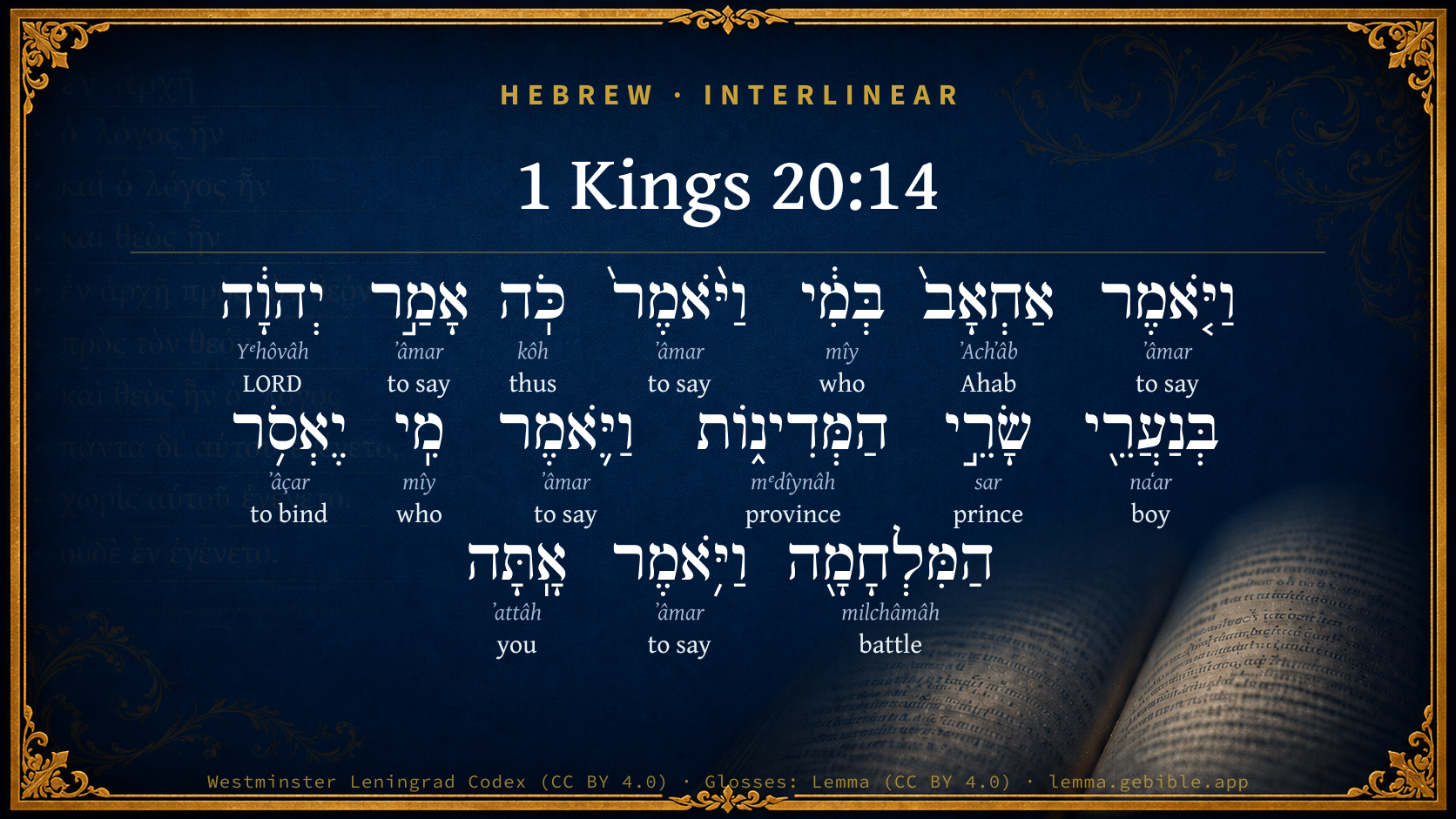
Hebrew (Westminster Leningrad Codex) 1 Kings 20:14 appears in the Hebrew Old Testament. The text above is from the Westminster Leningrad Codex. Each word links to its Strong’s number, a concise gloss, and parsing drawn from the Open Scriptures Hebrew Bible morphology. Click any word for its full Brown-Driver-Briggs (BDB) entry.
Download image
Cite this verse

1 Kings 20:14 (World English Bible). Public Domain. Lemma interlinear Bible study tool, https://lemma.gebible.app/v/1-kings/20/14.

Show BibTeX & RIS
BibTeX
RIS
English Translation
Ahab said, By whom? He said, Thus says Yahweh, By the young men of the princes of the provinces. Then he said, Who shall begin the battle? He answered, You.
World English Bible · Public Domain
Highlights Full analysis ↓
Download a study sheet

One document with this verse’s original text, its word-by-word gloss line, the meaning frame, cross-references with their text, attributed commentary, and full source and license credits — printable, and it pastes into notes with its structure intact.

This verse Autodidact and up

Study sheet (.html) Plain text (.txt)

A passage Seminary Student

Up to 50 verses in one chapter. A passage sheet keeps up to 6 commentary sources and 12 cross-references per verse, in the order this page ranks them, and says so on the sheet whenever that leaves anything out. Ask for a single verse and you get the Autodidact verse sheet above.

Everything on this page stays free to read, with no account — the sheet is a download of what is already on screen, not access to it.

Want to remove ads? Support Godless Engineer
Compare translations 3

The same verse in 3 English versions, stacked beneath the original-language interlinear above. Click any original word for its lexicon entry.

Each is an independent rendering of the whole verse — the interlinear is not word-aligned to these translations.

Highlighted words mark where these versions differ — a whole-verse word diff, not a word-by-word alignment.

  • World English Bible Public Domain
    Ahab said, By whom? He said, Thus says Yahweh, By the young men of the princes of the provinces. Then he said, Who shall begin the battle? He answered, You.
  • King James Version Public Domain
    And Ahab said, By whom? And he said, Thus saith the LORD, Even by the young men of the princes of the provinces. Then he said, Who shall order the battle? And he answered, Thou.
  • unfoldingWord Literal Text CC BY-SA 4.0
    And Ahab said, “By whom?” And he said, “Thus says Yahweh, ‘By the servants of the leaders of the districts.’” And he said, “Who will bind the battle?” And he said, “You.”

unfoldingWord Literal Text — © unfoldingWord, licensed CC BY-SA 4.0. Word-aligned USFM3 via Door43 (git.door43.org/unfoldingWord/en_ult).

Versions to compare (up to 4)

3 of 4 selected

Show all 18 translations

Every available English version of this verse, each an independent rendering of the whole verse.

  • World English Bible Public Domain
    Ahab said, By whom? He said, Thus says Yahweh, By the young men of the princes of the provinces. Then he said, Who shall begin the battle? He answered, You.
  • Berean Standard Bible Public Domain
    “By whom?” Ahab asked. And the prophet replied, “This is what the LORD says: ‘By the young officers of the district governors.’” “Who will start the battle?” asked Ahab. “You will,” answered the prophet.
  • Majority Standard Bible Public Domain
    “By whom?” Ahab asked. And the prophet replied, “This is what the LORD says: ‘By the young officers of the district governors.’” “Who will start the battle?” asked Ahab. “You will,” answered the prophet.
  • King James Version Public Domain
    And Ahab said, By whom? And he said, Thus saith the LORD, Even by the young men of the princes of the provinces. Then he said, Who shall order the battle? And he answered, Thou.
  • American Standard Version (1901) Public Domain
    And Ahab said, By whom? And he said, Thus saith Jehovah, By the young men of the princes of the provinces. Then he said, Who shall begin the battle? And he answered, Thou.
  • Revised Version (1885) Public Domain
    And Ahab said, By whom? And he said, Thus saith the LORD, By the young men of the princes of the provinces. Then he said, Who shall begin the battle? And he answered, Thou.
  • Geneva Bible (1599) Public Domain
    And Ahab sayd, By whome? And he sayde, Thus sayth the Lord, By the seruants of the princes of the prouinces. He sayde againe, Who shall order the battel? And he answered, Thou.
  • Douay-Rheims (1899) Public Domain
    And Achab said: By whom? And he said to him: Thus saith the Lord: By the servants of the princes of the provinces. And he said: Who shall begin to fight? And he said: Thou.
  • Young's Literal Translation Public Domain
    And Ahab saith, `By whom?' and he saith, `Thus said Jehovah, By the young men of the heads of the provinces;' and he saith, `Who doth direct the battle?' and he saith, `Thou.'
  • Literal Standard Version CC BY-SA 4.0
    And Ahab says, “By whom?” And he says, “Thus said YHWH: By the young men of the heads of the provinces”; and he says, “Who directs the battle?” And he says, “You.”
  • Unlocked Literal Bible CC BY-SA 4.0
    Ahab replied, “By whom?” Yahweh replied and said, “By the young officers who serve the governors of the districts.” Then Ahab said, “Who will begin the battle?” Yahweh answered, “You.”
  • unfoldingWord Literal Text CC BY-SA 4.0
    And Ahab said, “By whom?” And he said, “Thus says Yahweh, ‘By the servants of the leaders of the districts.’” And he said, “Who will bind the battle?” And he said, “You.”
  • Darby Bible Public Domain
    And Ahab said, By whom? And he said, Thus saith Jehovah: By the servants of the princes of the provinces. Then he said, Who shall begin the battle? And he said, Thou.
  • World Messianic Bible Public Domain
    Ahab said, “By whom?” He said, “The LORD says, ‘By the young men of the princes of the provinces.’” Then he said, “Who shall begin the battle?” He answered, “You.”
  • Webster's Bible Public Domain
    And Ahab said, By whom? And he said, Thus saith the LORD, Even by the young men of the princes of the provinces. Then he said, Who shall order the battle? And he answered, Thou.
  • Free Bible Version CC BY-SA 4.0
    “But who's going to do this?” Ahab asked. The prophet answered, “This is what the Lord says: It will be the young officers under the district commanders.” “And who's going to start the battle?” he asked. The prophet replied, “You are!”
  • Bible in Basic English Public Domain
    And Ahab said, By whom? And he said, The Lord says, By the servants of the chiefs who are over the divisions of the land. Then he said, By whom is the fighting to be started? And he made answer, By you.
  • JPS Tanakh (1917) Public Domain
    And Ahab said: 'By whom?' And he said: 'Thus saith the LORD: By the young men of the princes of the provinces.' Then he said: 'Who shall begin the battle?' And he answered: 'Thou.'

Literal Standard Version (2020), Covenant Press — licensed CC BY-SA 4.0. Text via the HelloAO Bible API (eBible.org). Unlocked Literal Bible (unfoldingWord) — licensed CC BY-SA 4.0. Text via the HelloAO Bible API (eBible.org). unfoldingWord Literal Text — © unfoldingWord, licensed CC BY-SA 4.0. Word-aligned USFM3 via Door43 (git.door43.org/unfoldingWord/en_ult). Free Bible Version, Dr. Jonathan Gallagher — licensed CC BY-SA 4.0. Text via the HelloAO Bible API (eBible.org).

Word by word

More ways to search: Search by grammar → Find every occurrence → Compare this word →

Practice this passage: Drill this verse → Learn its vocabulary →

הַמְּדִינ֑וֹת
mᵉdîynâh
H4082
“the · provinces”
Particle, Definite Article + Noun, Common, Feminine, Plural, Absolute
Part of Speech
Particle + Noun
Type
Common
Gender
Feminine
Number
Plural
State
Absolute
Full BDB Definition

Origin: from H1777

TWOT: 426d

province, district - district - province
  1. וַיֹּ֤אמֶר ʼâmar H559 “and · to say” Conjunction + Verb, Qal, Sequential Imperfect, 3rd Person, Masculine, Singular
  2. אַחְאָב֙ ʼAchʼâb H256 “Ahab” Noun, Proper
  3. בְּמִ֔י mîy H4310 “in/at · who” Preposition + Particle, Interrogative
  4. וַיֹּ֨אמֶר֙ ʼâmar H559 “and · to say” Conjunction + Verb, Qal, Sequential Imperfect, 3rd Person, Masculine, Singular
  5. כֹּֽה kôh H3541 “thus” Adverb
  6. אָמַ֣ר ʼâmar H559 “to say” Verb, Qal, Perfect, 3rd Person, Masculine, Singular
  7. יְהוָ֔ה Yᵉhôvâh H3068 “LORD” Noun, Proper
  8. בְּנַעֲרֵ֖י naʻar H5288 “in/at · boys of” Preposition + Noun, Common, Masculine, Plural, Construct
  9. שָׂרֵ֣י sar H8269 “princes of” Noun, Common, Masculine, Plural, Construct
  10. וַיֹּ֛אמֶר ʼâmar H559 “and · to say” Conjunction + Verb, Qal, Sequential Imperfect, 3rd Person, Masculine, Singular
  11. מִֽי mîy H4310 “who” Particle, Interrogative
  12. יֶאְסֹ֥ר ʼâçar H631 “to bind” Verb, Qal, Imperfect, 3rd Person, Masculine, Singular
  13. הַמִּלְחָמָ֖ה milchâmâh H4421 “the · battle” Particle, Definite Article + Noun, Common, Feminine, Singular, Absolute
  14. וַיֹּ֥אמֶר ʼâmar H559 “and · to say” Conjunction + Verb, Qal, Sequential Imperfect, 3rd Person, Masculine, Singular
  15. אָֽתָּה ʼattâh H859 “you” Pronoun, Personal, 2nd Person, Masculine, Singular

About this verse

These counts appear in no published source. They are computed here, from the morphology-tagged text and Lemma’s own curated glosses. What Lemma adds →

16
words
11
distinct lemmas
Historical
section

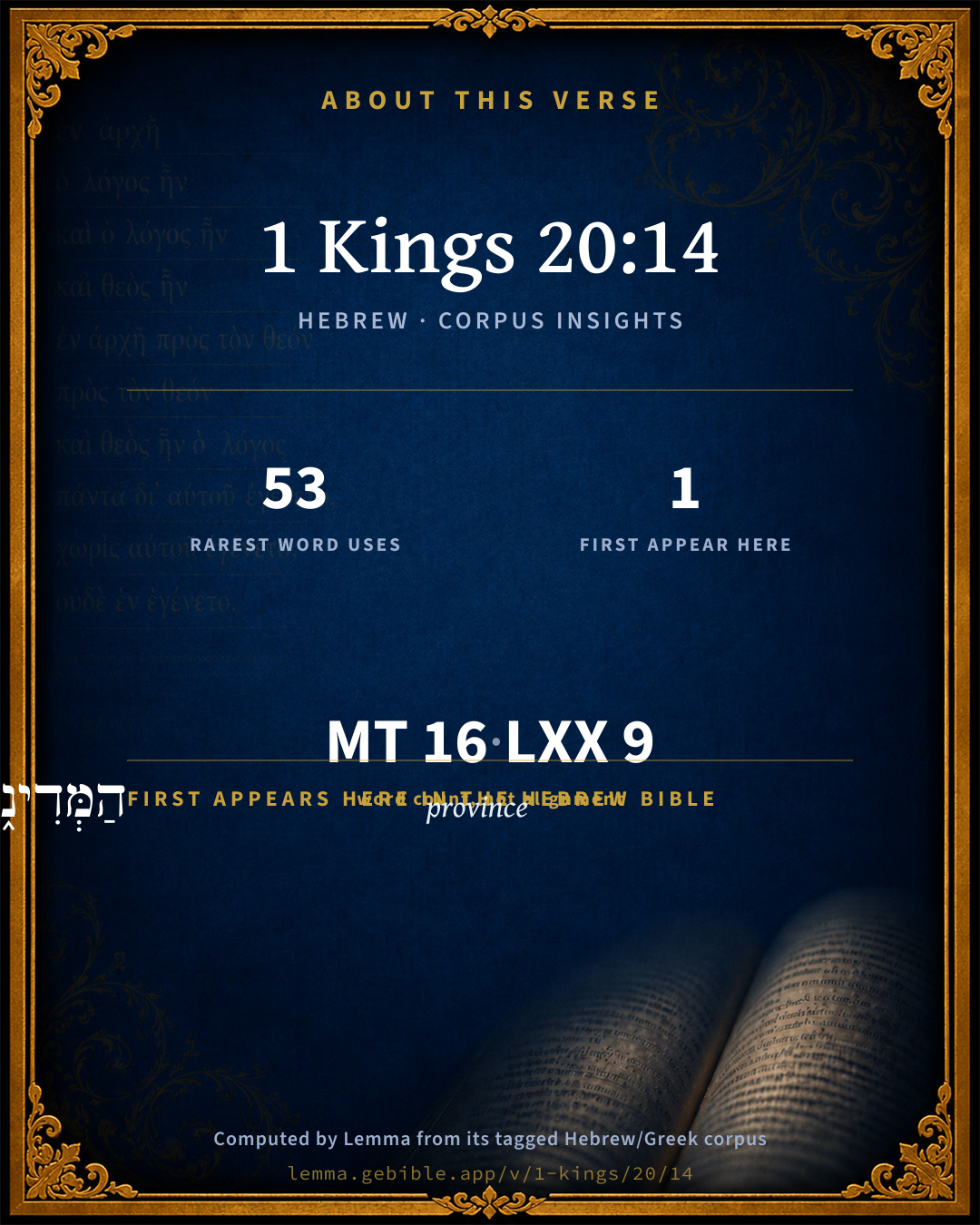
First appearance in Scripture

This word makes its first canonical appearance in the Hebrew Bible here:

  • הַמְּדִינ֑וֹת province H4082

Shared distinctive vocabulary

הַמְּדִינ֑וֹת province H4082 occurs in 40 verses of the Hebrew Bible. Also found in:

Grammatical profile

  • 6 verbs
  • 6 nouns
  • 1 pronoun
  • 1 adverb
  • 2 particles

Verb forms

  • וַיֹּ֤אמֶר Qal · Sequential Imperfect
  • וַיֹּ֨אמֶר֙ Qal · Sequential Imperfect
  • אָמַ֣ר Qal · Perfect
  • וַיֹּ֛אמֶר Qal · Sequential Imperfect
  • יֶאְסֹ֥ר Qal · Imperfect
  • וַיֹּ֥אמֶר Qal · Sequential Imperfect

Repetition

Words recur within this verse — often emphatic in Hebrew:

  • וַיֹּ֤אמֶר to say H559 ×5
  • בְּמִ֔י who H4310 ×2

Hebrew & Septuagint length

In English translation the verse runs 30 words from the Hebrew and 12 from the Septuagint (LXX English) — the Septuagint runs noticeably shorter here. See the side-by-side →

A rough comparison of the two English renderings, which tokenize alike — not a word-level alignment.

Word counts can differ between the Hebrew and the Greek without any difference in meaning — e.g. the Hebrew direct-object marker אֵת has no separate Greek word, and Greek often adds the article ὁ.

In the original languages it is 16 Hebrew tokens and 9 Greek tokens — but the two are counted differently (Hebrew bundles its prefixes and suffixes into one token; the Greek is in lemma form), so that isn’t a like-for-like length.

Cross-references

5

Topical passages linked to 1 Kings 20:14 in the Treasury of Scripture Knowledge — connected by theme and wording, ordered by reader-vote popularity; previews shown in the World English Bible.

  • Genesis 14:14–16 When Abram heard that his relative was taken captive, he led forth his trained men, born in his house, three hundred and eighteen, and pursued as far as Dan.
  • Judges 7:16–20 He divided the three hundred men into three companies, and he put into the hands of all of them trumpets, and empty pitchers, with torches within the pitchers.
  • 1 Samuel 17:50 So David prevailed over the Philistine with a sling and with a stone, and struck the Philistine, and killed him; but there was no sword in the hand of David.
  • 1 Kings 18:44 It happened at the seventh time, that he said, "Behold, a small cloud, like a man's hand, is rising out of the sea." He said, Go up, tell Ahab, Make ready [your chariot], and get you down, that the rain not stop you.
  • 1 Corinthians 1:27–29 but God chose the foolish things of the world that he might put to shame those who are wise. God chose the weak things of the world, that he might put to shame the things that are strong;

Cross-references courtesy of OpenBible.info (CC BY 4.0).

Hebrew and Greek witnesses Masoretic Hebrew ↔ Greek Septuagint

The same verse in the two great witnesses to the Old Testament, shown verse-for-verse.

Here the Septuagint runs noticeably shorter than the Hebrew — LXX2012 (modern English Septuagint) 12 words vs World English Bible 30. A rough length comparison of the two English translations, not a word-level alignment — read both below.

These are two independent witnesses, not word-aligned to each other, and the Septuagint is shown in lemma (dictionary) form.

Hebrew 1 Kings 20:14 Masoretic · Westminster Leningrad Codex

וַיֹּ֤אמֶר אַחְאָב֙ בְּמִ֔י וַיֹּ֨אמֶר֙ כֹּֽה אָמַ֣ר יְהוָ֔ה בְּנַעֲרֵ֖י שָׂרֵ֣י הַמְּדִינ֑וֹת וַיֹּ֛אמֶר מִֽי יֶאְסֹ֥ר הַמִּלְחָמָ֖ה וַיֹּ֥אמֶר אָֽתָּה

Ahab said, By whom? He said, Thus says Yahweh, By the young men of the princes of the provinces. Then he said, Who shall begin the battle? He answered, You.

World English Bible · Public Domain

Greek LXX 1 Kings 20:14 Septuagint · lemma form

καί ἀποστέλλω πρός ιεζαβελ λέγω λιθοβολέω ναβουθαι καί θνήσκω

And they sent to Jezabel, saying, Nabuthai is stoned, and is dead.

LXX2012 (modern English Septuagint) · Public Domain

On this verse, The Cambridge Bible for Schools and Colleges discusses the Septuagint’s reading. Read the note in Commentary ↓

Hebrew: Westminster Leningrad Codex (CC BY 4.0). Greek: Septuagint (public domain); English from LXX2012 (modern English Septuagint) (Public Domain). How the Septuagint differs from the Hebrew →

Targum (Aramaic paraphrase)

1

The Targum is the ancient Jewish Aramaic paraphrase of the Hebrew Scriptures — an interpretive translation, not the Hebrew text itself. Onkelos (literal) and Pseudo-Jonathan (expansive) render the Torah, and Jonathan the Prophets. Coverage is partial: where no permissively-licensed English translation exists for a verse, only the Aramaic is shown. This is verse-level text, not a word-by-word alignment to the Hebrew.

  1. Targum Jonathan Prophets (Joshua–Malachi)
    וַאֲמַר אַחְאָב בְּמַן וַאֲמַר כִּדְנַן אֲמַר יְיָ בְּעוּלֵמֵי רַבְרְבֵי מְדִינָתָא וַאֲמַר מַן יְטַקִיס קְרָבָא וַאֲמַר אָתְּ:

    (no public-domain English translation for this verse)

    Targum Jonathan — Aramaic: “Mikraot Gedolot” (public domain). English: “Sefaria Community Translation” (CC0 1.0 (public-domain dedication)); “London "Chaldee Paraphrase," 1871” (public domain). Text via Sefaria.

Commentary

Notes on 1 Kings 20:14 from classic Christian and Jewish commentators (each source and its license shown beneath its notes). The classic Christian expositions comment on the surrounding passage and are grouped to its opening verse, so a note may address several verses; the Jewish commentaries on the Tanakh (Rashi and others) are per-verse, so they appear only where the commentator wrote on this verse.

Lemma curates 59 commentaries, every one of them public domain or Creative Commons licensed, each selected and text-cleaned for this edition rather than reprinted as found. About our sources →

Trapp's Complete Commentary

John Trapp

1Ki 20:14 And Ahab said, By whom? And he said, Thus saith the LORD, [Even] by the young men of the princes of the provinces. Then he said, Who shall order the battle? And he answered, Thou.

Ver. 14. Even by the young men of the princes, &c.] By the noblemen’s sons, the young courtiers, and cavaliers. These were fresh water soldiers, likely, and unexperienced; carpet knights, fitter for a canopy than a camp, for language than a lance; but God had therefore the more glory by the victory gotten by them.

Who shall order the battle?] i.e., Set upon the Syrians, after that they are disordered by the young gallants. {a}

{a} Gens una Fabiorum.

John Trapp, A Commentary or Exposition upon All the Books of the Old and New Testament (1647–1656) — public domain. Text from a community e-Sword module.

Joseph Benson's Commentary

1Ki 20:14. By the young men of the princes, &c. — The Hebrew word נערי, nagnaree, here rendered young men, is ambiguous, and may mean either the sons or the servants of the princes of the provinces. It was not by old, experienced soldiers, but by those young men, who had lived delicately, and perhaps had never seen a fight, that this battle was to be won; in order that it might appear that the victory was wholly due to God’s gracious providence, and not to the valour or worthiness of the instruments. Then he said, Who shall order the battle? — Or, as some understand the words, Who shall begin the fight, they or we? Shall we make a sally, or wait till they assault us? He answered, Thou — The prophet bids the king begin and lead them on, partly to encourage the young men to fight courageously, as being in the presence of their prince; and partly to try whether Ahab would thus far trust God, or not.

Joseph Benson's Commentary on the Old and New Testaments (1811–1818) — public domain. Text from a community e-Sword module.

Adam Clarke's Commentary

Verse 14. By the young men of the princes of the provinces.] These were probably some chosen persons out of the militia of different districts, raised by the princes of the provinces; the same as we would call lord-lieutenants of counties.

Adam Clarke's Commentary on the Bible (1810–1826) — public domain. Text from a community e-Sword/MySword module.

Ellicott's Commentary for English Readers

(14) Who shall order the battle?—The marginal reading seems right, “Who shall give battle?” “Who shall begin the fray?”

A Bible Commentary for English Readers, edited by Charles John Ellicott (1878–1897) — public domain. Text from a community e-Sword module.

The Cambridge Bible for Schools and Colleges

gen. ed. J. J. S. Perowne

14. the young men of the princes of the provinces] The LXX. gives υἱοὶ τῶν ἡγεμόνων, ‘sons of the leaders’, and Josephus nearly the same. ‘The princes of the provinces’ were probably chieftains who had come from various parts of the kingdom of Israel. The ‘young men’ would be their attendants or squires. Evidently they are selected as persons who had no great experience though they might have the courage to go, few in number, against a much superior force.

Who shall order the battle] The verb, as is seen from the margin of A.V., means ‘to bind’ or ‘tie’. The R.V. taking this to apply to the bringing of the armies together has rendered begin. Instead of remaining within the walls, God encourages Ahab to be the first to strike a blow. Humanly speaking, even, such a step was likely to meet with some success. Josephus says Ahab was to lead because of the inexperience of the young men.

The Cambridge Bible for Schools and Colleges (gen. ed. J. J. S. Perowne; Cambridge University Press, 1878–1918) — public domain. Text from a community e-Sword module.

John Gill's Exposition

And Ahab said, by whom?.... Knowing he had no army with him sufficient to go out with against the Syrian army:

and he said, thus saith the Lord, even by the young men of the princes of the provinces; either such, as Kimchi thinks, who were brought up with him; or, as others, the sons of governors of provinces, who were kept as hostages, that their fathers might not rebel; neither of which is likely: but rather the servants of such princes who waited on them, and lived delicately and at ease, and were not trained up to military exercise, even by these should the victory be obtained:

then he said, who shall order the battle? begin the attack, we or they? or who shall conduct it, or be the general of the army, go before it, and lead them on? Ahab might think, being an idolater, that the Lord would not make use of him, or otherwise who could be thought of but himself?

and he answered, thou; thou must be the commander, go forth with the army, and make the attack upon the enemy.

John Gill's Exposition of the Whole Bible (1746–1763) — public domain (CC PDM 1.0). Text via the HelloAO Bible API.

Albert Barnes' Notes on the Bible

The “princes of the provinces” are the governors of districts, many of whom may have fled to the capital, as the hostile army advanced through Galilee and northern Samaria. The “young men” are their attendants, youths unaccustomed to war.

Who shall order the battle? - i. e., “Who shal join battle, begin the attack? We or the enemy?” The reply was, that the Israelites were to attack.

Albert Barnes' Notes on the Bible (1834–1885) — public domain. Text from a community e-Sword/MySword module.

Haydock's Catholic Bible Commentary

Servants. Literally, "footmen." (Haydock) --- Hebrew means either "sons or servants." The pages of honour, or the menial servants of the lords, were not likely to gain the victory. (Calmet) --- There were 232 in number, ver. 15. Achab followed them, (ver. 19.) with 7000; and this army defeated the Syrians. --- Thou, not in person; but thy men must begin the attack.

George Leo Haydock (1774–1849), Haydock's Catholic Family Bible and Commentary, 1859 edition — public domain. Excludes Psalms (Douay-Rheims chapter numbering differs from Protestant) and Deuterocanonical books (Catholic canon only).

Matthew Poole's English Annotations

By the young men of the princes of the provinces; not by old and experienced soldiers, but by those young men; either the sons of the princes and great men of the land, who were generally fled thither for safety; or their pages or servants that used to attend upon them, who are bred up delicately, and seem unfit for the business.

He answered, Thou, partly to encourage the young men to fight courageously, as being in the presence of their prince; and partly that it might appear that the victory was wholly due to God’s gracious and powerful providence, and not to the valour or worthiness of the instruments.

Matthew Poole's English Annotations on the Holy Bible (1683–1685) — public domain. Text from a community e-Sword/MySword module.

Whedon's Commentary on the Bible

Daniel D. Whedon

14. Young men of the princes of the provinces — These princes of the provinces were the local governors of the several districts in the kingdom, who had been called into Samaria by order of the king to help defend the city against Ben-hadad. Their young men were their servants or attendants. Jehovah will show Ahab, and also Ben-hadad, that “the battle is not to the strong,” and these two hundred and thirty-two youths shall be mightier than the boasted numbers of the king of Syria.

Who shall order the battle — Literally, Who shall bind on the battle? That is, Who shall begin the fight?

Daniel D. Whedon (gen. ed.), Commentary on the Old and New Testaments (1874–1909) — public domain. Text from a community e-Sword module.

The Pulpit Commentary

And Ahab said, By whom? And he said, Thus saith the Lord Observe the repetition. He is careful to give special prominence to the sacred name, as the only help in trouble, (Psa_20:1, Psa_20:5, Psa_20:7, etc.) Even by the young men or servants r"n", has both meanings, corresponding with paiv (cf. Gen_37:2; 2Ki_5:20 2Ki_8:4) of the princes of the provinces. The local governors, (cf. 1Ki_4:7 1Ki_10:15) on the approach of Ben hadad, had apparently fled to the capital. Whether these "young men" were their "pages" (Thenius), or even were "young lads" (Ewald) at all, or, on the contrary, a "select body of strong young men" (Bahr), the bodyguard of the various governors (2Sa_18:15) (Von Gerlach), may be doubtful; but when Bahr says that Ahab would not have consented to appoint weak boys to lead the van, at least without remonstrance, he must have forgotten that all the ordinary means at Ahab"s disposal were equally insufficient, and that in themselves 200 or 2000 tried veterans would have been just as inadequate a force as 200 pages. The agency by which the victory was won was purposely weak and feeble (per turbam imbellem), in order that the work might be seen to be of God (cf. Jud_1:7:2; 1Co_1:27, 1Co_1:29) And this consideration makes against the supposition that the attacking body was composed of tried and skilful warriors. Then he said, Who shall order Heb. bind; we speak of joining battle" the battle? The meaning is not, "who shall command this force," but, "which side shall begin the fray?" And he answered, Thou i.e., thy band of young men shall make the attack.

The Pulpit Commentary (1880–1919), ed. H.D.M. Spence-Jones & Joseph S. Exell — public domain. Text from a community e-Sword module.

John Wesley's Explanatory Notes

He said, &c. - Not by old and experienced soldiers, but by those young men; either the sons of the princes, and great men of the land, who were fled thither for safety; or their pages, or servants that used to attend them: who are bred up delicately, and seem unfit for the business. Thou - Partly to encourage the young men to fight courageously, as being the presence of their prince: and partly, that it might appear, that the victory was wholly due to God's gracious providence, and not to the valour or worthiness of the instruments.

John Wesley, Explanatory Notes Upon the Whole Bible (1754–1765) — public domain. Text via the GEBible commentary corpus.

Rashi

Rabbi Shlomo Yitzchaki (Rashi)

By the youths of the officers of the provinces. They are the hostages, for all the governors of the other nations would give their children into his custody [as a guarantee] that they will not rebel against him.

Who will lead the battle? Who will array [the battle], to command it.

You. You go forth first and so you shall kill him. (And now you shall shout: Omitted in some texts)

Rashi on the Tanakh — English translations: “The Judaica Press complete Tanach with Rashi, translated by A. J. Rosenberg” (CC BY 4.0); “Pentateuch with Rashi's commentary by M. Rosenbaum and A.M. Silbermann, 1929-1934” (public domain); “The Metsudah Tanach series, Lakewood, N.J” (CC BY 4.0); and “The Book of Joshua, Metsudah Publications, 1997” (CC BY 4.0). Text via Sefaria.

Lesson kit

Teaching starters — assembled from the data on this page, not authored interpretation. Every prompt links to the verse data it draws on. Edit before teaching.

1 Kings, in the Historical, opens this verse with 16 words (11 distinct Hebrew lemmas). Its most distinctive word is mᵉdîynâh (“province”). The Greek Septuagint runs shorter here. A historical commentator’s framing appears above. Read the whole chapter for the surrounding context.

Discussion questions

  1. What does “province” (mᵉdîynâh) contribute to the verse as a whole?
  2. The word “province” first appears here in Scripture. What is being introduced at this debut?
  3. 1 Kings 20:15 shares the word «province» with this verse. How do the two illuminate each other?
  4. “to say” occurs 5× in this one verse. What is the effect of the repetition?
  5. Compared with the Hebrew, the Septuagint runs shorter here. What questions does that raise?
  6. These translations render this verse differently; the difference is in the English rendering, not the original. What questions does that raise?
  7. The verb «וַיֹּ֤אמֶר» is Qal Sequential Imperfect. How does its form color the action?
  8. Reading how Trapp's Complete Commentary and Joseph Benson's Commentary read this verse, where do the two commentators agree and where do they part?

Things to notice

Reading settings

Reading text

Shown beneath each verse's original-language words.

Old Testament
Old Testament edition

Read the OT as the Masoretic Hebrew (MT) or the Greek Septuagint (LXX).

English shown for the Greek Septuagint (in the Hebrew ↔ Greek comparison).

Comparing translations? Open the Compare panel on any verse page to stack up to four side by side.