
Judges 16:26

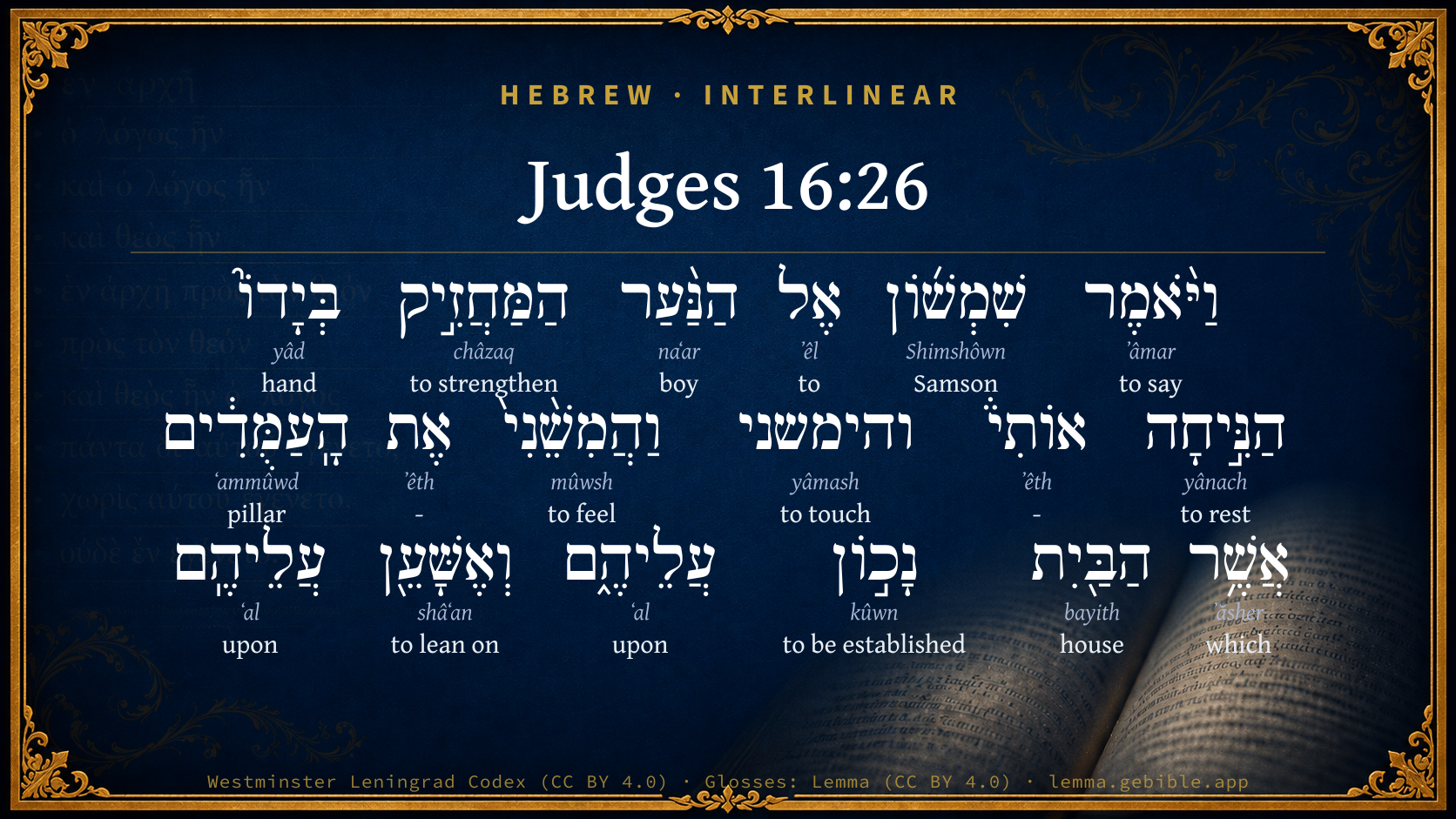
Hebrew (Westminster Leningrad Codex) Judges 16:26 appears in the Hebrew Old Testament. The text above is from the Westminster Leningrad Codex. Each word links to its Strong’s number, a concise gloss, and parsing drawn from the Open Scriptures Hebrew Bible morphology. Click any word for its full Brown-Driver-Briggs (BDB) entry.
Download image
Cite this verse

Judges 16:26 (World English Bible). Public Domain. Lemma interlinear Bible study tool, https://lemma.gebible.app/v/judges/16/26.

Show BibTeX & RIS
BibTeX
RIS
English Translation
and Samson said to the boy who held him by the hand, Allow me that I may feel the pillars whereupon the house rests, that I may lean on them.
World English Bible · Public Domain
Highlights
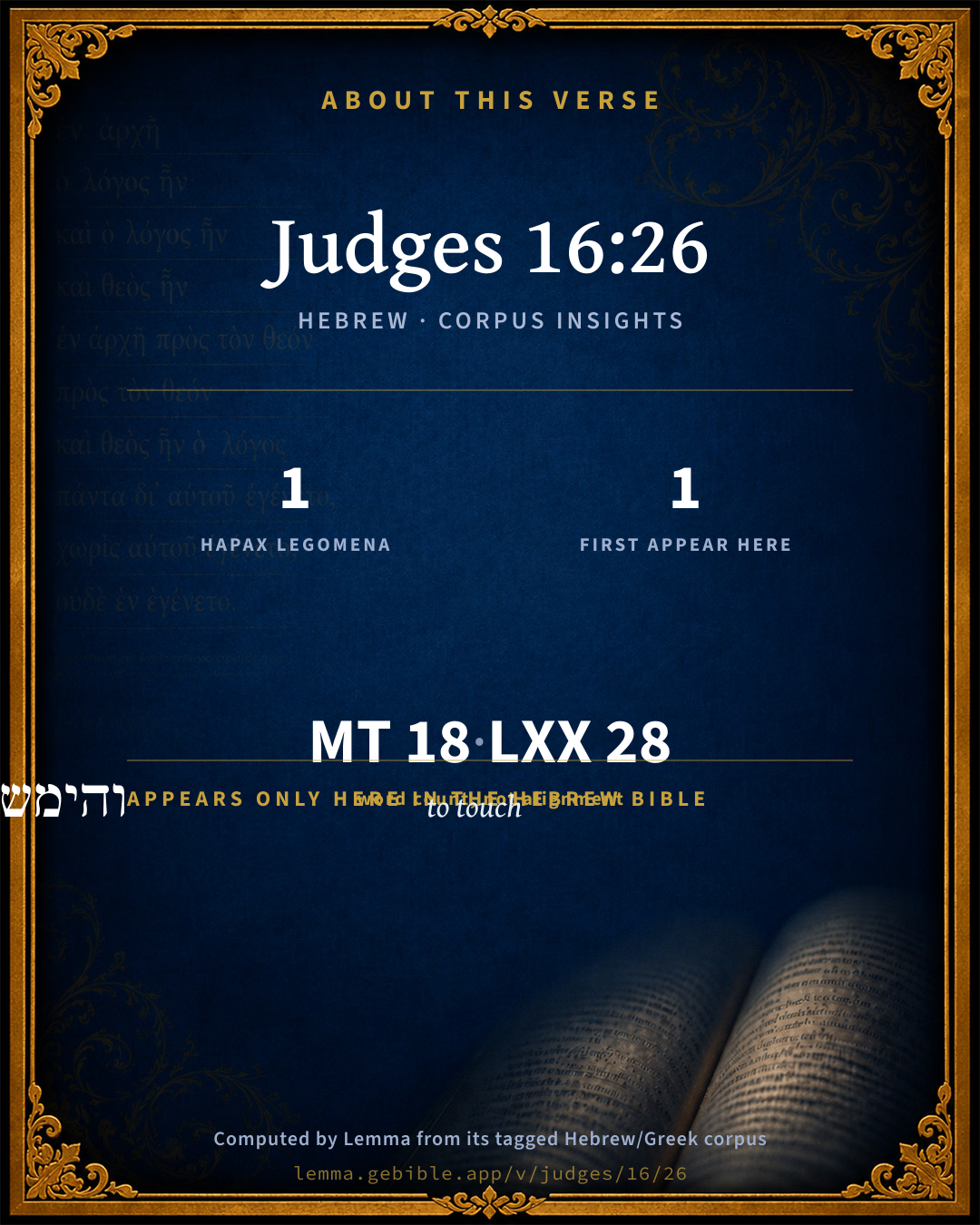
  • 1 hapax legomenon — only here in the Hebrew Bible
  • 1 first appearance in the Hebrew Bible
Full analysis ↓
Download a study sheet

One document with this verse’s original text, its word-by-word gloss line, the meaning frame, cross-references with their text, attributed commentary, and full source and license credits — printable, and it pastes into notes with its structure intact.

This verse Autodidact and up

Study sheet (.html) Plain text (.txt)

A passage Seminary Student

Up to 50 verses in one chapter. A passage sheet keeps up to 6 commentary sources and 12 cross-references per verse, in the order this page ranks them, and says so on the sheet whenever that leaves anything out. Ask for a single verse and you get the Autodidact verse sheet above.

Everything on this page stays free to read, with no account — the sheet is a download of what is already on screen, not access to it.

Want to remove ads? Support Godless Engineer
Compare translations 3

The same verse in 3 English versions, stacked beneath the original-language interlinear above. Click any original word for its lexicon entry.

Each is an independent rendering of the whole verse — the interlinear is not word-aligned to these translations.

Highlighted words mark where these versions differ — a whole-verse word diff, not a word-by-word alignment.

  • World English Bible Public Domain
    and Samson said to the boy who held him by the hand, Allow me that I may feel the pillars whereupon the house rests, that I may lean on them.
  • King James Version Public Domain
    And Samson said unto the lad that held him by the hand, Suffer me that I may feel the pillars whereupon the house standeth, that I may lean upon them.
  • unfoldingWord Literal Text CC BY-SA 4.0
    And Samson said to the young man holding onto his hand, “Let me rest. Let me feel the columns upon which the house is set so I may support myself on them.”

unfoldingWord Literal Text — © unfoldingWord, licensed CC BY-SA 4.0. Word-aligned USFM3 via Door43 (git.door43.org/unfoldingWord/en_ult).

Versions to compare (up to 4)

3 of 4 selected

Show all 18 translations

Every available English version of this verse, each an independent rendering of the whole verse.

  • World English Bible Public Domain
    and Samson said to the boy who held him by the hand, Allow me that I may feel the pillars whereupon the house rests, that I may lean on them.
  • Berean Standard Bible Public Domain
    Samson said to the servant who held his hand, “Lead me where I can feel the pillars supporting the temple, so I can lean against them.”
  • Majority Standard Bible Public Domain
    Samson said to the servant who held his hand, “Lead me where I can feel the pillars supporting the temple, so I can lean against them.”
  • King James Version Public Domain
    And Samson said unto the lad that held him by the hand, Suffer me that I may feel the pillars whereupon the house standeth, that I may lean upon them.
  • American Standard Version (1901) Public Domain
    and Samson said unto the lad that held him by the hand, Suffer me that I may feel the pillars whereupon the house resteth, that I may lean upon them.
  • Revised Version (1885) Public Domain
    and Samson said unto the lad that held him by the hand, Suffer me that I may feel the pillars whereupon the house resteth, that I may lean upon them.
  • Geneva Bible (1599) Public Domain
    Then Samson saide vnto the seruant that led him by the hande, Lead me, that I may touch the pillars that the house standeth vpon, and that I may leane to them.
  • Douay-Rheims (1899) Public Domain
    And he said to the lad that guided his steps: Suffer me to touch the pillars which support the whole house, and let me lean upon them, and rest a little.
  • Young's Literal Translation Public Domain
    And Samson saith unto the young man who is keeping hold on his hand, `Let me alone, and let me feel the pillars on which the house is established, and I lean upon them.'
  • Literal Standard Version CC BY-SA 4.0
    And Samson says to the young man who is keeping hold on his hand, “Let me also feel the pillars on which the house is established, and I lean on them.”
  • Unlocked Literal Bible CC BY-SA 4.0
    Samson said to the boy who held his hand, “Permit me to touch the pillars on which the building rests, so that I can lean against them.”
  • unfoldingWord Literal Text CC BY-SA 4.0
    And Samson said to the young man holding onto his hand, “Let me rest. Let me feel the columns upon which the house is set so I may support myself on them.”
  • Darby Bible Public Domain
    and Samson said to the lad who held him by the hand, "Let me feel the pillars on which the house rests, that I may lean against them."
  • World Messianic Bible Public Domain
    and Samson said to the boy who held him by the hand, “Allow me to feel the pillars on which the house rests, that I may lean on them.”
  • Webster's Bible Public Domain
    And Samson said to the lad that held him by the hand, Suffer me that I may feel the pillars upon which the house standeth, that I may lean upon them.
  • Free Bible Version CC BY-SA 4.0
    Samson said to the servant boy who was leading him by the hand, “Leave me by the pillars on which the temple rests so I can feel them, and lean against them.”
  • Bible in Basic English Public Domain
    And Samson said to the boy who took him by the hand, Let me put my hand on the pillars supporting the house, so that I may put my back against them.
  • JPS Tanakh (1917) Public Domain
    And Samson said unto the lad that held him by the hand: 'Suffer me that I may feel the pillars whereupon the house resteth, that I may lean upon them.'

Literal Standard Version (2020), Covenant Press — licensed CC BY-SA 4.0. Text via the HelloAO Bible API (eBible.org). Unlocked Literal Bible (unfoldingWord) — licensed CC BY-SA 4.0. Text via the HelloAO Bible API (eBible.org). unfoldingWord Literal Text — © unfoldingWord, licensed CC BY-SA 4.0. Word-aligned USFM3 via Door43 (git.door43.org/unfoldingWord/en_ult). Free Bible Version, Dr. Jonathan Gallagher — licensed CC BY-SA 4.0. Text via the HelloAO Bible API (eBible.org).

Word by word

More ways to search: Search by grammar → Find every occurrence → Compare this word →

Practice this passage: Drill this verse → Learn its vocabulary →

והימשני
yâmash
H3237
“and · touch · me”
Conjunction + Verb, Hiphil, Imperative, 2nd Person, Masculine, Singular + Suffix, Personal, 1st Person, Common, Singular
Part of Speech
Conjunction + Verb
Stem
Hiphil
Form
Imperative
Person
2nd Person
Gender
Masculine
Number
Singular
Full BDB Definition

Origin: a primitive root

TWOT: None

to touch - (Hiphil) to touch, feel
  1. וַיֹּ֨אמֶר ʼâmar H559 “and · to say” Conjunction + Verb, Qal, Sequential Imperfect, 3rd Person, Masculine, Singular
  2. שִׁמְשׁ֜וֹן Shimshôwn H8123 “Samson” Noun, Proper
  3. אֶל ʼêl H413 “to” Preposition
  4. הַנַּ֨עַר naʻar H5288 “the · boy” Particle, Definite Article + Noun, Common, Masculine, Singular, Absolute
  5. הַמַּחֲזִ֣יק châzaq H2388 “the · strengthening” Particle, Definite Article + Verb, Hiphil, Participle Active, Masculine, Singular, Absolute
  6. בְּיָדוֹ֮ yâd H3027 “in/at · hand · his” Preposition + Noun, Common, Both, Singular, Construct + Suffix, Personal, 3rd Person, Masculine, Singular
  7. הַנִּ֣יחָה yânach H3240 “rest” Verb, Hiphil, Imperative, 2nd Person, Masculine, Singular + Suffix, h
  8. אוֹתִי֒ ʼêth H853 “- · me” Particle, Direct Object + Suffix, Personal, 1st Person, Common, Singular
  9. וַהֲמִשֵׁ֨נִי֙ mûwsh H4184 “and · feel · me” Conjunction + Verb, Hiphil, Imperative, 2nd Person, Masculine, Singular + Suffix, Personal, 1st Person, Common, Singular
  10. אֶת ʼêth H853 “-” Particle, Direct Object
  11. הָֽעַמֻּדִ֔ים ʻammûwd H5982 “the · pillars” Particle, Definite Article + Noun, Common, Masculine, Plural, Absolute
  12. אֲשֶׁ֥ר ʼăsher H834 “which” Particle, Relative
  13. הַבַּ֖יִת bayith H1004 “the · house” Particle, Definite Article + Noun, Common, Masculine, Singular, Absolute
  14. נָכ֣וֹן kûwn H3559 “being established” Verb, Niphal, Participle Active, Masculine, Singular, Absolute
  15. עֲלֵיהֶ֑ם ʻal H5921 “upon · them” Preposition + Suffix, Personal, 3rd Person, Masculine, Plural
  16. וְאֶשָּׁעֵ֖ן shâʻan H8172 “and · to lean on” Conjunction + Verb, Niphal, Imperfect, 1st Person, Common, Singular
  17. עֲלֵיהֶֽם ʻal H5921 “upon · them” Preposition + Suffix, Personal, 3rd Person, Masculine, Plural

About this verse

These counts appear in no published source. They are computed here, from the morphology-tagged text and Lemma’s own curated glosses. What Lemma adds →

18
words
16
distinct lemmas
Historical
section

Notable vocabulary

1 hapax legomenon — a word that appears only here in the entire Hebrew Bible:

  • והימשני to touch H3237

First appearance in Scripture

This word makes its first canonical appearance in the Hebrew Bible here:

  • והימשני to touch H3237

Shared distinctive vocabulary

וַהֲמִשֵׁ֨נִי֙ to feel H4184 occurs in 3 verses of the Hebrew Bible. Also found in:

Grammatical profile

  • 7 verbs
  • 5 nouns
  • 3 prepositions
  • 3 particles

Verb forms

  • וַיֹּ֨אמֶר Qal · Sequential Imperfect
  • הַמַּחֲזִ֣יק Hiphil · Participle Active
  • הַנִּ֣יחָה Hiphil · Imperative
  • והימשני Hiphil · Imperative
  • וַהֲמִשֵׁ֨נִי֙ Hiphil · Imperative
  • נָכ֣וֹן Niphal · Participle Active
  • וְאֶשָּׁעֵ֖ן Niphal · Imperfect

Repetition

A word recurs within this verse — often emphatic in Hebrew:

  • עֲלֵיהֶ֑ם upon H5921 ×2

Hebrew & Septuagint length

In English translation the verse runs 30 words from the Hebrew and 29 from the Septuagint (LXX English) — closely comparable.

A rough comparison of the two English renderings, which tokenize alike — not a word-level alignment.

Word counts can differ between the Hebrew and the Greek without any difference in meaning — e.g. the Hebrew direct-object marker אֵת has no separate Greek word, and Greek often adds the article ὁ.

In the original languages it is 18 Hebrew tokens and 28 Greek tokens — but the two are counted differently (Hebrew bundles its prefixes and suffixes into one token; the Greek is in lemma form), so that isn’t a like-for-like length.

Hebrew and Greek witnesses Masoretic Hebrew ↔ Greek Septuagint

The same verse in the two great witnesses to the Old Testament, shown verse-for-verse.

These are two independent witnesses, not word-aligned to each other, and the Septuagint is shown in lemma (dictionary) form.

Hebrew Judges 16:26 Masoretic · Westminster Leningrad Codex

וַיֹּ֨אמֶר שִׁמְשׁ֜וֹן אֶל הַנַּ֨עַר הַמַּחֲזִ֣יק בְּיָדוֹ֮ הַנִּ֣יחָה אוֹתִי֒ והימשני וַהֲמִשֵׁ֨נִי֙ אֶת הָֽעַמֻּדִ֔ים אֲשֶׁ֥ר הַבַּ֖יִת נָכ֣וֹן עֲלֵיהֶ֑ם וְאֶשָּׁעֵ֖ן עֲלֵיהֶֽם

and Samson said to the boy who held him by the hand, Allow me that I may feel the pillars whereupon the house rests, that I may lean on them.

World English Bible · Public Domain

Greek LXX Judges 16:26 Septuagint · lemma form

καί εἶπον σαμψων πρός ὁ νεανίας ὁ κρατέω ὁ χείρ αὐτός ἀποἵημι ἐγώ καί ψηλαφάω ὁ κίων ἐπί ὅς ὁ οἶκος στήκω ἐπί αὐτός καί ἐπιστηρίζω ἐπί αὐτός

And Sampson said to the young man that held his hand, Suffer me to feel the pillars on which the house rests, and I will stay myself upon them.

LXX2012 (modern English Septuagint) · Public Domain

Hebrew: Westminster Leningrad Codex (CC BY 4.0). Greek: Septuagint (public domain); English from LXX2012 (modern English Septuagint) (Public Domain). How the Septuagint differs from the Hebrew →

Targum (Aramaic paraphrase)

1

The Targum is the ancient Jewish Aramaic paraphrase of the Hebrew Scriptures — an interpretive translation, not the Hebrew text itself. Onkelos (literal) and Pseudo-Jonathan (expansive) render the Torah, and Jonathan the Prophets. Coverage is partial: where no permissively-licensed English translation exists for a verse, only the Aramaic is shown. This is verse-level text, not a word-by-word alignment to the Hebrew.

  1. Targum Jonathan Prophets (Joshua–Malachi)
    וַאֲמַר שִׁמְשׁוֹן לְעוּלֵימָא דְמַתְקֵיף בִּידֵיהּ שְׁבוֹק מִנִי וַאֲמִישֵׁנִי יַת עַמוּדַיָא דְבֵיתָא מְתַקֵן עִלַוֵיהוֹן וְאִסְתְּמִיךְ עִלַוֵיהוֹן:

    (no public-domain English translation for this verse)

    Targum Jonathan — Aramaic: “Mikraot Gedolot” (public domain). English: “Sefaria Community Translation” (CC0 1.0 (public-domain dedication)); “London "Chaldee Paraphrase," 1871” (public domain). Text via Sefaria.

Commentary

Notes on Judges 16:26 from classic Christian and Jewish commentators (each source and its license shown beneath its notes). The classic Christian expositions comment on the surrounding passage and are grouped to its opening verse, so a note may address several verses; the Jewish commentaries on the Tanakh (Rashi and others) are per-verse, so they appear only where the commentator wrote on this verse.

Lemma curates 59 commentaries, every one of them public domain or Creative Commons licensed, each selected and text-cleaned for this edition rather than reprinted as found. About our sources →

Trapp's Complete Commentary

John Trapp

Jdg 16:26 And Samson said unto the lad that held him by the hand, Suffer me that I may feel the pillars whereupon the house standeth, that I may lean upon them.

Ver. 26. That I may lean upon them.] And so rest me, who am wearied out, either with grinding in the prison, or now making sport.

John Trapp, A Commentary or Exposition upon All the Books of the Old and New Testament (1647–1656) — public domain. Text from a community e-Sword module.

Joseph Benson's Commentary

Jdg 16:26. The pillars whereon the house standeth — It is probable that this house, whether it were a temple or theatre, was no more than a wooden building, raised for the present occasion, much in the form of an amphitheatre, in the midst of which were two large wooden pillars, on which the main beams of the roof rested, so that if these should be pulled away, the building must necessarily fall. Pliny, in the fifteenth chapter of the thirty-sixth book of his Natural History, speaks of two theatres, built by C. Curio, in Julius Cesar’s time, each of which was supported only by one pillar, though many thousands of people sat together in it; and mentions the fall of an amphitheatre, by which fifty thousand people were killed or wounded.

Joseph Benson's Commentary on the Old and New Testaments (1811–1818) — public domain. Text from a community e-Sword module.

Ellicott's Commentary for English Readers

(26) That I may feel the pillars.—The temple of Dagon had a flat roof; but further than this we are unable to conjecture what was its architecture. An attempt to explain it is found in Stark’s Gaza, p. 332, seq.

A Bible Commentary for English Readers, edited by Charles John Ellicott (1878–1897) — public domain. Text from a community e-Sword module.

John Gill's Exposition

And Samson said to the lad that held him by the hand,.... And led him about; as nothing is more common now than for a blind man to be led by a boy:

suffer me that I may feel the pillars whereupon the house standeth; he might by information know in what manner the house was built, that it was supported by pillars, if he had never been in it before when he had his sight; and he might understand, by some means or another, that he was near these pillars, and placed between them, though being blind, did not know which way to direct his hands towards them to feel them, as he proposed to do, and therefore desired the lad that led him to guide his hands towards them:

that I may lean upon them; being, as he might at least pretend to be, weary, as Josephus says (x); either by grinding at the mill, or through being led to and fro in this house, that all might see him, and cast their flouts and jeers at him,

(x) Ut supra. (Antiqu. l. 5. c. 8. sect. 12.)

John Gill's Exposition of the Whole Bible (1746–1763) — public domain (CC PDM 1.0). Text via the HelloAO Bible API.

Albert Barnes' Notes on the Bible

More literally, “let me rest, and let me feel the pillars, that I may lean upon them.” He feigned weariness with his dancing and singing, and asked to recover himself by leaning against the pillars. The flat roof, from the top of which, as well as under it, spectators could see what was being done on the stage in front, was mainly supported by two pillars. The lords and principal persons sat UNDER the roof, while the people, to the number of 3,000, stood ON the flat roof. When the pillars were removed, the weight of 3,000 people brought the roof down with a fearful crash, and those above fell together with the stones and timbers upon those below, and a great slaughter was the result, Samson himself perishing under the ruins.

Albert Barnes' Notes on the Bible (1834–1885) — public domain. Text from a community e-Sword/MySword module.

Whedon's Commentary on the Bible

Daniel D. Whedon

26. The lad that held him — The blind man needs a lad to show him the way, and how humiliating this alone, leaving out other considerations, that the once mighty Samson is now led about by a lad!

The pillars whereupon the house standeth — This passage shows the existence in that early time of pillars or columns in Philistine architecture. In Egypt, Syria, and the farther East, they were doubtless common long before this, and not a few of the broken columns still found in the ruined cities of Palestine probably belong to the same period. It has been a question how such a large building could have been torn down by merely pulling out two pillars. But the possibility of such a thing is hardly to be questioned. The plan of the building and the style of its architecture are now unknown, but from the known plans of many partially ruined temples and palaces of the East we may at least infer that, whatever else it comprised, this house at Gaza had a spacious court or hall, on which rested several rows of columns, supporting an equally spacious roof above. The roof was covered and the great hall filled with men and women, and under such a pressure it is in the highest degree probable that the sudden removal of two central pillars would precipitate the whole house into a heap of ruins. Dr. Thomson, who made observations on the spot, finds a further explanation in the peculiar topography of Gaza. “Most of it,” he writes, “is built on hills, which, though comparatively low, have declivities exceedingly steep. The temple was erected over one of these beyond a doubt, for such was and is the custom in the East. There is such a steep declivity on the northeast corner of the present city, near the old dilapidated castle and palace, and the houses in that vicinity have fragments of columns wrought into the walls, and laid down as sills for their gates. I am inclined to believe,” he adds, “that the immense roof which rested upon these columns was sustained by arches. If this were so, and the centre columns stood on the brow of the declivity, near the old castle, the whole edifice would be precipitated down the hill merely by tearing away those centre supports.”

Daniel D. Whedon (gen. ed.), Commentary on the Old and New Testaments (1874–1909) — public domain. Text from a community e-Sword module.

The Pulpit Commentary

Suffer me, or it may be rendered, Let me rest. He pretended to be tired, and asked to be allowed to rest a few minutes and lean against the pillars. That I may feel, or, literally, and make me feel. He adds his motive for making the requestthat I may lean upon them to rest himself after the severe exercise of dancing.

The Pulpit Commentary (1880–1919), ed. H.D.M. Spence-Jones & Joseph S. Exell — public domain. Text from a community e-Sword module.

John Wesley's Explanatory Notes

Whereon the house standeth-Whether it were a temple, or theatre, or some slight building run up for the purpose.

John Wesley, Explanatory Notes Upon the Whole Bible (1754–1765) — public domain. Text via the GEBible commentary corpus.

Rashi

Rabbi Shlomo Yitzchaki (Rashi)

And give me a hold. "Palpare" in old French, as in, "Perhaps my father will touch me."

Rashi on the Tanakh — English translations: “The Judaica Press complete Tanach with Rashi, translated by A. J. Rosenberg” (CC BY 4.0); “Pentateuch with Rashi's commentary by M. Rosenbaum and A.M. Silbermann, 1929-1934” (public domain); “The Metsudah Tanach series, Lakewood, N.J” (CC BY 4.0); and “The Book of Joshua, Metsudah Publications, 1997” (CC BY 4.0). Text via Sefaria.

Lesson kit

Teaching starters — assembled from the data on this page, not authored interpretation. Every prompt links to the verse data it draws on. Edit before teaching.

Judges, in the Historical, opens this verse with 18 words (16 distinct Hebrew lemmas). Its most distinctive word is yâmash (“to touch”). A historical commentator’s framing appears above. Read the whole chapter for the surrounding context.

Discussion questions

  1. What does “to touch” (yâmash) contribute to the verse as a whole?
  2. 1 word here appears nowhere else in the Hebrew Bible. Why might the author reach for such rare wording?
  3. This is the first place “to touch” appears in Scripture (first appears here). What does its debut here establish?
  4. How does Genesis 27:21, which shares the word «to feel», read alongside this verse?
  5. What does the repetition of “upon” (2× in this one verse) do in this verse?
  6. These translations render this verse differently. What is at stake in choosing one wording over another?
  7. «וַיֹּ֨אמֶר» is a Qal Sequential Imperfect verb. How does that grammatical form shape the action described?
  8. Compare how Trapp's Complete Commentary and Joseph Benson's Commentary read this verse. Where do they agree or differ?

Things to notice

  • 1 word in this verse appears nowhere else in the Hebrew Bible.
  • 1 word makes its first canonical appearance in Scripture here.
  • This verse counts 18 Hebrew ↔ 28 Greek words.
  • These translations choose different wording for 24 words in this verse.
  • “upon” occurs 2× in this single verse.

Reading settings

Reading text

Shown beneath each verse's original-language words.

Old Testament
Old Testament edition

Read the OT as the Masoretic Hebrew (MT) or the Greek Septuagint (LXX).

English shown for the Greek Septuagint (in the Hebrew ↔ Greek comparison).

Comparing translations? Open the Compare panel on any verse page to stack up to four side by side.