
1 Kings 20:15

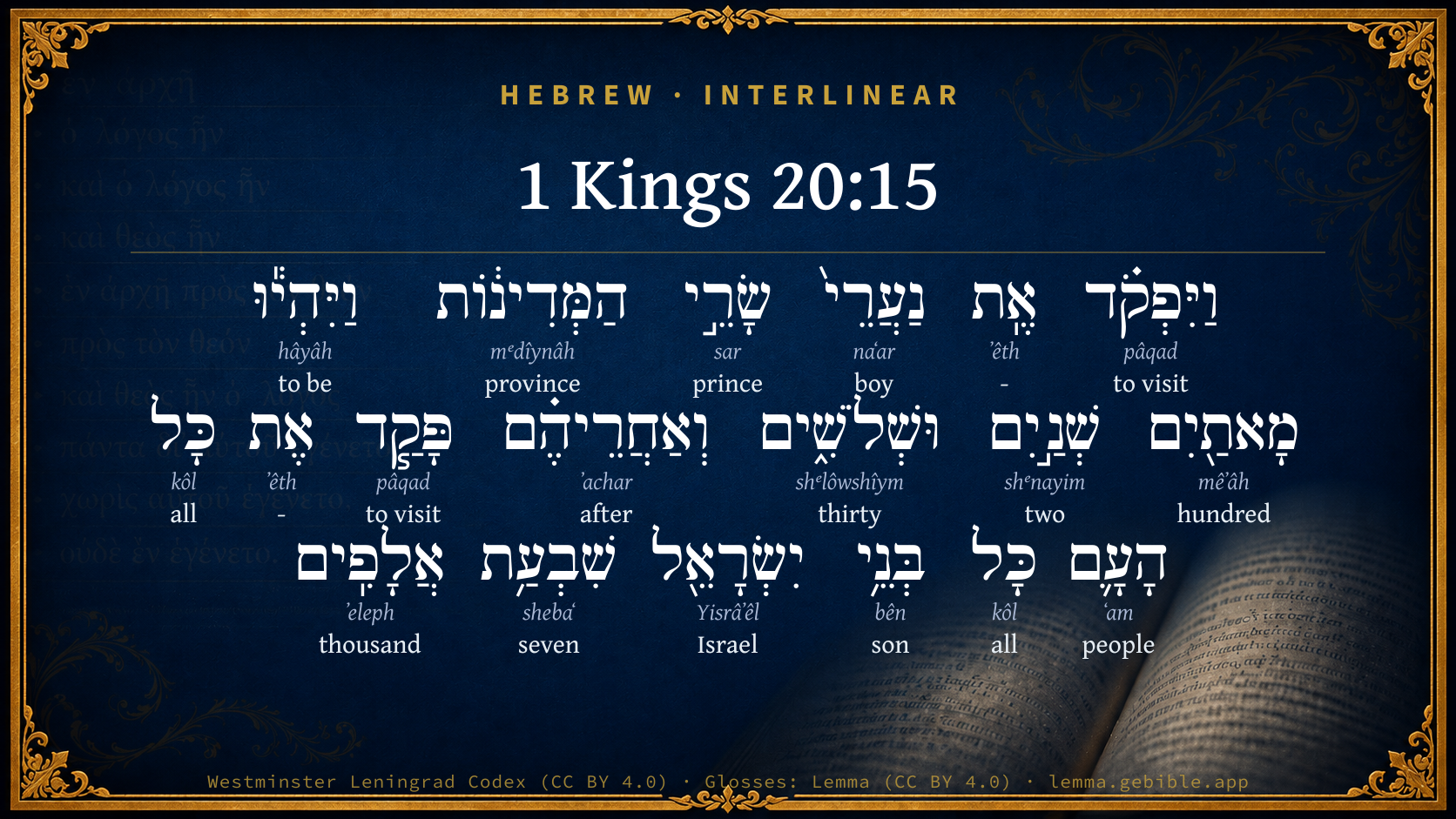
Hebrew (Westminster Leningrad Codex) 1 Kings 20:15 appears in the Hebrew Old Testament. The text above is from the Westminster Leningrad Codex. Each word links to its Strong’s number, a concise gloss, and parsing drawn from the Open Scriptures Hebrew Bible morphology. Click any word for its full Brown-Driver-Briggs (BDB) entry.
Download image
Cite this verse

1 Kings 20:15 (World English Bible). Public Domain. Lemma interlinear Bible study tool, https://lemma.gebible.app/v/1-kings/20/15.

Show BibTeX & RIS
BibTeX
RIS
English Translation
Then he mustered the young men of the princes of the provinces, and they were two hundred and thirty-two: and after them he mustered all the people, even all the children of Israel, being seven thousand.
World English Bible · Public Domain
Download a study sheet

One document with this verse’s original text, its word-by-word gloss line, the meaning frame, cross-references with their text, attributed commentary, and full source and license credits — printable, and it pastes into notes with its structure intact.

This verse Autodidact and up

Study sheet (.html) Plain text (.txt)

A passage Seminary Student

Up to 50 verses in one chapter. A passage sheet keeps up to 6 commentary sources and 12 cross-references per verse, in the order this page ranks them, and says so on the sheet whenever that leaves anything out. Ask for a single verse and you get the Autodidact verse sheet above.

Everything on this page stays free to read, with no account — the sheet is a download of what is already on screen, not access to it.

Want to remove ads? Support Godless Engineer
Compare translations 3

The same verse in 3 English versions, stacked beneath the original-language interlinear above. Click any original word for its lexicon entry.

Each is an independent rendering of the whole verse — the interlinear is not word-aligned to these translations.

Highlighted words mark where these versions differ — a whole-verse word diff, not a word-by-word alignment.

  • World English Bible Public Domain
    Then he mustered the young men of the princes of the provinces, and they were two hundred and thirty-two: and after them he mustered all the people, even all the children of Israel, being seven thousand.
  • King James Version Public Domain
    Then he numbered the young men of the princes of the provinces, and they were two hundred and thirty two: and after them he numbered all the people, even all the children of Israel, being seven thousand.
  • unfoldingWord Literal Text CC BY-SA 4.0
    And he mustered the servants of the leaders of the districts, and they were 232. And after them he mustered all of the people. All of the sons of Israel 7,000.

unfoldingWord Literal Text — © unfoldingWord, licensed CC BY-SA 4.0. Word-aligned USFM3 via Door43 (git.door43.org/unfoldingWord/en_ult).

Versions to compare (up to 4)

3 of 4 selected

Show all 18 translations

Every available English version of this verse, each an independent rendering of the whole verse.

  • World English Bible Public Domain
    Then he mustered the young men of the princes of the provinces, and they were two hundred and thirty-two: and after them he mustered all the people, even all the children of Israel, being seven thousand.
  • Berean Standard Bible Public Domain
    So Ahab assembled the young officers of the district governors, and there were 232 men. And after them, he assembled the rest of the Israelite troops, 7,000 in all.
  • Majority Standard Bible Public Domain
    So Ahab assembled the young officers of the district governors, and there were 232 men. And after them, he assembled the rest of the Israelite troops, 7,000 in all.
  • King James Version Public Domain
    Then he numbered the young men of the princes of the provinces, and they were two hundred and thirty two: and after them he numbered all the people, even all the children of Israel, being seven thousand.
  • American Standard Version (1901) Public Domain
    Then he mustered the young men of the princes of the provinces, and they were two hundred and thirty-two: and after them he mustered all the people, even all the children of Israel, being seven thousand.
  • Revised Version (1885) Public Domain
    Then he mustered the young men of the princes of the provinces, and they were two hundred and thirty two: and after them he mustered all the people, even all the children of Israel, being seven thousand.
  • Geneva Bible (1599) Public Domain
    Then he nombred the seruantes of the princes of the prouinces, and they were two hundreth, two and thirtie: and after them he nombred the whole people of all the children of Israel, euen seuen thousand.
  • Douay-Rheims (1899) Public Domain
    So he mustered the servants of the princes of the provinces, and he found the number of two hundred and thirty-two: and he mustered after them the people, all the children of Israel, seven thousand:
  • Young's Literal Translation Public Domain
    And he inspecteth the young men of the heads of the provinces, and they are two hundred, two and thirty, and after them he hath inspecteth the whole of the people, all the sons of Israel, seven thousand,
  • Literal Standard Version CC BY-SA 4.0
    And he inspects the young men of the heads of the provinces, and they are two hundred and thirty-two, and after them he has mustered all the people, all the sons of Israel—seven thousand,
  • Unlocked Literal Bible CC BY-SA 4.0
    Then Ahab mustered the young officers who served the governors of the districts. They numbered 232. After them he mustered all the soldiers, all the army of Israel; seven thousand in number.
  • unfoldingWord Literal Text CC BY-SA 4.0
    And he mustered the servants of the leaders of the districts, and they were 232. And after them he mustered all of the people. All of the sons of Israel 7,000.
  • Darby Bible Public Domain
    And he numbered the servants of the princes of the provinces, and they were two hundred and thirty-two; and after them he numbered all the people, all the children of Israel, seven thousand.
  • World Messianic Bible Public Domain
    Then he mustered the young men of the princes of the provinces, and they were two hundred and thirty-two. After them, he mustered all the people, even all the children of Israel, being seven thousand.
  • Webster's Bible Public Domain
    Then he numbered the young men of the princes of the provinces, and they were two hundred and thirty two: and after them he numbered all the people, even all the children of Israel, being seven thousand.
  • Free Bible Version CC BY-SA 4.0
    So Ahab called up the 232 young officers of the district commanders, and assembled the 7,000 soldiers that made up Israel's army.
  • Bible in Basic English Public Domain
    Then he got together the servants of all the chiefs who were over the divisions of the land, two hundred and thirty-two of them; and after them, he got together all the people, all the children of Israel, seven thousand.
  • JPS Tanakh (1917) Public Domain
    Then he numbered the young men of the princes of the provinces, and they were two hundred and thirty-two; and after them he numbered all the people, even all the children of Israel, being seven thousand.

Literal Standard Version (2020), Covenant Press — licensed CC BY-SA 4.0. Text via the HelloAO Bible API (eBible.org). Unlocked Literal Bible (unfoldingWord) — licensed CC BY-SA 4.0. Text via the HelloAO Bible API (eBible.org). unfoldingWord Literal Text — © unfoldingWord, licensed CC BY-SA 4.0. Word-aligned USFM3 via Door43 (git.door43.org/unfoldingWord/en_ult). Free Bible Version, Dr. Jonathan Gallagher — licensed CC BY-SA 4.0. Text via the HelloAO Bible API (eBible.org).

Word by word

More ways to search: Search by grammar → Find every occurrence → Compare this word →

Practice this passage: Drill this verse → Learn its vocabulary →

הַמְּדִינ֔וֹת
mᵉdîynâh
H4082
“the · provinces”
Particle, Definite Article + Noun, Common, Feminine, Plural, Absolute
Part of Speech
Particle + Noun
Type
Common
Gender
Feminine
Number
Plural
State
Absolute
Full BDB Definition

Origin: from H1777

TWOT: 426d

province, district - district - province
  1. וַיִּפְקֹ֗ד pâqad H6485 “and · to visit” Conjunction + Verb, Qal, Sequential Imperfect, 3rd Person, Masculine, Singular
  2. אֶֽת ʼêth H853 “-” Particle, Direct Object
  3. נַעֲרֵי֙ naʻar H5288 “boys of” Noun, Common, Masculine, Plural, Construct
  4. שָׂרֵ֣י sar H8269 “princes of” Noun, Common, Masculine, Plural, Construct
  5. וַיִּהְי֕וּ hâyâh H1961 “and · to be” Conjunction + Verb, Qal, Sequential Imperfect, 3rd Person, Masculine, Plural
  6. מָאתַ֖יִם mêʼâh H3967 “hundred” Adjective, Cardinal number, Both, Dual, Absolute
  7. שְׁנַ֣יִם shᵉnayim H8147 “two” Adjective, Cardinal number, Masculine, Dual, Absolute
  8. וּשְׁלֹשִׁ֑ים shᵉlôwshîym H7970 “and · thirty” Conjunction + Adjective, Cardinal number, Both, Plural, Absolute
  9. וְאַחֲרֵיהֶ֗ם ʼachar H310 “and · after · them” Conjunction + Preposition + Suffix, Personal, 3rd Person, Masculine, Plural
  10. פָּקַ֧ד pâqad H6485 “to visit” Verb, Qal, Perfect, 3rd Person, Masculine, Singular
  11. אֶת ʼêth H853 “-” Particle, Direct Object
  12. כָּל kôl H3605 “all of” Noun, Common, Masculine, Singular, Construct
  13. הָעָ֛ם ʻam H5971 “the · people” Particle, Definite Article + Noun, Common, Masculine, Singular, Absolute
  14. כָּל kôl H3605 “all of” Noun, Common, Masculine, Singular, Construct
  15. בְּנֵ֥י bên H1121 “sons of” Noun, Common, Masculine, Plural, Construct
  16. יִשְׂרָאֵ֖ל Yisrâʼêl H3478 “Israel” Noun, Proper
  17. שִׁבְעַ֥ת shebaʻ H7651 “seven” Adjective, Cardinal number, Masculine, Singular, Construct
  18. אֲלָפִֽים ʼeleph H505 “thousand” Adjective, Cardinal number, Both, Plural, Absolute

About this verse

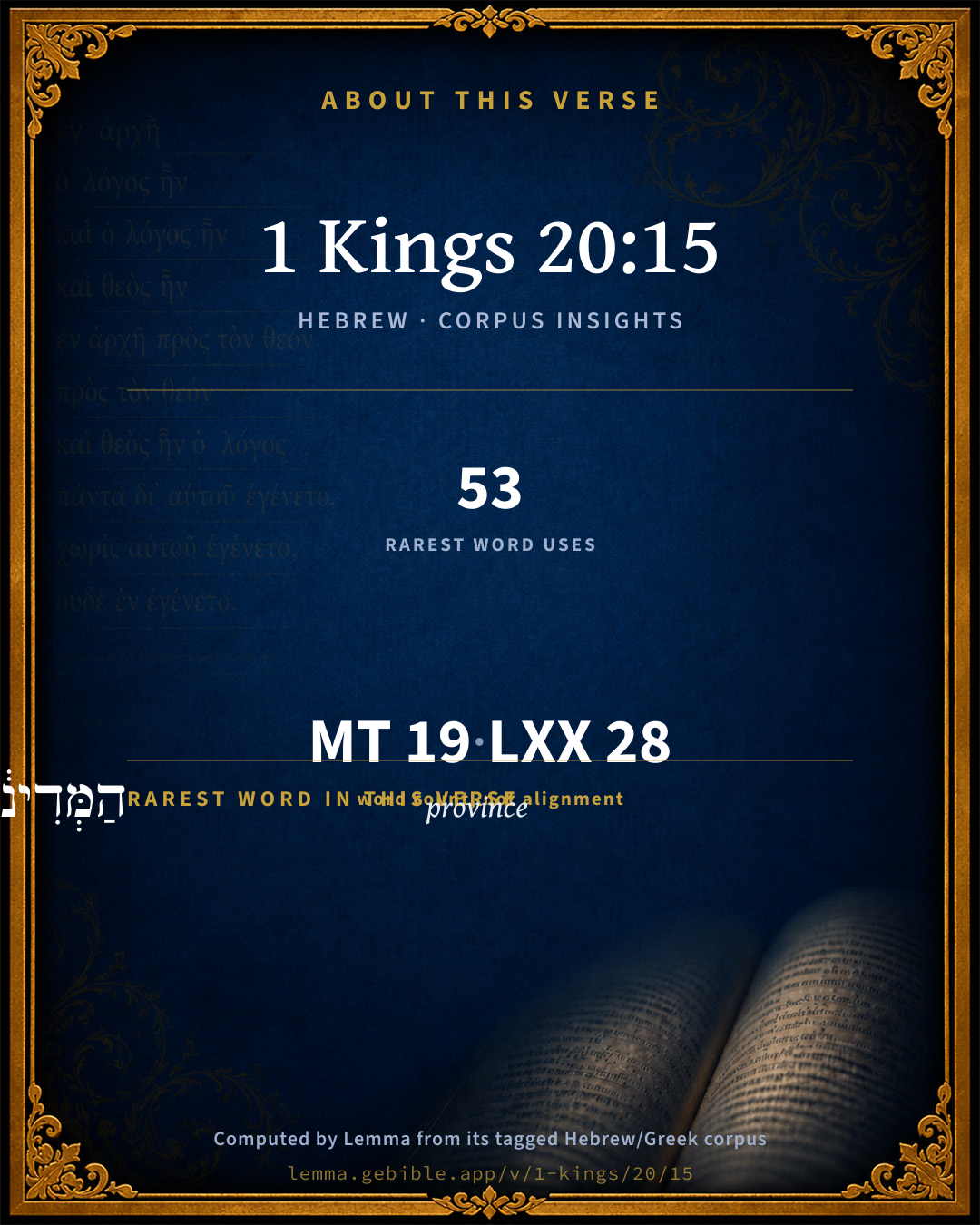
These counts appear in no published source. They are computed here, from the morphology-tagged text and Lemma’s own curated glosses. What Lemma adds →

19
words
16
distinct lemmas
Historical
section

Shared distinctive vocabulary

הַמְּדִינ֔וֹת province H4082 occurs in 40 verses of the Hebrew Bible. Also found in:

Grammatical profile

  • 3 verbs
  • 8 nouns
  • 5 adjectives
  • 1 preposition
  • 2 particles

Verb forms

  • וַיִּפְקֹ֗ד Qal · Sequential Imperfect
  • וַיִּהְי֕וּ Qal · Sequential Imperfect
  • פָּקַ֧ד Qal · Perfect

Repetition

Words recur within this verse — often emphatic in Hebrew:

  • וַיִּפְקֹ֗ד to visit H6485 ×2
  • כָּל all H3605 ×2

Hebrew & Septuagint length

In English translation the verse runs 36 words from the Hebrew and 40 from the Septuagint (LXX English) — closely comparable.

A rough comparison of the two English renderings, which tokenize alike — not a word-level alignment.

Word counts can differ between the Hebrew and the Greek without any difference in meaning — e.g. the Hebrew direct-object marker אֵת has no separate Greek word, and Greek often adds the article ὁ.

In the original languages it is 19 Hebrew tokens and 28 Greek tokens — but the two are counted differently (Hebrew bundles its prefixes and suffixes into one token; the Greek is in lemma form), so that isn’t a like-for-like length.

Cross-references

8

Topical passages linked to 1 Kings 20:15 in the Treasury of Scripture Knowledge — connected by theme and wording, ordered by reader-vote popularity; previews shown in the World English Bible.

  • Judges 7:7 Yahweh said to Gideon, By the three hundred men who lapped will I save you, and deliver the Midianites into your hand; and let all the people go every man to his place.
  • Judges 7:16 He divided the three hundred men into three companies, and he put into the hands of all of them trumpets, and empty pitchers, with torches within the pitchers.
  • 1 Samuel 14:2 Saul abode in the uttermost part of Gibeah under the pomegranate tree which is in Migron: and the people who were with him were about six hundred men;
  • 1 Samuel 14:6 Jonathan said to the young man who bore his armor, Come, and let us go over to the garrison of these uncircumcised: it may be that Yahweh will work for us; for there is no restraint to Yahweh to save by many or by few.
  • 1 Kings 19:18 Yet will I leave [me] seven thousand in Israel, all the knees which have not bowed to Baal, and every mouth which has not kissed him.
  • 2 Kings 13:7 For he didn't leave to Jehoahaz of the people save fifty horsemen, and ten chariots, and ten thousand footmen; for the king of Syria destroyed them, and made them like the dust in threshing.
  • 2 Chronicles 14:11 Asa cried to Yahweh his God, and said, Yahweh, there is none besides you to help, between the mighty and him who has no strength: help us, Yahweh our God; for we rely on you, and in your name are we come against this multitude. Yahweh, you are our God; don't let man prevail against you.
  • Psalms 106:40–43 Therefore Yahweh burned with anger against his people. He abhorred his inheritance.

Cross-references courtesy of OpenBible.info (CC BY 4.0).

Hebrew and Greek witnesses Masoretic Hebrew ↔ Greek Septuagint

The same verse in the two great witnesses to the Old Testament, shown verse-for-verse.

These are two independent witnesses, not word-aligned to each other, and the Septuagint is shown in lemma (dictionary) form.

Hebrew 1 Kings 20:15 Masoretic · Westminster Leningrad Codex

וַיִּפְקֹ֗ד אֶֽת נַעֲרֵי֙ שָׂרֵ֣י הַמְּדִינ֔וֹת וַיִּהְי֕וּ מָאתַ֖יִם שְׁנַ֣יִם וּשְׁלֹשִׁ֑ים וְאַחֲרֵיהֶ֗ם פָּקַ֧ד אֶת כָּל הָעָ֛ם כָּל בְּנֵ֥י יִשְׂרָאֵ֖ל שִׁבְעַ֥ת אֲלָפִֽים

Then he mustered the young men of the princes of the provinces, and they were two hundred and thirty-two: and after them he mustered all the people, even all the children of Israel, being seven thousand.

World English Bible · Public Domain

Greek LXX 1 Kings 20:15 Septuagint · lemma form

καί γίγνομαι ὡς ἀκούω ιεζαβελ καί εἶπον πρός αχααβ ἀναἵστημι κληρονομέω ὁ ἀμπελών ναβουθαι ὁ ιεζραηλίτης ὅς οὐ δίδωμι σύ ἀργύριον ὅτι οὐ εἰμί ναβουθαι ζάω ὅτι θνήσκω

And it came to pass, when Jezabel heard it, that she said to Achaab, Arise, take possession of the vineyard of Nabuthai the Jezraelite, who would not sell it to you: for Nebuthai is not alive, for he is dead.

LXX2012 (modern English Septuagint) · Public Domain

On this verse, The Cambridge Bible for Schools and Colleges discusses the Septuagint’s reading. Read the note in Commentary ↓

Hebrew: Westminster Leningrad Codex (CC BY 4.0). Greek: Septuagint (public domain); English from LXX2012 (modern English Septuagint) (Public Domain). How the Septuagint differs from the Hebrew →

Targum (Aramaic paraphrase)

1

The Targum is the ancient Jewish Aramaic paraphrase of the Hebrew Scriptures — an interpretive translation, not the Hebrew text itself. Onkelos (literal) and Pseudo-Jonathan (expansive) render the Torah, and Jonathan the Prophets. Coverage is partial: where no permissively-licensed English translation exists for a verse, only the Aramaic is shown. This is verse-level text, not a word-by-word alignment to the Hebrew.

  1. Targum Jonathan Prophets (Joshua–Malachi)
    וּמְנָא יַת עוּלֵימֵי רַבְרְבֵי מְדִינָתָא וַהֲווֹ מָאתָן וּתְלָתִין וּתְרֵין וּבַתְרֵיהוֹן מְנָא יַת כָּל עַמָא כָּל בְּנֵי יִשְׂרָאֵל שַׁבְעָא אַלְפִין:

    (no public-domain English translation for this verse)

    Targum Jonathan — Aramaic: “Mikraot Gedolot” (public domain). English: “Sefaria Community Translation” (CC0 1.0 (public-domain dedication)); “London "Chaldee Paraphrase," 1871” (public domain). Text via Sefaria.

Commentary

Notes on 1 Kings 20:15 from classic Christian and Jewish commentators (each source and its license shown beneath its notes). The classic Christian expositions comment on the surrounding passage and are grouped to its opening verse, so a note may address several verses; the Jewish commentaries on the Tanakh (Rashi and others) are per-verse, so they appear only where the commentator wrote on this verse.

Lemma curates 59 commentaries, every one of them public domain or Creative Commons licensed, each selected and text-cleaned for this edition rather than reprinted as found. About our sources →

Trapp's Complete Commentary

John Trapp

1Ki 20:15 Then he numbered the young men of the princes of the provinces, and they were two hundred and thirty two: and after them he numbered all the people, [even] all the children of Israel, [being] seven thousand.

Ver. 15. And they were two hundred and thirty.] These having God’s word for their warrant, had better success than those three hundred Roman gentlemen, who going out - for a name - to fight with some neighbouring enemies, perished by their own foolhardiness. {a}

{a} Flor., lib. i., cap. 12. Veientes.

John Trapp, A Commentary or Exposition upon All the Books of the Old and New Testament (1647–1656) — public domain. Text from a community e-Sword module.

Joseph Benson's Commentary

1Ki 20:15. He numbered all the men of Israel — All in Samaria and the neighbourhood that were fit to go out to war; all except those whom their age, or infirmity, or other sufficient causes excused; but certainly not all the men of war in Israel, who must have been far more than seven thousand.

Joseph Benson's Commentary on the Old and New Testaments (1811–1818) — public domain. Text from a community e-Sword module.

Adam Clarke's Commentary

Verse 15. Two hundred and thirty-two] These were probably the king's life or body guards; not all the militia, but two hundred and thirty of them who constituted the royal guard in Samaria. They were therefore the king's own regiment, and he is commanded by the prophet to put himself at their head.

Seven thousand.] How low must the state of Israel have been at this time! These Jarchi thinks were the seven thousand who had not bowed the knee to Baal.

Adam Clarke's Commentary on the Bible (1810–1826) — public domain. Text from a community e-Sword/MySword module.

Ellicott's Commentary for English Readers

(15) The young men—i.e., the attendants or armour-bearers of the territorial chiefs, no doubt picked men and well armed. The whole garrison is stated as seven thousand—enough, perhaps, to man the walls, but wholly unfit to take the field. The sally is made at noon, when (as Josephus relates) the besiegers were resting unarmed in the heat of the day.

A Bible Commentary for English Readers, edited by Charles John Ellicott (1878–1897) — public domain. Text from a community e-Sword module.

The Cambridge Bible for Schools and Colleges

gen. ed. J. J. S. Perowne

15. Then he numbered [R.V. mustered] the young men] The verb occurs several times in this chapter, and is always rendered ‘numbered’ (see 1Ki_20:26-27 and the two instances in this verse), as indeed it is in nearly all cases in A.V. But looking at 1Ki_20:27, in comparison with this verse, ‘to number’ can hardly be correct, for then the operation would have been performed twice over, manifestly a needless proceeding. The verb literally signifies ‘to visit’, hence ‘to hold a visitation, or gathering,’ and so ‘to muster’ appears to represent the sense here very well. See also the note on 1Ki_20:25 below.

even all the children of Israel] The LXX. omits these words. The smallness of the number mentioned (7000) is very remarkable. Josephus only speaks of them as the rest of the army. There were no doubt many more men of war in Israel, but if the number in the text be correct, it must be that Ahab had not been able to bring many soldiers together in the city by reason of the suddenness of the attack, or because so many other persons from the country had crowded into the safest places, and thus there was no room for more.

The Cambridge Bible for Schools and Colleges (gen. ed. J. J. S. Perowne; Cambridge University Press, 1878–1918) — public domain. Text from a community e-Sword module.

John Gill's Exposition

Then he numbered the young men of the princes of the provinces, and they were two hundred and thirty two,.... A very small number to go forth against so great an army as the host of the Syrians, and these raw unexperienced young men:

and after them he numbered all the people, even all the children of Israel, being seven thousand; which could never be the number of all the people in the land, nor even in the city of Samaria, who were able to bear arms; but it must mean such who were willing to go out to war on this occasion: and the number being just the same as of those that bowed not the knee to Baal, has led the Jewish commentators to conclude that these were the men that were numbered for war; but it is not likely that they were all in Samaria, or that none but those would go to war, though it must be owned the number is remarkable.

John Gill's Exposition of the Whole Bible (1746–1763) — public domain (CC PDM 1.0). Text via the HelloAO Bible API.

Albert Barnes' Notes on the Bible

Seven thousand - Considering how populous Palestine was in the time of the earlier Israelite kings (see 2Ch 13:3; 2Ch 14:8; 2Ch 17:14-18), the smallness of this number is somewhat surprising. If the reading be sound, we must suppose, first, that Ben-hadad’s attack was very sudden, and that Ahab had no time to collect forces from distant parts of the country; and secondly, that during the long siege the garrison of Samaria had been greatly reduced, until it now did not exceed 7,000 men fit for service.

Albert Barnes' Notes on the Bible (1834–1885) — public domain. Text from a community e-Sword/MySword module.

Matthew Poole's English Annotations

All the children of Israel; either,

1. All the men; for they only went out to battle; and the rest of the men might be consumed with the sword or famine, or other judgments. Or rather,

2. All the men of war, or all that were fit to go out to war; all except those whom their age, or infirmity, or other sufficient causes excused. Being seven thousand; which number may possibly be noted with respect unto those seven thousand, commended 1Ki 19:18, for whose sakes principally God gave this deliverance.

Matthew Poole's English Annotations on the Holy Bible (1683–1685) — public domain. Text from a community e-Sword/MySword module.

Whedon's Commentary on the Bible

Daniel D. Whedon

15. Seven thousand — Some have supposed that these were the seven thousand that had not bowed the knee to Baal. 1Ki_19:18. That, however, can only be regarded as a pleasing conjecture. Keil thinks that in both places seven thousand denotes the whole covenant people, but with this distinction, that in 1Ki_19:18, it is the actually elect of Israel, while here it only represents the elect.

Daniel D. Whedon (gen. ed.), Commentary on the Old and New Testaments (1874–1909) — public domain. Text from a community e-Sword module.

The Pulpit Commentary

Then he numbered or reviewed (cf. Num_1:44 sqq.; 3:39-43) the young men of the princes of the provinces, and they were two hundred and thirty-two cf. 2Ch_14:11; Psalm ia Deu_32:30, etc. LXX diako triakonta. Theodoret remarks that by this band 230, as he understood it Almighty God would destroy the hosts of thirty and two kings. The numbers may have been recorded because of the correspondency: and after them he numbered all the people, even all the children of Israel, being seven thousand. This number is of course to be understood, unlike that of ch. 19:18, literally. And the context (cf. ver. 19) shows that this was the number of fighting men. But this small army can hardly fail to create surprise, especially if we compare it with the statistics of the soldiery of an earlier age (2Sa_24:9; 1Ch_21:5; 2Ch_13:3 2Ch_14:8) It is true this was not strictly an army, but a garrison for the defence of the capital. But it looks very much as if, under the feeble rule of Ahab, the kingdom of Israel had become thoroughly disorganized. "The position of Jarchi is that of a true Rabbi, viz., that the 7000 were those who had not bowed the knee unto Baal," (1Ki_19:18) Bahr.

The young men were two hundred and thirty-two. " "Not by might nor by power. God"s host is ever a little flock (cf. Jud 7:2-7; 2Ch_20:12; 1Co_1:27-29) The "weak things" were chosen then, as subsequently, "that no flesh should glory in his presence." God never departs from that rule. The "carpenter"s son," the "fishermen," the "unlearned and ignorant men it is the same principle underlies His choice in every case.

The Pulpit Commentary (1880–1919), ed. H.D.M. Spence-Jones & Joseph S. Exell — public domain. Text from a community e-Sword module.

John Wesley's Explanatory Notes

All Israel - All that were fit to go out to war; all, except those whom their age, or the same infirmity excused.

John Wesley, Explanatory Notes Upon the Whole Bible (1754–1765) — public domain. Text via the GEBible commentary corpus.

Rashi

Rabbi Shlomo Yitzchaki (Rashi)

Seven thousand. I say that they are the ones about whom it is stated, “All those whose knees did not bend to the Baal,” were seven thousand.

Rashi on the Tanakh — English translations: “The Judaica Press complete Tanach with Rashi, translated by A. J. Rosenberg” (CC BY 4.0); “Pentateuch with Rashi's commentary by M. Rosenbaum and A.M. Silbermann, 1929-1934” (public domain); “The Metsudah Tanach series, Lakewood, N.J” (CC BY 4.0); and “The Book of Joshua, Metsudah Publications, 1997” (CC BY 4.0). Text via Sefaria.

Lesson kit

Teaching starters — assembled from the data on this page, not authored interpretation. Every prompt links to the verse data it draws on. Edit before teaching.

1 Kings, in the Historical, opens this verse with 19 words (16 distinct Hebrew lemmas). Its most distinctive word is mᵉdîynâh (“province”). A historical commentator’s framing appears above. Read the whole chapter for the surrounding context.

Discussion questions

  1. The word mᵉdîynâh carries the sense “province.” How does it shape the verse?
  2. How does 1 Kings 20:14, which shares the word «province», read alongside this verse?
  3. What does the repetition of “to visit” (2× in this one verse) do in this verse?
  4. These translations render this verse differently; the difference is in the English rendering, not the original. What questions does that raise?
  5. «וַיִּפְקֹ֗ד» is a Qal Sequential Imperfect verb. How does that grammatical form shape the action described?
  6. Compare how Trapp's Complete Commentary and Joseph Benson's Commentary read this verse. Where do they agree or differ?

Things to notice

Reading settings

Reading text

Shown beneath each verse's original-language words.

Old Testament
Old Testament edition

Read the OT as the Masoretic Hebrew (MT) or the Greek Septuagint (LXX).

English shown for the Greek Septuagint (in the Hebrew ↔ Greek comparison).

Comparing translations? Open the Compare panel on any verse page to stack up to four side by side.