
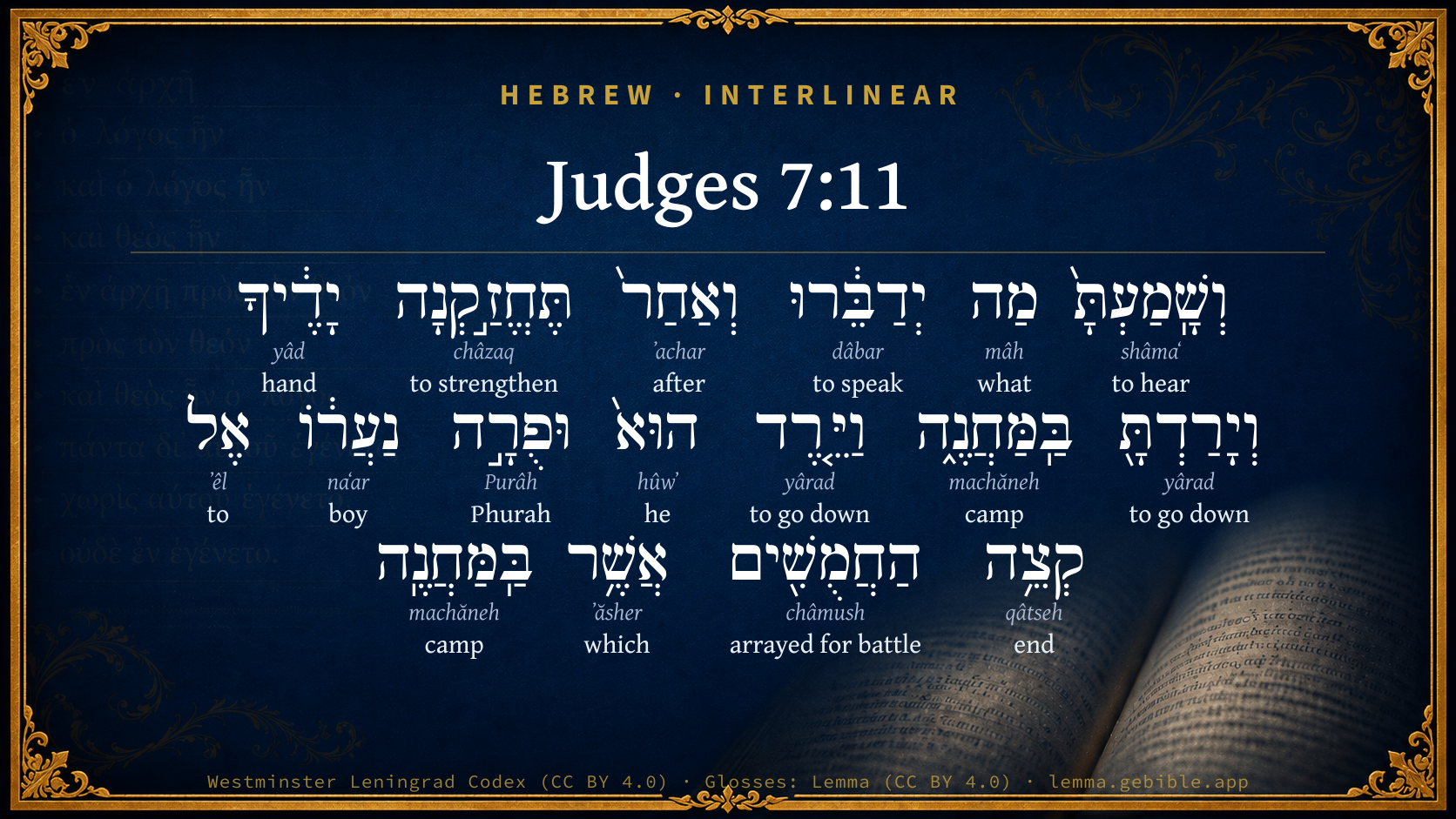
Judges 7:11

Hebrew (Westminster Leningrad Codex) Judges 7:11 appears in the Hebrew Old Testament. The text above is from the Westminster Leningrad Codex. Each word links to its Strong’s number, a concise gloss, and parsing drawn from the Open Scriptures Hebrew Bible morphology. Click any word for its full Brown-Driver-Briggs (BDB) entry.
Download image
Cite this verse

Judges 7:11 (World English Bible). Public Domain. Lemma interlinear Bible study tool, https://lemma.gebible.app/v/judges/7/11.

Show BibTeX & RIS
BibTeX
RIS
English Translation
and you shall hear what they say; and afterward shall your hands be strengthened to go down into the camp. Then went he down with Purah his servant to the outermost part of the armed men who were in the camp.
World English Bible · Public Domain
Download a study sheet

One document with this verse’s original text, its word-by-word gloss line, the meaning frame, cross-references with their text, attributed commentary, and full source and license credits — printable, and it pastes into notes with its structure intact.

This verse Autodidact and up

Study sheet (.html) Plain text (.txt)

A passage Seminary Student

Up to 50 verses in one chapter. A passage sheet keeps up to 6 commentary sources and 12 cross-references per verse, in the order this page ranks them, and says so on the sheet whenever that leaves anything out. Ask for a single verse and you get the Autodidact verse sheet above.

Everything on this page stays free to read, with no account — the sheet is a download of what is already on screen, not access to it.

Want to remove ads? Support Godless Engineer
Compare translations 3

The same verse in 3 English versions, stacked beneath the original-language interlinear above. Click any original word for its lexicon entry.

Each is an independent rendering of the whole verse — the interlinear is not word-aligned to these translations.

Highlighted words mark where these versions differ — a whole-verse word diff, not a word-by-word alignment.

  • World English Bible Public Domain
    and you shall hear what they say; and afterward shall your hands be strengthened to go down into the camp. Then went he down with Purah his servant to the outermost part of the armed men who were in the camp.
  • King James Version Public Domain
    And thou shalt hear what they say; and afterward shall thine hands be strengthened to go down unto the host. Then went he down with Phurah his servant unto the outside of the armed men that were in the host.
  • unfoldingWord Literal Text CC BY-SA 4.0
    and you shall hear what they are speaking, and afterward, your hands will be strong and you shall go down against the camp.” So he went down, he and Purah his servant, to the edge of the armed who in the camp.

unfoldingWord Literal Text — © unfoldingWord, licensed CC BY-SA 4.0. Word-aligned USFM3 via Door43 (git.door43.org/unfoldingWord/en_ult).

Versions to compare (up to 4)

3 of 4 selected

Show all 18 translations

Every available English version of this verse, each an independent rendering of the whole verse.

  • World English Bible Public Domain
    and you shall hear what they say; and afterward shall your hands be strengthened to go down into the camp. Then went he down with Purah his servant to the outermost part of the armed men who were in the camp.
  • Berean Standard Bible Public Domain
    and listen to what they are saying. Then your hands will be strengthened to attack the camp.” So he went with Purah his servant to the outposts where armed men were guarding the camp.
  • Majority Standard Bible Public Domain
    and listen to what they are saying. Then your hands will be strengthened to attack the camp.” So he went with Purah his servant to the outposts where armed men were guarding the camp.
  • King James Version Public Domain
    And thou shalt hear what they say; and afterward shall thine hands be strengthened to go down unto the host. Then went he down with Phurah his servant unto the outside of the armed men that were in the host.
  • American Standard Version (1901) Public Domain
    and thou shalt hear what they say; and afterward shall thy hands be strengthened to go down into the camp. Then went he down with Purah his servant unto the outermost part of the armed men that were in the camp.
  • Revised Version (1885) Public Domain
    and thou shalt hear what they say; and afterward shall thine hands be strengthened to go down into the camp. Then went he down with Purah his servant unto the outermost part of the armed men that were in the camp.
  • Geneva Bible (1599) Public Domain
    And thou shalt hearken what they say, and so shall thine handes be strong to go downe vnto the hoste. Then went he downe and Phurah his seruant vnto the outside of the souldiers that were in the hoste.
  • Douay-Rheims (1899) Public Domain
    And when thou shalt hear what they are saying, then shall thy hands be strengthened, and thou shalt go down more secure to the enemies' camp. And he went down with Phara his servant into part of the camp, where was the watch of men in arms.
  • Young's Literal Translation Public Domain
    and thou hast heard what they speak, and afterwards are thy hands strengthened, and thou hast gone down against the camp.' And he goeth down, he and Phurah his young man, unto the extremity of the fifties who `are' in the camp;
  • Literal Standard Version CC BY-SA 4.0
    and you have heard what they speak, and afterward your hands are strengthened, and you have gone down against the camp.” And he goes down, he and his young man Phurah, to the extremity of the fifties who [are] in the camp;
  • Unlocked Literal Bible CC BY-SA 4.0
    and listen to what they are saying, and your courage will be strengthened to attack the camp.” So Gideon went with Purah his servant, down to the guard posts of the camp.
  • unfoldingWord Literal Text CC BY-SA 4.0
    and you shall hear what they are speaking, and afterward, your hands will be strong and you shall go down against the camp.” So he went down, he and Purah his servant, to the edge of the armed who in the camp.
  • Darby Bible Public Domain
    and you shall hear what they say, and afterward your hands shall be strengthened to go down against the camp." Then he went down with Purah his servant to the outposts of the armed men that were in the camp.
  • World Messianic Bible Public Domain
    You will hear what they say; and afterward your hands will be strengthened to go down into the camp.” Then went he down with Purah his servant to the outermost part of the armed men who were in the camp.
  • Webster's Bible Public Domain
    And thou shalt hear what they say; and afterward shall thy hands be strengthened to go down to the host. Then went he down with Phurah his servant to the outside of the armed men that were in the host.
  • Free Bible Version CC BY-SA 4.0
    You'll hear what they're talking about and then you'll have the courage to attack the camp.” So he took his servant Purah with him and went to the edge of the camp where armed men were on guard.
  • Bible in Basic English Public Domain
    And after hearing what they are saying, you will get strength to go down against the army. So he went down with his servant Purah to the outer line of the tents of the armed men.
  • JPS Tanakh (1917) Public Domain
    And thou shalt hear what they say; and afterward shall thy hands be strengthened to go down upon the camp.' Then went he down with Purah his servant unto the outermost part of the armed men that were in the camp.

Literal Standard Version (2020), Covenant Press — licensed CC BY-SA 4.0. Text via the HelloAO Bible API (eBible.org). Unlocked Literal Bible (unfoldingWord) — licensed CC BY-SA 4.0. Text via the HelloAO Bible API (eBible.org). unfoldingWord Literal Text — © unfoldingWord, licensed CC BY-SA 4.0. Word-aligned USFM3 via Door43 (git.door43.org/unfoldingWord/en_ult). Free Bible Version, Dr. Jonathan Gallagher — licensed CC BY-SA 4.0. Text via the HelloAO Bible API (eBible.org).

Word by word

More ways to search: Search by grammar → Find every occurrence → Compare this word →

Practice this passage: Drill this verse → Learn its vocabulary →

וּפֻרָ֣ה
Purâh
H6513
“and · Phurah”
Conjunction + Noun, Proper
Part of Speech
Conjunction + Noun
Type
Proper
Full BDB Definition

Origin: for H6288

TWOT: None

Phurah = "bough" - the servant of Gideon, probably his armour-bearer
  1. וְשָֽׁמַעְתָּ֙ shâmaʻ H8085 “and · to hear” Conjunction + Verb, Qal, Sequential Perfect, 2nd Person, Masculine, Singular
  2. מַה mâh H4100 “what” Particle, Interrogative
  3. יְדַבֵּ֔רוּ dâbar H1696 “to speak” Verb, Piel, Imperfect, 3rd Person, Masculine, Plural
  4. וְאַחַר֙ ʼachar H310 “and · after” Conjunction + Adverb
  5. תֶּחֱזַ֣קְנָה châzaq H2388 “to strengthen” Verb, Qal, Imperfect, 3rd Person, Feminine, Plural
  6. יָדֶ֔יךָ yâd H3027 “hands · your” Noun, Common, Both, Dual, Construct + Suffix, Personal, 2nd Person, Masculine, Singular
  7. וְיָרַדְתָּ֖ yârad H3381 “and · to go down” Conjunction + Verb, Qal, Sequential Perfect, 2nd Person, Masculine, Singular
  8. בַּֽמַּחֲנֶ֑ה machăneh H4264 “in/at the · camp” Preposition, Determined + Noun, Common, Both, Singular, Absolute
  9. וַיֵּ֤רֶד yârad H3381 “and · to go down” Conjunction + Verb, Qal, Sequential Imperfect, 3rd Person, Masculine, Singular
  10. הוּא֙ hûwʼ H1931 “he” Pronoun, Personal, 3rd Person, Masculine, Singular
  11. נַעֲר֔וֹ naʻar H5288 “boy · his” Noun, Common, Masculine, Singular, Construct + Suffix, Personal, 3rd Person, Masculine, Singular
  12. אֶל ʼêl H413 “to” Preposition
  13. קְצֵ֥ה qâtseh H7097 “end of” Noun, Common, Both, Singular, Construct
  14. הַחֲמֻשִׁ֖ים châmush H2571 “the · arrayed for battle” Particle, Definite Article + Verb, Qal, Participle Passive, Masculine, Plural, Absolute
  15. אֲשֶׁ֥ר ʼăsher H834 “which” Particle, Relative
  16. בַּֽמַּחֲנֶֽה machăneh H4264 “in/at the · camp” Preposition, Determined + Noun, Common, Both, Singular, Absolute

About this verse

These counts appear in no published source. They are computed here, from the morphology-tagged text and Lemma’s own curated glosses. What Lemma adds →

17
words
15
distinct lemmas
Historical
section

Notable vocabulary

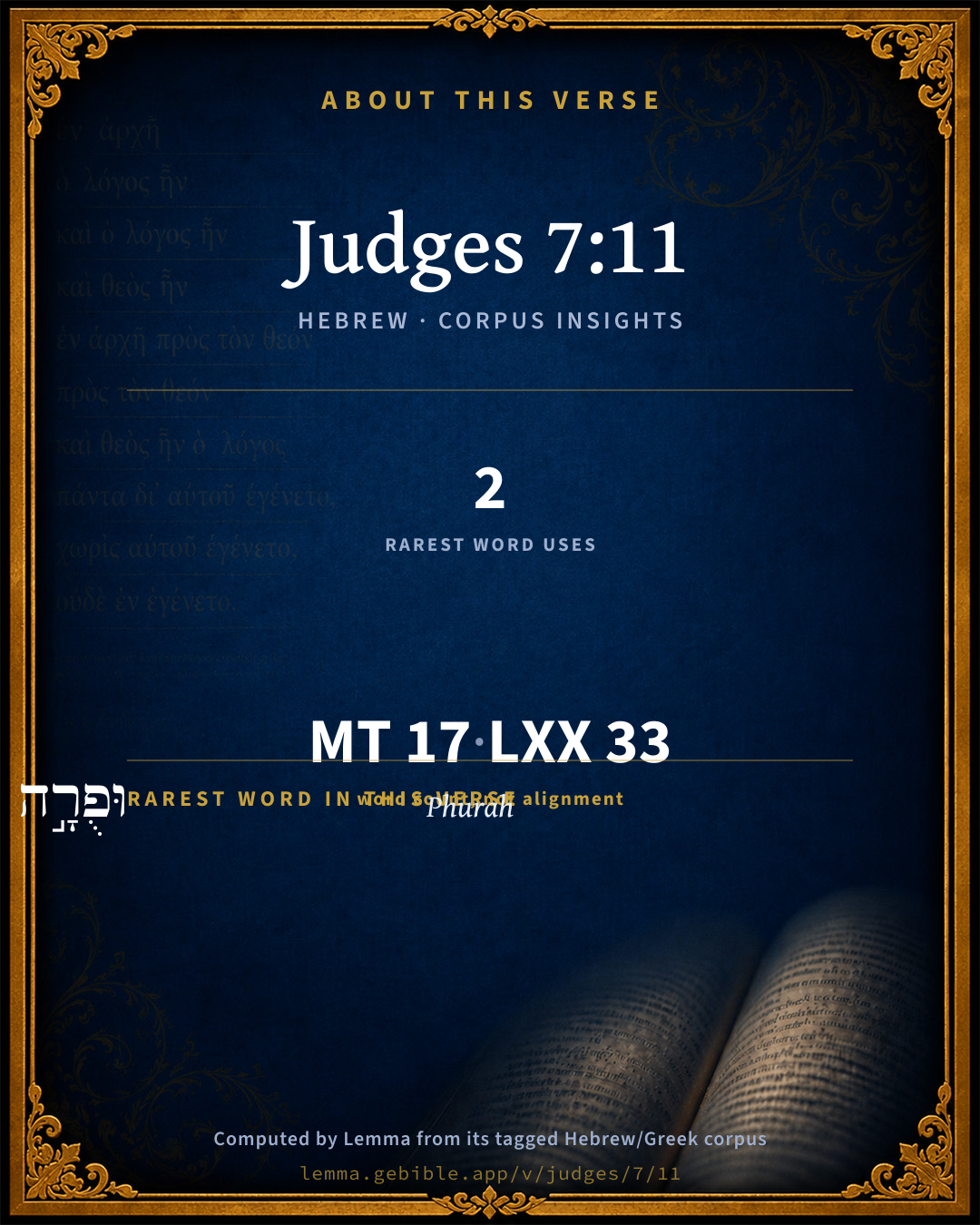
The rarest word here is וּפֻרָ֣ה Phurah H6513 — appearing just 2 times in the whole Hebrew Bible.

Shared distinctive vocabulary

וּפֻרָ֣ה Phurah H6513 occurs in 2 verses of the Hebrew Bible. Also found in:

Grammatical profile

  • 6 verbs
  • 6 nouns
  • 1 pronoun
  • 1 preposition
  • 1 adverb
  • 2 particles

Verb forms

  • וְשָֽׁמַעְתָּ֙ Qal · Sequential Perfect
  • יְדַבֵּ֔רוּ Piel · Imperfect
  • תֶּחֱזַ֣קְנָה Qal · Imperfect
  • וְיָרַדְתָּ֖ Qal · Sequential Perfect
  • וַיֵּ֤רֶד Qal · Sequential Imperfect
  • הַחֲמֻשִׁ֖ים Qal · Participle Passive

Repetition

Words recur within this verse — often emphatic in Hebrew:

  • וְיָרַדְתָּ֖ to go down H3381 ×2
  • בַּֽמַּחֲנֶ֑ה camp H4264 ×2

Hebrew & Septuagint length

In English translation the verse runs 41 words from the Hebrew and 44 from the Septuagint (LXX English) — closely comparable.

A rough comparison of the two English renderings, which tokenize alike — not a word-level alignment.

Word counts can differ between the Hebrew and the Greek without any difference in meaning — e.g. the Hebrew direct-object marker אֵת has no separate Greek word, and Greek often adds the article ὁ.

In the original languages it is 17 Hebrew tokens and 33 Greek tokens — but the two are counted differently (Hebrew bundles its prefixes and suffixes into one token; the Greek is in lemma form), so that isn’t a like-for-like length.

Cross-references

13

Topical passages linked to Judges 7:11 in the Treasury of Scripture Knowledge — connected by theme and wording, ordered by reader-vote popularity; previews shown in the World English Bible.

  • 2 Corinthians 12:9–10 He has said to me, "My grace is sufficient for you, for my power is made perfect in weakness." Most gladly therefore I will rather glory in my weaknesses, that the power of Christ may rest on me.
  • Ephesians 6:10 Finally, be strong in the Lord, and in the strength of his might.
  • Philippians 4:13 I can do all things through Christ, who strengthens me.
  • Genesis 24:14 Let it happen, that the young lady to whom I will say, 'Please let down your pitcher, that I may drink.' She will say, 'Drink, and I will also give your camels a drink.' Let the same be she who you have appointed for your servant Isaac. Thereby will I know that you have shown kindness to my master."
  • Exodus 13:18 but God led the people around by the way of the wilderness by the Red Sea; and the children of Israel went up armed out of the land of Egypt.
  • Judges 7:13–15 When Gideon had come, behold, there was a man telling a dream to his fellow; and he said, Behold, I dreamed a dream; and, behold, a cake of barley bread tumbled into the camp of Midian, and came to the tent, and struck it so that it fell, and turned it upside down, so that the tent lay flat.
  • 1 Samuel 14:8–10 Then said Jonathan, Behold, we will pass over to the men, and we will disclose ourselves to them.
  • 1 Samuel 23:16 Jonathan, Saul's son, arose, and went to David into the wood, and strengthened his hand in God.
  • Ezra 6:22 and kept the feast of unleavened bread seven days with joy: for Yahweh had made them joyful, and had turned the heart of the king of Assyria to them, to strengthen their hands in the work of the house of God, the God of Israel.
  • Isaiah 35:3–4 Strengthen you the weak hands, and confirm the feeble knees.
  • Nehemiah 6:9 For they all would have made us afraid, saying, Their hands shall be weakened from the work, that it not be done. But now, [God], strengthen you my hands.
  • Ephesians 3:16 that he would grant you, according to the riches of his glory, that you may be strengthened with power through his Spirit in the inward man;
  • 1 Samuel 14:12 The men of the garrison answered Jonathan and his armor bearer, and said, Come up to us, and we will show you a thing. Jonathan said to his armor bearer, Come up after me; for Yahweh has delivered them into the hand of Israel.

Cross-references courtesy of OpenBible.info (CC BY 4.0).

Hebrew and Greek witnesses Masoretic Hebrew ↔ Greek Septuagint

The same verse in the two great witnesses to the Old Testament, shown verse-for-verse.

These are two independent witnesses, not word-aligned to each other, and the Septuagint is shown in lemma (dictionary) form.

Hebrew Judges 7:11 Masoretic · Westminster Leningrad Codex

וְשָֽׁמַעְתָּ֙ מַה יְדַבֵּ֔רוּ וְאַחַר֙ תֶּחֱזַ֣קְנָה יָדֶ֔יךָ וְיָרַדְתָּ֖ בַּֽמַּחֲנֶ֑ה וַיֵּ֤רֶד הוּא֙ וּפֻרָ֣ה נַעֲר֔וֹ אֶל קְצֵ֥ה הַחֲמֻשִׁ֖ים אֲשֶׁ֥ר בַּֽמַּחֲנֶֽה

and you shall hear what they say; and afterward shall your hands be strengthened to go down into the camp. Then went he down with Purah his servant to the outermost part of the armed men who were in the camp.

World English Bible · Public Domain

Greek LXX Judges 7:11 Septuagint · lemma form

καί ἀκούω τίς λαλέω καί μετά οὗτος ἰσχύω ὁ χείρ σύ καί καταβαίνω ἐν ὁ παρεμβολή καί καταβαίνω αὐτός καί φαρα ὁ παιδάριον αὐτός πρός ἀρχή ὁ πεντήκοντα ὅς εἰμί ἐν ὁ παρεμβολή

And you shall hear what they shall say, and afterwards your hands shall be strong, and you shall go down into the camp: and he went down and Phara his servant to the extremity of the companies of fifty, which were in the camp.

LXX2012 (modern English Septuagint) · Public Domain

On this verse, Ellicott's Commentary for English Readers discusses the Septuagint’s reading. Read the note in Commentary ↓

Hebrew: Westminster Leningrad Codex (CC BY 4.0). Greek: Septuagint (public domain); English from LXX2012 (modern English Septuagint) (Public Domain). How the Septuagint differs from the Hebrew →

Targum (Aramaic paraphrase)

1

The Targum is the ancient Jewish Aramaic paraphrase of the Hebrew Scriptures — an interpretive translation, not the Hebrew text itself. Onkelos (literal) and Pseudo-Jonathan (expansive) render the Torah, and Jonathan the Prophets. Coverage is partial: where no permissively-licensed English translation exists for a verse, only the Aramaic is shown. This is verse-level text, not a word-by-word alignment to the Hebrew.

  1. Targum Jonathan Prophets (Joshua–Malachi)
    וְתִשְׁמַע מַה יְמַלְלוּן וּבָתַר כֵּן יִתְקוֹף יְדָךְ וְתֵחוֹת בְּמַשְׁרִיתָא וּנְחַת הוּא וּפוּרָה עוּלֵימֵיהּ לִסְטַר מְזַרְזַיָא דִי בְּמַשְׁרִיתָא:

    (no public-domain English translation for this verse)

    Targum Jonathan — Aramaic: “Mikraot Gedolot” (public domain). English: “Sefaria Community Translation” (CC0 1.0 (public-domain dedication)); “London "Chaldee Paraphrase," 1871” (public domain). Text via Sefaria.

Commentary

Notes on Judges 7:11 from classic Christian and Jewish commentators (each source and its license shown beneath its notes). The classic Christian expositions comment on the surrounding passage and are grouped to its opening verse, so a note may address several verses; the Jewish commentaries on the Tanakh (Rashi and others) are per-verse, so they appear only where the commentator wrote on this verse.

Lemma curates 59 commentaries, every one of them public domain or Creative Commons licensed, each selected and text-cleaned for this edition rather than reprinted as found. About our sources →

Trapp's Complete Commentary

John Trapp

Jdg 7:11 And thou shalt hear what they say; and afterward shall thine hands be strengthened to go down unto the host. Then went he down with Phurah his servant unto the outside of the armed men that [were] in the host.

Ver. 11. And thou shalt hear.] For further confirmation of thy faith. So low stoopeth the Lord to our meanness.

Unto the outside of the armed men.] And if the strength of the army despond of the victory, what mayest thou think of the rest?

John Trapp, A Commentary or Exposition upon All the Books of the Old and New Testament (1647–1656) — public domain. Text from a community e-Sword module.

Jamieson, Fausset & Brown

Robert Jamieson, A. R. Fausset & David Brown

the outside of the armed men that were in the host--"Armed," means embodied under the five officers established by the ordinary laws and usages of encampments. The camp seems to have been unprotected by any rampart, since Gideon had no difficulty in reaching and overhearing a conversation, so important to him.

Jamieson, Fausset & Brown — Commentary Critical and Explanatory on the Whole Bible (1871) — public domain (CC PDM 1.0). Text via the HelloAO Bible API.

Adam Clarke's Commentary

Verse 11. Unto the outside of the armed men] No doubt the vast multitudes of Midianites, c., which came merely for plunder, were wholly unarmed but they had a guard of armed men, as all the caravans have, and those guards were on the outside of the multitudes; it was to these that Gideon and his servant came.

Adam Clarke's Commentary on the Bible (1810–1826) — public domain. Text from a community e-Sword/MySword module.

Ellicott's Commentary for English Readers

(11)And thou shalt hear what they say.—This was the kind of omen known by the Jews as the Bath Kol, or “Daughter of a Voice.” For a similar instance see 1Sa_14:6 (Jonathan and his armour-bearer). The word is used in slightly different senses. Sometimes it means a voice from heaven (Mat_3:17, &c): such voices from heaven are described in the Talmud; sometimes it means the first chance words which a man hears after being bidden to look out for them as a Divine intimation; sometimes it means an actual echo (see Hamburger’s Talmud. Wörterb., s.5).

It was one of the four recognised modes of Divine direction (viz., prophets, dreams, Urim, and the Bath Kol, 1Sa_28:6-15), but stood lowest of the four. It was also known to the Greeks, among whom the oracle sometimes bade a man to take as his answer the first casual words which he heard spoken on leaving the Temple.

The armed men.—Literally, ranks by, five, the word (chamooshim) rendered “harnessed” in Exo_13:18, “armed” in Jos_1:14. Probably here the word means “foreposts,” or “sentries”; and the Vulgate renders it “vigiliae.” The LXX. curiously render it “to the beginning,” (or in other MSS.) “to part of the fifty,” following a wrong punctuation.

That were in the host.—Probably “the host” was in some respects more like a temporary nomad migration, such as is so common among all wandering tribes. If so, it would not be by any means entirely composed of “armed men,” but would, like the Persians under Xerxes, trail with it a vast mass of camp followers, &c., who would probably be encamped in the centre with the baggage.

A Bible Commentary for English Readers, edited by Charles John Ellicott (1878–1897) — public domain. Text from a community e-Sword module.

The Cambridge Bible for Schools and Colleges

gen. ed. J. J. S. Perowne

11. shall thine hands be strengthened] for a bold stroke. Hebrew speaks of the hands where we should speak of the heart; cf. 2Sa_2:7; 2Sa_16:21.

the armed men] Elsewhere of the Israelite hosts at the period of the Wandering and the Occupation; Exo_13:18 E, Num_32:17 JE, Jos_1:14; Jos_4:12 D; the exact meaning of the word is not known. The LXX renders fifty by a mistaken etymology.

The Cambridge Bible for Schools and Colleges (gen. ed. J. J. S. Perowne; Cambridge University Press, 1878–1918) — public domain. Text from a community e-Sword module.

John Gill's Exposition

And thou shalt hear what they shall say,.... The Midianites, or what shall be said by any of them; for though it was the night season, and so not a time for much conversation, as it may be supposed to be the dead of the night; yet something would be said and heard, which is a clear proof of the prescience of God respecting future contingent events:

and afterwards shall thine hands be strengthened; and his heart encouraged by what he should hear:

to go down into the camp; in an hostile manner, with his three hundred men, after his return to them:

then went he down with Phurah his servant; first privately, only they two, leaving his little army on the hill: and came

unto the outside of the armed men that were in the host; the sentinels, who were without side the camp, and stood complete in armour to guard it; and they came as near to them, in as still and private manner as they could, without being discovered. The Septuagint version is,"to the beginning of the fifty that were in the host;''and the Syriac and Arabic versions,"to the captain of the fifty;''these might be a party of the outer guards, consisting of fifty men, with one at the head of them, placed for the safety of the army in the night season, and to give notice of any approach to them, or attempt on them.

John Gill's Exposition of the Whole Bible (1746–1763) — public domain (CC PDM 1.0). Text via the HelloAO Bible API.

Albert Barnes' Notes on the Bible

The armed men - The word is rendered harnessed in Exo 13:18 (see the note). The most probable meaning of the word is arrayed in divisions or ranks.

Albert Barnes' Notes on the Bible (1834–1885) — public domain. Text from a community e-Sword/MySword module.

Haydock's Catholic Bible Commentary

Servant. Thus he confessed that he was not entirely free from fear himself, ver. 5, 10. (Haydock) --- The most courageous feel less alarm, when they have a companion, (Menochius) as Diomede observed, when he desired that one or two might accompany him in the attempt to explore the enemy’s camp. (Homer, Iliad x.) --- Arms. The greatest part of this immense crowd of people, who came to plunder, neglected the laws of war; as the Israelites had not dared, for a long time, to oppose them. A select number of 135,000 men in arms was destined to keep them in order, and to protect them. Among these Gedeon insinuated himself, to know how they were encamped, and what sentiments they entertained. (Calmet)

George Leo Haydock (1774–1849), Haydock's Catholic Family Bible and Commentary, 1859 edition — public domain. Excludes Psalms (Douay-Rheims chapter numbering differs from Protestant) and Deuterocanonical books (Catholic canon only).

Matthew Poole's English Annotations

Afterward shall thine hands be strengthened; thou wilt be encouraged to proceed, notwithstanding the smallness of thy number, which may deter thee.

Matthew Poole's English Annotations on the Holy Bible (1683–1685) — public domain. Text from a community e-Sword/MySword module.

Whedon's Commentary on the Bible

Daniel D. Whedon

11. The outside of the armed men — On the word חמשׁים, rendered armed men, see at Exo_13:18, and Jos_1:14. It does not mean that every individual in this host of Midian was armed, any more than Exo_13:18, means that every Israelite that went out of Egypt was armed with weapons of war.

Daniel D. Whedon (gen. ed.), Commentary on the Old and New Testaments (1874–1909) — public domain. Text from a community e-Sword module.

The Pulpit Commentary

The armed men. The exact meaning of the word here rendered armed men (chamushim), and which occurs Exo_13:18 Jos_1:14 Jos_4:12, is a little uncertain, but it is generally thought to be synonymous with another word ( calutsim), also rendered armed, (Num_32:32 Deu_3:18) and to mean literally girded, i.e. prepared to fight. These fighting men, as distinguished from the numbers of the nomads who were with their camels and cattle scattered all along the plain, were all collected in the camp, to the edge of which Gideon and Phurah crept stealthily in the dark.

The Pulpit Commentary (1880–1919), ed. H.D.M. Spence-Jones & Joseph S. Exell — public domain. Text from a community e-Sword module.

John Wesley's Explanatory Notes

Thine hand strengthened - Thou wilt be encourage to proceed, notwithstanding the smallness of thy number.

John Wesley, Explanatory Notes Upon the Whole Bible (1754–1765) — public domain. Text via the GEBible commentary corpus.

Keil & Delitzsch

C. F. Keil & F. Delitzsch

But when Gideon came with his attendant to the end of the armed men (chamushim, as in Jos 1:14; Exo 13:18) in the hostile camp, and the enemy were lying spread out with their camels in the valley, an innumerable multitude, he heard one (of the fighting men) relate to his fellow (i.e., to another) a dream which he had had: "Behold a cake of barley bread was rolling into the camp of Midian, and it came to the tent and smote it, so that it fell and turned upwards, and let the tent lay along." Then the other replied, "This is nothing else than the sword of Gideon the son of Joash the Israelite: God hath given Midian and all the camp into his hand." "The end of fighting men" signifies the outermost or foremost of the outposts in the enemy's camp, which contained not only fighting men, but the whole of the baggage of the enemy, who had invaded the land as nomads, with their wives, their children, and their flocks. In Jdg 7:12, the innumerable multitude of the enemy is described once more in the form of a circumstantial clause, as in Jdg 6:5, not so much to distinguish the fighting men from the camp generally, as to bring out more vividly the contents and meaning of the following dream. The comparison of the enemy to the sand by the sea-side recalls Jos 11:4, and is frequently met with (see Gen 22:17; Gen 32:13; Sa1 13:5). With the word ויּבא in Jdg 7:13, the thread of the narrative, which was broken off by the circumstantial clause in Jdg 7:12, is resumed and carried further. The ἁπ. λεγ. צלוּל (Keri, צליל) is rendered cake, placenta, by the early translators: see Ges. Thes. p. 1170. The derivation of the word has been disputed, and is by no means certain, as צלל does not give any suitable meaning, either in the sense of to ring or to be overshadowed, and the meaning to roll (Ges. l.c.) cannot be philologically sustained; whilst צלה, to roast, can hardly be thought of, since this is merely used to denote the roasting of flesh, and קלה was the word commonly applied to the roasting of grains, and even "the roasted of barley bread" would hardly be equivalent to subcinericeus panis ex hordeo (Vulgate). "The tent," with the definite article, is probably the principal tent in the camp, i.e., the tent of the general. למעלה, upwards, so that the bottom came to the top. "The tent lay along," or the tent fell, lay in ruins, is added to give emphasis to the words. "This is nothing if not," i.e., nothing but. The cake of bread which had rolled into the Midianitish camp and overturned the tent, signifies nothing else than the sword of Gideon, i.e., Gideon, who is bursting into the camp with his sword, and utterly destroying it.

This interpretation of the dream was certainly a natural one under the circumstances. Gideon is especially mentioned simply as the leader of the Israelites; whilst the loaf of barley bread, which was the food of the poorer classes, is to be regarded as strictly speaking the symbol of Israel, which was so despised among the nations. The rising of the Israelites under Gideon had not remained a secret to the Midianites, and no doubt filled them with fear; so that in a dream this fear might easily assume the form of the defeat or desolation and destruction of their camp by Gideon. And the peculiar form of the dream is also psychologically conceivable. As the tent is everything to a nomad, he might very naturally picture the cultivator of the soil as a man whose life is all spent in cultivating and baking bread. In this way bread would become almost involuntarily a symbol of the cultivator of the soil, whilst in his own tent he would see a symbol not only of his mode of life, but of his freedom, greatness, and power. If we add to this, that the free pastoral tribes, particularly the Bedouins of Arabia, look down with pride not only upon the poor tillers of the soil, but even upon the inhabitants of towns, and that in Palestine, the land of wheat, none but the poorer classes feed upon barley bread, we have here all the elements out of which the dream of the Midianitish warrior was formed. The Israelites had really been crushed by the Midianites into a poor nation of slaves. But whilst the dream itself admits of being explained in this manner in a perfectly natural way, it acquires the higher supernatural character of a divine inspiration, from the fact that God not only foreknew it, but really caused the Midianite to dream, and to relate the dream to his comrade, just at the time when Gideon had secretly entered the camp, so that he should hear it, and discover therefrom, as God had foretold him, the despondency of the foe. Under these circumstances, Gideon could not fail to regard the dream as a divine inspiration, and to draw the assurance from it, that God had certainly given the Midianites into his hands.

Keil & Delitzsch — Biblical Commentary on the Old Testament (1861–1891) — public domain (CC PDM 1.0). Text via the HelloAO Bible API. (Old Testament only.)

Lesson kit

Teaching starters — assembled from the data on this page, not authored interpretation. Every prompt links to the verse data it draws on. Edit before teaching.

Judges, in the Historical, opens this verse with 17 words (15 distinct Hebrew lemmas). Its most distinctive word is Purâh (“Phurah”). A historical commentator’s framing appears above. Read the whole chapter for the surrounding context.

Discussion questions

  1. What does “Phurah” (Purâh) contribute to the verse as a whole?
  2. How does Judges 7:10, which shares the word «Phurah», read alongside this verse?
  3. What does the repetition of “to go down” (2× in this one verse) do in this verse?
  4. These translations render this verse differently. What is at stake in choosing one wording over another?
  5. «וְשָֽׁמַעְתָּ֙» is a Qal Sequential Perfect verb. How does that grammatical form shape the action described?
  6. Compare how Trapp's Complete Commentary and Jamieson, Fausset & Brown read this verse. Where do they agree or differ?

Things to notice

Reading settings

Reading text

Shown beneath each verse's original-language words.

Old Testament
Old Testament edition

Read the OT as the Masoretic Hebrew (MT) or the Greek Septuagint (LXX).

English shown for the Greek Septuagint (in the Hebrew ↔ Greek comparison).

Comparing translations? Open the Compare panel on any verse page to stack up to four side by side.