
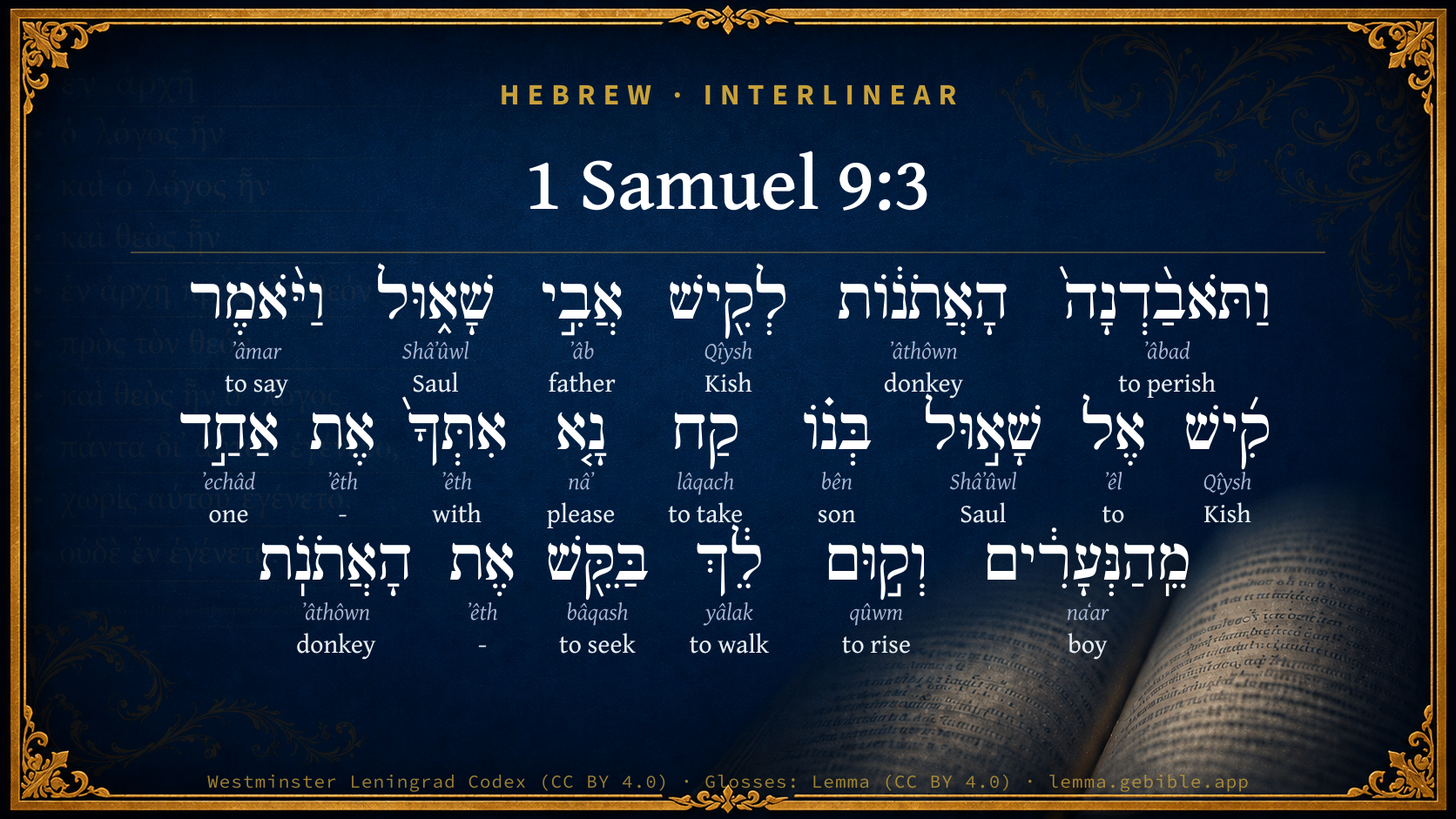
1 Samuel 9:3

Hebrew (Westminster Leningrad Codex) 1 Samuel 9:3 appears in the Hebrew Old Testament. The text above is from the Westminster Leningrad Codex. Each word links to its Strong’s number, a concise gloss, and parsing drawn from the Open Scriptures Hebrew Bible morphology. Click any word for its full Brown-Driver-Briggs (BDB) entry.
Download image
Cite this verse

1 Samuel 9:3 (World English Bible). Public Domain. Lemma interlinear Bible study tool, https://lemma.gebible.app/v/1-samuel/9/3.

Show BibTeX & RIS
BibTeX
RIS
English Translation
The donkeys of Kish, Saul's father, were lost. Kish said to Saul his son, Take now one of the servants with you, and arise, go seek the donkeys.
World English Bible · Public Domain
Download a study sheet

One document with this verse’s original text, its word-by-word gloss line, the meaning frame, cross-references with their text, attributed commentary, and full source and license credits — printable, and it pastes into notes with its structure intact.

This verse Autodidact and up

Study sheet (.html) Plain text (.txt)

A passage Seminary Student

Up to 50 verses in one chapter. A passage sheet keeps up to 6 commentary sources and 12 cross-references per verse, in the order this page ranks them, and says so on the sheet whenever that leaves anything out. Ask for a single verse and you get the Autodidact verse sheet above.

Everything on this page stays free to read, with no account — the sheet is a download of what is already on screen, not access to it.

Want to remove ads? Support Godless Engineer
Compare translations 3

The same verse in 3 English versions, stacked beneath the original-language interlinear above. Click any original word for its lexicon entry.

Each is an independent rendering of the whole verse — the interlinear is not word-aligned to these translations.

Highlighted words mark where these versions differ — a whole-verse word diff, not a word-by-word alignment.

  • World English Bible Public Domain
    The donkeys of Kish, Saul's father, were lost. Kish said to Saul his son, Take now one of the servants with you, and arise, go seek the donkeys.
  • King James Version Public Domain
    And the asses of Kish Saul's father were lost. And Kish said to Saul his son, Take now one of the servants with thee, and arise, go seek the asses.
  • unfoldingWord Literal Text CC BY-SA 4.0
    Now the female donkeys of Kish, the father of Saul, became lost. And Kish said to Saul his son, “Please take one of the servants with you and arise, go seek the female donkeys.”

unfoldingWord Literal Text — © unfoldingWord, licensed CC BY-SA 4.0. Word-aligned USFM3 via Door43 (git.door43.org/unfoldingWord/en_ult).

Versions to compare (up to 4)

3 of 4 selected

Show all 18 translations

Every available English version of this verse, each an independent rendering of the whole verse.

  • World English Bible Public Domain
    The donkeys of Kish, Saul's father, were lost. Kish said to Saul his son, Take now one of the servants with you, and arise, go seek the donkeys.
  • Berean Standard Bible Public Domain
    One day the donkeys of Saul’s father Kish wandered off, and Kish said to his son Saul, “Take one of the servants and go look for the donkeys.”
  • Majority Standard Bible Public Domain
    One day the donkeys of Saul’s father Kish wandered off, and Kish said to his son Saul, “Take one of the servants and go look for the donkeys.”
  • King James Version Public Domain
    And the asses of Kish Saul's father were lost. And Kish said to Saul his son, Take now one of the servants with thee, and arise, go seek the asses.
  • American Standard Version (1901) Public Domain
    And the asses of Kish, Saul's father, were lost. And Kish said to Saul his son, Take now one of the servants with thee, and arise, go seek the asses.
  • Revised Version (1885) Public Domain
    And the asses of Kish Saul’s father were lost. And Kish said to Saul his son, Take now one of the servants with thee, and arise, go seek the asses.
  • Geneva Bible (1599) Public Domain
    And the asses of Kish Sauls father were lost: therefore Kish said to Saul his sonne, Take nowe one of the seruants with thee, and arise, goe, and seeke the asses.
  • Douay-Rheims (1899) Public Domain
    And the asses of Cis, Sauls father, were lost: and Cis said to his son Saul: Take one of the servants with thee, and arise, go, and seek the asses. And when they had passed through mount Ephraim,
  • Young's Literal Translation Public Domain
    And the asses of Kish, father of Saul, are lost, and Kish saith unto Saul his son, `Take, I pray thee, with thee, one of the young men, and rise, go, seek the asses.'
  • Literal Standard Version CC BY-SA 4.0
    And the donkeys of Kish, father of Saul, are lost, and Kish says to his son Saul, “Now take one of the young men with you, and rise, go, seek the donkeys.”
  • Unlocked Literal Bible CC BY-SA 4.0
    Now the donkeys of Kish, Saul's father, were lost. So Kish said to Saul his son, “Take one of the servants with you; arise and go look for the donkeys.”
  • unfoldingWord Literal Text CC BY-SA 4.0
    Now the female donkeys of Kish, the father of Saul, became lost. And Kish said to Saul his son, “Please take one of the servants with you and arise, go seek the female donkeys.”
  • Darby Bible Public Domain
    And the asses of Kish Saul's father were lost; and Kish said to Saul his son, Take, I pray, one of the young men with thee, and arise, go seek the asses.
  • World Messianic Bible Public Domain
    The donkeys of Kish, Saul’s father, were lost. Kish said to Saul his son, “Now take one of the servants with you, and arise, go look for the donkeys.”
  • Webster's Bible Public Domain
    And the asses of Kish, Saul's father, were lost. And Kish said to Saul his son, Take now one of the servants with thee, and arise, go seek the asses.
  • Free Bible Version CC BY-SA 4.0
    One time the donkeys of Saul's father Kish went astray. Kish told his son Saul, “Please go and look for the donkeys. You can take one of the servants with you.”
  • Bible in Basic English Public Domain
    Now the asses of Saul's father Kish had gone wandering away. And Kish said to his son Saul, Take one of the servants with you, and get up and go in search of the asses.
  • JPS Tanakh (1917) Public Domain
    Now the asses of Kish Saul's father were lost. And Kish said to Saul his son: 'Take now one of the servants with thee, and arise, go seek the asses.'

Literal Standard Version (2020), Covenant Press — licensed CC BY-SA 4.0. Text via the HelloAO Bible API (eBible.org). Unlocked Literal Bible (unfoldingWord) — licensed CC BY-SA 4.0. Text via the HelloAO Bible API (eBible.org). unfoldingWord Literal Text — © unfoldingWord, licensed CC BY-SA 4.0. Word-aligned USFM3 via Door43 (git.door43.org/unfoldingWord/en_ult). Free Bible Version, Dr. Jonathan Gallagher — licensed CC BY-SA 4.0. Text via the HelloAO Bible API (eBible.org).

Word by word

More ways to search: Search by grammar → Find every occurrence → Compare this word →

Practice this passage: Drill this verse → Learn its vocabulary →

לְקִ֖ישׁ
Qîysh
H7027
“to/for · Kish”
Preposition + Noun, Proper
Part of Speech
Preposition + Noun
Type
Proper
Full BDB Definition

Origin: from H6983

TWOT: None

Kish = "bent" - a Benjamite of the family of Matri, father of king Saul - an ancestor of Mordecai - son of Gibeon and brother of Abdon, Zur, Baal, Ner, Nadab, Gedor, Ahio, Zechariah, and Mikloth; uncle of Kish the father of king Saul - a Merarite Levite, son of Mahli and grandson of Merari the progenitor of the family - a Merarite Levite, son of Abdi in the time of king Hezekiah of Judah
  1. וַתֹּאבַ֨דְנָה֙ ʼâbad H6 “and · to perish” Conjunction + Verb, Qal, Sequential Imperfect, 3rd Person, Feminine, Plural
  2. הָאֲתֹנ֔וֹת ʼâthôwn H860 “the · donkeys” Particle, Definite Article + Noun, Common, Feminine, Plural, Absolute
  3. אֲבִ֣י ʼâb H1 “father of” Noun, Common, Masculine, Singular, Construct
  4. שָׁא֑וּל Shâʼûwl H7586 “Saul” Noun, Proper
  5. וַיֹּ֨אמֶר ʼâmar H559 “and · to say” Conjunction + Verb, Qal, Sequential Imperfect, 3rd Person, Masculine, Singular
  6. קִ֜ישׁ Qîysh H7027 “Kish” Noun, Proper
  7. אֶל ʼêl H413 “to” Preposition
  8. שָׁא֣וּל Shâʼûwl H7586 “Saul” Noun, Proper
  9. בְּנ֗וֹ bên H1121 “son · his” Noun, Common, Masculine, Singular, Construct + Suffix, Personal, 3rd Person, Masculine, Singular
  10. קַח lâqach H3947 “take” Verb, Qal, Imperative, 2nd Person, Masculine, Singular
  11. נָ֤א nâʼ H4994 “please” Particle, Exhortation
  12. אִתְּךָ֙ ʼêth H854 “with · you” Preposition + Suffix, Personal, 2nd Person, Masculine, Singular
  13. אֶת ʼêth H853 “-” Particle, Direct Object
  14. אַחַ֣ד ʼechâd H259 “one” Adjective, Cardinal number, Masculine, Singular, Absolute
  15. מֵֽהַנְּעָרִ֔ים naʻar H5288 “from · the · boys” Preposition + Particle, Definite Article + Noun, Common, Masculine, Plural, Absolute
  16. וְק֣וּם qûwm H6965 “and · rise” Conjunction + Verb, Qal, Imperative, 2nd Person, Masculine, Singular
  17. לֵ֔ךְ yâlak H3212 “walk” Verb, Qal, Imperative, 2nd Person, Masculine, Singular
  18. בַּקֵּ֖שׁ bâqash H1245 “seek” Verb, Piel, Imperative, 2nd Person, Masculine, Singular
  19. אֶת ʼêth H853 “-” Particle, Direct Object
  20. הָאֲתֹנֹֽת ʼâthôwn H860 “the · donkeys” Particle, Definite Article + Noun, Common, Feminine, Plural, Absolute

About this verse

These counts appear in no published source. They are computed here, from the morphology-tagged text and Lemma’s own curated glosses. What Lemma adds →

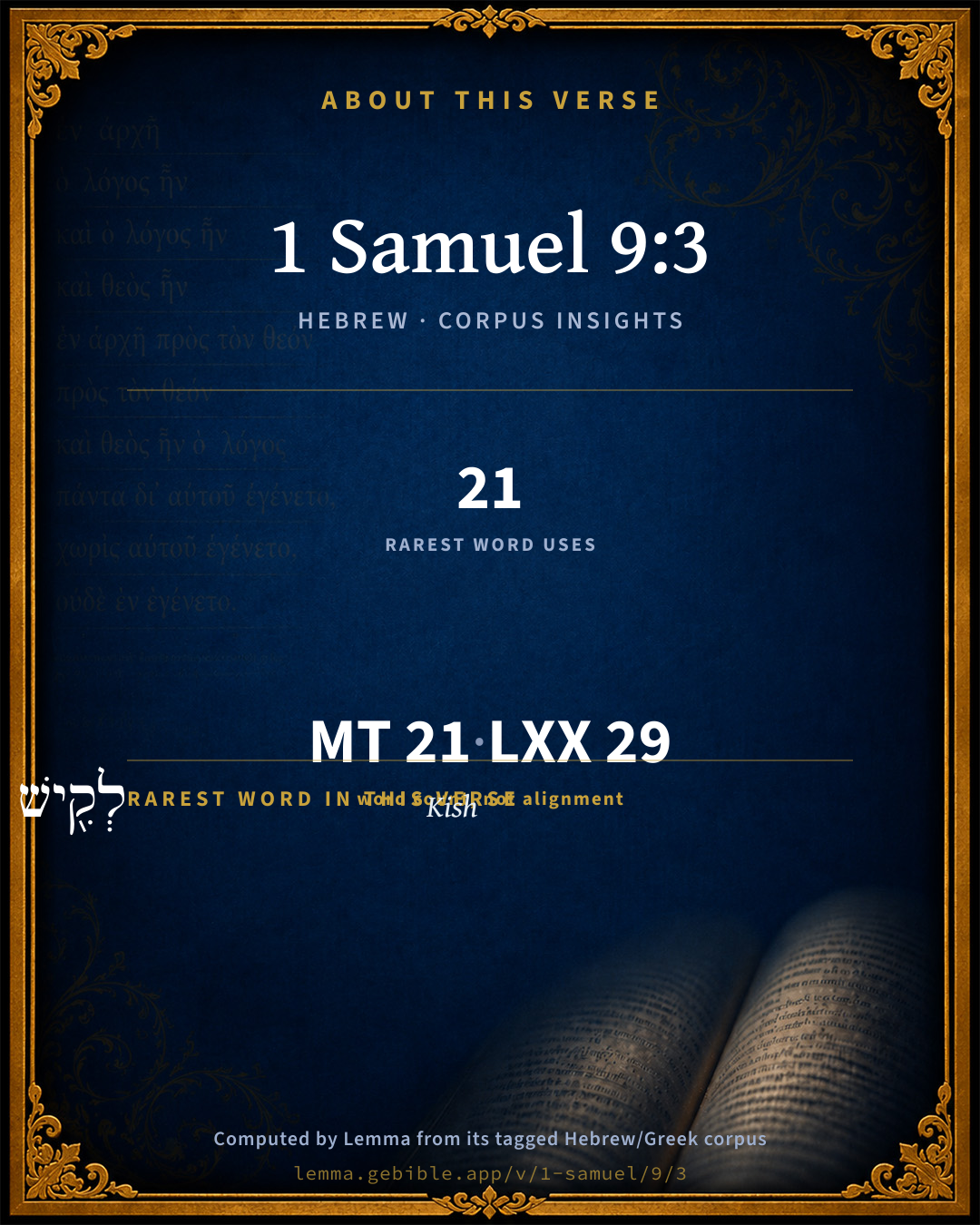
21
words
17
distinct lemmas
Historical
section

Notable vocabulary

The rarest word here is לְקִ֖ישׁ Kish H7027 — appearing just 21 times in the whole Hebrew Bible.

Shared distinctive vocabulary

לְקִ֖ישׁ Kish H7027 occurs in 17 verses of the Hebrew Bible. Also found in:

Grammatical profile

  • 6 verbs
  • 9 nouns
  • 1 adjective
  • 2 prepositions
  • 3 particles

Verb forms

  • וַתֹּאבַ֨דְנָה֙ Qal · Sequential Imperfect
  • וַיֹּ֨אמֶר Qal · Sequential Imperfect
  • קַח Qal · Imperative
  • וְק֣וּם Qal · Imperative
  • לֵ֔ךְ Qal · Imperative
  • בַּקֵּ֖שׁ Piel · Imperative

Repetition

Words recur within this verse — often emphatic in Hebrew:

  • הָאֲתֹנ֔וֹת donkey H860 ×2
  • לְקִ֖ישׁ Kish H7027 ×2
  • שָׁא֑וּל Saul H7586 ×2

Hebrew & Septuagint length

In English translation the verse runs 28 words from the Hebrew and 34 from the Septuagint (LXX English) — closely comparable.

A rough comparison of the two English renderings, which tokenize alike — not a word-level alignment.

Word counts can differ between the Hebrew and the Greek without any difference in meaning — e.g. the Hebrew direct-object marker אֵת has no separate Greek word, and Greek often adds the article ὁ.

In the original languages it is 21 Hebrew tokens and 29 Greek tokens — but the two are counted differently (Hebrew bundles its prefixes and suffixes into one token; the Greek is in lemma form), so that isn’t a like-for-like length.

Cross-references

3

Topical passages linked to 1 Samuel 9:3 in the Treasury of Scripture Knowledge — connected by theme and wording, ordered by reader-vote popularity; previews shown in the World English Bible.

  • Judges 5:10 Tell [of it], you who ride on white donkeys, You who sit on rich carpets, You who walk by the way.
  • Judges 10:4 He had thirty sons who rode on thirty donkey colts, and they had thirty cities, which are called Havvoth Jair to this day, which are in the land of Gilead.
  • 1 Samuel 10:2 When you are departed from me today, then you shall find two men by Rachel's tomb, in the border of Benjamin at Zelzah; and they will tell you, The donkeys which you went to seek are found; and, behold, your father has left off caring for the donkeys, and is anxious for you, saying, What shall I do for my son?

Cross-references courtesy of OpenBible.info (CC BY 4.0).

Hebrew and Greek witnesses Masoretic Hebrew ↔ Greek Septuagint

The same verse in the two great witnesses to the Old Testament, shown verse-for-verse.

These are two independent witnesses, not word-aligned to each other, and the Septuagint is shown in lemma (dictionary) form.

Hebrew 1 Samuel 9:3 Masoretic · Westminster Leningrad Codex

וַתֹּאבַ֨דְנָה֙ הָאֲתֹנ֔וֹת לְקִ֖ישׁ אֲבִ֣י שָׁא֑וּל וַיֹּ֨אמֶר קִ֜ישׁ אֶל שָׁא֣וּל בְּנ֗וֹ קַח נָ֤א אִתְּךָ֙ אֶת אַחַ֣ד מֵֽהַנְּעָרִ֔ים וְק֣וּם לֵ֔ךְ בַּקֵּ֖שׁ אֶת הָאֲתֹנֹֽת

The donkeys of Kish, Saul's father, were lost. Kish said to Saul his son, Take now one of the servants with you, and arise, go seek the donkeys.

World English Bible · Public Domain

Greek LXX 1 Samuel 9:3 Septuagint · lemma form

καί ἀποὀλλύω ὁ ὄνος κις πατήρ σαούλ καί εἶπον κις πρός σαούλ ὁ υἱός αὐτός λαμβάνω μετά σεαυτοῦ εἷς ὁ παιδάριον καί ἀναἵστημι καί πορεύομαι καί ζητέω ὁ ὄνος

And the asses of Kis the father of Saul were lost; and Kis said to Saul his son, Take with you one of the young men, and arise you⌃, and go seek the asses.

LXX2012 (modern English Septuagint) · Public Domain

Hebrew: Westminster Leningrad Codex (CC BY 4.0). Greek: Septuagint (public domain); English from LXX2012 (modern English Septuagint) (Public Domain). How the Septuagint differs from the Hebrew →

Targum (Aramaic paraphrase)

1

The Targum is the ancient Jewish Aramaic paraphrase of the Hebrew Scriptures — an interpretive translation, not the Hebrew text itself. Onkelos (literal) and Pseudo-Jonathan (expansive) render the Torah, and Jonathan the Prophets. Coverage is partial: where no permissively-licensed English translation exists for a verse, only the Aramaic is shown. This is verse-level text, not a word-by-word alignment to the Hebrew.

  1. Targum Jonathan Prophets (Joshua–Malachi)
    וַאֲבָדָא אֲתָנַיָא לְקִישׁ אָבוּהִי דְשָׁאוּל וַאֲמַר קִישׁ לְשָׁאוּל בְּרֵיהּ דְבַר כְּעַן עִמָךְ יַת חַד מֵעוּלֵמַיָא וְקוּם אֱזִיל בָּעֵי יַת אֲתָנַיָא:

    (no public-domain English translation for this verse)

    Targum Jonathan — Aramaic: “Mikraot Gedolot” (public domain). English: “Sefaria Community Translation” (CC0 1.0 (public-domain dedication)); “London "Chaldee Paraphrase," 1871” (public domain). Text via Sefaria.

Commentary

Notes on 1 Samuel 9:3 from classic Christian and Jewish commentators (each source and its license shown beneath its notes). The classic Christian expositions comment on the surrounding passage and are grouped to its opening verse, so a note may address several verses; the Jewish commentaries on the Tanakh (Rashi and others) are per-verse, so they appear only where the commentator wrote on this verse.

Lemma curates 59 commentaries, every one of them public domain or Creative Commons licensed, each selected and text-cleaned for this edition rather than reprinted as found. About our sources →

Matthew Henry's Commentary

Here is, I. A great man rising from small beginnings. It does not appear that Saul had any preferment at all, or was in any post of honour or trust, till he was chosen king of Israel. Most that are advanced rise gradually, but Saul, from the level with his neighbours, stepped at once into the throne, according to that of Hannah, He raiseth up the poor out of the dust, to set them among princes, Sa1 2:8. Saul, it should seem, though he was himself married and had children grown up, yet lived in his father's house, and was subject to him. Promotion comes not by chance nor human probabilities, but God is the Judge.

II. A great event arising from small occurrences. How low does the history begin! Having to trace Saul to the crown, we find him first employed as meanly as any we meet with called out to preferment.

1. Saul's father sends him with one of his servants to seek some asses that he had lost. It may be they had no way then to give public notice of such a number of asses strayed or stolen out of the grounds of Kish the Benjamite. A very good law they had to oblige men to bring back an ox or an ass that went astray, but it is to be feared that was, as other good laws, neglected and forgotten. It is easy to observe here that those who have must expect to lose, that it is wisdom to look after what is lost, that no man should think it below him to know the state of his flocks, that children should be forward to serve their parents' interests. Saul readily went to seek his father's asses, Sa1 9:3, Sa1 9:4. His taking care of the asses is to be ascribed, not so much to the humility of his spirit as to the plainness and simplicity of those times. But his obedience to his father in it was very commendable. Seest thou a man diligent in his business, and dutiful to his superiors, willing to stoop and willing to take pains? he does as Saul stand fair for preferment. The servant of Kish would be faithful only as a servant, but Saul as a son, in his own business, and therefore he was sent with him. Saul and his servants travelled far (probably on foot) in quest of the asses, but in vain: they found them not. He missed of what he sought, but had no reason to complain of the disappointment, for he met with the kingdom, which he never dreamed of.

2. When he could not find them, he determined to return to his father (Sa1 9:5), in consideration of his father's tender concern for him, being apprehensive that if they staid out any longer his aged father would begin to fear, as Jacob concerning Joseph, that an evil beast had devoured them or some mischief had befallen them; he will leave caring for the asses, as much as he was in care about them, and will take thought for us. Children should take care that they do nothing to grieve or frighten their parents, but be tender of their tenderness.

3. His servant proposed (for, it should seem, he had more religion in him than his master) that, since they were now at Ramah, they should call on Samuel, and take his advice in this important affair. Observe here, (1.) They were close by the city where Samuel lived, and that put it into their heads to consult him (Sa1 9:6): There is in this city a man of God. Note, Wherever we are we should improve our opportunities of acquainting ourselves with those that are wise and good. But there are many that will consult a man of God, if he comes in their way, that would not go a step out of their way to get wisdom. (2.) The servant spoke very respectfully concerning Samuel, though he had not personal knowledge of him, but by common fame only: He is a man of God, and an honourable man. Note, Men of God are honourable men, and should be so in our eyes. Acquaintance with the things of God, and serviceableness to the kingdom of God, put true honour upon men, and make them great. This was the honour of Samuel, as a man of God, that all he saith comes surely to pass. This was observed concerning him when he was a young prophet (Sa1 3:19), God did let none of his words fall to the ground; and still it held true. (3.) They agreed to consult him concerning the way that they should go; peradventure he can show us. All the use they would make of the man of God was to be advised by him whether they should return home, or, if there were any hopes of finding the asses, which way they must go next - a poor business to employ a prophet about! Had they said, "Let us give up the asses for lost, and, now that we are so near the man of God, let us go and learn from him the good knowledge of God, let us consult him how we may order our conversations aright, and enquire the law at his mouth, since we may not have such another opportunity, and then we shall not lose our journey" - the proposal would have been such as became Israelites; but to make prophecy, that glory of Israel, serve so mean a turn as this, discovered too much what manner of spirit they were of. Note, Most people would rather be told their fortune than told their duty, how to be rich than how to be saved. If it were the business of the men of God to direct for the recovery of lost asses, they would be consulted much more than they are now that it is their business to direct for the recovery of lost souls; so preposterous is the care of most men! (4.) Saul was thoughtful what present they should bring to the man of God, what fee they should give him for his advice (Sa1 9:7): What shall we bring the man? They could not present him, as Jeroboam's wife did Ahijah, with loaves and cakes (Kg1 14:3), for their bread was spent; but the servant bethought himself that he had in his pocket the fourth part of a shekel, about seven-pence halfpenny in value, and that he would give to the man of God to direct them, Sa1 9:8. "That will do," says Saul; "let us go," Sa1 9:10. Some think that when Saul talked of giving Samuel a fee he measured him by himself, or by his sons, as if he must be hired to do an honest Israelite a kindness, and was like the false prophets, that divined for money, Mic 3:11. He came to him as a fortune-teller, rather than as a prophet, and therefore thought the fourth part of a shekel was enough to give him. But it rather seems to be agreeable to the general usage of those times, as it is to natural equity, that those who sowed spiritual things should reap not only eternal things from him that employs them, but temporal things from those for whom they are employed. Samuel needed not their money, nor would he have denied them his advice if they had not brought it (it is probable, when he had it, he gave it to the por); but they brought it to him as a token of their respect and the value they put upon his office; nor did he refuse it, for they were able to give it, and, though it was but little, it was the widow's mite. But Saul, as he never thought of going to the man of God till the servant proposed it, so, it should seem, he mentioned the want of a present as an objection against their going; he would not own that he had money in his pocket, but, when the servant generously offered to be at the charge, then, "Well, said," says Saul; "come, let us go." Most people love a cheap religion, and like it best when they can devolve the expense of it on others. (5.) The historian here takes notice of the name then given to the prophets: they called them Seers, or seeing men (Sa1 9:9), not but that the name prophet was then used, and applied to such persons, but that of seers was more in use. Note, Those that are prophets must first be seers; those who undertake to speak to others of the things of God must have an insight into those things themselves.

Matthew Henry's Commentary on the Whole Bible (1708–1710) — public domain (CC PDM 1.0). Text via the HelloAO Bible API.

Trapp's Complete Commentary

John Trapp

1Sa 9:3 And the asses of Kish Saul’s father were lost. And Kish said to Saul his son, Take now one of the servants with thee, and arise, go seek the asses.

Ver. 3. And the asses of Kish, Saul’s father, were lost.] This was the rise of Saul’s royalty: Nam ex agasone factus est rex, et David ex opilione. And here we have a famous instance of God’s most wise providence, bringing about great matters by small and weak means. Saul quaerens asinos reperit regnum.

John Trapp, A Commentary or Exposition upon All the Books of the Old and New Testament (1647–1656) — public domain. Text from a community e-Sword module.

Joseph Benson's Commentary

1Sa 9:3. The asses of Kish were lost — Asses were there of great price, because of the scarcity of horses, and therefore were not thought unworthy to be sought by Saul, especially in these ancient times, when simplicity, humility, and industry were in fashion among persons of quality.

Joseph Benson's Commentary on the Old and New Testaments (1811–1818) — public domain. Text from a community e-Sword module.

Geneva Bible (1599)

Geneva Bible translators

All these circumstances were means to serve unto God’s providence, whereby Saul (though not approved of God) was made king.

Geneva Bible (1599) marginal notes — public domain. Text via Bolls.life.

Jamieson, Fausset & Brown

Robert Jamieson, A. R. Fausset & David Brown

the asses of Kish Saul's father were lost. And Kish said to Saul . . . arise, go seek the asses--The probability is that the family of Kish, according to the immemorial usage of Oriental shepherds in the purely pastoral regions, had let the animals roam at large during the grazing season, at the close of which messengers were despatched in search of them. Such travelling searches are common; and, as each owner has his own stamp marked on his cattle, the mention of it to the shepherds he meets gradually leads to the discovery of the strayed animals. This ramble of Saul's had nothing extraordinary in it, except its superior directions and issue, which turned its uncertainty into certainty.

Jamieson, Fausset & Brown — Commentary Critical and Explanatory on the Whole Bible (1871) — public domain (CC PDM 1.0). Text via the HelloAO Bible API.

Adam Clarke's Commentary

Verse 3. The asses of Kish - were lost] What a wonderful train of occurrences were connected in order to bring Saul to the throne of Israel! Every thing seems to go on according to the common course of events, and yet all conspired to favour the election of a man to the kingdom who certainly did not come there by the approbation of God.

Asses grow to great perfection in the East; and at this time, as there were no horses in Judea, they were very useful; and on them kings and princes rode.

Adam Clarke's Commentary on the Bible (1810–1826) — public domain. Text from a community e-Sword/MySword module.

The Cambridge Bible for Schools and Colleges

gen. ed. J. J. S. Perowne

3–10. Saul’s search for his Father’s Asses

3. the asses] In the East asses are valuable property, indispensable for farm-work and travelling. The possession of a drove of asses, and several servants, indicates that Kish was a man of some substance.

The Cambridge Bible for Schools and Colleges (gen. ed. J. J. S. Perowne; Cambridge University Press, 1878–1918) — public domain. Text from a community e-Sword module.

John Gill's Exposition

And the asses of Kish, Saul's father, were lost,.... Had got out of the stables or fields, in which they were kept, and strayed from thence:

and Kish said to Saul his son, take now one of the servants with thee, and arise, go seek the asses; he chose not to send his servants only, who might not be so careful and diligent in searching for them, but his son, and not him alone, but a servant with him to wait upon him, and assist him. And it was quite agreeable to the simplicity of those times for persons of equal or greater substance to be employed in such an affair; asses made a considerable part of the wealth and riches of men, were rode upon by persons of quality, and were fed and taken care of by the sons of dukes and princes; see Job 1:3. The Jews (w) have a tradition, that this servant was Doeg the Edomite.

(w) Hieron. Trad. Heb. in Paralip, fol. 83. A.

John Gill's Exposition of the Whole Bible (1746–1763) — public domain (CC PDM 1.0). Text via the HelloAO Bible API.

Haydock's Catholic Bible Commentary

Asses. The greatest noblemen rode upon such, Judges v. 10. A prince of Esau fed asses, Genesis xxx. 24. Agriculture, and keeping sheep, were the employment of men of the first eminence in the heroic ages, as hunting and other equally laborious exercises are now in fashion. (Calmet)

George Leo Haydock (1774–1849), Haydock's Catholic Family Bible and Commentary, 1859 edition — public domain. Excludes Psalms (Douay-Rheims chapter numbering differs from Protestant) and Deuterocanonical books (Catholic canon only).

Matthew Poole's English Annotations

Which were there of great price and use, Jdg 10:4; Jdg 12:14, because of the scarcity of horses, Deu 17:16, and therefore not held unworthy of Saul’s seeking, at least in those ancient times, when simplicity, humility, and industry were in fashion among persons of quality.

Matthew Poole's English Annotations on the Holy Bible (1683–1685) — public domain. Text from a community e-Sword/MySword module.

Whedon's Commentary on the Bible

Daniel D. Whedon

3. One of the servants — Traditionally believed to have been Doeg the Edomite, afterwards chief herdsman of Saul. 1Sa_21:7. His being “detained before the Lord” at Nob shows him to have been religiously disposed, and this may account for his knowledge of the seer Samuel. See on 1Sa_9:6.

Go seek the asses — “Among cattle in the East at all times, and especially in times ere horses were in use for riding, asses were of very much importance; and when, therefore, it was found one morning that some of Kish’s asses were missing, Saul himself, accompanied by a servant, at once set out in search of them. If such an incident now happened in Palestine, it would be at once concluded that the animals had been stolen; and it speaks well for the state of society in the time of Samuel that this suspicion never crossed the mind of Saul or his father. It was simply concluded that the asses had strayed.” — Kitto.

Daniel D. Whedon (gen. ed.), Commentary on the Old and New Testaments (1874–1909) — public domain. Text from a community e-Sword module.

The Pulpit Commentary

The asses of Kish...were lost. So strangely is the trivial ever united with events most solemn and weighty, that Saul set out upon this journey, in which he was to find a kingdom, with no other object than to look for some lost asses Hebrew, "she-asses." As used for riding, (Jud_1:10:4) the ass was valuable, and as these were probably kept for breeding, they were allowed more liberty than the males, and so strayed away.

The Pulpit Commentary (1880–1919), ed. H.D.M. Spence-Jones & Joseph S. Exell — public domain. Text from a community e-Sword module.

John Wesley's Explanatory Notes

The asses - Which were there of great price, because of the scarcity of horses, and therefore not held unworthy of Saul's seeking, at least in those ancient times, when simplicity, humility, and industry were in fashion among persons of quality.

John Wesley, Explanatory Notes Upon the Whole Bible (1754–1765) — public domain. Text via the GEBible commentary corpus.

unfoldingWord translationNotes

Door43 World Missions Community

Now

The writer has ended the background information (1 Samuel 9:1-2) and starts a new main part of the story.

arise and go

"stop what you are doing and go"

the hill country of Ephraim ... the land of Shalishah ... the land of Shaalim ... the land of the Benjamites

These are all areas in Israel. (See: How to Translate Names)

did not find them ... they were not there ... did not find them

The words "them" and "they" all refer to the donkeys.

translationWords

donkey

servant

raise

Ephraim

unfoldingWord translationNotes — © Distant Shores Media and the Door43 World Missions Community, licensed CC BY-SA 4.0. Source: git.door43.org/Door43/en_tn.

Lesson kit

Teaching starters — assembled from the data on this page, not authored interpretation. Every prompt links to the verse data it draws on. Edit before teaching.

1 Samuel, in the Historical, opens this verse with 21 words (17 distinct Hebrew lemmas). Its most distinctive word is Qîysh (“Kish”). A historical commentator’s framing appears above. Read the whole chapter for the surrounding context.

Discussion questions

  1. What does “Kish” (Qîysh) contribute to the verse as a whole?
  2. 1 Samuel 9:1 shares the word «Kish» with this verse. How do the two illuminate each other?
  3. “donkey” occurs 2× in this one verse. What is the effect of the repetition?
  4. These translations render this verse differently; the difference is in the English rendering, not the original. What questions does that raise?
  5. The verb «וַתֹּאבַ֨דְנָה֙» is Qal Sequential Imperfect. How does its form color the action?
  6. Reading how Matthew Henry's Commentary and Trapp's Complete Commentary read this verse, where do the two commentators agree and where do they part?

Things to notice

Reading settings

Reading text

Shown beneath each verse's original-language words.

Old Testament
Old Testament edition

Read the OT as the Masoretic Hebrew (MT) or the Greek Septuagint (LXX).

English shown for the Greek Septuagint (in the Hebrew ↔ Greek comparison).

Comparing translations? Open the Compare panel on any verse page to stack up to four side by side.