2 Samuel 1:15

Hebrew (Westminster Leningrad Codex) 2 Samuel 1:15 appears in the Hebrew Old Testament. The text above is from the Westminster Leningrad Codex. Each word links to its Strong’s number, a concise gloss, and parsing drawn from the Open Scriptures Hebrew Bible morphology. Click any word for its full Brown-Driver-Briggs (BDB) entry.
Download image
Cite this verse

2 Samuel 1:15 (World English Bible). Public Domain. Lemma interlinear Bible study tool, https://lemma.gebible.app/v/2-samuel/1/15.

Show BibTeX & RIS
BibTeX
RIS
English Translation
David called one of the young men, and said, Go near, and fall on him. He struck him, so that he died.
World English Bible · Public Domain
Download a study sheet

One document with this verse’s original text, its word-by-word gloss line, the meaning frame, cross-references with their text, attributed commentary, and full source and license credits — printable, and it pastes into notes with its structure intact.

This verse Autodidact and up

Study sheet (.html) Plain text (.txt)

A passage Seminary Student

Up to 50 verses in one chapter. A passage sheet keeps up to 6 commentary sources and 12 cross-references per verse, in the order this page ranks them, and says so on the sheet whenever that leaves anything out. Ask for a single verse and you get the Autodidact verse sheet above.

Everything on this page stays free to read, with no account — the sheet is a download of what is already on screen, not access to it.

Want to remove ads? Support Godless Engineer
Compare translations 3

The same verse in 3 English versions, stacked beneath the original-language interlinear above. Click any original word for its lexicon entry.

Each is an independent rendering of the whole verse — the interlinear is not word-aligned to these translations.

Highlighted words mark where these versions differ — a whole-verse word diff, not a word-by-word alignment.

  • World English Bible Public Domain
    David called one of the young men, and said, Go near, and fall on him. He struck him, so that he died.
  • King James Version Public Domain
    And David called one of the young men, and said, Go near, and fall upon him. And he smote him that he died.
  • unfoldingWord Literal Text CC BY-SA 4.0
    And David called to one of the young men, and he said, “Approach, attack him!” And he struck him, and he died.

unfoldingWord Literal Text — © unfoldingWord, licensed CC BY-SA 4.0. Word-aligned USFM3 via Door43 (git.door43.org/unfoldingWord/en_ult).

Versions to compare (up to 4)

3 of 4 selected

Show all 18 translations

Every available English version of this verse, each an independent rendering of the whole verse.

  • World English Bible Public Domain
    David called one of the young men, and said, Go near, and fall on him. He struck him, so that he died.
  • Berean Standard Bible Public Domain
    Then David summoned one of the young men and said, “Go, execute him!” So the young man struck him down, and he died.
  • Majority Standard Bible Public Domain
    Then David summoned one of the young men and said, “Go, execute him!” So the young man struck him down, and he died.
  • King James Version Public Domain
    And David called one of the young men, and said, Go near, and fall upon him. And he smote him that he died.
  • American Standard Version (1901) Public Domain
    And David called one of the young men, and said, Go near, and fall upon him. And he smote him, so that he died.
  • Revised Version (1885) Public Domain
    And David called one of the young men, and said, Go near, and fall upon him. And he smote him that he died.
  • Geneva Bible (1599) Public Domain
    Then Dauid called one of his yong men, and said, Goe neere, and fall vpon him. And hee smote him that he dyed.
  • Douay-Rheims (1899) Public Domain
    And David calling one of his servants, said: Go near and fall upon him. And he struck him so that he died.
  • Young's Literal Translation Public Domain
    And David calleth to one of the youths, and saith, `Draw nigh -- fall upon him;' and he smiteth him, and he dieth;
  • Literal Standard Version CC BY-SA 4.0
    And David calls to one of the youths and says, “Draw near—fall on him”; and he strikes him, and he dies;
  • Unlocked Literal Bible CC BY-SA 4.0
    David called one of the young men and said, “Go and kill him.” So that man went and struck him down, and the Amalekite died.
  • unfoldingWord Literal Text CC BY-SA 4.0
    And David called to one of the young men, and he said, “Approach, attack him!” And he struck him, and he died.
  • Darby Bible Public Domain
    Then David called one of the young men and said, Draw near, [and] fall on him. And he smote him that he died.
  • World Messianic Bible Public Domain
    David called one of the young men and said, “Go near, and cut him down!” He struck him so that he died.
  • Webster's Bible Public Domain
    And David called one of the young men, and said, Go near, and fall upon him. And he smote him that he died.
  • Free Bible Version CC BY-SA 4.0
    David called over one of his men and said, “Go ahead, kill him!” So the man cut the Amalekite down and killed him.
  • Bible in Basic English Public Domain
    And David sent for one of his young men and said, Go near and put an end to him. And he put him to death.
  • JPS Tanakh (1917) Public Domain
    And David called one of the young men, and said: 'Go near, and fall upon him.' And he smote him that he died.

Literal Standard Version (2020), Covenant Press — licensed CC BY-SA 4.0. Text via the HelloAO Bible API (eBible.org). Unlocked Literal Bible (unfoldingWord) — licensed CC BY-SA 4.0. Text via the HelloAO Bible API (eBible.org). unfoldingWord Literal Text — © unfoldingWord, licensed CC BY-SA 4.0. Word-aligned USFM3 via Door43 (git.door43.org/unfoldingWord/en_ult). Free Bible Version, Dr. Jonathan Gallagher — licensed CC BY-SA 4.0. Text via the HelloAO Bible API (eBible.org).

Word by word

More ways to search: Search by grammar → Find every occurrence → Compare this word →

Practice this passage: Drill this verse → Learn its vocabulary →

פְּגַע
pâgaʻ
H6293
“meet”
Verb, Qal, Imperative, 2nd Person, Masculine, Singular
Part of Speech
Verb
Stem
Qal
Form
Imperative
Person
2nd Person
Gender
Masculine
Number
Singular
Full BDB Definition

Origin: a primitive root

TWOT: 1731

to encounter, meet, reach, entreat, make intercession - (Qal) - to meet, light upon, join - to meet (of kindness) - to encounter, fall upon (of hostility) - to encounter, entreat (of request) - to strike, touch (of boundary) - (Hiphil) - to cause to light upon - to cause to entreat - to make entreaty, interpose - to make attack - to reach the mark
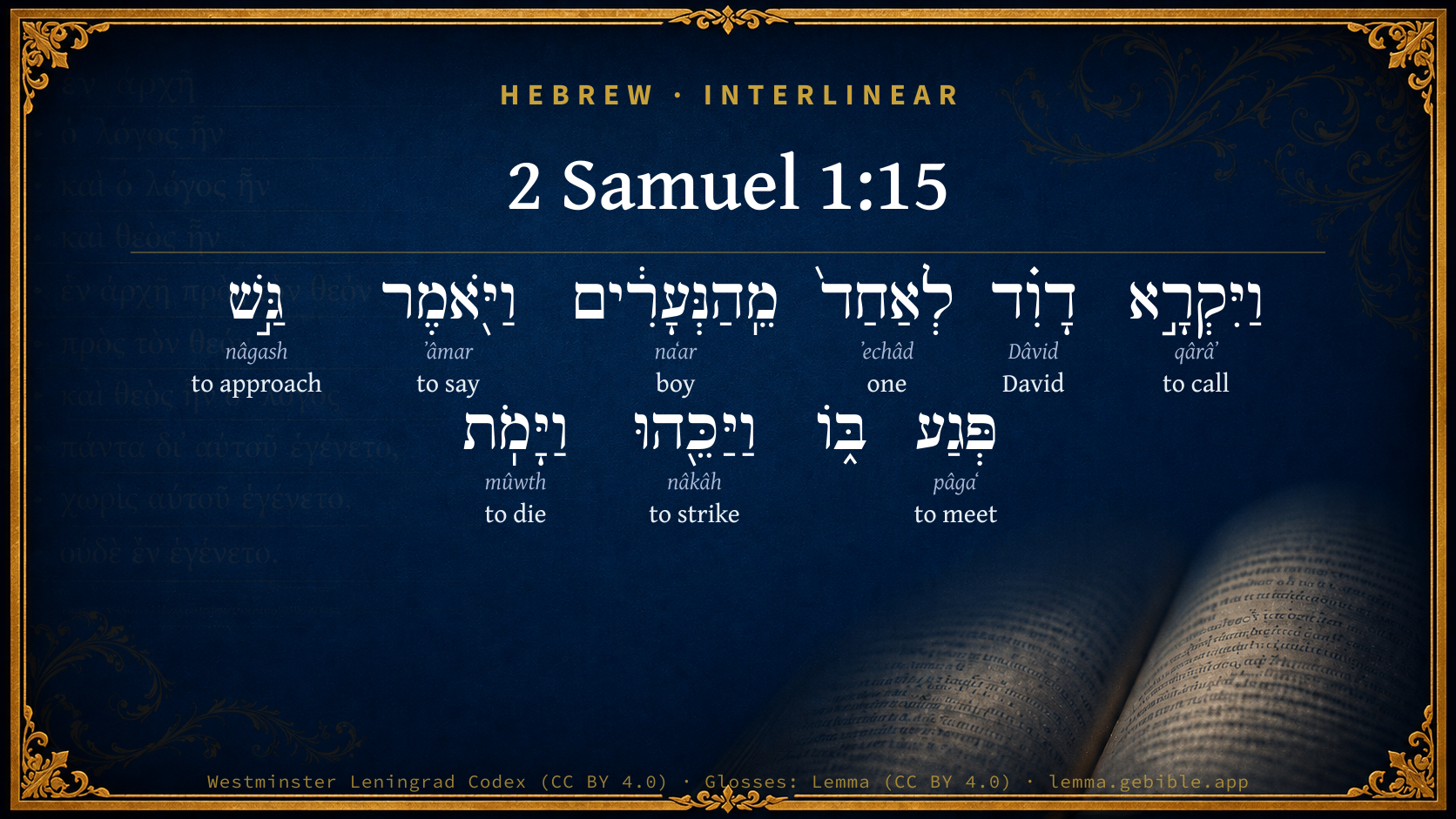
  1. וַיִּקְרָ֣א qârâʼ H7121 “and · to call” Conjunction + Verb, Qal, Sequential Imperfect, 3rd Person, Masculine, Singular
  2. דָוִ֗ד Dâvid H1732 “David” Noun, Proper
  3. לְאַחַד֙ ʼechâd H259 “to/for · one” Preposition + Adjective, Cardinal number, Masculine, Singular, Absolute
  4. מֵֽהַנְּעָרִ֔ים naʻar H5288 “from · the · boys” Preposition + Particle, Definite Article + Noun, Common, Masculine, Plural, Absolute
  5. וַיֹּ֖אמֶר ʼâmar H559 “and · to say” Conjunction + Verb, Qal, Sequential Imperfect, 3rd Person, Masculine, Singular
  6. גַּ֣שׁ nâgash H5066 “approach” Verb, Qal, Imperative, 2nd Person, Masculine, Singular
  7. וַיַּכֵּ֖הוּ nâkâh H5221 “and · to strike · him” Conjunction + Verb, Hiphil, Sequential Imperfect, 3rd Person, Masculine, Singular + Suffix, Personal, 3rd Person, Masculine, Singular
  8. וַיָּמֹֽת mûwth H4191 “and · to die” Conjunction + Verb, Qal, Sequential Imperfect, 3rd Person, Masculine, Singular

About this verse

These counts appear in no published source. They are computed here, from the morphology-tagged text and Lemma’s own curated glosses. What Lemma adds →

10
words
9
distinct lemmas
Historical
section

Shared distinctive vocabulary

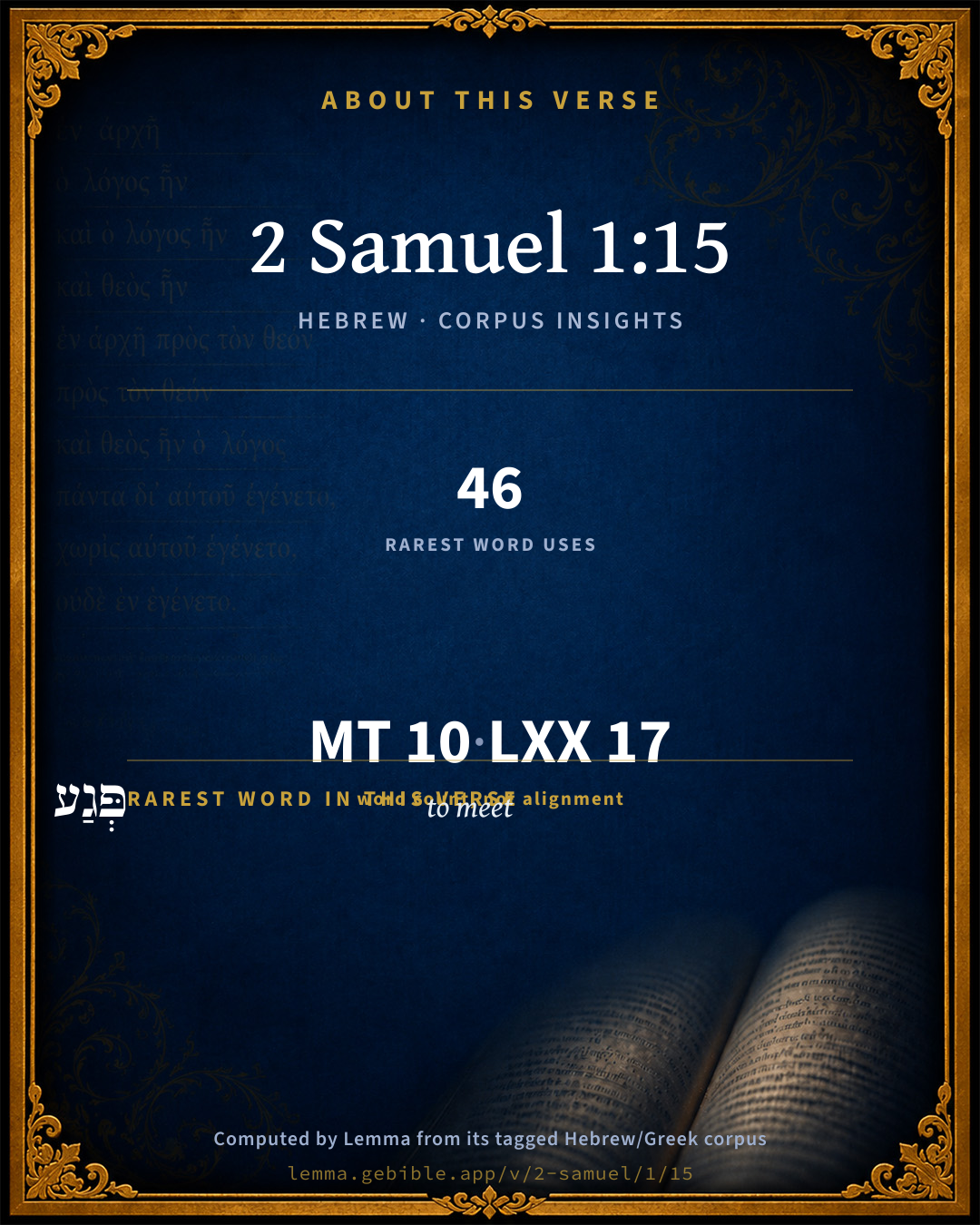
פְּגַע to meet H6293 occurs in 43 verses of the Hebrew Bible. Also found in:

Grammatical profile

  • 6 verbs
  • 2 nouns
  • 1 adjective
  • 1 preposition

Verb forms

  • וַיִּקְרָ֣א Qal · Sequential Imperfect
  • וַיֹּ֖אמֶר Qal · Sequential Imperfect
  • גַּ֣שׁ Qal · Imperative
  • פְּגַע Qal · Imperative
  • וַיַּכֵּ֖הוּ Hiphil · Sequential Imperfect
  • וַיָּמֹֽת Qal · Sequential Imperfect

Hebrew & Septuagint length

In English translation the verse runs 22 words from the Hebrew and 22 from the Septuagint (LXX English) — the same length.

A rough comparison of the two English renderings, which tokenize alike — not a word-level alignment.

Word counts can differ between the Hebrew and the Greek without any difference in meaning — e.g. the Hebrew direct-object marker אֵת has no separate Greek word, and Greek often adds the article ὁ.

In the original languages it is 10 Hebrew tokens and 17 Greek tokens — but the two are counted differently (Hebrew bundles its prefixes and suffixes into one token; the Greek is in lemma form), so that isn’t a like-for-like length.

Cross-references

8

Topical passages linked to 2 Samuel 1:15 in the Treasury of Scripture Knowledge — connected by theme and wording, ordered by reader-vote popularity; previews shown in the World English Bible.

  • Judges 8:20 He said to Jether his firstborn, Up, and kill them. But the youth didn't draw his sword; for he feared, because he was yet a youth.
  • 1 Samuel 22:17–18 The king said to the guard who stood about him, Turn, and kill the priests of Yahweh; because their hand also is with David, and because they knew that he fled, and didn't disclose it to me. But the servants of the king wouldn't put forth their hand to fall on the priests of Yahweh.
  • 2 Samuel 4:10–12 when one told me, saying, Behold, Saul is dead, thinking to have brought good news, I took hold of him, and killed him in Ziklag, which was the reward I gave him for his news.
  • 1 Kings 2:25 King Solomon sent by Benaiah the son of Jehoiada; and he fell on him, so that he died.
  • 1 Kings 2:34 Then Benaiah the son of Jehoiada went up, and fell on him, and killed him; and he was buried in his own house in the wilderness.
  • 1 Kings 2:46 So the king commanded Benaiah the son of Jehoiada; and he went out, and fell on him, so that he died. The kingdom was established in the hand of Solomon.
  • Job 5:12 He frustrates the devices of the crafty, So that their hands can't perform their enterprise.
  • Proverbs 11:18 Wicked people earn deceitful wages, But one who sows righteousness reaps a sure reward.

Cross-references courtesy of OpenBible.info (CC BY 4.0).

Hebrew and Greek witnesses Masoretic Hebrew ↔ Greek Septuagint

The same verse in the two great witnesses to the Old Testament, shown verse-for-verse.

These are two independent witnesses, not word-aligned to each other, and the Septuagint is shown in lemma (dictionary) form.

Hebrew 2 Samuel 1:15 Masoretic · Westminster Leningrad Codex

וַיִּקְרָ֣א דָוִ֗ד לְאַחַד֙ מֵֽהַנְּעָרִ֔ים וַיֹּ֖אמֶר גַּ֣שׁ פְּגַע בּ֑וֹ וַיַּכֵּ֖הוּ וַיָּמֹֽת

David called one of the young men, and said, Go near, and fall on him. He struck him, so that he died.

World English Bible · Public Domain

Greek LXX 2 Samuel 1:15 Septuagint · lemma form

καί καλέω δαυίδ εἷς ὁ παιδάριον αὐτός καί εἶπον προςἔρχομαι ἀποἀντάω αὐτός καί πατάσσω αὐτός καί ἀποθνήσκω

And David called one of his young men, and said, Go and fall upon him: and he struck him, and he died.

LXX2012 (modern English Septuagint) · Public Domain

Hebrew: Westminster Leningrad Codex (CC BY 4.0). Greek: Septuagint (public domain); English from LXX2012 (modern English Septuagint) (Public Domain). How the Septuagint differs from the Hebrew →

Targum (Aramaic paraphrase)

1

The Targum is the ancient Jewish Aramaic paraphrase of the Hebrew Scriptures — an interpretive translation, not the Hebrew text itself. Onkelos (literal) and Pseudo-Jonathan (expansive) render the Torah, and Jonathan the Prophets. Coverage is partial: where no permissively-licensed English translation exists for a verse, only the Aramaic is shown. This is verse-level text, not a word-by-word alignment to the Hebrew.

  1. Targum Jonathan Prophets (Joshua–Malachi)
    וּקְרָא דָוִד לְחַד מֵעוּלֵמַיָא וַאֲמַר קְרַב שְׁלוֹט בֵּיהּ וּמְחָהִי וְקַטְלֵיהּ:

    (no public-domain English translation for this verse)

    Targum Jonathan — Aramaic: “Mikraot Gedolot” (public domain). English: “Sefaria Community Translation” (CC0 1.0 (public-domain dedication)); “London "Chaldee Paraphrase," 1871” (public domain). Text via Sefaria.

Commentary

Notes on 2 Samuel 1:15 from classic Christian and Jewish commentators (each source and its license shown beneath its notes). The classic Christian expositions comment on the surrounding passage and are grouped to its opening verse, so a note may address several verses; the Jewish commentaries on the Tanakh (Rashi and others) are per-verse, so they appear only where the commentator wrote on this verse.

Lemma curates 59 commentaries, every one of them public domain or Creative Commons licensed, each selected and text-cleaned for this edition rather than reprinted as found. About our sources →

Trapp's Complete Commentary

John Trapp

2Sa 1:15 And David called one of the young men, and said, Go near, [and] fall upon him. And he smote him that he died.

Ver. 15. And he smote him that he died.] And alike sped those that murdered Ishbosheth, whom David caused instantly to be put to death, abhorring their treason, though attended with a kingdom. He that betrayed the Rhodes to the Turk was served in like sort, ending his life with shame and torment. So was Earl Godwin here, and Earl Doring in Bohemia by Duke Neda.

John Trapp, A Commentary or Exposition upon All the Books of the Old and New Testament (1647–1656) — public domain. Text from a community e-Sword module.

Joseph Benson's Commentary

2Sa 1:15. He smote him that he died — Abarbinel thinks that, as the man was an Amalekite, David supposed that he had killed Saul out of revenge for the slaughter he had made of the Amalekites. But, if not; if the fact were as this Amalekite stated, and Saul bid him despatch him, “David rightly judged, that Saul had no power over his own life; and, consequently, should not have been obeyed in such a command: God and the state had as much right to his life when he was weary of it as when he most loved it. And, besides all this, it behooved David to vindicate his own innocence to the world, by so public an execution: he might otherwise, perhaps, have been branded with the guilt of employing that wretch to murder his persecutor. David also, doubtless, had it in view to deter others by this example. He consulted his own safety in this, as Cesar is said, by restoring the statues of Pompey, to have fixed his own. This was a wise lecture to princes, and many of them have unquestionably profited by it.” — Delaney.

Joseph Benson's Commentary on the Old and New Testaments (1811–1818) — public domain. Text from a community e-Sword module.

Tyndale Open Study Notes

Tyndale Open Resources

1:15-16 The Amalekite expected a reward for killing David’s rival but was instead condemned for killing the Lord’s anointed. David himself had twice refused the opportunity to kill Saul (see 1 Sam 24:5-7; 26:9-11).

Tyndale Open Study Notes — © Tyndale Open Resources, licensed CC BY-SA 4.0. Text via the HelloAO Bible API.

Ellicott's Commentary for English Readers

(15) Fall upon him.—All question of David’s authority to pronounce a capital sentence is here quite out of place. The Amalekite had just recognised him as king, and therefore acknowledged his authority. But, besides this, David and his band of 600 outlaws were accustomed to live by the sword, and to defend themselves against Philistines, Amalekites, and other foes as best they could; and here stood before them one, by his own confession, guilty of high treason.

A Bible Commentary for English Readers, edited by Charles John Ellicott (1878–1897) — public domain. Text from a community e-Sword module.

John Gill's Exposition

And David called one of the young men,.... His servants that attended on him:

and said, go near, and fall upon him; by smiting him with his sword:

and he smote him, that he died; his orders were instantly obeyed. Kings and generals of armies had great power in those times and countries to execute a man immediately, without any other judge or jury: what may serve, or David might think would serve, to justify him in doing this, is what follows.

John Gill's Exposition of the Whole Bible (1746–1763) — public domain (CC PDM 1.0). Text via the HelloAO Bible API.

The Pulpit Commentary

Go near, and fall upon him. This was no hasty sentence, for they had "fasted until even." And before pronouncing it David asks, "Whence art thou?" that is, he makes more full inquiry into his condition and previous doings. He knew that he was an Amalekite, and most probably had seen clearly enough that his whole story was false; but before deciding upon his fate, he desired fuller information as to the man"s previous life. His question elicits from him that he was a subject of Saul. For the word "stranger" means a settler, who had withdrawn from his own country and joined himself to Israel. Moreover, it was the Amalekite"s father who had done this, and probably he was one of many, who, finding their old nomad life too dangerous, had sought a home in the southern districts of Judah; but when the war broke out, the old instinct of these Bedaween made them follow the army for pilfer and trade in spoil. But as the son of a settler, the Amalekite owed by birth allegiance to Saul, and, should the occasion arise, was bound to render him loyal aid. Now, according to his own account, he had found Saul in no immediate danger of death, "for his life was still whole within him." Escape was at least possible with the Amalekite"s aid, but he is eager to hill him. And David"s question, "How wast thou not afraid to destroy the Lord"s anointed?" virtually means, "How wast thou not afraid to kill thy own king?" The Lord, that is, Jehovah, was no name of power to any outside the covenant people, nor in settling in Judea did the Amalekites accept the national religion. But the words would show even to a stranger that Saul was Israel"s lawful and consecrated king. Commentators, with strange perverseness, have found in these words an outbreak of selfishness on David"s part, and have supposed that he wished to guard his own person against future treason by making a wholesome example. But this is both to misunderstand the examination of the culprit summed up in vers. 13, 14, and also to put aside all account of the deep and agonizing sorrow which was rending David"s heart. What would have been an Englishman"s feelings if news had come that we had lost, for instance, the battle of Waterloo, and if the fugitive who brought the information had said that he had killed the wounded commander-in-chief? In David"s case, besides deep distress at the disaster which had befallen his country, there was personal grief for the death of Jonathan and of Saul"s other sons, who were David"s brothers-in-law; and the words really prove his loyalty to Saul himself. He was still Jehovah"s anointed, whatever his conduct might have been; and we have found David on previous occasions actuated by the same generous respect for duty when clearly it was contrary to his own interests (see, for instance,. (1Sa_26:9) David put the wretch justly to death for meanly murdering one whom he might possibly have saved. And the man"s very purpose was to suggest to David, in a covert way, that escape really was possible, but that he had made all things sure, and so deserved a large reward. As a matter of fact, he had not killed Saul, but had invented the story because, judging David by his own immoral standard, he had supposed that he would regard the crime as a valuable service.

The Pulpit Commentary (1880–1919), ed. H.D.M. Spence-Jones & Joseph S. Exell — public domain. Text from a community e-Sword module.

Lesson kit

Teaching starters — assembled from the data on this page, not authored interpretation. Every prompt links to the verse data it draws on. Edit before teaching.

2 Samuel, in the Historical, opens this verse with 10 words (9 distinct Hebrew lemmas). Its most distinctive word is pâgaʻ (“to meet”). A historical commentator’s framing appears above. Read the whole chapter for the surrounding context.

Discussion questions

  1. The word pâgaʻ carries the sense “to meet.” How does it shape the verse?
  2. Genesis 23:8 shares the word «to meet» with this verse. How do the two illuminate each other?
  3. These translations render this verse differently; the difference is in the English rendering, not the original. What questions does that raise?
  4. The verb «וַיִּקְרָ֣א» is Qal Sequential Imperfect. How does its form color the action?
  5. Reading how Trapp's Complete Commentary and Joseph Benson's Commentary read this verse, where do the two commentators agree and where do they part?

Things to notice

Reading settings

Reading text

Shown beneath each verse's original-language words.

Old Testament
Old Testament edition

Read the OT as the Masoretic Hebrew (MT) or the Greek Septuagint (LXX).

English shown for the Greek Septuagint (in the Hebrew ↔ Greek comparison).

Comparing translations? Open the Compare panel on any verse page to stack up to four side by side.