
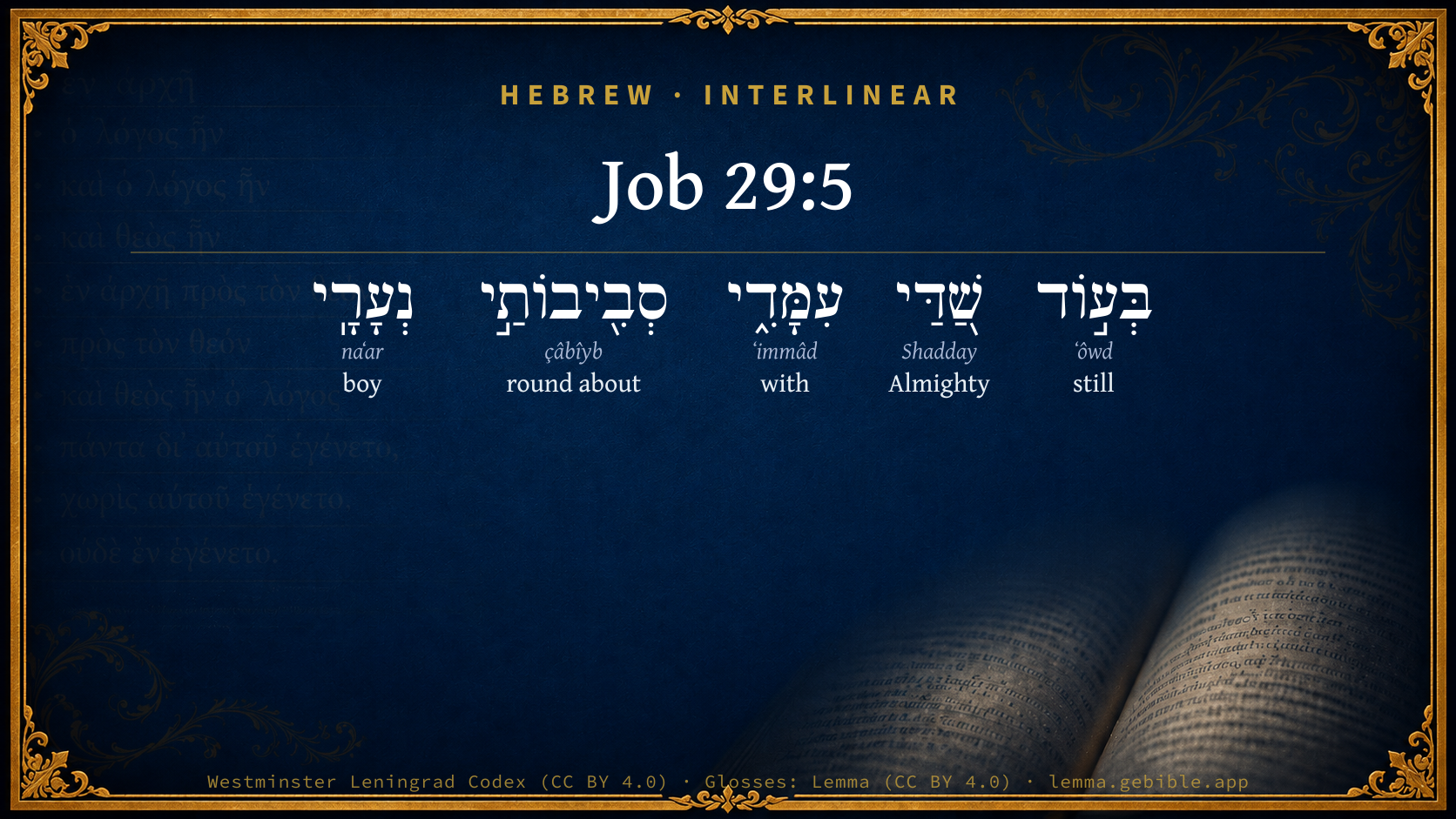
Job 29:5

Hebrew (Westminster Leningrad Codex) Job 29:5 appears in the Hebrew Old Testament. The text above is from the Westminster Leningrad Codex. Each word links to its Strong’s number, a concise gloss, and parsing drawn from the Open Scriptures Hebrew Bible morphology. Click any word for its full Brown-Driver-Briggs (BDB) entry.
Download image
Cite this verse

Job 29:5 (World English Bible). Public Domain. Lemma interlinear Bible study tool, https://lemma.gebible.app/v/job/29/5.

Show BibTeX & RIS
BibTeX
RIS
English Translation
When the Almighty was yet with me, And my children were around me;
World English Bible · Public Domain
Download a study sheet

One document with this verse’s original text, its word-by-word gloss line, the meaning frame, cross-references with their text, attributed commentary, and full source and license credits — printable, and it pastes into notes with its structure intact.

This verse Autodidact and up

Study sheet (.html) Plain text (.txt)

A passage Seminary Student

Up to 50 verses in one chapter. A passage sheet keeps up to 6 commentary sources and 12 cross-references per verse, in the order this page ranks them, and says so on the sheet whenever that leaves anything out. Ask for a single verse and you get the Autodidact verse sheet above.

Everything on this page stays free to read, with no account — the sheet is a download of what is already on screen, not access to it.

Want to remove ads? Support Godless Engineer
Compare translations 3

The same verse in 3 English versions, stacked beneath the original-language interlinear above. Click any original word for its lexicon entry.

Each is an independent rendering of the whole verse — the interlinear is not word-aligned to these translations.

Highlighted words mark where these versions differ — a whole-verse word diff, not a word-by-word alignment.

  • World English Bible Public Domain
    When the Almighty was yet with me, And my children were around me;
  • King James Version Public Domain
    When the Almighty was yet with me, when my children were about me;
  • unfoldingWord Literal Text CC BY-SA 4.0
    when the Almighty still with me, my children around me,

unfoldingWord Literal Text — © unfoldingWord, licensed CC BY-SA 4.0. Word-aligned USFM3 via Door43 (git.door43.org/unfoldingWord/en_ult).

Versions to compare (up to 4)

3 of 4 selected

Show all 18 translations

Every available English version of this verse, each an independent rendering of the whole verse.

  • World English Bible Public Domain
    When the Almighty was yet with me, And my children were around me;
  • Berean Standard Bible Public Domain
    when the Almighty was still with me and my children were around me,
  • Majority Standard Bible Public Domain
    when the Almighty was still with me and my children were around me,
  • King James Version Public Domain
    When the Almighty was yet with me, when my children were about me;
  • American Standard Version (1901) Public Domain
    When the Almighty was yet with me, And my children were about me;
  • Revised Version (1885) Public Domain
    When the Almighty was yet with me, and my children were about me;
  • Geneva Bible (1599) Public Domain
    When the almightie was yet with me, and my children round about me.
  • Douay-Rheims (1899) Public Domain
    When the Almighty was with me: and my servants round about me?
  • Young's Literal Translation Public Domain
    When yet the Mighty One `is' with me. Round about me -- my young ones,
  • Literal Standard Version CC BY-SA 4.0
    When yet the Mighty One [is] with me. Around me—my young ones,
  • Unlocked Literal Bible CC BY-SA 4.0
    when the Almighty was yet with me, and my children were around me,
  • unfoldingWord Literal Text CC BY-SA 4.0
    when the Almighty still with me, my children around me,
  • Darby Bible Public Domain
    When the Almighty was yet with me, my young men round about me;
  • World Messianic Bible Public Domain
    when the Almighty was yet with me, and my children were around me,
  • Webster's Bible Public Domain
    When the Almighty was yet with me, when my children were about me;
  • Free Bible Version CC BY-SA 4.0
    The Almighty was still with me and I was surrounded with my children.
  • Bible in Basic English Public Domain
    While the Ruler of all was still with me, and my children were round me;
  • JPS Tanakh (1917) Public Domain
    When the Almighty was yet with me, and my children were about me;

Literal Standard Version (2020), Covenant Press — licensed CC BY-SA 4.0. Text via the HelloAO Bible API (eBible.org). Unlocked Literal Bible (unfoldingWord) — licensed CC BY-SA 4.0. Text via the HelloAO Bible API (eBible.org). unfoldingWord Literal Text — © unfoldingWord, licensed CC BY-SA 4.0. Word-aligned USFM3 via Door43 (git.door43.org/unfoldingWord/en_ult). Free Bible Version, Dr. Jonathan Gallagher — licensed CC BY-SA 4.0. Text via the HelloAO Bible API (eBible.org).

Word by word

More ways to search: Search by grammar → Find every occurrence → Compare this word →

Practice this passage: Drill this verse → Learn its vocabulary →

About this verse

These counts appear in no published source. They are computed here, from the morphology-tagged text and Lemma’s own curated glosses. What Lemma adds →

5
words
5
distinct lemmas
Wisdom
section

Shared distinctive vocabulary

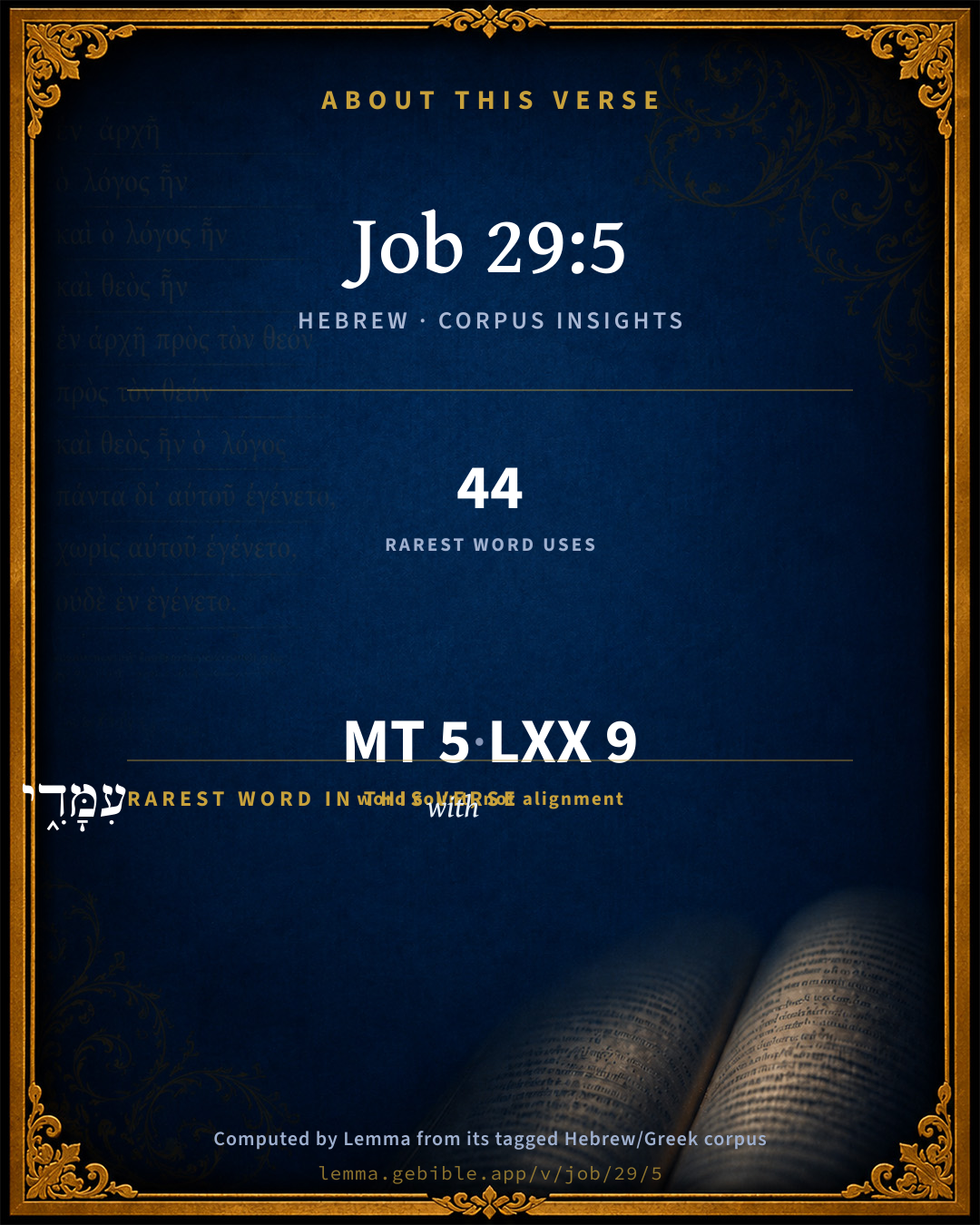
עִמָּדִ֑י with H5978 occurs in 44 verses of the Hebrew Bible. Also found in:

Grammatical profile

  • 3 nouns
  • 1 preposition
  • 1 adverb

Hebrew & Septuagint length

In English translation the verse runs 13 words from the Hebrew and 11 from the Septuagint (LXX English) — closely comparable.

A rough comparison of the two English renderings, which tokenize alike — not a word-level alignment.

Word counts can differ between the Hebrew and the Greek without any difference in meaning — e.g. the Hebrew direct-object marker אֵת has no separate Greek word, and Greek often adds the article ὁ.

In the original languages it is 5 Hebrew tokens and 9 Greek tokens — but the two are counted differently (Hebrew bundles its prefixes and suffixes into one token; the Greek is in lemma form), so that isn’t a like-for-like length.

Cross-references

17

Topical passages linked to Job 29:5 in the Treasury of Scripture Knowledge — connected by theme and wording, ordered by reader-vote popularity; previews shown in the World English Bible.

  • Psalms 128:3 Your wife will be as a fruitful vine, In the innermost parts of your house; Your children like olive plants, Around your table.
  • Psalms 127:3–5 Behold, children are a heritage of Yahweh. The fruit of the womb is his reward.
  • Deuteronomy 33:27–29 The eternal God is [your] dwelling-place, Underneath are the everlasting arms. He thrust out the enemy from before you, Said, Destroy.
  • Joshua 1:9 Haven't I commanded you? Be strong and of good courage; don't be afraid, neither be dismayed: for Yahweh your God is with you wherever you go.
  • Psalms 30:7 You, Yahweh, when you favored me, made my mountain to stand strong. But when you hid your face, I was troubled.
  • Song of Solomon 2:4 He brought me to the banquet hall. His banner over me is love.
  • Song of Solomon 3:1–2 By night on my bed, I sought him whom my soul loves. I sought him, but I didn't find him.
  • Judges 6:12–13 The angel of Yahweh appeared to him, and said to him, Yahweh is with you, you mighty man of valor.
  • Job 1:2–5 There were born to him seven sons and three daughters.
  • Job 23:3 Oh that I knew where I might find him! That I might come even to his seat!
  • Job 23:8–10 "If I go east, he is not there; If west, I can't find him;
  • Job 42:13–16 He had also seven sons and three daughters.
  • Psalms 43:2 For you are the God of my strength. Why have you rejected me? Why do I go mourning because of the oppression of the enemy?
  • Psalms 44:8–9 In God we have made our boast all day long, We will give thanks to your name forever. Selah.
  • Jeremiah 14:8 You hope of Israel, the Savior of it in the time of trouble, why should you be as a foreigner in the land, and as a wayfaring man who turns aside to stay for a night?
  • Matthew 9:15 Jesus said to them, "Can the friends of the bridegroom mourn, as long as the bridegroom is with them? But the days will come when the bridegroom will be taken away from them, and then they will fast.
  • Proverbs 17:6 Children's children are the crown of old men; The glory of children are their parents.

Cross-references courtesy of OpenBible.info (CC BY 4.0).

Hebrew and Greek witnesses Masoretic Hebrew ↔ Greek Septuagint

The same verse in the two great witnesses to the Old Testament, shown verse-for-verse.

These are two independent witnesses, not word-aligned to each other, and the Septuagint is shown in lemma (dictionary) form.

Hebrew Job 29:5 Masoretic · Westminster Leningrad Codex

בְּע֣וֹד שַׁ֭דַּי עִמָּדִ֑י סְבִ֖יבוֹתַ֣י נְעָרָֽי

When the Almighty was yet with me, And my children were around me;

World English Bible · Public Domain

Greek LXX Job 29:5 Septuagint · lemma form

ὅτε εἰμί ὑλώδης λίαν κύκλος δέ ἐγώ ὁ παῖς

When I was very fruitful, and my children were about me;

LXX2012 (modern English Septuagint) · Public Domain

Hebrew: Westminster Leningrad Codex (CC BY 4.0). Greek: Septuagint (public domain); English from LXX2012 (modern English Septuagint) (Public Domain). How the Septuagint differs from the Hebrew →

Commentary

Notes on Job 29:5 from classic Christian and Jewish commentators (each source and its license shown beneath its notes). The classic Christian expositions comment on the surrounding passage and are grouped to its opening verse, so a note may address several verses; the Jewish commentaries on the Tanakh (Rashi and others) are per-verse, so they appear only where the commentator wrote on this verse.

Lemma curates 59 commentaries, every one of them public domain or Creative Commons licensed, each selected and text-cleaned for this edition rather than reprinted as found. About our sources →

Trapp's Complete Commentary

John Trapp

Job 29:5 When the Almighty [was] yet with me, [when] my children [were] about me;

Ver. 5. When the Almighty was yet with me] To prosper me, and give me all that heart could wish or need require. But if that be not done, God’s people are apt to think him absent. "Is the Lord among us?" say they in the wilderness; as if that could not be, and they athirst, Exo 17:7. So Gideon in the invasion of the Midianites; "The Lord," saith the angel, "is with thee, thou valiant man. But Gideon said unto him, Oh my Lord, if the Lord be with us, why then is all this befallen us?" Jdg 6:12-13. "If it be so, why am I thus?" as she said, Gen 25:22. Si amatur, quomodo infirmatur? If Lazarus be Christ’s friend, why is he sick? (Aug.). But these two may very well stand together; and God is never nearer to his children than when they, for crying, cannot see him. Moses speaks of the good will of him that dwelt in the bush, the burning bush, Exo 3:2 Deu 33:2-3, but not consumed. God is with his in the fiery trial, Isa 43:2, as he was with the three children, and with the martyrs.

When my children were about me] Round about my table, Psa 128:3, morigerous and obsequious unto me; when my children and servants (for the word signifieth both) were about me; as circles about a point or centre, all looking at and observing me, to do as I directed them.

John Trapp, A Commentary or Exposition upon All the Books of the Old and New Testament (1647–1656) — public domain. Text from a community e-Sword module.

Joseph Benson's Commentary

Job 29:5-6. When the Almighty was yet with me — On my side; whereas now he is against me, and hath forsaken me. When my children were about me — Or, servants, for the word נערי, nagnarai, signifies both. When the members of my family were wont to be present to join and assist in our religious services, and we had communion with God and with each other. When I washed my steps with butter — When I had all temporal blessings as well as spiritual, and abounded with all sorts of good things, which is often signified by this or such like phrases. When I had such numerous herds of cattle, and consequently such plenty of butter, that if I had so pleased I might have washed my feet with it. And the rock poured me out rivers of oil — When not only fruitful fields, but even barren and rocky places, (such as the part of Arabia where Job lived,) yielded me olive-trees and oil in great plenty: see Deu 32:13.

Joseph Benson's Commentary on the Old and New Testaments (1811–1818) — public domain. Text from a community e-Sword module.

The Cambridge Bible for Schools and Colleges

gen. ed. J. J. S. Perowne

5. Naturally the first element in Job’s happiness in those past days was the presence of his children.

The Cambridge Bible for Schools and Colleges (gen. ed. J. J. S. Perowne; Cambridge University Press, 1878–1918) — public domain. Text from a community e-Sword module.

John Gill's Exposition

When the Almighty was yet with me,.... Not merely by his powerful and providential presence, as he is with all men; but in a special manner by his gracious presence, which is a wonderful and distinguishing favour; but sometimes the people of God are without it, at least they think so, and which was now Job's case, see Job 23:2; and therefore he desires he would return to him, and show him his face and favour:

when my children were about me; as olive plants about his table, in their youth; when he looked at them with great delight and pleasure, as his growing hopes; and, when grown up, and were not far from him, but were round about him, and lay near his heart, and whose welfare, temporal and spiritual, he was solicitous for; but now they were all taken away from him, and were no more: the word for "children" signifies also "servants" (t), and may take in them, of whom he had many to do his work and business; to attend upon him, to wait his orders, and execute them, and guard his person; but now many of them were slain by the Sabeans and Chaldeans, and by fire from heaven; and those he had were very disrespectful to him, see Job 19:15.

(t) "juvenes mei", Tigurine version; "vel famuli vel filii", Mercerus, Drusius; so Jarchi.

John Gill's Exposition of the Whole Bible (1746–1763) — public domain (CC PDM 1.0). Text via the HelloAO Bible API.

Albert Barnes' Notes on the Bible

When the Almighty was yet with me - Job regarded God as withdrawn from him. He now looked back with deep interest to the time when he dwelt with him.

Albert Barnes' Notes on the Bible (1834–1885) — public domain. Text from a community e-Sword/MySword module.

Matthew Poole's English Annotations

With me, i.e. on my side; whereas now he is against me, and hath forsaken me.

My children, or servants, or both; and therefore he useth this word, which comprehends both.

Matthew Poole's English Annotations on the Holy Bible (1683–1685) — public domain. Text from a community e-Sword/MySword module.

Whedon's Commentary on the Bible

Daniel D. Whedon

5. My children about me — Next to the blessing of God’s presence was that of the children. Compare Psa_127:3; Psa_128:3.

Daniel D. Whedon (gen. ed.), Commentary on the Old and New Testaments (1874–1909) — public domain. Text from a community e-Sword module.

The Pulpit Commentary

When the Almighty was yet with me. These are terribly sad words. Job, in his afflictions, has come to look on the Almighty as no longer "with him no longer on his side; but rather against him, an enemy. (see Job_6:4 Job_7:19 Job_9:17 Job_10:16, etc.) When my children were about me. (comp. Job_1:2, Job_1:4, Job_1:5)

The Pulpit Commentary (1880–1919), ed. H.D.M. Spence-Jones & Joseph S. Exell — public domain. Text from a community e-Sword module.

Rashi

Rabbi Shlomo Yitzchaki (Rashi)

my young men My servants.

Rashi on the Tanakh — English translations: “The Judaica Press complete Tanach with Rashi, translated by A. J. Rosenberg” (CC BY 4.0); “Pentateuch with Rashi's commentary by M. Rosenbaum and A.M. Silbermann, 1929-1934” (public domain); “The Metsudah Tanach series, Lakewood, N.J” (CC BY 4.0); and “The Book of Joshua, Metsudah Publications, 1997” (CC BY 4.0). Text via Sefaria.

Lesson kit

Teaching starters — assembled from the data on this page, not authored interpretation. Every prompt links to the verse data it draws on. Edit before teaching.

Job, in the Wisdom, opens this verse with 5 words (5 distinct Hebrew lemmas). Its most distinctive word is ʻimmâd (“with”). A historical commentator’s framing appears above. Read the whole chapter for the surrounding context.

Discussion questions

  1. What does “with” (ʻimmâd) contribute to the verse as a whole?
  2. How does Genesis 3:12, which shares the word «with», read alongside this verse?
  3. These translations render this verse differently; the difference is in the English rendering, not the original. What questions does that raise?
  4. Compare how Trapp's Complete Commentary and Joseph Benson's Commentary read this verse. Where do they agree or differ?

Things to notice

Reading settings

Reading text

Shown beneath each verse's original-language words.

Old Testament
Old Testament edition

Read the OT as the Masoretic Hebrew (MT) or the Greek Septuagint (LXX).

English shown for the Greek Septuagint (in the Hebrew ↔ Greek comparison).

Comparing translations? Open the Compare panel on any verse page to stack up to four side by side.