
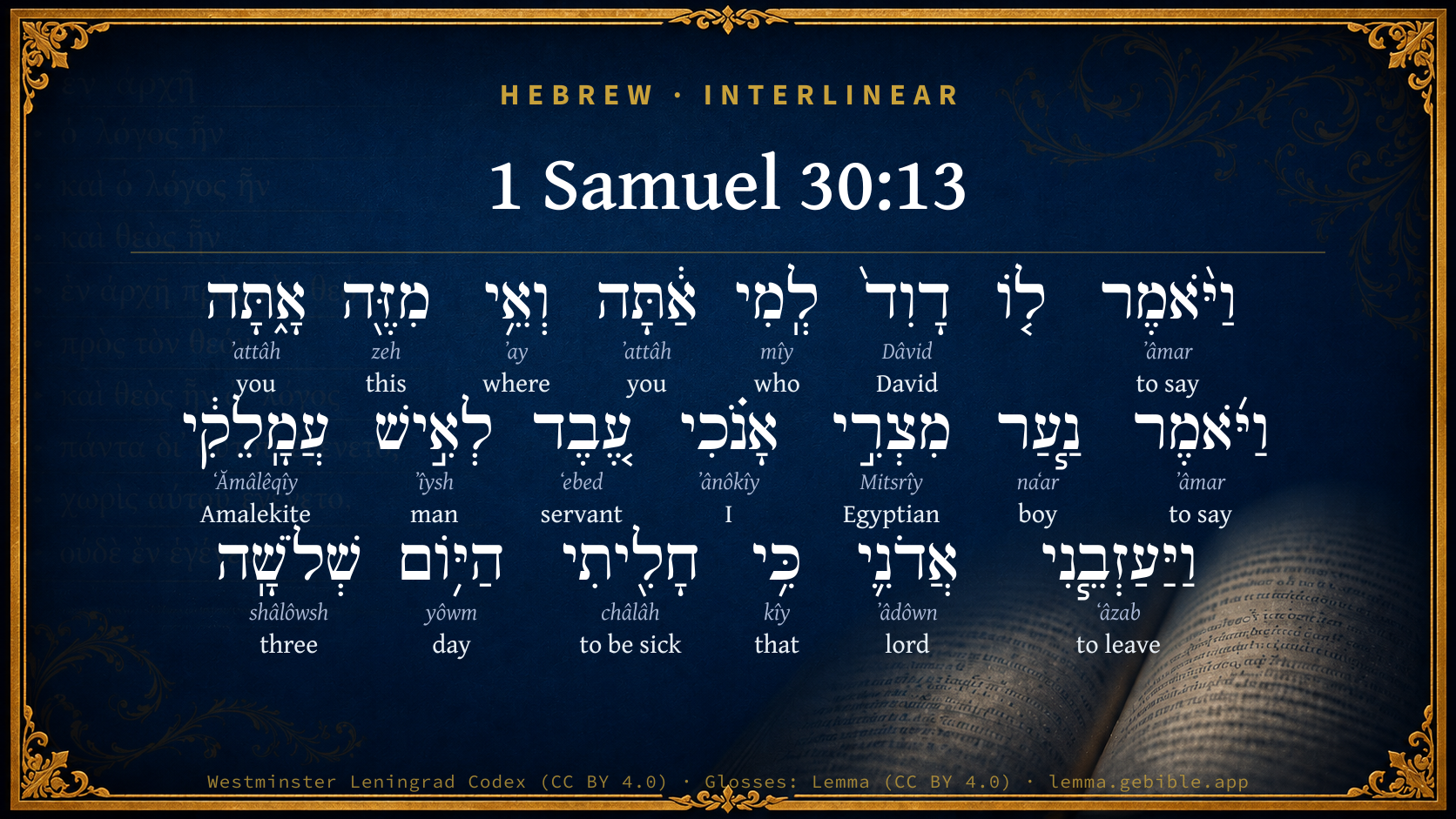
1 Samuel 30:13

Hebrew (Westminster Leningrad Codex) 1 Samuel 30:13 appears in the Hebrew Old Testament. The text above is from the Westminster Leningrad Codex. Each word links to its Strong’s number, a concise gloss, and parsing drawn from the Open Scriptures Hebrew Bible morphology. Click any word for its full Brown-Driver-Briggs (BDB) entry.
Download image
Cite this verse

1 Samuel 30:13 (World English Bible). Public Domain. Lemma interlinear Bible study tool, https://lemma.gebible.app/v/1-samuel/30/13.

Show BibTeX & RIS
BibTeX
RIS
English Translation
David said to him, To whom belong you? and whence are you? He said, I am a young man of Egypt, servant to an Amalekite; and my master left me, because three days ago I fell sick.
World English Bible · Public Domain
Download a study sheet

One document with this verse’s original text, its word-by-word gloss line, the meaning frame, cross-references with their text, attributed commentary, and full source and license credits — printable, and it pastes into notes with its structure intact.

This verse Autodidact and up

Study sheet (.html) Plain text (.txt)

A passage Seminary Student

Up to 50 verses in one chapter. A passage sheet keeps up to 6 commentary sources and 12 cross-references per verse, in the order this page ranks them, and says so on the sheet whenever that leaves anything out. Ask for a single verse and you get the Autodidact verse sheet above.

Everything on this page stays free to read, with no account — the sheet is a download of what is already on screen, not access to it.

Want to remove ads? Support Godless Engineer
Compare translations 3

The same verse in 3 English versions, stacked beneath the original-language interlinear above. Click any original word for its lexicon entry.

Each is an independent rendering of the whole verse — the interlinear is not word-aligned to these translations.

Highlighted words mark where these versions differ — a whole-verse word diff, not a word-by-word alignment.

  • World English Bible Public Domain
    David said to him, To whom belong you? and whence are you? He said, I am a young man of Egypt, servant to an Amalekite; and my master left me, because three days ago I fell sick.
  • King James Version Public Domain
    And David said unto him, To whom belongest thou? and whence art thou? And he said, I am a young man of Egypt, servant to an Amalekite; and my master left me, because three days agone I fell sick.
  • unfoldingWord Literal Text CC BY-SA 4.0
    And David said to him, “To whom you? And where from this you?” And he said, “I an Egyptian young man, the slave of a man of the Amalekite. But my master abandoned me the third day because I became sick.

unfoldingWord Literal Text — © unfoldingWord, licensed CC BY-SA 4.0. Word-aligned USFM3 via Door43 (git.door43.org/unfoldingWord/en_ult).

Versions to compare (up to 4)

3 of 4 selected

Show all 18 translations

Every available English version of this verse, each an independent rendering of the whole verse.

  • World English Bible Public Domain
    David said to him, To whom belong you? and whence are you? He said, I am a young man of Egypt, servant to an Amalekite; and my master left me, because three days ago I fell sick.
  • Berean Standard Bible Public Domain
    Then David asked him, “To whom do you belong, and where are you from?” “I am an Egyptian,” he replied, “the slave of an Amalekite. My master abandoned me three days ago when I fell ill.
  • Majority Standard Bible Public Domain
    Then David asked him, “To whom do you belong, and where are you from?” “I am an Egyptian,” he replied, “the slave of an Amalekite. My master abandoned me three days ago when I fell ill.
  • King James Version Public Domain
    And David said unto him, To whom belongest thou? and whence art thou? And he said, I am a young man of Egypt, servant to an Amalekite; and my master left me, because three days agone I fell sick.
  • American Standard Version (1901) Public Domain
    And David said unto him, To whom belongest thou? and whence art thou? And he said, I am a young man of Egypt, servant to an Amalekite; and my master left me, because three days ago I fell sick.
  • Revised Version (1885) Public Domain
    And David said unto him, To whom belongest thou? and whence art thou? And he said, I am a young man of Egypt, servant to an Amalekite; and my master left me, because three days agone I fell sick.
  • Geneva Bible (1599) Public Domain
    And Dauid saide vnto him, To whome belongest thou? and whence art thou? And he saide, I am a yong man of Egypt, and seruant to an Amalekite: and my master left me three dayes agoe, because I fell sicke.
  • Douay-Rheims (1899) Public Domain
    And David said to him: To whom dost thou belong? or whence dost thou come? and whither art thou going? He said: I am a young man of Egypt, the servant of an Amalecite, and my master left me, because I began to be sick three days ago.
  • Young's Literal Translation Public Domain
    And David saith to him, `Whose `art' thou? and whence `art' thou?' And he saith, `An Egyptian youth I `am', servant to a man, an Amalekite, and my lord forsaketh me, for I have been sick three days,
  • Literal Standard Version CC BY-SA 4.0
    And David says to him, “Whose [are] you? And where [are] you from?” And he says, “I [am] an Egyptian youth, servant to a man, an Amalekite, and my lord forsakes me, for I have been sick [for] three days,
  • Unlocked Literal Bible CC BY-SA 4.0
    David said to him, “To whom do you belong? Where do you come from?” He said, “I am a young man of Egypt, servant to an Amalekite; my master left me because three days ago I fell sick.
  • unfoldingWord Literal Text CC BY-SA 4.0
    And David said to him, “To whom you? And where from this you?” And he said, “I an Egyptian young man, the slave of a man of the Amalekite. But my master abandoned me the third day because I became sick.
  • Darby Bible Public Domain
    And David said to him, To whom belongest thou? and whence art thou? And he said, I am a young man of Egypt, servant of an Amalekite; and my master left me, because three days ago I fell sick.
  • World Messianic Bible Public Domain
    David asked him, “To whom do you belong? Where are you from?” He said, “I am a young man of Egypt, servant to an Amalekite; and my master left me, because three days ago I got sick.
  • Webster's Bible Public Domain
    And David said to him, To whom belongest thou? and whence art thou? And he said, I am a young man of Egypt, servant to an Amalekite; and my master left me, because three days ago I fell sick.
  • Free Bible Version CC BY-SA 4.0
    “Whose slave are you, and where do you come from?” David asked him. “I'm an Egyptian,” he replied, “the slave of an Amalekite. My master left me behind three days ago when I got sick.
  • Bible in Basic English Public Domain
    And David said to him, Whose man are you and where do you come from? And he said, I am a young man of Egypt, servant to an Amalekite; and my master went on without me because three days back I became ill.
  • JPS Tanakh (1917) Public Domain
    And David said unto him: 'To whom belongest thou? and whence art thou?' And he said: 'I am a young Egyptian, servant to an Amalekite; and my master left me, because three days ago I fell sick.

Literal Standard Version (2020), Covenant Press — licensed CC BY-SA 4.0. Text via the HelloAO Bible API (eBible.org). Unlocked Literal Bible (unfoldingWord) — licensed CC BY-SA 4.0. Text via the HelloAO Bible API (eBible.org). unfoldingWord Literal Text — © unfoldingWord, licensed CC BY-SA 4.0. Word-aligned USFM3 via Door43 (git.door43.org/unfoldingWord/en_ult). Free Bible Version, Dr. Jonathan Gallagher — licensed CC BY-SA 4.0. Text via the HelloAO Bible API (eBible.org).

Word by word

More ways to search: Search by grammar → Find every occurrence → Compare this word →

Practice this passage: Drill this verse → Learn its vocabulary →

עֲמָֽלֵקִ֔י
ʻĂmâlêqîy
H6003
“Amalekite”
Noun, Gentilic, Masculine, Singular, Absolute
Part of Speech
Noun
Type
Gentilic
Gender
Masculine
Number
Singular
State
Absolute
Full BDB Definition

Origin: from H6002

TWOT: None

Amalekite = see Amalek " people of lapping" - descendants of Amalek, the grandson of Esau
  1. וַיֹּ֨אמֶר ʼâmar H559 “and · to say” Conjunction + Verb, Qal, Sequential Imperfect, 3rd Person, Masculine, Singular
  2. דָוִד֙ Dâvid H1732 “David” Noun, Proper
  3. לְֽמִי mîy H4310 “to/for · who” Preposition + Particle, Interrogative
  4. אַ֔תָּה ʼattâh H859 “you” Pronoun, Personal, 2nd Person, Masculine, Singular
  5. וְאֵ֥י ʼay H335 “and · where” Conjunction + Particle, Interrogative
  6. מִזֶּ֖ה zeh H2088 “from · this” Preposition + Pronoun, Demonstrative, Masculine, Singular
  7. אָ֑תָּה ʼattâh H859 “you” Pronoun, Personal, 2nd Person, Masculine, Singular
  8. וַיֹּ֜אמֶר ʼâmar H559 “and · to say” Conjunction + Verb, Qal, Sequential Imperfect, 3rd Person, Masculine, Singular
  9. נַ֧עַר naʻar H5288 “boy” Noun, Common, Masculine, Singular, Absolute
  10. מִצְרִ֣י Mitsrîy H4713 “Egyptian” Noun, Gentilic, Masculine, Singular, Absolute
  11. אָנֹ֗כִי ʼânôkîy H595 “I” Pronoun, Personal, 1st Person, Common, Singular
  12. עֶ֚בֶד ʻebed H5650 “servant” Noun, Common, Masculine, Singular, Absolute
  13. לְאִ֣ישׁ ʼîysh H376 “to/for · man” Preposition + Noun, Common, Masculine, Singular, Absolute
  14. וַיַּעַזְבֵ֧נִי ʻâzab H5800 “and · to leave · me” Conjunction + Verb, Qal, Sequential Imperfect, 3rd Person, Masculine, Singular + Suffix, Personal, 1st Person, Common, Singular
  15. אֲדֹנִ֛י ʼâdôwn H113 “lord · my” Noun, Common, Masculine, Singular, Construct + Suffix, Personal, 1st Person, Common, Singular
  16. כִּ֥י kîy H3588 “that” Conjunction
  17. חָלִ֖יתִי châlâh H2470 “to be sick” Verb, Qal, Perfect, 1st Person, Common, Singular
  18. הַיּ֥וֹם yôwm H3117 “the · day” Particle, Definite Article + Noun, Common, Masculine, Singular, Absolute
  19. שְׁלֹשָֽׁה shâlôwsh H7969 “three” Adjective, Cardinal number, Masculine, Singular, Absolute

About this verse

These counts appear in no published source. They are computed here, from the morphology-tagged text and Lemma’s own curated glosses. What Lemma adds →

21
words
18
distinct lemmas
Historical
section

Notable vocabulary

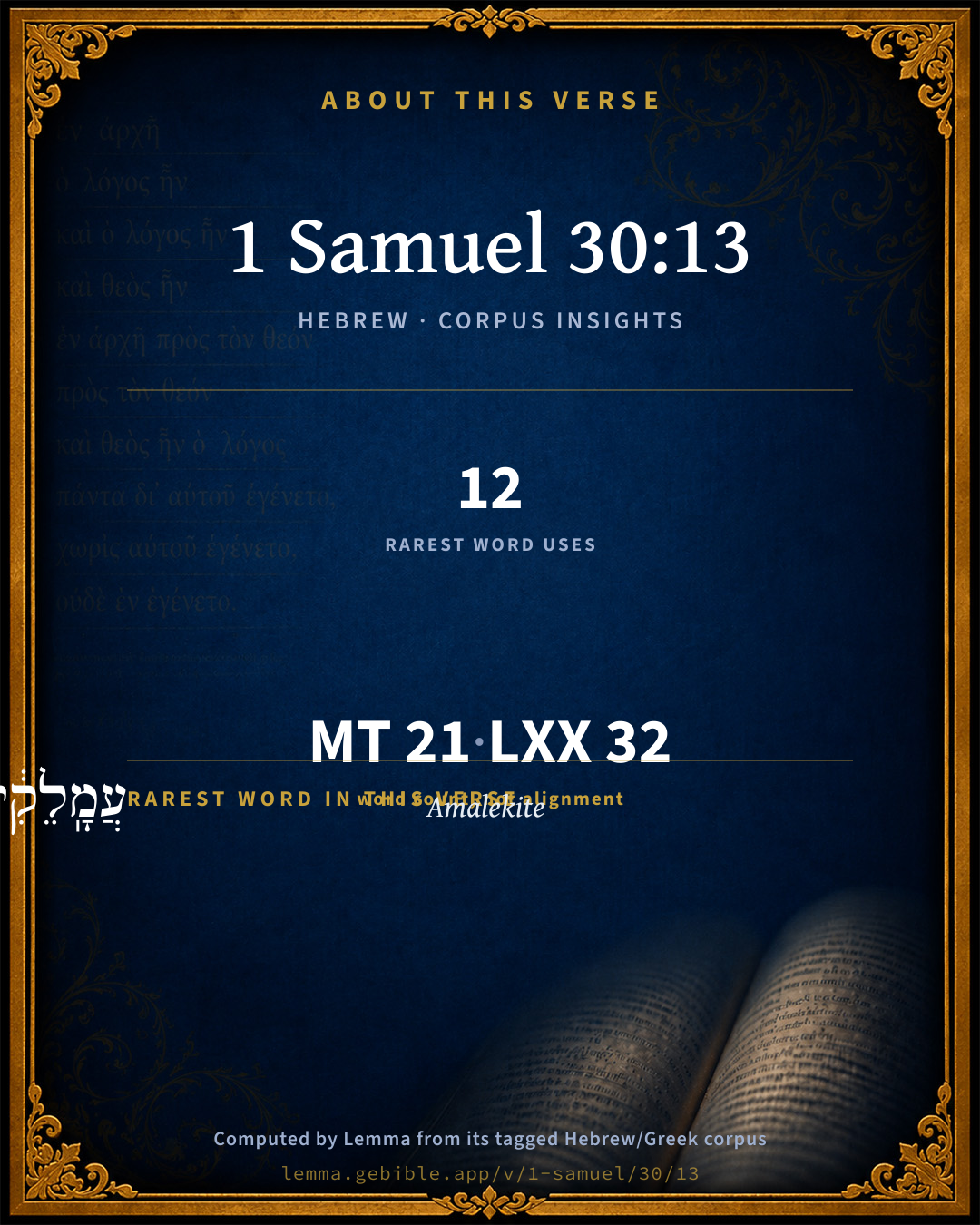
The rarest word here is עֲמָֽלֵקִ֔י Amalekite H6003 — appearing just 12 times in the whole Hebrew Bible.

Shared distinctive vocabulary

עֲמָֽלֵקִ֔י Amalekite H6003 occurs in 12 verses of the Hebrew Bible. Also found in:

Grammatical profile

  • 4 verbs
  • 8 nouns
  • 1 adjective
  • 4 pronouns
  • 1 preposition
  • 1 conjunction
  • 2 particles

Verb forms

  • וַיֹּ֨אמֶר Qal · Sequential Imperfect
  • וַיֹּ֜אמֶר Qal · Sequential Imperfect
  • וַיַּעַזְבֵ֧נִי Qal · Sequential Imperfect
  • חָלִ֖יתִי Qal · Perfect

Repetition

Words recur within this verse — often emphatic in Hebrew:

  • וַיֹּ֨אמֶר to say H559 ×2
  • אַ֔תָּה you H859 ×2

Hebrew & Septuagint length

In English translation the verse runs 37 words from the Hebrew and 39 from the Septuagint (LXX English) — closely comparable.

A rough comparison of the two English renderings, which tokenize alike — not a word-level alignment.

Word counts can differ between the Hebrew and the Greek without any difference in meaning — e.g. the Hebrew direct-object marker אֵת has no separate Greek word, and Greek often adds the article ὁ.

In the original languages it is 21 Hebrew tokens and 32 Greek tokens — but the two are counted differently (Hebrew bundles its prefixes and suffixes into one token; the Greek is in lemma form), so that isn’t a like-for-like length.

Cross-references

3

Topical passages linked to 1 Samuel 30:13 in the Treasury of Scripture Knowledge — connected by theme and wording, ordered by reader-vote popularity; previews shown in the World English Bible.

  • Proverbs 12:10 A righteous man regards the life of his animal, But the tender mercies of the wicked are cruel.
  • James 2:13 For judgment is without mercy to him who has shown no mercy. Mercy triumphs over judgment.
  • Job 31:13–15 "If I have despised the cause of my man-servant Or of my maid-servant, When they contended with me;

Cross-references courtesy of OpenBible.info (CC BY 4.0).

Hebrew and Greek witnesses Masoretic Hebrew ↔ Greek Septuagint

The same verse in the two great witnesses to the Old Testament, shown verse-for-verse.

These are two independent witnesses, not word-aligned to each other, and the Septuagint is shown in lemma (dictionary) form.

Hebrew 1 Samuel 30:13 Masoretic · Westminster Leningrad Codex

וַיֹּ֨אמֶר ל֤וֹ דָוִד֙ לְֽמִי אַ֔תָּה וְאֵ֥י מִזֶּ֖ה אָ֑תָּה וַיֹּ֜אמֶר נַ֧עַר מִצְרִ֣י אָנֹ֗כִי עֶ֚בֶד לְאִ֣ישׁ עֲמָֽלֵקִ֔י וַיַּעַזְבֵ֧נִי אֲדֹנִ֛י כִּ֥י חָלִ֖יתִי הַיּ֥וֹם שְׁלֹשָֽׁה

David said to him, To whom belong you? and whence are you? He said, I am a young man of Egypt, servant to an Amalekite; and my master left me, because three days ago I fell sick.

World English Bible · Public Domain

Greek LXX 1 Samuel 30:13 Septuagint · lemma form

καί εἶπον αὐτός δαυίδ τίς σύ εἰμί καί πόθεν εἰμί καί εἶπον ὁ παιδάριον ὁ αἰγύπτιος ἐγώ εἰμί δοῦλος ἀνήρ αμαληκίτης καί καταλείπω ἐγώ ὁ κύριος ἐγώ ὅτι ἐνὀχλέω ἐγώ σήμερον τριταῖος

And David said to him, Whose are you? and whence are you? and the young man the Egyptian said, I am the servant of an Amalekite; and my master left me, because I was taken ill three days ago.

LXX2012 (modern English Septuagint) · Public Domain

Hebrew: Westminster Leningrad Codex (CC BY 4.0). Greek: Septuagint (public domain); English from LXX2012 (modern English Septuagint) (Public Domain). How the Septuagint differs from the Hebrew →

Targum (Aramaic paraphrase)

1

The Targum is the ancient Jewish Aramaic paraphrase of the Hebrew Scriptures — an interpretive translation, not the Hebrew text itself. Onkelos (literal) and Pseudo-Jonathan (expansive) render the Torah, and Jonathan the Prophets. Coverage is partial: where no permissively-licensed English translation exists for a verse, only the Aramaic is shown. This is verse-level text, not a word-by-word alignment to the Hebrew.

  1. Targum Jonathan Prophets (Joshua–Malachi)
    וַאֲמַר לֵיהּ דָוִד דְמָן אַתְּ וְאֵי מִדֵין אַתְּ וַאֲמַר עוּלֵימָא מִצְרָאָה אֲנָא עַבְדָא לְגַבְרָא עַמַלְקָאָה וְשַׁבְקַנִי רִבּוֹנִי אֲרֵי אִתְמְרָעִית יוֹמָא דֵין דְנָן תְּלָתָא יוֹמִין:

    (no public-domain English translation for this verse)

    Targum Jonathan — Aramaic: “Mikraot Gedolot” (public domain). English: “Sefaria Community Translation” (CC0 1.0 (public-domain dedication)); “London "Chaldee Paraphrase," 1871” (public domain). Text via Sefaria.

Commentary

Notes on 1 Samuel 30:13 from classic Christian and Jewish commentators (each source and its license shown beneath its notes). The classic Christian expositions comment on the surrounding passage and are grouped to its opening verse, so a note may address several verses; the Jewish commentaries on the Tanakh (Rashi and others) are per-verse, so they appear only where the commentator wrote on this verse.

Lemma curates 59 commentaries, every one of them public domain or Creative Commons licensed, each selected and text-cleaned for this edition rather than reprinted as found. About our sources →

Trapp's Complete Commentary

John Trapp

1Sa 30:13 And David said unto him, To whom [belongest] thou? and whence [art] thou? And he said, I [am] a young man of Egypt, servant to an Amalekite; and my master left me, because three days agone I fell sick.

Ver. 13. And my master left me, because three days agone.] He should the rather have looked to him, and taken order for his carriage and cure; as did the good Samaritan for a mere stranger. But this is merces mundi, the world’s wages: and Eucherius here observeth, that the world usually serveth her servants in this sort, casting them off when at worst: and then God taketh them up, those that belong to his election, and not only relieveth them, but maketh great use of them in the Christian warfare.

John Trapp, A Commentary or Exposition upon All the Books of the Old and New Testament (1647–1656) — public domain. Text from a community e-Sword module.

Tyndale Open Study Notes

Tyndale Open Resources

30:13 because I was sick: Only healthy and vigorous slaves were valuable to the Amalekites; the rest were expendable.

Tyndale Open Study Notes — © Tyndale Open Resources, licensed CC BY-SA 4.0. Text via the HelloAO Bible API.

Adam Clarke's Commentary

Verse 13. My master left me, because three days agone I fell sick.] This was very inhuman: though they had booty enough, and no doubt asses sufficient to carry the invalids, yet they left this poor man to perish; and God visited it upon them, as he made this very person the means of their destruction, by the information which he was enabled to give to David and his men.

Adam Clarke's Commentary on the Bible (1810–1826) — public domain. Text from a community e-Sword/MySword module.

The Cambridge Bible for Schools and Colleges

gen. ed. J. J. S. Perowne

13. To whom belongest thou] His appearance shewed that he was a slave.

servant] Slave: captured in some Amalekite foray.

three days agone] So that more than three days had elapsed since the sack of Ziklag, for they had gone at least one long day’s march before he was deserted. “Agone,” now usually written ago, is the past participle of an obsolete verb agon, to go away.

my master left me] “A barbarous act, to leave him there to perish, when they had camels good store, for the carriage of men as well as of their spoil (1Sa_30:17): but this inhumanity cost them dear; for by this means they lost their own lives.” Patrick.

The Cambridge Bible for Schools and Colleges (gen. ed. J. J. S. Perowne; Cambridge University Press, 1878–1918) — public domain. Text from a community e-Sword module.

John Gill's Exposition

And David said unto him, to whom belongest thou?.... To what country or people? and to whom among them?

and whence art thou? of what nation? where wast thou born? what countryman art thou? for his being called an Egyptian before seems to be by anticipation, unless it was guessed at by his habit; for until he had eaten and drank he could not speak, and so could not be known by his speech:

for he said, I am a young man of Egypt; that was the country he belonged to, and came from; he was an Egyptian by birth:

servant to an Amalekite; one of those that had invaded the country, and burnt Ziklag, as it follows:

and my master left me, because three days agone I fell sick; which was very barbarous and cruel to leave him at all, when they had camels with them, Sa1 30:17; and no doubt carriages for their arms, provision, and spoil, and men; and more so to leave him without anybody with him to take care of him, and without any food, when he capable of eating any; but so it was ordered by the providence of God, that should be left to be the instrument of the just ruin of his master, and of the whole troop.

John Gill's Exposition of the Whole Bible (1746–1763) — public domain (CC PDM 1.0). Text via the HelloAO Bible API.

Haydock's Catholic Bible Commentary

Ago. His master’s inhumanity was justly punished, and God provided for the safety of his poor slave, while he sent a guide for David. (Haydock)

George Leo Haydock (1774–1849), Haydock's Catholic Family Bible and Commentary, 1859 edition — public domain. Excludes Psalms (Douay-Rheims chapter numbering differs from Protestant) and Deuterocanonical books (Catholic canon only).

Matthew Poole's English Annotations

I am a young man of Egypt; God by his providence so ordering it, that he was not one of that cursed race of the Amalekites, who were to be utterly destroyed, but an Egyptian, who might be spared.

My master left me, in this place and condition; which was barbarous inhumanity; for he ought, and easily might have carried him away with the prey which they had taken. But he paid dearly for this cruelty, for this was the occasion of the ruin of him and of all their company. And God by his secret providence ordered the matter thus for that very end. So that there is no fighting against God, who can make the smallest accidents serviceable to the production of the greatest effects.

Matthew Poole's English Annotations on the Holy Bible (1683–1685) — public domain. Text from a community e-Sword/MySword module.

The Pulpit Commentary

To whom belongest thou? As he was probably unarmed, and his garb that of a slave, David asks who is his owner and what his country. He learns from him besides that he was left behind three days ago because he fell sick. The word does not imply more than temporary faintness, and is that translated sorry in 1Sa_22:8. But his life was of too little value for them to mount him on a camel, or even to leave with him supplies of food, and so their inhumanity led to their destruction.

The Pulpit Commentary (1880–1919), ed. H.D.M. Spence-Jones & Joseph S. Exell — public domain. Text from a community e-Sword module.

John Wesley's Explanatory Notes

Egypt - God by his providence so ordering it, that he was not one of that cursed race of the Amalekites, who were to be utterly destroyed, but an Egyptian, who might be spared. Left me - In this place and condition: which was barbarous inhumanity: for he ought, and easily might have carried him away with the prey which they had taken. But he paid dear for this cruelty, for this was the occasion of the ruin of him and all their company. And God by his secret providence ordered the matter thus for that very end. So that there is no fighting against God, who can make the smallest accidents serviceable to the production of the greatest effects.

John Wesley, Explanatory Notes Upon the Whole Bible (1754–1765) — public domain. Text via the GEBible commentary corpus.

Keil & Delitzsch

C. F. Keil & F. Delitzsch

When David asked him whence he had come (to whom, i.e., to what people or tribe, dost thou belong?), the young man said that he was an Egyptian, and servant of an Amalekite, and that he had been left behind by his master when he fell sick three days before ("to-day three," sc., days): he also said, "We invaded the south of the Crethites, and what belongs to Judah, and the south of Caleb, and burned Ziklag with fire." הכּרתי, identical with כּרתים (Eze 25:16; Zep 2:5), denotes those tribes of the Philistines who dwelt in the south-west of Canaan, and is used by Ezekiel and Zephaniah as synonymous with Philistim. The origin of the name is involved in obscurity, as the explanation which prevailed for a time, viz., that it was derived from Creta, is without sufficient foundation (vid., Stark, Gaza, pp. 66 and 99ff.). The Negeb "belonging to Judah" is the eastern portion of the Negeb. One part of it belonged to the family of Caleb, and was called Caleb's Negeb (vid., Sa1 25:3).

Keil & Delitzsch — Biblical Commentary on the Old Testament (1861–1891) — public domain (CC PDM 1.0). Text via the HelloAO Bible API. (Old Testament only.)

unfoldingWord translationNotes

Door43 World Missions Community

David said to him

David questioned the Egyptian slave.

three days ago

"three days in the past"

three days

3 days (See: Numbers)

a raid

an attack on a town to take property

translationWords

David

Egypt

servant

lord

Judah

Caleb

unfoldingWord translationNotes — © Distant Shores Media and the Door43 World Missions Community, licensed CC BY-SA 4.0. Source: git.door43.org/Door43/en_tn.

Lesson kit

Teaching starters — assembled from the data on this page, not authored interpretation. Every prompt links to the verse data it draws on. Edit before teaching.

1 Samuel, in the Historical, opens this verse with 21 words (18 distinct Hebrew lemmas). Its most distinctive word is ʻĂmâlêqîy (“Amalekite”). A historical commentator’s framing appears above. Read the whole chapter for the surrounding context.

Discussion questions

  1. What does “Amalekite” (ʻĂmâlêqîy) contribute to the verse as a whole?
  2. How does Genesis 14:7, which shares the word «Amalekite», read alongside this verse?
  3. What does the repetition of “to say” (2× in this one verse) do in this verse?
  4. These translations render this verse differently. What is at stake in choosing one wording over another?
  5. «וַיֹּ֨אמֶר» is a Qal Sequential Imperfect verb. How does that grammatical form shape the action described?
  6. Compare how Trapp's Complete Commentary and Tyndale Open Study Notes read this verse. Where do they agree or differ?

Things to notice

Reading settings

Reading text

Shown beneath each verse's original-language words.

Old Testament
Old Testament edition

Read the OT as the Masoretic Hebrew (MT) or the Greek Septuagint (LXX).

English shown for the Greek Septuagint (in the Hebrew ↔ Greek comparison).

Comparing translations? Open the Compare panel on any verse page to stack up to four side by side.