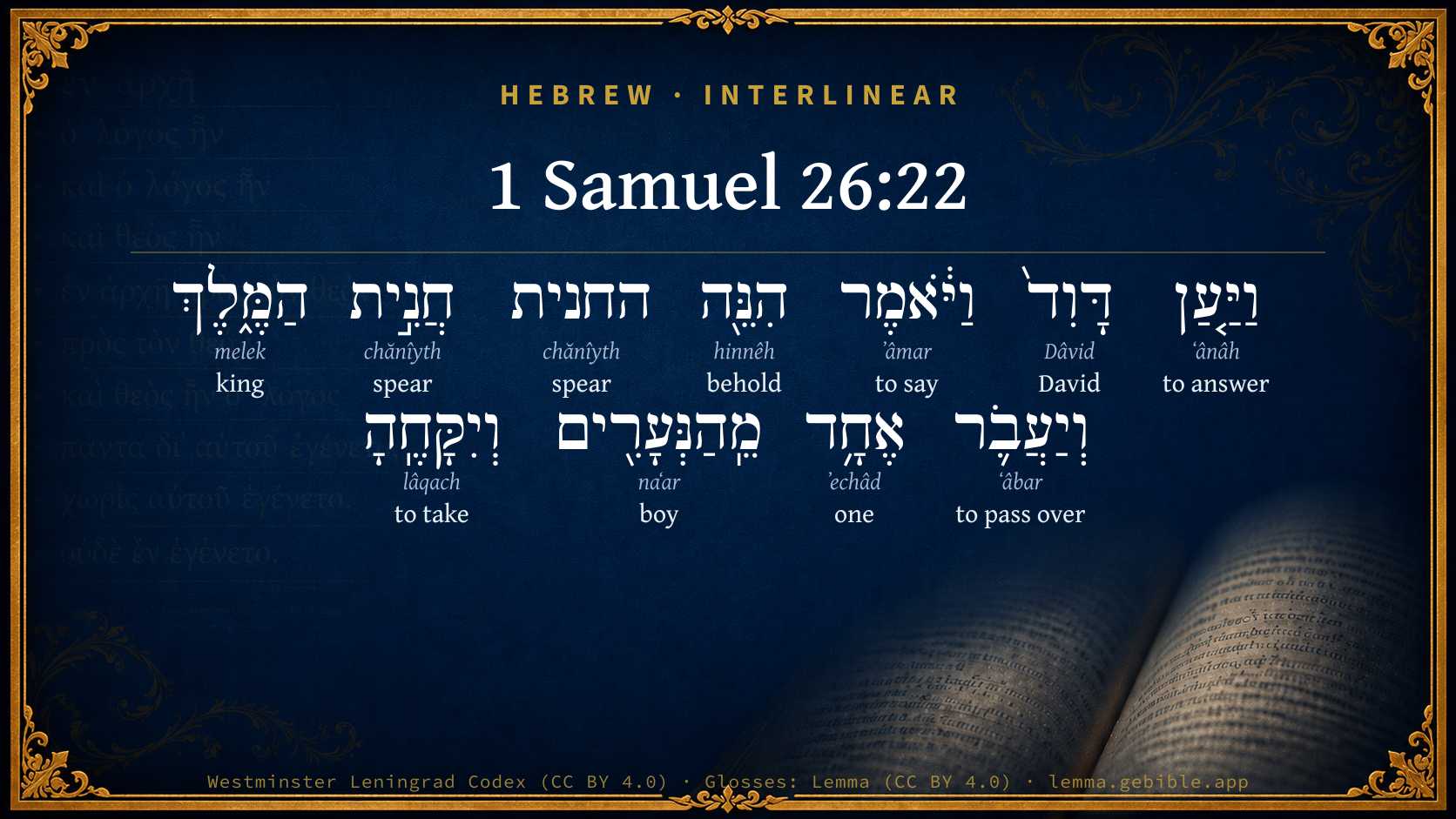
1 Samuel 26:22

Hebrew (Westminster Leningrad Codex) 1 Samuel 26:22 appears in the Hebrew Old Testament. The text above is from the Westminster Leningrad Codex. Each word links to its Strong’s number, a concise gloss, and parsing drawn from the Open Scriptures Hebrew Bible morphology. Click any word for its full Brown-Driver-Briggs (BDB) entry.
Download image
Cite this verse

1 Samuel 26:22 (World English Bible). Public Domain. Lemma interlinear Bible study tool, https://lemma.gebible.app/v/1-samuel/26/22.

Show BibTeX & RIS
BibTeX
RIS
English Translation
David answered, Behold the spear, O king! let then one of the young men come over and get it.
World English Bible · Public Domain
Download a study sheet

One document with this verse’s original text, its word-by-word gloss line, the meaning frame, cross-references with their text, attributed commentary, and full source and license credits — printable, and it pastes into notes with its structure intact.

This verse Autodidact and up

Study sheet (.html) Plain text (.txt)

A passage Seminary Student

Up to 50 verses in one chapter. A passage sheet keeps up to 6 commentary sources and 12 cross-references per verse, in the order this page ranks them, and says so on the sheet whenever that leaves anything out. Ask for a single verse and you get the Autodidact verse sheet above.

Everything on this page stays free to read, with no account — the sheet is a download of what is already on screen, not access to it.

Want to remove ads? Support Godless Engineer
Compare translations 3

The same verse in 3 English versions, stacked beneath the original-language interlinear above. Click any original word for its lexicon entry.

Each is an independent rendering of the whole verse — the interlinear is not word-aligned to these translations.

Highlighted words mark where these versions differ — a whole-verse word diff, not a word-by-word alignment.

  • World English Bible Public Domain
    David answered, Behold the spear, O king! let then one of the young men come over and get it.
  • King James Version Public Domain
    And David answered and said, Behold the king's spear! and let one of the young men come over and fetch it.
  • unfoldingWord Literal Text CC BY-SA 4.0
    And David answered and said, “Behold the spear of the king! Now let one of the young men pass over and take it.

unfoldingWord Literal Text — © unfoldingWord, licensed CC BY-SA 4.0. Word-aligned USFM3 via Door43 (git.door43.org/unfoldingWord/en_ult).

Versions to compare (up to 4)

3 of 4 selected

Show all 18 translations

Every available English version of this verse, each an independent rendering of the whole verse.

  • World English Bible Public Domain
    David answered, Behold the spear, O king! let then one of the young men come over and get it.
  • Berean Standard Bible Public Domain
    “Here is the king’s spear,” David answered. “Let one of the young men come over and get it.
  • Majority Standard Bible Public Domain
    “Here is the king’s spear,” David answered. “Let one of the young men come over and get it.
  • King James Version Public Domain
    And David answered and said, Behold the king's spear! and let one of the young men come over and fetch it.
  • American Standard Version (1901) Public Domain
    And David answered and said, Behold the spear, O king! let then one of the young men come over and fetch it.
  • Revised Version (1885) Public Domain
    And David answered and said, Behold the spear, O king! let then one of the young men come over and fetch it.
  • Geneva Bible (1599) Public Domain
    Then Dauid answered, and saide, Beholde the Kings speare, let one of the yong men come ouer and set it.
  • Douay-Rheims (1899) Public Domain
    And David answering, said: Behold the king's spear: let one of the king's servants come over and fetch it.
  • Young's Literal Translation Public Domain
    And David answereth and saith, `Lo, the king's spear; and let one of the young men pass over, and receive it;
  • Literal Standard Version CC BY-SA 4.0
    And David answers and says, “Behold, the king’s spear; and let one of the young men pass over, and receive it;
  • Unlocked Literal Bible CC BY-SA 4.0
    David answered and said, “See, your spear is here, king! Let one of the young men come over and get it and bring it to you.
  • unfoldingWord Literal Text CC BY-SA 4.0
    And David answered and said, “Behold the spear of the king! Now let one of the young men pass over and take it.
  • Darby Bible Public Domain
    And David answered and said, Behold the king's spear, and let one of the young men come over and fetch it.
  • World Messianic Bible Public Domain
    David answered, “Behold the spear, O king! Let one of the young men come over and get it.
  • Webster's Bible Public Domain
    And David answered and said, Behold the king's spear! and let one of the young men come over and take it.
  • Free Bible Version CC BY-SA 4.0
    “I have the king's spear here,” said David. “Send one of your men over to collect it.
  • Bible in Basic English Public Domain
    Then David said, Here is the king's spear! let one of the young men come over and get it.
  • JPS Tanakh (1917) Public Domain
    And David answered and said: 'Behold the king's spear! let then one of the young men come over and fetch it.

Literal Standard Version (2020), Covenant Press — licensed CC BY-SA 4.0. Text via the HelloAO Bible API (eBible.org). Unlocked Literal Bible (unfoldingWord) — licensed CC BY-SA 4.0. Text via the HelloAO Bible API (eBible.org). unfoldingWord Literal Text — © unfoldingWord, licensed CC BY-SA 4.0. Word-aligned USFM3 via Door43 (git.door43.org/unfoldingWord/en_ult). Free Bible Version, Dr. Jonathan Gallagher — licensed CC BY-SA 4.0. Text via the HelloAO Bible API (eBible.org).

Word by word

More ways to search: Search by grammar → Find every occurrence → Compare this word →

Practice this passage: Drill this verse → Learn its vocabulary →

החנית
chănîyth
H2595
“the · spear”
Particle, Definite Article + Noun, Common, Feminine, Singular, Absolute
Part of Speech
Particle + Noun
Type
Common
Gender
Feminine
Number
Singular
State
Absolute
Full BDB Definition

Origin: from H2583

TWOT: TWOT- 690b

spear - spear - shaft of a spear - spear-head
  1. וַיַּ֤עַן ʻânâh H6030 “and · to answer” Conjunction + Verb, Qal, Sequential Imperfect, 3rd Person, Masculine, Singular
  2. דָּוִד֙ Dâvid H1732 “David” Noun, Proper
  3. וַיֹּ֔אמֶר ʼâmar H559 “and · to say” Conjunction + Verb, Qal, Sequential Imperfect, 3rd Person, Masculine, Singular
  4. הִנֵּ֖ה hinnêh H2009 “behold” Particle, Demonstrative
  5. חֲנִ֣ית chănîyth H2595 “spear” Noun, Common, Feminine, Singular, Absolute
  6. הַמֶּ֑לֶךְ melek H4428 “the · king” Particle, Definite Article + Noun, Common, Masculine, Singular, Absolute
  7. וְיַעֲבֹ֛ר ʻâbar H5674 “and · to pass over” Conjunction + Verb, Qal, Imperfect, 3rd Person, Masculine, Singular
  8. אֶחָ֥ד ʼechâd H259 “one” Adjective, Cardinal number, Masculine, Singular, Absolute
  9. מֵֽהַנְּעָרִ֖ים naʻar H5288 “from · the · boys” Preposition + Particle, Definite Article + Noun, Common, Masculine, Plural, Absolute
  10. וְיִקָּחֶֽהָ lâqach H3947 “and · to take · her” Conjunction + Verb, Qal, Imperfect, 3rd Person, Masculine, Singular + Suffix, Personal, 3rd Person, Feminine, Singular

About this verse

These counts appear in no published source. They are computed here, from the morphology-tagged text and Lemma’s own curated glosses. What Lemma adds →

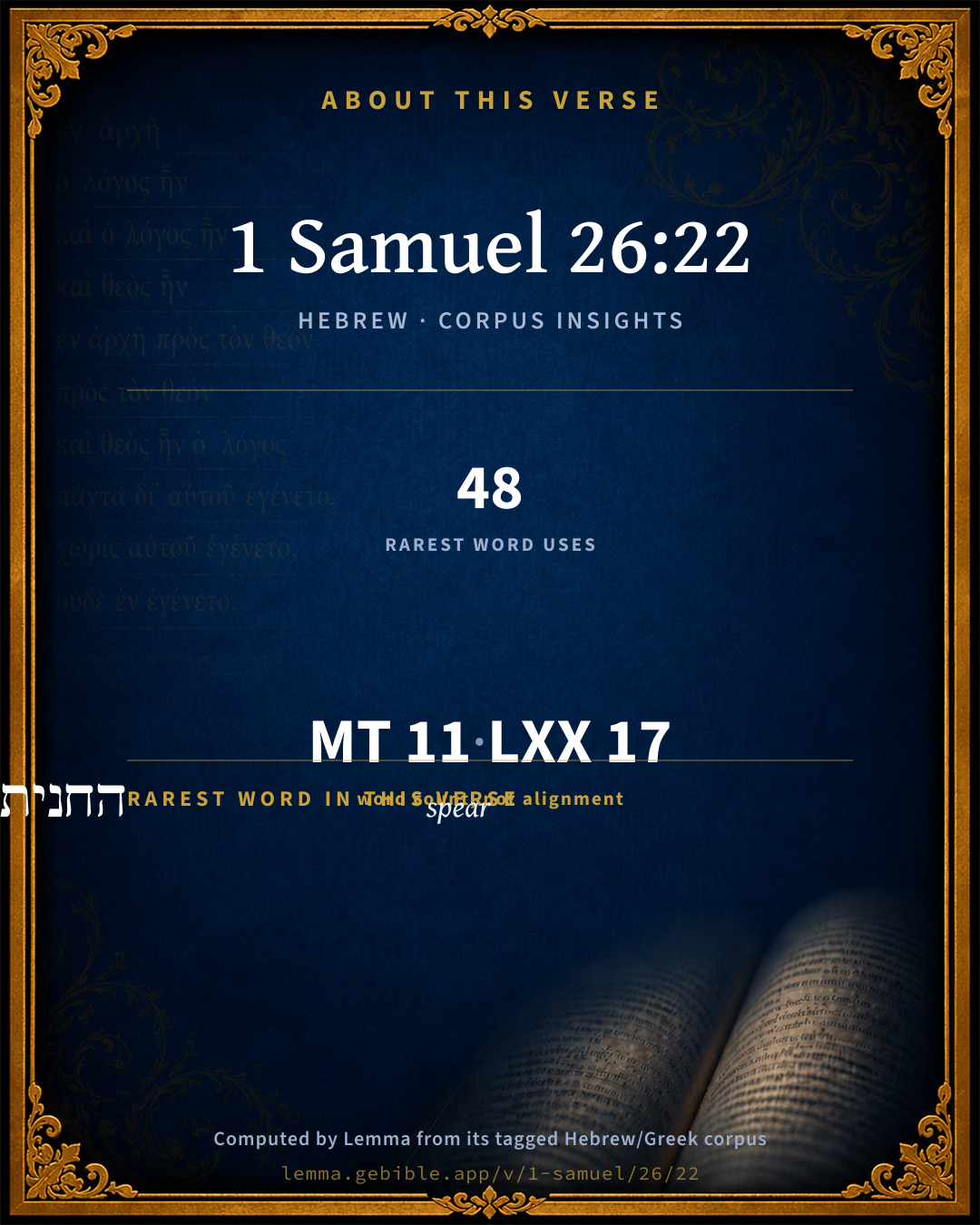
11
words
10
distinct lemmas
Historical
section

Shared distinctive vocabulary

החנית spear H2595 occurs in 40 verses of the Hebrew Bible. Also found in:

Grammatical profile

  • 4 verbs
  • 5 nouns
  • 1 adjective
  • 1 particle

Verb forms

  • וַיַּ֤עַן Qal · Sequential Imperfect
  • וַיֹּ֔אמֶר Qal · Sequential Imperfect
  • וְיַעֲבֹ֛ר Qal · Imperfect
  • וְיִקָּחֶֽהָ Qal · Imperfect

Repetition

A word recurs within this verse — often emphatic in Hebrew:

  • החנית spear H2595 ×2

Hebrew & Septuagint length

In English translation the verse runs 19 words from the Hebrew and 21 from the Septuagint (LXX English) — closely comparable.

A rough comparison of the two English renderings, which tokenize alike — not a word-level alignment.

Word counts can differ between the Hebrew and the Greek without any difference in meaning — e.g. the Hebrew direct-object marker אֵת has no separate Greek word, and Greek often adds the article ὁ.

In the original languages it is 11 Hebrew tokens and 17 Greek tokens — but the two are counted differently (Hebrew bundles its prefixes and suffixes into one token; the Greek is in lemma form), so that isn’t a like-for-like length.

Hebrew and Greek witnesses Masoretic Hebrew ↔ Greek Septuagint

The same verse in the two great witnesses to the Old Testament, shown verse-for-verse.

These are two independent witnesses, not word-aligned to each other, and the Septuagint is shown in lemma (dictionary) form.

Hebrew 1 Samuel 26:22 Masoretic · Westminster Leningrad Codex

וַיַּ֤עַן דָּוִד֙ וַיֹּ֔אמֶר הִנֵּ֖ה החנית חֲנִ֣ית הַמֶּ֑לֶךְ וְיַעֲבֹ֛ר אֶחָ֥ד מֵֽהַנְּעָרִ֖ים וְיִקָּחֶֽהָ

David answered, Behold the spear, O king! let then one of the young men come over and get it.

World English Bible · Public Domain

Greek LXX 1 Samuel 26:22 Septuagint · lemma form

καί ἀποκρίνω δαυίδ καί εἶπον ἰδού ὁ δόρυ ὁ βασιλεύς διαἔρχομαι εἷς ὁ παιδάριον καί λαμβάνω αὐτός

And David answered and said, Behold, the spear of the king: let one of the servants come over and take it.

LXX2012 (modern English Septuagint) · Public Domain

Hebrew: Westminster Leningrad Codex (CC BY 4.0). Greek: Septuagint (public domain); English from LXX2012 (modern English Septuagint) (Public Domain). How the Septuagint differs from the Hebrew →

Targum (Aramaic paraphrase)

1

The Targum is the ancient Jewish Aramaic paraphrase of the Hebrew Scriptures — an interpretive translation, not the Hebrew text itself. Onkelos (literal) and Pseudo-Jonathan (expansive) render the Torah, and Jonathan the Prophets. Coverage is partial: where no permissively-licensed English translation exists for a verse, only the Aramaic is shown. This is verse-level text, not a word-by-word alignment to the Hebrew.

  1. Targum Jonathan Prophets (Joshua–Malachi)
    וַאֲתֵיב דָוִד וַאֲמַר הָא מוּרְנִיתָא דְמַלְכָּא וְיֶעְבַּר חַד מֵעוּלֵמַיָא וְיִסְבָהּ:

    (no public-domain English translation for this verse)

    Targum Jonathan — Aramaic: “Mikraot Gedolot” (public domain). English: “Sefaria Community Translation” (CC0 1.0 (public-domain dedication)); “London "Chaldee Paraphrase," 1871” (public domain). Text via Sefaria.

Commentary

Notes on 1 Samuel 26:22 from classic Christian and Jewish commentators (each source and its license shown beneath its notes). The classic Christian expositions comment on the surrounding passage and are grouped to its opening verse, so a note may address several verses; the Jewish commentaries on the Tanakh (Rashi and others) are per-verse, so they appear only where the commentator wrote on this verse.

Lemma curates 59 commentaries, every one of them public domain or Creative Commons licensed, each selected and text-cleaned for this edition rather than reprinted as found. About our sources →

Trapp's Complete Commentary

John Trapp

1Sa 26:22 And David answered and said, Behold the king’s spear! and let one of the young men come over and fetch it.

Ver. 22. Behold the king’s spear!] Which I took away, not to retain it, but to return it, whereas thereby I had cleared nay much wronged innocence.

John Trapp, A Commentary or Exposition upon All the Books of the Old and New Testament (1647–1656) — public domain. Text from a community e-Sword module.

Joseph Benson's Commentary

1Sa 26:22-24. Behold the king’s spear, &c. — He did not think it proper to put himself in Saul’s power by going and presenting it himself to him. The Lord render to every man his righteousness — In these words David shows the assurance he had that, however Saul dealt by him, the Lord would vindicate his cause on account of his integrity and righteous dealing. So let my life be much set by, &c. — He prays that God would spare his life as he had spared Saul’s, and show him similar mercy, and then he trusted that he should be delivered out of all his troubles.

Joseph Benson's Commentary on the Old and New Testaments (1811–1818) — public domain. Text from a community e-Sword module.

The Cambridge Bible for Schools and Colleges

gen. ed. J. J. S. Perowne

22. let one of the young men, &c.] For he durst not now venture to put himself in Saul’s power, as he appears to have done upon the former occasion. Cp. 1Sa_26:13.

The Cambridge Bible for Schools and Colleges (gen. ed. J. J. S. Perowne; Cambridge University Press, 1878–1918) — public domain. Text from a community e-Sword module.

John Gill's Exposition

And David answered and said, behold the king's spear!.... And which perhaps was his sceptre, and which David therefore would not keep, lest it should be thought or said that he had deprived him of an ensign of his royalty, and be interpreted as a token of his design to seize his crown and throne:

and let one of the young men come over and fetch it; for notwithstanding the acknowledgment Saul had made of his sin and folly, David did not choose to carry the spear to him; not caring to trust him, and put himself into his hands, lest the evil spirit should return and come upon him suddenly, and alter his disposition and carriage; nor would he send any of his men with it, whose lives were dear to him, lest they should be seized as traitors, but desires one of Saul's men might be sent for it.

John Gill's Exposition of the Whole Bible (1746–1763) — public domain (CC PDM 1.0). Text via the HelloAO Bible API.

Haydock's Catholic Bible Commentary

It. He would not keep the spear, lest it might seem disrespectful.

George Leo Haydock (1774–1849), Haydock's Catholic Family Bible and Commentary, 1859 edition — public domain. Excludes Psalms (Douay-Rheims chapter numbering differs from Protestant) and Deuterocanonical books (Catholic canon only).

The Pulpit Commentary

Vers. 22-24. Behold the king"s spear. Rather, "Behold the spear, O king." The other is an unnecessary correction of the Kri. Having restored to Saul this ensign of his authority, David prays that Jehovah may render to every man his righteousness, i.e. may requite David for his upright conduct towards Saul, and by implication punish Saul himself for his unjust conduct. And also his faithfulness, his fidelity, and steady allegiance. This refers exclusively to David, who gives as proof of his faithfulness to his king that he had spared his life when it was delivered into his power. In return for which act God, he affirms, will protect his life. Ver. 24 would be better translated, "And behold, as thy life was great (in value) in my sight this day, so shall my life be great (in value) in the sight of Jehovah, and he shall deliver me out of every strait," every narrowness and difficulty into which Saul"s persecution might drive him.

The Pulpit Commentary (1880–1919), ed. H.D.M. Spence-Jones & Joseph S. Exell — public domain. Text from a community e-Sword module.

unfoldingWord translationNotes

Door43 World Missions Community

Yahweh put you into my hand today

The word "hand" is a metonym for the person's power. "Yahweh gave me an opportunity to attack you today" or "Yahweh placed me where I could easily have killed you" (See: Metonymy)

pay each man

"give what is proper to each man""

his anointed

David speaks as if Saul were another person to show that he respects Saul because Saul is king. AT: "the one he has chosen to be king" (See: Pronouns)

translationWords

David

king

Yahweh

righteous

faithful

hand

anoint

unfoldingWord translationNotes — © Distant Shores Media and the Door43 World Missions Community, licensed CC BY-SA 4.0. Source: git.door43.org/Door43/en_tn.

Lesson kit

Teaching starters — assembled from the data on this page, not authored interpretation. Every prompt links to the verse data it draws on. Edit before teaching.

1 Samuel, in the Historical, opens this verse with 11 words (10 distinct Hebrew lemmas). Its most distinctive word is chănîyth (“spear”). A historical commentator’s framing appears above. Read the whole chapter for the surrounding context.

Discussion questions

  1. What does “spear” (chănîyth) contribute to the verse as a whole?
  2. 1 Samuel 13:19 shares the word «spear» with this verse. How do the two illuminate each other?
  3. “spear” occurs 2× in this one verse. What is the effect of the repetition?
  4. These translations render this verse differently; the difference is in the English rendering, not the original. What questions does that raise?
  5. The verb «וַיַּ֤עַן» is Qal Sequential Imperfect. How does its form color the action?
  6. Reading how Trapp's Complete Commentary and Joseph Benson's Commentary read this verse, where do the two commentators agree and where do they part?

Things to notice

Reading settings

Reading text

Shown beneath each verse's original-language words.

Old Testament
Old Testament edition

Read the OT as the Masoretic Hebrew (MT) or the Greek Septuagint (LXX).

English shown for the Greek Septuagint (in the Hebrew ↔ Greek comparison).

Comparing translations? Open the Compare panel on any verse page to stack up to four side by side.