
1 Samuel 1:24

Hebrew (Westminster Leningrad Codex) 1 Samuel 1:24 appears in the Hebrew Old Testament. The text above is from the Westminster Leningrad Codex. Each word links to its Strong’s number, a concise gloss, and parsing drawn from the Open Scriptures Hebrew Bible morphology. Click any word for its full Brown-Driver-Briggs (BDB) entry.
Download image
Cite this verse

1 Samuel 1:24 (World English Bible). Public Domain. Lemma interlinear Bible study tool, https://lemma.gebible.app/v/1-samuel/1/24.

Show BibTeX & RIS
BibTeX
RIS
English Translation
When she had weaned him, she took him up with her, with three bulls, and one ephah of meal, and a bottle of wine, and brought him to the house of Yahweh in Shiloh: and the child was young.
World English Bible · Public Domain
Highlights
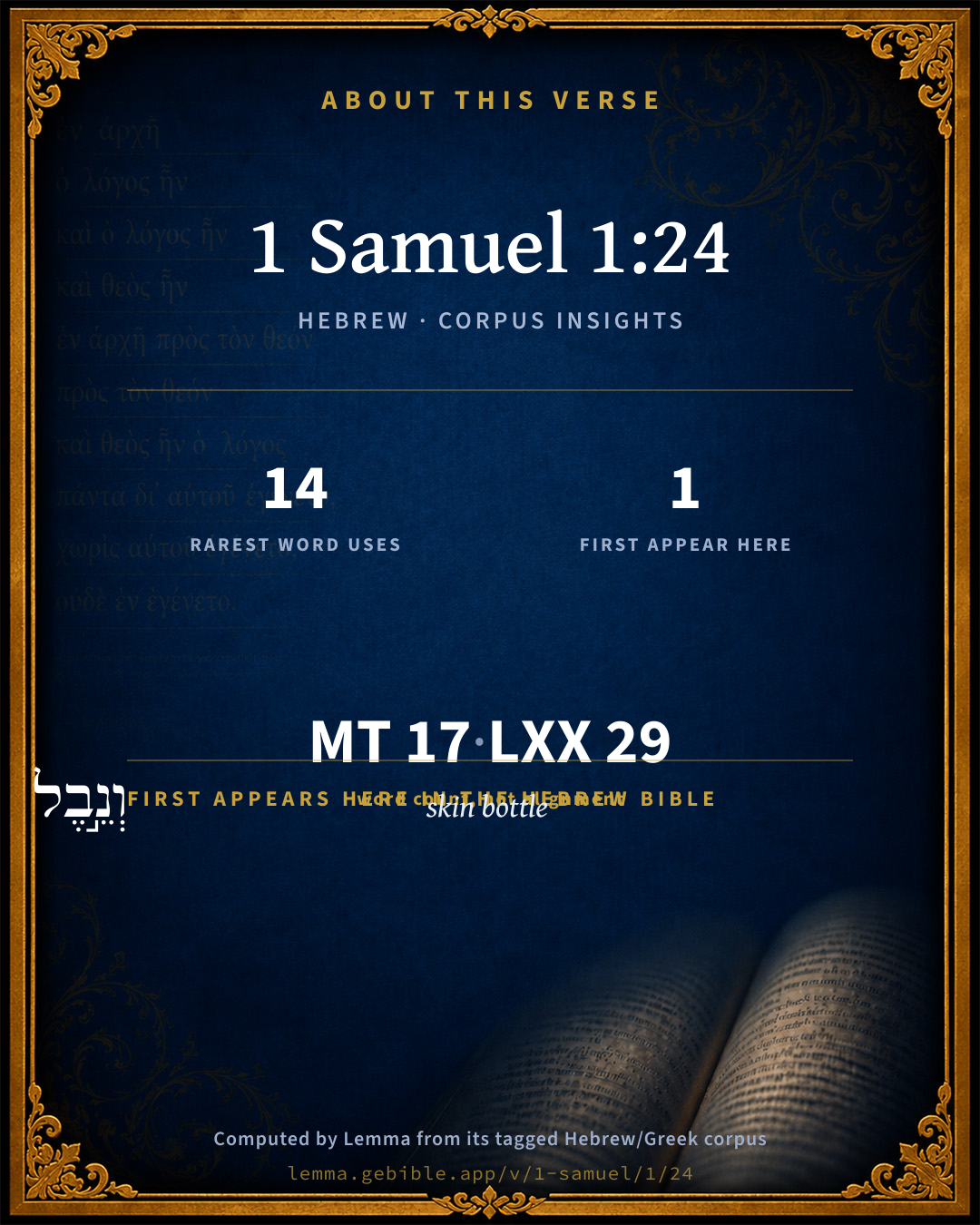
  • 1 first appearance in the Hebrew Bible
Full analysis ↓
Download a study sheet

One document with this verse’s original text, its word-by-word gloss line, the meaning frame, cross-references with their text, attributed commentary, and full source and license credits — printable, and it pastes into notes with its structure intact.

This verse Autodidact and up

Study sheet (.html) Plain text (.txt)

A passage Seminary Student

Up to 50 verses in one chapter. A passage sheet keeps up to 6 commentary sources and 12 cross-references per verse, in the order this page ranks them, and says so on the sheet whenever that leaves anything out. Ask for a single verse and you get the Autodidact verse sheet above.

Everything on this page stays free to read, with no account — the sheet is a download of what is already on screen, not access to it.

Want to remove ads? Support Godless Engineer
Compare translations 3

The same verse in 3 English versions, stacked beneath the original-language interlinear above. Click any original word for its lexicon entry.

Each is an independent rendering of the whole verse — the interlinear is not word-aligned to these translations.

Highlighted words mark where these versions differ — a whole-verse word diff, not a word-by-word alignment.

  • World English Bible Public Domain
    When she had weaned him, she took him up with her, with three bulls, and one ephah of meal, and a bottle of wine, and brought him to the house of Yahweh in Shiloh: and the child was young.
  • King James Version Public Domain
    And when she had weaned him, she took him up with her, with three bullocks, and one ephah of flour, and a bottle of wine, and brought him unto the house of the LORD in Shiloh: and the child was young.
  • unfoldingWord Literal Text CC BY-SA 4.0
    And she brought him up with her when she had weaned him, with three bulls and one ephah flour and a skin of wine. And she brought him the house of Yahweh Shiloh. (Now the boy was a boy.)

unfoldingWord Literal Text — © unfoldingWord, licensed CC BY-SA 4.0. Word-aligned USFM3 via Door43 (git.door43.org/unfoldingWord/en_ult).

Versions to compare (up to 4)

3 of 4 selected

Show all 18 translations

Every available English version of this verse, each an independent rendering of the whole verse.

  • World English Bible Public Domain
    When she had weaned him, she took him up with her, with three bulls, and one ephah of meal, and a bottle of wine, and brought him to the house of Yahweh in Shiloh: and the child was young.
  • Berean Standard Bible Public Domain
    Once she had weaned him, Hannah took the boy with her, along with a three-year-old bull, an ephah of flour, and a skin of wine. Though the boy was still young, she brought him to the house of the LORD at Shiloh.
  • Majority Standard Bible Public Domain
    Once she had weaned him, Hannah took the boy with her, along with a three-year-old bull, an ephah of flour, and a skin of wine. Though the boy was still young, she brought him to the house of the LORD at Shiloh.
  • King James Version Public Domain
    And when she had weaned him, she took him up with her, with three bullocks, and one ephah of flour, and a bottle of wine, and brought him unto the house of the LORD in Shiloh: and the child was young.
  • American Standard Version (1901) Public Domain
    And when she had weaned him, she took him up with her, with three bullocks, and one ephah of meal, and a bottle of wine, and brought him unto the house of Jehovah in Shiloh: and the child was young.
  • Revised Version (1885) Public Domain
    And when she had weaned him, she took him up with her, with three bullocks, and one ephah of meal, and a bottle of wine, and brought him unto the house of the LORD in Shiloh: and the child was young.
  • Geneva Bible (1599) Public Domain
    And when she had weined him, she tooke him with her with three bullockes and an Ephah of floure and a bottell of wine, and brought him vnto the house of the Lord in Shiloh, and the childe was yong.
  • Douay-Rheims (1899) Public Domain
    And after she had weaned him, she carried him with her, with three calves, and three bushels of flour, and a bottle of wine, and she brought him to the house of the Lord in Silo. Now the child was as yet very young:
  • Young's Literal Translation Public Domain
    and she causeth him to go up with her when she hath weaned him, with three bullocks, and one ephah of flour, and a bottle of wine, and she bringeth him into the house of Jehovah at Shiloh, and the youth `is but' a youth.
  • Literal Standard Version CC BY-SA 4.0
    and she causes him to go up with her when she has weaned him, with three bullocks, and one ephah of flour, and a bottle of wine, and she brings him into the house of YHWH at Shiloh, and the youth [is but] a youth.
  • Unlocked Literal Bible CC BY-SA 4.0
    When she had weaned him, she took him with her, along with a three-year-old bull, one ephah of meal, and a bottle of wine, and brought him to the house of Yahweh in Shiloh. Now the child was still young.
  • unfoldingWord Literal Text CC BY-SA 4.0
    And she brought him up with her when she had weaned him, with three bulls and one ephah flour and a skin of wine. And she brought him the house of Yahweh Shiloh. (Now the boy was a boy.)
  • Darby Bible Public Domain
    And she took him up with her when she had weaned him, with three bullocks, and one ephah of flour, and a flask of wine, and brought him to the house of Jehovah to Shiloh; and the boy was young.
  • World Messianic Bible Public Domain
    When she had weaned him, she took him up with her, with three bulls, and one efah of meal, and a container of wine, and brought him to the LORD’s house in Shiloh. The child was young.
  • Webster's Bible Public Domain
    And when she had weaned him, she took him up with her, with three bullocks, and one ephah of flour, and a bottle of wine, and brought him to the house of the LORD in Shiloh: and the child was young.
  • Free Bible Version CC BY-SA 4.0
    When she had weaned him, Hannah took the boy with her, along with a three-year-old bull, an ephah of flour, and a wineskin containing wine. Even though the boy was young, she brought him to the Lord's Temple at Shiloh.
  • Bible in Basic English Public Domain
    Then when she had done so, she took him with her, with a three-year old ox and an ephah of meal and a skin full of wine, and took him to the house of the Lord at Shiloh: now the child was still very young.
  • JPS Tanakh (1917) Public Domain
    And when she had weaned him, she took him up with her, with three bullocks, and one ephah of meal, and a bottle of wine, and brought him unto the house of the LORD in Shiloh; and the child was young.

Literal Standard Version (2020), Covenant Press — licensed CC BY-SA 4.0. Text via the HelloAO Bible API (eBible.org). Unlocked Literal Bible (unfoldingWord) — licensed CC BY-SA 4.0. Text via the HelloAO Bible API (eBible.org). unfoldingWord Literal Text — © unfoldingWord, licensed CC BY-SA 4.0. Word-aligned USFM3 via Door43 (git.door43.org/unfoldingWord/en_ult). Free Bible Version, Dr. Jonathan Gallagher — licensed CC BY-SA 4.0. Text via the HelloAO Bible API (eBible.org).

Word by word

More ways to search: Search by grammar → Find every occurrence → Compare this word →

Practice this passage: Drill this verse → Learn its vocabulary →

קֶ֨מַח֙
qemach
H7058
“flour”
Noun, Common, Masculine, Singular, Absolute
Part of Speech
Noun
Type
Common
Gender
Masculine
Number
Singular
State
Absolute
Full BDB Definition

Origin: from an unused root probably meaning to grind

TWOT: 2033a

flour, meal, meal flour
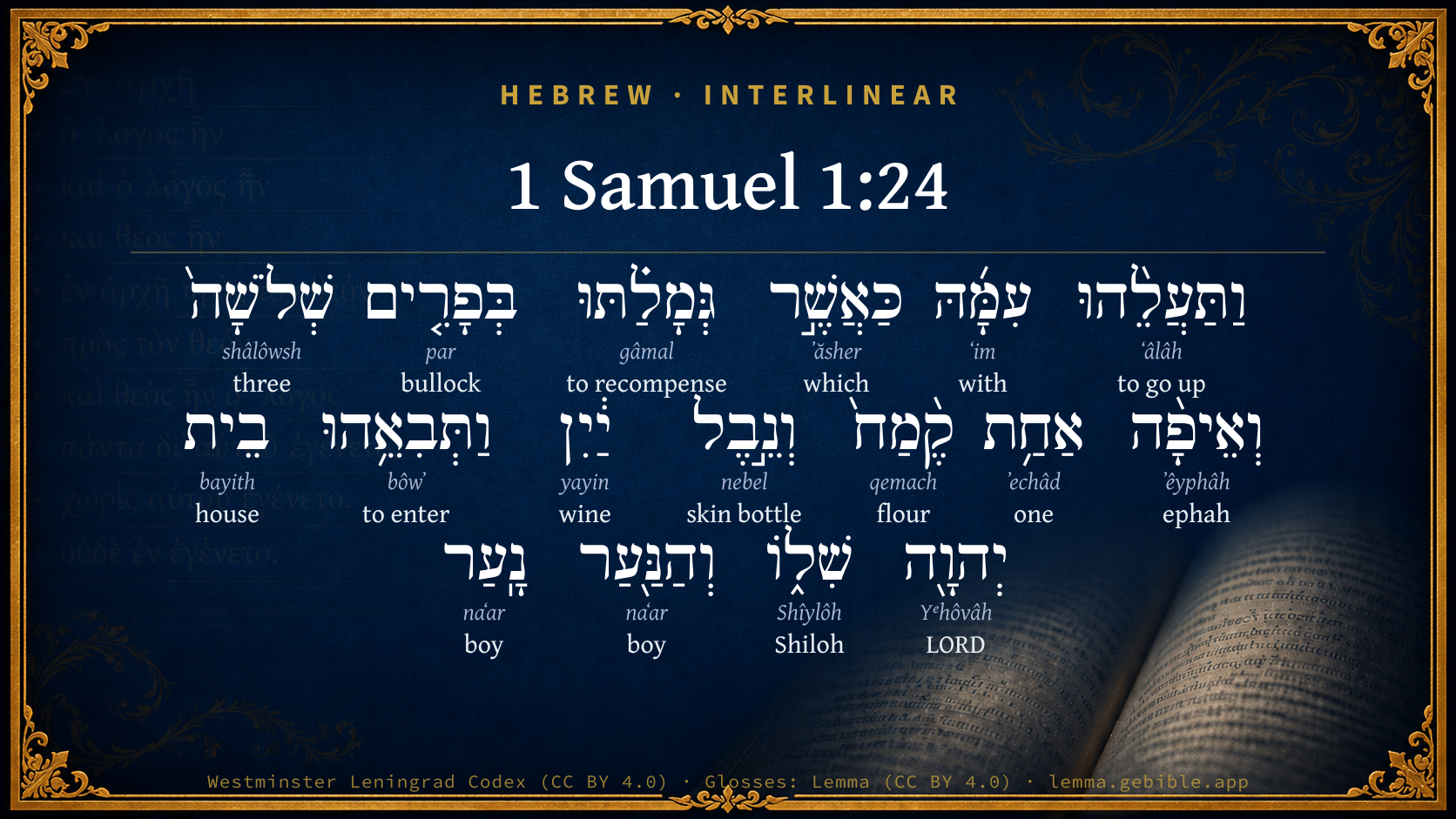
  1. וַתַּעֲלֵ֨הוּ ʻâlâh H5927 “and · to go up · him” Conjunction + Verb, Hiphil, Sequential Imperfect, 3rd Person, Feminine, Singular + Suffix, Personal, 3rd Person, Masculine, Singular
  2. עִמָּ֜הּ ʻim H5973 “with · her” Preposition + Suffix, Personal, 3rd Person, Feminine, Singular
  3. כַּאֲשֶׁ֣ר ʼăsher H834 “like/as · which” Preposition + Particle, Relative
  4. גְּמָלַ֗תּוּ gâmal H1580 “to recompense · him” Verb, Qal, Perfect, 3rd Person, Feminine, Singular + Suffix, Personal, 3rd Person, Masculine, Singular
  5. בְּפָרִ֤ים par H6499 “in/at · bullocks” Preposition + Noun, Common, Masculine, Plural, Absolute
  6. שְׁלֹשָׁה֙ shâlôwsh H7969 “three” Adjective, Cardinal number, Masculine, Singular, Absolute
  7. וְאֵיפָ֨ה ʼêyphâh H374 “and · ephah” Conjunction + Noun, Common, Feminine, Singular, Absolute
  8. אַחַ֥ת ʼechâd H259 “one” Adjective, Cardinal number, Feminine, Singular, Absolute
  9. וְנֵ֣בֶל nebel H5035 “and · skin bottle of” Conjunction + Noun, Common, Masculine, Singular, Construct
  10. יַ֔יִן yayin H3196 “wine” Noun, Common, Masculine, Singular, Absolute
  11. וַתְּבִאֵ֥הוּ bôwʼ H935 “and · to enter · him” Conjunction + Verb, Hiphil, Sequential Imperfect, 3rd Person, Feminine, Singular + Suffix, Personal, 3rd Person, Masculine, Singular
  12. בֵית bayith H1004 “house of” Noun, Common, Masculine, Singular, Construct
  13. יְהוָ֖ה Yᵉhôvâh H3068 “LORD” Noun, Proper
  14. שִׁל֑וֹ Shîylôh H7887 “Shiloh” Noun, Proper
  15. וְהַנַּ֖עַר naʻar H5288 “and · the · boy” Conjunction + Particle, Definite Article + Noun, Common, Masculine, Singular, Absolute
  16. נָֽעַר naʻar H5288 “boy” Noun, Common, Masculine, Singular, Absolute

About this verse

These counts appear in no published source. They are computed here, from the morphology-tagged text and Lemma’s own curated glosses. What Lemma adds →

17
words
16
distinct lemmas
Historical
section

Notable vocabulary

The rarest word here is קֶ֨מַח֙ flour H7058 — appearing just 14 times in the whole Hebrew Bible.

First appearance in Scripture

This word makes its first canonical appearance in the Hebrew Bible here:

  • וְנֵ֣בֶל skin bottle H5035

Shared distinctive vocabulary

קֶ֨מַח֙ flour H7058 occurs in 14 verses of the Hebrew Bible. Also found in:

Grammatical profile

  • 3 verbs
  • 10 nouns
  • 2 adjectives
  • 1 preposition
  • 1 particle

Verb forms

  • וַתַּעֲלֵ֨הוּ Hiphil · Sequential Imperfect
  • גְּמָלַ֗תּוּ Qal · Perfect
  • וַתְּבִאֵ֥הוּ Hiphil · Sequential Imperfect

Repetition

A word recurs within this verse — often emphatic in Hebrew:

  • וְהַנַּ֖עַר boy H5288 ×2

Hebrew & Septuagint length

In English translation the verse runs 39 words from the Hebrew and 44 from the Septuagint (LXX English) — closely comparable.

A rough comparison of the two English renderings, which tokenize alike — not a word-level alignment.

Word counts can differ between the Hebrew and the Greek without any difference in meaning — e.g. the Hebrew direct-object marker אֵת has no separate Greek word, and Greek often adds the article ὁ.

In the original languages it is 17 Hebrew tokens and 29 Greek tokens — but the two are counted differently (Hebrew bundles its prefixes and suffixes into one token; the Greek is in lemma form), so that isn’t a like-for-like length.

Cross-references

6

Topical passages linked to 1 Samuel 1:24 in the Treasury of Scripture Knowledge — connected by theme and wording, ordered by reader-vote popularity; previews shown in the World English Bible.

  • Numbers 15:9–10 then shall he offer with the bull a meal-offering of three tenth parts [of an ephah] of fine flour mixed with half a hin of oil:
  • Joshua 18:1 The whole congregation of the children of Israel assembled themselves together at Shiloh, and set up the tent of meeting there: and the land was subdued before them.
  • 1 Samuel 4:3–4 When the people were come into the camp, the elders of Israel said, Why has Yahweh struck us today before the Philistines? Let us get the ark of the covenant of Yahweh out of Shiloh to us, that it may come among us, and save us out of the hand of our enemies.
  • Deuteronomy 12:5–6 But to the place which Yahweh your God shall choose out of all your tribes, to put his name there, even to his habitation shall you seek, and there you shall come;
  • Deuteronomy 12:11 then it shall happen that to the place which Yahweh your God shall choose, to cause his name to dwell there, there shall you bring all that I command you: your burnt offerings, and your sacrifices, your tithes, and the heave-offering of your hand, and all your choice vows which you vow to Yahweh.
  • Deuteronomy 16:16 Three times in a year shall all your males appear before Yahweh your God in the place which he shall choose: in the feast of unleavened bread, and in the feast of weeks, and in the feast of tents; and they shall not appear before Yahweh empty:

Cross-references courtesy of OpenBible.info (CC BY 4.0).

Hebrew and Greek witnesses Masoretic Hebrew ↔ Greek Septuagint

The same verse in the two great witnesses to the Old Testament, shown verse-for-verse.

These are two independent witnesses, not word-aligned to each other, and the Septuagint is shown in lemma (dictionary) form.

Hebrew 1 Samuel 1:24 Masoretic · Westminster Leningrad Codex

וַתַּעֲלֵ֨הוּ עִמָּ֜הּ כַּאֲשֶׁ֣ר גְּמָלַ֗תּוּ בְּפָרִ֤ים שְׁלֹשָׁה֙ וְאֵיפָ֨ה אַחַ֥ת קֶ֨מַח֙ וְנֵ֣בֶל יַ֔יִן וַתְּבִאֵ֥הוּ בֵית יְהוָ֖ה שִׁל֑וֹ וְהַנַּ֖עַר נָֽעַר

When she had weaned him, she took him up with her, with three bulls, and one ephah of meal, and a bottle of wine, and brought him to the house of Yahweh in Shiloh: and the child was young.

World English Bible · Public Domain

Greek LXX 1 Samuel 1:24 Septuagint · lemma form

καί ἀναβαίνω μετά αὐτός εἰς σηλωμ ἐν μόσχος τριετίζω καί ἄρτος καί οιφι σεμίδαλις καί νεβελ οἶνος καί εἰςἔρχομαι εἰς οἶκος κύριος ἐν σηλωμ καί ὁ παιδάριον μετά αὐτός

And she went up with him to Selom with a calf of three years old, and loaves, and an ephah of fine flour, and a bottle of wine: and she entered into the house of the Lord in Selom, and the child with them.

LXX2012 (modern English Septuagint) · Public Domain

On this verse, The Preacher's Complete Homiletical Commentary discusses the Septuagint’s reading. Read the note in Commentary ↓

Hebrew: Westminster Leningrad Codex (CC BY 4.0). Greek: Septuagint (public domain); English from LXX2012 (modern English Septuagint) (Public Domain). How the Septuagint differs from the Hebrew →

Targum (Aramaic paraphrase)

1

The Targum is the ancient Jewish Aramaic paraphrase of the Hebrew Scriptures — an interpretive translation, not the Hebrew text itself. Onkelos (literal) and Pseudo-Jonathan (expansive) render the Torah, and Jonathan the Prophets. Coverage is partial: where no permissively-licensed English translation exists for a verse, only the Aramaic is shown. This is verse-level text, not a word-by-word alignment to the Hebrew.

  1. Targum Jonathan Prophets (Joshua–Malachi)
    וְאַסִקְתֵּיהּ עִמָהּ כַּד חֲסַלְתֵּיהּ בְּתוֹרִין תְּלָתָא וּמְכִילְתָא חֲדָא דְקִימְחָא וּגְרַב דַחֲמַר וְאַיְתִיתֵיהּ לְבֵית מַקְדְשָׁא דַייָ לְשִׁלוֹ וְרַבְיָא הֲוָה יָנִיק:

    (no public-domain English translation for this verse)

    Targum Jonathan — Aramaic: “Mikraot Gedolot” (public domain). English: “Sefaria Community Translation” (CC0 1.0 (public-domain dedication)); “London "Chaldee Paraphrase," 1871” (public domain). Text via Sefaria.

Commentary

Notes on 1 Samuel 1:24 from classic Christian and Jewish commentators (each source and its license shown beneath its notes). The classic Christian expositions comment on the surrounding passage and are grouped to its opening verse, so a note may address several verses; the Jewish commentaries on the Tanakh (Rashi and others) are per-verse, so they appear only where the commentator wrote on this verse.

Lemma curates 59 commentaries, every one of them public domain or Creative Commons licensed, each selected and text-cleaned for this edition rather than reprinted as found. About our sources →

Trapp's Complete Commentary

John Trapp

1Sa 1:24 And when she had weaned him, she took him up with her, with three bullocks, and one ephah of flour, and a bottle of wine, and brought him unto the house of the LORD in Shiloh: and the child [was] young.

Ver. 24. With three bullocks.] One for sacrifice, {1Sa 1:25} and the other two for the use of the priests, who lived of the oblations. Let ministers be liberally maintained.

John Trapp, A Commentary or Exposition upon All the Books of the Old and New Testament (1647–1656) — public domain. Text from a community e-Sword module.

The Biblical Illustrator

Joseph S. Exell

1Sa_1:24-28

And when she had weaned him, she took him up with her, with three bullocks.

The duty of presenting children to God in the way of religious education

There is nothing more characteristic of Christianity than the tenderness and sympathy which it inspires. The Bible delights in domestic scenes; and it presents to us the pious mother in her anxieties, in her prayers, in her vows, and then in the dedication of the child obtained by prayer to the Lord her God.

I. The first question we purpose to consider is, at what age do we propose to commence the education of children? And I answer, at the age at which Samuel was brought by Hannah to the Lord; when she had weaned him--when the child was young. Now, the reason why we begin with children so early, even under the age of seven years, is important. The reason, therefore, why we begin so early is, because their depravity begins to manifest itself so early: the disorder begins early, and we must begin early to apply the remedy.

2. And, also, because habits are early formed.

3. Because, also, in early age they are most susceptible.

4. Also, because in this age juvenile depravity abounds.

5. But it may be asked, not only at what age do we begin, and why do we begin so early; but, how do we apply ourselves to the work? I answer, we seize on the natural vivacity and buoyancy of children, and aim to improve it to good purposes.

II. The object we have ultimately in view. And that is, their dedication to God; we lend them to the Lord, that, as long as they live, they may be His.

1. Instruction in the elements of the Christian religion. The first thing that Eli would probably do with the young Samuel, would be to instruct him in the history of the Old Testament.

2. But there would be a danger, even in religious instruction, if the children were not early taught to deny themselves; if they were not duly disciplined, and made to practise self-government.

3. But beside this, due regard must be paid to the great sacrifice of the Christian system. I gather this from the first verse of the text. When Hannah took the young child to the house of God, she took with her three bullocks.

4. There is the hope that these children will be brought to dedicate themselves to God all the days of their lives. As long as he liveth, he shall be lent unto the Lord.

5. And then, all this must be accompanied by fervent prayer.

III. The motives we have to encourage us. The first is gratitude, looking back to the past; the next is hope, looking forward to the future. (D. Wilson.)

And the child was young.

Of infant baptism and of childlike children

In the Hebrew of this passage, the word translated young is the same as that translated child, so that the literal rendering of the words is, and the child was a child. This may have two meanings, both of which are very instructive. The first meaning is that the child was young in age, when he was dedicated to the Lord by his parents. Very likely the words before us, the child was young, are put in as a sort of explanation, as much as to say: He was entirely dependent upon his mother and father; so young that he could not have gone up to Shiloh by himself; if he could walk a little, it was all he could do; he could not have brought himself to Eli, or into the house of the Lord. But the words, and the child was young, may bear another and perhaps a more satisfactory meaning. It would be high praise if it were said of a man, and the man was a man; we should understand by it that he was brave, outspoken, fearless, upright, possessed of all manly virtues. And when it is said, the child was a child, perhaps we are to understand that the little Samuel had all childlike graces, was gentle, teachable, humble, submissive to his parents, and those set over him. And this may lead us to think how the young people of our own days have too often none of those graces, which should distinguish young people; the children are too often children no more--in forwardness, in conceit, in insubordination, in want of respect for parents and elders, they are like persons three or four times as old as themselves: a very bad sign of the times, and only matching too well with others which we see around us. (Dean Goulburn.)

The Biblical Illustrator, edited by Joseph S. Exell (c. 1880s–1900s) — public domain. Text from a community e-Sword module.

Joseph Benson's Commentary

1Sa 1:24. With three bullocks, &c. — As they were not to appear before the Lord empty, so upon this occasion they brought an ample offering to him, to testify their gratitude. And it is highly probable that one of these bullocks was wholly offered to God as a burnt-offering, and the other two were peace-offerings; or, as some rather think, one a sin-offering, and the other a peace-offering. One ephah of flour — For the meat or meal- offerings, which to each bullock were three tenth-deals, or three tenth parts of an ephah; and so nine parts of the ephah were spent, and the tenth part was given to the priest. Wine — For drink-offerings.

Joseph Benson's Commentary on the Old and New Testaments (1811–1818) — public domain. Text from a community e-Sword module.

The Preacher's Complete Homiletical Commentary

Joseph S. Exell (gen. ed.)

CRITICAL AND EXPOSITORY NOTES.—

1Sa_1:24. Hebrew mothers were accustomed to suckle their children for three years (2Ma_7:27). “A child three years old is not troublesome in the East, and his nurture and education could be committed to the women that served at the door of the Tabernacle. By the education which the boy received in the Sanctuary he was even as a child to grow into the service; and moreover, as a child, he could perform little outward services” (Lange’s Commentary). “Three bullocks.” Two would be required for the customary yearly offering, viz., one for the burnt-offering and the other for the thank-offering, the third was probably a special offering in connection with Samuel’s consecration, and on this account, the only one whose slaying is mentioned in 1Sa_1:25. “The child was young,” literally, “the child was a child,” i.e., not merely in tenderness of years, but in docility, meekness, and gentleness” (Wordsworth).

1Sa_1:28. Lent. “The meaning to lend, which the lexicons give to the word both here and in Exo_12:36, has no other support than the false rendering of the Septuagint, and is altogether unsuitable both in the one and in the other. Jehovah had not lent the son to Hannah, but had given him; still less could a man lend his son to the Lord” (Keil). “He” refers to Elkanah, and not to Samuel (Keil).

MAIN HOMILETICS OF THE PARAGRAPH.—1Sa_1:24-28

VOWS

I. When we pledge ourselves to a certain act or line of conduct on condition that God grants us a certain blessing, we must be very careful to fulfil our vow. If we enter into such a contract with a fellow-creature, we hold ourselves bound by honour to observe every jot and tittle of the contract. Let us be at least equally scrupulous in the performance of any pledge which we give to God. Hannah had placed before the Lord the conditions under which she would give to His service a son, to dwell in His house for ever. The petition had been granted on her own terms, and there is no holding back on her part. She evidently hastened to perform her vow; there was none of that deferring (Ecc_5:4) which looks like a repenting of the promise made. “When she had weaned him”—as soon as ever his age permitted his separation from his mother’s care—“she took him up with her.” And the sacrifices of thanksgiving which accompanied the dedication of this darling child show that the gift was that of a “cheerful giver”—that this great act of devotion on her part was performed with gladness (Psa_100:2).

II. Our faith is strengthened, and our gratitude deepened, when our vows can be paid on the very spot where they have been made. “Arise, and go up to Bethel” (Gen_35:1), said the Lord to Jacob. The command indicates that to visit the spot where he had fled from the face of Esau, and where he had dedicated himself to the service of God, would deepen the patriarch’s gratitude for all the mercy and truth that had followed him since, and would strengthen his faith in the “faithful Creator” and covenant-keeping God. “Arise, and go to Bethel” testifies that it is good to pay our vow in the place in which it was made. The very sight of the spot brings before us more vividly than anything else can do the circumstances of the past, and thus makes us realise more fully the blessings we have received in answer to the prayers then offered. Hannah was enabled to pay her vow in the very spot where she had made it: “I am the woman that stood by thee here, praying to the Lord,” etc.

OUTLINES AND SUGGESTIVE COMMENTS

1Sa_1:28. A double sacrifice was celebrated; one of the victims is endowed with reason, and the other is not; the one is offered up by the priest, the other by Hannah. That which was offered by the mother was a far more costly sacrifice than that presented by the priest. For Hannah offered the fruit of her womb; she treads in the steps of Abraham, she emulates the self-sacrifice of the patriarch. But Abraham received back his son and led him away, but Hannah leaves hers in the temple for the rest of his days.—Chrysostom.

Hannah’s piety did not cool when her wish was gratified.—Steele.

That God gives in answer to prayer, and that man devotes to God what he obtains, so that God takes again what He has given, or lays claim to it for the ends of His kingdom, is the law of reciprocity in the intercourse between the living God and His saints; the latter contribute nothing for the realisation of the special ends of His kingdom which they have not received from Him, and are not by Him enabled to contribute.—Lange’s Commentary.

True religion is a divine life in the soul, which its author first tries and then honours.

1. It is a life of faith, hope, and love.

2. It is tried by Satan, who will seek to place such men as Hophni and Phinehas at the altar, if it be but to distress and drive away from it such worshippers as Hannah. The family is often our furnace, it has pains as necessarily secret as severe; and where they can be told they are told in vain to any but God. Such was the family of Hannah. The Church itself will try the patience and faith of its true members. It will try whether we can acknowledge a true minister of God, and meekly bear with his infirmities, though, like Eli, he mistakes our case, and chills the heart which he should cherish; whether we can receive the promises of God from His mouth, though it sometimes speaks unadvisedly. The Church is a fire to try the Church. 3. But true religion will be owned and honoured of him who gave it, as was the case with Hannah. The Lord often does so beyond all that we ask or think. Hannah had asked for a man-child; but it was not in her contemplation to ask for a Samuel—that light of Israel—that prophet mighty in word and deed—that blessing and pattern to the world in every age.—Cecil.

The Preacher's Complete Homiletical Commentary (gen. ed. Joseph S. Exell; Funk & Wagnalls, c. 1892) — public domain (pre-1929). A full-Bible homiletical/sermon-outline anthology covering 65 of 66 books (2 John is absent from the source module). Text from a community e-Sword module.

Keil & Delitzsch

C. F. Keil & F. Delitzsch

As soon as the boy was weaned, Hannah brought him, although still a נער, i.e., a tender boy, to Shiloh, with a sacrifice of three oxen, an ephah of meal, and a pitcher of wine, and gave him up to Eli when the ox (bullock) had been slain, i.e., offered in sacrifice as a burnt-offering. The striking circumstance that, according to Sa1 1:24, Samuel's parents brought three oxen with them to Shiloh, and yet in Sa1 1:25 the ox (הפּר) alone is spoken of as being slain (or sacrificed), may be explained very simply on the supposition that in Sa1 1:25 that particular sacrifice is referred to, which was associated with the presentation of the boy, that is to say, the burnt-offering by virtue of which the boy was consecrated to the Lord as a spiritual sacrifice for a lifelong service at His sanctuary, whereas the other two oxen served as the yearly festal offering, i.e., the burnt-offerings and thank-offerings which Elkanah presented year by year, and the presentation of which the writer did not think it needful to mention, simply because it followed partly from Sa1 1:3 and partly from the Mosaic law.

(Note: The interpretation of שׁלשׁה בּפרים by ἐν μόσχῳ τριετίζοντι (lxx), upon which Thenius would found an alteration of the text, is proved to be both arbitrary and wrong by the fact that the translators themselves afterwards mention the θυσία, which Elkanah brought year by year, and the μόσχος, and consequently represent him as offering at least two animals, in direct opposition to the μόσχῳ τριετίζοντι. This discrepancy cannot be removed by the assertion that in Sa1 1:24 the sacrificial animal intended for the dedication of the boy is the only one mentioned; and the presentation of the regular festal sacrifice is taken for granted, for an ephah of meal would not be the proper quantity to be offered in connection with a single ox, since, according to the law in Num 15:8-9, only three-tenths of an ephah of meal were required when an ox was presented as a burnt-offering or slain offering. The presentation of an ephah of meal presupposes the offering of three oxen, and therefore shows that in Sa1 1:24 the materials are mentioned for all the sacrifices that Elkanah was about to offer.)

Keil & Delitzsch — Biblical Commentary on the Old Testament (1861–1891) — public domain (CC PDM 1.0). Text via the HelloAO Bible API. (Old Testament only.)

Geneva Bible (1599)

Geneva Bible translators

Hebrew, a child.

Geneva Bible (1599) marginal notes — public domain. Text via Bolls.life.

Jamieson, Fausset & Brown

Robert Jamieson, A. R. Fausset & David Brown

three bullocks--The Septuagint renders it "a bullock of three years old"; which is probably the true rendering.

Next: 1 Samuel Chapter 2

Jamieson, Fausset & Brown — Commentary Critical and Explanatory on the Whole Bible (1871) — public domain (CC PDM 1.0). Text via the HelloAO Bible API.

Adam Clarke's Commentary

Verse 24. With three bullocks] The Septuagint, the Syriac, and the Arabic, read, a bullock of three years old; and this is probably correct, because we read, 1Sa 1:25, that they slew eth happar, THE bullock. We hear of no more, and we know that a bullock or heifer of three years old was ordinarily used, see Ge 15:9.

One ephah of flour] Seven gallons and a half.

A bottle of wine] נבל יין nebel yayin, a skin full of wine. Their bottles for wine and fluids in general were made out of skins of goats, stripped off without being cut up; the places whence the legs were extracted sewed up, as also the lower part; and the top tied. See Clarke on Ge 21:14, and "Mt 9:17". These three things, the ox, the flour, and the wine, probably constituted the consecration-offering.

Adam Clarke's Commentary on the Bible (1810–1826) — public domain. Text from a community e-Sword/MySword module.

Ellicott's Commentary for English Readers

(24, 25) With three bullocks . . . And they slew a bullock.—There at first sight seems a discrepancy here, and the LXX. translators seem to have felt it, for they read, instead of “three bullocks,” “a bullock of three years old.” The true explanation, however, is that the one bullock alluded to in 1Sa_1:25 was the burnt offering by which the child was consecrated to the Lord. The other two were the yearly festival offering, the presentation of which being the usual gift, the chronicler did not think it here worth while to mention again.

A Bible Commentary for English Readers, edited by Charles John Ellicott (1878–1897) — public domain. Text from a community e-Sword module.

The Cambridge Bible for Schools and Colleges

gen. ed. J. J. S. Perowne

24. three bullocks] We may conjecture that one was intended for a burnt-offering, one for the “sacrifice in performing a vow,” and one for a peace-offering. See Num_15:8.

one ephah of flour] According to Josephus, the ephah contained about 8½ gallons, according to Jewish authorities about 4½ gallons. The smaller estimate is probably correct. Three tenth parts of an ephah of flour were to be offered with each bullock (Num_15:9) as a “meat-offering” (minchah).

a bottle of wine] i.e. a skin-bottle, which would hold a considerable quantity. The prescribed drink-offering with each bullock was half an hin of wine (Num_15:10), or about three pints, the hin being a sixth part of the bath, which was of the same capacity as the ephah (Eze_45:11).

the house of the Lord] See note on 1Sa_1:9.

the child was young] Lit. “the child was a child.” The term is quite vague, and gives no clue to Samuel’s age at the time. See however the note on 1Sa_1:22.

The Cambridge Bible for Schools and Colleges (gen. ed. J. J. S. Perowne; Cambridge University Press, 1878–1918) — public domain. Text from a community e-Sword module.

John Gill's Exposition

And when she had weaned him,.... At the usual time of weaning children; See Gill on Sa1 1:23 some refer this not only to the milk of the breast, from which he was weaned, but to such food as was common to children, and so supposes him grown up to nine or ten years of age:

she took him up with her; to the tabernacle at Shiloh, at a yearly festival: with three bullocks; for three sorts of offerings, burnt offering, sin offering, and peace offering; or since one only is spoken of as slain, that is, for sacrifice, the other two might be for food to entertain her family and friends with while there; or as a present to the high priest, to whose care she committed her son:

and one ephah of flour; if the bullocks were all sacrificed, three tenth deals, or three tenth parts of the ephah, went for a meat offering to each bullock, which made nine parts out of ten, and the tenth part she had to dispose of at pleasure; see Num 15:9, though that seems to be restrained to a burnt offering only:

and a bottle of wine; part of which might be for the drink offering which always attended a meat offering, and the rest for her own use, and that of her friends:

and brought him unto the house of the Lord in Shiloh: the tabernacle there, and delivered him up to the care of the high priest, to be trained up in the service of God:

and the child was young; a very child, very young in years, a little infant; not a sucking child, as the Targum, because weaned, otherwise of a very tender age; though some think this expresses that he was a well grown lad, and was sharp and acute, and could well distinguish between good and evil.

John Gill's Exposition of the Whole Bible (1746–1763) — public domain (CC PDM 1.0). Text via the HelloAO Bible API.

Haydock's Catholic Bible Commentary

Three calves. Septuagint, "a calf three years old," such as Abraham sacrificed, Genesis xv. 9. We only find one offered up, ver. 25. --- Bushels. Hebrew epha, (Calmet) each of which contained three bushes or measures, Ruth ii. 17. (Haydock) --- Bottle. Hebrew nebel, a large measure containing above 87 pints. (Calmet) --- The sacrifices seem to have been for thanksgiving, accompanied with an ephi for each calf, and with wine, Numbers xv., and Ezechiel xlvi. 7.

George Leo Haydock (1774–1849), Haydock's Catholic Family Bible and Commentary, 1859 edition — public domain. Excludes Psalms (Douay-Rheims chapter numbering differs from Protestant) and Deuterocanonical books (Catholic canon only).

Matthew Poole's English Annotations

Three bullocks; either, first, One to be offered at that time; the other two presented to the priest, whether for his own use, or to be offered afterwards, as he saw fit. Or, secondly, One for a burnt-offering the second for a sin-offering, the third for a peace-offering, of which they might all feast together; for all these sorts seem expedient for this work and time.

One ephah of flour, for the meat-offerings belonging to the principal sacrifices, which to each bullock were three tenth deals, or three tenth parts of an ephah, as appears from Num 15:9; 28:12; and so nine homers, or nine parts of the ephah, were spent, and the tenth part was either a separate meat-offering, or given to the priest.

A bottle of wine, for drink-offerings, according to the manner.

Matthew Poole's English Annotations on the Holy Bible (1683–1685) — public domain. Text from a community e-Sword/MySword module.

Whedon's Commentary on the Bible

Daniel D. Whedon

24. Three bullocks, and one ephah of flour, and a bottle of wine — See the law of meat offerings. Num_15:1-13. Several ancient versions read, instead of three bullocks, a bullock three years old; but this is probably an error, for, according to Num_15:9, a single bullock required with it but three tenths of an ephah of flour, while Hannah took a whole ephah, enough for three offerings.

The child was young — Probably three or four years old. Compare 1Sa_1:22, and 1Sa_2:18.

Daniel D. Whedon (gen. ed.), Commentary on the Old and New Testaments (1874–1909) — public domain. Text from a community e-Sword module.

John Wesley's Explanatory Notes

Three bullocks - One for a burnt-offering, the second for a sin- offering, and the third for a peace offering; all these sorts being expedient for this work and time. Flour - For the meal-offerings belonging to the principal sacrifices, which to each bullock were three tenth-deals, or three tenth parts of an ephah, and so nine parts of the ephah were spent, and the tenth part was given to the priest. Wine - For drink-offerings.

John Wesley, Explanatory Notes Upon the Whole Bible (1754–1765) — public domain. Text via the GEBible commentary corpus.

unfoldingWord translationNotes

Door43 World Missions Community

ephah

An ephah is about 22 liters of dry material. (See: Biblical Volume)

bottle

Wine was kept in animal skins, not glass bottles.

translationWords

cow

Shiloh

unfoldingWord translationNotes — © Distant Shores Media and the Door43 World Missions Community, licensed CC BY-SA 4.0. Source: git.door43.org/Door43/en_tn.

Rashi

Rabbi Shlomo Yitzchaki (Rashi)

One eiphah of flour. I heard in the name of Rabbi Yitzchok Halevi, that she brought one eiphah of flour, the equivalent of three seahs, from which to extract three tenths of an eiphah of fine flour, the required amount for one bull. As we learned in the Mishnah: The showbread was made of twenty-four tenths of an eiphah from twenty-four seahs; i.e., one tenth part of an eiphah of fine flour from each seah of wheat.

And a flask of wine. For a libation.

Though the child was still a lad. The Targum renders, 'though the child was still young.'

Rashi on the Tanakh — English translations: “The Judaica Press complete Tanach with Rashi, translated by A. J. Rosenberg” (CC BY 4.0); “Pentateuch with Rashi's commentary by M. Rosenbaum and A.M. Silbermann, 1929-1934” (public domain); “The Metsudah Tanach series, Lakewood, N.J” (CC BY 4.0); and “The Book of Joshua, Metsudah Publications, 1997” (CC BY 4.0). Text via Sefaria.

Radak

Rabbi David Kimhi (Radak)

With three bulls: Some of them to eat and some of them to slaughter to the Lord. And likewise, "one ephah of flour," to eat and to offer a grain-offering from it; and likewise, "and a jar of wine," to drink and to pour [a libation] from it. Hence it stated (I Samuel 1:25), "And they slaughtered the bull," and it did not say, "the bulls" - meaning to say, the bull that they offered to the Lord.

And the lad was a lad: Meaning to say, the lad was still a small and delicate lad. Yet, in spite of this, she did not wait for him until he became stronger, but rather once she weaned him - meaning to say, when she completed his nursing at the end of twenty-four months [from] when he was born - she brought him up immediately with her to the House of the Lord. And Yonatan translated it [in the Targum] as, "and the lad was a yanik." But this does not mean that he was still nursing (yonek). For behold, it states, "when she weaned him" - when she finished nursing him. Rather yanik means to say, a young lad. For this is the way of Aramaic, they call a lad a yanik - as we have found in the words of our Rabbis, may their memory be blessed, "a yanik who is wise"; "the yanuka master and the old master." But some explain, "and the lad was a lad (naar) is [that] he was sharp and knew [the difference] between good and evil, like a shaker (menaer), who shakes off the waste from the flax.

Radak on the Tanakh — English translations: “Sefaria Community Translation” (CC0 1.0 (public-domain dedication)); “Eliyahu Munk, HaChut Hameshulash” (CC BY 4.0); “Rabbi Mike Feuer, Jerusalem Anthology” (CC BY 4.0); and “R. David Kimhi on the first book of Psalms, Translated by R.G. Finch, London, 1919” (public domain). Text via Sefaria.

Lesson kit

Teaching starters — assembled from the data on this page, not authored interpretation. Every prompt links to the verse data it draws on. Edit before teaching.

1 Samuel, in the Historical, opens this verse with 17 words (16 distinct Hebrew lemmas). Its most distinctive word is qemach (“flour”). A historical commentator’s framing appears above. Read the whole chapter for the surrounding context.

Discussion questions

  1. What does “flour” (qemach) contribute to the verse as a whole?
  2. This is the first place “skin bottle” appears in Scripture (first appears here). What does its debut here establish?
  3. How does Genesis 18:6, which shares the word «flour», read alongside this verse?
  4. What does the repetition of “boy” (2× in this one verse) do in this verse?
  5. These translations render this verse differently. What is at stake in choosing one wording over another?
  6. «וַתַּעֲלֵ֨הוּ» is a Hiphil Sequential Imperfect verb. How does that grammatical form shape the action described?
  7. Compare how Trapp's Complete Commentary and The Biblical Illustrator read this verse. Where do they agree or differ?

Things to notice

Reading settings

Reading text

Shown beneath each verse's original-language words.

Old Testament
Old Testament edition

Read the OT as the Masoretic Hebrew (MT) or the Greek Septuagint (LXX).

English shown for the Greek Septuagint (in the Hebrew ↔ Greek comparison).

Comparing translations? Open the Compare panel on any verse page to stack up to four side by side.