1 Samuel 4:21

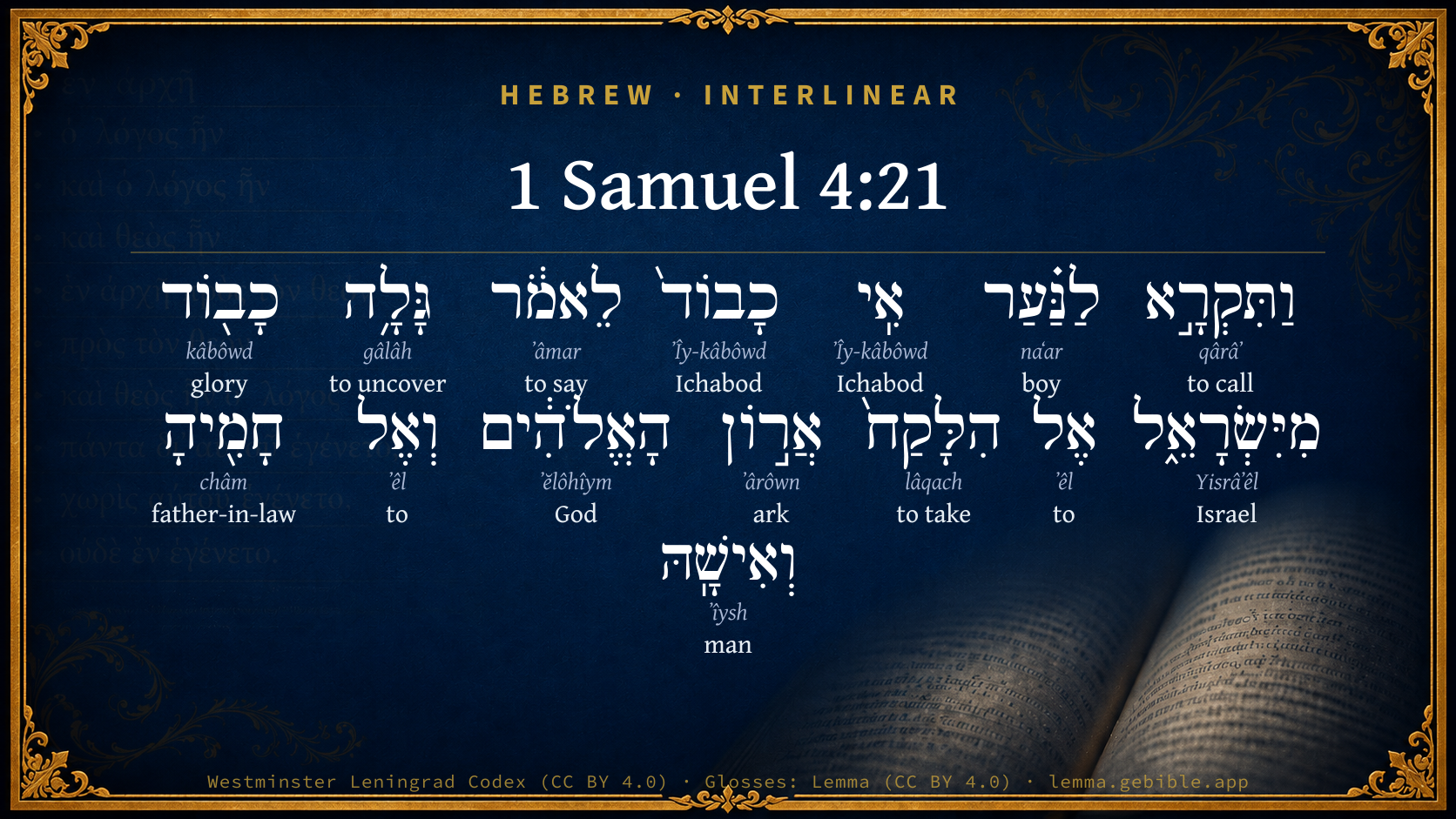
Hebrew (Westminster Leningrad Codex) 1 Samuel 4:21 appears in the Hebrew Old Testament. The text above is from the Westminster Leningrad Codex. Each word links to its Strong’s number, a concise gloss, and parsing drawn from the Open Scriptures Hebrew Bible morphology. Click any word for its full Brown-Driver-Briggs (BDB) entry.
Download image
Cite this verse

1 Samuel 4:21 (World English Bible). Public Domain. Lemma interlinear Bible study tool, https://lemma.gebible.app/v/1-samuel/4/21.

Show BibTeX & RIS
BibTeX
RIS
English Translation
She named the child Ichabod, saying, The glory is departed from Israel; because the ark of God was taken, and because of her father-in-law and her husband.
World English Bible · Public Domain
Highlights
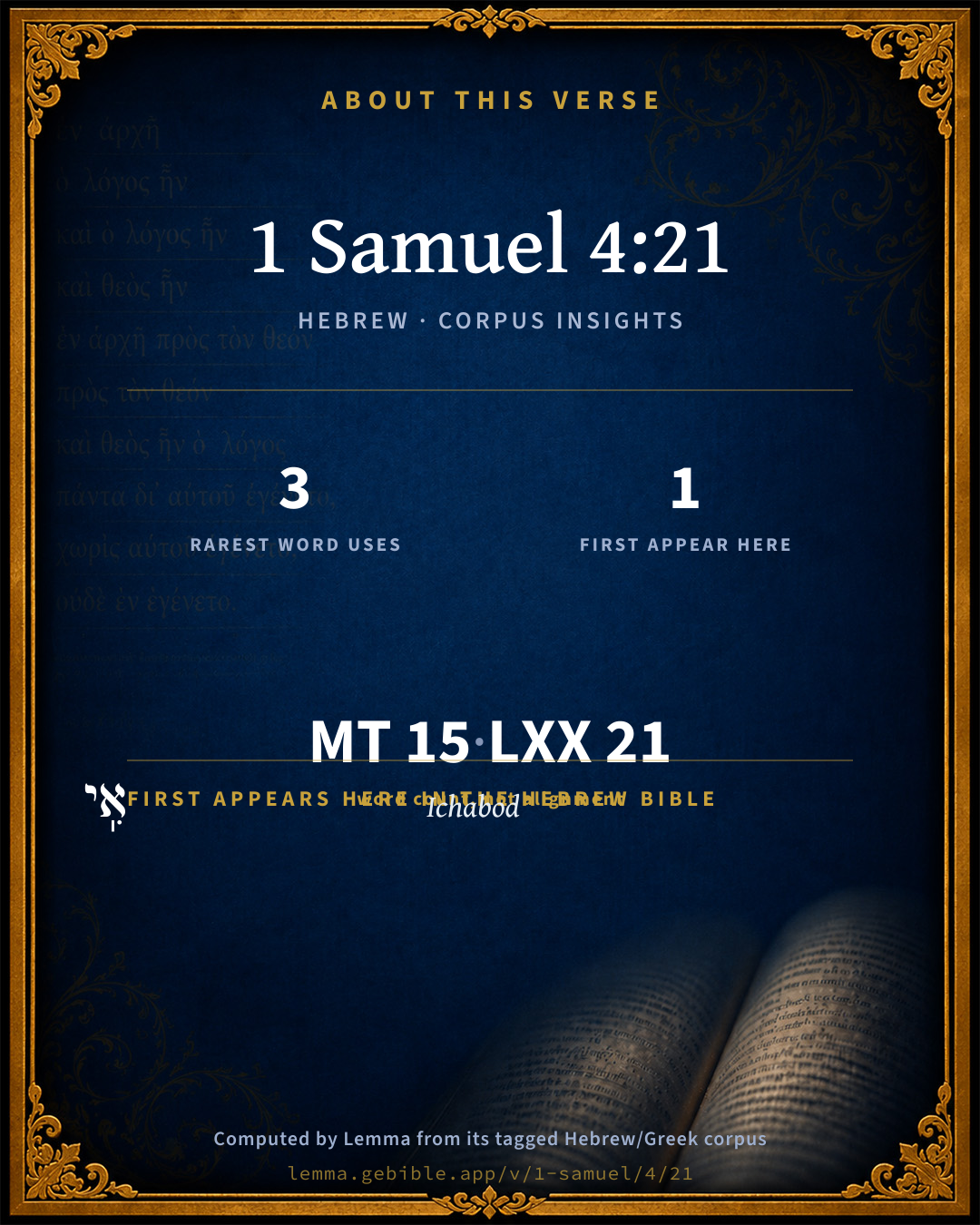
  • 1 first appearance in the Hebrew Bible
Full analysis ↓
Download a study sheet

One document with this verse’s original text, its word-by-word gloss line, the meaning frame, cross-references with their text, attributed commentary, and full source and license credits — printable, and it pastes into notes with its structure intact.

This verse Autodidact and up

Study sheet (.html) Plain text (.txt)

A passage Seminary Student

Up to 50 verses in one chapter. A passage sheet keeps up to 6 commentary sources and 12 cross-references per verse, in the order this page ranks them, and says so on the sheet whenever that leaves anything out. Ask for a single verse and you get the Autodidact verse sheet above.

Everything on this page stays free to read, with no account — the sheet is a download of what is already on screen, not access to it.

Want to remove ads? Support Godless Engineer
Compare translations 3

The same verse in 3 English versions, stacked beneath the original-language interlinear above. Click any original word for its lexicon entry.

Each is an independent rendering of the whole verse — the interlinear is not word-aligned to these translations.

Highlighted words mark where these versions differ — a whole-verse word diff, not a word-by-word alignment.

  • World English Bible Public Domain
    She named the child Ichabod, saying, The glory is departed from Israel; because the ark of God was taken, and because of her father-in-law and her husband.
  • King James Version Public Domain
    And she named the child Ichabod, saying, The glory is departed from Israel: because the ark of God was taken, and because of her father in law and her husband.
  • unfoldingWord Literal Text CC BY-SA 4.0
    And she called the boy Ichabod, saying, “The glory has departed from Israel,” about the Box of God being taken and about her father-in-law and her husband.

unfoldingWord Literal Text — © unfoldingWord, licensed CC BY-SA 4.0. Word-aligned USFM3 via Door43 (git.door43.org/unfoldingWord/en_ult).

Versions to compare (up to 4)

3 of 4 selected

Show all 18 translations

Every available English version of this verse, each an independent rendering of the whole verse.

  • World English Bible Public Domain
    She named the child Ichabod, saying, The glory is departed from Israel; because the ark of God was taken, and because of her father-in-law and her husband.
  • Berean Standard Bible Public Domain
    And she named the boy Ichabod, saying, “The glory has departed from Israel,” because the ark of God had been captured and her father-in-law and her husband had been killed.
  • Majority Standard Bible Public Domain
    And she named the boy Ichabod, saying, “The glory has departed from Israel,” because the ark of God had been captured and her father-in-law and her husband had been killed.
  • King James Version Public Domain
    And she named the child Ichabod, saying, The glory is departed from Israel: because the ark of God was taken, and because of her father in law and her husband.
  • American Standard Version (1901) Public Domain
    And she named the child Ichabod, saying, The glory is departed from Israel; because the ark of God was taken, and because of her father-in-law and her husband.
  • Revised Version (1885) Public Domain
    And she named the child Ichabod, saying, The glory is departed from Israel: because the ark of God was taken, and because of her father in law and her husband.
  • Geneva Bible (1599) Public Domain
    And she named the childe Ichabod, saying, The glory is departed from Israel, because the Arke of God was taken, and because of her father in lawe and her husband.
  • Douay-Rheims (1899) Public Domain
    And she called the child Ichabod, saying: The glory is gone from Israel, because the ark of God was taken, and for her father in law, and her husband:
  • Young's Literal Translation Public Domain
    and she calleth the youth I-Chabod, saying, `Honour hath removed from Israel,' because of the taking of the ark of God, and because of her father-in-law and her husband.
  • Literal Standard Version CC BY-SA 4.0
    and she calls the youth Ichabod, saying, “Glory has removed from Israel,” because of the taking of the Ark of God, and because of her father-in-law and her husband.
  • Unlocked Literal Bible CC BY-SA 4.0
    She named the child Ichabod, saying, “The glory has gone away from Israel!” for the ark of God had been captured, and because of her father-in-law and her husband.
  • unfoldingWord Literal Text CC BY-SA 4.0
    And she called the boy Ichabod, saying, “The glory has departed from Israel,” about the Box of God being taken and about her father-in-law and her husband.
  • Darby Bible Public Domain
    And she named the child Ichabod, saying, The glory is departed from Israel; because the ark of God was taken, and because of her father-in-law and her husband.
  • World Messianic Bible Public Domain
    She named the child Ichabod, saying, “The glory has departed from Israel!” because God’s ark was taken, and because of her father-in-law and her husband.
  • Webster's Bible Public Domain
    And she named the child I-chabod, saying, The glory hath departed from Israel. (Because the ark of God was taken, and because of her father-in-law and her husband.)
  • Free Bible Version CC BY-SA 4.0
    She named the boy Ichabod, saying, “The glory has left Israel,” because Ark of God had been captured, and her father-in-law and her husband had died.
  • Bible in Basic English Public Domain
    And she gave the child the name of Ichabod, saying, The glory has gone from Israel: because the ark of God was taken and because of her father-in-law and her husband.
  • JPS Tanakh (1917) Public Domain
    And she named the child Ichabod, saying: 'The glory is departed from Israel'; because the ark of God was taken, and because of her father-in-law and her husband.

Literal Standard Version (2020), Covenant Press — licensed CC BY-SA 4.0. Text via the HelloAO Bible API (eBible.org). Unlocked Literal Bible (unfoldingWord) — licensed CC BY-SA 4.0. Text via the HelloAO Bible API (eBible.org). unfoldingWord Literal Text — © unfoldingWord, licensed CC BY-SA 4.0. Word-aligned USFM3 via Door43 (git.door43.org/unfoldingWord/en_ult). Free Bible Version, Dr. Jonathan Gallagher — licensed CC BY-SA 4.0. Text via the HelloAO Bible API (eBible.org).

Word by word

More ways to search: Search by grammar → Find every occurrence → Compare this word →

Practice this passage: Drill this verse → Learn its vocabulary →

אִֽי
ʼÎy-kâbôwd
H350
“Ichabod”
Particle, Interjection
Part of Speech
Particle
Type
Interjection
Full BDB Definition

Origin: from H336 and H3519

TWOT: None

Ichabod = "no glory" - a son of Phinehas, so named because of the capture of the Ark by the Philistines
  1. וַתִּקְרָ֣א qârâʼ H7121 “and · to call” Conjunction + Verb, Qal, Sequential Imperfect, 3rd Person, Feminine, Singular
  2. לַנַּ֗עַר naʻar H5288 “to/for the · boy” Preposition, Determined + Noun, Common, Masculine, Singular, Absolute
  3. כָבוֹד֙ ʼÎy-kâbôwd H350 “Ichabod” Noun, Proper
  4. לֵאמֹ֔ר ʼâmar H559 “to say” Preposition + Verb, Qal, Infinitive Construct
  5. גָּלָ֥ה gâlâh H1540 “to uncover” Verb, Qal, Perfect, 3rd Person, Masculine, Singular
  6. כָב֖וֹד kâbôwd H3519 “glory” Noun, Common, Both, Singular, Absolute
  7. מִיִּשְׂרָאֵ֑ל Yisrâʼêl H3478 “from · Israel” Preposition + Noun, Proper
  8. אֶל ʼêl H413 “to” Preposition
  9. הִלָּקַח֙ lâqach H3947 “to take” Verb, Niphal, Infinitive Construct
  10. אֲר֣וֹן ʼârôwn H727 “ark of” Noun, Common, Both, Singular, Construct
  11. הָאֱלֹהִ֔ים ʼĕlôhîym H430 “the · God(s)” Particle, Definite Article + Noun, Common, Masculine, Plural, Absolute
  12. וְאֶל ʼêl H413 “and · to” Conjunction + Preposition
  13. חָמִ֖יהָ châm H2524 “father-in-law · her” Noun, Common, Masculine, Singular, Construct + Suffix, Personal, 3rd Person, Feminine, Singular
  14. וְאִישָֽׁהּ ʼîysh H376 “and · man · her” Conjunction + Noun, Common, Masculine, Singular, Construct + Suffix, Personal, 3rd Person, Feminine, Singular

About this verse

These counts appear in no published source. They are computed here, from the morphology-tagged text and Lemma’s own curated glosses. What Lemma adds →

15
words
13
distinct lemmas
Historical
section

Notable vocabulary

The rarest word here is אִֽי Ichabod H350 — appearing just 3 times in the whole Hebrew Bible.

First appearance in Scripture

This word makes its first canonical appearance in the Hebrew Bible here:

  • אִֽי Ichabod H350

Shared distinctive vocabulary

אִֽי Ichabod H350 occurs in 2 verses of the Hebrew Bible. Also found in:

Grammatical profile

  • 4 verbs
  • 8 nouns
  • 2 prepositions
  • 1 particle

Verb forms

  • וַתִּקְרָ֣א Qal · Sequential Imperfect
  • לֵאמֹ֔ר Qal · Infinitive Construct
  • גָּלָ֥ה Qal · Perfect
  • הִלָּקַח֙ Niphal · Infinitive Construct

Repetition

Words recur within this verse — often emphatic in Hebrew:

  • אִֽי Ichabod H350 ×2
  • אֶל to H413 ×2

Hebrew & Septuagint length

In English translation the verse runs 27 words from the Hebrew and 22 from the Septuagint (LXX English) — closely comparable.

A rough comparison of the two English renderings, which tokenize alike — not a word-level alignment.

Word counts can differ between the Hebrew and the Greek without any difference in meaning — e.g. the Hebrew direct-object marker אֵת has no separate Greek word, and Greek often adds the article ὁ.

In the original languages it is 15 Hebrew tokens and 21 Greek tokens — but the two are counted differently (Hebrew bundles its prefixes and suffixes into one token; the Greek is in lemma form), so that isn’t a like-for-like length.

Cross-references

7

Topical passages linked to 1 Samuel 4:21 in the Treasury of Scripture Knowledge — connected by theme and wording, ordered by reader-vote popularity; previews shown in the World English Bible.

  • Psalms 26:8 Yahweh, I love the habitation of your house, The place where your glory dwells.
  • Psalms 78:61 And delivered his strength into captivity, His glory into the adversary's hand.
  • Jeremiah 2:11 Has a nation changed [its] gods, which yet are no gods? but my people have changed their glory for that which does not profit.
  • Psalms 78:64 Their priests fell by the sword, And their widows couldn't weep.
  • 1 Samuel 4:11 The ark of God was taken; and the two sons of Eli, Hophni and Phinehas, were slain.
  • Hosea 9:12 Though they bring up their children, Yet I will bereave them, so that not a man shall be left. Indeed, woe also to them when I depart from them!
  • Psalms 106:20 Thus they exchanged their glory For an image of a bull that eats grass.

Cross-references courtesy of OpenBible.info (CC BY 4.0).

Hebrew and Greek witnesses Masoretic Hebrew ↔ Greek Septuagint

The same verse in the two great witnesses to the Old Testament, shown verse-for-verse.

These are two independent witnesses, not word-aligned to each other, and the Septuagint is shown in lemma (dictionary) form.

Hebrew 1 Samuel 4:21 Masoretic · Westminster Leningrad Codex

וַתִּקְרָ֣א לַנַּ֗עַר אִֽי כָבוֹד֙ לֵאמֹ֔ר גָּלָ֥ה כָב֖וֹד מִיִּשְׂרָאֵ֑ל אֶל הִלָּקַח֙ אֲר֣וֹן הָאֱלֹהִ֔ים וְאֶל חָמִ֖יהָ וְאִישָֽׁהּ

She named the child Ichabod, saying, The glory is departed from Israel; because the ark of God was taken, and because of her father-in-law and her husband.

World English Bible · Public Domain

Greek LXX 1 Samuel 4:21 Septuagint · lemma form

καί καλέω ὁ παιδάριον οὐαί βαρχαβωθ ὑπέρ ὁ κιβωτός ὁ θεός καί ὑπέρ ὁ πενθερός αὐτός καί ὑπέρ ὁ ἀνήρ αὐτός

And she called the child Uaebarchaboth, because of the ark of God, and because of her father-in-law, and because of her husband.

LXX2012 (modern English Septuagint) · Public Domain

On this verse, Adam Clarke's Commentary discusses the Septuagint’s reading. Read the note in Commentary ↓

Hebrew: Westminster Leningrad Codex (CC BY 4.0). Greek: Septuagint (public domain); English from LXX2012 (modern English Septuagint) (Public Domain). How the Septuagint differs from the Hebrew →

Targum (Aramaic paraphrase)

1

The Targum is the ancient Jewish Aramaic paraphrase of the Hebrew Scriptures — an interpretive translation, not the Hebrew text itself. Onkelos (literal) and Pseudo-Jonathan (expansive) render the Torah, and Jonathan the Prophets. Coverage is partial: where no permissively-licensed English translation exists for a verse, only the Aramaic is shown. This is verse-level text, not a word-by-word alignment to the Hebrew.

  1. Targum Jonathan Prophets (Joshua–Malachi)
    וּקְרַת לְרַבְיָא אִי כָבוֹד לְמֵימַר גְלָה יְקָרָא מִיִשְׂרָאֵל דְאִשְׁתְּבִי אֲרוֹנָא דַייָ וּדְמִית חָמוּהָא וּדְאִתְקְטֵל בַּעֲלָהּ:

    (no public-domain English translation for this verse)

    Targum Jonathan — Aramaic: “Mikraot Gedolot” (public domain). English: “Sefaria Community Translation” (CC0 1.0 (public-domain dedication)); “London "Chaldee Paraphrase," 1871” (public domain). Text via Sefaria.

Commentary

Notes on 1 Samuel 4:21 from classic Christian and Jewish commentators (each source and its license shown beneath its notes). The classic Christian expositions comment on the surrounding passage and are grouped to its opening verse, so a note may address several verses; the Jewish commentaries on the Tanakh (Rashi and others) are per-verse, so they appear only where the commentator wrote on this verse.

Lemma curates 59 commentaries, every one of them public domain or Creative Commons licensed, each selected and text-cleaned for this edition rather than reprinted as found. About our sources →

The Cambridge Bible for Schools and Colleges

gen. ed. J. J. S. Perowne

21. I-chabod] The name means No-glory, or Where is glory? Cp. Rachel’s significant name for Benjamin, Ben-oni = “Son of my sorrow” (Gen_35:18).

The glory is departed from Israel] In Exo_16:10; Exo_40:34-35, and many other passages, “the glory of the Lord” denotes the visible manifestation of the Presence and Majesty of Jehovah, known in later times as the Shechinah. The promise in Lev_16:2, “I will appear in the cloud on the mercy seat,” (cp. Exo_25:22; Num_7:89), connects this manifestation specially with the Ark, and though it does not appear that the Cloud rested continually between the Cherubim, yet along with the Ark the Glory which was the pledge of Jehovah’s Presence ‘had departed from Israel.’ In Rom_9:4 St Paul mentions the glory as one of the special privileges of his nation.

21, 22. The connexion will be made clearer by a literal translation as follows. And she called the child I-chabod, (saying, [The] Glory is departed from Israel), with reference to the ark being taken, and with reference to her father in law and her husband. And she said, [The] Glory is departed from Israel, because the ark of God was taken. Thus 1Sa_4:22 is not mere tautology. In 1Sa_4:21 the narrator connects the name I-chabod with the triple loss, and inserts her words “Glory is departed from Israel” parenthetically. In 1Sa_4:22 he repeats them with an explanation. The E. V. appears to be wrong (though the Hebrew is not decisive) in regarding “for the ark of God is taken” as the words of Phinehas’ wife.

The Cambridge Bible for Schools and Colleges (gen. ed. J. J. S. Perowne; Cambridge University Press, 1878–1918) — public domain. Text from a community e-Sword module.

Trapp's Complete Commentary

John Trapp

1Sa 4:21 And she named the child Ichabod, saying, The glory is departed from Israel: because the ark of God was taken, and because of her father in law and her husband.

Ver. 21. And she named the child Ichabod,] i.e., Inglorious, {a} as Josephus interpreteth it. Now no glory, because no ark. {b}

And because of her father-in-law, &c.] She was not without natural affection, but her spiritual affections prevailed. Hence, the comment on the next verse.

{a} Aδοξος.

{b} Fuit Ilium et ingens gloria Teucrorum.

John Trapp, A Commentary or Exposition upon All the Books of the Old and New Testament (1647–1656) — public domain. Text from a community e-Sword module.

Joseph Benson's Commentary

1Sa 4:21-22. I-chabod — Where is the glory? The glory is departed — That is, the glorious type and assurance of God’s presence, the ark, which is often called God’s glory, and which was the great safeguard and ornament of Israel, which they could glory in above all other nations. For the ark of God is taken — This is repeated to show her piety, and that the public loss lay heavier upon her spirit than her personal and domestic calamity.

Joseph Benson's Commentary on the Old and New Testaments (1811–1818) — public domain. Text from a community e-Sword module.

Geneva Bible (1599)

Geneva Bible translators

Or, No glory, or where is the glory?

Geneva Bible (1599) marginal notes — public domain. Text via Bolls.life.

Adam Clarke's Commentary

Verse 21. She named the child I-chabod] The versions are various on the original words כבוד I-chabod; the Septuagint, ουαιβαρχαβωθ ouaibrachaboth; the Syriac, [Syriac] yochobor; the Arabic, [Arabic] yochabad. But none of these give us much light on the subject. It is pretty evident they did not know well what signification to give the name; and we are left to collect its meaning from what she says afterwards, The glory is departed from Israel; the words literally mean, Where is the glory? And indeed where was it, when the armies of Israel were defeated by the Philistines, the priests slain, the supreme magistrate dead, and the ark of the Lord taken?

THIS is a very eventful, interesting, and affecting chapter, and prepares the reader for those signal manifestations of God's power and providence by which the ark was restored, the priesthood re-established, an immaculate judge given to Israel, the Philistine yoke broken, and the people of the Most High caused once more to triumph. God humbled them that he might exalt them; he suffered his glory for a time to become eclipsed, that he might afterwards cause it to break out with the greater effulgence.

Adam Clarke's Commentary on the Bible (1810–1826) — public domain. Text from a community e-Sword/MySword module.

Ellicott's Commentary for English Readers

(21-22) The glory is departed from Israel.—This singular and circumstantial account of the death of the widow of Phinehas, the evil warrior-priest, the son of Eli, which follows directly after the story of the great national disaster, is introduced from the records of that sad time, not from any special interest in the hapless woman and her sad fate, but solely for the purpose of showing how deeply the heart of Israel was penetrated with a love for their God, His Tabernacle, and its sacred contents. It was not the intelligence of her husband’s bloody end on the field of battle, or of her father-in-law’s death on his throne, or the downfall of her house, which stirred her so painfully; she could have borne all this better than the news that the Ark of the Covenant was in the hands of the idolatrous enemies of God. Von Gerlach remarks that “the wife of this deeply corrupt man shows how penetrated the whole people then was with the sense of the value of its covenant with God.”

The meaning of the term I-chabod is much disputed, owing to the doubt which hangs over the first syllable—“I” followed by “chabod.” It is usually taken to mean a simple negative; “not:” chabod signifying “glory:” I-chabod thus represents “not glory:” i.e., there is no glory. Others render the “I” syllable as a query, “Where?” “Where is the glory?” the answer, of course, being, “It is nowhere.” But the best rendering seems to be to understand the syllable “I” as an exclamation of bitter sorrow, “Alas !” The name then could be translated, “Alas! the glory.”

A Bible Commentary for English Readers, edited by Charles John Ellicott (1878–1897) — public domain. Text from a community e-Sword module.

John Gill's Exposition

And she named the child Ichabod,.... Which some render, "where is the glory?" as in the margin of our Bibles; but it signifies "no glory", as Jarchi and Kimchi interpret it; her husband being dead, she gives her child its name; the reason for which name follows:

saying, the glory is departed from Israel: the God of glory, or the glorious Lord, was departed from Israel; the ark, the symbol of his presence, being taken from them, and carried captive by the enemy; see Psa 78:61.

because the ark of God was taken, and because of her father in law, and her husband; who were dead; these are the words either of the writer of this book, or, as Abarbinel thinks, of the women that assisted at her labour; who interpreted the name of the child, and suggested what were her intentions in giving this name, which she had only expressed in general terms; the particulars of which they thought fit to give, agreeably to her meaning, as they supposed; which were the taking of the ark, and the death of her father-in-law, and of her husband; but according to the same writer she before her death corrected the sense they put upon her intention in thus naming the child; showing that it was not on the account of the death of her father and husband that she supposed the glory to be departed, and therefore named her child Ichabod: but solely and alone because the ark was taken, as in the next verse.

John Gill's Exposition of the Whole Bible (1746–1763) — public domain (CC PDM 1.0). Text via the HelloAO Bible API.

Albert Barnes' Notes on the Bible

Is departed - Properly, “Is gone into captivity.”

Albert Barnes' Notes on the Bible (1834–1885) — public domain. Text from a community e-Sword/MySword module.

Haydock's Catholic Bible Commentary

Ichabod. That is, Where is the glory? or, there is no glory. We see how much the Israelites lamented the loss of the ark, which was but the symbol of God’s presence amongst them. How much more ought Christians lament the loss of God himself, when by sin they have drove him out of their souls? (Challoner) --- The ark is often called the glory of Israel, Isaias lxiv. 21., and Psalm xxv. 8. Ichabod might remind the people that the greatest loss had been sustained by them, as well as by his family. His mother had both in view the ark, Heli, and Phinees, her husband, (Haydock) when she exclaimed, ichabod, "Woe! or, Alas! the glory." (Mendoza) --- The Scripture does not mention Ophni’s posterity. But besides this posthumous son, Phinees had one elder, who now succeeded Heli in the pontificate, (Chap. xiv. 3.; Josephus; Salien, the year of the world 2940, the year before Christ 1113,) while Samuel took possession of the civil administration, and almost totally eclipsed the glory of Achitob. Many of the Fathers have even looked upon him as the high priest. But he was only a Levite, though, by dispensation, he acted sometimes as an extraordinary priest. (St. Jerome, contra Jov. i., and in 1 Cor.) He reduced the people to a sense of their duty, and taught them to trust in the true God alone, and they would be protected, though deprived of the ark. This was also presently restored to them. (Haydock)

George Leo Haydock (1774–1849), Haydock's Catholic Family Bible and Commentary, 1859 edition — public domain. Excludes Psalms (Douay-Rheims chapter numbering differs from Protestant) and Deuterocanonical books (Catholic canon only).

Matthew Poole's English Annotations

The glory, i.e. the glorious type and assurance of God’s presence, the ark, which is oft called God’s glory, as Psa 26:8; 78:61; Isa 64:11, and which was the great safeguard and ornament of Israel, which they could glory in above all other nations.

Matthew Poole's English Annotations on the Holy Bible (1683–1685) — public domain. Text from a community e-Sword/MySword module.

Whedon's Commentary on the Bible

Daniel D. Whedon

21. She named the child — Though unable to answer or regard the words of comfort given by the bystanders, (1Sa_4:20,) she sufficiently aroused herself at the last moment to give her child a name.

Ichabod — אי כבוד, Where the glory? equivalent to a negative statement, no glory, inglorious. Sad name for one to bear through life, a constant reminder of Israel’s shame and woe! This dying mother shows an example of profoundest affection for the cause of God. Though Israel’s armies fly, and thousands are slain, and among them her own husband, yet, like Eli, her grief is rather that the ark of God is taken.

The preceding chapters present to us the character of Eli in three different aspects: (1.) The devoted high priest. He takes particular interest in Hannah when he understands her sorrows, and bestows upon her his priestly benediction, (1Sa_1:17; 1Sa_2:20;) he tenderly reminds his sons of their awful responsibilities before God, (1Sa_2:25;) he bows in humble submissiveness to the prophecy of his downfall, (1Sa_3:18,) and shows his profound devotion to God by his anxiety for the ark, and his sudden fall and death at the tidings of its capture. We can find in him no indication of hypocrisy, or lack of faith in God. (2.) The partial judge. He judged Israel forty years, and, on the whole, was probably careful and just. We first meet with him sitting on his throne at the door of the tabernacle, where he appears quick to discern and reprove improprieties, (1Sa_1:14,) and this may be regarded as a fair example of his usual administration. But his partiality appears when his own sons are the offenders. Though their sins are black and dreadful, defiling the holy place and making even the offerings an abomination, yet he deals with them only by counsel and reproof. 1Sa_2:22-25. He should have used his power and authority as judge to correct such flagrant abuses and punish the impious offenders, even though they were his own flesh and blood. But they were his darling sons, and he forbore, (3.) The unduly affectionate father. Eli let his paternal love run away with his judgment; his fondness for his sons restrained him from the exercise of proper parental authority. We quote with admiration the excellent remarks of Adam Clarke: “Many fine families have been spoiled, and many ruined, by the separate exercise of these two principles. Parental affection, when alone, infallibly degenerates into foolish fondness; and parental authority frequently degenerates into brutal tyranny when standing by itself. The first sort of parents will be loved without being respected; the second sort will be dreaded, without either respect or esteem. A father may be as fond of his offspring as Eli, and his children be sons of Belial; he may be as authoritative as the grand Turk, and his children despise and plot rebellion against him. But let parental authority be tempered with fatherly affection, and let the rein of discipline be steadily held by this powerful but affectionate hand, and there shall the pleasure of God prosper; there will he give his blessing, even life for evermore.”

Daniel D. Whedon (gen. ed.), Commentary on the Old and New Testaments (1874–1909) — public domain. Text from a community e-Sword module.

John Wesley's Explanatory Notes

I-chabod - Where is the glory? The glory - That is, the glorious type and assurance of God's presence, the ark, which is often called God's glory, and which wast the great safeguard and ornament of Israel, which they could glory in above all other nations.

John Wesley, Explanatory Notes Upon the Whole Bible (1754–1765) — public domain. Text via the GEBible commentary corpus.

unfoldingWord translationNotes

Door43 World Missions Community

Ichabod

The name is actually a phrase that means "no glory." The name of a person sometimes reveals information about the person, place, or thing it refers to. (See: How to Translate Names)

for the ark of God had been captured ... the ark of God has been captured

This can be stated in active form. AT: "for the Philistines had captured the ark of God ... because the Philistines have captured the ark of God" (See: Active or Passive)

translationWords

name

glory

ark of the covenant

unfoldingWord translationNotes — © Distant Shores Media and the Door43 World Missions Community, licensed CC BY-SA 4.0. Source: git.door43.org/Door43/en_tn.

Rashi

Rabbi Shlomo Yitzchaki (Rashi)

I chavod. There is no glory; similar to, "He will save " אִי נָקִי one who is not innocent, [meaning the same as] אֵין נָקִי.

Because of the capture of. Meaning the same as 'to the capture of', but it is unnecessary to remove the expression of 'to' for one who understands its meaning.

Because of the capture of. Envers etweirs l'estre pris in O. F.

And because of her father-in-law. I.e., because of this misfortune that her father-in-law and husband had perished.

Rashi on the Tanakh — English translations: “The Judaica Press complete Tanach with Rashi, translated by A. J. Rosenberg” (CC BY 4.0); “Pentateuch with Rashi's commentary by M. Rosenbaum and A.M. Silbermann, 1929-1934” (public domain); “The Metsudah Tanach series, Lakewood, N.J” (CC BY 4.0); and “The Book of Joshua, Metsudah Publications, 1997” (CC BY 4.0). Text via Sefaria.

Lesson kit

Teaching starters — assembled from the data on this page, not authored interpretation. Every prompt links to the verse data it draws on. Edit before teaching.

1 Samuel, in the Historical, opens this verse with 15 words (13 distinct Hebrew lemmas). Its most distinctive word is ʼÎy-kâbôwd (“Ichabod”). A historical commentator’s framing appears above. Read the whole chapter for the surrounding context.

Discussion questions

  1. The word ʼÎy-kâbôwd carries the sense “Ichabod.” How does it shape the verse?
  2. This is the first place “Ichabod” appears in Scripture (first appears here). What does its debut here establish?
  3. How does 1 Samuel 14:3, which shares the word «Ichabod», read alongside this verse?
  4. What does the repetition of “Ichabod” (2× in this one verse) do in this verse?
  5. These translations render this verse differently. What is at stake in choosing one wording over another?
  6. «וַתִּקְרָ֣א» is a Qal Sequential Imperfect verb. How does that grammatical form shape the action described?
  7. Compare how The Cambridge Bible for Schools and Colleges and Trapp's Complete Commentary read this verse. Where do they agree or differ?

Things to notice

Reading settings

Reading text

Shown beneath each verse's original-language words.

Old Testament
Old Testament edition

Read the OT as the Masoretic Hebrew (MT) or the Greek Septuagint (LXX).

English shown for the Greek Septuagint (in the Hebrew ↔ Greek comparison).

Comparing translations? Open the Compare panel on any verse page to stack up to four side by side.