
Genesis 22:3

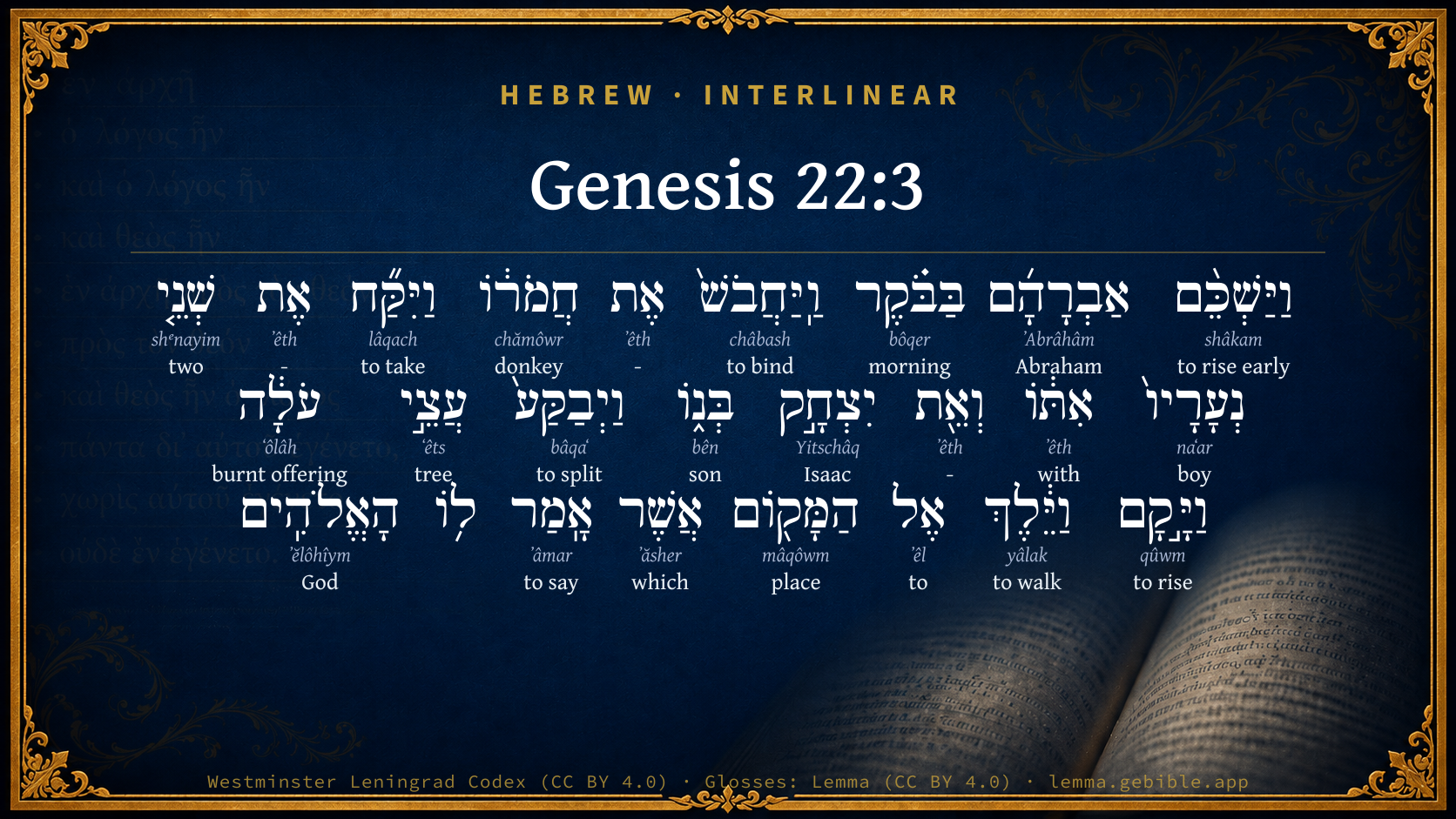
Hebrew (Westminster Leningrad Codex) Genesis 22:3 appears in the Hebrew Old Testament. The text above is from the Westminster Leningrad Codex. Each word links to its Strong’s number, a concise gloss, and parsing drawn from the Open Scriptures Hebrew Bible morphology. Click any word for its full Brown-Driver-Briggs (BDB) entry.
Download image
Cite this verse

Genesis 22:3 (World English Bible). Public Domain. Lemma interlinear Bible study tool, https://lemma.gebible.app/v/genesis/22/3.

Show BibTeX & RIS
BibTeX
RIS
English Translation
Abraham rose early in the morning, and saddled his donkey, and took two of his young men with him, and Isaac his son. He split the wood for the burnt offering, and rose up, and went to the place of which God had told him.
World English Bible · Public Domain
Highlights
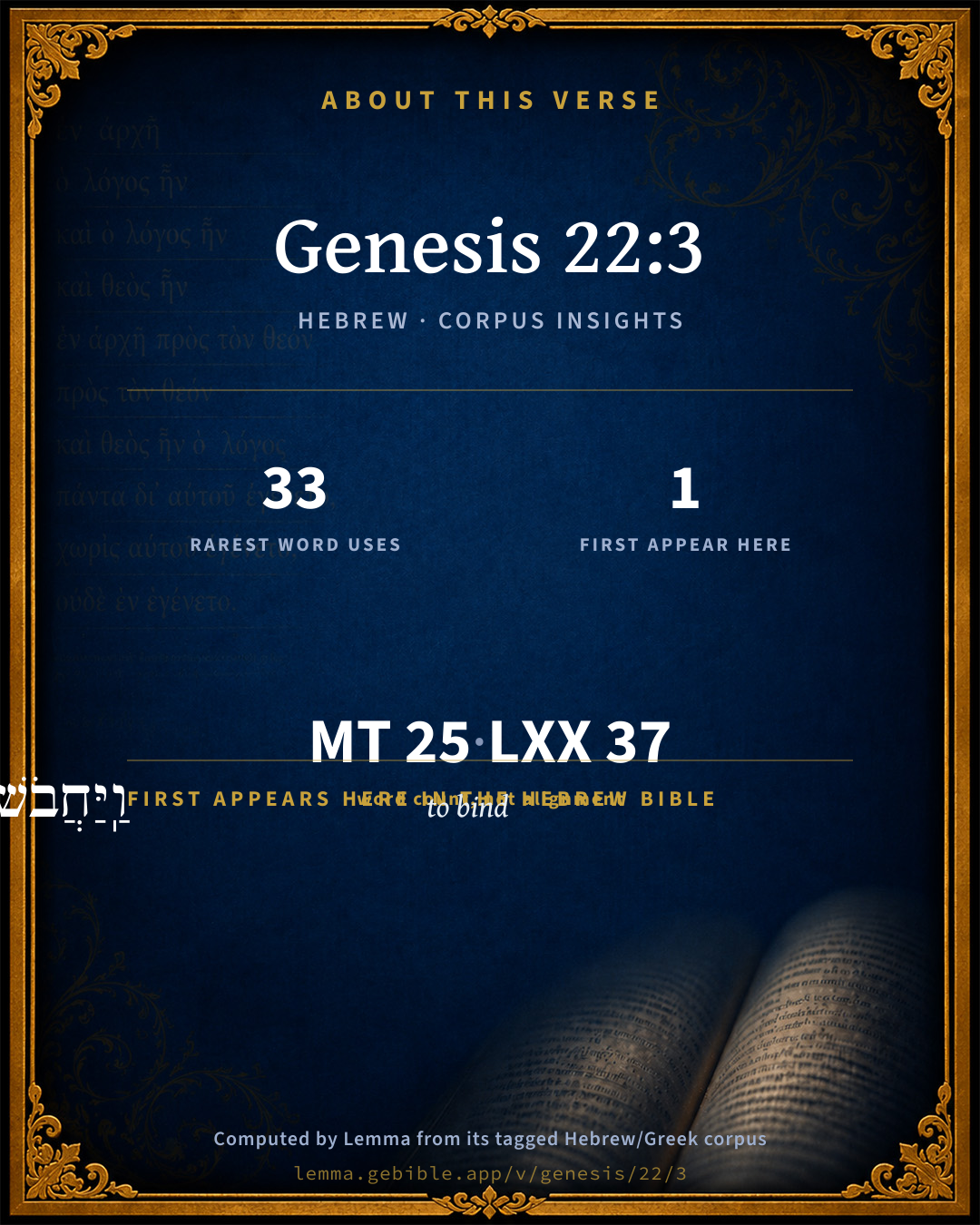
  • 1 first appearance in the Hebrew Bible
Full analysis ↓
Download a study sheet

One document with this verse’s original text, its word-by-word gloss line, the meaning frame, cross-references with their text, attributed commentary, and full source and license credits — printable, and it pastes into notes with its structure intact.

This verse Autodidact and up

Study sheet (.html) Plain text (.txt)

A passage Seminary Student

Up to 50 verses in one chapter. A passage sheet keeps up to 6 commentary sources and 12 cross-references per verse, in the order this page ranks them, and says so on the sheet whenever that leaves anything out. Ask for a single verse and you get the Autodidact verse sheet above.

Everything on this page stays free to read, with no account — the sheet is a download of what is already on screen, not access to it.

Want to remove ads? Support Godless Engineer
Compare translations 3

The same verse in 3 English versions, stacked beneath the original-language interlinear above. Click any original word for its lexicon entry.

Each is an independent rendering of the whole verse — the interlinear is not word-aligned to these translations.

Highlighted words mark where these versions differ — a whole-verse word diff, not a word-by-word alignment.

  • World English Bible Public Domain
    Abraham rose early in the morning, and saddled his donkey, and took two of his young men with him, and Isaac his son. He split the wood for the burnt offering, and rose up, and went to the place of which God had told him.
  • King James Version Public Domain
    And Abraham rose up early in the morning, and saddled his ass, and took two of his young men with him, and Isaac his son, and clave the wood for the burnt offering, and rose up, and went unto the place of which God had told him.
  • unfoldingWord Literal Text CC BY-SA 4.0
    So Abraham got up early in the morning and saddled his donkey. Then he took two of his young men with him and Isaac his son, and he cut wood for the burnt offering. Then he got up and left for the place that God had told to him.

unfoldingWord Literal Text — © unfoldingWord, licensed CC BY-SA 4.0. Word-aligned USFM3 via Door43 (git.door43.org/unfoldingWord/en_ult).

Versions to compare (up to 4)

3 of 4 selected

Show all 18 translations

Every available English version of this verse, each an independent rendering of the whole verse.

  • World English Bible Public Domain
    Abraham rose early in the morning, and saddled his donkey, and took two of his young men with him, and Isaac his son. He split the wood for the burnt offering, and rose up, and went to the place of which God had told him.
  • Berean Standard Bible Public Domain
    So Abraham got up early the next morning, saddled his donkey, and took along two of his servants and his son Isaac. He split the wood for a burnt offering and set out for the place God had designated.
  • Majority Standard Bible Public Domain
    So Abraham got up early the next morning, saddled his donkey, and took along two of his servants and his son Isaac. He split the wood for a burnt offering and set out for the place God had designated.
  • King James Version Public Domain
    And Abraham rose up early in the morning, and saddled his ass, and took two of his young men with him, and Isaac his son, and clave the wood for the burnt offering, and rose up, and went unto the place of which God had told him.
  • American Standard Version (1901) Public Domain
    And Abraham rose early in the morning, and saddled his ass, and took two of his young men with him, and Isaac his son. And he clave the wood for the burnt-offering, and rose up, and went unto the place of which God had told him.
  • Revised Version (1885) Public Domain
    And Abraham rose early in the morning, and saddled his ass, and took two of his young men with him, and Isaac his son; and he clave the wood for the burnt offering, and rose up, and went unto the place of which God had told him.
  • Geneva Bible (1599) Public Domain
    Then Abraham rose vp early in the morning, and sadled his asse, and tooke two of his seruants with him, and Izhak his sonne, and cloue wood for the burnt offering, and rose vp and went to the place, which God had tolde him.
  • Douay-Rheims (1899) Public Domain
    So Abraham rising up in the night, saddled his ass: and took with him two young men, and Isaac his son: and when he had cut wood for the holocaust he went his way to the place which God had commanded him.
  • Young's Literal Translation Public Domain
    And Abraham riseth early in the morning, and saddleth his ass, and taketh two of his young men with him, and Isaac his son, and he cleaveth the wood of the burnt-offering, and riseth and goeth unto the place of which God hath spoken to him.
  • Literal Standard Version CC BY-SA 4.0
    And Abraham rises early in the morning, and saddles his donkey, and takes two of his young men with him, and his son Isaac, and he cleaves the wood of the burnt-offering, and rises and goes to the place of which God has spoken to him.
  • Unlocked Literal Bible CC BY-SA 4.0
    So Abraham rose early in the morning, saddled his donkey, and took two of his young men with him, along with Isaac his son. He cut the wood for the burnt offering, then set out on his journey to the place that God had told him about.
  • unfoldingWord Literal Text CC BY-SA 4.0
    So Abraham got up early in the morning and saddled his donkey. Then he took two of his young men with him and Isaac his son, and he cut wood for the burnt offering. Then he got up and left for the place that God had told to him.
  • Darby Bible Public Domain
    And Abraham rose early in the morning, and saddled his ass, and took two of his young men with him, and Isaac his son; and he clave the wood for the burnt-offering, and rose up and went to the place that God had told him of.
  • World Messianic Bible Public Domain
    Abraham rose early in the morning, and saddled his donkey; and took two of his young men with him, and Isaac his son. He split the wood for the burnt offering, and rose up, and went to the place of which God had told him.
  • Webster's Bible Public Domain
    And Abraham rose early in the morning, and saddled his ass, and took two of his young men with him, and Isaac his son, and cleft the wood for the burnt-offering, and rose and went to the place which God had named to him.
  • Free Bible Version CC BY-SA 4.0
    Abraham got up early in the morning and saddled up his donkey. He took two servants and Isaac with him and went to cut firewood for the burnt offering. Then he left with them to go to the place God had told him about.
  • Bible in Basic English Public Domain
    And Abraham got up early in the morning, and made ready his ass, and took with him two of his young men and Isaac, his son, and after the wood for the burned offering had been cut, he went on his way to the place of which God had given him word.
  • JPS Tanakh (1917) Public Domain
    And Abraham rose early in the morning, and saddled his ass, and took two of his young men with him, and Isaac his son; and he cleaved the wood for the burnt-offering, and rose up, and went unto the place of which God had told him.

Literal Standard Version (2020), Covenant Press — licensed CC BY-SA 4.0. Text via the HelloAO Bible API (eBible.org). Unlocked Literal Bible (unfoldingWord) — licensed CC BY-SA 4.0. Text via the HelloAO Bible API (eBible.org). unfoldingWord Literal Text — © unfoldingWord, licensed CC BY-SA 4.0. Word-aligned USFM3 via Door43 (git.door43.org/unfoldingWord/en_ult). Free Bible Version, Dr. Jonathan Gallagher — licensed CC BY-SA 4.0. Text via the HelloAO Bible API (eBible.org).

Word by word

More ways to search: Search by grammar → Find every occurrence → Compare this word →

Practice this passage: Drill this verse → Learn its vocabulary →

וַֽיַּחֲבֹשׁ֙
châbash
H2280
“and · to bind”
Conjunction + Verb, Qal, Sequential Imperfect, 3rd Person, Masculine, Singular
Part of Speech
Conjunction + Verb
Stem
Qal
Form
Sequential Imperfect
Person
3rd Person
Gender
Masculine
Number
Singular
Full BDB Definition

Origin: a primitive root

TWOT: 599

to tie, bind, bind on, bind up, saddle, restrain, bandage, govern - (Qal) - to bind, bind on - to bind up - (Piel) to bind, restrain - (Pual) to be bound up
  1. וַיַּשְׁכֵּ֨ם shâkam H7925 “and · to rise early” Conjunction + Verb, Hiphil, Sequential Imperfect, 3rd Person, Masculine, Singular
  2. אַבְרָהָ֜ם ʼAbrâhâm H85 “Abraham” Noun, Proper
  3. בַּבֹּ֗קֶר bôqer H1242 “in/at the · morning” Preposition, Determined + Noun, Common, Masculine, Singular, Absolute
  4. אֶת ʼêth H853 “-” Particle, Direct Object
  5. חֲמֹר֔וֹ chămôwr H2543 “donkey · his” Noun, Common, Both, Singular, Construct + Suffix, Personal, 3rd Person, Masculine, Singular
  6. וַיִּקַּ֞ח lâqach H3947 “and · to take” Conjunction + Verb, Qal, Sequential Imperfect, 3rd Person, Masculine, Singular
  7. אֶת ʼêth H853 “-” Particle, Direct Object
  8. שְׁנֵ֤י shᵉnayim H8147 “two” Adjective, Cardinal number, Masculine, Dual, Construct
  9. נְעָרָיו֙ naʻar H5288 “boys · his” Noun, Common, Masculine, Plural, Construct + Suffix, Personal, 3rd Person, Masculine, Singular
  10. אִתּ֔וֹ ʼêth H854 “with · him” Preposition + Suffix, Personal, 3rd Person, Masculine, Singular
  11. וְאֵ֖ת ʼêth H853 “and · -” Conjunction + Particle, Direct Object
  12. יִצְחָ֣ק Yitschâq H3327 “Isaac” Noun, Proper
  13. בְּנ֑וֹ bên H1121 “son · his” Noun, Common, Masculine, Singular, Construct + Suffix, Personal, 3rd Person, Masculine, Singular
  14. וַיְבַקַּע֙ bâqaʻ H1234 “and · to split” Conjunction + Verb, Piel, Sequential Imperfect, 3rd Person, Masculine, Singular
  15. עֲצֵ֣י ʻêts H6086 “trees of” Noun, Common, Masculine, Plural, Construct
  16. עֹלָ֔ה ʻôlâh H5930 “burnt offering” Noun, Common, Feminine, Singular, Absolute
  17. וַיָּ֣קָם qûwm H6965 “and · to rise” Conjunction + Verb, Qal, Sequential Imperfect, 3rd Person, Masculine, Singular
  18. וַיֵּ֔לֶךְ yâlak H3212 “and · to walk” Conjunction + Verb, Qal, Sequential Imperfect, 3rd Person, Masculine, Singular
  19. אֶל ʼêl H413 “to” Preposition
  20. הַמָּק֖וֹם mâqôwm H4725 “the · place” Particle, Definite Article + Noun, Common, Masculine, Singular, Absolute
  21. אֲשֶׁר ʼăsher H834 “which” Particle, Relative
  22. אָֽמַר ʼâmar H559 “to say” Verb, Qal, Perfect, 3rd Person, Masculine, Singular
  23. הָאֱלֹהִֽים ʼĕlôhîym H430 “the · God(s)” Particle, Definite Article + Noun, Common, Masculine, Plural, Absolute

About this verse

These counts appear in no published source. They are computed here, from the morphology-tagged text and Lemma’s own curated glosses. What Lemma adds →

25
words
22
distinct lemmas
Pentateuch
section

First appearance in Scripture

This word makes its first canonical appearance in the Hebrew Bible here:

  • וַֽיַּחֲבֹשׁ֙ to bind H2280

Shared distinctive vocabulary

וַֽיַּחֲבֹשׁ֙ to bind H2280 occurs in 30 verses of the Hebrew Bible. Also found in:

Grammatical profile

  • 7 verbs
  • 10 nouns
  • 1 adjective
  • 3 prepositions
  • 4 particles

Verb forms

  • וַיַּשְׁכֵּ֨ם Hiphil · Sequential Imperfect
  • וַֽיַּחֲבֹשׁ֙ Qal · Sequential Imperfect
  • וַיִּקַּ֞ח Qal · Sequential Imperfect
  • וַיְבַקַּע֙ Piel · Sequential Imperfect
  • וַיָּ֣קָם Qal · Sequential Imperfect
  • וַיֵּ֔לֶךְ Qal · Sequential Imperfect
  • אָֽמַר Qal · Perfect

Hebrew & Septuagint length

In English translation the verse runs 45 words from the Hebrew and 46 from the Septuagint (LXX English) — closely comparable.

A rough comparison of the two English renderings, which tokenize alike — not a word-level alignment.

Word counts can differ between the Hebrew and the Greek without any difference in meaning — e.g. the Hebrew direct-object marker אֵת has no separate Greek word, and Greek often adds the article ὁ.

In the original languages it is 25 Hebrew tokens and 37 Greek tokens — but the two are counted differently (Hebrew bundles its prefixes and suffixes into one token; the Greek is in lemma form), so that isn’t a like-for-like length.

Cross-references

9

Topical passages linked to Genesis 22:3 in the Treasury of Scripture Knowledge — connected by theme and wording, ordered by reader-vote popularity; previews shown in the World English Bible.

  • Psalms 119:60 I will hurry, and not delay, To obey your commandments.
  • Matthew 10:37 He who loves father or mother more than me is not worthy of me; and he who loves son or daughter more than me isn't worthy of me.
  • Luke 14:26 "If anyone comes to me, and doesn't hate his own father, mother, wife, children, brothers, and sisters, yes, and his own life also, he can't be my disciple.
  • Genesis 17:23 Abraham took Ishmael his son, all who were born in his house, and all who were bought with his money; every male among the men of Abraham's house, and circumcised the flesh of their foreskin in the same day, as God had said to him.
  • Genesis 21:14 Abraham rose up early in the morning, and took bread and a bottle of water, and gave it to Hagar, putting it on her shoulder, and gave her the child, and sent her away. She departed, and wandered in the wilderness of Beersheba.
  • Ecclesiastes 9:10 Whatever your hand finds to do, do it with your might; for there is no work, nor device, nor knowledge, nor wisdom, in Sheol, where you are going.
  • Isaiah 26:3–4 You will keep [him] in perfect peace, [whose] mind [is] stayed [on you]; because he trusts in you.
  • Galatians 1:16 to reveal his Son in me, that I might preach him among the Gentiles, I didn't immediately confer with flesh and blood,
  • Hebrews 11:17–19 By faith, Abraham, being tested, offered up Isaac. Yes, he who had gladly received the promises was offering up his one and only son;

Cross-references courtesy of OpenBible.info (CC BY 4.0).

Hebrew and Greek witnesses Masoretic Hebrew ↔ Greek Septuagint

The same verse in the two great witnesses to the Old Testament, shown verse-for-verse.

These are two independent witnesses, not word-aligned to each other, and the Septuagint is shown in lemma (dictionary) form.

Hebrew Genesis 22:3 Masoretic · Westminster Leningrad Codex

וַיַּשְׁכֵּ֨ם אַבְרָהָ֜ם בַּבֹּ֗קֶר וַֽיַּחֲבֹשׁ֙ אֶת חֲמֹר֔וֹ וַיִּקַּ֞ח אֶת שְׁנֵ֤י נְעָרָיו֙ אִתּ֔וֹ וְאֵ֖ת יִצְחָ֣ק בְּנ֑וֹ וַיְבַקַּע֙ עֲצֵ֣י עֹלָ֔ה וַיָּ֣קָם וַיֵּ֔לֶךְ אֶל הַמָּק֖וֹם אֲשֶׁר אָֽמַר ל֥וֹ הָאֱלֹהִֽים

Abraham rose early in the morning, and saddled his donkey, and took two of his young men with him, and Isaac his son. He split the wood for the burnt offering, and rose up, and went to the place of which God had told him.

World English Bible · Public Domain

Greek LXX Genesis 22:3 Septuagint · lemma form

ἀναἵστημι δέ αβρααμ ὁ πρωΐ ἐπισάττω ὁ ὄνος αὐτός παραλαμβάνω δέ μετά ἑαυτοῦ δύο παῖς καί ισαακ ὁ υἱός αὐτός καί σχίζω ξύλον εἰς ὁλοκάρπωσις ἀναἵστημι πορεύομαι καί ἔρχομαι ἐπί ὁ τόπος ὅς εἶπον αὐτός ὁ θεός

And Abraam rose up in the morning and saddled his ass, and he took with him two servants, and Isaac his son, and having split wood for a whole burnt offering, he arose and departed, and came to the place of which God spoke to him,

LXX2012 (modern English Septuagint) · Public Domain

Hebrew: Westminster Leningrad Codex (CC BY 4.0). Greek: Septuagint (public domain); English from LXX2012 (modern English Septuagint) (Public Domain). How the Septuagint differs from the Hebrew →

Targum (Aramaic paraphrase)

2

The Targum is the ancient Jewish Aramaic paraphrase of the Hebrew Scriptures — an interpretive translation, not the Hebrew text itself. Onkelos (literal) and Pseudo-Jonathan (expansive) render the Torah, and Jonathan the Prophets. Coverage is partial: where no permissively-licensed English translation exists for a verse, only the Aramaic is shown. This is verse-level text, not a word-by-word alignment to the Hebrew.

  1. Targum Onkelos Torah (Genesis–Deuteronomy)
    וְאַקְדֵּים אַבְרָהָם בְּצַפְרָא וְזָרֵז יָת חֲמָרֵהּ וּדְבַר יָת תְּרֵין עוּלֵימוֹהִי עִמֵּהּ וְיָת יִצְחָק בְּרֵהּ וְצַלַּח אָעֵי לַעֲלָתָא וְקָם וַאֲזַל לְאַתְרָא דִּי אֲמַר לֵהּ יְיָ

    (no public-domain English translation for this verse)

    Targum Onkelos — Aramaic: “Onkelos Genesis” (public domain); “Onkelos Exodus” (public domain); “Onkelos Leviticus” (public domain); “Onkelos Numbers” (public domain); “Onkelos Deuteronomy” (public domain). English: “Sefaria Community Translation” (CC0 1.0 (public-domain dedication)); “J.W. Etheridge. The Targums of Onkelos and Jonathan Ben Uzziel on the Pentateuch. London: Longmans, Green, 1862” (public domain). Text via Sefaria.

  2. Targum Pseudo-Jonathan Torah (Genesis–Deuteronomy)
    וְאַקְדֵים אַבְרָהָם בְּצַפְרָא וְזָרֵיז יַת חַמְרֵיהּ וּדְבַר יַת תְּרֵין טַלְיוֹ עִמֵיהּ יַת אֱלִיעֶזֶר וְיַת יִשְׁמָעֵאל וְיַת יִצְחָק בְּרֵיהּ וְקָטַע קֵיסִין דַקִיתָא וּתְאֵנָתָא וְדִיקְלָא דְחַזְיַין לְעָלָתָא וְקָם וְאָזַל לְאַתְרָא דְאָמַר לֵיהּ יְיָ

    And Abraham rose up in the morning and saddled his ass, and took two young men with him, Eliezer and Ishmael, and Izhak his son, and cut the small wood and the figs and the palm, which are provided for the whole burnt offering, and arose and went to the land of which the Lord had told him.

    Targum Pseudo-Jonathan — Aramaic: “Targum Jonathan on Genesis” (public domain); “Targum Jonathan on Exodus” (public domain); “Targum Jonathan on Leviticus” (public domain); “Targum Jonathan on Numbers” (public domain); “Targum Jonathan on Deuteronomy” (public domain). English: “The Targum of Jonathan ben Uzziel, trans. J. W. Etheridge, London, 1862” (public domain). Text via Sefaria.

Commentary

Notes on Genesis 22:3 from classic Christian and Jewish commentators (each source and its license shown beneath its notes). The classic Christian expositions comment on the surrounding passage and are grouped to its opening verse, so a note may address several verses; the Jewish commentaries on the Tanakh (Rashi and others) are per-verse, so they appear only where the commentator wrote on this verse.

Lemma curates 59 commentaries, every one of them public domain or Creative Commons licensed, each selected and text-cleaned for this edition rather than reprinted as found. About our sources →

Matthew Henry's Commentary

We have here Abraham's obedience to this severe command. Being tried, he offered up Isaac, Heb 11:17. Observe,

I. The difficulties which he broke through in this act of obedience. Much might have been objected against it; as, 1. It seemed directly against an antecedent law of God, which forbids murder, under a severe penalty, Gen 9:5, Gen 9:6. Now can the unchangeable God contradict himself? He that hates robbery for burnt-offering (Isa 61:8) cannot delight in murder for it. 2. How would it consist with natural affection to his own son? It would be not only murder, but the worst of murders. Cannot Abraham be obedient but he must be unnatural? If God insist upon a human sacrifice, is there none but Isaac to be the offering, and none but Abraham to be the offerer? Must the father of the faithful be the monster of all fathers? 3. God gave him no reason for it. When Ishmael was to be cast out, a just cause was assigned, which satisfied Abraham; but here Isaac must die, and Abraham must kill him, and neither the one nor the other must know why or wherefore. If Isaac had been to die a martyr for the truth, or his life had been the ransom of some other life more precious, it would have been another matter; of if he had died as a criminal, a rebel against God or his parents, as in the case of the idolater (Deu 13:8, Deu 13:9), or the stubborn son (Deu 21:18, Deu 21:19), it might have passed as a sacrifice to justice. But the case is not so: he is dutiful, obedient, hopeful, son. "Lord, what profit is there in his blood?" 4. How would this consist with the promise? Was it not said that in Isaac shall thy seed be called? But what comes of that seed, if this pregnant bud be broken off so soon? 5. How should he ever look Sarah in the face again? With what face can he return to her and his family with the blood of Isaac sprinkled on his garments and staining all his raiment? "Surely a bloody husband hast thou been to me" would Sarah say (as Exo 4:25, Exo 4:26), and it would be likely to alienate her affections for ever both from him and from his God. 6. What would the Egyptians say, and the Canaanites and the Perizzites who dwelt then in the land? It would be an eternal reproach to Abraham, and to his altars. "Welcome nature, if this be grace." These and many similar objection might have been made; but he was infallibly assured that it was indeed a command of God and not a delusion, and this was sufficient to answer them all. Note, God's commands must not be disputed, but obeyed; we must not consult with flesh and blood about them (Gal 1:15, Gal 1:16), but with a gracious obstinacy persist in our obedience to them.

II. The several steps of obedience, all which help to magnify it, and to show that he was guided by prudence, and governed by faith, in the whole transaction.

1. He rises early, Gen 22:3. Probably the command was given in the visions of the night, and early the next morning he set himself about the execution of it - did not delay, did not demur, did not take time to deliberate; for the command was peremptory, and would not admit a debate. Note, Those that do the will of God heartily will do it speedily; while we delay, time is lost and the heart hardened.

2. He gets things ready for a sacrifice, and, as if he himself had been a Gibeonite, it should seem, with his own hands he cleaves the wood for the burnt-offering, that it might not be to seek when the sacrifice was to be offered. Spiritual sacrifices must thus be prepared for.

3. It is very probable that he said nothing about it to Sarah. This is a journey which she must know nothing of, lest she prevent it. There is so much in our own hearts to hinder our progress in duty that we have need, as much as may be, to keep out of the way of other hindrances.

4. He carefully looked about him, to discover the place appointed for this sacrifice, to which God had promised by some sign to direct him. Probably the direction was given by an appearance of the divine glory in the place, some pillar of fire reaching from heaven to earth, visible at a distance, and to which he pointed when he said (Gen 22:5), "We will go yonder, where you see the light, and worship."

5. He left his servants at some distance off (Gen 22:5), lest they should interpose, and create him some disturbance in his strange oblation; for Isaac was, no doubt, the darling of the whole family. Thus, when Christ was entering upon his agony in the garden, he took only three of his disciples with him, and left the rest at the garden door. Note, It is our wisdom and duty, when we are going to worship God, to lay aside all those thoughts and cares which may divert us from the service, leave them at the bottom of the hill, that we may attend on the Lord without distraction.

6. He obliged Isaac to carry the wood (both to try his obedience in a smaller matter first, and that he might typify Christ, who carried his own cross, Joh 19:17), while he himself, though he knew what he did, with a steady and undaunted resolution carried the fatal knife and fire, Gen 22:6. Note, Those that through grace are resolved upon the substance of any service or suffering for God must overlook the little circumstances which make it doubly difficult to flesh and blood.

7. Without any ruffle or disorder, he talks it over with Isaac, as if it had been but a common sacrifice that he was going to offer, Gen 22:7, Gen 22:8.

(1.) It was a very affecting question that Isaac asked him, as they were going together: My father, said Isaac; it was a melting word, which, one would think, would strike deeper into the breast of Abraham than his knife could into the breast of Isaac. He might have said, or thought, at least, "Call me not thy father who am now to be thy murderer; can a father be so barbarous, so perfectly lost to all the tenderness of a father?" Yet he keeps his temper, and keeps his countenance, to admiration; he calmly waits for his son's question, and this is it: Behold the fire and the wood, but where is the lamb? See how expert Isaac was in the law and custom of sacrifices. This it is to be well-catechised: this is, [1.] A trying question to Abraham. How could he endure to think that Isaac was himself the lamb? So it is, but Abraham, as yet, dares not tell him so. Where God knows the faith to be armour of proof, he will laugh at the trial of the innocent, Job 9:23. [2.] It is a teaching question to us all, that, when we are going to worship God, we should seriously consider whether we have every thing ready, especially the lamb for a burnt-offering. Behold, the fire is ready, the Spirit's assistance and God's acceptance; the wood is ready, the instituted ordinances designed to kindle our affections (which indeed, without the Spirit, are but like wood without fire, but the Spirit works by them); all things are now ready, but where is the lamb? Where is the heart? Is that ready to be offered up to God, to ascend to him as a burnt-offering?

(2.) It was a very prudent answer which Abraham gave him: My son, God will provide himself a lamb. This was the language, either, [1.] Of his obedience. "We must offer the lamb which God has appointed now to be offered;" thus giving him this general rule of submission to the divine will, to prepare him for the application of it to himself very quickly. Or, [2.] Of his faith. Whether he meant it so or not, this proved to be the meaning of it; a sacrifice was provided instead of Isaac. Thus, First, Christ, the great sacrifice of atonement, was of God's providing; when none in heaven or earth could have found a lamb for that burnt-offering, God himself found the ransom, Psa 89:20. Secondly, All our sacrifices of acknowledgment are of God's providing too. It is he that prepares the heart, Psa 10:17. The broken and contrite spirit is a sacrifice of God (Psa 51:17), of his providing.

8. With the same resolution and composedness of mind, after many thoughts of heart, he applies himself to the completing of this sacrifice, Gen 22:9, Gen 22:10. He goes on with a holy wilfulness, after many a weary step, and with a heavy heart he arrives at length at the fatal place, builds the altar (an altar of earth, we may suppose, the saddest that ever he built, and he had built many a one), lays the wood in order for his Isaac's funeral pile, and now tells him the amazing news: "Isaac, thou art the lamb which God has provided." Isaac, for aught that appears, is as willing as Abraham; we do not find that he raised any objection against it, that he petitioned for his life, that he attempted to make his escape, much less that he struggled with his aged father, or made any resistance: Abraham does it, God will have it done, and Isaac has learnt to submit to both, Abraham no doubt comforting him with the same hopes with which he himself by faith was comforted. Yet it is necessary that a sacrifice be bound. The great sacrifice, which in the fullness of time was to be offered up, must be bound, and therefore so must Isaac. But with what heart could tender Abraham tie those guiltless hands, which perhaps had often been lifted up to ask his blessing, and stretched out to embrace him, and were now the more straitly bound with the cords of love and duty! However, it must be done. Having bound him, he lays him upon the altar, and his hand upon the head of his sacrifice; and now, we may suppose, with floods of tears, he gives, and takes, the final farewell of a parting kiss: perhaps he takes another for Sarah from her dying son. This being done, he resolutely forgets the bowels of a father, and puts on the awful gravity of a sacrificer. With a fixed heart, and an eye lifted up to heaven, he takes the knife, and stretches out his hand to give a fatal cut to Isaac's throat. Be astonished, O heavens! at this; and wonder, O earth! Here is an act of faith and obedience, which deserves to be a spectacle to God, angels, and men. Abraham's darling, Sarah's laughter, the church's hope, the heir of promise, lies ready to bleed and die by his own father's hand, who never shrinks at the doing of it. Now this obedience of Abraham in offering up Isaac is a lively representation, (1.) Of the love of God to us, in delivering up his only-begotten Son to suffer and die for us, as a sacrifice. It pleased the Lord himself to bruise him. See Isa 53:10; Zac 13:7. Abraham was obliged, both in duty and gratitude, to part with Isaac, and parted with him to a friend; but God was under no obligations to us, for we were enemies. (2.) Of our duty to God, in return for that love. We must tread in the steps of this faith of Abraham. God, by his word, calls us to part with all for Christ, - all our sins, though they have been as a right hand, or a right eye, or an Isaac - all those things that are competitors and rivals with Christ for the sovereignty of the heart (Luk 14:26); and we must cheerfully let them all go. God, by his providence, which is truly the voice of God, calls us to part with an Isaac sometimes, and we must do it with a cheerful resignation and submission to his holy will, Sa1 3:18.

Matthew Henry's Commentary on the Whole Bible (1708–1710) — public domain (CC PDM 1.0). Text via the HelloAO Bible API.

Trapp's Complete Commentary

John Trapp

Gen 22:3 And Abraham rose up early in the morning, and saddled his ass, and took two of his young men with him, and Isaac his son, and clave the wood for the burnt offering, and rose up, and went unto the place of which God had told him.

Ver. 3. And Abraham rose up early, &c.] To show his prompt and present obedience. He neither consulted with his wife, nor with his own reason. She might have haply hung upon him and hindered him, as Zipporah did Moses to the hazarding of his life. {Exo 4:24-26} He captivates all the powers of the soul to his Creator; goes after him without questioning, and so shows himself to be "renewed in the spirit of his mind": that is, in his natural reason: for that, like an old beldam, is the mother and nurse of all our distempers and strayings. Cassianus tells us of a young man that had given himself up to a Christian life: and his parents, misliking that way, wrote letters to dissuade him from it; which when he knew, he would not once open them, but threw them in the fire. Let us do so by the suggestions of flesh and blood, and the counsel of carnal friends, or we shall never rest and feast in Abraham’s bosom. I know not by what reason, said Borthwick the Scotch martyr, they so called them my friends, which so greatly laboured to convert me, as they called it: neither will I more esteem them than the Midianites, which in time past called the children of Israel to do sacrifice to their idols. {a}

{a} Act. and Mon., fol. 1157.

John Trapp, A Commentary or Exposition upon All the Books of the Old and New Testament (1647–1656) — public domain. Text from a community e-Sword module.

Joseph Benson's Commentary

Gen 22:3. The several steps of this obedience all help to magnify it, and to show that he was guided by prudence, and governed by faith, in the whole transaction. 1st, He rises early — Probably the command was given in the visions of the night, and early the next morning he sets himself about it, did not delay, did not demur. Those that do the will of God heartily, will do it speedily. 2d, He gets things ready for a sacrifice, and, it should seem, with his own hands “cleaves the wood for the burnt-offering.” 3d, He left his servants at some distance, lest they should have created him some disturbance in his strange oblation. Thus, when Christ was entering upon his agony in the garden, he took only three of his disciples with him.

Joseph Benson's Commentary on the Old and New Testaments (1811–1818) — public domain. Text from a community e-Sword module.

Tyndale Open Study Notes

Tyndale Open Resources

22:3 Abraham’s immediate, unquestioning obedience is almost as astounding as the test.

Tyndale Open Study Notes — © Tyndale Open Resources, licensed CC BY-SA 4.0. Text via the HelloAO Bible API.

Jamieson, Fausset & Brown

Robert Jamieson, A. R. Fausset & David Brown

Abraham rose . . . early, &c.--That there might be no appearance of delay or reluctance on his part, he made every preparation for the sacrifice before setting out--the materials, the knife, and the servants to convey them. From Beer-sheba to Moriah, a journey of two days, he had the painful secret pent up in his bosom. So distant a place must have been chosen for some important reason. It is generally thought that this was one the hills of Jerusalem, on which the Great Sacrifice was afterwards offered.

Jamieson, Fausset & Brown — Commentary Critical and Explanatory on the Whole Bible (1871) — public domain (CC PDM 1.0). Text via the HelloAO Bible API.

Adam Clarke's Commentary

Verse 3. Two of his young men] Eliezer and Ishmael, according to the Targum.

Clave the wood] Small wood, fig and palm, proper for a burnt-offering. - Targum.

Adam Clarke's Commentary on the Bible (1810–1826) — public domain. Text from a community e-Sword/MySword module.

John Calvin's Commentaries

3. And Abraham rose up early in the morning. This promptitude shows the greatness of Abraham’s faith. Innumerable thoughts might come into the mind of the holy man; each of which would have overwhelmed his spirit, unless he had fortified it by faith. And there is no doubt that Satan, during the darkness of the night, would heap upon him a vast mass of cares. Gradually to overcome them, by contending with them, was the part of heroical courage. But when they were overcome, then immediately to gird himself to the fulfillment of the command of God, and even to rise early in the morning to do it, was a remarkable effort. Other men, prostrated by a message so dire and terrible, would have fainted, and have lain torpid, as if deprived of life; but the first dawn of morning was scarcely early enough for Abraham’s haste. Therefore, in a few words, Moses highly extols his faith, when he declares that it surmounted, in so short a space of time, the very temptation which was attended with many labyrinths.

John Calvin's Commentaries (1540-1563) — public domain. Text from the Calvin Translation Society English edition (1840s-50s) via the Christian Classics Ethereal Library (ccel.org). Calvin's coverage is partial (roughly two-thirds of the Bible); uncommented books and verses are honest gaps, never fabricated. The 19th-century editor's footnotes and remarks are omitted so the notes are faithfully Calvin's own voice.

Ellicott's Commentary for English Readers

(3) And Abraham . . . —Every preparation for the sacrifice is minutely detailed, as if to show the calmness with which Abraham girded up himself for obedience. He even took the wood ready cleft, not because there was no wood there (Gen_22:13), but in order that on arriving at the destined place there might be nothing to distract their thoughts, and that so they might proceed at once to the sacrifice.

A Bible Commentary for English Readers, edited by Charles John Ellicott (1878–1897) — public domain. Text from a community e-Sword module.

The Cambridge Bible for Schools and Colleges

gen. ed. J. J. S. Perowne

3. And Abraham rose early, &c.] Abraham’s prompt unquestioning obedience is here depicted in the description of his successive acts. The mental struggle is passed over in silence. Calvin notes: “quasi oculis clausis pergit quo jubetur.” Cf. Wis_10:5, “wisdom knew the righteous man and preserved him blameless unto God, and kept him strong when his heart yearned towards his child.”

the wood] Implying that the place of the sacrifice would be treeless.

the place] See note on Gen_12:6. Was it a local sanctuary?

of which God had told him) Cf. Gen_22:2, the narrative is condensed. The names of the “place” and the mountain spoken of by God are not recorded.

The Cambridge Bible for Schools and Colleges (gen. ed. J. J. S. Perowne; Cambridge University Press, 1878–1918) — public domain. Text from a community e-Sword module.

John Gill's Exposition

And Abraham rose up early in the morning,.... For it seems it was in a dream or vision of the night that the above orders were given; and as soon as it was morning he rose and prepared to execute them with all readiness, and without any hesitation and delay:

and saddled his ass; for his journey, not to carry the wood and provision on, which probably were carried by his servants, but to ride on; and this Jarchi thinks he did himself, and the words in their precise sense suggest this; but it does no, necessarily follow, because he may be said to do what he ordered his servant to do; of the Jews' fabulous account of this ass, see Zac 9:9,

and took two of his young men with him; the Targum of Jonathan says, these were Ishmael his son, and Eliezer his servant; and so other Jewish writers (r), who tell us, that just at this time Ishmael came out of the wilderness to visit his father, and he took him with him; but for this there is no foundation: they were two of his servants, of whom he had many:

and Isaac his son: who was the principal person to be taken, since he was to be the sacrifice: whether Abraham acquainted Sarah with the affairs and she consented to it, cannot be said with certainty; it is plain Isaac knew not what his father's design was; and though Sarah and the whole family might know, by the preparation made, he was going to offer a sacrifice, yet they knew not where, nor what it was to be:

and clave the wood for the burnt offering; not knowing whether he should find wood sufficient on the mountain, where he was to go; and that he might not be unprovided when he came there, takes this method, which shows his full intention to obey the divine command:

and rose up, and went unto the place of which God had told him; that is, he mounted his ass, and rode towards the place God had spoken of to him, and who had directed him which way to steer his course.

(r) Pirke Eliezer, c. 31. Jarchi in loc.

John Gill's Exposition of the Whole Bible (1746–1763) — public domain (CC PDM 1.0). Text via the HelloAO Bible API.

Haydock's Catholic Bible Commentary

In the night: de nocte, Hebrew, "very early in the morning." --- His son, 25 years old, without perhaps saying a word to Sara about the intended sacrifice; though some believe, he had too great an opinion of her faith and constancy, not to reveal to her the order of God. The Scripture is silent. (Calmet)

George Leo Haydock (1774–1849), Haydock's Catholic Family Bible and Commentary, 1859 edition — public domain. Excludes Psalms (Douay-Rheims chapter numbering differs from Protestant) and Deuterocanonical books (Catholic canon only).

Matthew Poole's English Annotations

Abraham rose up early in the morning, that he might execute God’s command without doubt or delay;

and saddled his ass, for greater expedition, not waiting for his servant to do it.

Matthew Poole's English Annotations on the Holy Bible (1683–1685) — public domain. Text from a community e-Sword/MySword module.

Whedon's Commentary on the Bible

Daniel D. Whedon

3. Rose up early — An early start on a journey is all-important in the East. Thus would the traveller avoid the heat of the day in the open sun, by travelling before the sun was up, and resting in the heat of the day.

Saddled his ass — The modern saddle was not then known, but pieces of cloth and garments (Mar_11:7) were bound (חבשׁ) on the back of the animal. The saddling also implied the binding on of whatever baggage the traveller would take along. The Oriental ass is a nobler animal than that which we of the West associate with that name. (See the Bible Dictionaries on the word.)

Took two of his young men — An incident which shows the naturalness and accuracy of the narrative. A chief like Abraham would not travel far unattended.

Daniel D. Whedon (gen. ed.), Commentary on the Old and New Testaments (1874–1909) — public domain. Text from a community e-Sword module.

The Pulpit Commentary

And Abraham rose up early in the morning, a habit of the patriarch"s after receiving a Divine communication (cf. Gen_19:27 Gen_20:8 Gen_21:14) and saddled his ass, and took two of his young men with him (the ass for the wood, and the young men for the ass), and Isaac his son (explaining to him as yet only his intention to offer sacrifice upon a distant mountain), and clave the wood for the burnt offering (obviously with his own bands), and rose up (expressive of resolute determination), and went unto (or towards) the place of which God had told him literally, the Elohim had spoken to him. The accumulation of brief, sententious clauses in this verse admirably represents the calm deliberation and unflinching heroism with which the patriarch proceeded to execute the Divine command.

The Pulpit Commentary (1880–1919), ed. H.D.M. Spence-Jones & Joseph S. Exell — public domain. Text from a community e-Sword module.

John Wesley's Explanatory Notes

The several steps of this obedience, all help to magnify it, and to shew that he was guided by prudence, and governed by faith, in the whole transaction. (1.) He rises early - Probably the command was given in the visions of the night, and early the next morning he sets himself about it, did not delay, did not demur. Those that do the will of God heartily will do it speedily. (2.) He gets things ready for a sacrifice, and it should seem, with his own hands, cleaves the wood for the burnt-offering. (3.) He left his servants at some distance off, left they should have created him some disturbance in his strange oblation. Thus when Christ was entering upon his agony in the garden, he took only three of his disciples with him.

John Wesley, Explanatory Notes Upon the Whole Bible (1754–1765) — public domain. Text via the GEBible commentary corpus.

Rashi

Rabbi Shlomo Yitzchaki (Rashi)

וישכם AND HE ROSE EARLY — He was alert to fulfil the command (Pesachim 4a)

ויחבוש AND HE SADDLED [HIS ASS]—He himself: he did not order one of his servants to do so, for love disregards the rule imposed on one by his exalted position in life. (“Love” here means Love of God as displayed in obedience to His command.) (Genesis Rabbah 55:8)

את שני נעריו HIS TWO LADS — Ishmael and Eliezer. For a man of high standing should not travel without two men as attendants (Leviticus Rabbah 26:7) so that if one needs to ease himself and goes aside for this purpose the other will still remain with him (Midrash Tanchuma, Balak 8)

ויבקע AND HE CLEAVED [THE WOOD] — Its rendering in the Targum וצלח has the same meaning as the verb in (2 Samuel 19:18) And they rushed into the Jordan”, which signifies cleaving the waters; old French fendre; English to split.

Rashi on the Tanakh — English translations: “The Judaica Press complete Tanach with Rashi, translated by A. J. Rosenberg” (CC BY 4.0); “Pentateuch with Rashi's commentary by M. Rosenbaum and A.M. Silbermann, 1929-1934” (public domain); “The Metsudah Tanach series, Lakewood, N.J” (CC BY 4.0); and “The Book of Joshua, Metsudah Publications, 1997” (CC BY 4.0). Text via Sefaria.

Ramban (Nachmanides)

Rabbi Moshe ben Nachman (Ramban / Nachmanides)

AND HE CLEAVED THE WOOD FOR THE BURNT-OFFERING. This illustrates Abraham’s zeal in performing a commandment for he thought that perhaps there would be no wood in that place, and so he carried it for three days. It may be that Abraham disqualified for use as an offering any wood in which a worm is found, as is the law of the Torah, and so he took from his house sound wood for the burnt-offering. Hence it says, And he cleaved the wood for the burnt-offering.

Ramban (Nachmanides) on the Tanakh — English translation: “Commentary on the Torah by Ramban (Nachmanides). Translated and annotated by Charles B. Chavel. New York, Shilo Pub. House, 1971-1976” (CC BY 4.0). Text via Sefaria.

Radak

Rabbi David Kimhi (Radak)

וישכם אברהם, he rose early to carry out G’d’s bidding without telling Sarah anything about it. He was afraid that she might do harm to herself out of her love for Yitzchok.

את שני נעריו, the ones who usually accompanied him on any journey.

אל המקום אשר אמר לו, to the land known as Moriah, seeing that G’d had not yet revealed to him on which mountain he was to offer Yitzchok as a burnt offering.

Radak on the Tanakh — English translations: “Sefaria Community Translation” (CC0 1.0 (public-domain dedication)); “Eliyahu Munk, HaChut Hameshulash” (CC BY 4.0); “Rabbi Mike Feuer, Jerusalem Anthology” (CC BY 4.0); and “R. David Kimhi on the first book of Psalms, Translated by R.G. Finch, London, 1919” (public domain). Text via Sefaria.

Lesson kit

Teaching starters — assembled from the data on this page, not authored interpretation. Every prompt links to the verse data it draws on. Edit before teaching.

Genesis, in the Pentateuch, opens this verse with 25 words (22 distinct Hebrew lemmas). Its most distinctive word is châbash (“to bind”). A historical commentator’s framing appears above. Read the whole chapter for the surrounding context.

Discussion questions

  1. The word châbash carries the sense “to bind.” How does it shape the verse?
  2. This is the first place “to bind” appears in Scripture (first appears here). What does its debut here establish?
  3. How does Exodus 29:9, which shares the word «to bind», read alongside this verse?
  4. These translations render this verse differently. What is at stake in choosing one wording over another?
  5. «וַיַּשְׁכֵּ֨ם» is a Hiphil Sequential Imperfect verb. How does that grammatical form shape the action described?
  6. Compare how Matthew Henry's Commentary and Trapp's Complete Commentary read this verse. Where do they agree or differ?

Things to notice

Reading settings

Reading text

Shown beneath each verse's original-language words.

Old Testament
Old Testament edition

Read the OT as the Masoretic Hebrew (MT) or the Greek Septuagint (LXX).

English shown for the Greek Septuagint (in the Hebrew ↔ Greek comparison).

Comparing translations? Open the Compare panel on any verse page to stack up to four side by side.