
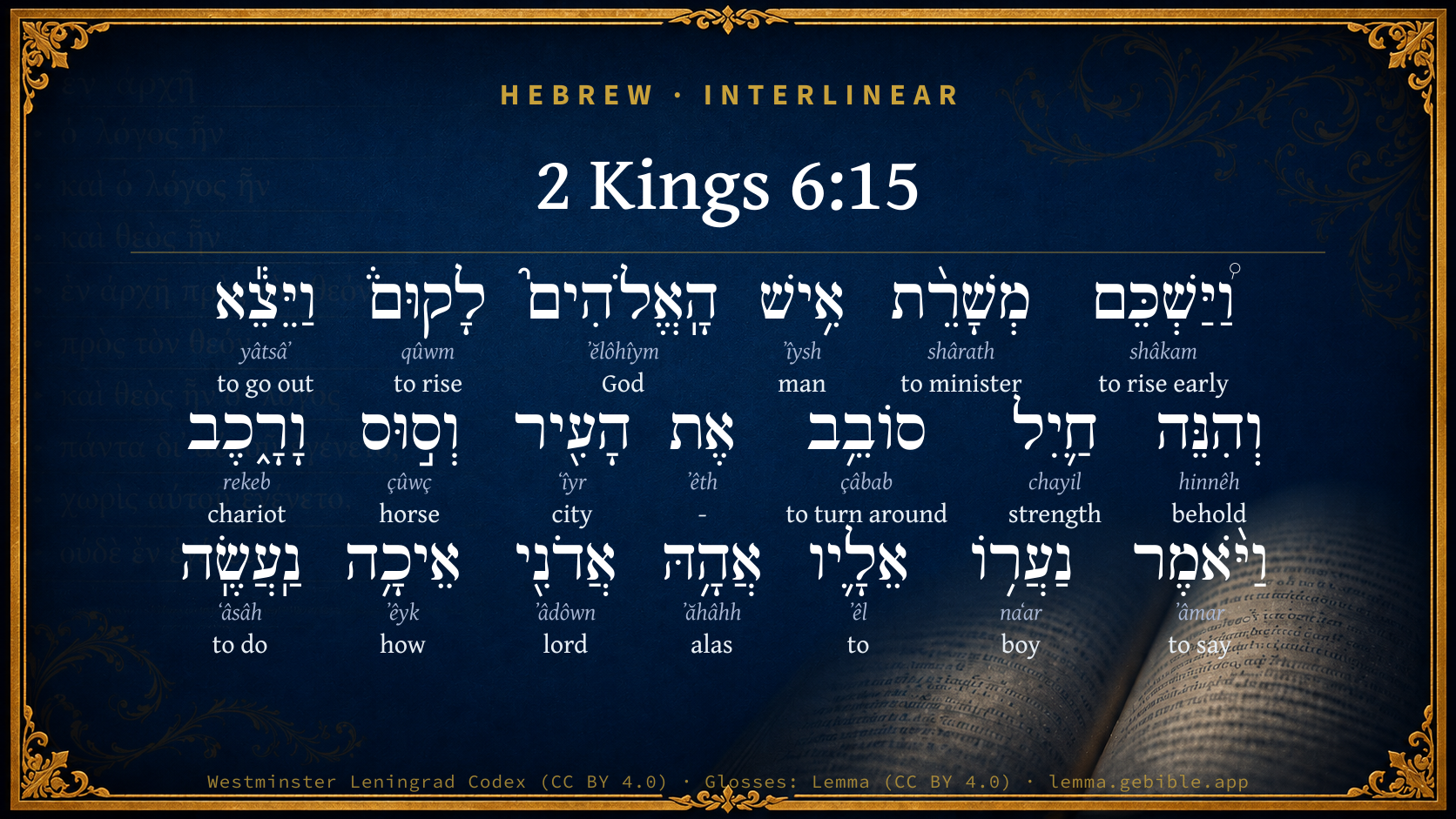
2 Kings 6:15

Hebrew (Westminster Leningrad Codex) 2 Kings 6:15 appears in the Hebrew Old Testament. The text above is from the Westminster Leningrad Codex. Each word links to its Strong’s number, a concise gloss, and parsing drawn from the Open Scriptures Hebrew Bible morphology. Click any word for its full Brown-Driver-Briggs (BDB) entry.
Download image
Cite this verse

2 Kings 6:15 (World English Bible). Public Domain. Lemma interlinear Bible study tool, https://lemma.gebible.app/v/2-kings/6/15.

Show BibTeX & RIS
BibTeX
RIS
English Translation
When the servant of the man of God was risen early, and gone forth, behold, a host with horses and chariots was round about the city. His servant said to him, Alas, my master! how shall we do?
World English Bible · Public Domain
Download a study sheet

One document with this verse’s original text, its word-by-word gloss line, the meaning frame, cross-references with their text, attributed commentary, and full source and license credits — printable, and it pastes into notes with its structure intact.

This verse Autodidact and up

Study sheet (.html) Plain text (.txt)

A passage Seminary Student

Up to 50 verses in one chapter. A passage sheet keeps up to 6 commentary sources and 12 cross-references per verse, in the order this page ranks them, and says so on the sheet whenever that leaves anything out. Ask for a single verse and you get the Autodidact verse sheet above.

Everything on this page stays free to read, with no account — the sheet is a download of what is already on screen, not access to it.

Want to remove ads? Support Godless Engineer
Compare translations 3

The same verse in 3 English versions, stacked beneath the original-language interlinear above. Click any original word for its lexicon entry.

Each is an independent rendering of the whole verse — the interlinear is not word-aligned to these translations.

Highlighted words mark where these versions differ — a whole-verse word diff, not a word-by-word alignment.

  • World English Bible Public Domain
    When the servant of the man of God was risen early, and gone forth, behold, a host with horses and chariots was round about the city. His servant said to him, Alas, my master! how shall we do?
  • King James Version Public Domain
    And when the servant of the man of God was risen early, and gone forth, behold, an host compassed the city both with horses and chariots. And his servant said unto him, Alas, my master! how shall we do?
  • unfoldingWord Literal Text CC BY-SA 4.0
    And the servant of the man of God arose early to arise, and he went out, and behold, an army surrounding the city, and horse and chariot. And his servant said to him, “Alas, my lord! What shall we do?”

unfoldingWord Literal Text — © unfoldingWord, licensed CC BY-SA 4.0. Word-aligned USFM3 via Door43 (git.door43.org/unfoldingWord/en_ult).

Versions to compare (up to 4)

3 of 4 selected

Show all 18 translations

Every available English version of this verse, each an independent rendering of the whole verse.

  • World English Bible Public Domain
    When the servant of the man of God was risen early, and gone forth, behold, a host with horses and chariots was round about the city. His servant said to him, Alas, my master! how shall we do?
  • Berean Standard Bible Public Domain
    When the servant of the man of God got up and went out early in the morning, an army with horses and chariots had surrounded the city. So he asked Elisha, “Oh, my master, what are we to do?”
  • Majority Standard Bible Public Domain
    When the servant of the man of God got up and went out early in the morning, behold, an army with horses and chariots had surrounded the city. So he asked Elisha, “Oh, my master, what are we to do?”
  • King James Version Public Domain
    And when the servant of the man of God was risen early, and gone forth, behold, an host compassed the city both with horses and chariots. And his servant said unto him, Alas, my master! how shall we do?
  • American Standard Version (1901) Public Domain
    And when the servant of the man of God was risen early, and gone forth, behold, a host with horses and chariots was round about the city. And his servant said unto him, Alas, my master! how shall we do?
  • Revised Version (1885) Public Domain
    And when the servant of the man of God was risen early, and gone forth, behold, an host with horses and chariots was round about the city. And his servant said unto him, Alas, my master! how shall we do?
  • Geneva Bible (1599) Public Domain
    And when the seruant of the man of God arose earely to goe out, beholde, an hoste compassed the citie with horses and charets. Then his seruant sayde vnto him, Alas master, howe shall we doe?
  • Douay-Rheims (1899) Public Domain
    And the servant of the man of God rising early, went out, and saw an army round about the city, and horses and chariots: and he told him, saying: Alas, alas, alas, my lord, what shall we do?
  • Young's Literal Translation Public Domain
    And the servant of the man of God riseth early, and goeth out, and lo, a force is surrounding the city, and horse and chariot, and his young man saith unto him, `Alas! my lord, how do we do?'
  • Literal Standard Version CC BY-SA 4.0
    And the servant of the man of God rises early, and goes out, and behold, a force is surrounding the city, and horse and chariot, and his young man says to him, “Aah! My lord, how do we do?”
  • Unlocked Literal Bible CC BY-SA 4.0
    When the servant of the man of God had risen early and gone outside, behold, a large army with horses and chariots surrounded the city. His servant said to him, “Oh, my master! What will we do?”
  • unfoldingWord Literal Text CC BY-SA 4.0
    And the servant of the man of God arose early to arise, and he went out, and behold, an army surrounding the city, and horse and chariot. And his servant said to him, “Alas, my lord! What shall we do?”
  • Darby Bible Public Domain
    And when the attendant of the man of God rose early and went forth, behold, an army surrounded the city, with horses and chariots. And his servant said to him, Alas, my master! how shall we do?
  • World Messianic Bible Public Domain
    When the servant of the man of God had risen early and gone out, behold, an army with horses and chariots was around the city. His servant said to him, “Alas, my master! What shall we do?”
  • Webster's Bible Public Domain
    And when the servant of the man of God had risen early, and gone forth, behold, a host compassed the city both with horses and chariots. And his servant said to him, Alas, my master! how shall we do?
  • Free Bible Version CC BY-SA 4.0
    Early in the morning when the servant of the man of God got up, he went out and saw that an army with horses and chariots had surrounded the city. “Oh, my master, what are we going to do?” he asked Elisha.
  • Bible in Basic English Public Domain
    Now the servant of the man of God, having got up early and gone out, saw an army with horses and carriages of war all round the town. And the servant said to him, O my master, what are we to do?
  • JPS Tanakh (1917) Public Domain
    And when the servant of the man of God was risen early, and gone forth, behold, a host with horses and chariots was round about the city. And his servant said unto him: 'Alas, my master! how shall we do?'

Literal Standard Version (2020), Covenant Press — licensed CC BY-SA 4.0. Text via the HelloAO Bible API (eBible.org). Unlocked Literal Bible (unfoldingWord) — licensed CC BY-SA 4.0. Text via the HelloAO Bible API (eBible.org). unfoldingWord Literal Text — © unfoldingWord, licensed CC BY-SA 4.0. Word-aligned USFM3 via Door43 (git.door43.org/unfoldingWord/en_ult). Free Bible Version, Dr. Jonathan Gallagher — licensed CC BY-SA 4.0. Text via the HelloAO Bible API (eBible.org).

Word by word

More ways to search: Search by grammar → Find every occurrence → Compare this word →

Practice this passage: Drill this verse → Learn its vocabulary →

אֲהָ֥הּ
ʼăhâhh
H162
“alas”
Particle, Interjection
Part of Speech
Particle
Type
Interjection
Full BDB Definition

Origin: apparently a primitive word expressing pain exclamatorily, Oh!

TWOT: 30

alas!, oh!, ah!
  1. וַ֠יַּשְׁכֵּם shâkam H7925 “and · to rise early” Conjunction + Verb, Hiphil, Sequential Imperfect, 3rd Person, Masculine, Singular
  2. מְשָׁרֵ֨ת shârath H8334 “ministering” Verb, Piel, Participle Active, Masculine, Singular, Construct
  3. אִ֥ישׁ ʼîysh H376 “man of” Noun, Common, Masculine, Singular, Construct
  4. הָֽאֱלֹהִים֮ ʼĕlôhîym H430 “the · God(s)” Particle, Definite Article + Noun, Common, Masculine, Plural, Absolute
  5. לָקוּם֒ qûwm H6965 “to rise” Preposition + Verb, Qal, Infinitive Construct
  6. וַיֵּצֵ֕א yâtsâʼ H3318 “and · to go out” Conjunction + Verb, Qal, Sequential Imperfect, 3rd Person, Masculine, Singular
  7. וְהִנֵּה hinnêh H2009 “and · behold” Conjunction + Particle, Demonstrative
  8. חַ֛יִל chayil H2428 “strength” Noun, Common, Masculine, Singular, Absolute
  9. סוֹבֵ֥ב çâbab H5437 “turning around” Verb, Qal, Participle Active, Masculine, Singular, Absolute
  10. אֶת ʼêth H853 “-” Particle, Direct Object
  11. הָעִ֖יר ʻîyr H5892 “the · city” Particle, Definite Article + Noun, Common, Feminine, Singular, Absolute
  12. וְס֣וּס çûwç H5483 “and · horse” Conjunction + Noun, Common, Masculine, Singular, Absolute
  13. וָרָ֑כֶב rekeb H7393 “and · chariot” Conjunction + Noun, Common, Masculine, Singular, Absolute
  14. וַיֹּ֨אמֶר ʼâmar H559 “and · to say” Conjunction + Verb, Qal, Sequential Imperfect, 3rd Person, Masculine, Singular
  15. נַעֲר֥וֹ naʻar H5288 “boy · his” Noun, Common, Masculine, Singular, Construct + Suffix, Personal, 3rd Person, Masculine, Singular
  16. אֵלָ֛יו ʼêl H413 “to · him” Preposition + Suffix, Personal, 3rd Person, Masculine, Singular
  17. אֲדֹנִ֖י ʼâdôwn H113 “lord · my” Noun, Common, Masculine, Singular, Construct + Suffix, Personal, 1st Person, Common, Singular
  18. אֵיכָ֥ה ʼêyk H349 “how” Particle, Interrogative
  19. נַֽעֲשֶֽׂה ʻâsâh H6213 “to do” Verb, Qal, Imperfect, 1st Person, Common, Plural

About this verse

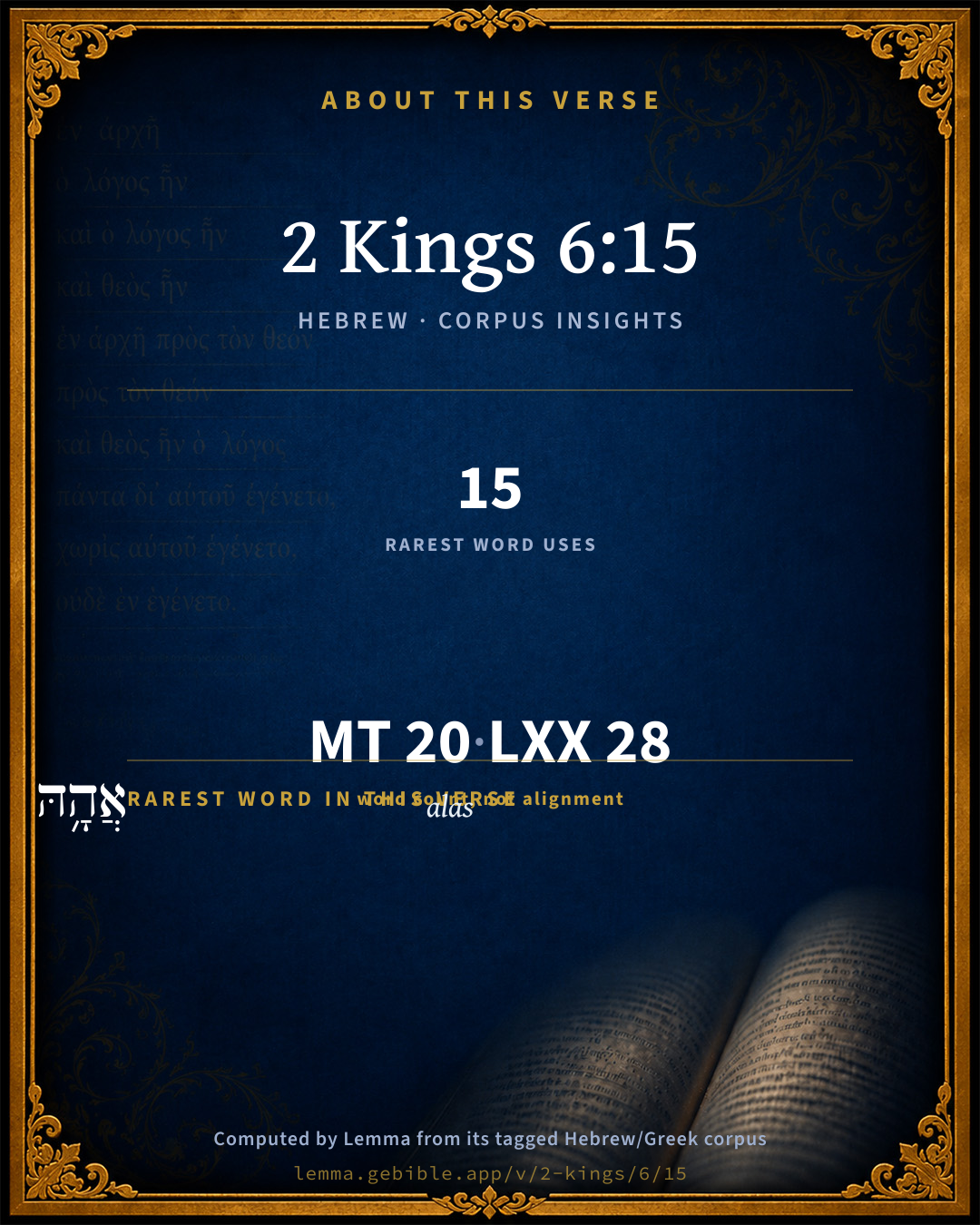
These counts appear in no published source. They are computed here, from the morphology-tagged text and Lemma’s own curated glosses. What Lemma adds →

20
words
20
distinct lemmas
Historical
section

Notable vocabulary

The rarest word here is אֲהָ֥הּ alas H162 — appearing just 15 times in the whole Hebrew Bible.

Shared distinctive vocabulary

אֲהָ֥הּ alas H162 occurs in 15 verses of the Hebrew Bible. Also found in:

Grammatical profile

  • 7 verbs
  • 8 nouns
  • 1 preposition
  • 4 particles

Verb forms

  • וַ֠יַּשְׁכֵּם Hiphil · Sequential Imperfect
  • מְשָׁרֵ֨ת Piel · Participle Active
  • לָקוּם֒ Qal · Infinitive Construct
  • וַיֵּצֵ֕א Qal · Sequential Imperfect
  • סוֹבֵ֥ב Qal · Participle Active
  • וַיֹּ֨אמֶר Qal · Sequential Imperfect
  • נַֽעֲשֶֽׂה Qal · Imperfect

Hebrew & Septuagint length

In English translation the verse runs 38 words from the Hebrew and 34 from the Septuagint (LXX English) — closely comparable.

A rough comparison of the two English renderings, which tokenize alike — not a word-level alignment.

Word counts can differ between the Hebrew and the Greek without any difference in meaning — e.g. the Hebrew direct-object marker אֵת has no separate Greek word, and Greek often adds the article ὁ.

In the original languages it is 20 Hebrew tokens and 28 Greek tokens — but the two are counted differently (Hebrew bundles its prefixes and suffixes into one token; the Greek is in lemma form), so that isn’t a like-for-like length.

Cross-references

11

Topical passages linked to 2 Kings 6:15 in the Treasury of Scripture Knowledge — connected by theme and wording, ordered by reader-vote popularity; previews shown in the World English Bible.

  • Matthew 8:26 He said to them, "Why are you fearful, oh you of little faith?" Then he got up, rebuked the wind and the sea, and there was a great calm.
  • 2 Chronicles 20:12 Our God, will you not judge them? for we have no might against this great company that comes against us; neither know we what to do: but out eyes are on you.
  • Exodus 24:13 Moses rose up with Joshua, his servant, and Moses went up onto God's Mountain.
  • Psalms 53:5 There they were in great fear, where no fear was, For God has scattered the bones of him who encamps against you. You have put them to shame, Because God has rejected them.
  • 1 Kings 19:21 He returned from following him, and took the yoke of oxen, and killed them, and boiled their flesh with the instruments of the oxen, and gave to the people, and they ate. Then he arose, and went after Elijah, and ministered to him.
  • 2 Kings 3:11 But Jehoshaphat said, Isn't there here a prophet of Yahweh, that we may inquire of Yahweh by him? One of the king of Israel's servants answered, Elisha the son of Shaphat is here, who poured water on the hands of Elijah.
  • 2 Kings 5:20 But Gehazi the servant of Elisha the man of God, said, Behold, my master has spared this Naaman the Syrian, in not receiving at his hands that which he brought: as Yahweh lives, I will run after him, and take somewhat of him.
  • 2 Kings 5:27 The leprosy therefore of Naaman shall cleave to you, and to your seed forever. He went out from his presence a leper [as white] as snow.
  • 2 Kings 6:5 But as one was felling a beam, the axe head fell into the water; and he cried, and said, Alas, my master! for it was borrowed.
  • Matthew 20:26–28 It shall not be so among you, but whoever desires to become great among you shall be your servant.
  • Acts 13:5 When they were at Salamis, they proclaimed the word of God in the synagogues of the Jews. They had also John as their attendant.

Cross-references courtesy of OpenBible.info (CC BY 4.0).

Hebrew and Greek witnesses Masoretic Hebrew ↔ Greek Septuagint

The same verse in the two great witnesses to the Old Testament, shown verse-for-verse.

These are two independent witnesses, not word-aligned to each other, and the Septuagint is shown in lemma (dictionary) form.

Hebrew 2 Kings 6:15 Masoretic · Westminster Leningrad Codex

וַ֠יַּשְׁכֵּם מְשָׁרֵ֨ת אִ֥ישׁ הָֽאֱלֹהִים֮ לָקוּם֒ וַיֵּצֵ֕א וְהִנֵּה חַ֛יִל סוֹבֵ֥ב אֶת הָעִ֖יר וְס֣וּס וָרָ֑כֶב וַיֹּ֨אמֶר נַעֲר֥וֹ אֵלָ֛יו אֲהָ֥הּ אֲדֹנִ֖י אֵיכָ֥ה נַֽעֲשֶֽׂה

When the servant of the man of God was risen early, and gone forth, behold, a host with horses and chariots was round about the city. His servant said to him, Alas, my master! how shall we do?

World English Bible · Public Domain

Greek LXX 2 Kings 6:15 Septuagint · lemma form

καί ὀρθρίζω ὁ λειτουργός ελισαιε ἀναἵστημι καί ἐκἔρχομαι καί ἰδού δύναμις κυκλόω ὁ πόλις καί ἵππος καί ἅρμα καί εἶπον ὁ παιδάριον πρός αὐτός ὦ κύριος πῶς ποιέω

And the servant of Elisaie rose up early and went out; and, behold, a host compassed the city, and horses and chariots: and the servant said to him, O master, what shall we do?

LXX2012 (modern English Septuagint) · Public Domain

Hebrew: Westminster Leningrad Codex (CC BY 4.0). Greek: Septuagint (public domain); English from LXX2012 (modern English Septuagint) (Public Domain). How the Septuagint differs from the Hebrew →

Targum (Aramaic paraphrase)

1

The Targum is the ancient Jewish Aramaic paraphrase of the Hebrew Scriptures — an interpretive translation, not the Hebrew text itself. Onkelos (literal) and Pseudo-Jonathan (expansive) render the Torah, and Jonathan the Prophets. Coverage is partial: where no permissively-licensed English translation exists for a verse, only the Aramaic is shown. This is verse-level text, not a word-by-word alignment to the Hebrew.

  1. Targum Jonathan Prophets (Joshua–Malachi)
    וְאַקְדִים מְשׁוּמְשָׁנֵיהּ דִנְבִיָא דַייָ לְמֵיקָם וּנְפַק וְהָא מַשִׁרְיַן אַקִיפָא יַת קַרְתָּא סוּסְוָן וּרְתִיכִין וַאֲמַר עוּלֵימֵיהּ לֵיהּ בְּבָעוּ רִבּוֹנִי אֵיכְדֵין נַעֲבֵּיד:

    (no public-domain English translation for this verse)

    Targum Jonathan — Aramaic: “Mikraot Gedolot” (public domain). English: “Sefaria Community Translation” (CC0 1.0 (public-domain dedication)); “London "Chaldee Paraphrase," 1871” (public domain). Text via Sefaria.

Commentary

Notes on 2 Kings 6:15 from classic Christian and Jewish commentators (each source and its license shown beneath its notes). The classic Christian expositions comment on the surrounding passage and are grouped to its opening verse, so a note may address several verses; the Jewish commentaries on the Tanakh (Rashi and others) are per-verse, so they appear only where the commentator wrote on this verse.

Lemma curates 59 commentaries, every one of them public domain or Creative Commons licensed, each selected and text-cleaned for this edition rather than reprinted as found. About our sources →

Trapp's Complete Commentary

John Trapp

2Ki 6:15 And when the servant of the man of God was risen early, and gone forth, behold, an host compassed the city both with horses and chariots. And his servant said unto him, Alas, my master! how shall we do?

Ver. 15. Alas, my master! how shall we do?] Vox desperantis. Flesh and blood in an exigent gives up all for lost. Infidelity limiteth God’s boundless power and bottomless mercy: this is a kind of taking away of the Almighty. Hope above hope. Qui nil potest sperare, desperet nihil.

John Trapp, A Commentary or Exposition upon All the Books of the Old and New Testament (1647–1656) — public domain. Text from a community e-Sword module.

Joseph Benson's Commentary

2Ki 6:15. The servant said, Alas! my master — Perhaps the Syrians had assured the inhabitants they intended no harm to them, but only came to take Elisha; which the young man hearing, was put into great fear: for, having probably not been long with the prophet, (being only taken into his service since Gehazi’s dismission,) and having not yet seen any of his wonderful works, he gave himself and his master up for lost men. How shall we do? — It is to no purpose to think either of fighting or flying, but we must unavoidably fall into their hands.

Joseph Benson's Commentary on the Old and New Testaments (1811–1818) — public domain. Text from a community e-Sword module.

Tyndale Open Study Notes

Tyndale Open Resources

6:15 The identity of Elisha’s alarmed servant is unknown. He was evidently the replacement of Gehazi (5:27).

Tyndale Open Study Notes — © Tyndale Open Resources, licensed CC BY-SA 4.0. Text via the HelloAO Bible API.

Jamieson, Fausset & Brown

Robert Jamieson, A. R. Fausset & David Brown

his servant said unto him, Alas, my master! how shall we do?--When the Syrian detachment surrounded the place by night, for the apprehension of the prophet, his servant was paralyzed with fear. This was a new servant, who had only been with him since Gehazi's dismissal and consequently had little or no experience of his master's powers. His faith was easily shaken by so unexpected an alarm.

Jamieson, Fausset & Brown — Commentary Critical and Explanatory on the Whole Bible (1871) — public domain (CC PDM 1.0). Text via the HelloAO Bible API.

Ellicott's Commentary for English Readers

(15) The servant of the man of God.—One waiting on (i.e., a minister of) the man of God. Not Gehazi, who is never called Elisha’s minister, and is usually mentioned by name.

Was risen early.—For the Hebrew construction, comp. Psa_127:2; Isa_5:11; Hos_6:4.

Gone forth.—To the outside of the house, which commanded a view of the valley below, where the Syrians lay.

And his servant said.—On returning into the house. The narrative is contracted.

A Bible Commentary for English Readers, edited by Charles John Ellicott (1878–1897) — public domain. Text from a community e-Sword module.

The Cambridge Bible for Schools and Colleges

gen. ed. J. J. S. Perowne

15. the servant] The word is the same which in 2Ki_4:43 was rendered ‘servitor’. It is the special and more personal servant. Hence the R.V. puts ‘or, minister’ in the margin.

a host compassed the city both with horses and chariots] R.V. an host with horses and chariots was round about the city. The words are not the same in Hebrew as in the previous verse where ‘compassed’ was used. Literally ‘an host and horses &c.’ The horses and chariots were in addition to the footmen, who alone were spoken of in verse 14.

The Cambridge Bible for Schools and Colleges (gen. ed. J. J. S. Perowne; Cambridge University Press, 1878–1918) — public domain. Text from a community e-Sword module.

John Gill's Exposition

And he answered, fear not, for they that be with us are more than they that be with them. Meaning the legions of angels that encamped around them.

And he answered, fear not, for they that be with us are more than they that be with them. Meaning the legions of angels that encamped around them.

2 Kings 6:17

kg2 6:17

kg2 6:17

kg2 6:17And Elisha prayed, and said, Lord, I pray thee, open his eyes, that he may see,.... Not the eyes of his body, which were not shut nor blinded, but the eyes of his mind; or, in other words, grant him a vision, represented in so strong a light, as to remove his fears:

and the Lord opened the eyes of the young man, and he saw; he had a vision of angels:

and, behold, the mountain; on which the city was built, or one near it:

was full of horses and chariots of fire; angels in this form, as in Kg2 2:11, and these were

round about Elisha; being round about the city where he was; or rather so in the vision it was represented to the young man, he saw his master surrounded with horses and chariots of fire, in the utmost safety.

John Gill's Exposition of the Whole Bible (1746–1763) — public domain (CC PDM 1.0). Text via the HelloAO Bible API.

Haydock's Catholic Bible Commentary

Servant, Giezi; as his leprosy is placed too soon. (Salien) (Menochius)

George Leo Haydock (1774–1849), Haydock's Catholic Family Bible and Commentary, 1859 edition — public domain. Excludes Psalms (Douay-Rheims chapter numbering differs from Protestant) and Deuterocanonical books (Catholic canon only).

Matthew Poole's English Annotations

The servant having been with him but a little time, even since Gehazi’s dismission, had not yet seen any experiments of his great power; or if he had, his faith might easily be shaken upon so great and sudden a danger.

Gone forth; either out of the gates of the city, where he might see them; or out of his house into the streets of the city, where he might learn this by the common fame and tumult of the people.

Matthew Poole's English Annotations on the Holy Bible (1683–1685) — public domain. Text from a community e-Sword/MySword module.

Whedon's Commentary on the Bible

Daniel D. Whedon

15. Servant of the man of God — Not Gehazi, but another chosen in his place; probably a young man taken from one of the schools of the prophets.

Daniel D. Whedon (gen. ed.), Commentary on the Old and New Testaments (1874–1909) — public domain. Text from a community e-Sword module.

The Pulpit Commentary

And when the servant of the man of God was risen early he had, perhaps, heard the arrival of the Syrian forces during the night,and "rose early" to reconnoiterand gone forth, behold, a host compassed the city both with horses and chariots; rather, a host compassed the city, and horses, and chariots. A force of footmen, a force of horsemen, and a chariot force, are intended (cutup. ver. 14). And his servant said unto him, Alas, my master! how shall we do? Though the servant could not know that it was Elisha"s person which was especially sought, yet he was naturally alarmed at seeing the city invested by a hostile force, and anticipated either death or capture, which last would involve the being sold as a slave. Hence his "Alas!" and his piteous cry, "How shall we do?" Can we, i.e. in any way, save ourselves?

Vers. 15-17. Invincible helpers of the good.

when the servant of the man of God was risen," etc. The context illustrates two circumstances too frequently overlooked, but ever demanding the recognition and study of mankind.

1. The value of a good man to his country. The Syrian monarch makes war with Israel; his counsels are formed, his arrangements are complete, and sanguine are his hopes of victory. But there is a good man in Israel Elisha who reads the hidden purpose of the Syrian despot, sounds the alarm, puts his country on its guard, invokes Heaven, and thus confounds the wily stratagems and thwarts the murderous purposes of the foe. "So the bands of Syria came no more into the land of Israel." True piety is the source of true patriotism; its prayers and prophecies are the sure "defenses" of nations. This idea is dawning on the world now; and in coming periods will blaze in broad daylight on mankind. We shall one day see that the victories of truth and prayer were the only victories that ever served the interest of any nation, and that many a pious man, who lived in obscurity and died under oppression, conferred greater blessings on the commonwealth than those statesmen and warriors whose patriotism has been emblazoned in history and sung in verse. The context illustrates:

2. The source of a wicked mans weakness. Why did not this Syrian tyrant succeed in his plans? The words which one of his servants addressed to him explain the cause: "Elisha, the prophet that is in Israel, telleth the King of Israel the words that thou speakest in thy bedchamber." His projects would not bear the light. As a principle, wicked men would seldom, if ever, realize their ends were there a prophet to unveil their hearts, and publish all the selfish, sensual, dishonest, and blasphemous thoughts that transpire in the hidden chamber of their souls. Wicked tradesmen, lawyers, statesmen, and others succeed only as they conceal their hearts from public view. Let some prophet, like Ezekiel of old, break open the barred door of their "chamber of imagery," and expose the hideous forms "portrayed upon the wall," the impious works that are wrought "in the dark, and forthwith they will lose all public sympathy, patronage, and support. O my soul, cherish thou thoughts that shall bear a prophet"s fiery glance principles that will glow, bloom, and look attractive in the daylight; and purposes that will commend thee to the Divine consciousness of brother spirits, and to the favor of the Everlasting. I proceed to state, with the utmost brevity, a few general truths suggested by the incident before us.

I THAT THE GOOD ARE OFTEN PLACED IN CIRCUMSTANCES TO REQUIRE SUPERHUMAN HELP. Elisha and his servant were, at this time, at Dothan. The Syrian king, enraged with the prophet for frustrating his military designs on Israel, sends "horses, and chariots, and a great host" in pursuit of him. The mighty army "came by night, and compassed the city about." Early in the morning the prophet"s servant beheld the armed and ruthless multitude drawn up around the city. Here were enemies, which the prophet himself could not subdue, perils from which his unaided power could not extricate himself. Faint symbol this of the spiritual enemies that surround our dwellings! True, in these days, the antagonists of the good are not so outwardly visible as they were in times that are past. The great enemy does not send forth his host now garbed in the attire of the persecutors. They appear not amongst us in the grim and savage forms of the Julians and the Neros, the Maximins and the Diocletians; they assume a habiliment more consonant with the tastes of this civilized era. Their forms fascinate rather than terrify. They seek to draw rather than to drive. But still, are they any less deadly in their aim, or formidable in their power, because they change their garb, drop the sword, and stretch out the hand of false friendship? It is not the plundering of our property nor the wounding of our bodies that injures us most, but the corrupting of our souls. The awakening within our spiritual natures of an impure suggestion may work a far more fearful ruin than incarcerating us in dungeons, or sending us to the martyr"s stake and flames. I call those forces mine enemies that are unfavorable to my spiritual interests. Whatever dims my inner vision, and tends to veil from me the sublimities of the "unseen;" whatever deadens my sensibility to duty, and interferes with the free and vigorous play of my faculties; whatever draws me from the eternal future, and links me to the transient present; whatever cools, materializes, and contracts my sympathies, and keeps me more in connection with the contingent than the absolute; whatever depresses me in my struggles to reach that ideal of perfection dimly portrayed in my soul, but drawn out in abiding loveliness in the life of Jesus; whatever forces act thus, I call, with emphasis, my foes. And do not such foes surround us? Tell me of a period when "sinful lusts," which "war against the soul," were more potent and active than now? Our civilization is little more than a perfection in those arts that minister to the senses, pander to the appetites, and gratify the desires of the flesh. When did worldliness ever wield a more wide and mighty sway? When were the votaries of mammon so numerous and enthusiastic in their devotions? The deepest cry of the age seems to be, "My soul thirsteth for gold." When did corrupt literature scatter over the social soil the seeds of error, impiety, and licentiousness to such an extent as now? We are as truly hemmed in by antagonistic forces as was Elisha by the horses and chariots and hosts than encompassed him at Dothan. As we glance at them, the impression of the prophet"s servant comes to us, "Alas, master! what shall we do?" We require the help that Elisha had help from without from Heaven.

II THAT HEAVEN HAS PROVIDED HELPERS FOR MEN SUPERIOR TO ALL ANTAGONISTS. "And he answered, Fear not: for they that be with us are more than they that be with them" It is generally supposed that the reference is here to the angels "that excel in strength," and that they were the horses and chariots of fire that came to the prophet"s help. Angels are the hosts of God, and "the body-guard of the good spirits, sent forth to minister unto the heirs of salvation." This doctrine is so antecedently probable, so clearly revealed in Scripture, and so generally believed, as to require no evidence. It is to their superiority that our attention is now called.

1. They are more" in number than the foe. If we confine our attention to merely what we see in this world, we shall conclude that the agents of evil are the mere numerous. A wider survey of the general realm of spiritual being, as suggested by philosophy, and as revealed in the Bible, presents an opposite view. As malformations in nature are few compared with symmetrically organized existences, so evil spirits are few compared with the good. The great cities, principalities, and hierarchies of the universe are loyal subjects of the great King, and zealous agents in promoting his will; it is but a little province that has here and there thrown off its allegiance. Hell is but a withered leaf in the waving forest of life a flickering meteor in the starry vault of being. It is our happiness to know that evil is the exception in the universe; good is the rule. Thus evil exists as a contingency it might or might not be; but good exists by an absolute necessity it is and must be, because God is and must be.

2. They are more" in the instrumentalities they wield. The agents of evil are not only fewer in number, but inferior also in their armor. Falsehood, selfishness, wrong, these are their miserable weapons; and are they not weakness compared with truth, love, right, the weapons of the good? Ay; they can no more stand before them than "dry stubble" before the raging fire the gloom of the night-heavens before the rising sun. The history of the world gives many instances of one man, with truth and right on his side, subduing countries under the reign of falsehood and wrong.

3. They are "more" in their invincible determination. The power of a moral intelligence in any operation will not be entirely or chiefly determined by the instruments he employs, but by the strength of the purpose under which he acts. A man with a weak purpose, however great his advantages, will not do much. Now, the agents of evil can have no invincible purpose, for the obvious reason that their consciences whose sanctions can alone give invincibility are not on their side. Just as far as any being is under the influence of evil, he must be fickle and fearful. "The wicked flee when no man pursueth: but the righteous are bold as a lion.

4. They are more" in the authority under which they act. The Bible teaches that the angels of evil are under the control of one master-spirit of darkness prince of the power of the air;" but those of the good are under the authority of the Infinite. His Spirit inspires them, his will they obey, his energy is their strength. Satan, the master of the evil spirits, is himself the creature and slave of God. The moral usurper cannot move or breathe but by the permission of him who "maketh his angels spirits, and his ministers a flame of fire." Truly, then, my pious friend, however great the spiritual foes, thy helpers are greater. To the eye of sense, indeed, thou seemest to wrestle against fearful odds. Wealth, fashion, customs, influence, worldly maxims, habits, and even numbers, seem against thee; but "fear not: for they that be with us are mere than they that be with them." Open the eye of faith, and look beyond the boundary-line of sense, and thou shalt see that the great "mountain" of universal being is "full of horses and chariots of fire round about" thee.

III THAT THE SUPERIOR HELPERS OF THE GOOD ARE ONLY SEEN BY SOME. Elisha saw the celestial helpers, but his servant saw them not saw nothing but the enemy. The one, consequently, stood calm amidst the gleaming and rattling weapons of the Syrian army, the other was all perturbation and alarm. Thus men under similar circumstances receive different impressions. The event which overwhelms one with alarm inspires another with hope and heroism. The reason of this is that some have eyes to see only the evil in things, others to see the good as well. Why is this? Why is it that all men cannot see the spiritual helpers that surround them? Several reasons might be assigned.

1. There is the tendency to judge after the senses. The majority of men, like the servant of the prophet, see only with the physical eye. Although true philosophy shows that all things that come within the cognizance of the senses are shadows, not substances semblance, not essence, they reversely consider the visible and tangible only as real Spirits, therefore, which lie beyond the line of sense, and which are the living creatures in all the wheels" of human events, and in all the forms of matter, are never practically realized, and often theoretically ignored.

2. There is the habit of referring everything to secondary causes. This habit allows no room for God, nor for spiritual interpositions, but in a miracle. What is regular it calls natural; what is miraculous alone is Divine. It sees God in holding the sun over Gibeon, and the moon in the valley of Ajalon, but sees nothing of him in rolling these stupendous bodies, age after age, in their spheres, with an undeviating regularity, and a swiftness incalculable. I say nothing of the irrationality of this habit, nor of its prevalence, of which there can be no question. All I say is that, since God helps us by natural laws, this habit manifestly prevents men from seeing the helpers he sends.

3. There is also a gloominess of disposition. This is sometimes a cause. There are men who will not see good. They hear no music in the harp of love; they see no brightness in the unclouded sky of noon. On this earth, even when robed in its summer beauty or laden with autumnal wealth, they sing, or rather groan

Lord, what a wretched land is this, That yields us no supply!

The horses and chariots of mercy may move around them as celestial guards, yet they cry, "All these things are against me.

4. There is want of sympathy with God. Strong and earnest sympathy with a being always induces the mind to bring that Being near near to the inner eye and heart. By this law we bring the distant near cross oceans and continents. Yes; from worlds beyond the grave the imagination wafts the loved one home to our inmost breasts; and we see the form and hear the voice again. Had we this sympathy with God and holy spirits, we should set them always before us. Jesus had it, and he said, "Ye leave me alone; and yet I am not alone, because the Father is with me.

IV THAT TO SEE THESE SUPERHUMAN HELPERS ONLY REQUIRES THE OPENING OF THE EYES. "Lord, I pray thee, open his eyes." The outward world is to us according to bur five senses. Had we fewer, it would be less than it is; or, if more, it would be greater. There are, probably, properties in the material system which we have at present no sense to discover; or, peradventure, there may be senses closed up within, that will one day be developed, and make this old world a new thing to us. But, likely as this may be, the existence of a sense in the soul for seeing spiritual existences is more probable. I am not disposed to pronounce all who have stated that they have seen such beings to be either fanatics or impostors. The a priori wonder is, not that they should be seen, but that they are not more generally perceived. We are related to the material world, and we have senses to discern material existences. We are, confessedly, more intimately and solemnly related to the spiritual; and is it not natural to expect that we should have a sense to see spiritual beings?

Were such a sense to be opened within us, as the eye of the prophet"s servant was now opened, what visions would burst upon us! The microscope gives to us a new world of wonders; but were God to open the spiritual eye, what a multitude of worlds would be revealed! Ah, my skeptic brother! deniest thou a spiritual world? Where is thy reason? Wilt thou plead the fact that thou hast never seen a spiritual existence? This, assuredly, will not serve thee. Wilt thou permit a deaf man to deny that a thunderstorm ever rent our cloudy atmosphere, because he has never heard the terrific rear; or a blind man to deny that a rainbow has ever spanned these skies, because he, forsooth, has never seen the beauteous arch? Why, then, shouldest thou deny a spiritual world? Before the eyes of the prophet"s servant were opened, he might have denied the existence of these helpers. When his master spoke to him of them, he might have said within himself, Has my master lost his reason, or is he dreaming? I see nothing on the mountain but the Syrian host." All at once, however, his eyes were opened, and what a scene burst upon him! "The mountain was full of horses and chariots of fire round about Elisha." Even so it will be with thee, my friend: ere many days shall pass, God will open thine eyes; and that spiritual world in which thou art now living, and whose existence thou deniest, will burst in awful sublimity upon thine astonished soul! D.T.

The Pulpit Commentary (1880–1919), ed. H.D.M. Spence-Jones & Joseph S. Exell — public domain. Text from a community e-Sword module.

Keil & Delitzsch

C. F. Keil & F. Delitzsch

When Elisha's servant went out the next morning and saw the army, which had surrounded the town in the night, he said to the prophet, "Alas, my lord, how shall we do?" But Elisha quieted him, saying, "Fear not, for those with us are more than those with them." He then prayed that the Lord might open his servant's eyes, whereupon he saw the mountain upon which Dothan stood full of fiery horses and chariots round about Elisha. Opening the eyes was translation into the ecstatic state of clairvoyance, in which an insight into the invisible spirit-world was granted him. The fiery horses and chariots were symbols of the protecting powers of Heaven, which surrounded the prophet. The fiery form indicated the super-terrestrial origin of this host. Fire, as the most ethereal of all earthly elements, was the most appropriate substratum for making the spirit-world visible. The sight was based upon Jacob's vision (Gen 32:2), in which he saw a double army of angels encamped around him, at the time when he was threatened with danger from Esau.

Keil & Delitzsch — Biblical Commentary on the Old Testament (1861–1891) — public domain (CC PDM 1.0). Text via the HelloAO Bible API. (Old Testament only.)

Lesson kit

Teaching starters — assembled from the data on this page, not authored interpretation. Every prompt links to the verse data it draws on. Edit before teaching.

2 Kings, in the Historical, opens this verse with 20 words (20 distinct Hebrew lemmas). Its most distinctive word is ʼăhâhh (“alas”). A historical commentator’s framing appears above. Read the whole chapter for the surrounding context.

Discussion questions

  1. What does “alas” (ʼăhâhh) contribute to the verse as a whole?
  2. Joshua 7:7 shares the word «alas» with this verse. How do the two illuminate each other?
  3. These translations render this verse differently; the difference is in the English rendering, not the original. What questions does that raise?
  4. The verb «וַ֠יַּשְׁכֵּם» is Hiphil Sequential Imperfect. How does its form color the action?
  5. Reading how Trapp's Complete Commentary and Joseph Benson's Commentary read this verse, where do the two commentators agree and where do they part?

Things to notice

Reading settings

Reading text

Shown beneath each verse's original-language words.

Old Testament
Old Testament edition

Read the OT as the Masoretic Hebrew (MT) or the Greek Septuagint (LXX).

English shown for the Greek Septuagint (in the Hebrew ↔ Greek comparison).

Comparing translations? Open the Compare panel on any verse page to stack up to four side by side.