2 Kings 4:12

Hebrew (Westminster Leningrad Codex) 2 Kings 4:12 appears in the Hebrew Old Testament. The text above is from the Westminster Leningrad Codex. Each word links to its Strong’s number, a concise gloss, and parsing drawn from the Open Scriptures Hebrew Bible morphology. Click any word for its full Brown-Driver-Briggs (BDB) entry.
Download image
Cite this verse

2 Kings 4:12 (World English Bible). Public Domain. Lemma interlinear Bible study tool, https://lemma.gebible.app/v/2-kings/4/12.

Show BibTeX & RIS
BibTeX
RIS
English Translation
He said to Gehazi his servant, Call this Shunammite. When he had called her, she stood before him.
World English Bible · Public Domain
Highlights
  • 1 first appearance in the Hebrew Bible
Full analysis ↓
Download a study sheet

One document with this verse’s original text, its word-by-word gloss line, the meaning frame, cross-references with their text, attributed commentary, and full source and license credits — printable, and it pastes into notes with its structure intact.

This verse Autodidact and up

Study sheet (.html) Plain text (.txt)

A passage Seminary Student

Up to 50 verses in one chapter. A passage sheet keeps up to 6 commentary sources and 12 cross-references per verse, in the order this page ranks them, and says so on the sheet whenever that leaves anything out. Ask for a single verse and you get the Autodidact verse sheet above.

Everything on this page stays free to read, with no account — the sheet is a download of what is already on screen, not access to it.

Want to remove ads? Support Godless Engineer
Compare translations 3

The same verse in 3 English versions, stacked beneath the original-language interlinear above. Click any original word for its lexicon entry.

Each is an independent rendering of the whole verse — the interlinear is not word-aligned to these translations.

Highlighted words mark where these versions differ — a whole-verse word diff, not a word-by-word alignment.

  • World English Bible Public Domain
    He said to Gehazi his servant, Call this Shunammite. When he had called her, she stood before him.
  • King James Version Public Domain
    And he said to Gehazi his servant, Call this Shunammite. And when he had called her, she stood before him.
  • unfoldingWord Literal Text CC BY-SA 4.0
    And he said to Gehazi his servant, “Call for this Shunammitess.” And he called for her, and she stood to his face.

unfoldingWord Literal Text — © unfoldingWord, licensed CC BY-SA 4.0. Word-aligned USFM3 via Door43 (git.door43.org/unfoldingWord/en_ult).

Versions to compare (up to 4)

3 of 4 selected

Show all 18 translations

Every available English version of this verse, each an independent rendering of the whole verse.

  • World English Bible Public Domain
    He said to Gehazi his servant, Call this Shunammite. When he had called her, she stood before him.
  • Berean Standard Bible Public Domain
    And he said to Gehazi his servant, “Call the Shunammite woman.” And when he had called her, she stood before him,
  • Majority Standard Bible Public Domain
    And he said to Gehazi his servant, “Call the Shunammite woman.” And when he had called her, she stood before him,
  • King James Version Public Domain
    And he said to Gehazi his servant, Call this Shunammite. And when he had called her, she stood before him.
  • American Standard Version (1901) Public Domain
    And he said to Gehazi his servant, Call this Shunammite. And when he had called her, she stood before him.
  • Revised Version (1885) Public Domain
    And he said to Gehazi his servant, Call this Shunammite. And when he had called her, she stood before him.
  • Geneva Bible (1599) Public Domain
    And sayd to Gehazi his seruant, Call this Shunammite: and when hee called her, she stood before him.
  • Douay-Rheims (1899) Public Domain
    And he said to Giezi his servant Call this Sunamitess. And when he had called her, and she stood before him,
  • Young's Literal Translation Public Domain
    and he saith unto Gehazi his young man, `Call for this Shunammite;' and he calleth for her, and she standeth before him.
  • Literal Standard Version CC BY-SA 4.0
    and he says to his young man Gehazi, “Call for this Shunammite”; and he calls for her, and she stands before him.
  • Unlocked Literal Bible CC BY-SA 4.0
    Elisha said to Gehazi his servant, “Call this Shunammite.” When he had called her, she stood before him.
  • unfoldingWord Literal Text CC BY-SA 4.0
    And he said to Gehazi his servant, “Call for this Shunammitess.” And he called for her, and she stood to his face.
  • Darby Bible Public Domain
    And he said to Gehazi his servant, Call this Shunammite. And he called her, and she stood before him.
  • World Messianic Bible Public Domain
    He said to Gehazi his servant, “Call this Shunammite.” When he had called her, she stood before him.
  • Webster's Bible Public Domain
    And he said to Gehazi his servant, Call this Shunamite. And when he had called her, she stood before him.
  • Free Bible Version CC BY-SA 4.0
    He said to his servant Gehazi, “Ask the Shunammite woman to come here.” Gehazi called her and she came to see Elisha.
  • Bible in Basic English Public Domain
    And he said to Gehazi, his servant, Send for this Shunammite. So in answer to his voice she came before him.
  • JPS Tanakh (1917) Public Domain
    And he said to Gehazi his servant: 'Call this Shunammite.' And when he had called her, she stood before him.

Literal Standard Version (2020), Covenant Press — licensed CC BY-SA 4.0. Text via the HelloAO Bible API (eBible.org). Unlocked Literal Bible (unfoldingWord) — licensed CC BY-SA 4.0. Text via the HelloAO Bible API (eBible.org). unfoldingWord Literal Text — © unfoldingWord, licensed CC BY-SA 4.0. Word-aligned USFM3 via Door43 (git.door43.org/unfoldingWord/en_ult). Free Bible Version, Dr. Jonathan Gallagher — licensed CC BY-SA 4.0. Text via the HelloAO Bible API (eBible.org).

Word by word

More ways to search: Search by grammar → Find every occurrence → Compare this word →

Practice this passage: Drill this verse → Learn its vocabulary →

לַשּׁוּנַמִּ֣ית
Shûwnammîyth
H7767
“to/for the · Shunammite”
Preposition, Determined + Noun, Gentilic, Feminine, Singular, Absolute
Part of Speech
Preposition + Noun
Type
Gentilic
Gender
Feminine
Number
Singular
State
Absolute
Full BDB Definition

Origin: patrial from H7766

TWOT: None

Shunammite = see Shunen " double resting place" - an inhabitant of Shunem
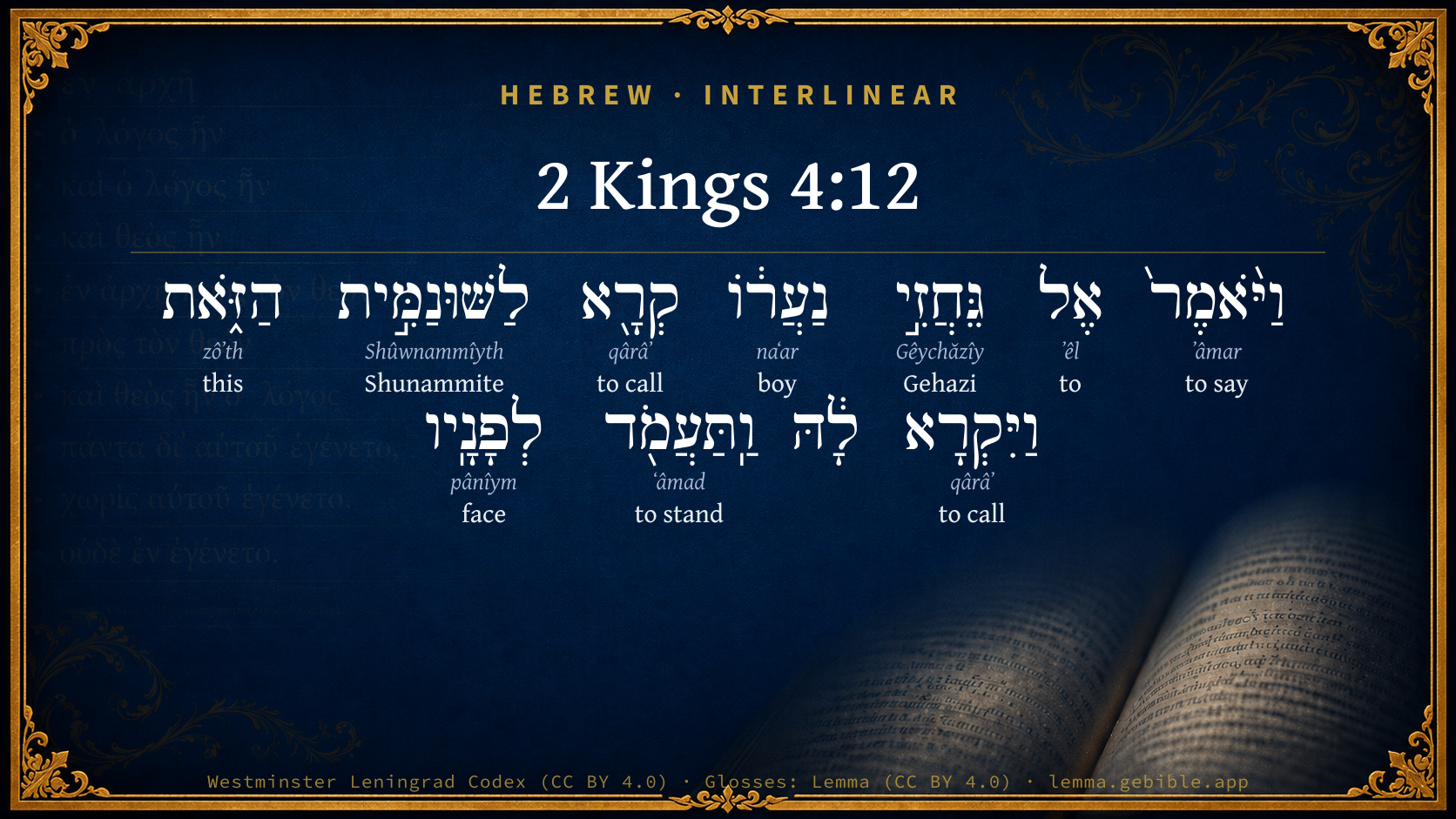
  1. וַיֹּ֨אמֶר֙ ʼâmar H559 “and · to say” Conjunction + Verb, Qal, Sequential Imperfect, 3rd Person, Masculine, Singular
  2. אֶל ʼêl H413 “to” Preposition
  3. גֵּחֲזִ֣י Gêychăzîy H1522 “Gehazi” Noun, Proper
  4. נַעֲר֔וֹ naʻar H5288 “boy · his” Noun, Common, Masculine, Singular, Construct + Suffix, Personal, 3rd Person, Masculine, Singular
  5. קְרָ֖א qârâʼ H7121 “call” Verb, Qal, Imperative, 2nd Person, Masculine, Singular
  6. הַזֹּ֑את zôʼth H2063 “the · this” Particle, Definite Article + Pronoun, Demonstrative, Feminine, Singular
  7. וַיִּקְרָא qârâʼ H7121 “and · to call” Conjunction + Verb, Qal, Sequential Imperfect, 3rd Person, Masculine, Singular
  8. וַֽתַּעֲמֹ֖ד ʻâmad H5975 “and · to stand” Conjunction + Verb, Qal, Sequential Imperfect, 3rd Person, Feminine, Singular
  9. לְפָנָֽיו pânîym H6440 “to/for · face(s) · his” Preposition + Noun, Common, Both, Plural, Construct + Suffix, Personal, 3rd Person, Masculine, Singular

About this verse

These counts appear in no published source. They are computed here, from the morphology-tagged text and Lemma’s own curated glosses. What Lemma adds →

11
words
9
distinct lemmas
Historical
section

Notable vocabulary

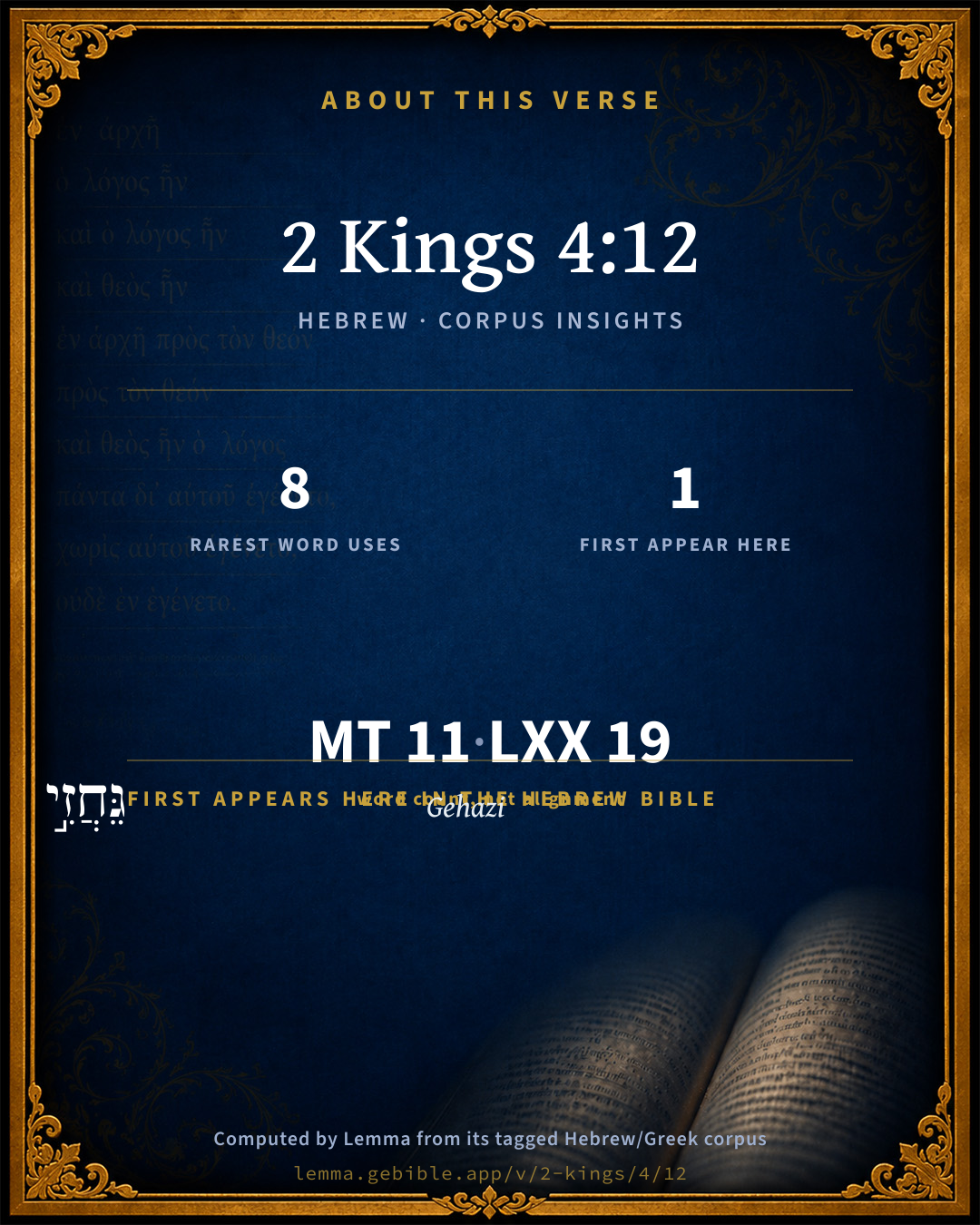
The rarest word here is לַשּׁוּנַמִּ֣ית Shunammite H7767 — appearing just 8 times in the whole Hebrew Bible.

First appearance in Scripture

This word makes its first canonical appearance in the Hebrew Bible here:

  • גֵּחֲזִ֣י Gehazi H1522

Shared distinctive vocabulary

לַשּׁוּנַמִּ֣ית Shunammite H7767 occurs in 8 verses of the Hebrew Bible. Also found in:

Grammatical profile

  • 4 verbs
  • 4 nouns
  • 1 pronoun
  • 2 prepositions

Verb forms

  • וַיֹּ֨אמֶר֙ Qal · Sequential Imperfect
  • קְרָ֖א Qal · Imperative
  • וַיִּקְרָא Qal · Sequential Imperfect
  • וַֽתַּעֲמֹ֖ד Qal · Sequential Imperfect

Repetition

A word recurs within this verse — often emphatic in Hebrew:

  • קְרָ֖א to call H7121 ×2

Hebrew & Septuagint length

In English translation the verse runs 18 words from the Hebrew and 20 from the Septuagint (LXX English) — closely comparable.

A rough comparison of the two English renderings, which tokenize alike — not a word-level alignment.

Word counts can differ between the Hebrew and the Greek without any difference in meaning — e.g. the Hebrew direct-object marker אֵת has no separate Greek word, and Greek often adds the article ὁ.

In the original languages it is 11 Hebrew tokens and 19 Greek tokens — but the two are counted differently (Hebrew bundles its prefixes and suffixes into one token; the Greek is in lemma form), so that isn’t a like-for-like length.

Cross-references

7

Topical passages linked to 2 Kings 4:12 in the Treasury of Scripture Knowledge — connected by theme and wording, ordered by reader-vote popularity; previews shown in the World English Bible.

  • 2 Kings 8:4–5 Now the king was talking with Gehazi the servant of the man of God, saying, Please tell me all the great things that Elisha has done.
  • 1 Kings 19:3 When he saw that, he arose, and went for his life, and came to Beersheba, which belongs to Judah, and left his servant there.
  • 2 Kings 3:11 But Jehoshaphat said, Isn't there here a prophet of Yahweh, that we may inquire of Yahweh by him? One of the king of Israel's servants answered, Elisha the son of Shaphat is here, who poured water on the hands of Elijah.
  • 2 Kings 4:29–31 Then he said to Gehazi, Gird up your loins, and take my staff in your hand, and go your way: if you meet any man, Don't greet him; and if anyone greets you, don't answer him again: and lay my staff on the face of the child.
  • 2 Kings 5:20–27 But Gehazi the servant of Elisha the man of God, said, Behold, my master has spared this Naaman the Syrian, in not receiving at his hands that which he brought: as Yahweh lives, I will run after him, and take somewhat of him.
  • 1 Kings 18:43 He said to his servant, Go up now, look toward the sea. He went up, and looked, and said, There is nothing. He said, Go again seven times.
  • Acts 13:5 When they were at Salamis, they proclaimed the word of God in the synagogues of the Jews. They had also John as their attendant.

Cross-references courtesy of OpenBible.info (CC BY 4.0).

Hebrew and Greek witnesses Masoretic Hebrew ↔ Greek Septuagint

The same verse in the two great witnesses to the Old Testament, shown verse-for-verse.

These are two independent witnesses, not word-aligned to each other, and the Septuagint is shown in lemma (dictionary) form.

Hebrew 2 Kings 4:12 Masoretic · Westminster Leningrad Codex

וַיֹּ֨אמֶר֙ אֶל גֵּחֲזִ֣י נַעֲר֔וֹ קְרָ֖א לַשּׁוּנַמִּ֣ית הַזֹּ֑את וַיִּקְרָא לָ֔הּ וַֽתַּעֲמֹ֖ד לְפָנָֽיו

He said to Gehazi his servant, Call this Shunammite. When he had called her, she stood before him.

World English Bible · Public Domain

Greek LXX 2 Kings 4:12 Septuagint · lemma form

καί εἶπον πρός γιεζι ὁ παιδάριον αὐτός καλέω ἐγώ ὁ σωμανῖτις οὗτος καί καλέω αὐτός καί ἵστημι ἐνώπιον αὐτός

And he said to Giezi his servant, Call me this Somanite. and he called her, and she stood before him.

LXX2012 (modern English Septuagint) · Public Domain

Hebrew: Westminster Leningrad Codex (CC BY 4.0). Greek: Septuagint (public domain); English from LXX2012 (modern English Septuagint) (Public Domain). How the Septuagint differs from the Hebrew →

Targum (Aramaic paraphrase)

1

The Targum is the ancient Jewish Aramaic paraphrase of the Hebrew Scriptures — an interpretive translation, not the Hebrew text itself. Onkelos (literal) and Pseudo-Jonathan (expansive) render the Torah, and Jonathan the Prophets. Coverage is partial: where no permissively-licensed English translation exists for a verse, only the Aramaic is shown. This is verse-level text, not a word-by-word alignment to the Hebrew.

  1. Targum Jonathan Prophets (Joshua–Malachi)
    וַאֲמַר לְגֵיחֲזֵי עוּלֵימֵיהּ קְרִי לְשׁוּנַמִיתָא הָדָא וּקְרָא לָהּ וְקָמַת קֳדָמוֹהִי:

    (no public-domain English translation for this verse)

    Targum Jonathan — Aramaic: “Mikraot Gedolot” (public domain). English: “Sefaria Community Translation” (CC0 1.0 (public-domain dedication)); “London "Chaldee Paraphrase," 1871” (public domain). Text via Sefaria.

Commentary

Notes on 2 Kings 4:12 from classic Christian and Jewish commentators (each source and its license shown beneath its notes). The classic Christian expositions comment on the surrounding passage and are grouped to its opening verse, so a note may address several verses; the Jewish commentaries on the Tanakh (Rashi and others) are per-verse, so they appear only where the commentator wrote on this verse.

Lemma curates 59 commentaries, every one of them public domain or Creative Commons licensed, each selected and text-cleaned for this edition rather than reprinted as found. About our sources →

Trapp's Complete Commentary

John Trapp

2Ki 4:12 And he said to Gehazi his servant, Call this Shunammite. And when he had called her, she stood before him.

Ver. 12. Call this Shunammite.] Gehazi it seemeth was sent to call her, but withal to acquaint her with the business, - viz., that if she had any suit to the king or his general, &c., - and to bring back her answer; whereupon consulting with Gehazi what was to be done for her, and understanding by him that she had no child, Elisha bade Gehazi call her, as 2Ki 4:15.

John Trapp, A Commentary or Exposition upon All the Books of the Old and New Testament (1647–1656) — public domain. Text from a community e-Sword module.

Joseph Benson's Commentary

2Ki 4:12. She stood before him — The narrative seems to be a little perplexed, but may be thus conceived: it is in this verse recorded in the general, that the prophet sent Gehazi to call her, and that she came to him upon that call; then follows a particular description of the whole business, with all the circumstances; first, of the message with which Gehazi was sent when he went to call her, and of her answer to that message, (2Ki 4:13,) and Gehazi’s conjecture thereupon, (2Ki 4:14,) and then of her coming to the prophet at his call; which is there repeated to make way for the following passages.

Joseph Benson's Commentary on the Old and New Testaments (1811–1818) — public domain. Text from a community e-Sword module.

Adam Clarke's Commentary

Verse 12. Gehazi his servant] This is the first time we hear of this very indifferent character.

Adam Clarke's Commentary on the Bible (1810–1826) — public domain. Text from a community e-Sword/MySword module.

Ellicott's Commentary for English Readers

(12) Gehazi his servant.—First mentioned here. His name means “valley of vision,” and is perhaps derived from his native place, which may have got its name from being a haunt of prophets.

His servant.—His young man (Gen_22:3).

She stood before him—i.e., before Gehazi. The sentence, “And when he had called her, she stood before him,” is an anticipation of the result, and might be placed within a parenthesis.

A Bible Commentary for English Readers, edited by Charles John Ellicott (1878–1897) — public domain. Text from a community e-Sword module.

The Cambridge Bible for Schools and Colleges

gen. ed. J. J. S. Perowne

12. to Gehazi his servant] Gehazi is mentioned in this narrative, in ch. 2Ki_5:20 and the following verses, and again in ch. 2Ki_8:4. He probably stood in the same position to Elisha which the latter had held towards Elijah, though the men were utterly different in character. Gehazi appears from 2Ki_8:4 to have been a person of consequence enough to be known to, and conversed with, by the king. See note there.

she stood before him] i.e. before Elisha. It is clear that Elisha’s character inspired great reverence, and though the Shunammite was his hostess she did not come unbidden into his presence.

The Cambridge Bible for Schools and Colleges (gen. ed. J. J. S. Perowne; Cambridge University Press, 1878–1918) — public domain. Text from a community e-Sword module.

John Gill's Exposition

And he said to Gehazi his servant,.... Who attended him wherever he went, and ministered to him, and lay very probably in the same chamber with him; he might be one of the sons of the prophets:

call this Shunammite; tell her I desire to speak with her:

and when he had called her, she stood before him; at the door of the chamber, in great reverence of him, and with much humility, waiting to hear what he had to say to her: this must be understood after what had further passed between Elisha and Gehazi, and between Gehazi and the woman, who returned to his master, and acquainted him with what she had said to him, upon which he was sent to call her, and she came.

John Gill's Exposition of the Whole Bible (1746–1763) — public domain (CC PDM 1.0). Text via the HelloAO Bible API.

Matthew Poole's English Annotations

i.e. Before the prophet, in the door of his chamber, as it is said, 2Ki 4:15. The relation seems to be a little perplexed, but may be thus conceived. It is in this verse recorded, in the general, that the prophet sent Gehazi to call her, and that she came to him upon that call; then follows a particular description of the whole business, with all the circumstances, first, of the message with which Gehazi was sent when he went to call her, and of her answer to that message, 2Ki 4:13, and of Gehazi’s conjecture thereupon, 2Ki 4:14, and then of her coming to the prophet at his call; which is there repeated to make way for the following passages.

Matthew Poole's English Annotations on the Holy Bible (1683–1685) — public domain. Text from a community e-Sword/MySword module.

The Pulpit Commentary

And he said to Gehazi his servant. Gehazi is here mentioned for the first time. He seems to have been Elisha"s "servant" in a lower sense than Elisha had been Elijah"s. Still, his position was such that on one occasion (2Ki_8:4, 2Ki_8:5) a king of Israel did not disdain to hold a conversation with him. Call this Shunammite. And when he had called her, she stood before him; i.e. before Gehazi. Elisha communicates with the woman through his servant, or at any rate in his presence, probably to prevent any suspicion of impropriety arising in the mind of any one. The prophet of the Lord must not be evil spoken of.

The Pulpit Commentary (1880–1919), ed. H.D.M. Spence-Jones & Joseph S. Exell — public domain. Text from a community e-Sword module.

John Wesley's Explanatory Notes

She stood - The relation seems to be a little perplexed, but may be thus conceived. It is in this verse recorded in the general, that the prophet sent Gehazi to call her, and that she came to him upon that call: then follows a particular description of the whole business, with all the circumstances, first, of the message with which Gehazi was sent when he went to call her, and of her answer to that message, ver. 13, and of Gehazi's conjecture thereupon, ver. 14, and then of her coming to the prophet at his call: which is there repeated to make way for the following passages.

John Wesley, Explanatory Notes Upon the Whole Bible (1754–1765) — public domain. Text via the GEBible commentary corpus.

unfoldingWord translationNotes

Door43 World Missions Community

Gehazi

This is the name of a man. (See: How to Translate Names)

Call this Shunammite

"Call the Shunammite woman." This refers to the woman from Shunem that Elisha was staying with.

You have gone to all this trouble to care for us

The phrase "gone to all this trouble" is an idiom that means to make great effort to do something. AT: "You have made a great effort to care for us" or "You have worked very hard to take care of us" (See: Idiom)

What can be done for you

This can be stated in active form. AT: "What can we do for you" (See: Active or Passive)

Can we speak for you

Here Elisha is asking if she would like for him to speak to the king or army commander to make a request for her. The implicit meaning of this question can be made explicit. AT: "Can we make a request for you" (See: Assumed Knowledge and Implicit Information)

I live among my own people

The woman is implying that she does not need anything because her family cares for her needs. AT: "I live surrounded by my family, and because they take care of me, I have no needs" (See: Assumed Knowledge and Implicit Information)

translationWords

servant

call

trouble

king

commander

unfoldingWord translationNotes — © Distant Shores Media and the Door43 World Missions Community, licensed CC BY-SA 4.0. Source: git.door43.org/Door43/en_tn.

Lesson kit

Teaching starters — assembled from the data on this page, not authored interpretation. Every prompt links to the verse data it draws on. Edit before teaching.

2 Kings, in the Historical, opens this verse with 11 words (9 distinct Hebrew lemmas). Its most distinctive word is Shûwnammîyth (“Shunammite”). A historical commentator’s framing appears above. Read the whole chapter for the surrounding context.

Discussion questions

  1. What does “Shunammite” (Shûwnammîyth) contribute to the verse as a whole?
  2. This is the first place “Gehazi” appears in Scripture (first appears here). What does its debut here establish?
  3. How does 1 Kings 1:3, which shares the word «Shunammite», read alongside this verse?
  4. What does the repetition of “to call” (2× in this one verse) do in this verse?
  5. The translations on this page render this verse differently — a whole-verse word diff, not a word-by-word alignment. What might account for the different wordings?
  6. «וַיֹּ֨אמֶר֙» is a Qal Sequential Imperfect verb. How does that grammatical form shape the action described?
  7. Compare how Trapp's Complete Commentary and Joseph Benson's Commentary read this verse. Where do they agree or differ?

Things to notice

Reading settings

Reading text

Shown beneath each verse's original-language words.

Old Testament
Old Testament edition

Read the OT as the Masoretic Hebrew (MT) or the Greek Septuagint (LXX).

English shown for the Greek Septuagint (in the Hebrew ↔ Greek comparison).

Comparing translations? Open the Compare panel on any verse page to stack up to four side by side.