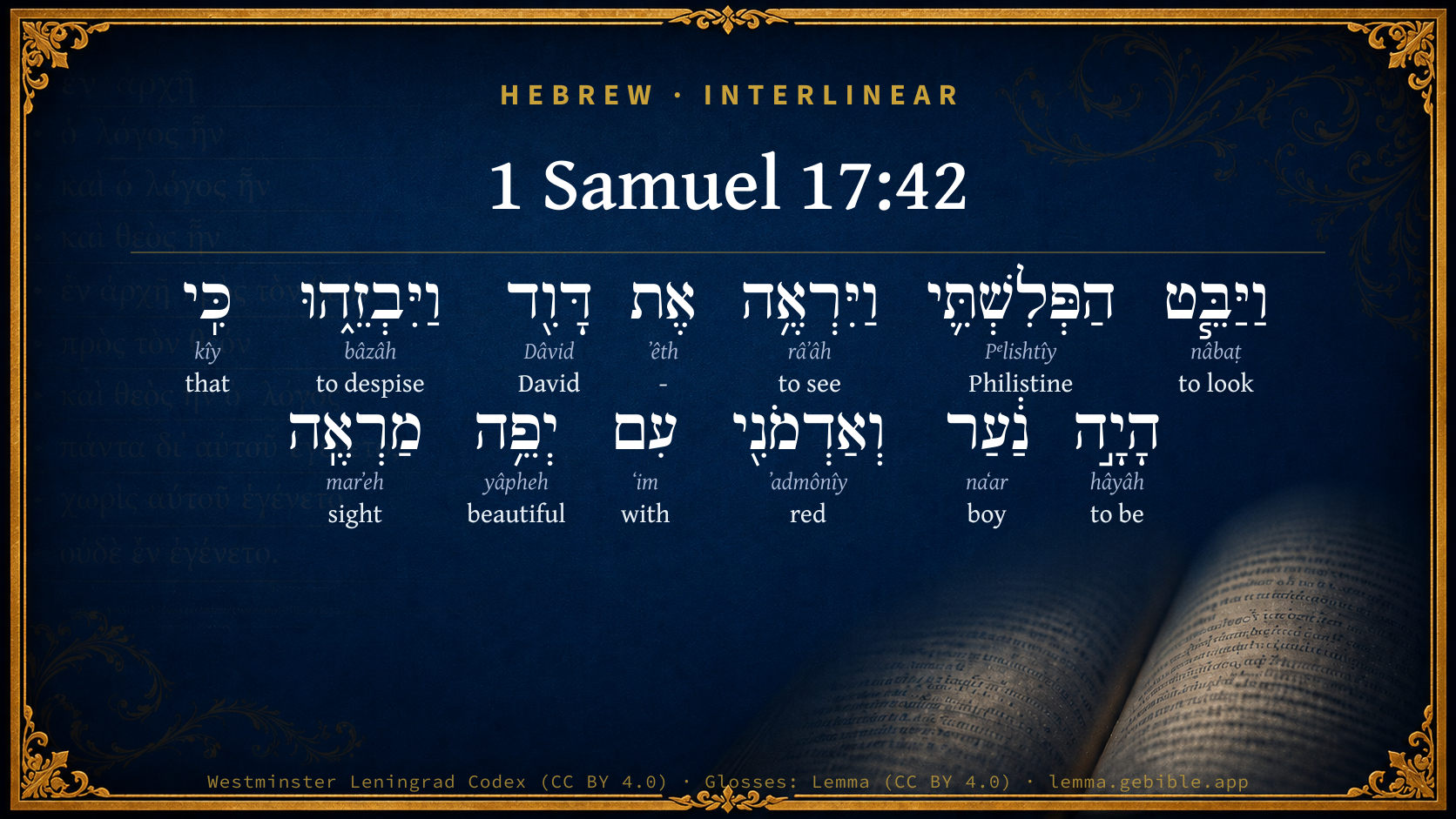
1 Samuel 17:42

Hebrew (Westminster Leningrad Codex) 1 Samuel 17:42 appears in the Hebrew Old Testament. The text above is from the Westminster Leningrad Codex. Each word links to its Strong’s number, a concise gloss, and parsing drawn from the Open Scriptures Hebrew Bible morphology. Click any word for its full Brown-Driver-Briggs (BDB) entry.
Download image
Cite this verse

1 Samuel 17:42 (World English Bible). Public Domain. Lemma interlinear Bible study tool, https://lemma.gebible.app/v/1-samuel/17/42.

Show BibTeX & RIS
BibTeX
RIS
English Translation
When the Philistine looked about, and saw David, he disdained him; for he was but a youth, and ruddy, and withal of a fair face.
World English Bible · Public Domain
Download a study sheet

One document with this verse’s original text, its word-by-word gloss line, the meaning frame, cross-references with their text, attributed commentary, and full source and license credits — printable, and it pastes into notes with its structure intact.

This verse Autodidact and up

Study sheet (.html) Plain text (.txt)

A passage Seminary Student

Up to 50 verses in one chapter. A passage sheet keeps up to 6 commentary sources and 12 cross-references per verse, in the order this page ranks them, and says so on the sheet whenever that leaves anything out. Ask for a single verse and you get the Autodidact verse sheet above.

Everything on this page stays free to read, with no account — the sheet is a download of what is already on screen, not access to it.

Want to remove ads? Support Godless Engineer
Compare translations 3

The same verse in 3 English versions, stacked beneath the original-language interlinear above. Click any original word for its lexicon entry.

Each is an independent rendering of the whole verse — the interlinear is not word-aligned to these translations.

Highlighted words mark where these versions differ — a whole-verse word diff, not a word-by-word alignment.

  • World English Bible Public Domain
    When the Philistine looked about, and saw David, he disdained him; for he was but a youth, and ruddy, and withal of a fair face.
  • King James Version Public Domain
    And when the Philistine looked about, and saw David, he disdained him: for he was but a youth, and ruddy, and of a fair countenance.
  • unfoldingWord Literal Text CC BY-SA 4.0
    And the Philistine looked and saw David, and he despised him, for he was a youth, and ruddy with a beautiful appearance.

unfoldingWord Literal Text — © unfoldingWord, licensed CC BY-SA 4.0. Word-aligned USFM3 via Door43 (git.door43.org/unfoldingWord/en_ult).

Versions to compare (up to 4)

3 of 4 selected

Show all 18 translations

Every available English version of this verse, each an independent rendering of the whole verse.

  • World English Bible Public Domain
    When the Philistine looked about, and saw David, he disdained him; for he was but a youth, and ruddy, and withal of a fair face.
  • Berean Standard Bible Public Domain
    When the Philistine looked and saw David, he despised him because he was just a boy, ruddy and handsome.
  • Majority Standard Bible Public Domain
    When the Philistine looked and saw David, he despised him because he was just a boy, ruddy and handsome.
  • King James Version Public Domain
    And when the Philistine looked about, and saw David, he disdained him: for he was but a youth, and ruddy, and of a fair countenance.
  • American Standard Version (1901) Public Domain
    And when the Philistine looked about, and saw David, he disdained him; for he was but a youth, and ruddy, and withal of a fair countenance.
  • Revised Version (1885) Public Domain
    And when the Philistine looked about, and saw David, he disdained him: for he was but a youth, and ruddy, and withal of a fair countenance.
  • Geneva Bible (1599) Public Domain
    Now when the Philistim looked about and saw Dauid, he disdeined him: for he was but yong, ruddie, and of a comely face.
  • Douay-Rheims (1899) Public Domain
    And when the Philistine looked, and beheld David, he despised him. For he was a young man, ruddy, and of a comely countenance.
  • Young's Literal Translation Public Domain
    and the Philistine looketh attentively, and seeth David, and despiseth him, for he was a youth, and ruddy, with a fair appearance.
  • Literal Standard Version CC BY-SA 4.0
    and the Philistine looks attentively, and sees David, and despises him, for he was a youth, and ruddy, with a handsome appearance.
  • Unlocked Literal Bible CC BY-SA 4.0
    When the Philistine looked around and saw David, he despised him, for he was only a boy, and ruddy, with a handsome appearance.
  • unfoldingWord Literal Text CC BY-SA 4.0
    And the Philistine looked and saw David, and he despised him, for he was a youth, and ruddy with a beautiful appearance.
  • Darby Bible Public Domain
    And when the Philistine looked about and saw David, he disdained him; for he was a youth, and ruddy, and besides of a beautiful countenance.
  • World Messianic Bible Public Domain
    When the Philistine looked around and saw David, he disdained him; for he was but a youth, and ruddy, and had a good looking face.
  • Webster's Bible Public Domain
    And when the Philistine looked about, and saw David, he disdained him: for he was a youth, and ruddy, and of a fair countenance.
  • Free Bible Version CC BY-SA 4.0
    When the Philistine looked closely he could see that David was just a red-faced handsome youth, and so he treated David with contempt.
  • Bible in Basic English Public Domain
    And when the Philistine, taking note, saw David, he had a poor opinion of him: for he was only a boy, red-haired and good-looking.
  • JPS Tanakh (1917) Public Domain
    And when the Philistine looked about, and saw David, he disdained him; for he was but a youth, and ruddy, and withal of a fair countenance.

Literal Standard Version (2020), Covenant Press — licensed CC BY-SA 4.0. Text via the HelloAO Bible API (eBible.org). Unlocked Literal Bible (unfoldingWord) — licensed CC BY-SA 4.0. Text via the HelloAO Bible API (eBible.org). unfoldingWord Literal Text — © unfoldingWord, licensed CC BY-SA 4.0. Word-aligned USFM3 via Door43 (git.door43.org/unfoldingWord/en_ult). Free Bible Version, Dr. Jonathan Gallagher — licensed CC BY-SA 4.0. Text via the HelloAO Bible API (eBible.org).

Word by word

More ways to search: Search by grammar → Find every occurrence → Compare this word →

Practice this passage: Drill this verse → Learn its vocabulary →

וְאַדְמֹנִ֖י
ʼadmônîy
H132
“and · red”
Conjunction + Adjective, Adjective, Masculine, Singular, Absolute
Part of Speech
Conjunction + Adjective
Type
Adjective
Gender
Masculine
Number
Singular
State
Absolute
Full BDB Definition

Origin: from H119

TWOT: 26h

red, ruddy (of Esau as infant)
  1. וַיַּבֵּ֧ט nâbaṭ H5027 “and · to look” Conjunction + Verb, Hiphil, Sequential Imperfect, 3rd Person, Masculine, Singular
  2. הַפְּלִשְׁתִּ֛י Pᵉlishtîy H6430 “the · Philistine” Particle, Definite Article + Noun, Gentilic, Masculine, Singular, Absolute
  3. וַיִּרְאֶ֥ה râʼâh H7200 “and · to see” Conjunction + Verb, Qal, Sequential Imperfect, 3rd Person, Masculine, Singular
  4. אֶת ʼêth H853 “-” Particle, Direct Object
  5. דָּוִ֖ד Dâvid H1732 “David” Noun, Proper
  6. וַיִּבְזֵ֑הוּ bâzâh H959 “and · to despise · him” Conjunction + Verb, Qal, Sequential Imperfect, 3rd Person, Masculine, Singular + Suffix, Personal, 3rd Person, Masculine, Singular
  7. כִּֽי kîy H3588 “that” Conjunction
  8. הָיָ֣ה hâyâh H1961 “to be” Verb, Qal, Perfect, 3rd Person, Masculine, Singular
  9. נַ֔עַר naʻar H5288 “boy” Noun, Common, Masculine, Singular, Absolute
  10. עִם ʻim H5973 “with” Preposition
  11. יְפֵ֥ה yâpheh H3303 “beautiful of” Adjective, Adjective, Masculine, Singular, Construct
  12. מַרְאֶֽה marʼeh H4758 “sight” Noun, Common, Masculine, Singular, Absolute

About this verse

These counts appear in no published source. They are computed here, from the morphology-tagged text and Lemma’s own curated glosses. What Lemma adds →

13
words
13
distinct lemmas
Historical
section

Notable vocabulary

The rarest word here is וְאַדְמֹנִ֖י red H132 — appearing just 3 times in the whole Hebrew Bible.

Shared distinctive vocabulary

וְאַדְמֹנִ֖י red H132 occurs in 3 verses of the Hebrew Bible. Also found in:

Grammatical profile

  • 4 verbs
  • 4 nouns
  • 2 adjectives
  • 1 preposition
  • 1 conjunction
  • 1 particle

Verb forms

  • וַיַּבֵּ֧ט Hiphil · Sequential Imperfect
  • וַיִּרְאֶ֥ה Qal · Sequential Imperfect
  • וַיִּבְזֵ֑הוּ Qal · Sequential Imperfect
  • הָיָ֣ה Qal · Perfect

Hebrew & Septuagint length

In English translation the verse runs 25 words from the Hebrew and 18 from the Septuagint (LXX English) — closely comparable.

A rough comparison of the two English renderings, which tokenize alike — not a word-level alignment.

Word counts can differ between the Hebrew and the Greek without any difference in meaning — e.g. the Hebrew direct-object marker אֵת has no separate Greek word, and Greek often adds the article ὁ.

Cross-references

8

Topical passages linked to 1 Samuel 17:42 in the Treasury of Scripture Knowledge — connected by theme and wording, ordered by reader-vote popularity; previews shown in the World English Bible.

  • 1 Samuel 16:12 He sent, and brought him in. Now he was ruddy, and withal of a beautiful face, and goodly to look on. Yahweh said, Arise, anoint him; for this is he.
  • 1 Samuel 17:33 Saul said to David, You are not able to go against this Philistine to fight with him; for you are but a youth, and he a man of war from his youth.
  • Psalms 123:3–4 Have mercy on us, Yahweh, have mercy on us, For we have endured much contempt.
  • Proverbs 16:18 Pride goes before destruction, And a haughty spirit before a fall.
  • 2 Corinthians 11:27–29 in labor and travail, in watchings often, in hunger and thirst, in fastings often, and in cold and nakedness.
  • 1 Kings 20:18 He said, Whether they are come out for peace, take them alive, or whether they are come out for war, taken them alive.
  • 2 Kings 18:23–24 Now therefore, Please give pledges to my master the king of Assyria, and I will give you two thousand horses, if you are able on your part to set riders on them.
  • Nehemiah 4:2–4 He spoke before his brothers and the army of Samaria, and said, What are these feeble Jews doing? will they fortify themselves? will they sacrifice? will they make an end in a day? will they revive the stones out of the heaps of rubbish, seeing they are burned?

Cross-references courtesy of OpenBible.info (CC BY 4.0).

Hebrew and Greek witnesses Masoretic Hebrew ↔ Greek Septuagint

The same verse in the two great witnesses to the Old Testament, shown verse-for-verse.

These are two independent witnesses, not word-aligned to each other, and the Septuagint is shown in lemma (dictionary) form.

Hebrew 1 Samuel 17:42 Masoretic · Westminster Leningrad Codex

וַיַּבֵּ֧ט הַפְּלִשְׁתִּ֛י וַיִּרְאֶ֥ה אֶת דָּוִ֖ד וַיִּבְזֵ֑הוּ כִּֽי הָיָ֣ה נַ֔עַר וְאַדְמֹנִ֖י עִם יְפֵ֥ה מַרְאֶֽה

When the Philistine looked about, and saw David, he disdained him; for he was but a youth, and ruddy, and withal of a fair face.

World English Bible · Public Domain

Greek LXX 1 Samuel 17:42 Septuagint · lemma form
And Goliath saw David, and despised him; for he was a lad, and ruddy, with a fair countenance.

LXX2012 (modern English Septuagint) · Public Domain

Hebrew: Westminster Leningrad Codex (CC BY 4.0). Greek: Septuagint (public domain); English from LXX2012 (modern English Septuagint) (Public Domain). How the Septuagint differs from the Hebrew →

Targum (Aramaic paraphrase)

1

The Targum is the ancient Jewish Aramaic paraphrase of the Hebrew Scriptures — an interpretive translation, not the Hebrew text itself. Onkelos (literal) and Pseudo-Jonathan (expansive) render the Torah, and Jonathan the Prophets. Coverage is partial: where no permissively-licensed English translation exists for a verse, only the Aramaic is shown. This is verse-level text, not a word-by-word alignment to the Hebrew.

  1. Targum Jonathan Prophets (Joshua–Malachi)
    וְאִסְתְּכֵי פְלִשְׁתָּאָה וַחֲזָא יַת דָוִד וְשַׁטְיֵהּ אֲרֵי הֲוָה יַנִיק וְסַמוֹק שַׁפִּיר בְּרֵיוֵיהּ:

    (no public-domain English translation for this verse)

    Targum Jonathan — Aramaic: “Mikraot Gedolot” (public domain). English: “Sefaria Community Translation” (CC0 1.0 (public-domain dedication)); “London "Chaldee Paraphrase," 1871” (public domain). Text via Sefaria.

Commentary

Notes on 1 Samuel 17:42 from classic Christian and Jewish commentators (each source and its license shown beneath its notes). The classic Christian expositions comment on the surrounding passage and are grouped to its opening verse, so a note may address several verses; the Jewish commentaries on the Tanakh (Rashi and others) are per-verse, so they appear only where the commentator wrote on this verse.

Lemma curates 59 commentaries, every one of them public domain or Creative Commons licensed, each selected and text-cleaned for this edition rather than reprinted as found. About our sources →

Trapp's Complete Commentary

John Trapp

1Sa 17:42 And when the Philistine looked about, and saw David, he disdained him: for he was [but] a youth, and ruddy, and of a fair countenance.

Ver. 42. For hewas but a youth, and ruddy, and of a fair countenance.] No son of Mars, {a} hardened and habituated in feats of chivalry, but some effeminate Adonis he took him for, a knight of Venus rather than Bellona, fitter for a canopy than a camp, for language than a lance: cuius bella, labella; spicula, pocula; spolia, dolia; scutum, scortum; stratagemata, tragemata.

{a} Militia est operis altera digna tui.

John Trapp, A Commentary or Exposition upon All the Books of the Old and New Testament (1647–1656) — public domain. Text from a community e-Sword module.

Joseph Benson's Commentary

1Sa 17:42-43. He disdained him — He had looked about, expecting to meet some tall, strong man; but when he saw what a mean figure he made with whom he was to engage, he despised him, and thought it below him to enter the lists with him, fearing that the contemptibleness of the champion with whom he contended would lessen the glory of the victory. For he was a youth of a fair countenance — Not having so much as the countenance of a martial person. Am I a dog? — Dost thou think to beat me as easily as thou wouldst thy dog? The Philistine cursed David by his gods — Imprecating the impotent vengeance of his idols against him, wishing that Dagon, Ashtaroth, and the rest of his gods would confound and destroy David. Thus the Romans used to curse their enemies, saying, “All the gods and goddesses destroy thee.”

Joseph Benson's Commentary on the Old and New Testaments (1811–1818) — public domain. Text from a community e-Sword module.

Tyndale Open Study Notes

Tyndale Open Resources

17:42 ruddy-faced: The same Hebrew word is translated “dark” (16:12) and “very red” (Gen 25:25). Here, it emphasizes David’s youthfulness and inexperience. • boy: Saul had expressed similar disbelief (1 Sam 17:33). As a champion, Goliath expected to be met by an Israelite warrior of similar rank.

Tyndale Open Study Notes — © Tyndale Open Resources, licensed CC BY-SA 4.0. Text via the HelloAO Bible API.

Jamieson, Fausset & Brown

Robert Jamieson, A. R. Fausset & David Brown

the Philistine said . . . said David to the Philistine--When the two champions met, they generally made each of them a speech, and sometimes recited some verses, filled with allusions and epithets of the most opprobrious kind, hurling contempt and defiance at one another. This kind of abusive dialogue is common among the Arab combatants still. David's speech, however, presents a striking contrast to the usual strain of these invectives. It was full of pious trust, and to God he ascribed all the glory of the triumph he anticipated.

Jamieson, Fausset & Brown — Commentary Critical and Explanatory on the Whole Bible (1871) — public domain (CC PDM 1.0). Text via the HelloAO Bible API.

Adam Clarke's Commentary

Verse 42. He disdained him] He held him in contempt; he saw that he was young, and from his ruddy complexion supposed him to be effeminate.

Adam Clarke's Commentary on the Bible (1810–1826) — public domain. Text from a community e-Sword/MySword module.

The Cambridge Bible for Schools and Colleges

gen. ed. J. J. S. Perowne

42. he disdained him] See Pro_16:18.

The Cambridge Bible for Schools and Colleges (gen. ed. J. J. S. Perowne; Cambridge University Press, 1878–1918) — public domain. Text from a community e-Sword module.

John Gill's Exposition

And when the Philistine looked about, and saw David, he disdained him,.... He looked about for his antagonist, to take a view of him, what sort of a man he was, expecting to see one much like himself; but observing a puny young man, he despised him in his heart, and perhaps looked upon it as an affront to him to send such a man to fight with him:

for he was but a youth; his age was one reason why he despised him, being, as before observed, about twenty years of age, and not come to his full strength, a stripling, as he is called, Sa1 17:56, another reason follows:

and ruddy, and of a fair countenance; looked effeminate, had not the appearance of a soldier, of a weather beaten veteran, exposed to heat and cold, and inured to hardships.

John Gill's Exposition of the Whole Bible (1746–1763) — public domain (CC PDM 1.0). Text via the HelloAO Bible API.

Matthew Poole's English Annotations

Not having so much as the countenance of a martial person.

Matthew Poole's English Annotations on the Holy Bible (1683–1685) — public domain. Text from a community e-Sword/MySword module.

John Wesley's Explanatory Notes

Fair - Not having so much as the countenance of a martial person.

John Wesley, Explanatory Notes Upon the Whole Bible (1754–1765) — public domain. Text via the GEBible commentary corpus.

Lesson kit

Teaching starters — assembled from the data on this page, not authored interpretation. Every prompt links to the verse data it draws on. Edit before teaching.

1 Samuel, in the Historical, opens this verse with 13 words (13 distinct Hebrew lemmas). Its most distinctive word is ʼadmônîy (“red”). A historical commentator’s framing appears above. Read the whole chapter for the surrounding context.

Discussion questions

  1. What does “red” (ʼadmônîy) contribute to the verse as a whole?
  2. Genesis 25:25 shares the word «red» with this verse. How do the two illuminate each other?
  3. These translations render this verse differently; the difference is in the English rendering, not the original. What questions does that raise?
  4. The verb «וַיַּבֵּ֧ט» is Hiphil Sequential Imperfect. How does its form color the action?
  5. Reading how Trapp's Complete Commentary and Joseph Benson's Commentary read this verse, where do the two commentators agree and where do they part?

Things to notice

Reading settings

Reading text

Shown beneath each verse's original-language words.

Old Testament
Old Testament edition

Read the OT as the Masoretic Hebrew (MT) or the Greek Septuagint (LXX).

English shown for the Greek Septuagint (in the Hebrew ↔ Greek comparison).

Comparing translations? Open the Compare panel on any verse page to stack up to four side by side.