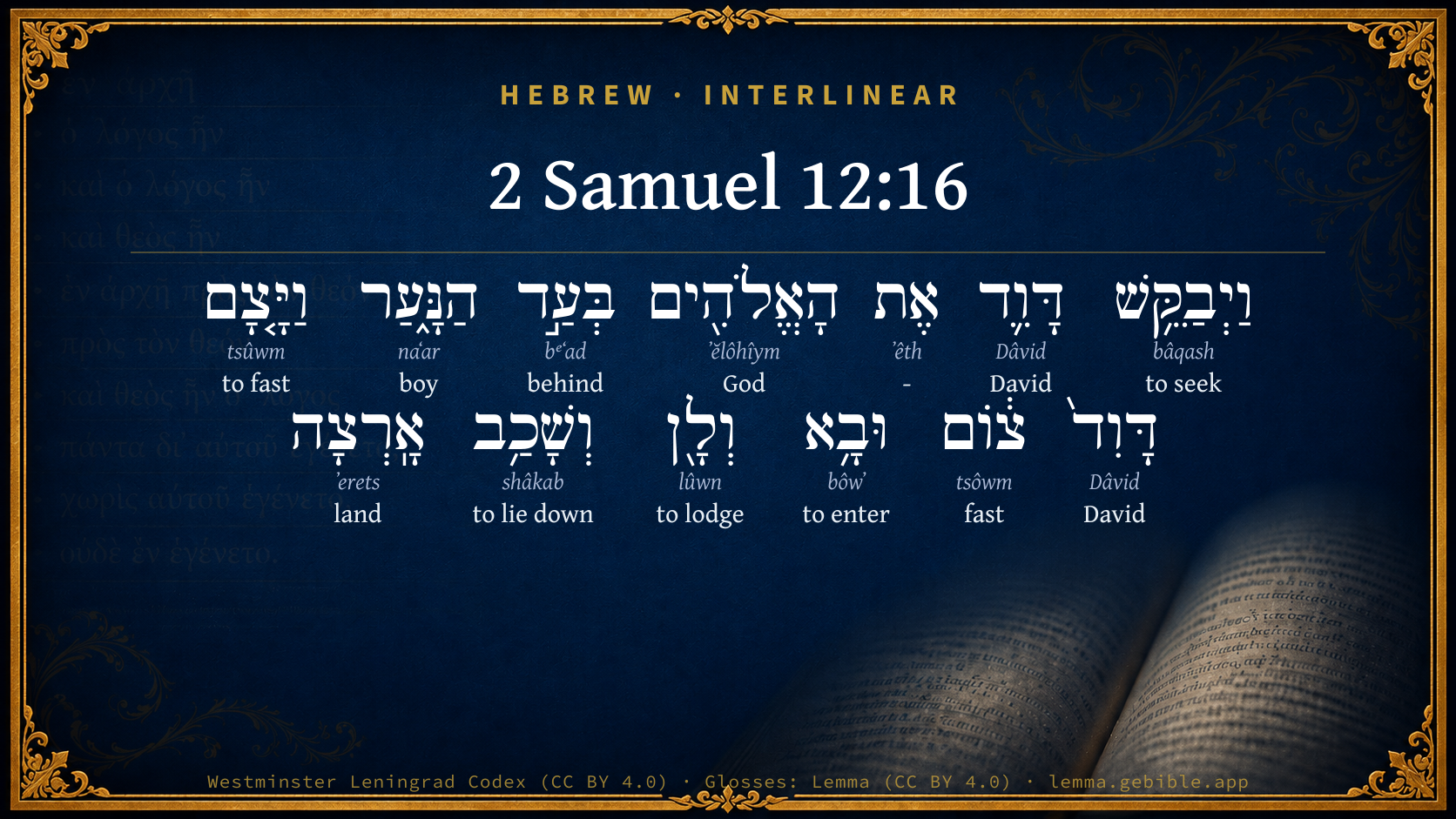
2 Samuel 12:16

Hebrew (Westminster Leningrad Codex) 2 Samuel 12:16 appears in the Hebrew Old Testament. The text above is from the Westminster Leningrad Codex. Each word links to its Strong’s number, a concise gloss, and parsing drawn from the Open Scriptures Hebrew Bible morphology. Click any word for its full Brown-Driver-Briggs (BDB) entry.
Download image
Cite this verse

2 Samuel 12:16 (World English Bible). Public Domain. Lemma interlinear Bible study tool, https://lemma.gebible.app/v/2-samuel/12/16.

Show BibTeX & RIS
BibTeX
RIS
English Translation
David therefore begged God for the child; and David fasted, and went in, and lay all night on the earth.
World English Bible · Public Domain
Highlights
  • 1 first appearance in the Hebrew Bible
Full analysis ↓
Download a study sheet

One document with this verse’s original text, its word-by-word gloss line, the meaning frame, cross-references with their text, attributed commentary, and full source and license credits — printable, and it pastes into notes with its structure intact.

This verse Autodidact and up

Study sheet (.html) Plain text (.txt)

A passage Seminary Student

Up to 50 verses in one chapter. A passage sheet keeps up to 6 commentary sources and 12 cross-references per verse, in the order this page ranks them, and says so on the sheet whenever that leaves anything out. Ask for a single verse and you get the Autodidact verse sheet above.

Everything on this page stays free to read, with no account — the sheet is a download of what is already on screen, not access to it.

Want to remove ads? Support Godless Engineer
Compare translations 3

The same verse in 3 English versions, stacked beneath the original-language interlinear above. Click any original word for its lexicon entry.

Each is an independent rendering of the whole verse — the interlinear is not word-aligned to these translations.

Highlighted words mark where these versions differ — a whole-verse word diff, not a word-by-word alignment.

  • World English Bible Public Domain
    David therefore begged God for the child; and David fasted, and went in, and lay all night on the earth.
  • King James Version Public Domain
    David therefore besought God for the child; and David fasted, and went in, and lay all night upon the earth.
  • unfoldingWord Literal Text CC BY-SA 4.0
    And David sought God on behalf of the boy. And David fasted a fast, and he went in and lodged and lay on the ground.

unfoldingWord Literal Text — © unfoldingWord, licensed CC BY-SA 4.0. Word-aligned USFM3 via Door43 (git.door43.org/unfoldingWord/en_ult).

Versions to compare (up to 4)

3 of 4 selected

Show all 18 translations

Every available English version of this verse, each an independent rendering of the whole verse.

  • World English Bible Public Domain
    David therefore begged God for the child; and David fasted, and went in, and lay all night on the earth.
  • Berean Standard Bible Public Domain
    David pleaded with God for the boy. He fasted and went into his house and spent the night lying in sackcloth on the ground.
  • Majority Standard Bible Public Domain
    David pleaded with God for the boy. He fasted and went into his house and spent the night lying in sackcloth on the ground.
  • King James Version Public Domain
    David therefore besought God for the child; and David fasted, and went in, and lay all night upon the earth.
  • American Standard Version (1901) Public Domain
    David therefore besought God for the child; and David fasted, and went in, and lay all night upon the earth.
  • Revised Version (1885) Public Domain
    David therefore besought God for the child; and David fasted, and went in, and lay all night upon the earth.
  • Geneva Bible (1599) Public Domain
    Dauid therefore besought God for the childe, and fasted and went in, and lay all night vpon the earth.
  • Douay-Rheims (1899) Public Domain
    And David besought the Lord for the child: and David kept a fast, and going in by himself lay upon the ground.
  • Young's Literal Translation Public Domain
    and David seeketh God for the youth, and David keepeth a fast, and hath gone in and lodged, and lain on the earth.
  • Literal Standard Version CC BY-SA 4.0
    and David seeks God for the youth, and David keeps a fast, and has gone in and lodged, and lain on the earth.
  • Unlocked Literal Bible CC BY-SA 4.0
    David then implored God for the boy. David fasted and went inside and lay all night on the floor.
  • unfoldingWord Literal Text CC BY-SA 4.0
    And David sought God on behalf of the boy. And David fasted a fast, and he went in and lodged and lay on the ground.
  • Darby Bible Public Domain
    And David besought God for the child; and David fasted, and went in, and lay all night on the earth.
  • World Messianic Bible Public Domain
    David therefore begged God for the child; and David fasted, and went in and lay all night on the ground.
  • Webster's Bible Public Domain
    David therefore besought God for the child; and David fasted, and went in, and lay all night upon the earth.
  • Free Bible Version CC BY-SA 4.0
    David pleaded with God on behalf of the boy. He fasted, went to his bedroom, and spent the night lying in sackcloth on the ground.
  • Bible in Basic English Public Domain
    So David made prayer to God for the child; and he took no food day after day, and went in and, stretching himself out on the earth, was there all night.
  • JPS Tanakh (1917) Public Domain
    David therefore besought God for the child; and David fasted, and as often as he went in, he lay all night upon the earth.

Literal Standard Version (2020), Covenant Press — licensed CC BY-SA 4.0. Text via the HelloAO Bible API (eBible.org). Unlocked Literal Bible (unfoldingWord) — licensed CC BY-SA 4.0. Text via the HelloAO Bible API (eBible.org). unfoldingWord Literal Text — © unfoldingWord, licensed CC BY-SA 4.0. Word-aligned USFM3 via Door43 (git.door43.org/unfoldingWord/en_ult). Free Bible Version, Dr. Jonathan Gallagher — licensed CC BY-SA 4.0. Text via the HelloAO Bible API (eBible.org).

Word by word

More ways to search: Search by grammar → Find every occurrence → Compare this word →

Practice this passage: Drill this verse → Learn its vocabulary →

וַיָּ֤צָם
tsûwm
H6684
“and · to fast”
Conjunction + Verb, Qal, Sequential Imperfect, 3rd Person, Masculine, Singular
Part of Speech
Conjunction + Verb
Stem
Qal
Form
Sequential Imperfect
Person
3rd Person
Gender
Masculine
Number
Singular
Full BDB Definition

Origin: a primitive root

TWOT: 1890

(Qal) to abstain from food, fast
  1. וַיְבַקֵּ֥שׁ bâqash H1245 “and · to seek” Conjunction + Verb, Piel, Sequential Imperfect, 3rd Person, Masculine, Singular
  2. דָּוִ֛ד Dâvid H1732 “David” Noun, Proper
  3. אֶת ʼêth H853 “-” Particle, Direct Object
  4. הָאֱלֹהִ֖ים ʼĕlôhîym H430 “the · God(s)” Particle, Definite Article + Noun, Common, Masculine, Plural, Absolute
  5. בְּעַ֣ד bᵉʻad H1157 “behind” Preposition
  6. הַנָּ֑עַר naʻar H5288 “the · boy” Particle, Definite Article + Noun, Common, Masculine, Singular, Absolute
  7. דָּוִד֙ Dâvid H1732 “David” Noun, Proper
  8. צ֔וֹם tsôwm H6685 “fast” Noun, Common, Masculine, Singular, Absolute
  9. וּבָ֥א bôwʼ H935 “and · to enter” Conjunction + Verb, Qal, Perfect, 3rd Person, Masculine, Singular
  10. וְלָ֖ן lûwn H3885 “and · to lodge” Conjunction + Verb, Qal, Perfect, 3rd Person, Masculine, Singular
  11. וְשָׁכַ֥ב shâkab H7901 “and · to lie down” Conjunction + Verb, Qal, Perfect, 3rd Person, Masculine, Singular
  12. אָֽרְצָה ʼerets H776 “land · toward” Noun, Common, Both, Singular, Absolute + Suffix, Demonstrative

About this verse

These counts appear in no published source. They are computed here, from the morphology-tagged text and Lemma’s own curated glosses. What Lemma adds →

13
words
12
distinct lemmas
Historical
section

Notable vocabulary

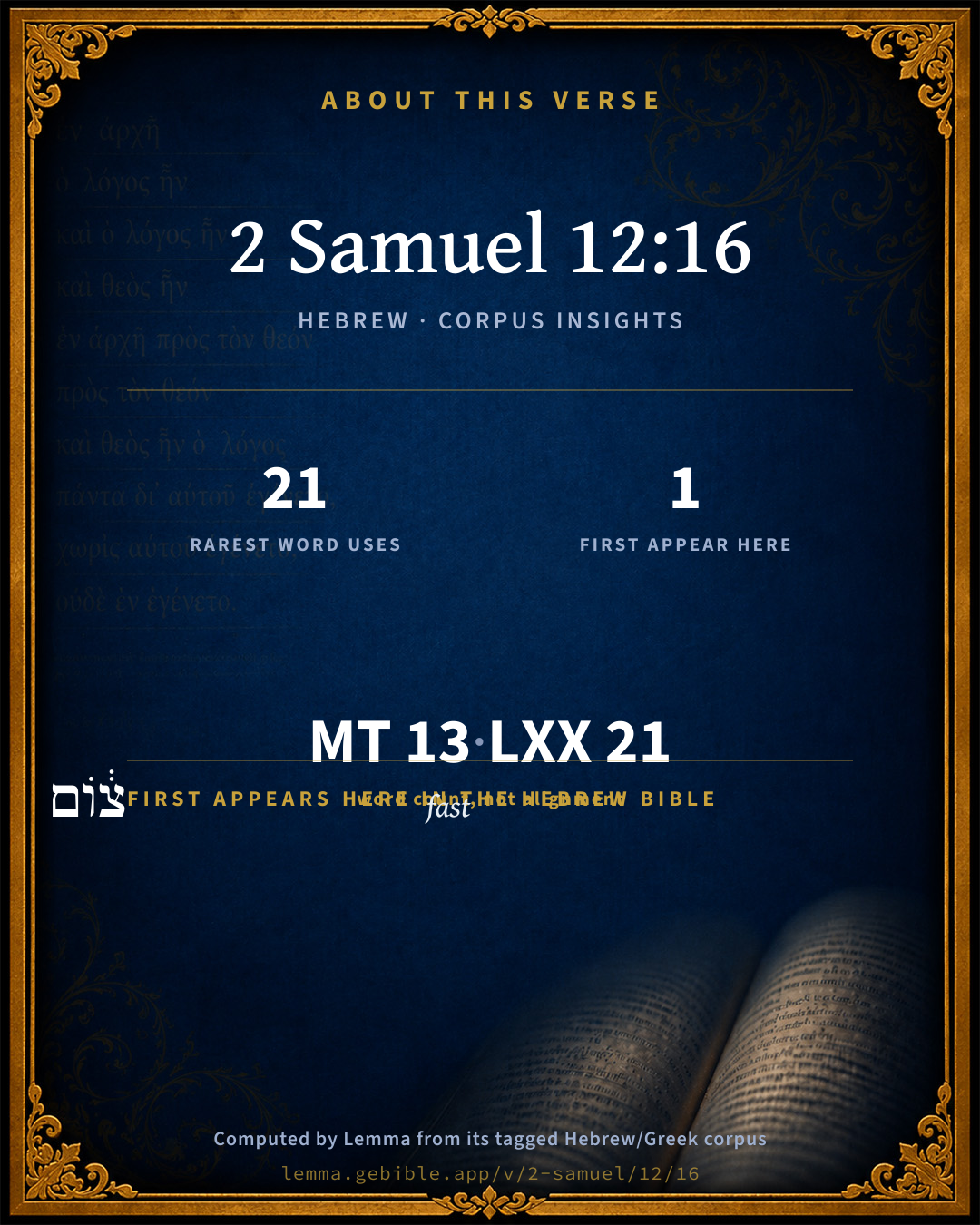
The rarest word here is וַיָּ֤צָם to fast H6684 — appearing just 21 times in the whole Hebrew Bible.

First appearance in Scripture

This word makes its first canonical appearance in the Hebrew Bible here:

Shared distinctive vocabulary

וַיָּ֤צָם to fast H6684 occurs in 17 verses of the Hebrew Bible. Also found in:

Grammatical profile

  • 5 verbs
  • 6 nouns
  • 1 preposition
  • 1 particle

Verb forms

  • וַיְבַקֵּ֥שׁ Piel · Sequential Imperfect
  • וַיָּ֤צָם Qal · Sequential Imperfect
  • וּבָ֥א Qal · Perfect
  • וְלָ֖ן Qal · Perfect
  • וְשָׁכַ֥ב Qal · Perfect

Repetition

A word recurs within this verse — often emphatic in Hebrew:

  • דָּוִ֛ד David H1732 ×2

Hebrew & Septuagint length

In English translation the verse runs 20 words from the Hebrew and 21 from the Septuagint (LXX English) — closely comparable.

A rough comparison of the two English renderings, which tokenize alike — not a word-level alignment.

Word counts can differ between the Hebrew and the Greek without any difference in meaning — e.g. the Hebrew direct-object marker אֵת has no separate Greek word, and Greek often adds the article ὁ.

In the original languages it is 13 Hebrew tokens and 21 Greek tokens — but the two are counted differently (Hebrew bundles its prefixes and suffixes into one token; the Greek is in lemma form), so that isn’t a like-for-like length.

Cross-references

12

Topical passages linked to 2 Samuel 12:16 in the Treasury of Scripture Knowledge — connected by theme and wording, ordered by reader-vote popularity; previews shown in the World English Bible.

  • 2 Samuel 13:31 Then the king arose, and tore his garments, and lay on the earth; and all his servants stood by with their clothes torn.
  • 2 Samuel 12:22 He said, While the child was yet alive, I fasted and wept: for I said, Who knows whether Yahweh will not be gracious to me, that the child may live?
  • 1 Kings 21:27 It happened, when Ahab heard those words, that he tore his clothes, and put sackcloth on his flesh, and fasted, and lay in sackcloth, and went softly.
  • Esther 4:16 Go, gather together all the Jews who are present in Shushan, and fast you for me, and neither eat nor drink three days, night or day: I also and my maidens will fast in like manner; and so will I go in to the king, which is not according to the law: and if I perish, I perish.
  • Psalms 50:15 Call on me in the day of trouble. I will deliver you, and you will honor me."
  • Psalms 69:10 When I wept and I fasted, That was to my reproach.
  • Isaiah 22:12 In that day did the Lord, Yahweh of Hosts, call to weeping, and to mourning, and to baldness, and to girding with sackcloth:
  • Jonah 3:9 Who knows whether God will not turn and repent, and turn away from his fierce anger, so that we might not perish?"
  • Acts 9:9 He was without sight for three days, and neither ate nor drank.
  • Job 20:12–14 "Though wickedness is sweet in his mouth, Though he hide it under his tongue,
  • Isaiah 26:16 Yahweh, in trouble have they visited you; they poured out a prayer [when] your chastening was on them.
  • Joel 2:12–14 "Yet even now," says Yahweh, "turn to me with all your heart, And with fasting, and with weeping, and with mourning."

Cross-references courtesy of OpenBible.info (CC BY 4.0).

Hebrew and Greek witnesses Masoretic Hebrew ↔ Greek Septuagint

The same verse in the two great witnesses to the Old Testament, shown verse-for-verse.

These are two independent witnesses, not word-aligned to each other, and the Septuagint is shown in lemma (dictionary) form.

Hebrew 2 Samuel 12:16 Masoretic · Westminster Leningrad Codex

וַיְבַקֵּ֥שׁ דָּוִ֛ד אֶת הָאֱלֹהִ֖ים בְּעַ֣ד הַנָּ֑עַר וַיָּ֤צָם דָּוִד֙ צ֔וֹם וּבָ֥א וְלָ֖ן וְשָׁכַ֥ב אָֽרְצָה

David therefore begged God for the child; and David fasted, and went in, and lay all night on the earth.

World English Bible · Public Domain

Greek LXX 2 Samuel 12:16 Septuagint · lemma form

καί ζητέω δαυίδ ὁ θεός περί ὁ παιδάριον καί νηστεύω δαυίδ νηστεία καί εἰςἔρχομαι καί αὐλίζω ἐν σάκκος ἐπί ὁ γῆ

And David enquired of God concerning the child, and David fasted, and went in and lay all night upon the ground.

LXX2012 (modern English Septuagint) · Public Domain

Hebrew: Westminster Leningrad Codex (CC BY 4.0). Greek: Septuagint (public domain); English from LXX2012 (modern English Septuagint) (Public Domain). How the Septuagint differs from the Hebrew →

Targum (Aramaic paraphrase)

1

The Targum is the ancient Jewish Aramaic paraphrase of the Hebrew Scriptures — an interpretive translation, not the Hebrew text itself. Onkelos (literal) and Pseudo-Jonathan (expansive) render the Torah, and Jonathan the Prophets. Coverage is partial: where no permissively-licensed English translation exists for a verse, only the Aramaic is shown. This is verse-level text, not a word-by-word alignment to the Hebrew.

  1. Targum Jonathan Prophets (Joshua–Malachi)
    וּבְעָא דָוִד רַחֲמִין מִן קֳדָם יְיָ עַל רַבְיָא וְצָם דָוִד צוֹמָא וְעַל וּבָת וּשְׁכִיב עַל אַרְעָא:

    (no public-domain English translation for this verse)

    Targum Jonathan — Aramaic: “Mikraot Gedolot” (public domain). English: “Sefaria Community Translation” (CC0 1.0 (public-domain dedication)); “London "Chaldee Paraphrase," 1871” (public domain). Text via Sefaria.

Commentary

Notes on 2 Samuel 12:16 from classic Christian and Jewish commentators (each source and its license shown beneath its notes). The classic Christian expositions comment on the surrounding passage and are grouped to its opening verse, so a note may address several verses; the Jewish commentaries on the Tanakh (Rashi and others) are per-verse, so they appear only where the commentator wrote on this verse.

Lemma curates 59 commentaries, every one of them public domain or Creative Commons licensed, each selected and text-cleaned for this edition rather than reprinted as found. About our sources →

Trapp's Complete Commentary

John Trapp

2Sa 12:16 David therefore besought God for the child; and David fasted, and went in, and lay all night upon the earth.

Ver. 16. David therefore besought God.] As knowing that God doth sometimes threaten, that he may not punish: with humble submission therefore to his goodwill and pleasure he supplicateth for the sick child: wherein also he showeth his good assurance of the pardon of his own sin, by taking the humble boldness to sue for his sick child.

And lay all night upon the earth.] By this χαμευνια, humi-cubatio, lying on the ground, joined with his fasting and prayer, David doth both evidence his affection and edge his devotion. It was in the time of this humiliation, it is thought by some, that David uttered the fifty-first Psalm: which he afterwards published.

John Trapp, A Commentary or Exposition upon All the Books of the Old and New Testament (1647–1656) — public domain. Text from a community e-Sword module.

Geneva Bible (1599)

Geneva Bible translators

To wit, to his privy chamber.

Geneva Bible (1599) marginal notes — public domain. Text via Bolls.life.

Adam Clarke's Commentary

Verse 16. David - besought God for the child] How could he do so, after the solemn assurance that he had from God that the child should die? The justice of God absolutely required that the penalty of the law should be exacted; either the father or the son shall die. This could not be reversed.

Adam Clarke's Commentary on the Bible (1810–1826) — public domain. Text from a community e-Sword/MySword module.

Ellicott's Commentary for English Readers

(16) Besought God for the child.—It can hardly be necessary to say that this does not imply any want of submissiveness to God’s will on David’s part, nor an inordinate love for the child of his guilt. “In the case of a man whose penitence was so earnest and so deep, the prayer for the preservation of his child must have sprung from some other source than excessive love of any created object. His great desire was to avert the stroke as a sign of the wrath of God, in the hope that he might be able to discern, in the preservation of the child, a proof of Divine favour consequent upon the restoration of his fellowship with God. But when the child was dead, he humbled himself under the mighty hand of God, and rested satisfied with His grace, without giving himself up to fruitless pain” (O. von Gerlach, quoted by Keil). Yet David’s deep love for the child is not to be overlooked altogether.

A Bible Commentary for English Readers, edited by Charles John Ellicott (1878–1897) — public domain. Text from a community e-Sword module.

The Cambridge Bible for Schools and Colleges

gen. ed. J. J. S. Perowne

16. besought God for the child] Such a prayer was not presumptuous, for God’s threatenings like his promises are conditional. See Isa_38:1 ff.; Jon_3:7-10.

fasted] Cp. Neh_1:4; Est_4:16; Dan_9:3; Act_14:23.

went in] To his private chamber (Mat_6:6), where he lay all night upon the floor, instead of sleeping on his bed. Cp. ch. 2Sa_13:31. The tense of the verbs went in and lay all night is frequentative, indicating that David did so repeatedly.

The Cambridge Bible for Schools and Colleges (gen. ed. J. J. S. Perowne; Cambridge University Press, 1878–1918) — public domain. Text from a community e-Sword module.

John Gill's Exposition

And the elders of his house arose, and went to him, to raise him up from the earth,.... To persuade him to rise up, and sit upon a seat, and go to bed, after having taken some food; these were some of the chief officers at court, and had the management of the affairs of his household:

but he would not; they could not persuade him to it:

neither did he eat bread with them; that evening, as he had used to do; they being the princes of his court, who were wont to sit at table with him.

John Gill's Exposition of the Whole Bible (1746–1763) — public domain (CC PDM 1.0). Text via the HelloAO Bible API.

Albert Barnes' Notes on the Bible

The death of the infant child of one of the numerous harem of an Oriental monarch would in general be a matter of little moment to the father. The deep feeling shown by David on this occasion is both an indication of his affectionate and tender nature, and also a proof of the strength of his passion for Bath-sheba. He went into his most private chamber, his closet Mat 6:6, and “lay upon the earth” 2Sa 13:31, rather “the ground,” meaning the floor of his chamber as opposed to his couch.

Albert Barnes' Notes on the Bible (1834–1885) — public domain. Text from a community e-Sword/MySword module.

Haydock's Catholic Bible Commentary

A fast, (jejunavit jejunio) denotes, with more than ordinary rigour. (Salien) --- By himself. Hebrew, "he went in, and lay all night upon the ground." (Haydock)

George Leo Haydock (1774–1849), Haydock's Catholic Family Bible and Commentary, 1859 edition — public domain. Excludes Psalms (Douay-Rheims chapter numbering differs from Protestant) and Deuterocanonical books (Catholic canon only).

Matthew Poole's English Annotations

David besought God for the child; supposing the threatening might be conditional, and so the execution of it prevented by prayer.

Went in, to wit, into his closet, as Mat 6:6, to pray solitarily and earnestly, as he had done with others. Or this word may only note his progress and continuance in the actions here expressed.

Matthew Poole's English Annotations on the Holy Bible (1683–1685) — public domain. Text from a community e-Sword/MySword module.

Whedon's Commentary on the Bible

Daniel D. Whedon

16. Besought God for the child — For, according to 2Sa_12:22, he entertained some hope that God might yet spare him.

Went in — Into some private apartment of his own house.

Lay all night upon the earth — Evidence of profoundest anguish and grief. Compare 2Sa_13:31.

Daniel D. Whedon (gen. ed.), Commentary on the Old and New Testaments (1874–1909) — public domain. Text from a community e-Sword module.

The Pulpit Commentary

David... went in. He went, not into the sanctuary, which he did not enter until after the child"s death, but into some private room in his own house. There he remained, passing his nights stretched on the ground, and fasting until the seventh day. His fasting does not imply that he took no food during this long interval, but that he abstained from the royal table, and ate so much only as was necessary to maintain life. Now, what was the meaning of this privacy and abstinence? Evidently it was David"s acknowledgment, before all his subjects, of his iniquity, and of his sorrow for it. The sickness of the child followed immediately upon Nathan"s visit, and we may feel sure that news of his rebuke, and of all that passed between him and the king, ran quickly throughout Jerusalem. And David at once takes the position of a condemned criminal, and humbles himself with that thoroughness which forms so noble a part of his character. Grieved as he was at the child"s sickness, and at the mother"s sorrow, yet his grief was mainly for his sin; and he was willing that all should know how intense was his shame and self-reproach. And even when the most honourable of the rulers of his household, (Gen_24:2) or, as Ewald thinks, his uncles and elder brethren, came to comfort him, he persists in maintaining an attitude of heart stricken penitence.

The Pulpit Commentary (1880–1919), ed. H.D.M. Spence-Jones & Joseph S. Exell — public domain. Text from a community e-Sword module.

John Wesley's Explanatory Notes

Besought - Supposing the threatening might be conditional, and so the execution of it prevented by prayer. Went - Into his closet.

John Wesley, Explanatory Notes Upon the Whole Bible (1754–1765) — public domain. Text via the GEBible commentary corpus.

unfoldingWord translationNotes

Door43 World Missions Community

implored

to beg or pray with strong desire

went inside

David went into his room when he was alone. AT: "went inside his room" (See: Assumed Knowledge and Implicit Information)

to raise him up from the floor

"and urged him to get up from the floor"

It came about

"It happened"

he did not listen to our voice

The servants are referred to here by their voices to emphasize that they were speaking. AT: "he did not listen to us" (See: Synecdoche)

the seventh day

"day 7." This refers to the seventh day after the baby was born. AT: "the seventh day after he was born" (See: Assumed Knowledge and Implicit Information and Numbers)

Look

This is used to get people's attention. AT: "Listen"

What might he do to himself if we tell him that the boy is dead?!

The servants ask this rhetorical question to express their fear. This can be written as a statement. AT: "We are afraid that he may harm himself if we tell him that the boy is dead!" (See: Rhetorical Question)

translationWords

God

fast

elder

servant

fear

life

voice

unfoldingWord translationNotes — © Distant Shores Media and the Door43 World Missions Community, licensed CC BY-SA 4.0. Source: git.door43.org/Door43/en_tn.

Rashi

Rabbi Shlomo Yitzchaki (Rashi)

And came to repose and lied on the ground. And came [back] to the house and reposed at night lying on the ground.

Rashi on the Tanakh — English translations: “The Judaica Press complete Tanach with Rashi, translated by A. J. Rosenberg” (CC BY 4.0); “Pentateuch with Rashi's commentary by M. Rosenbaum and A.M. Silbermann, 1929-1934” (public domain); “The Metsudah Tanach series, Lakewood, N.J” (CC BY 4.0); and “The Book of Joshua, Metsudah Publications, 1997” (CC BY 4.0). Text via Sefaria.

Lesson kit

Teaching starters — assembled from the data on this page, not authored interpretation. Every prompt links to the verse data it draws on. Edit before teaching.

2 Samuel, in the Historical, opens this verse with 13 words (12 distinct Hebrew lemmas). Its most distinctive word is tsûwm (“to fast”). A historical commentator’s framing appears above. Read the whole chapter for the surrounding context.

Discussion questions

  1. The word tsûwm carries the sense “to fast.” How does it shape the verse?
  2. This is the first place “fast” appears in Scripture (first appears here). What does its debut here establish?
  3. How does Judges 20:26, which shares the word «to fast», read alongside this verse?
  4. What does the repetition of “David” (2× in this one verse) do in this verse?
  5. These translations render this verse differently. What is at stake in choosing one wording over another?
  6. «וַיְבַקֵּ֥שׁ» is a Piel Sequential Imperfect verb. How does that grammatical form shape the action described?
  7. Compare how Trapp's Complete Commentary and Geneva Bible (1599) read this verse. Where do they agree or differ?

Things to notice

Reading settings

Reading text

Shown beneath each verse's original-language words.

Old Testament
Old Testament edition

Read the OT as the Masoretic Hebrew (MT) or the Greek Septuagint (LXX).

English shown for the Greek Septuagint (in the Hebrew ↔ Greek comparison).

Comparing translations? Open the Compare panel on any verse page to stack up to four side by side.