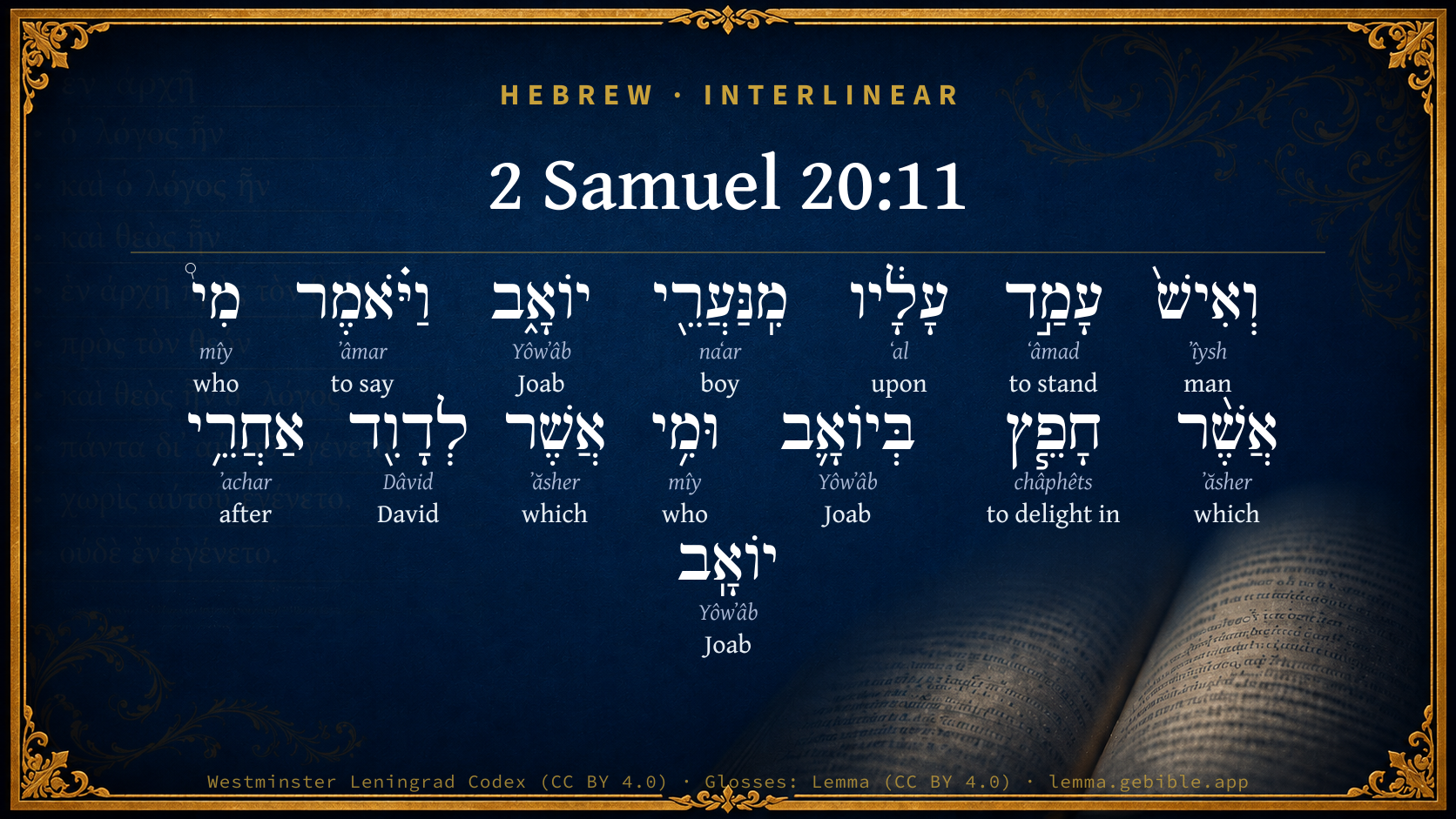
2 Samuel 20:11

Hebrew (Westminster Leningrad Codex) 2 Samuel 20:11 appears in the Hebrew Old Testament. The text above is from the Westminster Leningrad Codex. Each word links to its Strong’s number, a concise gloss, and parsing drawn from the Open Scriptures Hebrew Bible morphology. Click any word for its full Brown-Driver-Briggs (BDB) entry.
Download image
Cite this verse

2 Samuel 20:11 (World English Bible). Public Domain. Lemma interlinear Bible study tool, https://lemma.gebible.app/v/2-samuel/20/11.

Show BibTeX & RIS
BibTeX
RIS
English Translation
There stood by him one of Joab's young men, and said, He who favors Joab, and he who is for David, let him follow Joab.
World English Bible · Public Domain
Download a study sheet

One document with this verse’s original text, its word-by-word gloss line, the meaning frame, cross-references with their text, attributed commentary, and full source and license credits — printable, and it pastes into notes with its structure intact.

This verse Autodidact and up

Study sheet (.html) Plain text (.txt)

A passage Seminary Student

Up to 50 verses in one chapter. A passage sheet keeps up to 6 commentary sources and 12 cross-references per verse, in the order this page ranks them, and says so on the sheet whenever that leaves anything out. Ask for a single verse and you get the Autodidact verse sheet above.

Everything on this page stays free to read, with no account — the sheet is a download of what is already on screen, not access to it.

Want to remove ads? Support Godless Engineer
Compare translations 3

The same verse in 3 English versions, stacked beneath the original-language interlinear above. Click any original word for its lexicon entry.

Each is an independent rendering of the whole verse — the interlinear is not word-aligned to these translations.

Highlighted words mark where these versions differ — a whole-verse word diff, not a word-by-word alignment.

  • World English Bible Public Domain
    There stood by him one of Joab's young men, and said, He who favors Joab, and he who is for David, let him follow Joab.
  • King James Version Public Domain
    And one of Joab's men stood by him, and said, He that favoreth Joab, and he that is for David, let him go after Joab.
  • unfoldingWord Literal Text CC BY-SA 4.0
    And a man from the young men of Joab stood beside him, and he said, “Whoever delights in Joab and whoever to David, after Joab!”

unfoldingWord Literal Text — © unfoldingWord, licensed CC BY-SA 4.0. Word-aligned USFM3 via Door43 (git.door43.org/unfoldingWord/en_ult).

Versions to compare (up to 4)

3 of 4 selected

Show all 18 translations

Every available English version of this verse, each an independent rendering of the whole verse.

  • World English Bible Public Domain
    There stood by him one of Joab's young men, and said, He who favors Joab, and he who is for David, let him follow Joab.
  • Berean Standard Bible Public Domain
    One of Joab’s young men stood near Amasa and said, “Whoever favors Joab, and whoever is for David, let him follow Joab!”
  • Majority Standard Bible Public Domain
    One of Joab’s young men stood near Amasa and said, “Whoever favors Joab, and whoever is for David, let him follow Joab!”
  • King James Version Public Domain
    And one of Joab's men stood by him, and said, He that favoreth Joab, and he that is for David, let him go after Joab.
  • American Standard Version (1901) Public Domain
    And there stood by him one of Joab's young men, and said, He that favoreth Joab, and he that is for David, let him follow Joab.
  • Revised Version (1885) Public Domain
    And there stood by him one of Joab’s young men, and said, He that favoureth Joab, and he that is for David, let him follow Joab.
  • Geneva Bible (1599) Public Domain
    And one of Ioabs men stoode by him, and saide, He that fauoureth Ioab, and hee that is of Dauids part, let him go after Ioab.
  • Douay-Rheims (1899) Public Domain
    In the mean time some men of Joab's company stopping at the dead body of Amasa, said: Behold he that would have been in Joab's stead the companion of David.
  • Young's Literal Translation Public Domain
    And a man hath stood by him, of the young men of Joab, and saith, `He who hath delight in Joab, and he who `is' for David -- after Joab!'
  • Literal Standard Version CC BY-SA 4.0
    And a man has stood by him, of the young men of Joab, and says, “He who has delight in Joab, and he who [is] for David—after Joab!”
  • Unlocked Literal Bible CC BY-SA 4.0
    Then one of Joab's men stood by Amasa, and the man said, “He who favors Joab, and he who is for David, let him follow Joab.”
  • unfoldingWord Literal Text CC BY-SA 4.0
    And a man from the young men of Joab stood beside him, and he said, “Whoever delights in Joab and whoever to David, after Joab!”
  • Darby Bible Public Domain
    And one of Joab's young men stood by [Amasa] and said, He that favours Joab, and he that is for David, let him follow Joab.
  • World Messianic Bible Public Domain
    One of Joab’s young men stood by him, and said, “He who favors Joab, and he who is for David, let him follow Joab!”
  • Webster's Bible Public Domain
    And one of Joab's men stood by him, and said, He that favoreth Joab, and he that is for David, let him go after Joab.
  • Free Bible Version CC BY-SA 4.0
    One of Joab's men stood beside Amasa and called out, “If you're on Joab's side, and if you are on David's side, then follow Joab!”
  • Bible in Basic English Public Domain
    And one of Joab's young men, taking his place at Amasa's side, said, Whoever is for Joab and for David, let him go after Joab!
  • JPS Tanakh (1917) Public Domain
    And there stood by him one of Joab's young men, and said: 'He that favoureth Joab, and he that is for David let him follow Joab.'

Literal Standard Version (2020), Covenant Press — licensed CC BY-SA 4.0. Text via the HelloAO Bible API (eBible.org). Unlocked Literal Bible (unfoldingWord) — licensed CC BY-SA 4.0. Text via the HelloAO Bible API (eBible.org). unfoldingWord Literal Text — © unfoldingWord, licensed CC BY-SA 4.0. Word-aligned USFM3 via Door43 (git.door43.org/unfoldingWord/en_ult). Free Bible Version, Dr. Jonathan Gallagher — licensed CC BY-SA 4.0. Text via the HelloAO Bible API (eBible.org).

Word by word

More ways to search: Search by grammar → Find every occurrence → Compare this word →

Practice this passage: Drill this verse → Learn its vocabulary →

חָפֵ֧ץ
châphêts
H2654
“to delight in”
Verb, Qal, Perfect, 3rd Person, Masculine, Singular
Part of Speech
Verb
Stem
Qal
Form
Perfect
Person
3rd Person
Gender
Masculine
Number
Singular
Full BDB Definition

Origin: a primitive root

TWOT: 712 , 713

to delight in, take pleasure in, desire, be pleased with - (Qal) - of men - to take pleasure in, delight in - to delight, desire, be pleased to do - of God - to delight in, have pleasure in - to be pleased to do - to move, bend down - (Qal) to bend down
  1. וְאִישׁ֙ ʼîysh H376 “and · man” Conjunction + Noun, Common, Masculine, Singular, Absolute
  2. עָמַ֣ד ʻâmad H5975 “to stand” Verb, Qal, Perfect, 3rd Person, Masculine, Singular
  3. עָלָ֔יו ʻal H5921 “upon · him” Preposition + Suffix, Personal, 3rd Person, Masculine, Singular
  4. מִֽנַּעֲרֵ֖י naʻar H5288 “from · boys of” Preposition + Noun, Common, Masculine, Plural, Construct
  5. יוֹאָ֑ב Yôwʼâb H3097 “Joab” Noun, Proper
  6. וַיֹּ֗אמֶר ʼâmar H559 “and · to say” Conjunction + Verb, Qal, Sequential Imperfect, 3rd Person, Masculine, Singular
  7. מִי֩ mîy H4310 “who” Particle, Interrogative
  8. אֲשֶׁ֨ר ʼăsher H834 “which” Particle, Relative
  9. בְּיוֹאָ֛ב Yôwʼâb H3097 “in/at · Joab” Preposition + Noun, Proper
  10. וּמִ֥י mîy H4310 “and · who” Conjunction + Particle, Interrogative
  11. אֲשֶׁר ʼăsher H834 “which” Particle, Relative
  12. לְדָוִ֖ד Dâvid H1732 “to/for · David” Preposition + Noun, Proper
  13. אַחֲרֵ֥י ʼachar H310 “after” Preposition
  14. יוֹאָֽב Yôwʼâb H3097 “Joab” Noun, Proper

About this verse

These counts appear in no published source. They are computed here, from the morphology-tagged text and Lemma’s own curated glosses. What Lemma adds →

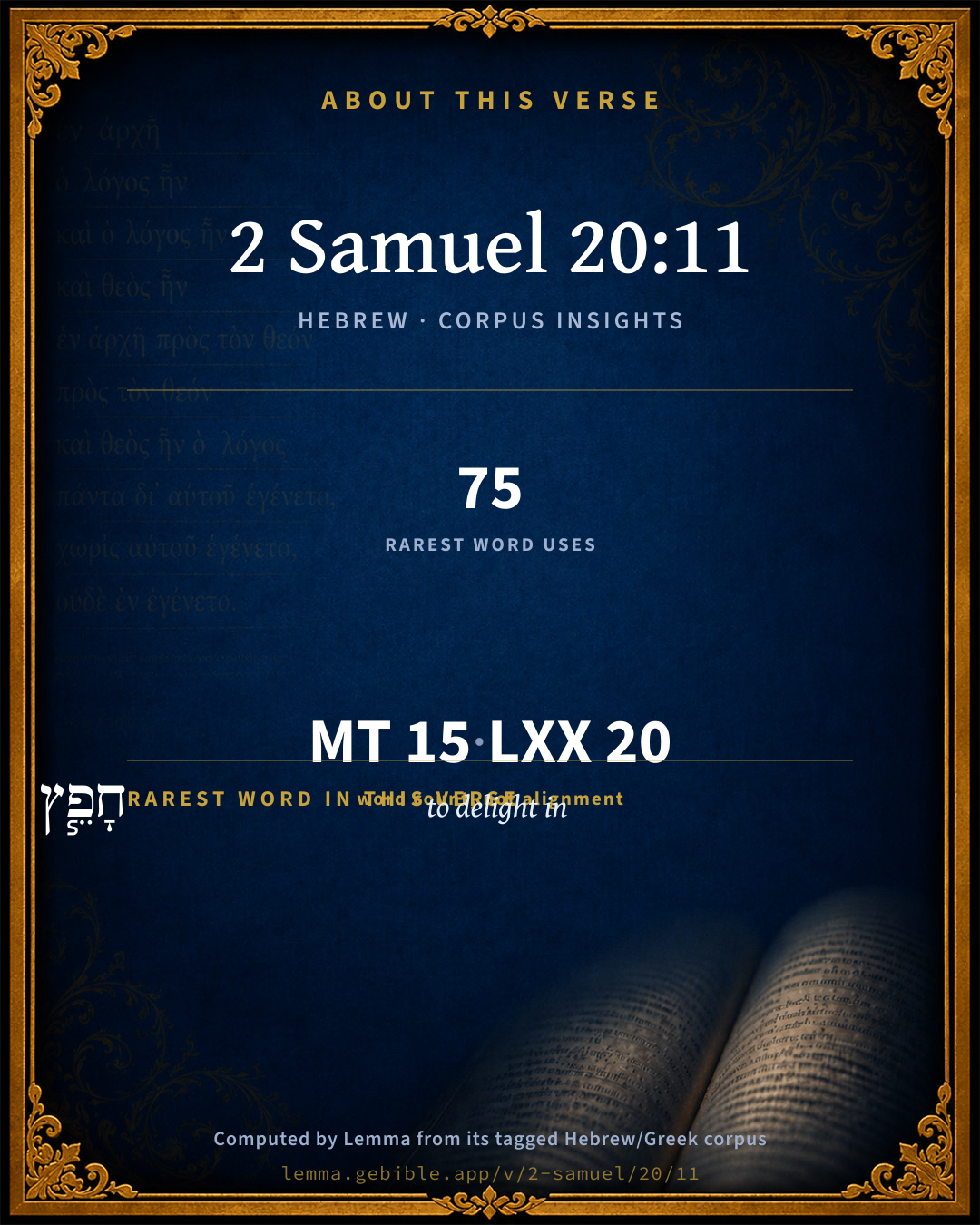
15
words
11
distinct lemmas
Historical
section

Grammatical profile

  • 3 verbs
  • 6 nouns
  • 2 prepositions
  • 4 particles

Verb forms

  • עָמַ֣ד Qal · Perfect
  • וַיֹּ֗אמֶר Qal · Sequential Imperfect
  • חָפֵ֧ץ Qal · Perfect

Repetition

Words recur within this verse — often emphatic in Hebrew:

  • יוֹאָ֑ב Joab H3097 ×3
  • מִי֩ who H4310 ×2
  • אֲשֶׁ֨ר which H834 ×2

Hebrew & Septuagint length

In English translation the verse runs 25 words from the Hebrew and 30 from the Septuagint (LXX English) — closely comparable.

A rough comparison of the two English renderings, which tokenize alike — not a word-level alignment.

Word counts can differ between the Hebrew and the Greek without any difference in meaning — e.g. the Hebrew direct-object marker אֵת has no separate Greek word, and Greek often adds the article ὁ.

In the original languages it is 15 Hebrew tokens and 20 Greek tokens — but the two are counted differently (Hebrew bundles its prefixes and suffixes into one token; the Greek is in lemma form), so that isn’t a like-for-like length.

Cross-references

5

Topical passages linked to 2 Samuel 20:11 in the Treasury of Scripture Knowledge — connected by theme and wording, ordered by reader-vote popularity; previews shown in the World English Bible.

  • 2 Samuel 20:13 When he was removed out of the highway, all the people went on after Joab, to pursue after Sheba the son of Bichri.
  • 2 Samuel 20:4 Then said the king to Amasa, Call me the men of Judah together within three days, and be here present.
  • 2 Samuel 20:6–7 David said to Abishai, Now will Sheba the son of Bichri do us more harm than did Absalom: take your lord's servants, and pursue after him, lest he get him fortified cities, and escape out of our sight.
  • 2 Samuel 20:21 The matter is not so: but a man of the hill-country of Ephraim, Sheba the son of Bichri by name, has lifted up his hand against the king, even against David; deliver him only, and I will depart from the city. The woman said to Joab, Behold, his head shall be thrown to you over the wall.
  • 2 Kings 9:32 He lifted up his face to the window, and said, Who is on my side? who? There looked out to him two or three eunuchs.

Cross-references courtesy of OpenBible.info (CC BY 4.0).

Hebrew and Greek witnesses Masoretic Hebrew ↔ Greek Septuagint

The same verse in the two great witnesses to the Old Testament, shown verse-for-verse.

These are two independent witnesses, not word-aligned to each other, and the Septuagint is shown in lemma (dictionary) form.

Hebrew 2 Samuel 20:11 Masoretic · Westminster Leningrad Codex

וְאִישׁ֙ עָמַ֣ד עָלָ֔יו מִֽנַּעֲרֵ֖י יוֹאָ֑ב וַיֹּ֗אמֶר מִי֩ אֲשֶׁ֨ר חָפֵ֧ץ בְּיוֹאָ֛ב וּמִ֥י אֲשֶׁר לְדָוִ֖ד אַחֲרֵ֥י יוֹאָֽב

There stood by him one of Joab's young men, and said, He who favors Joab, and he who is for David, let him follow Joab.

World English Bible · Public Domain

Greek LXX 2 Samuel 20:11 Septuagint · lemma form

καί ἀνήρ ἵστημι ἐπί αὐτός ὁ παιδάριον ιωαβ καί εἶπον τίς ὁ βούλομαι ιωαβ καί τίς ὁ δαυίδ ὀπίσω ιωαβ

And there stood over him one of the servants of Joab, and said, Who is he that is for Joab, and who is on the side of David following Joab?

LXX2012 (modern English Septuagint) · Public Domain

Hebrew: Westminster Leningrad Codex (CC BY 4.0). Greek: Septuagint (public domain); English from LXX2012 (modern English Septuagint) (Public Domain). How the Septuagint differs from the Hebrew →

Targum (Aramaic paraphrase)

1

The Targum is the ancient Jewish Aramaic paraphrase of the Hebrew Scriptures — an interpretive translation, not the Hebrew text itself. Onkelos (literal) and Pseudo-Jonathan (expansive) render the Torah, and Jonathan the Prophets. Coverage is partial: where no permissively-licensed English translation exists for a verse, only the Aramaic is shown. This is verse-level text, not a word-by-word alignment to the Hebrew.

  1. Targum Jonathan Prophets (Joshua–Malachi)
    וְגַבְרָא קָאִים עִילַווֹהִי מֵעוּלֵימֵי יוֹאָב וַאֲמַר מַן דְרָעִי בְיוֹאָב וּמַן דִי לְדָוִד יֵיזֵל בָּתַר יוֹאָב:

    (no public-domain English translation for this verse)

    Targum Jonathan — Aramaic: “Mikraot Gedolot” (public domain). English: “Sefaria Community Translation” (CC0 1.0 (public-domain dedication)); “London "Chaldee Paraphrase," 1871” (public domain). Text via Sefaria.

Commentary

Notes on 2 Samuel 20:11 from classic Christian and Jewish commentators (each source and its license shown beneath its notes). The classic Christian expositions comment on the surrounding passage and are grouped to its opening verse, so a note may address several verses; the Jewish commentaries on the Tanakh (Rashi and others) are per-verse, so they appear only where the commentator wrote on this verse.

Lemma curates 59 commentaries, every one of them public domain or Creative Commons licensed, each selected and text-cleaned for this edition rather than reprinted as found. About our sources →

Trapp's Complete Commentary

John Trapp

2Sa 20:11 And one of Joab’s men stood by him, and said, He that favoureth Joab, and he that [is] for David, [let him go] after Joab.

Ver. 11. And one of Joab’s men stood by him.] This soldier was left there by Joab to justify the fact, and to advise them to march on, notwithstanding it. One interpreter saith that these words are a bitter jeer of a certain servant insulting over dead Amasa, and extolling the wicked act of his master Joab.

John Trapp, A Commentary or Exposition upon All the Books of the Old and New Testament (1647–1656) — public domain. Text from a community e-Sword module.

Joseph Benson's Commentary

2Sa 20:11-13. One of Joab’s men stood by him — By the command of his master, who knew that this would occasion disorder among Amasa’s soldiers, and therefore left a man there on purpose to deliver the following message: He that favoureth Joab — He that would have Joab to be general, rather than such a perfidious rebel as Amasa. And he that is for David — He that wisheth David good success against Sheba, and against all rebels. He cunningly joins David and Joab together, as if their interests were inseparable. When the man saw that all the people stood still — Wondering at the spectacle, and inquiring into the occasion of it. He removed Amasa out of the highway — Perceiving that it both incensed them against Joab, and hindered the king’s service. And cast a cloth upon him — But the covering of blood with a cloth cannot stop its cry to God for vengeance. All the people went on after Joab — They that were behind did not know that Amasa was killed, and so marched on without any scruple.

Joseph Benson's Commentary on the Old and New Testaments (1811–1818) — public domain. Text from a community e-Sword module.

Geneva Bible (1599)

Geneva Bible translators

He stood by Amasa at Joab’s appointment.

Geneva Bible (1599) marginal notes — public domain. Text via Bolls.life.

Jamieson, Fausset & Brown

Robert Jamieson, A. R. Fausset & David Brown

He that favoureth Joab, and he that is for David, let him go after Joab--It is a striking proof of Joab's unrivalled influence over the army, that with this villainous murder perpetrated before their eyes they unanimously followed him as their leader in pursuit of Sheba. A soldier conjoined his name with David's, and such a magic spell was in the word "Joab," that all the people "went on"--Amasa's men as well as the rest. The conjunction of these two names is very significant. It shows that the one could not afford to do without the other--neither Joab to rebel against David, nor David to get rid of Joab, though hating him.

Jamieson, Fausset & Brown — Commentary Critical and Explanatory on the Whole Bible (1871) — public domain (CC PDM 1.0). Text via the HelloAO Bible API.

Adam Clarke's Commentary

Verse 11. He that favoureth Joab] As if he had said, There is now no other commander besides Joab; and Joab is steadily attached to David: let those therefore who are loyal follow Joab.

Adam Clarke's Commentary on the Bible (1810–1826) — public domain. Text from a community e-Sword/MySword module.

Ellicott's Commentary for English Readers

(11) One of Joab’s man.—Com. 2Sa_20:7. Time was too precious for Joab himself to wait. He must put down the rebellion of Sheba by rapid action, and thereby render himself impregnable in the high office which had been his, and which he had now again usurped. He left one of his trusty men, however, by the body of Amasa, with a battle cry which should suggest that he had rightly been put to death for his doubtful loyalty, and that all who were attached to Joab and loyal to David should follow Joab. Joab’s real motive for murdering Amasa, as for murdering Abner (2Sa_3:27), was personal jealousy and ambition.

A Bible Commentary for English Readers, edited by Charles John Ellicott (1878–1897) — public domain. Text from a community e-Sword module.

The Cambridge Bible for Schools and Colleges

gen. ed. J. J. S. Perowne

11. one of Joab’s men] One of Joab’s young men, perhaps one of his armour-bearers (ch. 2Sa_18:15), remained by the corpse at Joab’s command in order to invite Amasa’s followers to join Joab. Time was too precious for Joab himself to lose a moment.

He that favoureth Joab, &c.] Lit. He that delighteth (ch. 2Sa_15:26) in Joab. He appeals to their personal attachment to himself as general, and to their loyalty to David; insinuating that Amasa was not faithful to the king, and had met his death justly for his treachery. Joab’s real motive in murdering Amasa, as before in the case of Abner, was jealousy.

The Cambridge Bible for Schools and Colleges (gen. ed. J. J. S. Perowne; Cambridge University Press, 1878–1918) — public domain. Text from a community e-Sword module.

John Gill's Exposition

And one of Joab's men stood by him,.... By the body of Amasa; no doubt by the order of Joab, to satisfy the people as they came up, and reconcile them to this fact, and to exhort them not to stop, but to follow after Joab; for though Amasa their general was dead, Joab had taken the command of the army, and the pursuit was carried on with as much rigour as ever:

and said, he that favoureth Joab, and he that is for David, let him go after Joab: he that likes Joab should be general, and is in the interest of David, let him make no stay here, but follow after Joab; Joab and David are put together, as if their interests were the same; though there seems to be an indecency in placing Joab first.

John Gill's Exposition of the Whole Bible (1746–1763) — public domain (CC PDM 1.0). Text via the HelloAO Bible API.

Albert Barnes' Notes on the Bible

He that favoreth Joab ... - This speech, addressed to Amasa’s followers as well as Joab’s, shows very distinctly that the rivalry between Joab and Amasa, and David’s purpose to make Amasa captain in Joab’s room, were well known; and shows also the real reason why Joab killed Amasa. What is added, “and he that is for David,” was intended to identify Joab’s cause with David’s, and also to insinuate that Amasa had not been loyal to David (2Sa 20:5 note).

Albert Barnes' Notes on the Bible (1834–1885) — public domain. Text from a community e-Sword/MySword module.

Haydock's Catholic Bible Commentary

Some men. The same author [Josephus?] and the Hebrew only mention "one of," &c. (Haydock) --- Behold. Thus they insult over him, being attached to Joab. Hebrew, "Who loves Joab? and who is David? Let him follow Joab;" or, "who is this who wished to supplant Joab? and who desired to be in David’s favour, after Joab? (Calmet)

George Leo Haydock (1774–1849), Haydock's Catholic Family Bible and Commentary, 1859 edition — public domain. Excludes Psalms (Douay-Rheims chapter numbering differs from Protestant) and Deuterocanonical books (Catholic canon only).

Matthew Poole's English Annotations

One of Joab’s men, left there on purpose to deliver the following message.

He that favoureth Joab; he that would have Joab to be general, rather than such a perfidious rebel and traitor as Amasa.

He that is for David; he that wisheth David good success against Sheba, and against all rebels; whereby he implies that though this fact of his was done against the king’s command, yet it was for his interest and defence.

Matthew Poole's English Annotations on the Holy Bible (1683–1685) — public domain. Text from a community e-Sword/MySword module.

Whedon's Commentary on the Bible

Daniel D. Whedon

11. One of Joab’s men stood — Doubtless he was instructed to do so by Joab himself.

By him — By the bloody corpse of Amasa.

He that favoureth Joab… after Joab — There is no other commander now, and his heart is still loyal to David. Thus Joab’s bold and fearless action defeats the purposes of his king.

Daniel D. Whedon (gen. ed.), Commentary on the Old and New Testaments (1874–1909) — public domain. Text from a community e-Sword module.

The Pulpit Commentary

One of Joab"s men. Joab left one of his personal followers to prevent any halt of the people round Amasa"s body, and to suggest that he was a traitor. For he was to say to them as they came up, not only that "whosoever had pleasure in Joab," but also that "all who were for David, were to go after Joab." All loyal men were to regard him as captain of the host, and to disobey him would be rebellion. Naturally they would conclude from this that Amasa had not really been true to David, and that his death was the punishment inflicted on him for his past guilt.

The Pulpit Commentary (1880–1919), ed. H.D.M. Spence-Jones & Joseph S. Exell — public domain. Text from a community e-Sword module.

John Wesley's Explanatory Notes

One - Left there on purpose to deliver the following message. favoureth Joab - He that would have Joab to be general, rather than such a perfidious rebel as Amasa. For David - He that wisheth David good success against Sheba, and against all rebels.

John Wesley, Explanatory Notes Upon the Whole Bible (1754–1765) — public domain. Text via the GEBible commentary corpus.

unfoldingWord translationNotes

Door43 World Missions Community

he who is for David

To be "for" someone means to support them. AT: "he who supports David" or "he who is loyal to David" (See: Idiom)

Amasa lay wallowing in his blood

"Amasa lay squirming in his blood." Amasa may have still been alive and rolling in his blood, but he was probably dead by this time. It is described this way to show how gruesome his body looked. AT: "Amasa lay dead in his blood" (See: Assumed Knowledge and Implicit Information)

all the people stood still ... came by him stood still

This means they stopped walking and were staring at Amasa's dead body. AT: "all the people stood still staring at the dead body ... came by him stood still, staring at his dead body" (See: Assumed Knowledge and Implicit Information)

he carried Amasa

"he carried Amasa's body"

After Amasa was taken off the road

This may be stated in active form. AT: "After the man took Amasa off the road" (See: Active or Passive)

in pursuit of

This abstract noun can be stated as a verb. AT: "pursuing" (See: Abstract Nouns)

translationWords

favor

David

blood

unfoldingWord translationNotes — © Distant Shores Media and the Door43 World Missions Community, licensed CC BY-SA 4.0. Source: git.door43.org/Door43/en_tn.

Lesson kit

Teaching starters — assembled from the data on this page, not authored interpretation. Every prompt links to the verse data it draws on. Edit before teaching.

2 Samuel, in the Historical, opens this verse with 15 words (11 distinct Hebrew lemmas). Its most distinctive word is châphêts (“to delight in”). A historical commentator’s framing appears above. Read the whole chapter for the surrounding context.

Discussion questions

  1. What does “to delight in” (châphêts) contribute to the verse as a whole?
  2. How does 2 Samuel 20:13, which shares this passage’s theme, read alongside this verse?
  3. What does the repetition of “Joab” (3× in this one verse) do in this verse?
  4. These translations render this verse differently. What is at stake in choosing one wording over another?
  5. «עָמַ֣ד» is a Qal Perfect verb. How does that grammatical form shape the action described?
  6. Compare how Trapp's Complete Commentary and Joseph Benson's Commentary read this verse. Where do they agree or differ?

Things to notice

Reading settings

Reading text

Shown beneath each verse's original-language words.

Old Testament
Old Testament edition

Read the OT as the Masoretic Hebrew (MT) or the Greek Septuagint (LXX).

English shown for the Greek Septuagint (in the Hebrew ↔ Greek comparison).

Comparing translations? Open the Compare panel on any verse page to stack up to four side by side.