
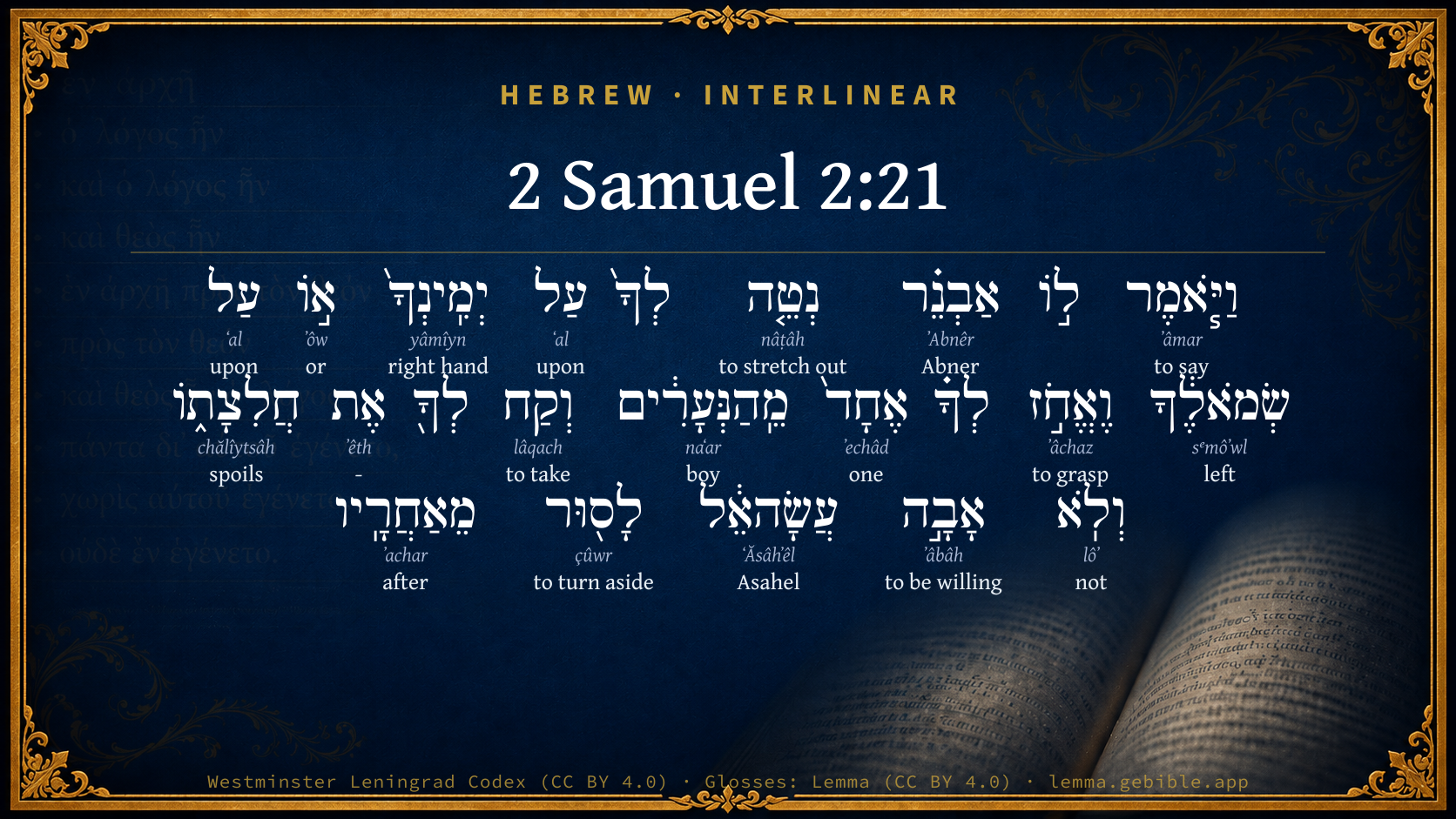
2 Samuel 2:21

Hebrew (Westminster Leningrad Codex) 2 Samuel 2:21 appears in the Hebrew Old Testament. The text above is from the Westminster Leningrad Codex. Each word links to its Strong’s number, a concise gloss, and parsing drawn from the Open Scriptures Hebrew Bible morphology. Click any word for its full Brown-Driver-Briggs (BDB) entry.
Download image
Cite this verse

2 Samuel 2:21 (World English Bible). Public Domain. Lemma interlinear Bible study tool, https://lemma.gebible.app/v/2-samuel/2/21.

Show BibTeX & RIS
BibTeX
RIS
English Translation
Abner said to him, Turn you aside to your right hand or to your left, and lay you hold on one of the young men, and take you his armor. But Asahel would not turn aside from following him.
World English Bible · Public Domain
Download a study sheet

One document with this verse’s original text, its word-by-word gloss line, the meaning frame, cross-references with their text, attributed commentary, and full source and license credits — printable, and it pastes into notes with its structure intact.

This verse Autodidact and up

Study sheet (.html) Plain text (.txt)

A passage Seminary Student

Up to 50 verses in one chapter. A passage sheet keeps up to 6 commentary sources and 12 cross-references per verse, in the order this page ranks them, and says so on the sheet whenever that leaves anything out. Ask for a single verse and you get the Autodidact verse sheet above.

Everything on this page stays free to read, with no account — the sheet is a download of what is already on screen, not access to it.

Want to remove ads? Support Godless Engineer
Compare translations 3

The same verse in 3 English versions, stacked beneath the original-language interlinear above. Click any original word for its lexicon entry.

Each is an independent rendering of the whole verse — the interlinear is not word-aligned to these translations.

Highlighted words mark where these versions differ — a whole-verse word diff, not a word-by-word alignment.

  • World English Bible Public Domain
    Abner said to him, Turn you aside to your right hand or to your left, and lay you hold on one of the young men, and take you his armor. But Asahel would not turn aside from following him.
  • King James Version Public Domain
    And Abner said to him, Turn thee aside to thy right hand or to thy left, and lay thee hold on one of the young men, and take thee his armor. But Asahel would not turn aside from following of him.
  • unfoldingWord Literal Text CC BY-SA 4.0
    And Abner said to him, “Turn aside for yourself to your right or to your left and seize for yourself one of the young men and take for yourself his spoil.” But Asahel was not willing to turn from behind him.

unfoldingWord Literal Text — © unfoldingWord, licensed CC BY-SA 4.0. Word-aligned USFM3 via Door43 (git.door43.org/unfoldingWord/en_ult).

Versions to compare (up to 4)

3 of 4 selected

Show all 18 translations

Every available English version of this verse, each an independent rendering of the whole verse.

  • World English Bible Public Domain
    Abner said to him, Turn you aside to your right hand or to your left, and lay you hold on one of the young men, and take you his armor. But Asahel would not turn aside from following him.
  • Berean Standard Bible Public Domain
    So Abner told him, “Turn to your right or to your left, seize one of the young men, and take his equipment for yourself.” But Asahel would not stop chasing him.
  • Majority Standard Bible Public Domain
    So Abner told him, “Turn to your right or to your left, seize one of the young men, and take his equipment for yourself.” But Asahel would not stop chasing him.
  • King James Version Public Domain
    And Abner said to him, Turn thee aside to thy right hand or to thy left, and lay thee hold on one of the young men, and take thee his armor. But Asahel would not turn aside from following of him.
  • American Standard Version (1901) Public Domain
    And Abner said to him, Turn thee aside to thy right hand or to thy left, and lay thee hold on one of the young men, and take thee his armor. But Asahel would not turn aside from following him.
  • Revised Version (1885) Public Domain
    And Abner said to him, Turn thee aside to thy right hand or to thy left, and lay thee hold on one of the young men, and take thee his armour. But Asahel would not turn aside from following of him.
  • Geneva Bible (1599) Public Domain
    Then Abner said, Turne thee either to the right hande, or to the left, and take one of the yong men, and take thee his weapons: and Asahel would not depart from him.
  • Douay-Rheims (1899) Public Domain
    And Abner said to him: Go to the right hand or to the left, and lay hold on one of the young men and take thee his spoils. But Asael would not leave off following him close.
  • Young's Literal Translation Public Domain
    And Abner saith to him, `Turn thee aside to thy right hand or to thy left, and seize for thee one of the youths, and take to thee his armour;' and Asahel hath not been willing to turn aside from after him.
  • Literal Standard Version CC BY-SA 4.0
    And Abner says to him, “Turn aside to your right hand or to your left, and seize one of the youths for yourself, and take his armor for yourself”; and Asahel has not been willing to turn aside from after him.
  • Unlocked Literal Bible CC BY-SA 4.0
    Abner said to him, “Turn aside to your right or to your left, and seize one of the young men and take his armor.” But Asahel would not turn aside.
  • unfoldingWord Literal Text CC BY-SA 4.0
    And Abner said to him, “Turn aside for yourself to your right or to your left and seize for yourself one of the young men and take for yourself his spoil.” But Asahel was not willing to turn from behind him.
  • Darby Bible Public Domain
    And Abner said to him, Turn thee aside, to thy right hand or to thy left, and lay hold of one of the young men, and take for thyself his armour. But Asahel would not turn aside from following him.
  • World Messianic Bible Public Domain
    Abner said to him, “Turn away to your right hand or to your left, and grab one of the young men, and take his armor.” But Asahel would not turn away from following him.
  • Webster's Bible Public Domain
    And Abner said to him, Turn thee aside to thy right hand or to thy left, and lay hold on one of the young men, and take to thee his armor. But Asahel would not turn aside from following him.
  • Free Bible Version CC BY-SA 4.0
    Abner told him, “Leave me alone! Go and fight somebody else and take his weapons for yourself!” But Asahel refused to stop chasing him.
  • Bible in Basic English Public Domain
    And Abner said, Then go to the right or to the left and put your hands on one of the fighting-men and take his arms. But Asahel would not be turned away from going after Abner.
  • JPS Tanakh (1917) Public Domain
    And Abner said to him: 'Turn thee aside to thy right hand or to thy left, and lay thee hold on one of the young men, and take thee his armour.' But Asahel would not turn aside from following him.

Literal Standard Version (2020), Covenant Press — licensed CC BY-SA 4.0. Text via the HelloAO Bible API (eBible.org). Unlocked Literal Bible (unfoldingWord) — licensed CC BY-SA 4.0. Text via the HelloAO Bible API (eBible.org). unfoldingWord Literal Text — © unfoldingWord, licensed CC BY-SA 4.0. Word-aligned USFM3 via Door43 (git.door43.org/unfoldingWord/en_ult). Free Bible Version, Dr. Jonathan Gallagher — licensed CC BY-SA 4.0. Text via the HelloAO Bible API (eBible.org).

Word by word

More ways to search: Search by grammar → Find every occurrence → Compare this word →

Practice this passage: Drill this verse → Learn its vocabulary →

חֲלִצָת֑וֹ
chălîytsâh
H2488
“spoils · his”
Noun, Common, Feminine, Singular, Construct + Suffix, Personal, 3rd Person, Masculine, Singular
Part of Speech
Noun
Type
Common
Gender
Feminine
Number
Singular
State
Construct
Full BDB Definition

Origin: from H2503

TWOT: 667a , 668a

what is stripped off (a person in war), armour, spoils, belt
  1. וַיֹּ֧אמֶר ʼâmar H559 “and · to say” Conjunction + Verb, Qal, Sequential Imperfect, 3rd Person, Masculine, Singular
  2. אַבְנֵ֗ר ʼAbnêr H74 “Abner” Noun, Proper
  3. נְטֵ֤ה nâṭâh H5186 “stretch out” Verb, Qal, Imperative, 2nd Person, Masculine, Singular
  4. עַל ʻal H5921 “upon” Preposition
  5. יְמִֽינְךָ֙ yâmîyn H3225 “right hand · your” Noun, Common, Feminine, Singular, Construct + Suffix, Personal, 2nd Person, Masculine, Singular
  6. א֣וֹ ʼôw H176 “or” Conjunction
  7. עַל ʻal H5921 “upon” Preposition
  8. שְׂמֹאלֶ֔ךָ sᵉmôʼwl H8040 “left · your” Noun, Common, Masculine, Singular, Construct + Suffix, Personal, 2nd Person, Masculine, Singular
  9. וֶאֱחֹ֣ז ʼâchaz H270 “and · grasp” Conjunction + Verb, Qal, Imperative, 2nd Person, Masculine, Singular
  10. אֶחָד֙ ʼechâd H259 “one” Adjective, Cardinal number, Masculine, Singular, Absolute
  11. מֵֽהַנְּעָרִ֔ים naʻar H5288 “from · the · boys” Preposition + Particle, Definite Article + Noun, Common, Masculine, Plural, Absolute
  12. וְקַח lâqach H3947 “and · take” Conjunction + Verb, Qal, Imperative, 2nd Person, Masculine, Singular
  13. אֶת ʼêth H853 “-” Particle, Direct Object
  14. וְלֹֽא lôʼ H3808 “and · not” Conjunction + Particle, Negative
  15. אָבָ֣ה ʼâbâh H14 “to be willing” Verb, Qal, Perfect, 3rd Person, Masculine, Singular
  16. עֲשָׂהאֵ֔ל ʻĂsâhʼêl H6214 “Asahel” Noun, Proper
  17. לָס֖וּר çûwr H5493 “to turn aside” Preposition + Verb, Qal, Infinitive Construct
  18. מֵאַחֲרָֽיו ʼachar H310 “from · after · him” Preposition + Preposition + Suffix, Personal, 3rd Person, Masculine, Singular

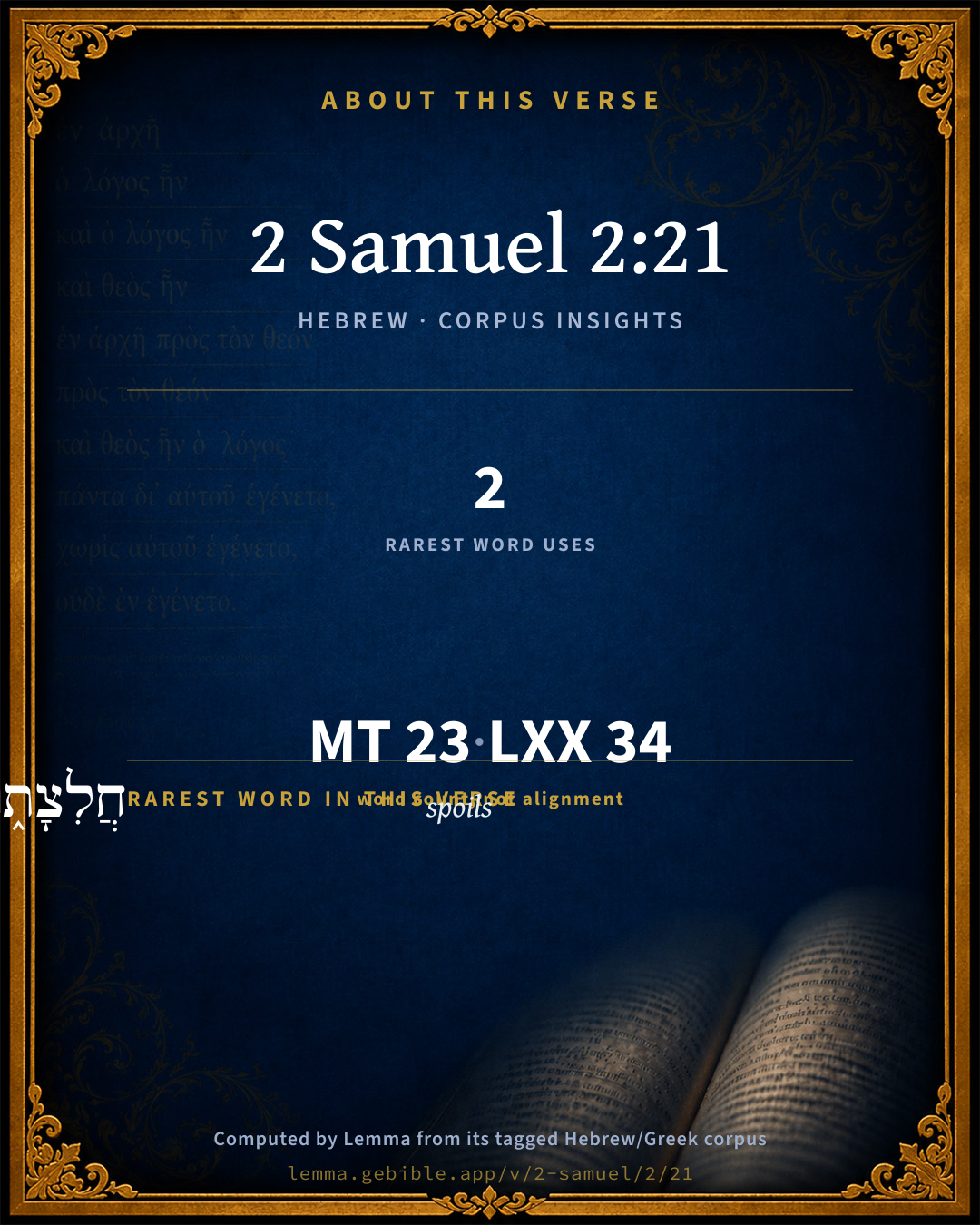
About this verse

These counts appear in no published source. They are computed here, from the morphology-tagged text and Lemma’s own curated glosses. What Lemma adds →

23
words
18
distinct lemmas
Historical
section

Notable vocabulary

The rarest word here is חֲלִצָת֑וֹ spoils H2488 — appearing just 2 times in the whole Hebrew Bible.

Shared distinctive vocabulary

חֲלִצָת֑וֹ spoils H2488 occurs in 2 verses of the Hebrew Bible. Also found in:

Grammatical profile

  • 6 verbs
  • 6 nouns
  • 1 adjective
  • 7 prepositions
  • 1 conjunction
  • 2 particles

Verb forms

  • וַיֹּ֧אמֶר Qal · Sequential Imperfect
  • נְטֵ֤ה Qal · Imperative
  • וֶאֱחֹ֣ז Qal · Imperative
  • וְקַח Qal · Imperative
  • אָבָ֣ה Qal · Perfect
  • לָס֖וּר Qal · Infinitive Construct

Repetition

A word recurs within this verse — often emphatic in Hebrew:

Hebrew & Septuagint length

In English translation the verse runs 39 words from the Hebrew and 41 from the Septuagint (LXX English) — closely comparable.

A rough comparison of the two English renderings, which tokenize alike — not a word-level alignment.

Word counts can differ between the Hebrew and the Greek without any difference in meaning — e.g. the Hebrew direct-object marker אֵת has no separate Greek word, and Greek often adds the article ὁ.

In the original languages it is 23 Hebrew tokens and 34 Greek tokens — but the two are counted differently (Hebrew bundles its prefixes and suffixes into one token; the Greek is in lemma form), so that isn’t a like-for-like length.

Cross-references

1

Topical passages linked to 2 Samuel 2:21 in the Treasury of Scripture Knowledge — connected by theme and wording, ordered by reader-vote popularity; previews shown in the World English Bible.

  • Judges 14:19 The Spirit of Yahweh came mightily on him, and he went down to Ashkelon, and struck thirty men of them, and took their spoil, and gave the changes [of clothing] to those who declared the riddle. His anger was kindled, and he went up to his father's house.

Cross-references courtesy of OpenBible.info (CC BY 4.0).

Hebrew and Greek witnesses Masoretic Hebrew ↔ Greek Septuagint

The same verse in the two great witnesses to the Old Testament, shown verse-for-verse.

These are two independent witnesses, not word-aligned to each other, and the Septuagint is shown in lemma (dictionary) form.

Hebrew 2 Samuel 2:21 Masoretic · Westminster Leningrad Codex

וַיֹּ֧אמֶר ל֣וֹ אַבְנֵ֗ר נְטֵ֤ה לְךָ֙ עַל יְמִֽינְךָ֙ א֣וֹ עַל שְׂמֹאלֶ֔ךָ וֶאֱחֹ֣ז לְךָ֗ אֶחָד֙ מֵֽהַנְּעָרִ֔ים וְקַח לְךָ֖ אֶת חֲלִצָת֑וֹ וְלֹֽא אָבָ֣ה עֲשָׂהאֵ֔ל לָס֖וּר מֵאַחֲרָֽיו

Abner said to him, Turn you aside to your right hand or to your left, and lay you hold on one of the young men, and take you his armor. But Asahel would not turn aside from following him.

World English Bible · Public Domain

Greek LXX 2 Samuel 2:21 Septuagint · lemma form

καί εἶπον αὐτός αβεννηρ ἐκκλίνω σύ εἰς ὁ δεξιός ἤ εἰς ὁ ἀριστερός καί καταἔχω σεαυτοῦ εἷς ὁ παιδάριον καί λαμβάνω σεαυτοῦ ὁ πανοπλία αὐτός καί οὐ θέλω ασαηλ ἐκκλίνω ἐκ ὁ ὄπισθε αὐτός

And Abenner said to him, Turn you to the right hand or to the left, and lay hold for yourself on one of the young men, and take to yourself his armor: but Asel would not turn back from following him.

LXX2012 (modern English Septuagint) · Public Domain

Hebrew: Westminster Leningrad Codex (CC BY 4.0). Greek: Septuagint (public domain); English from LXX2012 (modern English Septuagint) (Public Domain). How the Septuagint differs from the Hebrew →

Targum (Aramaic paraphrase)

1

The Targum is the ancient Jewish Aramaic paraphrase of the Hebrew Scriptures — an interpretive translation, not the Hebrew text itself. Onkelos (literal) and Pseudo-Jonathan (expansive) render the Torah, and Jonathan the Prophets. Coverage is partial: where no permissively-licensed English translation exists for a verse, only the Aramaic is shown. This is verse-level text, not a word-by-word alignment to the Hebrew.

  1. Targum Jonathan Prophets (Joshua–Malachi)
    וַאֲמַר לֵיהּ אַבְנֵר אִיתְפְנֵי לָךְ עַל יְמִינָךְ אוֹ עַל סְמָלָךְ וְאֵיחוּד לָךְ חַד מֵעוּלֵימַיָא וְסַב לָךְ יַת זְרָזֵיהּ וְלָא אָבָה עֲשָׂהאֵל לְמֵיזַר מִבַּתְרוֹהִי:

    (no public-domain English translation for this verse)

    Targum Jonathan — Aramaic: “Mikraot Gedolot” (public domain). English: “Sefaria Community Translation” (CC0 1.0 (public-domain dedication)); “London "Chaldee Paraphrase," 1871” (public domain). Text via Sefaria.

Commentary

Notes on 2 Samuel 2:21 from classic Christian and Jewish commentators (each source and its license shown beneath its notes). The classic Christian expositions comment on the surrounding passage and are grouped to its opening verse, so a note may address several verses; the Jewish commentaries on the Tanakh (Rashi and others) are per-verse, so they appear only where the commentator wrote on this verse.

Lemma curates 59 commentaries, every one of them public domain or Creative Commons licensed, each selected and text-cleaned for this edition rather than reprinted as found. About our sources →

Trapp's Complete Commentary

John Trapp

2Sa 2:21 And Abner said to him, Turn thee aside to thy right hand or to thy left, and lay thee hold on one of the young men, and take thee his armour. But Asahel would not turn aside from following of him.

Ver. 21. Lay thee hold on one of the young men.] Meddle with thy match, and contend not with him that is mightier than thou. Patroclus is no meet match for Hector. When Carolostadius opposed Luther’s consubstantiation, but weakly and insufficiently, Zuinglius said he was sorry that so good a cause wanted shoulders. {a} Heat of zeal sometimes, in the indiscreet pursuit of a just adversary, proves mortal to the agent, prejudicial to the service.

{a} Non satis humerorum haberet.

John Trapp, A Commentary or Exposition upon All the Books of the Old and New Testament (1647–1656) — public domain. Text from a community e-Sword module.

Joseph Benson's Commentary

2Sa 2:21-22. Abner said, Turn thee aside, &c. — If thou art ambitions to get a trophy or mark of thy valour, desist from me, who am an old and experienced captain, and go to some young and raw soldier; try thy skill upon him, and take away his arms from him. Abner was very unwilling to kill Asahel, which he knew he was able to do, and therefore he endeavoured, by fair speeches and motives, to induce him to desist from his design of attacking him. How should I hold up my face to Joab thy brother? — Who was a fierce man, and who, Abner knew, would study revenge.

Joseph Benson's Commentary on the Old and New Testaments (1811–1818) — public domain. Text from a community e-Sword module.

Geneva Bible (1599)

Geneva Bible translators

Or, spoil.

Geneva Bible (1599) marginal notes — public domain. Text via Bolls.life.

Adam Clarke's Commentary

Verse 21. Take thee his armour.] It seems Asahel wished to get the armour of Abner as a trophy; this also was greatly coveted by ancient heroes. Abner wished to spare him, for fear of exciting Joab's enmity; but as Asahel was obstinate in the pursuit, and was swifter of foot than Abner, the latter saw that he must either kill or be killed, and therefore he turned his spear and ran it through the body of Asahel. This turning about that he might pierce him is what we translate "the hinder end of his spear." This slaying of Asahel cost Abner his life, as we shall find in the next chapter.

Adam Clarke's Commentary on the Bible (1810–1826) — public domain. Text from a community e-Sword/MySword module.

The Cambridge Bible for Schools and Colleges

gen. ed. J. J. S. Perowne

21. take thee his armour] Probably, as in Jdg_14:19, his spoil: i.e. if Asahel was desirous of spoil, he might find it elsewhere, instead of attacking a practised warrior at the risk of his life.

The Cambridge Bible for Schools and Colleges (gen. ed. J. J. S. Perowne; Cambridge University Press, 1878–1918) — public domain. Text from a community e-Sword module.

John Gill's Exposition

And Abner said unto him,.... Having a respect for him, and consulting his good, and however fearing his brother Joab should he slay him:

turn thee aside to thy right or to thy left; he does not advise him to go back, which would have been to his disgrace, having engaged in the pursuit, but to turn to the right or left, as if pursuing some other person and not Abner:

and lay thee hold on one of the young men, and take thee his armour; one of the common soldiers, or an attendant on Abner, a young man like himself, whom he might be able to cope with, and take him a prisoner and disarm him, when he was not a match for such an old experienced officer as he was; and this Abner seems to speak as a friend, consulting the young man's safety and his honour too.

But, Asahel would not turn aside from following him; fired with the ambition of taking him, and not content with any prey short of him; and perhaps was the more animated by what he said, as supposing it arose from fear of him.

John Gill's Exposition of the Whole Bible (1746–1763) — public domain (CC PDM 1.0). Text via the HelloAO Bible API.

Albert Barnes' Notes on the Bible

His armour - Rather, as in the margin; i. e. content thyself with the spoil of some inferior soldier for a trophy.

Albert Barnes' Notes on the Bible (1834–1885) — public domain. Text from a community e-Sword/MySword module.

Haydock's Catholic Bible Commentary

Spoils. Attack one who may be a more equal match for thee. (Haydock)

George Leo Haydock (1774–1849), Haydock's Catholic Family Bible and Commentary, 1859 edition — public domain. Excludes Psalms (Douay-Rheims chapter numbering differs from Protestant) and Deuterocanonical books (Catholic canon only).

Matthew Poole's English Annotations

Take thee his armour: if thou art ambitious to get a trophy or mark of thy valour, desist from me, who am an old and experienced captain, and go to some young and raw soldier; try thy skill upon him, and take away his arms from him.

Matthew Poole's English Annotations on the Holy Bible (1683–1685) — public domain. Text from a community e-Sword/MySword module.

Whedon's Commentary on the Bible

Daniel D. Whedon

21. Lay thee hold on one of the young men — One of the common soldiers.

Take thee his armour — Asahel’s object was to slay Abner and take his armour as a trophy.

Daniel D. Whedon (gen. ed.), Commentary on the Old and New Testaments (1874–1909) — public domain. Text from a community e-Sword module.

John Wesley's Explanatory Notes

And take, &c. - If thou art ambitious to get a trophy or mark of thy valour, desist from me who am an old and experienced captain, and go to some young and raw soldier; try thy skill upon him, and take away his arms from him.

John Wesley, Explanatory Notes Upon the Whole Bible (1754–1765) — public domain. Text via the GEBible commentary corpus.

Lesson kit

Teaching starters — assembled from the data on this page, not authored interpretation. Every prompt links to the verse data it draws on. Edit before teaching.

2 Samuel, in the Historical, opens this verse with 23 words (18 distinct Hebrew lemmas). Its most distinctive word is chălîytsâh (“spoils”). A historical commentator’s framing appears above. Read the whole chapter for the surrounding context.

Discussion questions

  1. How does “spoils” (chălîytsâh) shape what this verse is saying?
  2. Judges 14:19 shares the word «spoils» with this verse. How do the two illuminate each other?
  3. “upon” occurs 2× in this one verse. What is the effect of the repetition?
  4. The translations on this page render this verse differently — a whole-verse word diff, not a word-by-word alignment. What might account for the different wordings?
  5. The verb «וַיֹּ֧אמֶר» is Qal Sequential Imperfect. How does its form color the action?
  6. Reading how Trapp's Complete Commentary and Joseph Benson's Commentary read this verse, where do the two commentators agree and where do they part?

Things to notice

Reading settings

Reading text

Shown beneath each verse's original-language words.

Old Testament
Old Testament edition

Read the OT as the Masoretic Hebrew (MT) or the Greek Septuagint (LXX).

English shown for the Greek Septuagint (in the Hebrew ↔ Greek comparison).

Comparing translations? Open the Compare panel on any verse page to stack up to four side by side.