
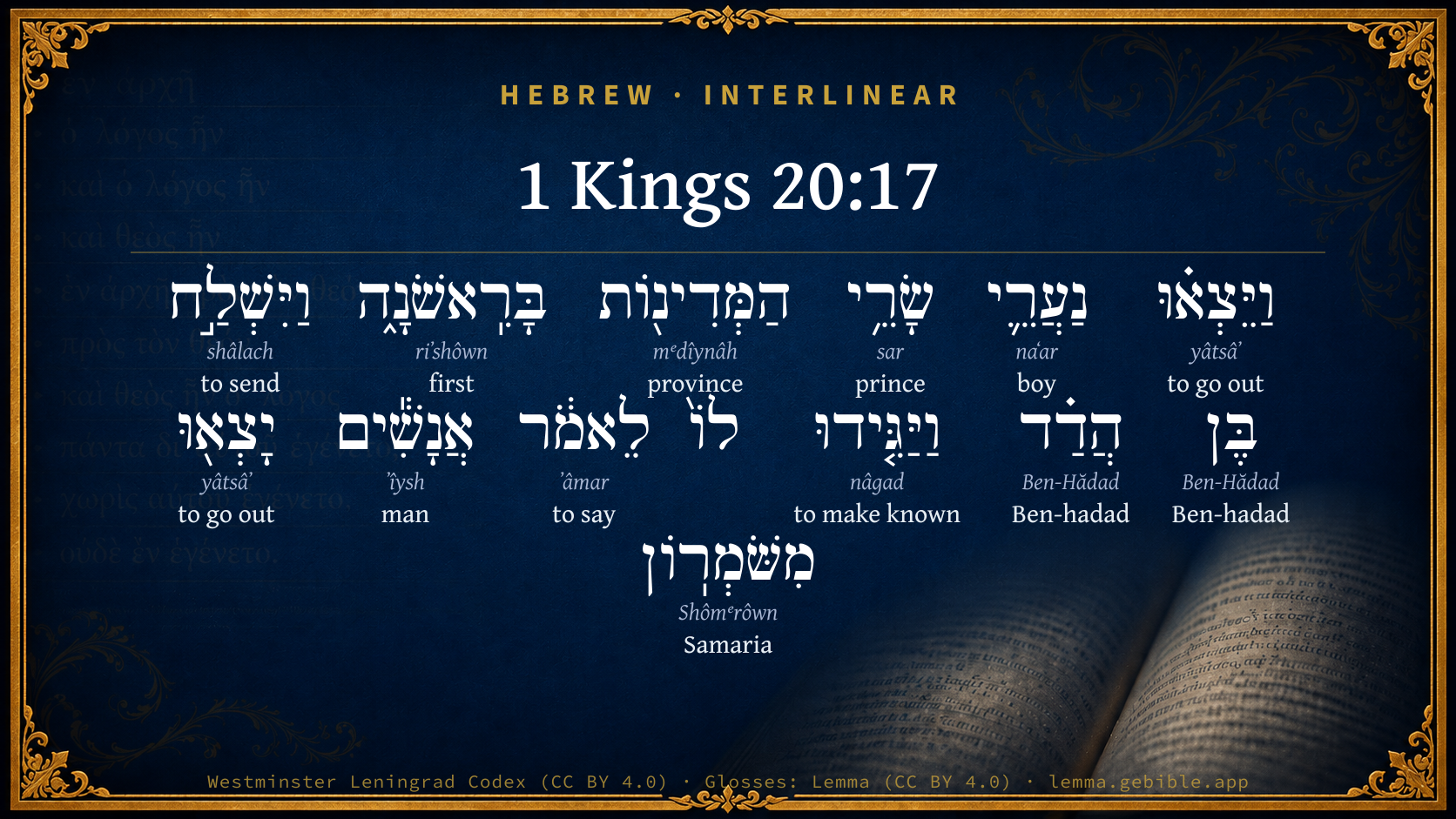
1 Kings 20:17

Hebrew (Westminster Leningrad Codex) 1 Kings 20:17 appears in the Hebrew Old Testament. The text above is from the Westminster Leningrad Codex. Each word links to its Strong’s number, a concise gloss, and parsing drawn from the Open Scriptures Hebrew Bible morphology. Click any word for its full Brown-Driver-Briggs (BDB) entry.
Download image
Cite this verse

1 Kings 20:17 (World English Bible). Public Domain. Lemma interlinear Bible study tool, https://lemma.gebible.app/v/1-kings/20/17.

Show BibTeX & RIS
BibTeX
RIS
English Translation
The young men of the princes of the provinces went out first; and Ben Hadad sent out, and they told him, saying, There are men come out from Samaria.
World English Bible · Public Domain
Download a study sheet

One document with this verse’s original text, its word-by-word gloss line, the meaning frame, cross-references with their text, attributed commentary, and full source and license credits — printable, and it pastes into notes with its structure intact.

This verse Autodidact and up

Study sheet (.html) Plain text (.txt)

A passage Seminary Student

Up to 50 verses in one chapter. A passage sheet keeps up to 6 commentary sources and 12 cross-references per verse, in the order this page ranks them, and says so on the sheet whenever that leaves anything out. Ask for a single verse and you get the Autodidact verse sheet above.

Everything on this page stays free to read, with no account — the sheet is a download of what is already on screen, not access to it.

Want to remove ads? Support Godless Engineer
Compare translations 3

The same verse in 3 English versions, stacked beneath the original-language interlinear above. Click any original word for its lexicon entry.

Each is an independent rendering of the whole verse — the interlinear is not word-aligned to these translations.

Highlighted words mark where these versions differ — a whole-verse word diff, not a word-by-word alignment.

  • World English Bible Public Domain
    The young men of the princes of the provinces went out first; and Ben Hadad sent out, and they told him, saying, There are men come out from Samaria.
  • King James Version Public Domain
    And the young men of the princes of the provinces went out first; and Benhadad sent out, and they told him, saying, There are men come out of Samaria.
  • unfoldingWord Literal Text CC BY-SA 4.0
    And the servants of the leaders of the districts went out at first. And Ben Hadad sent, and they declared to him, saying, “Men have gone out from Samaria.”

unfoldingWord Literal Text — © unfoldingWord, licensed CC BY-SA 4.0. Word-aligned USFM3 via Door43 (git.door43.org/unfoldingWord/en_ult).

Versions to compare (up to 4)

3 of 4 selected

Show all 18 translations

Every available English version of this verse, each an independent rendering of the whole verse.

  • World English Bible Public Domain
    The young men of the princes of the provinces went out first; and Ben Hadad sent out, and they told him, saying, There are men come out from Samaria.
  • Berean Standard Bible Public Domain
    And the young officers of the district governors marched out first. Now Ben-hadad had sent out scouts, who reported to him, “Men are marching out of Samaria.”
  • Majority Standard Bible Public Domain
    And the young officers of the district governors marched out first. Now Ben-hadad had sent out scouts, who reported to him, “Men are marching out of Samaria.”
  • King James Version Public Domain
    And the young men of the princes of the provinces went out first; and Benhadad sent out, and they told him, saying, There are men come out of Samaria.
  • American Standard Version (1901) Public Domain
    And the young men of the princes of the provinces went out first; and Ben-hadad sent out, and they told him, saying, There are men come out from Samaria.
  • Revised Version (1885) Public Domain
    And the young men of the princes of the provinces went out first; and Ben-hadad sent out, and they told him, saying, There are men come out from Samaria.
  • Geneva Bible (1599) Public Domain
    So the seruants of the princes of the prouinces went out first: and Ben-hadad sent out, and they shewed him, saying, There are men come out of Samaria.
  • Douay-Rheims (1899) Public Domain
    And the servants of the princes of the provinces went out first. And Benadad sent. And they told him, saying: There are men come out of Samaria.
  • Young's Literal Translation Public Domain
    And the young men of the heads of the provinces go out at the first, and Ben-Hadad sendeth, and they declare to him, saying, `Men have come out of Samaria.'
  • Literal Standard Version CC BY-SA 4.0
    And the young men of the heads of the provinces go out at the first, and Ben-Hadad sends, and they declare to him, saying, “Men have come out of Samaria.”
  • Unlocked Literal Bible CC BY-SA 4.0
    The young officers who served the governors of the districts went forward first. Then Ben Hadad was informed by scouts that he had sent out, “Men are coming out from Samaria.”
  • unfoldingWord Literal Text CC BY-SA 4.0
    And the servants of the leaders of the districts went out at first. And Ben Hadad sent, and they declared to him, saying, “Men have gone out from Samaria.”
  • Darby Bible Public Domain
    And the servants of the princes of the provinces went out first; and Ben-Hadad sent out, and they told him saying, There are men come out of Samaria.
  • World Messianic Bible Public Domain
    The young men of the princes of the provinces went out first; and Ben Hadad sent out, and they told him, saying, “Men are coming out from Samaria.”
  • Webster's Bible Public Domain
    And the young men of the princes of the provinces went out first; and Ben-hadad sent out, and they told him, saying, There are men come out of Samaria.
  • Free Bible Version CC BY-SA 4.0
    The young officers of the district commanders took the lead. The scouts Ben-hadad had sent out came and reported to him, “Enemy soldiers are advancing from Samaria.”
  • Bible in Basic English Public Domain
    And the servants of the chiefs who were over the divisions of the land went forward first; and when Ben-hadad sent out, they gave him the news, saying, Men have come out from Samaria.
  • JPS Tanakh (1917) Public Domain
    And the young men of the princes of the provinces went out first; and Ben-hadad sent out, and they told him, saying: 'There are men come out from Samaria.'

Literal Standard Version (2020), Covenant Press — licensed CC BY-SA 4.0. Text via the HelloAO Bible API (eBible.org). Unlocked Literal Bible (unfoldingWord) — licensed CC BY-SA 4.0. Text via the HelloAO Bible API (eBible.org). unfoldingWord Literal Text — © unfoldingWord, licensed CC BY-SA 4.0. Word-aligned USFM3 via Door43 (git.door43.org/unfoldingWord/en_ult). Free Bible Version, Dr. Jonathan Gallagher — licensed CC BY-SA 4.0. Text via the HelloAO Bible API (eBible.org).

Word by word

More ways to search: Search by grammar → Find every occurrence → Compare this word →

Practice this passage: Drill this verse → Learn its vocabulary →

בֶּן
Ben-Hădad
H1130
“Ben-hadad”
Noun, Proper
Part of Speech
Noun
Type
Proper
Full BDB Definition

Origin: from H1121 and H1908

TWOT: None

Ben-hadad = "son of [the false god] Hadad" - the king of Syria, contemporary with Asa of Judah - the son of Hazael, also king of Syria
  1. וַיֵּצְא֗וּ yâtsâʼ H3318 “and · to go out” Conjunction + Verb, Qal, Sequential Imperfect, 3rd Person, Masculine, Plural
  2. נַעֲרֵ֛י naʻar H5288 “boys of” Noun, Common, Masculine, Plural, Construct
  3. שָׂרֵ֥י sar H8269 “princes of” Noun, Common, Masculine, Plural, Construct
  4. הַמְּדִינ֖וֹת mᵉdîynâh H4082 “the · provinces” Particle, Definite Article + Noun, Common, Feminine, Plural, Absolute
  5. בָּרִֽאשֹׁנָ֑ה riʼshôwn H7223 “in/at the · first” Preposition, Determined + Adjective, Adjective, Feminine, Singular, Absolute
  6. וַיִּשְׁלַ֣ח shâlach H7971 “and · to send” Conjunction + Verb, Qal, Sequential Imperfect, 3rd Person, Masculine, Singular
  7. הֲדַ֗ד Ben-Hădad H1130 “Ben-hadad” Noun, Proper
  8. וַיַּגִּ֤ידוּ nâgad H5046 “and · to make known” Conjunction + Verb, Hiphil, Sequential Imperfect, 3rd Person, Masculine, Plural
  9. לֵאמֹ֔ר ʼâmar H559 “to say” Preposition + Verb, Qal, Infinitive Construct
  10. אֲנָשִׁ֕ים ʼîysh H376 “men” Noun, Common, Masculine, Plural, Absolute
  11. יָצְא֖וּ yâtsâʼ H3318 “to go out” Verb, Qal, Perfect, 3rd Person, Common, Plural
  12. מִשֹּׁמְרֽוֹן Shômᵉrôwn H8111 “from · Samaria” Preposition + Noun, Proper

About this verse

These counts appear in no published source. They are computed here, from the morphology-tagged text and Lemma’s own curated glosses. What Lemma adds →

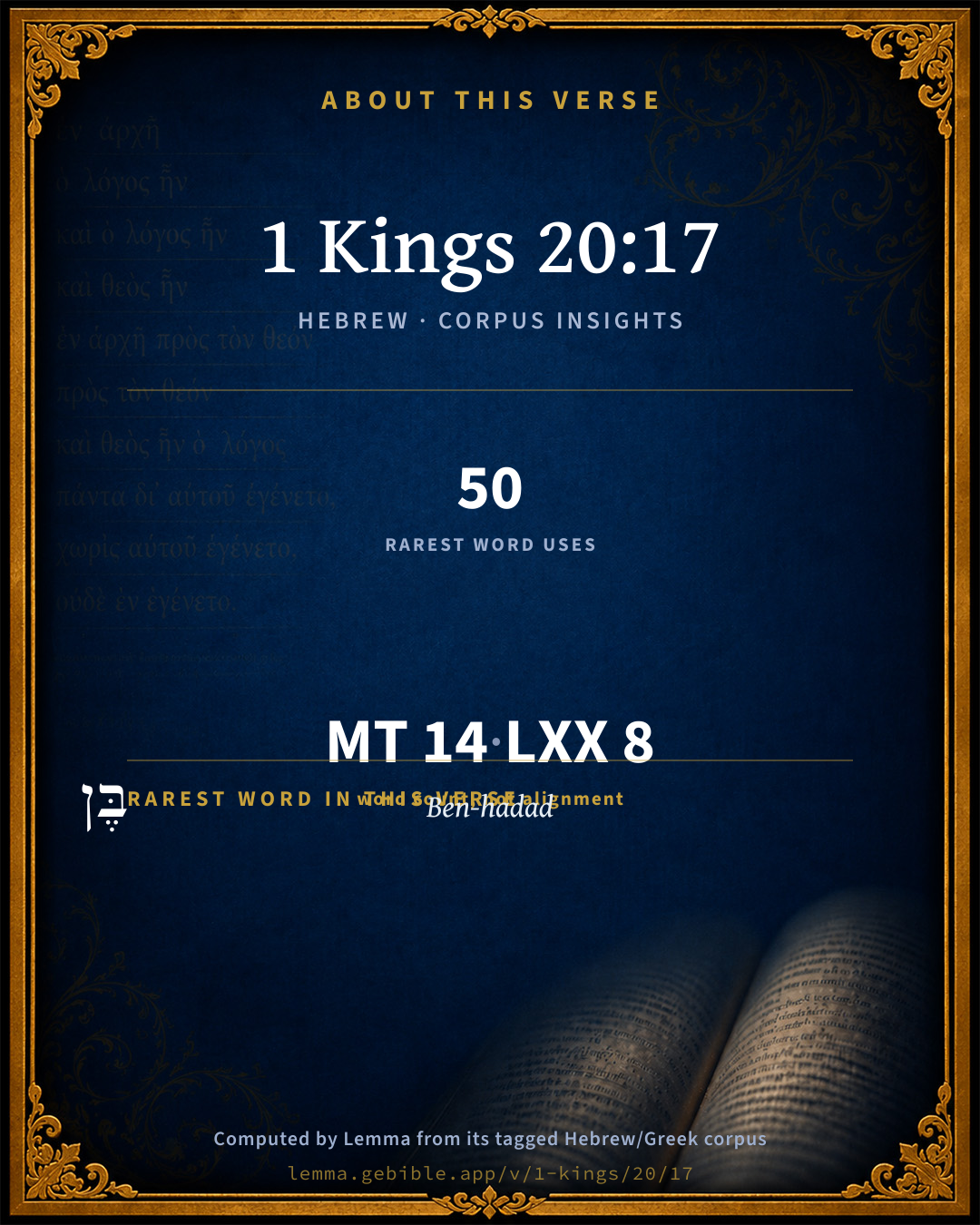
14
words
11
distinct lemmas
Historical
section

Shared distinctive vocabulary

בֶּן Ben-hadad H1130 occurs in 24 verses of the Hebrew Bible. Also found in:

Grammatical profile

  • 5 verbs
  • 7 nouns
  • 1 adjective
  • 1 preposition

Verb forms

  • וַיֵּצְא֗וּ Qal · Sequential Imperfect
  • וַיִּשְׁלַ֣ח Qal · Sequential Imperfect
  • וַיַּגִּ֤ידוּ Hiphil · Sequential Imperfect
  • לֵאמֹ֔ר Qal · Infinitive Construct
  • יָצְא֖וּ Qal · Perfect

Repetition

Words recur within this verse — often emphatic in Hebrew:

  • וַיֵּצְא֗וּ to go out H3318 ×2
  • בֶּן Ben-hadad H1130 ×2

Hebrew & Septuagint length

In English translation the verse runs 29 words from the Hebrew and 9 from the Septuagint (LXX English) — the Septuagint runs noticeably shorter here. See the side-by-side →

A rough comparison of the two English renderings, which tokenize alike — not a word-level alignment.

Word counts can differ between the Hebrew and the Greek without any difference in meaning — e.g. the Hebrew direct-object marker אֵת has no separate Greek word, and Greek often adds the article ὁ.

In the original languages it is 14 Hebrew tokens and 8 Greek tokens — but the two are counted differently (Hebrew bundles its prefixes and suffixes into one token; the Greek is in lemma form), so that isn’t a like-for-like length.

Cross-references

2

Topical passages linked to 1 Kings 20:17 in the Treasury of Scripture Knowledge — connected by theme and wording, ordered by reader-vote popularity; previews shown in the World English Bible.

  • 1 Kings 20:14–15 Ahab said, By whom? He said, Thus says Yahweh, By the young men of the princes of the provinces. Then he said, Who shall begin the battle? He answered, You.
  • 1 Kings 20:19 So these went out of the city, the young men of the princes of the provinces, and the army which followed them.

Cross-references courtesy of OpenBible.info (CC BY 4.0).

Hebrew and Greek witnesses Masoretic Hebrew ↔ Greek Septuagint

The same verse in the two great witnesses to the Old Testament, shown verse-for-verse.

Here the Septuagint runs noticeably shorter than the Hebrew — LXX2012 (modern English Septuagint) 9 words vs World English Bible 29. A rough length comparison of the two English translations, not a word-level alignment — read both below.

These are two independent witnesses, not word-aligned to each other, and the Septuagint is shown in lemma (dictionary) form.

Hebrew 1 Kings 20:17 Masoretic · Westminster Leningrad Codex

וַיֵּצְא֗וּ נַעֲרֵ֛י שָׂרֵ֥י הַמְּדִינ֖וֹת בָּרִֽאשֹׁנָ֑ה וַיִּשְׁלַ֣ח בֶּן הֲדַ֗ד וַיַּגִּ֤ידוּ לוֹ֙ לֵאמֹ֔ר אֲנָשִׁ֕ים יָצְא֖וּ מִשֹּׁמְרֽוֹן

The young men of the princes of the provinces went out first; and Ben Hadad sent out, and they told him, saying, There are men come out from Samaria.

World English Bible · Public Domain

Greek LXX 1 Kings 20:17 Septuagint · lemma form

καί εἶπον κύριος πρός ηλιου ὁ θεσβίτης λέγω

And the Lord spoke to Eliu the Thesbite, saying,

LXX2012 (modern English Septuagint) · Public Domain

On this verse, The Cambridge Bible for Schools and Colleges discusses the Septuagint’s reading. Read the note in Commentary ↓

Hebrew: Westminster Leningrad Codex (CC BY 4.0). Greek: Septuagint (public domain); English from LXX2012 (modern English Septuagint) (Public Domain). How the Septuagint differs from the Hebrew →

Targum (Aramaic paraphrase)

1

The Targum is the ancient Jewish Aramaic paraphrase of the Hebrew Scriptures — an interpretive translation, not the Hebrew text itself. Onkelos (literal) and Pseudo-Jonathan (expansive) render the Torah, and Jonathan the Prophets. Coverage is partial: where no permissively-licensed English translation exists for a verse, only the Aramaic is shown. This is verse-level text, not a word-by-word alignment to the Hebrew.

  1. Targum Jonathan Prophets (Joshua–Malachi)
    וּנְפַקוּ עוּלֵימֵי רַבְרְבֵי מְדִינָתָא בְּקַדְמֵיתָא וּשְׁלַח בַּר הֲדַד וְחַוִיאוּ לֵיהּ לְמֵימַר גַבְרִין נְפַקוּ מִשֹׁמְרוֹן:

    (no public-domain English translation for this verse)

    Targum Jonathan — Aramaic: “Mikraot Gedolot” (public domain). English: “Sefaria Community Translation” (CC0 1.0 (public-domain dedication)); “London "Chaldee Paraphrase," 1871” (public domain). Text via Sefaria.

Commentary

Notes on 1 Kings 20:17 from classic Christian and Jewish commentators (each source and its license shown beneath its notes). The classic Christian expositions comment on the surrounding passage and are grouped to its opening verse, so a note may address several verses; the Jewish commentaries on the Tanakh (Rashi and others) are per-verse, so they appear only where the commentator wrote on this verse.

Lemma curates 59 commentaries, every one of them public domain or Creative Commons licensed, each selected and text-cleaned for this edition rather than reprinted as found. About our sources →

Trapp's Complete Commentary

John Trapp

1Ki 20:17 And the young men of the princes of the provinces went out first; and Benhadad sent out, and they told him, saying, There are men come out of Samaria.

Ver. 17. And the young men … went out first.] As a forlorn hope to set first on the enemy: or as that Sacra cohors in the Theban army.

John Trapp, A Commentary or Exposition upon All the Books of the Old and New Testament (1647–1656) — public domain. Text from a community e-Sword module.

The Biblical Illustrator

Joseph S. Exell

1Ki_20:17

And the young men of the princes of the provinces went out first.

Young men encouraged to band together for the holy war

I. The mighty enemies to be opposed.

II. The glorious monarch under whom we fight.

III. The instruments employed on this occasion in his service. The young men of the princes of the provinces. Such it was, that God selected on this occasion, that His hand might be more clearly revealed. Thus the faith of His people was called forth and exercised; thus bold zeal in His cause would be encouraged. Nor is it only in the history of Israel, that young men have been employed. There have, in our own country and in our own Church, been in past days associations of young men, that have been eminently blessed of God. The societies for the reformation of manners originated with young men; and from 1668, for nearly a century, their associated efforts greatly blessed our country. Vice was discouraged and put down; and innumerable books of piety, circulated by the young men of that period, produced a great reformation of morals, especially in the city of London, but which spread also through other parts of the country.

IV. The victory obtained. (E. Bickersteth, M. A.)

Step in anywhere

During a great battle, a recruit who had lost his company in the tumult of strife, approached the general in command, and timidly asked where he should step in. Step in? thundered the general. Step in anywhere; theres fighting all along the line. A heavy piece of machinery was being moved into a building by means of a block and tackle. Suddenly one of the ropes parted, and the machine began to slide backward. The two men who had charge of the work sprang to stay its progress. Give us a lift! one of them shouted to a bystander. Where shall I take hold? asked the man thus addressed, unmindful of the fact that there was net a second to lose. Grab hold anywhere! yelled the mover. It may be that we are in a field where we are unaccustomed to work, and are timidly asking where we shall step in. We may find our answer in the words, Step in anywhere; theres fighting all along the line. Are you waiting to be called into some special Church work? Step in anywhere. If you are willing, you can be used. This is not the time to pick and choose as to what work we shall do. The need is so great, the force against us so strong, that only one duty awaits the Christian disciple--to take hold anywhere. (Signal.)

The Biblical Illustrator, edited by Joseph S. Exell (c. 1880s–1900s) — public domain. Text from a community e-Sword module.

Tyndale Open Study Notes

Tyndale Open Resources

20:17 first contingent: Ahab apparently sent this small squad to test the enemy. Surprise attacks in the ancient Near East often divided the attacking forces into assault groups designed to launch a pincer movement against the enemy (Judg 7:16; 1 Sam 11:11), to lure the opposing forces into an ambush (Josh 8:15-22), or to draw the enemy to a spot where the attacking army enjoyed a superior position (Judg 4:14-16; 5:19-21).

Tyndale Open Study Notes — © Tyndale Open Resources, licensed CC BY-SA 4.0. Text via the HelloAO Bible API.

Geneva Bible (1599)

Geneva Bible translators

That is, young men trained in the service of princes.

Geneva Bible (1599) marginal notes — public domain. Text via Bolls.life.

The Cambridge Bible for Schools and Colleges

gen. ed. J. J. S. Perowne

17. and Ben-hadad sent out] Even in his drunken revelry he is made aware that something unexpected is taking place, and he sends to know exactly what it is. The LXX. says ‘they send and announce to the king of Syria’, but this is hardly what would take place. When the messengers come back they tell the king that the besieged have taken a new course: ‘There are men come out of (R.V. from) Samaria;’ ‘They are not going to wait for our attack, but either come to attack us, or to make proposals for peace’.

The Cambridge Bible for Schools and Colleges (gen. ed. J. J. S. Perowne; Cambridge University Press, 1878–1918) — public domain. Text from a community e-Sword module.

John Gill's Exposition

And the young men of the princes of the provinces went out first,.... From Samaria, before the 7000 did:

and Benhadad sent out; of his pavilion, a messenger or messengers to his sentinels, to know what news, and how matters stood, whether Ahab had sent any message, signifying his compliance with his terms:

and they told him, saying, there are men come out of Samaria; but upon what account they could not say.

John Gill's Exposition of the Whole Bible (1746–1763) — public domain (CC PDM 1.0). Text via the HelloAO Bible API.

Albert Barnes' Notes on the Bible

Ben-hadad sent out, and they told him - The Septuagint has a better reading: “they sent and told the king of Syria.”

Albert Barnes' Notes on the Bible (1834–1885) — public domain. Text from a community e-Sword/MySword module.

Whedon's Commentary on the Bible

Daniel D. Whedon

17. The young men… went out first — That is, went out in front of the seven thousand, which followed, ready to pursue the flying Syrians. Compare 1Ki_20:19-20.

Ben-hadad sent out — To learn what this sudden sally from Samaria meant.

Daniel D. Whedon (gen. ed.), Commentary on the Old and New Testaments (1874–1909) — public domain. Text from a community e-Sword module.

The Pulpit Commentary

And the young men of the princes of the provinces went out first; and Ben-hadad sent out Or had sent out. Possibly, the unusual stir in the city, the mustering of the troops, etc., had led to his sending out scouts before the young men issued from the gates. The LXX, however, has "And they send and tell the king of Syria," which Rawlinson thinks represents a purer text. But it looks like an emendation to avoid the difficulty, which is removed by translating jlvYiw as pluperfect, and they told him saying, There are men come out of Samaria. Heb. men went forth, etc.

The Pulpit Commentary (1880–1919), ed. H.D.M. Spence-Jones & Joseph S. Exell — public domain. Text from a community e-Sword module.

Lesson kit

Teaching starters — assembled from the data on this page, not authored interpretation. Every prompt links to the verse data it draws on. Edit before teaching.

1 Kings, in the Historical, opens this verse with 14 words (11 distinct Hebrew lemmas). Its most distinctive word is Ben-Hădad (“Ben-hadad”). The Greek Septuagint runs shorter here. A historical commentator’s framing appears above. Read the whole chapter for the surrounding context.

Discussion questions

  1. What does “Ben-hadad” (Ben-Hădad) contribute to the verse as a whole?
  2. How does 1 Kings 15:18, which shares the word «Ben-hadad», read alongside this verse?
  3. What does the repetition of “to go out” (2× in this one verse) do in this verse?
  4. The Septuagint runs shorter here than the Hebrew. What might account for the difference?
  5. These translations render this verse differently. What is at stake in choosing one wording over another?
  6. «וַיֵּצְא֗וּ» is a Qal Sequential Imperfect verb. How does that grammatical form shape the action described?
  7. Compare how Trapp's Complete Commentary and The Biblical Illustrator read this verse. Where do they agree or differ?

Things to notice

Reading settings

Reading text

Shown beneath each verse's original-language words.

Old Testament
Old Testament edition

Read the OT as the Masoretic Hebrew (MT) or the Greek Septuagint (LXX).

English shown for the Greek Septuagint (in the Hebrew ↔ Greek comparison).

Comparing translations? Open the Compare panel on any verse page to stack up to four side by side.