1 Samuel 2:17

Hebrew (Westminster Leningrad Codex) 1 Samuel 2:17 appears in the Hebrew Old Testament. The text above is from the Westminster Leningrad Codex. Each word links to its Strong’s number, a concise gloss, and parsing drawn from the Open Scriptures Hebrew Bible morphology. Click any word for its full Brown-Driver-Briggs (BDB) entry.
Download image
Cite this verse

1 Samuel 2:17 (World English Bible). Public Domain. Lemma interlinear Bible study tool, https://lemma.gebible.app/v/1-samuel/2/17.

Show BibTeX & RIS
BibTeX
RIS
English Translation
The sin of the young men was very great before Yahweh; for the men despised the offering of Yahweh.
World English Bible · Public Domain
Download a study sheet

One document with this verse’s original text, its word-by-word gloss line, the meaning frame, cross-references with their text, attributed commentary, and full source and license credits — printable, and it pastes into notes with its structure intact.

This verse Autodidact and up

Study sheet (.html) Plain text (.txt)

A passage Seminary Student

Up to 50 verses in one chapter. A passage sheet keeps up to 6 commentary sources and 12 cross-references per verse, in the order this page ranks them, and says so on the sheet whenever that leaves anything out. Ask for a single verse and you get the Autodidact verse sheet above.

Everything on this page stays free to read, with no account — the sheet is a download of what is already on screen, not access to it.

Want to remove ads? Support Godless Engineer
Compare translations 3

The same verse in 3 English versions, stacked beneath the original-language interlinear above. Click any original word for its lexicon entry.

Each is an independent rendering of the whole verse — the interlinear is not word-aligned to these translations.

Highlighted words mark where these versions differ — a whole-verse word diff, not a word-by-word alignment.

  • World English Bible Public Domain
    The sin of the young men was very great before Yahweh; for the men despised the offering of Yahweh.
  • King James Version Public Domain
    Wherefore the sin of the young men was very great before the LORD: for men abhorred the offering of the LORD.
  • unfoldingWord Literal Text CC BY-SA 4.0
    So the sin of the young men very great at the face of Yahweh. For the men disdained the offering of Yahweh.

unfoldingWord Literal Text — © unfoldingWord, licensed CC BY-SA 4.0. Word-aligned USFM3 via Door43 (git.door43.org/unfoldingWord/en_ult).

Versions to compare (up to 4)

3 of 4 selected

Show all 18 translations

Every available English version of this verse, each an independent rendering of the whole verse.

  • World English Bible Public Domain
    The sin of the young men was very great before Yahweh; for the men despised the offering of Yahweh.
  • Berean Standard Bible Public Domain
    Thus the sin of these young men was severe in the sight of the LORD, for they were treating the LORD’s offering with contempt.
  • Majority Standard Bible Public Domain
    Thus the sin of these young men was severe in the sight of the LORD, for they were treating the LORD’s offering with contempt.
  • King James Version Public Domain
    Wherefore the sin of the young men was very great before the LORD: for men abhorred the offering of the LORD.
  • American Standard Version (1901) Public Domain
    And the sin of the young men was very great before Jehovah; for the men despised the offering of Jehovah.
  • Revised Version (1885) Public Domain
    And the sin of the young men was very great before the LORD: for men abhorred the offering of the LORD.
  • Geneva Bible (1599) Public Domain
    Therefore the sinne of the yong men was very great before the Lord: for men abhorred the offering of the Lord.
  • Douay-Rheims (1899) Public Domain
    Wherefore the sin of the young men was exceeding great before the Lord: because they withdrew men from the sacrifice of the Lord.
  • Young's Literal Translation Public Domain
    And the sin of the young men is very great `in' the presence of Jehovah, for the men have despised the offering of Jehovah.
  • Literal Standard Version CC BY-SA 4.0
    And the sin of the young men is very great [in] the presence of YHWH, for the men have despised the offering of YHWH.
  • Unlocked Literal Bible CC BY-SA 4.0
    The sin of these young men was very great before Yahweh, for they despised Yahweh's offering.
  • unfoldingWord Literal Text CC BY-SA 4.0
    So the sin of the young men very great at the face of Yahweh. For the men disdained the offering of Yahweh.
  • Darby Bible Public Domain
    And the sin of the young men was very great before Jehovah, for men despised the offering of Jehovah.
  • World Messianic Bible Public Domain
    The sin of the young men was very great before the LORD; for the men despised the LORD’s offering.
  • Webster's Bible Public Domain
    Wherefore the sin of the young men was very great before the LORD: for men abhorred the offering of the LORD.
  • Free Bible Version CC BY-SA 4.0
    The sins of these young men were extremely serious from the Lord's perspective because they were treating with contempt the Lord's offerings.
  • Bible in Basic English Public Domain
    And the sin of these young men was very great before the Lord; for they gave no honour to the Lord's offerings.
  • JPS Tanakh (1917) Public Domain
    And the sin of the young men was very great before the LORD; for the men dealt contemptuously with the offering of the LORD.

Literal Standard Version (2020), Covenant Press — licensed CC BY-SA 4.0. Text via the HelloAO Bible API (eBible.org). Unlocked Literal Bible (unfoldingWord) — licensed CC BY-SA 4.0. Text via the HelloAO Bible API (eBible.org). unfoldingWord Literal Text — © unfoldingWord, licensed CC BY-SA 4.0. Word-aligned USFM3 via Door43 (git.door43.org/unfoldingWord/en_ult). Free Bible Version, Dr. Jonathan Gallagher — licensed CC BY-SA 4.0. Text via the HelloAO Bible API (eBible.org).

Word by word

More ways to search: Search by grammar → Find every occurrence → Compare this word →

Practice this passage: Drill this verse → Learn its vocabulary →

נִֽאֲצוּ֙
nâʼats
H5006
“to despise”
Verb, Piel, Perfect, 3rd Person, Common, Plural
Part of Speech
Verb
Stem
Piel
Form
Perfect
Person
3rd Person
Gender
Common
Number
Plural
Full BDB Definition

Origin: a primitive root

TWOT: 1274

to spurn, contemn, despise, abhor - (Qal) to spurn, contemn - (Piel) - to spurn - to cause to contemn - (Hiphil) to spurn - (Hithpolel) to be contemned
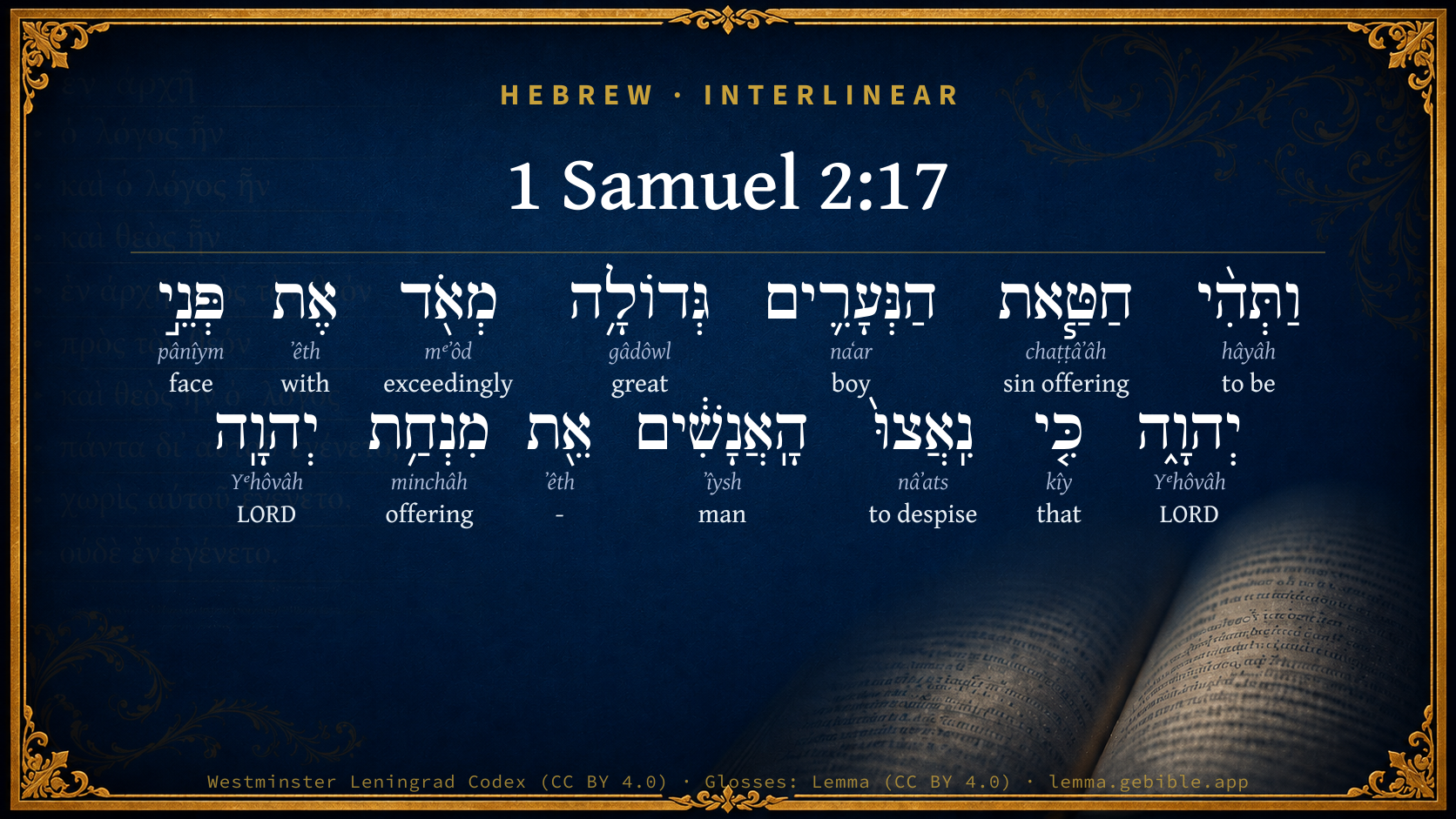
  1. וַתְּהִ֨י hâyâh H1961 “and · to be” Conjunction + Verb, Qal, Sequential Imperfect, 3rd Person, Feminine, Singular
  2. חַטַּ֧את chaṭṭâʼâh H2403 “sin offering of” Noun, Common, Feminine, Singular, Construct
  3. הַנְּעָרִ֛ים naʻar H5288 “the · boys” Particle, Definite Article + Noun, Common, Masculine, Plural, Absolute
  4. גְּדוֹלָ֥ה gâdôwl H1419 “great” Adjective, Adjective, Feminine, Singular, Absolute
  5. מְאֹ֖ד mᵉʼôd H3966 “exceedingly” Adverb
  6. אֶת ʼêth H854 “with” Preposition
  7. פְּנֵ֣י pânîym H6440 “face(s) of” Noun, Common, Both, Plural, Construct
  8. יְהוָ֑ה Yᵉhôvâh H3068 “LORD” Noun, Proper
  9. כִּ֤י kîy H3588 “that” Conjunction
  10. הָֽאֲנָשִׁ֔ים ʼîysh H376 “the · men” Particle, Definite Article + Noun, Common, Masculine, Plural, Absolute
  11. אֵ֖ת ʼêth H853 “-” Particle, Direct Object
  12. מִנְחַ֥ת minchâh H4503 “offering of” Noun, Common, Feminine, Singular, Construct
  13. יְהוָֽה Yᵉhôvâh H3068 “LORD” Noun, Proper

About this verse

These counts appear in no published source. They are computed here, from the morphology-tagged text and Lemma’s own curated glosses. What Lemma adds →

14
words
13
distinct lemmas
Historical
section

Notable vocabulary

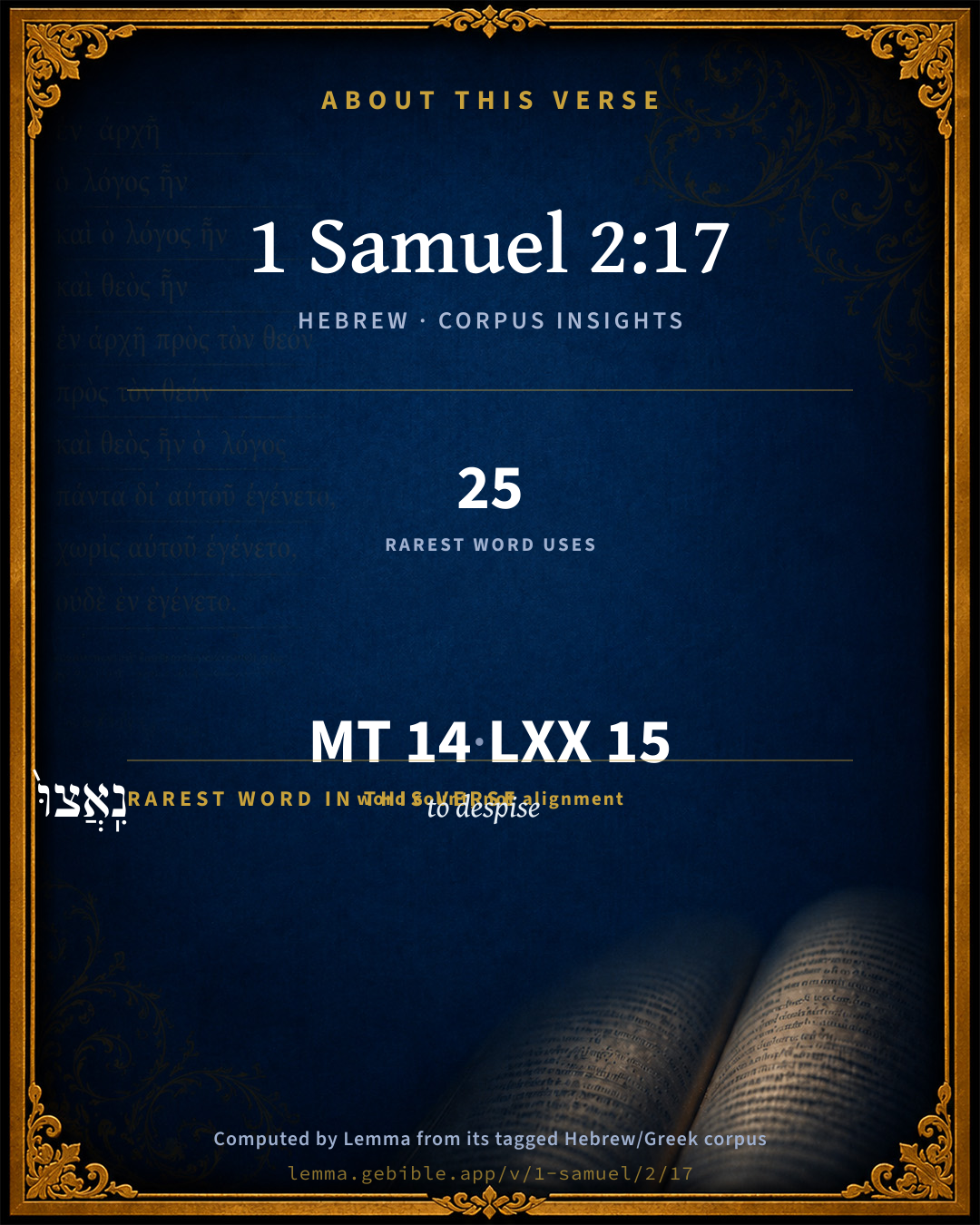
The rarest word here is נִֽאֲצוּ֙ to despise H5006 — appearing just 25 times in the whole Hebrew Bible.

Shared distinctive vocabulary

נִֽאֲצוּ֙ to despise H5006 occurs in 24 verses of the Hebrew Bible. Also found in:

Grammatical profile

  • 2 verbs
  • 7 nouns
  • 1 adjective
  • 1 preposition
  • 1 conjunction
  • 1 adverb
  • 1 particle

Verb forms

  • וַתְּהִ֨י Qal · Sequential Imperfect
  • נִֽאֲצוּ֙ Piel · Perfect

Repetition

A word recurs within this verse — often emphatic in Hebrew:

  • יְהוָ֑ה LORD H3068 ×2

Hebrew & Septuagint length

In English translation the verse runs 19 words from the Hebrew and 23 from the Septuagint (LXX English) — closely comparable.

A rough comparison of the two English renderings, which tokenize alike — not a word-level alignment.

Word counts can differ between the Hebrew and the Greek without any difference in meaning — e.g. the Hebrew direct-object marker אֵת has no separate Greek word, and Greek often adds the article ὁ.

In the original languages it is 14 Hebrew tokens and 15 Greek tokens — but the two are counted differently (Hebrew bundles its prefixes and suffixes into one token; the Greek is in lemma form), so that isn’t a like-for-like length.

Cross-references

9

Topical passages linked to 1 Samuel 2:17 in the Treasury of Scripture Knowledge — connected by theme and wording, ordered by reader-vote popularity; previews shown in the World English Bible.

  • Malachi 2:7–9 For the priest's lips should keep knowledge, and they should seek the law at his mouth; for he is the messenger of Yahweh of Hosts.
  • Genesis 6:11 The earth was corrupt before God, and the earth was filled with violence.
  • Genesis 13:13 Now the men of Sodom were exceedingly wicked and sinners against Yahweh.
  • Malachi 2:13 This again you do: you cover the altar of Yahweh with tears, with weeping, and with sighing, because he doesn't regard the offering any more, neither receives it with good will at your hand.
  • Genesis 10:9 He was a mighty hunter before Yahweh. Therefore it is said, "Like Nimrod, a mighty hunter before Yahweh."
  • 2 Kings 21:6 He made his son to pass through the fire, and practiced sorcery, and used enchantments, and dealt with those who had familiar spirits, and with wizards: he worked much evil in the sight of Yahweh, to provoke him to anger.
  • Psalms 51:4 Against you, and you only, have I sinned, And done that which is evil in your sight; That you may be proved right when you speak, And justified when you judge.
  • Isaiah 3:8 For Jerusalem is ruined, and Judah is fallen; Because their tongue and their doings are against Yahweh, To provoke the eyes of his glory.
  • Matthew 18:7 "Woe to the world because of occasions of stumbling! For it must be that the occasions come, but woe to that person through whom the occasion comes!

Cross-references courtesy of OpenBible.info (CC BY 4.0).

Hebrew and Greek witnesses Masoretic Hebrew ↔ Greek Septuagint

The same verse in the two great witnesses to the Old Testament, shown verse-for-verse.

These are two independent witnesses, not word-aligned to each other, and the Septuagint is shown in lemma (dictionary) form.

Hebrew 1 Samuel 2:17 Masoretic · Westminster Leningrad Codex

וַתְּהִ֨י חַטַּ֧את הַנְּעָרִ֛ים גְּדוֹלָ֥ה מְאֹ֖ד אֶת פְּנֵ֣י יְהוָ֑ה כִּ֤י נִֽאֲצוּ֙ הָֽאֲנָשִׁ֔ים אֵ֖ת מִנְחַ֥ת יְהוָֽה

The sin of the young men was very great before Yahweh; for the men despised the offering of Yahweh.

World English Bible · Public Domain

Greek LXX 1 Samuel 2:17 Septuagint · lemma form

καί εἰμί ὁ ἁμαρτία ὁ παιδάριον ἐνώπιον κύριος μέγας σφόδρα ὅτι ἀθετέω ὁ θυσία κύριος

So the sin of the young men was very great before the Lord, for they set at nothing the offering of the Lord.

LXX2012 (modern English Septuagint) · Public Domain

Hebrew: Westminster Leningrad Codex (CC BY 4.0). Greek: Septuagint (public domain); English from LXX2012 (modern English Septuagint) (Public Domain). How the Septuagint differs from the Hebrew →

Targum (Aramaic paraphrase)

1

The Targum is the ancient Jewish Aramaic paraphrase of the Hebrew Scriptures — an interpretive translation, not the Hebrew text itself. Onkelos (literal) and Pseudo-Jonathan (expansive) render the Torah, and Jonathan the Prophets. Coverage is partial: where no permissively-licensed English translation exists for a verse, only the Aramaic is shown. This is verse-level text, not a word-by-word alignment to the Hebrew.

  1. Targum Jonathan Prophets (Joshua–Malachi)
    וַהֲוַת חוֹב עוּלֵמַיָא סַגִי לַחֲדָא קֳדָם יְיָ אֲרֵי בָזוּ גַבְרַיָא יַת קוּרְבָּנַיָא דַיְיָ:

    (no public-domain English translation for this verse)

    Targum Jonathan — Aramaic: “Mikraot Gedolot” (public domain). English: “Sefaria Community Translation” (CC0 1.0 (public-domain dedication)); “London "Chaldee Paraphrase," 1871” (public domain). Text via Sefaria.

Commentary

Notes on 1 Samuel 2:17 from classic Christian and Jewish commentators (each source and its license shown beneath its notes). The classic Christian expositions comment on the surrounding passage and are grouped to its opening verse, so a note may address several verses; the Jewish commentaries on the Tanakh (Rashi and others) are per-verse, so they appear only where the commentator wrote on this verse.

Lemma curates 59 commentaries, every one of them public domain or Creative Commons licensed, each selected and text-cleaned for this edition rather than reprinted as found. About our sources →

Trapp's Complete Commentary

John Trapp

1Sa 2:17 Wherefore the sin of the young men was very great before the LORD: for men abhorred the offering of the LORD.

Ver. 17. Wherefore the sin of the young men was very great.] The greater because they were uncounsellable, ac ne moniti quidem ab ista perversitate desistebant; but became evil examples to God’s people, who might have desired the like of them, that one did once of a bad living preacher - viz., to point him out a nearer way to heaven than that he had taught in his sermons: for he went not that way himself.

For men abhorred the offering of the Lord.] Which yet was a great sin in them so to do, {1Sa 2:24} likeas it is in those now-a-days that separate from our churches because of the ill lives of some of our ministers. It is a true saying of a reverend divine, {a} The garden may be watered through a wooden gutter; the sun give comfortable light through a sluttish window; the field may be well sowed through a dirty hand; the bell call us to church, though it never enter itself but by the sound; the well may yield excellent water, though it have much mud: so may wicked ministers perform the true service of Christ, &c.

{a} Abbot.

John Trapp, A Commentary or Exposition upon All the Books of the Old and New Testament (1647–1656) — public domain. Text from a community e-Sword module.

Geneva Bible (1599)

Geneva Bible translators

Seeing the horrible abuse thereof.

Geneva Bible (1599) marginal notes — public domain. Text via Bolls.life.

Adam Clarke's Commentary

Verse 17. Wherefore the sin of the young men was very great] That is, Hophni and Phinehas, the sons of Eli.

Men abhorred the offering] As the people saw that the priests had no piety, and that they acted as if there was no God; they despised God's service, and became infidels.

A national priesthood, when the foundation is right, may be a great blessing; but if the priesthood becomes corrupt, though the foundation itself stand sure, the corruption of the national manners will be the unavoidable consequence.

Adam Clarke's Commentary on the Bible (1810–1826) — public domain. Text from a community e-Sword/MySword module.

Ellicott's Commentary for English Readers

(17) The sin of the young men was very great.—Grave peccatum sacerdotum ob scandalurn datum laicis (“the sin of the priests was a great one, because it put a stumbling-block in the way of the people”).—A. Lapide, quoted by Wordsworth. Religion was being brought into general disrepute through the conduct of its leading ministers; was it likely that piety, justice, and purity would be honoured and loved in the land of Israel when the whole ritual of the sacrifices was openly scoffed at in the great sanctuary of the people by the chief priests of their faith?

A Bible Commentary for English Readers, edited by Charles John Ellicott (1878–1897) — public domain. Text from a community e-Sword module.

The Cambridge Bible for Schools and Colleges

gen. ed. J. J. S. Perowne

17. the young men] Hophni and Phinehas.

men abhorred] Rather, the men despised, or, brought into contempt the offering of Jehovah. The Sept. omits the men. Corruption in the priesthood begets profanity in the people. Cp. Mal_2:8-9. “They made it vile in the eyes of the people by shewing how vile it was in their eyes.”

The Cambridge Bible for Schools and Colleges (gen. ed. J. J. S. Perowne; Cambridge University Press, 1878–1918) — public domain. Text from a community e-Sword module.

John Gill's Exposition

But Samuel ministered before the Lord,.... The ministration of Samuel, though a child, is observed both before and after the account of the ill behaviour and wickedness of Eli's sons; partly to the shame and disgrace of them, and as serving to aggravate their sin, and make it appear the more black and heinous; and partly to his honour and reputation, that he was not corrupted and turned aside from God by their evil practices. The phrase here used is different from that in Sa1 2:11 there he is said to minister before Eli, under his direction and guidance, but here before the Lord; being now engaged in higher services, and which he could perform without the assistance of Eli, as in the presence of God more immediately; it seems to have respect to him when more grown in age, stature, knowledge, and experience, though here related: yet still being "a child"; not got out of his childhood, or arrived to manhood:

girded with a linen ephod; such as priests used to wear, but not Levites in common, nor extraordinary persons on extraordinary occasions, see Sa1 22:18. This seems to be a peculiar favour, and a special honour which Eli granted to Samuel when so very young, on account of the grace of God bestowed on him in a wonderful manner; and because brought up in the tabernacle as a holy person, and a Nazarite; and because his birth was foretold, and he asked of God, as his name signified, as Procopius Gazaeus observes.

John Gill's Exposition of the Whole Bible (1746–1763) — public domain (CC PDM 1.0). Text via the HelloAO Bible API.

Albert Barnes' Notes on the Bible

The offering of the Lord - Minchah, here in the general sense of “gift or offering” to God (compare Mal 1:10-11; Mal 3:3). In its restricted sense, it is used of the meat offerings, the unbloody sacrifices, and is then coupled with bloody sacrifices, sacrifices of slain beasts. (See 1Sa 2:29.)

Albert Barnes' Notes on the Bible (1834–1885) — public domain. Text from a community e-Sword/MySword module.

Haydock's Catholic Bible Commentary

Lord. People, seeing that the law was not observed, refrained from presenting victims. (Menochius) --- They are but too apt to follow the bad example of their teachers. (Haydock) --- Hence God punishes the smallest faults of his ministers, with great severity, since they withdraw people from his service, by their scandalous behaviour, and are guilty of a more horrid sacrilege than those who laid violent hands on the Lord of majesty. (St. Bernard, ser. i.) Nothing brings a greater discredit on religion. (Calmet)

George Leo Haydock (1774–1849), Haydock's Catholic Family Bible and Commentary, 1859 edition — public domain. Excludes Psalms (Douay-Rheims chapter numbering differs from Protestant) and Deuterocanonical books (Catholic canon only).

Matthew Poole's English Annotations

The sin of the young men was very great; because they violently took away both man’s and God’s dues, and this before their time, and that with manifest contempt of God and men; and all this merely for the gratifying of their sensual appetite.

Before the Lord, i.e. even in the place of God’s special presence, where he saw and observed all their miscarriages; which argues the height of impiety and imprudence.

Men abhorred the offering of the Lord; they neglected and abhorred the practice of carrying up sacrifices to be offered, which they knew would be so grossly abused; and which, as they might think, would be rejected and abhorred by God himself; and therefore they would not contribute to the priests’ sin, and the corruption of God’s worship, but judged it better to neglect the thing, than to expose it to the priests’ depravation; wherein yet they erred, as we see, 1Sa 2:21.

Matthew Poole's English Annotations on the Holy Bible (1683–1685) — public domain. Text from a community e-Sword/MySword module.

Whedon's Commentary on the Bible

Daniel D. Whedon

17. The young men — Eli’s sons, Hophni and Phinehas.

Men abhorred the offering of the Lord — The conduct of these young men brought reproach upon the whole sacred service; and, indeed, there is nothing that tends more directly to bring religion itself into contempt, and to multiply infidels and scoffers, than open wickedness in the ministers of the altar.

Daniel D. Whedon (gen. ed.), Commentary on the Old and New Testaments (1874–1909) — public domain. Text from a community e-Sword module.

John Wesley's Explanatory Notes

Abhorred - But we know the validity and efficacy of the sacraments does not depend on the goodness of those that administer them. It was therefore folly and sin in the people, to think the worse of God's institutions. But it was the much greater sin of the priests, that gave them occasion so to do.

John Wesley, Explanatory Notes Upon the Whole Bible (1754–1765) — public domain. Text via the GEBible commentary corpus.

Rashi

Rabbi Shlomo Yitzchaki (Rashi)

They had disgraced. Meaning despised.

Rashi on the Tanakh — English translations: “The Judaica Press complete Tanach with Rashi, translated by A. J. Rosenberg” (CC BY 4.0); “Pentateuch with Rashi's commentary by M. Rosenbaum and A.M. Silbermann, 1929-1934” (public domain); “The Metsudah Tanach series, Lakewood, N.J” (CC BY 4.0); and “The Book of Joshua, Metsudah Publications, 1997” (CC BY 4.0). Text via Sefaria.

Lesson kit

Teaching starters — assembled from the data on this page, not authored interpretation. Every prompt links to the verse data it draws on. Edit before teaching.

1 Samuel, in the Historical, opens this verse with 14 words (13 distinct Hebrew lemmas). Its most distinctive word is nâʼats (“to despise”). A historical commentator’s framing appears above. Read the whole chapter for the surrounding context.

Discussion questions

  1. The word nâʼats carries the sense “to despise.” How does it shape the verse?
  2. Numbers 14:11 shares the word «to despise» with this verse. How do the two illuminate each other?
  3. “LORD” occurs 2× in this one verse. What is the effect of the repetition?
  4. These translations render this verse differently. What is at stake in choosing one wording over another?
  5. The verb «וַתְּהִ֨י» is Qal Sequential Imperfect. How does its form color the action?
  6. Reading how Trapp's Complete Commentary and Geneva Bible (1599) read this verse, where do the two commentators agree and where do they part?

Things to notice

Reading settings

Reading text

Shown beneath each verse's original-language words.

Old Testament
Old Testament edition

Read the OT as the Masoretic Hebrew (MT) or the Greek Septuagint (LXX).

English shown for the Greek Septuagint (in the Hebrew ↔ Greek comparison).

Comparing translations? Open the Compare panel on any verse page to stack up to four side by side.