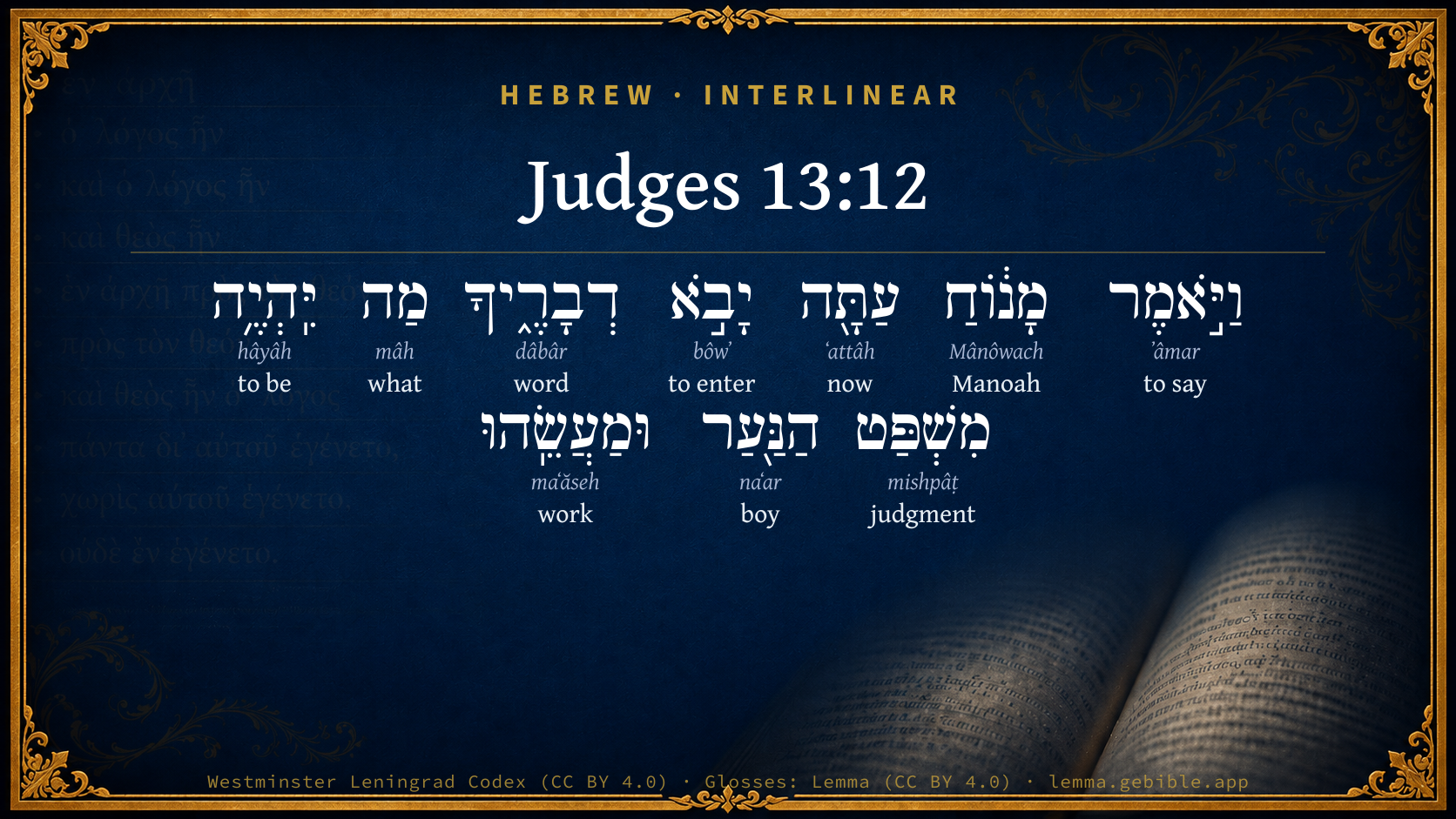
Judges 13:12

Hebrew (Westminster Leningrad Codex) Judges 13:12 appears in the Hebrew Old Testament. The text above is from the Westminster Leningrad Codex. Each word links to its Strong’s number, a concise gloss, and parsing drawn from the Open Scriptures Hebrew Bible morphology. Click any word for its full Brown-Driver-Briggs (BDB) entry.
Download image
Cite this verse

Judges 13:12 (World English Bible). Public Domain. Lemma interlinear Bible study tool, https://lemma.gebible.app/v/judges/13/12.

Show BibTeX & RIS
BibTeX
RIS
English Translation
Manoah said, Now let your words happen: what shall be the ordering of the child, and [how] shall we do to him?
World English Bible · Public Domain
Download a study sheet

One document with this verse’s original text, its word-by-word gloss line, the meaning frame, cross-references with their text, attributed commentary, and full source and license credits — printable, and it pastes into notes with its structure intact.

This verse Autodidact and up

Study sheet (.html) Plain text (.txt)

A passage Seminary Student

Up to 50 verses in one chapter. A passage sheet keeps up to 6 commentary sources and 12 cross-references per verse, in the order this page ranks them, and says so on the sheet whenever that leaves anything out. Ask for a single verse and you get the Autodidact verse sheet above.

Everything on this page stays free to read, with no account — the sheet is a download of what is already on screen, not access to it.

Want to remove ads? Support Godless Engineer
Compare translations 3

The same verse in 3 English versions, stacked beneath the original-language interlinear above. Click any original word for its lexicon entry.

Each is an independent rendering of the whole verse — the interlinear is not word-aligned to these translations.

Highlighted words mark where these versions differ — a whole-verse word diff, not a word-by-word alignment.

  • World English Bible Public Domain
    Manoah said, Now let your words happen: what shall be the ordering of the child, and [how] shall we do to him?
  • King James Version Public Domain
    And Manoah said, Now let thy words come to pass. How shall we order the child, and how shall we do unto him?
  • unfoldingWord Literal Text CC BY-SA 4.0
    And Manoah said, “Now may your words come. What will be the manner of the boy and his work?”

unfoldingWord Literal Text — © unfoldingWord, licensed CC BY-SA 4.0. Word-aligned USFM3 via Door43 (git.door43.org/unfoldingWord/en_ult).

Versions to compare (up to 4)

3 of 4 selected

Show all 18 translations

Every available English version of this verse, each an independent rendering of the whole verse.

  • World English Bible Public Domain
    Manoah said, Now let your words happen: what shall be the ordering of the child, and [how] shall we do to him?
  • Berean Standard Bible Public Domain
    Then Manoah asked, “When your words come to pass, what will be the boy’s rule of life and mission?”
  • Majority Standard Bible Public Domain
    Then Manoah asked, “When your words come to pass, what will be the boy’s rule of life and mission?”
  • King James Version Public Domain
    And Manoah said, Now let thy words come to pass. How shall we order the child, and how shall we do unto him?
  • American Standard Version (1901) Public Domain
    And Manoah said, Now let thy words come to pass: what shall be the ordering of the child, and `how' shall we do unto him?
  • Revised Version (1885) Public Domain
    And Manoah said, Now let thy words come to pass: what shall be the manner of the child, and what shall be his work?
  • Geneva Bible (1599) Public Domain
    Then Manoah sayde, Nowe let thy saying come to passe: but howe shall we order the childe and doe vnto him?
  • Douay-Rheims (1899) Public Domain
    And Manue said to him: When thy word shall come to pass, what wilt thou that the child should do? or from what shall he keep himself?
  • Young's Literal Translation Public Domain
    And Manoah saith, `Now let thy words come to pass; what is the custom of the youth -- and his work?'
  • Literal Standard Version CC BY-SA 4.0
    And Manoah says, “Now let Your words come to pass; what is the custom of the youth—and his work?”
  • Unlocked Literal Bible CC BY-SA 4.0
    So Manoah said, “Now may your words come true. What will be the rules for the child, and what will be his work?”
  • unfoldingWord Literal Text CC BY-SA 4.0
    And Manoah said, “Now may your words come. What will be the manner of the boy and his work?”
  • Darby Bible Public Domain
    And Mano'ah said, "Now when your words come true, what is to be the boy's manner of life, and what is he to do?"
  • World Messianic Bible Public Domain
    Manoah said, “Now let your words happen. What shall the child’s way of life and mission be?”
  • Webster's Bible Public Domain
    And Manoah said, Now let thy words come to pass. How shall we order the child, and how shall we do to him?
  • Free Bible Version CC BY-SA 4.0
    So Manoah said, “May your promise come true! What shall be decided for the boy, and what is to be his vocation?”
  • Bible in Basic English Public Domain
    And Manoah said, Now when your words come true, what is to be the rule for the child and what will be his work?
  • JPS Tanakh (1917) Public Domain
    And Manoah said: 'Now when thy word cometh to pass, what shall be the rule for the child, and what shall be done with him?'

Literal Standard Version (2020), Covenant Press — licensed CC BY-SA 4.0. Text via the HelloAO Bible API (eBible.org). Unlocked Literal Bible (unfoldingWord) — licensed CC BY-SA 4.0. Text via the HelloAO Bible API (eBible.org). unfoldingWord Literal Text — © unfoldingWord, licensed CC BY-SA 4.0. Word-aligned USFM3 via Door43 (git.door43.org/unfoldingWord/en_ult). Free Bible Version, Dr. Jonathan Gallagher — licensed CC BY-SA 4.0. Text via the HelloAO Bible API (eBible.org).

Word by word

More ways to search: Search by grammar → Find every occurrence → Compare this word →

Practice this passage: Drill this verse → Learn its vocabulary →

About this verse

These counts appear in no published source. They are computed here, from the morphology-tagged text and Lemma’s own curated glosses. What Lemma adds →

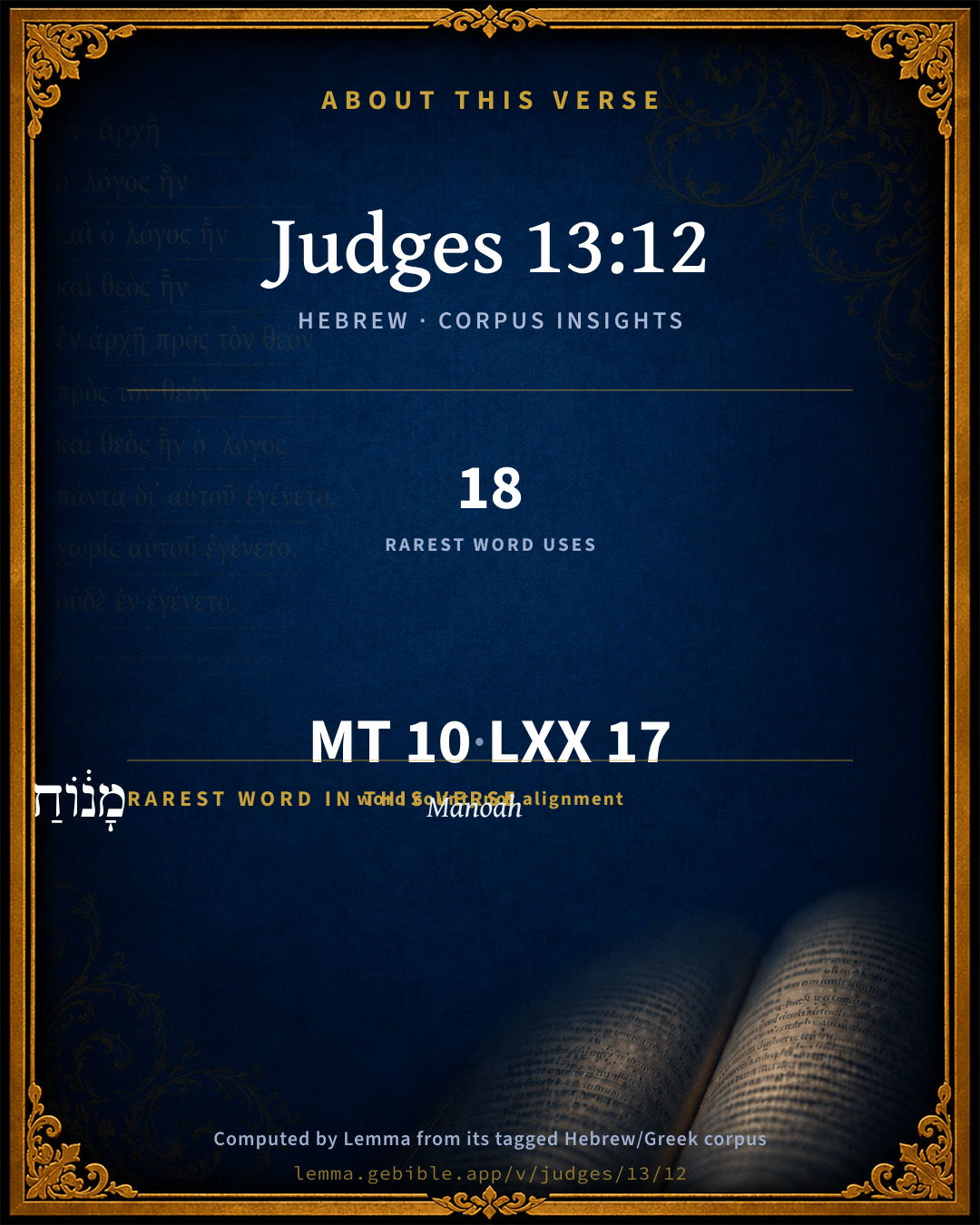
10
words
10
distinct lemmas
Historical
section

Notable vocabulary

The rarest word here is מָנ֔וֹחַ Manoah H4495 — appearing just 18 times in the whole Hebrew Bible.

Shared distinctive vocabulary

מָנ֔וֹחַ Manoah H4495 occurs in 14 verses of the Hebrew Bible. Also found in:

Grammatical profile

  • 3 verbs
  • 5 nouns
  • 1 adverb
  • 1 particle

Verb forms

  • וַיֹּ֣אמֶר Qal · Sequential Imperfect
  • יָבֹ֣א Qal · Imperfect
  • יִּֽהְיֶ֥ה Qal · Imperfect

Hebrew & Septuagint length

In English translation the verse runs 22 words from the Hebrew and 23 from the Septuagint (LXX English) — closely comparable.

A rough comparison of the two English renderings, which tokenize alike — not a word-level alignment.

Word counts can differ between the Hebrew and the Greek without any difference in meaning — e.g. the Hebrew direct-object marker אֵת has no separate Greek word, and Greek often adds the article ὁ.

In the original languages it is 10 Hebrew tokens and 17 Greek tokens — but the two are counted differently (Hebrew bundles its prefixes and suffixes into one token; the Greek is in lemma form), so that isn’t a like-for-like length.

Cross-references

4

Topical passages linked to Judges 13:12 in the Treasury of Scripture Knowledge — connected by theme and wording, ordered by reader-vote popularity; previews shown in the World English Bible.

  • Proverbs 22:6 Train up a child in the way he should go, And when he is old he will not depart from it.
  • Ephesians 6:4 You fathers, don't provoke your children to wrath, but nurture them in the discipline and instruction of the Lord.
  • Genesis 18:19 For I have known him, to the end that he may command his children and his household after him, that they may keep the way of Yahweh, to do righteousness and justice; to the end that Yahweh may bring on Abraham that which he has spoken of him."
  • Proverbs 4:4 He taught me, and said to me: "Let your heart retain my words. Keep my commandments, and live.

Cross-references courtesy of OpenBible.info (CC BY 4.0).

Hebrew and Greek witnesses Masoretic Hebrew ↔ Greek Septuagint

The same verse in the two great witnesses to the Old Testament, shown verse-for-verse.

These are two independent witnesses, not word-aligned to each other, and the Septuagint is shown in lemma (dictionary) form.

Hebrew Judges 13:12 Masoretic · Westminster Leningrad Codex

וַיֹּ֣אמֶר מָנ֔וֹחַ עַתָּ֖ה יָבֹ֣א דְבָרֶ֑יךָ מַה יִּֽהְיֶ֥ה מִשְׁפַּט הַנַּ֖עַר וּמַעֲשֵֽׂהוּ

Manoah said, Now let your words happen: what shall be the ordering of the child, and [how] shall we do to him?

World English Bible · Public Domain

Greek LXX Judges 13:12 Septuagint · lemma form

καί εἶπον μανωε νῦν ἔρχομαι ὁ λόγος σύ τίς εἰμί κρίσις ὁ παιδίον καί ὁ ποίημα αὐτός

And Manoe said, Now shall your word come to pass: what shall be the ordering of the child, and our dealings with him?

LXX2012 (modern English Septuagint) · Public Domain

On this verse, Ellicott's Commentary for English Readers discusses the Septuagint’s reading. Read the note in Commentary ↓

Hebrew: Westminster Leningrad Codex (CC BY 4.0). Greek: Septuagint (public domain); English from LXX2012 (modern English Septuagint) (Public Domain). How the Septuagint differs from the Hebrew →

Targum (Aramaic paraphrase)

1

The Targum is the ancient Jewish Aramaic paraphrase of the Hebrew Scriptures — an interpretive translation, not the Hebrew text itself. Onkelos (literal) and Pseudo-Jonathan (expansive) render the Torah, and Jonathan the Prophets. Coverage is partial: where no permissively-licensed English translation exists for a verse, only the Aramaic is shown. This is verse-level text, not a word-by-word alignment to the Hebrew.

  1. Targum Jonathan Prophets (Joshua–Malachi)
    וַאֲמַר מָנוֹחַ כְּעַן יִתְקַיְמוּן פִּתְגָמָךְ מַה יְהֵא דַחַזֵי לְרַבְיָא וּמַה נַעְבֵּיד לֵיהּ:

    (no public-domain English translation for this verse)

    Targum Jonathan — Aramaic: “Mikraot Gedolot” (public domain). English: “Sefaria Community Translation” (CC0 1.0 (public-domain dedication)); “London "Chaldee Paraphrase," 1871” (public domain). Text via Sefaria.

Commentary

Notes on Judges 13:12 from classic Christian and Jewish commentators (each source and its license shown beneath its notes). The classic Christian expositions comment on the surrounding passage and are grouped to its opening verse, so a note may address several verses; the Jewish commentaries on the Tanakh (Rashi and others) are per-verse, so they appear only where the commentator wrote on this verse.

Lemma curates 59 commentaries, every one of them public domain or Creative Commons licensed, each selected and text-cleaned for this edition rather than reprinted as found. About our sources →

Trapp's Complete Commentary

John Trapp

Jdg 13:12 And Manoah said, Now let thy words come to pass. How shall we order the child, and [how] shall we do unto him?

Ver. 12. How shall we order the child?] Or, What shall be his office and his work? This their solicitude about the child was very commendable. Let it be parents’ care, that

“ Ipsa Deo blandos fundant cunabula flores. ” - Virg.

Careless parents are a kind of parricides, peremptores potius quam parentes, saith Bernard.

John Trapp, A Commentary or Exposition upon All the Books of the Old and New Testament (1647–1656) — public domain. Text from a community e-Sword module.

Joseph Benson's Commentary

Jdg 13:12. Now let thy words come to pass — Or, thy words shall come to pass. I firmly believe thy promises shall be fulfilled. How shall we order the child? — Houbigant renders this, What shall be the method of educating the child? What rules shall we observe in bringing him up? How shall we do unto him? — What profession shall we prepare him for, or how shall we instruct him, so as to make him fit to be the deliverer of Israel?

Joseph Benson's Commentary on the Old and New Testaments (1811–1818) — public domain. Text from a community e-Sword module.

Ellicott's Commentary for English Readers

(12) How shall we order the child . . .?—The literal rendering is given in the margin, What shall be the ordering (mishpat; LXX., krima) of the child, and his work?

A Bible Commentary for English Readers, edited by Charles John Ellicott (1878–1897) — public domain. Text from a community e-Sword module.

The Cambridge Bible for Schools and Colleges

gen. ed. J. J. S. Perowne

12. Now let thy words come to pass] The marg. is to be preferred; for a conditional clause without the conditional particle in Hebrew cf. Num_12:14, and see Driver, Tenses, § 155. To relieve the obscurity, it is proposed to read ‘eth for ‘attah, ‘at the time when’ (König, Syntax, § 385 k), but this is a rather poetical and late construction, Deu_32:35, Job_6:17 etc.

the manner] i.e. what description of child shall he be? cf. 2Ki_1:7. By his work is meant business, occupation, cf. Gen_46:33, 1Sa_25:2 RVm. Cf. St.Luk_1:66.

The Cambridge Bible for Schools and Colleges (gen. ed. J. J. S. Perowne; Cambridge University Press, 1878–1918) — public domain. Text from a community e-Sword module.

John Gill's Exposition

And Manoah said, now let thy words come to pass,.... Which was not only a wish that they might, but a prayer of faith that they would come pass:

how shall we order the child? and how shall we do unto him? he believed a child would be born, and as he was to be a Nazarite, he knew what were the rules and orders to be observed concerning one in common; but as he was to be an extraordinary one, he was desirous of knowing what particular laws and rules were to be observed with respect to him, or what more was to be done to him than to another: the words may be rendered, as in the margin of our Bibles, "what shall be the judgment of the child, and his work?" and seems to relate not to what should be done to it, but what that should do; for being an extraordinary Nazarite, he supposed that some extraordinary work would be done by him, and he was curious to know it; and so Abarbinel interprets it of his request to know things future and wonderful, that should be done after the child was grown up; but this the angel chose not to inform him of, since it might have been prejudicial to them, should the Philistines get knowledge that this child would be a judge and saviour of Israel, and do such and such things to them as he did, they would have sought to have slain his wife while she bare him, or the child when born; and it may be observed, that though the angel told the woman at first, that he should "begin to deliver Israel out of the hand of the Philistines", Jdg 13:5, yet she said nothing of it to her husband, nor did the angel repeat it.

John Gill's Exposition of the Whole Bible (1746–1763) — public domain (CC PDM 1.0). Text via the HelloAO Bible API.

Albert Barnes' Notes on the Bible

Translate, “What shall be the manner (or ordering) of the child, and what shall be his work (or exploits).” The original message of the Angel had given information on these two points:

(1) how the child was to be brought up, namely, as a Nazarite;

(2) what he should do, namely, begin to deliver Israel.

Manoah desires to have the information repeated (compare 1Sa 17:26-27, 1Sa 17:30). Accordingly, in Jdg 13:13 the Angel refers to, and enlarges upon, his former injunctions.

Albert Barnes' Notes on the Bible (1834–1885) — public domain. Text from a community e-Sword/MySword module.

Haydock's Catholic Bible Commentary

Himself. Hebrew and Septuagint, "What shall be the judgment (education; Calmet) of the boy, and what his works? (or Protestants) how shall we do unto him?" (Haydock)

George Leo Haydock (1774–1849), Haydock's Catholic Family Bible and Commentary, 1859 edition — public domain. Excludes Psalms (Douay-Rheims chapter numbering differs from Protestant) and Deuterocanonical books (Catholic canon only).

Matthew Poole's English Annotations

Let thy words come to pass; or, thy words shall come to pass; I firmly believe that thy promises shall be fulfilled.

How shall we order the child? what rules shall we observe about his education?

Matthew Poole's English Annotations on the Holy Bible (1683–1685) — public domain. Text from a community e-Sword/MySword module.

Whedon's Commentary on the Bible

Daniel D. Whedon

12. Manoah said — Manoah’s words are not correctly rendered in our English version, but should read, Now thy words shall come to pass; what shall be the manner of the child and his work? The former sentence has the relation of a protasis to the following, as, When thy words come to pass, what shall be, etc.? By the manner and work of the child, Manoah meant both their manner and work towards their son, as expressed in the English version, and also his manner and work towards them and Israel. The Angel answers so far as their work is concerned, but leaves it for the future to tell the rest.

Daniel D. Whedon (gen. ed.), Commentary on the Old and New Testaments (1874–1909) — public domain. Text from a community e-Sword module.

The Pulpit Commentary

Let thy words come, etc. The verb is singular in the Hebrew here and in ver. 17. Possibly the true reading is word, as in the Septuagint. If the text is correct, words must be taken collectively, as making one promise. The saying marks Manoah"s earnest desire for a son. Some, however, construe it, If thy words come. How shall we order, etc. literally, What will be the manner of the child, and what will be his doing? i.e. either, What will be his manner, (cf. 1Sa_8:11, and following verses) and what will be his action or work? or, What will be his proper treatment, and what shall be done to him? The former is the most natural rendering of the words, and though the latter seems at first more suitable to the angel"s reply, yet if we take the angel"s reply as referring Manoah to what he had said before in vers. 4 and 5, we have a distinct answer to the questions. His manner will be to live as a Nazarite, and his action or work will be to begin to deliver Israel. (cf. Gen_16:12, where both the manner and the action of Ishmael are foretold) In fact, Manoah"s question refers directly to vers. 4 and 5, and is a request to have a confirmation of what was then said; just as David asked again and again, What shall be done to the man that killeth this Philistine?. (1Sa_17:26, 1Sa_17:30)

Vers. 12-14. Parental anxiety and its satisfying.

Questions of great importance, which every parent ought to study. Circumstances may occur that render the responsibility of the parent peculiarly heavy.

I ALL PARENTS, OR THOSE ABOUT TO BE PARENTS, SHOULD BRING THEIR PARENTAL CARES TO GOD.

1. It will relieve anxiety.

2. The sense of moral responsibility will be deepened and confirmed.

3. Direction will be given for duty and usefulness.

II THE BEST SAFEGUARD OF THE CHILD IS THE CONSECRATION OF THE PARENT. To regard the child-blessing as a trust. To seek the benefit of others through that which is a joy and gratification to oneself. To keep oneself pure and temperate, that no taint or evil tendency may pass to one"s posterity, and that in oneself, as in one"s children, God may be glorified. M.

The Pulpit Commentary (1880–1919), ed. H.D.M. Spence-Jones & Joseph S. Exell — public domain. Text from a community e-Sword module.

John Wesley's Explanatory Notes

Let thy words - Or, thy words shall come to pass: I firmly believe thy promises shall be fulfilled. How - What rules shall we observe about his education?

John Wesley, Explanatory Notes Upon the Whole Bible (1754–1765) — public domain. Text via the GEBible commentary corpus.

unfoldingWord translationNotes

Door43 World Missions Community

your words

"what you have said"

anything that comes from the vines

Here the angel refers to any food that grow on a vine as "coming" from the vine. AT: "anything that grows on a vine" (See: Metonymy)

unclean

Something that Yahweh has stated is unfit to eat is spoken of as if it were physically unclean. See how you translated this phrase in Judges 13:7. (See: Metaphor)

translationWords

angel

Yahweh

vine

wine

strong drink

law

declare

clean

obey

command

unfoldingWord translationNotes — © Distant Shores Media and the Door43 World Missions Community, licensed CC BY-SA 4.0. Source: git.door43.org/Door43/en_tn.

Rashi

Rabbi Shlomo Yitzchaki (Rashi)

What regulations must we follow with the boy? How shall we treat him? What should appropriately be done with the boy, what must we do with him?

Rashi on the Tanakh — English translations: “The Judaica Press complete Tanach with Rashi, translated by A. J. Rosenberg” (CC BY 4.0); “Pentateuch with Rashi's commentary by M. Rosenbaum and A.M. Silbermann, 1929-1934” (public domain); “The Metsudah Tanach series, Lakewood, N.J” (CC BY 4.0); and “The Book of Joshua, Metsudah Publications, 1997” (CC BY 4.0). Text via Sefaria.

Lesson kit

Teaching starters — assembled from the data on this page, not authored interpretation. Every prompt links to the verse data it draws on. Edit before teaching.

Judges, in the Historical, opens this verse with 10 words (10 distinct Hebrew lemmas). Its most distinctive word is Mânôwach (“Manoah”). A historical commentator’s framing appears above. Read the whole chapter for the surrounding context.

Discussion questions

  1. The word Mânôwach carries the sense “Manoah.” How does it shape the verse?
  2. How does Judges 13:2, which shares the word «Manoah», read alongside this verse?
  3. These translations render this verse differently. What is at stake in choosing one wording over another?
  4. «וַיֹּ֣אמֶר» is a Qal Sequential Imperfect verb. How does that grammatical form shape the action described?
  5. Compare how Trapp's Complete Commentary and Joseph Benson's Commentary read this verse. Where do they agree or differ?

Things to notice

Reading settings

Reading text

Shown beneath each verse's original-language words.

Old Testament
Old Testament edition

Read the OT as the Masoretic Hebrew (MT) or the Greek Septuagint (LXX).

English shown for the Greek Septuagint (in the Hebrew ↔ Greek comparison).

Comparing translations? Open the Compare panel on any verse page to stack up to four side by side.