
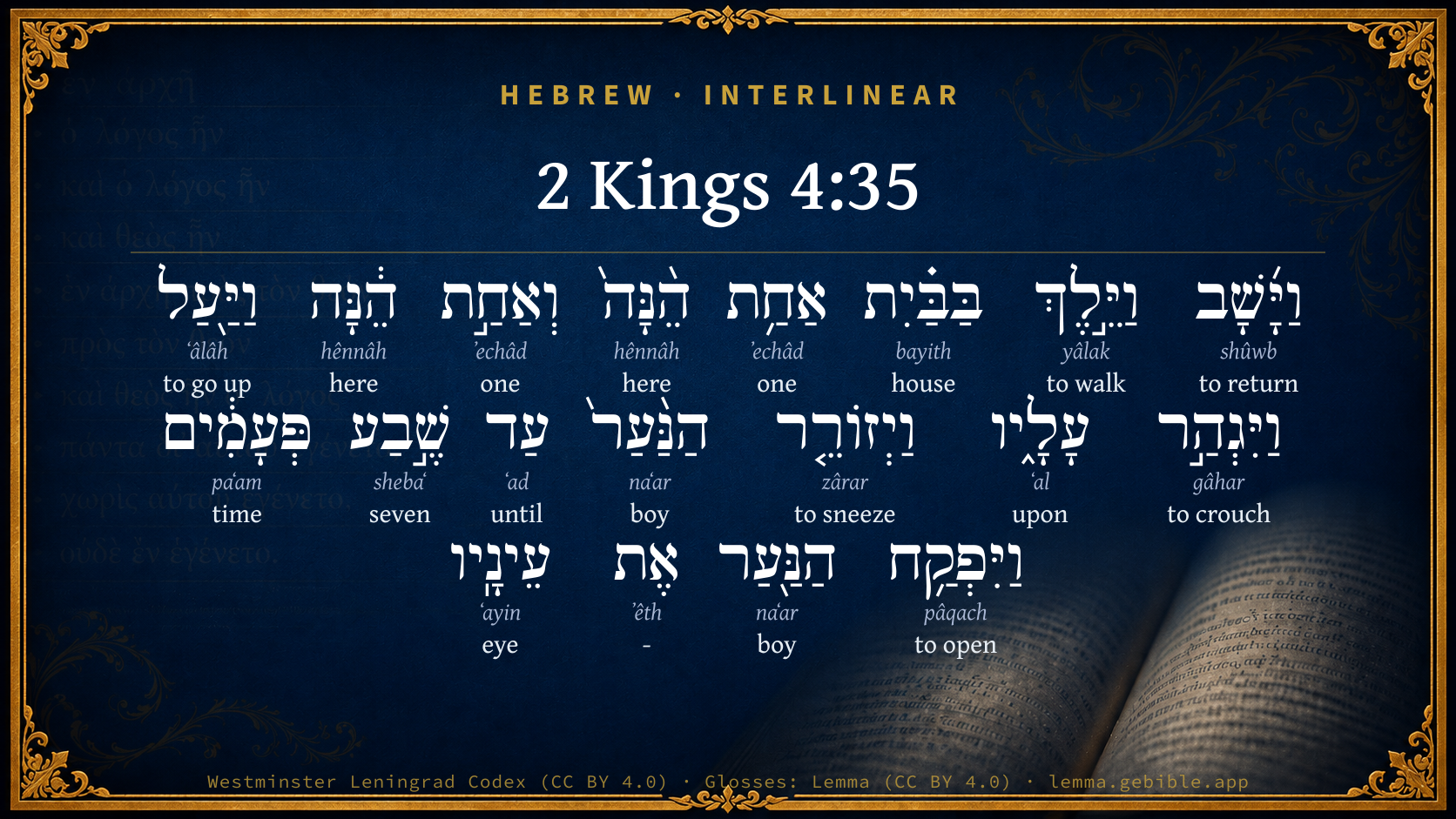
2 Kings 4:35

Hebrew (Westminster Leningrad Codex) 2 Kings 4:35 appears in the Hebrew Old Testament. The text above is from the Westminster Leningrad Codex. Each word links to its Strong’s number, a concise gloss, and parsing drawn from the Open Scriptures Hebrew Bible morphology. Click any word for its full Brown-Driver-Briggs (BDB) entry.
Download image
Cite this verse

2 Kings 4:35 (World English Bible). Public Domain. Lemma interlinear Bible study tool, https://lemma.gebible.app/v/2-kings/4/35.

Show BibTeX & RIS
BibTeX
RIS
English Translation
Then he returned, and walked in the house once back and forth; and went up, and stretched himself on him: and the child sneezed seven times, and the child opened his eyes.
World English Bible · Public Domain
Highlights
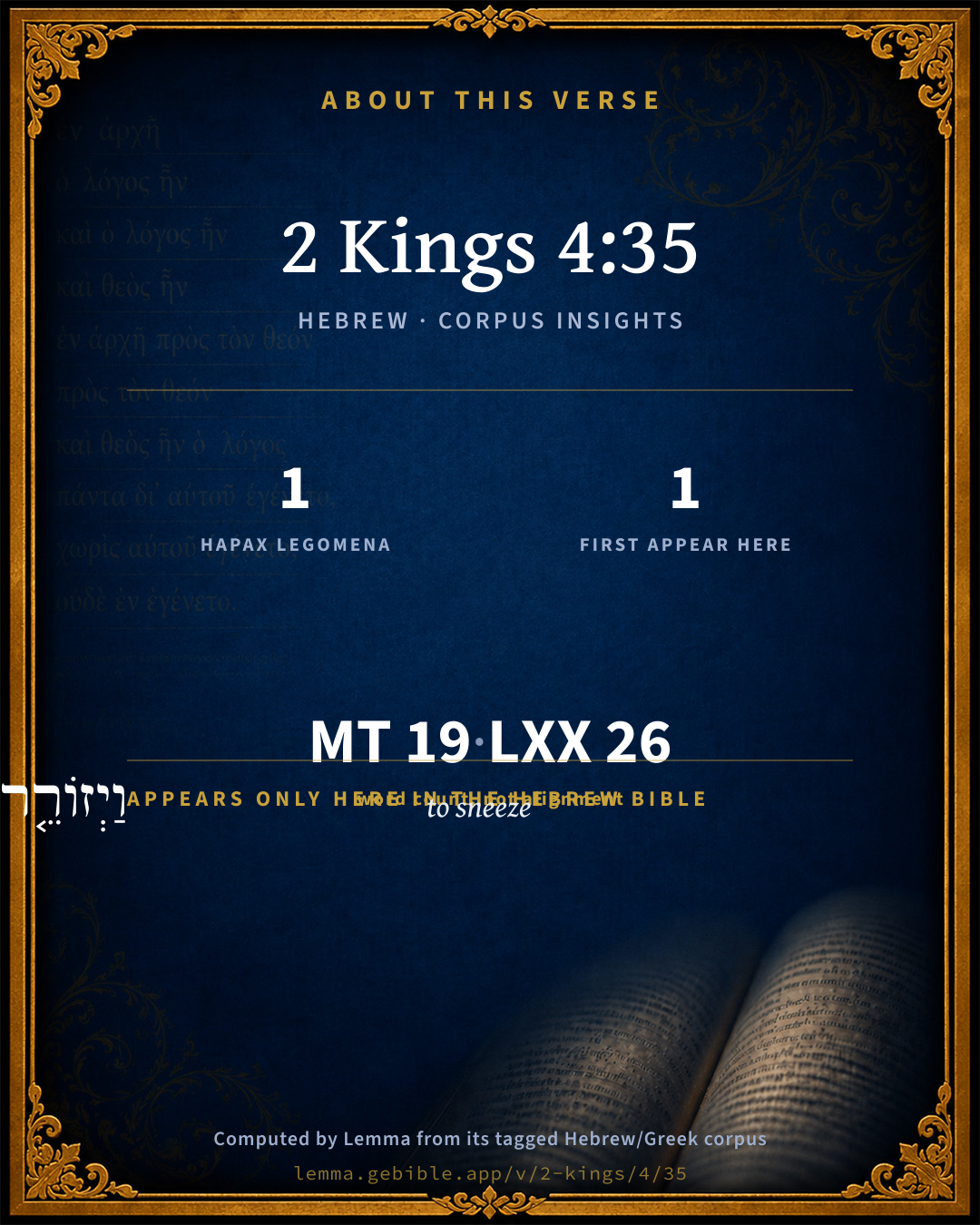
  • 1 hapax legomenon — only here in the Hebrew Bible
  • 1 first appearance in the Hebrew Bible
Full analysis ↓
Download a study sheet

One document with this verse’s original text, its word-by-word gloss line, the meaning frame, cross-references with their text, attributed commentary, and full source and license credits — printable, and it pastes into notes with its structure intact.

This verse Autodidact and up

Study sheet (.html) Plain text (.txt)

A passage Seminary Student

Up to 50 verses in one chapter. A passage sheet keeps up to 6 commentary sources and 12 cross-references per verse, in the order this page ranks them, and says so on the sheet whenever that leaves anything out. Ask for a single verse and you get the Autodidact verse sheet above.

Everything on this page stays free to read, with no account — the sheet is a download of what is already on screen, not access to it.

Want to remove ads? Support Godless Engineer
Compare translations 3

The same verse in 3 English versions, stacked beneath the original-language interlinear above. Click any original word for its lexicon entry.

Each is an independent rendering of the whole verse — the interlinear is not word-aligned to these translations.

Highlighted words mark where these versions differ — a whole-verse word diff, not a word-by-word alignment.

  • World English Bible Public Domain
    Then he returned, and walked in the house once back and forth; and went up, and stretched himself on him: and the child sneezed seven times, and the child opened his eyes.
  • King James Version Public Domain
    Then he returned, and walked in the house to and fro; and went up, and stretched himself upon him: and the child sneezed seven times, and the child opened his eyes.
  • unfoldingWord Literal Text CC BY-SA 4.0
    And he returned, and he walked in the house, once here and once here. And he went up, and he stretched out upon him. And the young man sneezed until seven times, and the young man opened his eyes.

unfoldingWord Literal Text — © unfoldingWord, licensed CC BY-SA 4.0. Word-aligned USFM3 via Door43 (git.door43.org/unfoldingWord/en_ult).

Versions to compare (up to 4)

3 of 4 selected

Show all 18 translations

Every available English version of this verse, each an independent rendering of the whole verse.

  • World English Bible Public Domain
    Then he returned, and walked in the house once back and forth; and went up, and stretched himself on him: and the child sneezed seven times, and the child opened his eyes.
  • Berean Standard Bible Public Domain
    Elisha turned away and paced back and forth across the room. Then he got on the bed and stretched himself out over the boy again, and the boy sneezed seven times and opened his eyes.
  • Majority Standard Bible Public Domain
    Elisha turned away and paced back and forth across the room. Then he got on the bed and stretched himself out over the boy again, and the boy sneezed seven times and opened his eyes.
  • King James Version Public Domain
    Then he returned, and walked in the house to and fro; and went up, and stretched himself upon him: and the child sneezed seven times, and the child opened his eyes.
  • American Standard Version (1901) Public Domain
    Then he returned, and walked in the house once to and fro; and went up, and stretched himself upon him: and the child sneezed seven times, and the child opened his eyes.
  • Revised Version (1885) Public Domain
    Then he returned, and walked in the house once to and fro; and went up, and stretched himself upon him: and the child sneezed seven times, and the child opened his eyes.
  • Geneva Bible (1599) Public Domain
    And hee went from him, and walked vp and downe in the house, and went vp and spred himselfe vpon him: then the childe neesed seuen times, and opened his eyes.
  • Douay-Rheims (1899) Public Domain
    Then he returned and walked in the house, once to and fro: and he went up, and lay upon him: and the child gaped seven times, and opened his eyes.
  • Young's Literal Translation Public Domain
    and he turneth back and walketh in the house, once hither and once thither, and goeth up and stretcheth himself upon him, and the youth sneezeth till seven times, and the youth openeth his eyes.
  • Literal Standard Version CC BY-SA 4.0
    and he turns back and walks in the house, once here and once there, and goes up and stretches himself on him, and the youth sneezes until seven times, and the youth opens his eyes.
  • Unlocked Literal Bible CC BY-SA 4.0
    Then Elisha got up and walked around the room and again went up and stretched himself out on the boy. The child sneezed seven times and then opened his eyes!
  • unfoldingWord Literal Text CC BY-SA 4.0
    And he returned, and he walked in the house, once here and once here. And he went up, and he stretched out upon him. And the young man sneezed until seven times, and the young man opened his eyes.
  • Darby Bible Public Domain
    And he returned, and walked in the house to and fro; and went up, and bent over him. And the lad sneezed seven times, and the lad opened his eyes.
  • World Messianic Bible Public Domain
    Then he returned, and walked in the house once back and forth, then went up and stretched himself out on him. Then the child sneezed seven times, and the child opened his eyes.
  • Webster's Bible Public Domain
    Then he returned, and walked in the house to and fro; and went up, and stretched himself upon him: and the child sneezed seven times, and the child opened his eyes.
  • Free Bible Version CC BY-SA 4.0
    Elisha got up, walked back and forth once in the room, and then got back on the bed and stretched out on him again. The boy sneezed seven times and then opened his eyes.
  • Bible in Basic English Public Domain
    Then he came back, and after walking once through the house and back, he went up, stretching himself out on the child seven times; and the child's eyes became open.
  • JPS Tanakh (1917) Public Domain
    Then he returned, and walked in the house once to and fro; and went up, and stretched himself upon him; and the child sneezed seven times, and the child opened his eyes.

Literal Standard Version (2020), Covenant Press — licensed CC BY-SA 4.0. Text via the HelloAO Bible API (eBible.org). Unlocked Literal Bible (unfoldingWord) — licensed CC BY-SA 4.0. Text via the HelloAO Bible API (eBible.org). unfoldingWord Literal Text — © unfoldingWord, licensed CC BY-SA 4.0. Word-aligned USFM3 via Door43 (git.door43.org/unfoldingWord/en_ult). Free Bible Version, Dr. Jonathan Gallagher — licensed CC BY-SA 4.0. Text via the HelloAO Bible API (eBible.org).

Word by word

More ways to search: Search by grammar → Find every occurrence → Compare this word →

Practice this passage: Drill this verse → Learn its vocabulary →

וַיְזוֹרֵ֤ר
zârar
H2237
“and · to sneeze”
Conjunction + Verb, Poel, Sequential Imperfect, 3rd Person, Masculine, Singular
Part of Speech
Conjunction + Verb
Stem
Poel
Form
Sequential Imperfect
Person
3rd Person
Gender
Masculine
Number
Singular
Full BDB Definition

Origin: a primitive root [compare H2114 ]

TWOT: 586

(Poel) to sneeze
  1. וַיָּ֜שָׁב shûwb H7725 “and · to return” Conjunction + Verb, Qal, Sequential Imperfect, 3rd Person, Masculine, Singular
  2. וַיֵּ֣לֶךְ yâlak H3212 “and · to walk” Conjunction + Verb, Qal, Sequential Imperfect, 3rd Person, Masculine, Singular
  3. בַּבַּ֗יִת bayith H1004 “in/at the · house” Preposition, Determined + Noun, Common, Masculine, Singular, Absolute
  4. אַחַ֥ת ʼechâd H259 “one” Adjective, Cardinal number, Feminine, Singular, Absolute
  5. הֵ֨נָּה֙ hênnâh H2008 “here” Adverb
  6. וְאַחַ֣ת ʼechâd H259 “and · one” Conjunction + Adjective, Cardinal number, Feminine, Singular, Absolute
  7. הֵ֔נָּה hênnâh H2008 “here” Adverb
  8. וַיַּ֖עַל ʻâlâh H5927 “and · to go up” Conjunction + Verb, Qal, Sequential Imperfect, 3rd Person, Masculine, Singular
  9. וַיִּגְהַ֣ר gâhar H1457 “and · to crouch” Conjunction + Verb, Qal, Sequential Imperfect, 3rd Person, Masculine, Singular
  10. עָלָ֑יו ʻal H5921 “upon · him” Preposition + Suffix, Personal, 3rd Person, Masculine, Singular
  11. הַנַּ֨עַר֙ naʻar H5288 “the · boy” Particle, Definite Article + Noun, Common, Masculine, Singular, Absolute
  12. עַד ʻad H5704 “until” Preposition
  13. שֶׁ֣בַע shebaʻ H7651 “seven” Adjective, Cardinal number, Feminine, Singular, Absolute
  14. פְּעָמִ֔ים paʻam H6471 “times” Noun, Common, Feminine, Plural, Absolute
  15. וַיִּפְקַ֥ח pâqach H6491 “and · to open” Conjunction + Verb, Qal, Sequential Imperfect, 3rd Person, Masculine, Singular
  16. הַנַּ֖עַר naʻar H5288 “the · boy” Particle, Definite Article + Noun, Common, Masculine, Singular, Absolute
  17. אֶת ʼêth H853 “-” Particle, Direct Object
  18. עֵינָֽיו ʻayin H5869 “eyes · his” Noun, Common, Both, Dual, Construct + Suffix, Personal, 3rd Person, Masculine, Singular

About this verse

These counts appear in no published source. They are computed here, from the morphology-tagged text and Lemma’s own curated glosses. What Lemma adds →

19
words
16
distinct lemmas
Historical
section

Notable vocabulary

1 hapax legomenon — a word that appears only here in the entire Hebrew Bible:

  • וַיְזוֹרֵ֤ר to sneeze H2237

First appearance in Scripture

This word makes its first canonical appearance in the Hebrew Bible here:

  • וַיְזוֹרֵ֤ר to sneeze H2237

Shared distinctive vocabulary

וַיִּגְהַ֣ר to crouch H1457 occurs in 3 verses of the Hebrew Bible. Also found in:

Grammatical profile

  • 6 verbs
  • 5 nouns
  • 3 adjectives
  • 2 prepositions
  • 2 adverbs
  • 1 particle

Verb forms

  • וַיָּ֜שָׁב Qal · Sequential Imperfect
  • וַיֵּ֣לֶךְ Qal · Sequential Imperfect
  • וַיַּ֖עַל Qal · Sequential Imperfect
  • וַיִּגְהַ֣ר Qal · Sequential Imperfect
  • וַיְזוֹרֵ֤ר Poel · Sequential Imperfect
  • וַיִּפְקַ֥ח Qal · Sequential Imperfect

Repetition

Words recur within this verse — often emphatic in Hebrew:

  • אַחַ֥ת one H259 ×2
  • הֵ֨נָּה֙ here H2008 ×2
  • הַנַּ֨עַר֙ boy H5288 ×2

Hebrew & Septuagint length

In English translation the verse runs 32 words from the Hebrew and 29 from the Septuagint (LXX English) — closely comparable.

A rough comparison of the two English renderings, which tokenize alike — not a word-level alignment.

Word counts can differ between the Hebrew and the Greek without any difference in meaning — e.g. the Hebrew direct-object marker אֵת has no separate Greek word, and Greek often adds the article ὁ.

In the original languages it is 19 Hebrew tokens and 26 Greek tokens — but the two are counted differently (Hebrew bundles its prefixes and suffixes into one token; the Greek is in lemma form), so that isn’t a like-for-like length.

Cross-references

8

Topical passages linked to 2 Kings 4:35 in the Treasury of Scripture Knowledge — connected by theme and wording, ordered by reader-vote popularity; previews shown in the World English Bible.

  • 2 Kings 8:5 It happened, as he was telling the king how he had restored to life him who was dead, that behold, the woman, whose son he had restored to life, cried to the king for her house and for her land. Gehazi said, My lord, O king, this is the woman, and this is her son, whom Elisha restored to life.
  • 2 Kings 13:21 It happened, as they were burying a man, that behold, they spied a band; and they cast the man into the tomb of Elisha: and as soon as the man touched the bones of Elisha, he revived, and stood up on his feet.
  • 1 Kings 17:22 Yahweh listened to the voice of Elijah; and the soul of the child came into him again, and he revived.
  • 2 Kings 8:1 Now Elisha had spoken to the woman, whose son he had restored to life, saying, Arise, and go you and your household, and sojourn wherever you can sojourn: for Yahweh has called for a famine; and it shall also come on the land seven years.
  • Luke 7:14–15 He came near and touched the coffin, and the bearers stood still. He said, "Young man, I tell you, arise!"
  • Luke 8:55 Her spirit returned, and she rose up immediately. He commanded that something be given to her to eat.
  • John 11:43–44 When he had said this, he cried with a loud voice, "Lazarus, come out!"
  • Acts 9:40 Peter put them all out, and kneeled down and prayed. Turning to the body, he said, "Tabitha, get up!" She opened her eyes, and when she saw Peter, she sat up.

Cross-references courtesy of OpenBible.info (CC BY 4.0).

Hebrew and Greek witnesses Masoretic Hebrew ↔ Greek Septuagint

The same verse in the two great witnesses to the Old Testament, shown verse-for-verse.

These are two independent witnesses, not word-aligned to each other, and the Septuagint is shown in lemma (dictionary) form.

Hebrew 2 Kings 4:35 Masoretic · Westminster Leningrad Codex

וַיָּ֜שָׁב וַיֵּ֣לֶךְ בַּבַּ֗יִת אַחַ֥ת הֵ֨נָּה֙ וְאַחַ֣ת הֵ֔נָּה וַיַּ֖עַל וַיִּגְהַ֣ר עָלָ֑יו וַיְזוֹרֵ֤ר הַנַּ֨עַר֙ עַד שֶׁ֣בַע פְּעָמִ֔ים וַיִּפְקַ֥ח הַנַּ֖עַר אֶת עֵינָֽיו

Then he returned, and walked in the house once back and forth; and went up, and stretched himself on him: and the child sneezed seven times, and the child opened his eyes.

World English Bible · Public Domain

Greek LXX 2 Kings 4:35 Septuagint · lemma form

καί ἐπιστρέφω καί πορεύομαι ἐν ὁ οἰκία ἔνθεν καί ἔνθεν καί ἀναβαίνω καί συνκάμπτω ἐπί ὁ παιδάριον ἕως ἑπτάκις καί ἀναοἴγω ὁ παιδάριον ὁ ὀφθαλμός αὐτός

And he returned, and walked up and down in the house: and he went up, and bowed himself on the child seven times; and the child opened his eyes.

LXX2012 (modern English Septuagint) · Public Domain

On this verse, Ellicott's Commentary for English Readers discusses the Septuagint’s reading. Read the note in Commentary ↓

Hebrew: Westminster Leningrad Codex (CC BY 4.0). Greek: Septuagint (public domain); English from LXX2012 (modern English Septuagint) (Public Domain). How the Septuagint differs from the Hebrew →

Targum (Aramaic paraphrase)

1

The Targum is the ancient Jewish Aramaic paraphrase of the Hebrew Scriptures — an interpretive translation, not the Hebrew text itself. Onkelos (literal) and Pseudo-Jonathan (expansive) render the Torah, and Jonathan the Prophets. Coverage is partial: where no permissively-licensed English translation exists for a verse, only the Aramaic is shown. This is verse-level text, not a word-by-word alignment to the Hebrew.

  1. Targum Jonathan Prophets (Joshua–Malachi)
    וְתַב וְהַלֵיךְ בְּבֵיתָא זִמְנָא חֲדָא לְכָא וְזִמְנָא חֲדָא לְכָא וּסְלִיק וְאַלְהֵי עֲלוֹהִי וְאִתְמוֹרַק רַבְיָא עַד שְׁבַע זִמְנִין וּפְקַח רַבְיָא יַת עֵינוֹהִי:

    (no public-domain English translation for this verse)

    Targum Jonathan — Aramaic: “Mikraot Gedolot” (public domain). English: “Sefaria Community Translation” (CC0 1.0 (public-domain dedication)); “London "Chaldee Paraphrase," 1871” (public domain). Text via Sefaria.

Commentary

Notes on 2 Kings 4:35 from classic Christian and Jewish commentators (each source and its license shown beneath its notes). The classic Christian expositions comment on the surrounding passage and are grouped to its opening verse, so a note may address several verses; the Jewish commentaries on the Tanakh (Rashi and others) are per-verse, so they appear only where the commentator wrote on this verse.

Lemma curates 59 commentaries, every one of them public domain or Creative Commons licensed, each selected and text-cleaned for this edition rather than reprinted as found. About our sources →

Trapp's Complete Commentary

John Trapp

2Ki 4:35 Then he returned, and walked in the house to and fro; and went up, and stretched himself upon him: and the child sneezed seven times, and the child opened his eyes.

Ver. 35. Then he returned, and walked, &c.] He found the mercy coming, and he sets to work with more vehemency and intention of desire, such as made him thus various in his actions, postures, and gestures. This is usual with those that are very earnest in their prayers. Hannah writhed her lips; Solomon spread his arms; the publican beat his breast; Christ cast himself grovelling on the ground; Elijah put his face betwixt his knees, &c.

And the child sneezed seven times.] Thereby venting and expelling those humours that oppressed his brains, and stopping the passages of the vital spirits, had suffocated him. His grief lay in his head, {2Ki 4:19} overheated by the sun. {a}

And the child opened his eyes.] Thus the work is done by degrees and with difficulty, mystically showing how hard it is to raise one dead in sins and trespasses, and to bring the work to any good effect. To comfort a wounded conscience is as great work, saith Luther, as to raise one from the dead.

{a} Aestus et aestas et Graecorum εοχαρα fit ab Hebraea Esch, Ignis. - Becman.

John Trapp, A Commentary or Exposition upon All the Books of the Old and New Testament (1647–1656) — public domain. Text from a community e-Sword module.

Joseph Benson's Commentary

2Ki 4:35. Then he returned and walked in the house — Exercising his mind in prayer to God. And went up, &c. — Repeating his former actions, to teach us not to be discouraged in our prayers, if we be not speedily answered. And the child sneezed seven times — Whereby his head was cleared, in which his pain had chiefly lain; and the child opened his eyes — So the work begun in the former verse is here perfected. Although miracles were for the most part done in an instant, yet sometimes they were done by degrees. See here the power of God, who kills and makes alive again! see the power of prayer; as it has the key of the clouds, so it has the key of death! see the power of faith; that fixed law of nature, namely, that death is a way whence there is no returning, shall rather be dispensed with, than this believing Shunammite shall be disappointed!

Joseph Benson's Commentary on the Old and New Testaments (1811–1818) — public domain. Text from a community e-Sword module.

Geneva Bible (1599)

Geneva Bible translators

Meaning, oftentimes.

Geneva Bible (1599) marginal notes — public domain. Text via Bolls.life.

Jamieson, Fausset & Brown

Robert Jamieson, A. R. Fausset & David Brown

the child sneezed seven times, and the child opened his eyes--These were the first acts of restored respiration, and they are described as successive steps. Miracles were for the most part performed instantaneously; but sometimes, also, they were advanced progressively towards completion (Kg1 18:44-45; Mar 8:24-25).

Jamieson, Fausset & Brown — Commentary Critical and Explanatory on the Whole Bible (1871) — public domain (CC PDM 1.0). Text via the HelloAO Bible API.

Adam Clarke's Commentary

Verse 35. The child sneezed seven times] That is, it sneezed abundantly. When the nervous influence began to act on the muscular system, before the circulation could be in every part restored, particular muscles, if not the whole body, would be thrown into strong contractions and shiverings, and sternutation or sneezing would be a natural consequence; particularly as obstructions must have taken place in the head and its vessels, because of the disorder of which the child died. Most people, as well as philosophers and physicians, have remarked how beneficial sneezings are to the removal of obstructions in the head. Sternutamenta, says Pliny, Hist. Nat., lib. xxviii., cap. 6, gravedinem capitis emendant; "Sneezing relieves disorders of the head."

Adam Clarke's Commentary on the Bible (1810–1826) — public domain. Text from a community e-Sword/MySword module.

Ellicott's Commentary for English Readers

(35) He returned.—From off the bed.

Walked in the house to and fro.—Or, in the chamber. Elisha’s walking to and fro is an index of intense excitement. He was earnestly expecting the fulfilment of his prayer. Cornelius à Lapide thinks the prophet walked “ut ambulando excitaret majorem calorem quem puero communicaret” (!)

The child sneezed.—The verb occurs here only. It denotes a faint rather than a loud sneeze. (Heb., ‘atîshâh; Job_41:10.) It is omitted by the LXX., which has, “and he bowed himself over the boy until seven times.” The repeated sneezing was a sign of restored respiration. (Comp. Luk_7:15.)

Keil supposes that whereas Elijah raised the widow’s son at once, his successor only restored the Shunammite’s son by degrees; and that this betokens an inferiority on the part of Elisha. But the narrative in 1Ki_17:17 seq. is plainly abridged.

A Bible Commentary for English Readers, edited by Charles John Ellicott (1878–1897) — public domain. Text from a community e-Sword module.

The Cambridge Bible for Schools and Colleges

gen. ed. J. J. S. Perowne

35. Then he returned] i.e. left the bed.

and walked in the house to and fro] The R.V. inserts ‘once’ before ‘to and fro’, which is according to the Hebrew. The exertion which he had used, and the emotion and anxiety he felt, would be overpowering. Hence the need for a change of posture. Elisha did not leave the chamber but walked from end to end of the room in which the child lay.

the child opened his eyes] The second effort, supported as it was, we may be sure, by repeated prayer, obtains a gracious answer. The dead child is brought to life.

The Cambridge Bible for Schools and Colleges (gen. ed. J. J. S. Perowne; Cambridge University Press, 1878–1918) — public domain. Text from a community e-Sword module.

John Gill's Exposition

Then he returned and walked in the house to and fro,.... Left the chamber, and came down to the house where the family chiefly resided, and walked to and fro in deep thought and meditation, and, no doubt, in fervent ejaculations for the wished for blessing to be completed:

and went up; to the chamber again, and up to the bed in it:

and stretched himself upon him; as before:

and the child sneezed seven times; which was a sign of life, and even of health; and hereby his head was cleared, as some observe, of those humours that had caused the pains in it (a), and had issued in death:

and the child opened his eyes; upon the prophet, another sign of life.

(a) Vid. Plin. Nat. Hist. l. 28. c. 6. Aristot. Problem. sect. 33. qu. 9.

John Gill's Exposition of the Whole Bible (1746–1763) — public domain (CC PDM 1.0). Text via the HelloAO Bible API.

Haydock's Catholic Bible Commentary

Upon him. Septuagint, "he breathed," &c. (Calmet) --- Other copies, (Alexandrian and Vatican) "he bent down upon the child seven times, and the child opened his eyes." --- Gaped. Protestants, "sneezed;" (Haydock) in which interpretation, Junius, Montanus, &c., agree. Arabic, "he turned his eyes about seven times." Others, "he trembled," (Calmet) or sighed; (Menochius) or Eliseus "clasped him in his arms," &c. The child died of a headache; (ver. 19.) and sneezing is accounted good for alleviating the pain. Sternutamenta capitis gravedinem emendant. (Pliny, [Natural History?] xxviii. 6.) (Calmet)

George Leo Haydock (1774–1849), Haydock's Catholic Family Bible and Commentary, 1859 edition — public domain. Excludes Psalms (Douay-Rheims chapter numbering differs from Protestant) and Deuterocanonical books (Catholic canon only).

Matthew Poole's English Annotations

Walked in the house to and fro: he changeth his postures for his own necessary refreshment, and walked to and fro, exercising his mind in prayer to God, and faith, for the accomplishment of this work.

Went up, and stretched himself upon him; repeating his former actions, to teach us not to be discouraged in our prayers, if we be not speedily answered, but to wait with patience, and continue, and be instant in prayer, till we obtain what we seek for.

The child opened his eyes; so the work begun in the former verse is here perfected. Although miracles were for the most part done in an instant, yet sometimes they were done by degrees, as here, and 1Ki 18:44,45; Mr 8:24,25.

Matthew Poole's English Annotations on the Holy Bible (1683–1685) — public domain. Text from a community e-Sword/MySword module.

Whedon's Commentary on the Bible

Daniel D. Whedon

35. Returned, and walked in the house — That is, he left the child, and went down stairs, and paced to and fro in a larger room than his own little chamber. His own animal heat might have become much reduced by absorption into the cold body of the child, and his walking to and fro was probably, as Bahr suggests, an involuntary result of the great emotion with which he looked and waited for the fulfilment of his prayer.

Went up — Upstairs again into his own room. He went up and repeated his former efforts again.

Sneezed seven times — “When the nervous influence began to act on the muscular system, before the circulation could be in every part restored, particular muscles, if not the whole body, would be thrown into strong contractions and shiverings, and sneezing would be a natural consequence; particularly as obstructions must have taken place in the head and its vessels, because of the disorder of which the child died.” — Clarke.

As might be expected, there have not been wanting rationalistic interpreters, who have explained this miracle as a case of suspended animation, or fit of apoplexy, and Elisha’s efforts as the manipulations of animal magnetism, by which sensation was restored. Of course, such expositors ignore or deny the plain statement that the child was dead, and so do not explain, but contradict and torture the word of Scripture.

Daniel D. Whedon (gen. ed.), Commentary on the Old and New Testaments (1874–1909) — public domain. Text from a community e-Sword module.

The Pulpit Commentary

Then he returned, and walked in the house to and fro; literally, once and once fro; took, i.e. , a single turn up and down the large room adjoining his bed-chamber scarcely with any remedial object, but as men do when they are in distress and doubt. And went up, and stretched himself upon himi.e. repeated his former act, laying himself upon the child, and warming itand the child sneezed seven times showing the recovery of suspended respirationand the child opened his eyes; i.e. came to himself.

The Pulpit Commentary (1880–1919), ed. H.D.M. Spence-Jones & Joseph S. Exell — public domain. Text from a community e-Sword module.

John Wesley's Explanatory Notes

He walked - He changeth his postures for his own necessary refreshment, and walked to and fro, exercising his mind in prayer to God. And went - Repeating his former actions, to teach us not to be discouraged in our prayers, if we be not speedily answered. Opened his eyes - So the work begun in the former verse is here perfected. Although miracles were for the most part done in an instant, yet sometimes they were done by degrees.

John Wesley, Explanatory Notes Upon the Whole Bible (1754–1765) — public domain. Text via the GEBible commentary corpus.

unfoldingWord translationNotes

Door43 World Missions Community

stretched himself out on the boy

"laid on top of the boy again"

the Shunammite

"the Shunammite woman"

Then she lay facedown on the ground at his feet and bowed to the ground

The woman bowed down before Elisha as a sign of great respect and appreciation. AT: "Then she bowed in front of Elisha with her face to the ground to show him her gratitude" (See: Symbolic Action)

translationWords

bow

unfoldingWord translationNotes — © Distant Shores Media and the Door43 World Missions Community, licensed CC BY-SA 4.0. Source: git.door43.org/Door43/en_tn.

Rashi

Rabbi Shlomo Yitzchaki (Rashi)

[The boy] sneezed. He sneezed.

Rashi on the Tanakh — English translations: “The Judaica Press complete Tanach with Rashi, translated by A. J. Rosenberg” (CC BY 4.0); “Pentateuch with Rashi's commentary by M. Rosenbaum and A.M. Silbermann, 1929-1934” (public domain); “The Metsudah Tanach series, Lakewood, N.J” (CC BY 4.0); and “The Book of Joshua, Metsudah Publications, 1997” (CC BY 4.0). Text via Sefaria.

Lesson kit

Teaching starters — assembled from the data on this page, not authored interpretation. Every prompt links to the verse data it draws on. Edit before teaching.

2 Kings, in the Historical, opens this verse with 19 words (16 distinct Hebrew lemmas). Its most distinctive word is zârar (“to sneeze”). A historical commentator’s framing appears above. Read the whole chapter for the surrounding context.

Discussion questions

  1. The word zârar carries the sense “to sneeze.” How does it shape the verse?
  2. This verse holds 1 word here found nowhere else in the Hebrew Bible. What might the rare word draw attention to?
  3. The word “to sneeze” first appears here in Scripture. What is being introduced at this debut?
  4. 1 Kings 18:42 shares the word «to crouch» with this verse. How do the two illuminate each other?
  5. “one” occurs 2× in this one verse. What is the effect of the repetition?
  6. These translations render this verse differently; the difference is in the English rendering, not the original. What questions does that raise?
  7. The verb «וַיָּ֜שָׁב» is Qal Sequential Imperfect. How does its form color the action?
  8. Reading how Trapp's Complete Commentary and Joseph Benson's Commentary read this verse, where do the two commentators agree and where do they part?

Things to notice

  • 1 word in this verse appears nowhere else in the Hebrew Bible.
  • 1 word makes its first canonical appearance in Scripture here.
  • This verse counts 19 Hebrew ↔ 26 Greek words.
  • These translations choose different wording for 12 words in this verse.
  • “one” occurs 2× in this single verse.

Reading settings

Reading text

Shown beneath each verse's original-language words.

Old Testament
Old Testament edition

Read the OT as the Masoretic Hebrew (MT) or the Greek Septuagint (LXX).

English shown for the Greek Septuagint (in the Hebrew ↔ Greek comparison).

Comparing translations? Open the Compare panel on any verse page to stack up to four side by side.